Thursday, May 12, 2016

BBC News - Anti-corruption summit: Cameron plans to name foreign property owners

Foreign firms that own property in the UK will have to declare their assets publicly in a bid to stamp out money-laundering, the government says.
cayman islands
Companies will have to be on a new register if they hold property or want to compete for government contracts.
The move comes as Prime Minister David Cameron attempts to lead a wider effort to crack down on global corruption.
World leaders are gathering in London for a summit aimed at stepping up action to tackle the problem.

Funds 'siphoned'

Downing Street said Mr Cameron's plans for a register of foreign companies owning UK property would include those who already owned property in the UK as well as those seeking to buy.
It said the register would mean "corrupt individuals and countries will no longer be able to move, launder and hide illicit funds through London's property market, and will not benefit from our public funds".
It said foreign companies owned about 100,000 properties in England and Wales and that more than 44,000 of these were in London.

Tax havens

Mr Cameron will also say that some of Britain's overseas territories and crown dependencies will join 33 other countries in agreeing to share automatically their own registers of company ownership, information that will be accessible to the police.
Matthew Hancock, Cabinet Office Minister, told the BBC: "It does not matter where in the world your company is registered if you own property in London or sell things to government, as part of government procurement, then you have to declare the beneficial ownership, in other words the ultimate ownership of the company."
Mr Cameron will also announce plans for a new anti-corruption co-ordination centre in London and a wider corporate offence for executives who fail to prevent fraud or money laundering inside their companies.
"Corruption is the cancer at the heart of so many of our problems in the world today," Mr Cameron wrote in the Guardian ahead of the summit.
"It destroys jobs and holds back growth, costing the world economy billions of pounds every year.
"It traps the poorest in the most desperate poverty as corrupt governments around the world siphon off funds and prevent hard-working people from getting the revenues and benefits of growth that are rightfully theirs."
The head of the Cayman Islands' main finance organisation has questioned whether a public register of the owners of businesses in offshore centres would be effective.
Jude Scott, the head of Cayman Finance, told the BBC's economics editor, Kamal Ahmed, that they and the British Virgin Islands had already agreed to share such details with tax authorities and law enforcement bodies to tackle tax evasion and money laundering.
Mr Scott said the register would only be really effective if it was global and all G20 and international financial centres took part.
In an interview with the Financial Times on Wednesday, Wayne Panton, the Cayman Islands' minister of financial services, said a public register would also only work if the information was verified.
He said the Cayman Islands had required company providers to collect and verify information for the past 15 years, but he ruled out putting it into the public domain.

'Battling hard'

The anti-corruption summit is being hailed as the first of its kind, bringing together governments, business and civil society.
It is being hosted by Mr Cameron. No full list of those attending the Lancaster House summit has been published, but participants will include US Secretary of State John Kerry, Nigerian President Muhammadu Buhari and Afghan President Ashraf Ghani.
No detailed agenda has been made public, but organisers say it will agree ways to "expose corruption so there is nowhere to hide".
The summit has already been overshadowed by controversy after it emerged that Mr Cameron had described Nigeria and Afghanistan as "fantastically corrupt".
He made the comment while talking to the Queen at Buckingham Palace and his words were caught on camera.
The PM later said the countries' leaders were "battling hard" to tackle the problem.

Tackling corruption

Asked ahead of the anti-corruption conference in London if Nigeria was "fantastically corrupt", President Buhari, who came to power last year on a promise to fight corruption, replied: "Yes."
Mr Buhari, speaking at a separate event hosted by the Commonwealth, said he was more interested in the return of stolen assets held in British banks, adding that corruption in Nigeria was endemic and his government was committed to fighting it.
Mr Hancock defended Mr Cameron's remarks.
"He (President Buhari) said the Prime Minister was telling the truth and the reason the President of Nigeria has come to this summit is because he is fully committed to tackling corruption in Nigeria. Indeed he won an election based on tackling corruption".
Mr Hancock said it was up to countries such as the UK to work with developing nations to make sure money taken from them is not hidden in assets in capital cities such as London.

Monday, May 9, 2016

Bloomberg News - Switzerland's EU Model Seen Through Lens of Brexit Debate

It’s not hard to see why Brexit campaigners tout Switzerland as a model for Britain’s life outside the European Union.
The Swiss have kept prospering as one of the world’s richest countries despite opting for treaties instead of membership to define their relationship with the bloc that surrounds them. While the EU accounts for 1 in 3 francs earned by Switzerland, the economy even weathered the region’s debt crisis well enough to avoid any recession since 2009, just like the U.K. has.
However, almost a quarter of the Swiss population is foreign -- a level some Brexit supporters might flinch at -- and many of them qualify for higher-paid jobs. The country has no leeway in harmonizing a large body of European legislation, and the government is struggling to renegotiate a deal with the EU to limit immigration while keeping its other treaties in force. That standoff provides a glimpse of the bargaining challenge that would also face Britain.
Here are five charts illustrating Switzerland’s relationship with the EU.
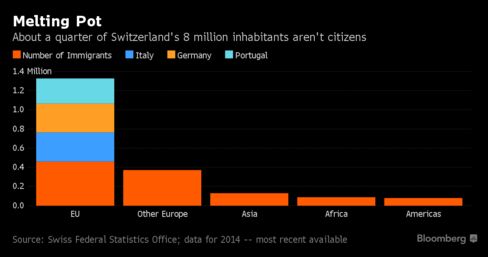
Switzerland is a draw for foreigners: Roughly 1 in 4 residents aren’t Swiss -- with the majority hailing from EU countries, sometimes living for decades in Switzerland without becoming citizens. Italians, Germans and Portuguese are the biggest groups.
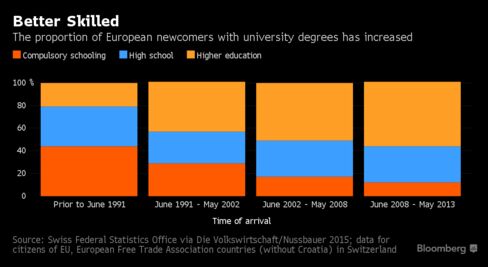
Since 2002, the Swiss have progressively dropped the labor market restrictions for citizens of EU countries, who may now in general take up a job and residence without special permission. While foreigners once tended toward unskilled jobs, they are now well educated -- latest numbers show that more than half have the equivalent of a university degree. That means they are vying for the country’s better-paid jobs.
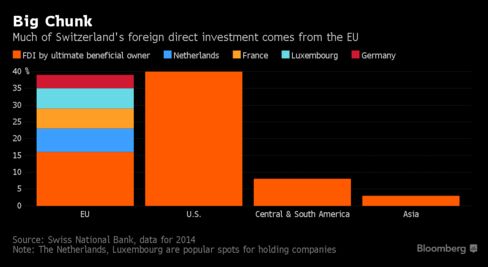
Underscoring Swiss dependence on the EU, the bloc was the source for 39 percent of Switzerland’s 2014 stock of foreign direct investments, a sum of 296 billion ($312 billion) francs. That’s about as much as came from the U.S. that year.
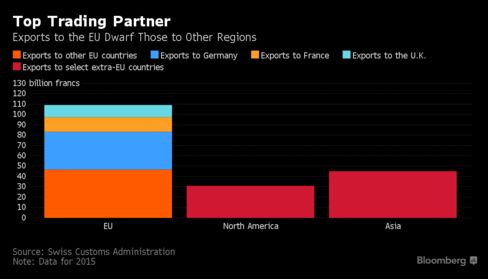
Switzerland also exported more to Germany than to either the U.S. or China in 2015, despite the weak euro making Swiss products relatively more expensive.
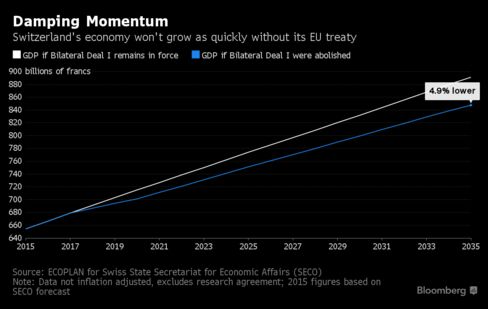
Were Switzerland’s Bilateral Agreement I -- which includes the free movement of persons and civil aviation -- to be nullified, economic output per capita would be 1,894 francs lower in 2035 than if the pact remained in force, according to a study by research consultancy Ecoplan for Switzerland’s State Secretariat for Economic Affairs.
“The idea that they’re an island at the heart of Europe, that’s false,” said Thomas Schaeubli, a political risk analyst at Wellershoff & Partners Ltd. in Zurich. “They’re not members, but a lot of Swiss laws and regulations are harmonized, not least due to the requirements of a globalized economy.”

Friday, May 6, 2016

BBC News - European Central Bank to withdraw €500 note

€500 notesImage copyrigh Images
The European Central Bank (ECB) says it will no longer produce the €500 (£400; $575) note because of concerns it could facilitate illegal activities.
The decision comes in the wake of a European Commission inquiry in February into the way the notes are used.
Senior ECB officials said at the time that they needed more evidence that the notes facilitated criminal activity.
The UK asked banks to stop handling €500 notes in 2010 after a report found they were mainly used by criminals.
The ECB says the €500 banknote remains legal tender and will always retain its value.
It will stop issuing the note around the end of 2018, when it will bring in new €100 and €200 banknotes.
A report earlier this year for the Harvard Kennedy School, urged the world's 20 largest economies to stop issuing the largest notes in circulation - £50, $100 and €500 notes - to tackle crime.
Peter Sands, former chief executive of Standard Chartered bank, said the high-denomination notes were favoured by terrorists, drug lords and tax evaders.
Illegal money flows exceed $2 trillion (£1.4 trillion) a year, he said

Thursday, May 5, 2016

BBC New - UK economy 'near stalling' as service sector slows

Shoppers on Oxford StreetImage copyrigh Images
UK economic growth is "near stalling", partly due to uncertainty over the EU referendum, according to a closely-watched survey.
Research firm Markit said its Purchasing Managers' Index (PMI) surveys for April pointed to growth of just 0.1% in the month.
The latest PMI survey indicated the UK's services sector grew at its slowest pace in three years in April.
The services PMI reading fell to 52.3 from 53.7 in March.
A reading above 50 indicates growth.

'Triple-whammy'

Earlier this week, similar surveys from Markit suggested manufacturing activitycontracted in April for the first time in three years, while construction activity grew at its slowest pace for nearly three years.
Chris Williamson, chief economist at Markit, said the surveys were a "triple-whammy of disappointing news".
"Some of the slowdown may be attributable to the early timing of Easter, though April also saw an increase in the number of companies reporting that uncertainty about the EU referendum caused customers to hold back on purchases, exacerbating already-weak demand linked to global growth jitters and ongoing government spending cuts," he said.
"The deterioration in April pushes the surveys into territory which has in the past seen the Bank of England start to worry about the need to revive growth."
Jobs growth in the services sector was also the slowest since August 2013, reflecting a recent weakening in the labour market as a whole.
Employment in manufacturing contracted in April and official data has shown that the number of people out of work rose for the first time since mid-2015 in the three months to February.

Margins squeezed

David Noble, head of the Chartered Institute of Procurement and Supply (CIPS), which produces the PMI surveys with Markit, said: "The looming EU referendum has had a profound effect on the [service] sector, keeping prices relatively stagnant and delaying new orders.
"At the other end of the supply chain, the National Living Wage has compounded cost increases, resulting in the overall rate of input price inflation hitting a 27-month high.
"Together, these factors have squeezed margins while fewer than half of businesses expect to grow over the next 12 months."
Howard Archer, chief UK and European economist at IHS Global Insight, said: "There is now compelling evidence that heightened uncertainty ahead of June's referendum on EU membership is taking an increasing toll on economic activity.
"A much weakened set of April purchasing managers' surveys for the services, manufacturing and construction surveys follows on from consumer confidence weakening to a 16-month low in April and the CBI reporting lacklustre retail sales"

Wednesday, May 4, 2016

Bloomberg News - U.S. Bondholders Ignore Brexit Risks Worrying European Investors

European investors seem more concerned than Americans about the possibility of a Brexit and the risk to U.K. bank bonds, according to Mizuho International Plc.
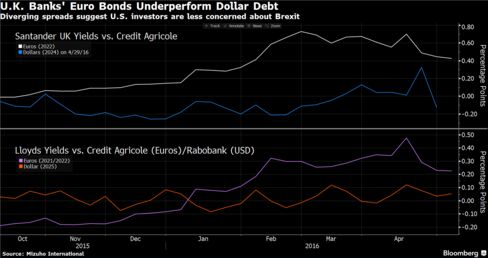
British lenders’ notes in euros have underperformed their dollar debt since last year, even taking into account foreign-exchange fluctuations. The premium investors demand to hold euro bonds issued by Banco Santander SA’s U.K. arm instead of similar Credit Agricole SA debt has widened to 43 basis points from about zero since October. By contrast, the difference in yields between the banks’ dollar notes is little changed.
“It’s different levels of skittishness about Brexit,” Roger Francis, a Mizuho analyst in London, said by phone. “European investors have a greater awareness of the issue and find it more alarming.”
Bonds at other U.K. lenders, including Lloyds Banking Group Plc, show similar patterns as the nation readies for the June 23 vote on whether to leave the European Union. A decision to quit may weigh heavily on domestic-focused banks, such as Santander UK Plc and Lloyds, if it leads to a slowdown in the the nation’s economy and real-estate sector, said Paul Dilworth, a fixed-income investor at Kames Capital Plc, which manages about 57 billion pounds ($83 billion).
The main exception to the diverging performance in U.K. bank bonds is Barclays Plc, according to Francis. Buybacks have helped tighten spreads on the lender’s euro notes, he said.
“European investors are leaning against U.K. names,” said Kames’ Dilworth. “We won’t get a decent recovery until the Brexit issue is totally out of the way.”

Tuesday, May 3, 2016

BBC News - ECB warns on US economic data leaks

wall street trader
US investors may have earned millions of dollars in profits from early access to leaked economic data the European Central Bank (ECB) has alleged.
Researchers at the bank studied the movements of trades ahead of several market-moving US economic reports.
They included a US consumer confidence index, home sales data and initial US GDP data among others.
The study found "strong" evidence of pre-announcement price moves in at least seven cases.
The ECB research paper, Price Drift Before US Macroeconomic News, studied investment trading patterns in the case of 21 market-moving economic indicators between 2008 and 2014.
It found that in the case of a third of the economic announcements, there was strong evidence of what is known as pre-announcement price drift, in which investors correctly bought or sold stocks or bonds in apparent anticipation of an economic announcement and its impact.
Price movements began about 30 minutes before the economic data was officially released, the paper said, and accounted for about half of the total price adjustment caused by the announcement.
The ECB paper said its findings pointed to a widespread leakage of information.
Public bodies in the US are regulated by Principal Federal Economic Indicator guidelines, but the report said most cases of significant price movements involved data that was released by private companies that were not subject to the same rules.
They called for an investigation "to definitively determine" if data was being leaked and how the leaks were occurring.
"Based on a back-of-the-envelope calculation, we estimate that since 2008, in the S&P E-mini futures market alone, the profits associated with trading prior to the official announcement release time have amounted to about $20m per year," the authors said.
"While the overall evidence points to leakage and proprietary data collection as the most likely sources of pre-announcement drift, reprocessing of public information may also contribute to some extent," the paper said, arguing that leakage could not be conclusively established.
"To ensure fairness in financial markets, strict release procedures need to be implemented for all market-moving announcements, including announcements originating in the private sector."

Monday, May 2, 2016

BBC News - Eurozone recovery picks up speed

The eurozone's economy grew by a faster-than-expected 0.6% in the first three months of the year, according to official statistics.
A man dries fresh pasta in a factory
The growth rate in the 19-nation bloc doubled from the 0.3% rate recorded in the previous quarter, and was above analysts' expectations of 0.4%.
However, separate data from Eurostat also indicated that deflation had returned to the eurozone.
Inflation in the bloc fell to minus 0.2% in April, down from zero in March.
Other Eurostat figures showed the eurozone's unemployment rate fell to 10.2% in March, the lowest rate for four-and-a-half years.

Uncertainties remain

The latest growth figures suggest that the eurozone's economy is now bigger than it was before the start of the financial crisis eight years ago.
The eurozone has recently benefited from a fall in oil prices and the euro, particularly in Germany.
Looser budgetary policies by government have also freed up resources in some of the region's debt-laden economies.
Howard Archer, economist at IHS Global Insight, said the eurozone should be able to sustain a growth rate of about 0.4% quarter-on-quarter in the future, but warned the rate could ease in the three months to June.
"Global economic uncertainties and problems are still a handicap for eurozone growth, not only through limiting exports but also through weighing down on business and consumer confidence," he said.
"The risk of recurrent terrorist attacks and the possibility of the UK voting to leave the EU in June's referendum are also uncertainties that could impact on eurozone growth."
Euro signImage copyrigh

ECB action

The inflation figures showed that energy prices fell 8.6% year-on-year in April, while unprocessed food prices rose 1.2%.
Stripping out those items, the core inflation rate showed consumer prices rose 0.8% year-on-year in April - less than a 1% increase in March.
The European Central Bank's target is to keep the headline inflation close to, but below, 2%.
In March, the ECB cut interest rates further and expanded its bond-buying stimulus programme in an attempt to drive growth in the eurozone and push up inflation.

Analysis: Andrew Walker, BBC economics correspondent

Deflation returns. Falling energy prices are keeping inflation very low for sure, but that was not what made the headline figure slip below zero once again.
Energy price falls actually slowed slightly. The key factor was a dip in services inflation to just 1%. Compare that with the European Central Bank's inflation target of below but close to 2%.
The gap between the data and the target is too wide for the ECB's liking. The view there is that there are economic costs when prices rise too slowly.
With luck the drop into negative territory might be a consequence of the early Easter, as some economists are saying. And at some stage the impact of oil price falls will stop dragging overall inflation down.
Still, the figures are a telling reminder of how the ECB is struggling to achieve its objective.