Tuesday, May 24, 2016

Bloomberg News - Here's How Likely Banks Think Brexit Is

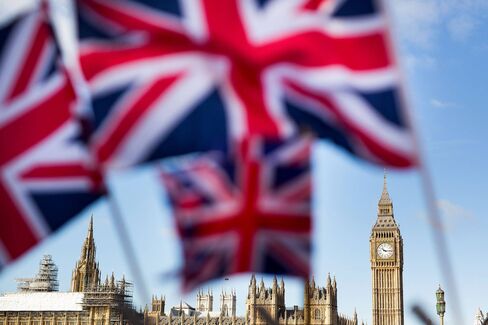
Symbolic U.K. Goods As Brexit Debate Continues
With just under a month to go until the U.K. vote on EU membership, investors are relatively sanguine as a flurry of polls show the remain camp firmly in the lead and betting odds for the U.K. staying in the trade bloc are at their shortest yet.
Analysts at Nomura see the likelihood of a Brexit at 25 percent while Societe Generale economists put the probability as high as 45 percent.
Short-sterling markets price the possibility the Bank of England’s next move may be a rate cut, a sign there’s still uncertainty about the June 23 vote outcome, according to analysts at the Royal Bank of Scotland Group PLC. Barclays PLC analysts say a vote for Brexit could see rates cut, possibly to zero, while Morgan Stanley expects a cut to 10 basis points under this scenario. Both say quantitative easing could resume.
Favored trades include selling sterling, peripheral European government bonds and FTSE 250 stocks.

Barclays

Baseline scenario is that the U.K. doesn’t leave the EU. Uncertainty is likely to weigh on investment and consumption, analysts write in a note dated April 19. A hypothetical exit would lead to a marked slowdown in activity in the second half of 2016 and in 2017 with average quarterly growth dropping to -0.1 percent in the second half and gross domestic product contracting by 0.4 percent in 2017.
Bank of England may cut rates by 50 basis points and could extend QE by another 100 billion to 150 billion pounds.
Remain cautious on peripheral spreads, which will find it difficult to tighten meaningfully given risks associated with the EU referendum and domestic political issues.

RBS

The MPC-dated SONIA strip suggests policy easing expectations revolve largely around a “leave” vote with the lowest point in the curve in autumn 2016, unwinding steadily thereafter, economist Ross Walker writes in note dated May 18.
Expect liquidity to dry up in coming weeks. The referendum is one of four global risk events taking place over 11 days in June, strategist Simon Peck writes in May 20 note. The others are the Bank of Japan meeting, Spanish elections and the European Central Bank’s next targeted long-term loans operation. If the U.K. votes to remain in the EU, the spread between 10-year Italian bonds against German bunds may quickly tighten by 60 to 70 basis points.
July and August dated SONIA look good value as Brexit is 6 percent discounted in July whereas it officially should be 50 percent. This favors long positions in safe haven bonds, which appear very underpriced for some outcomes in the upcoming events.

Morgan Stanley

Expect a gradual pick up in domestic inflation, leading to rate rises from early 2017 on a remain vote, analysts write in May 5 research note.
Uncertainty over the government, Scotland’s stance and trade will hit growth on a vote to leave, with a fall in the pound pushing inflation above target. BOE may cut the bank rate to 10 basis points and do another 50 billion of QE if a vote to leave leads to recession
U.K. and European equities could fall by 15-20 percent in the event of Brexit, albeit not necessarily in one immediate hit
Given the lack of Brexit-related premium in the price of 10Y gilts, maintain long vs 10Y Treasuries, analysts including Anton Heese write in May 20 research note. 10-year gilts are expected to perform ok in a “remain” scenario and to outperform significantly on risk off should there be a vote to leave, Heese says.

Bank of America Merrill Lynch

Polls suggest a remain vote is increasingly likely, Robert Wood writes in May 20 note; underlying economy is slowing and BOE’s latest forecasts suggest risks of rate cuts even in a “remain” scenario are rising.
Expect renewed period of pound weakness heading into the referendum, after seasonal outperformance in April, analysts write in May 20 note. The pound is vulnerable to further losses. as it was ahead of 2015 election. Favor shorting gilts versus bunds both as a trade working in a Brexit scenario and on diverging supply dynamics; keep front-end steepener in sterling swaps against flattener in euro swaps.

Societe Generale

See risk of Brexit at 45 percent. Brexit would hit growth by 0.5-1 percent for 10 years, analysts including Brian Hilliard write in March 10 note. The pound could trade below $1.30 and the euro could drop below parity against the dollar.
Risks of Brexit have diminished according to betting odds and the polls, but the 4y1y/5y1y/6y1y fly remains close to lows even as the front end has steepened. There’s potential for a return to levels seen in February and in 2015, Jason Simpson writes in May 20 note.

JPMorgan

The extent to which U.K. activity data is weakening ahead of the referendum will be an important factor for BOE policy decisions, whatever the outcome of the vote, analyst Allan Monks writes in May 20 note.
Expect a further 10 percent drop in the pound following a vote to leave, pushing inflation to close to 3 percent by the end of 2017. Taylor rule analysis suggests BOE cutting rates to zero isn’t unreasonable. The pound would have to fall by 30 percent to make a rate cut look unlikely if the U.K. voted to leave, Monks writes on May 23.
Vote to stay won’t necessarily leave prime minister David Cameron in authoritative control of his own party, Malcolm Barr writes in May 11 note.
Turn neutral on duration, take profit on long 10-year Gilts against USTs as markets re-price Brexit risk, strategists including Fabio Bassi write May 20. If Brexit happens, favor exporters over domestic corporates, and FTSE 100 against FTSE 250, JPMorgan equity strategists including Mislav Matejka and Emmanuel Cau write in April 25 note.

Nomura

See around a 25 percent likelihood the U.K. votes to leave the EU, analysts say in May 11 note. Most likely policy response will be for MPC to cut rates on any signs real economic data are deteriorating. If that’s sustained, the MPC may bring the Bank Rate to slightly negative before restarting QE although that’s not a foregone conclusion.
If poor market functioning facilitated a pound collapse far beyond the 10-15 percent trade-weighted fall Nomura expects, BOE intervention won’t be out of the question. Its efficacy though would be questioned by the markets. Expect significant curve steepening in a Brexit scenario.

Credit Suisse

Expect the U.K. to vote to stay, analysts including Neville Hall write in May 19 research note. The televised debate on June 21 may prove to be key.
The economy may not bounce back in the second half on a remain vote. Expect an immediate, simultaneous economic and financial shock on a vote to leave.
Buy USD/SEK 2-month 8.6372 strike 15d call to hedge for Brexit, a EUR/USD 2-month 1.1669 strike 25d call for a “remain” vote. Favor long FTSE 100 vs FTSE 250 in stocks.

RBC

Market-implied measures of Brexit risk indicate a “remain” is more likely, Sam Hill says in May 18 client note.
In a Brexit scenario, the uncertainty surrounding options for U.K.-EU relations may lead to a 2 percent to 4 percent decline in GDP over a 2-year to 3-year timeframe.
BOE cutting rates toward zero and the potential for further QE gilt purchases would lead to lower gilt yields. The pound could fall 10-15 percent. Favor trading the pound tactically. The dominant risk is that implied probability of exit risk rises, currency strategists say in May 6 research.

Deutsche Bank

In baseline view the U.K. stays, expect economy to grow at around 2 1/4 per cent this year and next. BOE may raise rates before end 2016, economist George Buckley writes in client on April 4. Brexit would be highly damaging for the economy.
The pound may bounce on a remain vote but downside risk to economy suggests selling the currency, analysts write in May 20 note. Favor buying 9-month GBP/USD put, shorting GBP TWI.

HSBC

Central case is U.K. votes to remain in the EU.
Forecast for first rate rise pushed back to May 2017 from Nov. 2016 and GDP forecasts for 2016 lowered to 1.8% vs 1.9% and for 2017 to 2.1% vs 2.2%, Simon Wells writes in note dated May 16. If the U.K. votes to leave, BOE cutting rates can’t be ruled out, but this isn’t HSBC’s central case.
Expect gilt yields to head lower and favor 5-year to 10-year segment of the curve; 2 to 5-year segment to flatten, Bert Lourenco says in May 12 note.

UBS

Expect markets to price in confrontational negotiations between the EU and the U.K. if it votes to leave. The pound would be most vulnerable, analysts Nishay Patel and John Wraith write in May 22 note.
See 10-year Italy-Germany spreads widening to above 175 basis points, Ireland-Germany to over 90 basis points and Spain to underperform Italy.
If the U.K. votes to stay, peripheral spreads may tighten vs Germany and the pound may appreciate over the remainder of the year.

Goldman Sachs

Don’t favor playing the pound against the euro to express a view on a possible exit as it wouldn’t be good news for the rest of Europe either. It’s not inconceivable for investors to sell euro-area assets as a result, strategist Silvia Ardagna writes in April 4 note.
If the U.K. remains in EU, the currency market would have to price a more hawkish BOE, and an earlier start and faster pace in tightening than discounted in forwards. Expect 15 percent upside in the pound over 12 months in this instance.

Monday, May 23, 2016

BBC News - Fracking approval being considered for first time in four years

Protest sign: Keep Ryedale rural No fracking
Councillors in North Yorkshire will on Friday consider whether to approve fracking in England for the first time since a ban on the technique was lifted in 2012.
They will consider plans by Third Energy to frack a well at a site near the village of Kirby Misperton in the district of Ryedale.
Campaigners say approval would set a "dangerous precedent".
But the company says its operations are no risk to people or the environment.
Fracking involves injecting water, sand and chemicals at high pressure into rocks deep underground to unlock trapped gas.
fracking graphic
The process was banned in 2011 after the shale gas firm Cuadrilla caused minor earth tremors when it fracked a well in Lancashire.

'Safe'

Third Energy has licences to produce gas in North Yorkshire and offshore in the North Sea.
In 2013 it drilled an exploratory well near the village of Kirby Misperton, close to the North York Moors National Park.
It now wants to frack the well to test whether it can unlock shale gas from rocks up to 10,000ft (3,000m) underground.
"All we want to do is test whether gas will flow from an existing well using hydraulic fracturing," says Rasik Valand, chief executive of Third Energy.
"What we are planning is safe. There is no risk to the environment or the public."

Protests

But there has been strong opposition to the plan from the local community and environmentalists.
Kirby Misperton
Hundreds of anti-fracking protesters are expected to gather outside the council meeting in Northallerton on Friday.
The council has received more than 4,000 representations, the vast majority against the proposal.
Green campaigners fear that approval here would open the door for fracking elsewhere.
"It risks setting a dangerous precedent for Britain," says Craig Bennett, chief executive of Friends of the Earth.
"We strongly urge councillors to reject this planning application which is clearly deeply unpopular with the local community."

Tourism threat?

Others are concerned about the impact on the local economy as Kirby Misperton is also home to Flamingo Land, one of Yorkshire's top tourists attractions.
Sign for Flamingo Land
Image captionThere are concerns that tourist sites will see a drop in numbers if fracking is approved
"This place is beautiful," says retired bishop, the Right Reverend Graham Cray, who lives in the village. "The economy is based on tourism and agriculture. Tourists don't come to a gas field and that is what we will turn into if we get the scale of fracking that is intended."
Last year Lancashire County Council rejected Cuadrilla's plan to carry out exploratory drilling and fracking at two new sites on the Fylde.
A planning inquiry into that application took place earlier this year. A recommendation will be sent in the summer to the communities secretary for a final decision.

Final decision

The Third Energy application involves an existing site that has produced gas since the 1990s.
The well has already been drilled.
Well head at Kirby Misperton
Image captionThe well head at Kirby Misperton
The shale gas produced will also be sent through a network of pipes to a nearby power station. That will avoid air pollution caused by flaring gas.
So the company expects the fracking activity to be completed within eight weeks.
The council's planning officer has recommended that the application be approved. But it is now down to the 11 councillors on the planning committee to take the final decision.
That decision may not come until Monday due to the number of people who have registered to speak at the meeting.
If approved, fracking could start by the end of the year.
The Department of Energy and Climate Change refused to comment on Third Energy's application ahead of the council meeting.
But in a statement it said: "Shale gas is a fantastic opportunity which will create jobs, boost our economy and strengthen our energy security.
"There is tough regulation in place to ensure that fracking can take place safely - now is the time to start exploration and find out just how much shale gas is there and how much we can get out of the ground."
You can follow John on Twitter at @JohnMoylanBBC

Friday, May 20, 2016

Bloomberg News - EU to Weigh Extension of Russia Sanctions, Won’t Tighten Them

The European Union will consider extending economic sanctions against Russia, but will stop short of tightening them, foreign-policy chief Federica Mogherini said.
Trade and investment curbs to punish Russia for its takeover of Crimea and intervention in eastern Ukraine in 2014 are set to lapse on July 31 and require a unanimous 28-nation vote to be prolonged.
“We will have a political discussion in the coming weeks with the member states on the rollover of existing sanctions,” Mogherini told reporters in Brussels on Friday. “There is no discussion at the moment on increasing the level of sanctions.”
Countries including Italy, Greece, Hungary and Austria have expressed discomfort with the penalties, though didn’t stand in the way of an extension last year. Opponents of sanctions have gotten quieter since then, as Russia continues to back the eastern Ukraine rebels and build up its military.

Thursday, May 19, 2016

BBC News - EU exit to see house values fall, say estate agents

houses in LondonImage copyright
A UK exit from the European Union could wipe thousands of pounds off house values over the next three years, estate agents have claimed.
Homeowners in London could lose as much as £7,500, while homes elsewhere in the UK could lose £2,300, the National Association of Estate Agents said.
The report, jointly commissioned by the Association of Residential Letting Agents, said rents could also fall.
The Vote Leave campaign said first-time buyers would welcome a drop in prices.
The study suggests that prices in London would be hit by a slump in demand from foreign buyers, particularly those from EU countries.
In 2013, 17% of homes sold in the middle of the capital went to EU nationals.
If the UK did not maintain free movement of labour after a vote to leave, the research claims the population of the UK could fall by more than a million people, as EU workers return home.
A separate research note from the ratings agency Moody's said a leave vote could be good news for first-time buyers.
"First-time buyers would benefit from lower competition for housing, as house price and rental inflation would slow down if immigration is curbed," said Gaby Trinkaus, a vice president and senior analyst at Moody's.
How would an EU exit affect average house prices?
YearRemain in EULeave EU
2016£278,500£277,600
2017£290,800£288,900
2018£303,000£300,800
London
2016£536,000£533,700
2017£564,500£559,300
2018£599,200£591,700
source: NAEA/ ARLA/ CEBR

Rents

The research - carried out by the Centre for Economics and Business Research (CEBR) - suggested a British exit could reduce the total value of UK housing by as much as £26.5bn by 2018.
As far as rents are concerned, it calculated that the impact would be minimal in the first two or three years.
EU nationals living in the UK are more likely to be renters than homeowners, it said.
So if fewer were to come to the UK in the longer term, country-wide rents could be impacted "more severely".
However, landlords said that if rents fell too far, many might sell up.
"If demand eases to such an extent that landlords cannot recuperate costs, we'll likely see a mass exit from the market, which would then just have the opposite effect on demand as supply falls - and we'd be back to square one," said David Cox, managing director of the Association of Residential Letting Agents (ARLA).
The Vote Leave campaign said that both renters and first-time buyers would benefit from a UK exit.
"The biggest pressure on housing supply is immigration which has made buying your first home and even renting unaffordable for many," said Matthew Elliott, chief executive of Vote Leave .
However the chancellor, George Osborne, has previously warned that first-time buyers would see higher mortgage payments in the event of a British exit.
construction workersImage copyrigh

Construction

The report also warns that a vote to leave could lead to fewer new homes being built, because of a shortage of construction workers.
About 5% of construction workers in England and Wales were born in other EU countries, according to the 2011 census.
If such workers could no longer travel so freely to the UK, estate agents say the skills shortage might be severe.
"We simply wouldn't have the resource to put the bricks and mortar together," said Mark Hayward, managing director of the National Association of Estate Agents (NAEA)
"It has the potential to have a very damaging effect on the future housing market."

Wednesday, May 18, 2016

Bloomberg News - Brexit May Delay Fed Rate Rise in Bloomberg Intelligence Model

U.K. voters may hamper the Federal Reserve’s ability to raise interest rates this summer, according to Bloomberg Intelligence.
A decision by the British electorate to withdraw from the European Union in a June 23 referendum could delay the next tightening move from U.S. policy makers by about three months, according to an economic model designed by analysts Jamie Murray, Carl Riccadonna and Dan Hanson.
That’s because so-called Brexit would hurt the U.K. economy, imposing a drag on U.S. exports and gross domestic product as well as triggering possible reverberations in financial markets, the analysts said in a report released on Wednesday.
“Should Britain vote to leave the EU on June 23, the implications for the U.S. economic outlook would be modest, but could prevent the Fed from hiking in July,” Murray, Riccadonna and Hanson wrote. With the U.S. presidential election “dominating the agenda for the remainder of the year, that could put two hikes in 2016 beyond the Fed’s reach.”
Investors see roughly a 12 percent chance of an interest-rate increase from the Fed when its officials convene in June and a 28 percent probability that the benchmark will be higher by the July meeting. Bloomberg Intelligence is forecasting a hike at the July gathering, but sees later in the year as more likely in a Brexit scenario.
Even so, two regional Fed Bank presidents said on Tuesday that two rate moves may still be warranted in 2016, as the economy continues to expand and inflation picks up. While one of those, Dallas Fed President Robert Kaplan, said action at “upcoming meetings” will be appropriate, he also said the Brexit vote would be a factor in June’s Federal Open Market Committee decision.

Tuesday, May 17, 2016

BBC News - UK inflation rate falls on cheaper air fares

Aircraft silhouetteImage copyrightES
The UK's inflation rate fell in April for the first time since September, largely because of cheaper air fares after the Easter holidays.
The Office for National Statistics (ONS) said the rate, as measured by the Consumer Prices Index, fell to 0.3%.
The ONS said the main causes were falls in the prices of air fares, vehicles, clothing and social housing rents.
The Bank of England said last week that it expected inflation to increase in the second half of the year.
By far the largest downward effect in April came from air transport, with prices falling by 14.2%, compared with a rise of 4.5% between the same two months last year.
This was influenced by the timing of the Easter holidays in March. Fare prices increased dramatically between February and March this year and then fell sharply in April.
The price of clothing and footwear also fell as retailers dropped prices to try to revive sales hit by last month's cold weather.
Inflation graphic
An alternative inflation measure, the Retail Prices Index, which is still used to index some rents and pensions, also fell from an annual rate of 1.6% in March to 1.3% in April.
Meanwhile core inflation, which strips out energy, food, alcohol and tobacco, fell to 1.2%, compared with economists' expectations for 1.4%.

Interest rates

Last week, the governor of the Bank of England, Mark Carney, had to write his sixth letter to the Chancellor George Osborne explaining why CPI inflation was still below the Bank's 2% target.
In it he said: "The underlying causes of the below-target inflation of the past year and a half have been: sharp falls in commodity prices, the past appreciation of sterling, and to a lesser degree the subdued pace of domestic cost growth."
The Bank of England's Monetary Policy Committee (MPC) voted last week to keep interest rates unchanged at the record low of 0.5%. The Bank is not expected to raise rates until at least next year.
Martin Beck, senior economic advisor to the EY Item Club, said: "We are likely to see inflation remain close to current rates until the latter part of the year, when the base effects associated with last winter's collapse in the oil price will begin to kick in and finally drag the CPI measure above 1%.
Such a benign outlook is likely to stay the MPC's hand until well into next year."
In a separate report, the ONS said that there had been a surge in house prices as landlords rushed to buy before higher stamp duty was imposed.
UK average house prices increased by 9.0% over the year to March 2016, up from 7.6% in the year to February 2016.
The pound lost about half a cent against the dollar immediately after the figures were released, but then recovered to stand at $1.4483, a gain on the day of more than 0.5%.

Monday, May 16, 2016

BBC News - CBI cuts forecast amid Brexit 'dark cloud of uncertainty'

Close up of brick layingImage copyright
A "dark cloud of uncertainty" over global growth and the outcome of the EU vote is chilling growth, says the CBI.
The lobby group cut its economic growth forecasts and says the economy will grow by 2% in 2016 and 2017, down from a previous forecast of 2.3% and 2.1%.
It said Brexit uncertainty was having a "tangible impact" on spending plans.
But the forecast is based on the assumption that "we stay in - it's not a forecast of the effects of Brexit," said CBI boss Carolyn Fairbairn.
She said: "A dark cloud of uncertainty is looming over global growth, particularly around weakening emerging markets and the outcome of the EU referendum, which is chilling some firms' plans to invest."
"At present, the economic signals are mixed - we are in an unusually uncertain period."
Household spending will be the main driver of economic growth.
The first rise in interest rates will not now be for another year, it said.
It forecasts the first move will be in the second quarter of 2017, to 0.75%, according to the business group's forecast.
Interest rates have been held at 0.5% since 2009.

'Widespread'

Ms Fairburn told BBC Radio 4's Today programme: "I was with a building society in Wales recently where investment decisions and housing decisions were being postponed.
"I've been talking to advertisers, broadcasters who are seeing slowdowns in the advertising market and some construction companies, so pretty widespread across the economy people are waiting to see what the outcome will be."
Asked if she agreed with the Governor of the Bank of England, Mark Carney, that Britain could go into a technical recession if Britain left the European Union, she said most economists would agree there would be a shock to the economy.
"How long and how deep will depend on how quickly we do trade deals.
"The process of leaving is very complicated - it's likely to take a long time and trade deals are hard to do so our own forecast with PWC does also show the possibility of a technical recession. So yes we would absolutely agree with it, it's a significant shock."
CommutersImage copyrigh

Pay pressure

Separately, growth in wages is likely to remain "stuck in the slow lane" until the end of the decade, according to a survey by the Chartered Institute of Personnel and Development (CIPD).
It suggests that pay will rise by 1.7% in the next year, as the "jobs-rich, pay-poor" economy continues.
Employees are unlikely to see much of a boost to their pay, the HR body, said after surveying more than 1,000 businesses.
Since the financial crisis, pay growth has struggled to keep up with rising prices. Last year, wage increases did outstrip the rate of inflation but levels are still historically low.
The latest figures are due out this week.
Low inflation, available skilled workers and a lack of productivity growth are working together to reduce the economic pressure for employers to pay their staff more, the CIPD said.
At the same time, firms are juggling increased costs to employing people.

'Go-slow'

Mark Beatson, chief economist at the CIPD, said: "The UK is now in its eighth year of productivity 'go-slow'... employers are having to manage the consequences of government-imposed increases to the cost of employing people.
"The National Living Wage and roll-out of pensions auto-enrolment were introduced to improve the living standards of low-paid employees, but this can only happen without significant job losses if the productivity of low-paid employees also increases."
The new mandatory National Living Wage (NLW) came into force in April. It requires employers to pay workers aged 25 and over at least £7.20 an hour.
Mr Beatson said that it would be no surprise if companies chose easier options - such as reducing hours, benefits and pay rises as a result. He called on the government to give more practical advice and support for businesses.