Thursday, June 9, 2016

Bloomberg News - U.K. Extends EU Referendum Voter Registration Into Thursday

The U.K. government extended by two days the registration deadline for this month’s European Union referendum after thousands of people were prevented from signing up in time.
Voters now have until midnight on Thursday to register to vote on June 23, Cabinet Office minister Matthew Hancock said Wednesday in a Twitter post. The registration website crashed at about 10:15 p.m. London time on Tuesday after suffering technical “issues,” the Electoral Commission said earlier in a statement. The failure came shortly before the original midnight deadline and just after the end of an ITV referendum special featuring Prime Minister David Cameron and U.K. Independence Party leader Nigel Farage.
The crash sparked concerns among pro-Remain campaigners that the problem could disproportionately affect younger voters, who polls show are more likely to choose to stay in the 28-nation bloc. That’s because of a concerted campaign this week targeted at getting the young to register.
“Evidence shows younger people are overwhelmingly pro-European, and if they are disenfranchised it could cost us our place in Europe,” Liberal Democrat leader Tim Farron said in an e-mailed statement. “It could also turn them off democracy for life. Voters must be given an extra day while this mess is sorted out urgently.”

‘Sensible Thing’

The Liberal Democrats, as well as the Labour opposition and the Scottish National Party, had all called for an extension of the deadline. Even Farage, whose party wants Britain out of the EU, conceded the deadline should be extended. “If the website crashed last night then maybe the sensible thing is to extend it by a day but I wouldn’t go beyond that,” he said in an ITV television interview.
The Vote Leave campaign group, though, suggested the computer crash masked the real reason for the extension. “We know that the government and their allies are trying to register as many likely ‘Remain’ voters as possible,” its chief executive, Matthew Elliott, said in an e-mail to supporters.

‘One Chance’

Nevertheless, it also issued a statement welcoming the extension.
"People will only have one chance to vote on whether they share free movement of people with Turkey, so the more people who register to vote on 23 June the better and we welcome the extension of the registration deadline," said Justice Secretary Michael Gove, one of the Leave campaign’s key figures, said. "It’s particularly important given how few young people normally vote and I hope that this election will be different."
Hancock earlier told lawmakers in Parliament that a total of 525,000 people registered to vote on Tuesday. At its peak, the website was processing 214,000 registrations per hour before it crashed, eclipsing the previous record of 74,000 per hour before last year’s general election, he said.
“Following the chaos of last night, tens of thousands of people will be relieved that they will have a say in this crucial vote,” the Labour Party’s spokeswoman on voter registration, Gloria de Piero, said in a statement. “We urge everyone who thinks they are not on the register to get back on that website and have their say.”

Wednesday, June 8, 2016

Reuters News - Germany, eyeing China, urges 'level playing field' for foreign investment

Germany's economy minister called on Wednesday for an international "level playing field" in foreign investment amid concerns over rising Chinese interest in German firms and said Berlin wanted the European Union to tackle the issue.
Sigmar Gabriel drew a distinction between open markets and what he called "a state-capitalist interventionist market", a clear reference to China, where German companies have long complained of obstacles to investment and acquiring local firms.

"What we can't do is sacrifice German companies and German jobs on the altar of open markets when in reality there isn't a level playing field. Open markets require the same rules of the game," Gabriel, who is also vice-chancellor, told reporters.
"This is not about protectionism but about creating fairness ... It's not about a specific company or country. It's about open markets based on fairness, on fair competition under the same conditions."
However, Gabriel denied a newspaper report suggesting that Germany would change its own law to block a 4.5 billion euro ($5.1 billion) bid by Chinese home appliance maker Midea for German industrial robot maker Kuka.
Kuka is the latest and biggest German industrial technology group to be targeted by a Chinese buyer as the world's second-largest economy is transforming itself into a high-tech industrial link from a low-cost manufacturer.
Earlier this week, Shanghai Yiqian Trading Company said it would buy Germany's Hahn airport.
Chancellor Angela Merkel may raise the issue of fair competition when she visits China next weekend.
ECONOMIC PRIORITY
Midea's offer has prompted Berlin to consider how crucial Kuka's technology is for the digitalization of industry, an economic priority for Merkel's government.
Gabriel, who has also been vocal about the impact of low Chinese steel prices on European industry, has said he would welcome a European counter-offer for Kuka but the government has made clear it cannot intervene in a corporate matter.
Asked about a report in Die Zeit weekly that Berlin was considering extending the scope of a law that allows the government to bloc a purchase if it poses a threat to security, Gabriel said: "There will be no Kuka law, that is rubbish."
"It's about needing to start talking about this in Europe. It's not about changing a law in Germany."
German influence could remain in Kuka via unlisted mechanical engineering group Voith, which holds 25.1 percent of Kuka shares, allowing it to block strategic decisions.
Voith CEO Hubert Lienhard, who has previously said Kuka management's positive stance towards the bid was premature, told Reuters he would wait for the concrete offer from Midea.
"We will look at our alternatives and our course of action as soon as we have the offer," he said.
Lienhard, also head of the Asia Pacific Committee of German Industry (APA), said there was no reason to panic about crucial technologies being lost.
"I do not see a sell-off of German industry," he told Reuters, adding about 80 percent of German industry consisted of small and medium-sized companies mostly privately owned, making hostile takeovers impossible.
BERLIN 

Tuesday, June 7, 2016

BBC News - Uncertainty for UK trade outside EU, says WTO chief

Director-general of the World Trade Organization (WTO) Roberto Azevedo of Brazil, gives a press conference on 9 Sept 2013Image copyright
Image captionWTO chief Roberto Azevedo said he did not know how trade talks would take if the UK left the EU
The UK outside the European Union would face uncertain trade relations, according to the World Trade Organization (WTO).
In a BBC interview, the WTO's director general, Roberto Azevedo, said Britain would not have the same negotiating leverage as the EU.
Britain could have to impose £9bn worth of additional tariffs on imports, raising the cost of living.
Exporters could face an extra £5bn of tariffs on their sales abroad.
Those figures for additional tariffs on goods going into or out of the UK come from the WTO analysis of preferential trade arrangements.
Under WTO rules, member countries are generally supposed to apply the same level of tariffs to goods wherever they come from. But there are exemptions for preferential regional and bilateral trade agreements.
So, we can allow into the UK goods duty free from the EU and from countries with which the EU has negotiated preferential deals. Such agreements are already in force for Turkey, Switzerland and South Korea, for example.
The EU itself is another case of a trade agreement (and more). Others are being negotiated, including the controversial Trans-Atlantic Trade and Investment Partnership with the United States.
On leaving the EU, the UK would no longer be party to those agreements (unless replacements had been negotiated in the meantime). Without a deal in place, we would, under WTO rules, have to impose tariffs on goods from the rest of the EU and those other countries.

Politically difficult

That would raise the cost to consumers and to businesses buying imported goods. The only way to avoid that under WTO rules would be to eliminate the tariffs altogether.
That is the approach favoured by some Brexit supporters, notably the economist Prof Patrick Minford. That kind of unilateral trade liberalisation does find some support in economic theory, but it tends to be politically difficult. It exposes industry to new competition without gaining better access for exporters.
Two workers weld vehicle panels in Nissan's Sunderland factory in north east England, 12 Nov 2014Image copyright
Image captionManufacturing accounts for about 10% of the output of the UK economy
Mr Azevedo mentioned two examples that have no tariffs on imports: Hong Kong and Macao. But it's very unusual.
In practice, it seems unlikely that any British government would go that far in the foreseeable future.
Equally, those other countries - the EU and those with EU preferential agreements - would have to impose tariffs on British goods at whatever rate they have set for the same goods from other WTO member countries.
Then there are the rest of the WTO member countries to consider, including some very important trading nations such as China, India and the US. Would they accept the UK simply adopting the EU tariffs? Or would they want to negotiate afresh? Mr Azevedo said it is "very difficult to tell".

Farm subsidies

In some areas, it would simply make no sense to adopt the EU's WTO commitments, especially farm subsidies. The EU has made commitments to limit them. The UK couldn't realistically expect other countries to accept the same cap. "Other members would definitely not agree to that," Mr Azevedo says.
Realistically, no British government would want to spend as much as the whole EU does on farm subsidies, but the issue is very important to many other WTO member so it is likely that a cap would need to be agreed.
How keen does he think other members would be to negotiate? "I don't know exactly how members are going to behave and what kind of engagement there will be," Mr Azevedo says.
A truck leaves Tokyo's international cargo terminalImage copyright
Nor could be sure how long negotiations would take.
"Two, three, four years. It can take a decade or more. It depends on the complexities of the negotiations and the appetite for members to do it quickly."
In the meantime, "there would be a vacuum. The UK would be the only WTO member without a list of its commitments… it's a legal uncertainty".

No crystal ball

In the interim, he said, it was "theoretically possible" that WTO members could treat the UK as they would a country that is not a member. That means potentially erecting significant new barriers to British goods and services, though he did not appear to think that the most likely picture.
He said: "They would most likely want to negotiate and make the rules of the game absolutely certain and legally binding for both sides."
Still, he did identify a downside. Investors want profitability and predictability "and predictability would be gone in this situation".
Campaigners for a leave vote often argue that because Britain is a large prosperous economy that imports more than it exports, our trade partners would have powerful incentives to negotiate seriously.
There is certainly some truth in that. But the WTO chief is very far from convinced that it would all fall into place quickly or easily.
Mr Azevedo, the world's top trade official, said "I don't have a crystal ball and the message I am bringing to you is that nobody has that crystal ball."
You can hear Andrew Walker 's interview with Roberto Azevedo on Business Daily on BBC World Service Radio on Wednesday 8 June at 0830 BST

Monday, June 6, 2016

Reuters News - Fed’s Yellen sees rate hikes ahead, but few hints on when

Federal Reserve Chair Janet Yellen on Monday gave a largely upbeat assessment of the U.S. economic outlook and said interest rate hikes are coming but, in an omission that stood out to some investors, gave little sense of when.
Overall, a Yellen said, "I see good reasons to expect that the positive forces supporting employment growth and higher inflation will continue to outweigh the negative ones."
While last month's jobs report, released Friday, was "disappointing," and bears watching, policymakers will respond "only to the extent that we determine or come to the view that the data is meaningful in terms of changing our view of the medium- and longer-term economic outlook."
Though she stressed surprises could emerge that could change her expectations, and listed four main risks to the U.S. economy - slower demand and productivity, and inflation and overseas risks - she concluded by downplaying them all and flagging her expectation that "further gradual increases in the federal funds rate are likely to be appropriate."
Still, Yellen was careful not to give any hints about the timing of a next rate increase, in contrast to a speech on May 27, when she said such a move would probably be appropriate "in coming months."
To some investors, the absence of a timeframe in Monday's remarks suggests the Fed will delay its next rate hike well beyond next week, when U.S. central bankers next gather to make monetary policy.
Economists now see September or possibly July as the most likely time for a quarter-point policy tightening, while traders in futures markets are betting on later in the year.
But to others, Yellen's repeated emphasis on the positive aspects of recent economic data continues to suggest a rate hike in the near future.
"The fact that she did remove that timeframe I think just suggests that June’s off the table, July is possible if the data cooperates," said Omar Esiner, chief market analyst for Commonwealth Foreign Exchange in Washington. "She’s a little bit more upbeat in that respect than the Street and I think that was a main takeaway for me.”
The U.S. central bank raised rates from near zero in December in the first U.S. policy tightening in nearly a decade.
Prospects of another hike this month were all but killed by a report last week showing only 38,000 jobs were created in May, somewhat muting recent upbeat data on consumer spending, housing and overall U.S. growth.
Although the jobs report was "concerning, let me emphasize that one should never attach too much significance to any single monthly report," Yellen said at the World Affairs Council of Philadelphia. "Other timely indicators from the labor market have been more positive."
The dollar initially rose following Yellen's comments but later retraced, and financial markets did not give an appreciable signal on whether investors saw more or less chances of a rate hike in the near future. U.S. stock prices were up modestly from levels just before the speech.
While Yellen did not repeat her line from a week-and-a-half ago when she said rate hikes would probably be appropriate in coming months, she said she remained optimistic inflation would rise to the Fed's 2-percent goal because oil prices had reversed their downward path and the dollar had steadied after a long period of gains.

(Reporting by Jonathan Spicer and Jason Lange; Additional reporting by Ann Saphir and Dion Rabouin; Editing by Andrea Ricci)

Friday, June 3, 2016

BBC News - UK service sector growth picks up, PMI survey suggests

Woman drinking coffee in Trafford CentreImage copyright
Activity in the UK's dominant service sector picked up last month, according to a closely-watched survey, but growth remained "subdued".
The Markit/CIPS Purchasing Managers' Index (PMI) for the sector rose to 53.5 last month from 52.3 in April. A figure above 50 indicates expansion.
More than a third of firms said they had suffered from the uncertainty over the EU referendum, Markit said.
It added the economy was likely to grow by 0.2% in the second quarter of 2016.
That would be a slowdown from the 0.4% growth recorded in the first three months of the year.
PMI surveys released earlier this week indicated the manufacturing sector edged back into growth during May, while activity in the construction sector slowed.
Markit chief economist Chris Williamson said: "The PMI surveys show that the pace of economic growth remained subdued in May, as 'Brexit' worries exacerbated existing headwinds.
"Growth has collapsed in manufacturing and construction, leaving the economy dependent on the service sector to sustain the upturn, though even here the pace of expansion has remained frustratingly weak so far this year."
The Markit/CIPS survey found new business in the service sector grew at its slowest pace for 41 months.
Job creation also slowed to its weakest pace since August 2013. Markit said this largely reflected "lacklustre inflows" of new business, while some firms said the new National Living Wage had affected hiring.
"Despite some improvement compared to April, this is still a pretty lacklustre survey that points to muted services activity," said Howard Archer, chief UK and European economist at IHS Global Insight.
"The muted services sector is particularly significant as the dominant sector was entirely responsible for UK GDP growth of 0.4% quarter-on-quarter in the first quarter."

Thursday, June 2, 2016

BBC News - Brazil's economy shrinks for fifth consecutive quarter

Brazil flagImage copyrightGETTY IMAGES
Brazil's economy continued to shrink in the first quarter of 2016, contracting by 0.3%.
It was the fifth consecutive quarter in which the economy has shrunk.
However, the figure was not as bad as the 0.8% contraction that had been predicted by economists.
As well as its worst recession in decades, Brazil is grappling with political crisis, following the removal from office of President Dilma Rousseff pending an impeachment trial.
The Instituto Brasileiro de Geografia e Estatistica (IBGE) also said that Brazil's GDP fell by 5.4% year-on-year - which was also better than the 6.1% contraction forecast by Itau Unibanco.
Earlier, the Organisation for Economic Cooperation and Development (OECD) cut its economic growth forecast for Brazil, citing political and corruption concerns.
The Brazilian economy is now expected to contract by 4.3% this year, the OECD said.
Production fell in all the three main economic sectors: agriculture, industry and services.
Exports were a rare bright spot, however, increasing by 6.5% compared with the fourth quarter after a sharp fall in the value of the real.

Analysis: Daniel Gallas, South America business correspondent

Brazil's economy keeps on contracting sharply - one of the fastest reversals of fortune in the emerging world.
The question now is: has the economy reached the bottom, or will it fall even further?
The deep cuts that Brazil's interim government plans to implement suggest things will get worse before they start improving.
Analysts believe Brazil's best chance of exiting recession are still a year away.

Neil Shearing, chief emerging markets economist at Capital Economics, said the smaller than expected contraction was only due to a rise in government spending.
It rose 1.1% quarter-on-quarter, reflecting what he described as "a last-ditch attempt by the Dilma administration to win back public support".
"With fiscal policy set to tighten over the second half of the year, this prop to the economy will go," Mr Sheaing added.
Brazil's interim president, Michel Temer, said on Wednesday that his government would not cut spending on health and education, but warned that sacrifices were needed to balance the books and restore the economy to growth. The country has a huge budget deficit and 11 million unemployed.
"There is no longer any room in Brazil for a bloated and inefficient state," he said in a speech on Wednesday.
Ms Rousseff was suspended last month to face charges of breaking budget rules. A Senate trial will probably continue until September, fueling political uncertainty.

Wednesday, June 1, 2016

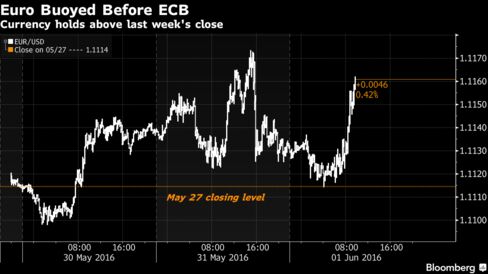
Bloomberg News - Euro Faces Upside Risk as ECB to Hold and U.S. Jobs Report Looms

The euro faces upside risks heading into the European Central Bank rate decision on Thursday, with President Mario Draghi and his fellow officials expected to keep monetary policy unchanged, analysts say.
The common currency will be driven mostly by expectations for the Federal Reserve’s next policy step, spurring greater scrutiny on U.S. non-farm payrolls data due a day after the ECB’s decision.

Bank of America Merrill Lynch

With the ECB in stasis for now, the burden of proof for further euro weakness continues to fall on the Federal Reserve, Athanasios Vamvakidis, head of G-10 foreign-exchange strategy, writes in a note to clients. Flow data also suggest there has been little pre-positioning among investors ahead of this week’s meeting, he adds.
Bank of America’s base case is for no change in ECB policy, particularly ahead of the start of the corporate sector purchase program and another round of targeted long-term loans, or TLTROs, Vamvakidis says. These policies afford ECB time to assess the measures’ impact on the real economy before deciding whether further measures are needed after summer, he adds.
Vamvakidis says he expects more gains in U.S. dollar, albeit modest, through the third quarter as the Fed tightens policy once more in September.

Citigroup

Swings in the euro could be limited this week, strategist Josh O’Byrne says in an interview. The expectations for the meeting are low as any signals on rates and the quantitative-easing program should be absent. There will probably be a debate over scope to signal the inclusion of Greek debt in the purchases program, he adds.

Morgan Stanley

The euro should remain fairly range-bound against the U.S. dollar as the ECB rate decision is unlikely to impact the currency significantly, strategists including Hans Redeker write in a note to clients.
The inflation and growth projections could be revised upward due to the higher oil prices, though this is unlikely to impact euro meaningfully, they add. Markets are only pricing a 5-basis-point rate cut this year, and ECB has made it clear that further rate cuts are unlikely. The yield differentials affecting the euro will continue to be driven by the Federal Reserve, according to the analysts.

BNP Paribas

There is little pressure on the ECB to act now, with activity having picked up in first quarter, inflation expectations rising, and the euro’s effective rate currently stable, strategists including Daniel Katzive write in a note to clients.
The euro may bounce against the U.S. dollar in the near term as the pair looks oversold and the Federal Reserve is unlikely to raise rates in June. The currency pair may rise considerably toward BNP’s mid-year forecast of 1.16, the strategists write.
The ECB hold policy also means upside risk for the euro against the yen, as the Bank of Japan will probably be the next Group-of-10 central bank to ease, BNP strategists say, adding that they favor long euro positions against Japanese currency heading into the summer.

Credit Agricole

The ECB meeting should discourage further selling of euros, strategists Valentin Marinov and Manuel Oliveri write in a note to clients. The meeting is likely to strengthen the market’s perception that the central bank is no longer an active participant in the global currency war, as it prefers to stimulate growth and inflation through the euro zone’s lending channel, they add.

Brown Brothers Harriman

The market view that ECB rates have bottomed may be positive for euro, global head of currency strategy Marc Chandler says in an interview.
The ECB meeting is not key to the direction of the currency going forward, with U.S. jobs data due the next day seen as more important, he adds. The main focus on Thursday will be on the details of corporate-bond purchases and TLTROs, along with the new forecasts, and any chance that the ECB will allow Greek bonds to be used as collateral, Chandler says.

Commerzbank

The Federal Reserve is reviving the “divergence trade,” with euro weakness being a result of medium-term restrictive Fed policy and expansionary ECB measures, strategists including Ulrich Leuchtmann write in a note to clients.
The Fed’s signals are more volatile than ever, he adds, and the medium-term euro outlook is subject to change more quickly than usual. Commerzbank expects the U.S. central bank to raise rates in June or July and sees euro at 1.10 against the U.S. dollar in the second quarter.

Nordea Markets

Holding light positions into the ECB meeting and U.S. jobs data is the favored strategy, strategist Aurelija Augulyte says in an interview. Long positions on the euro against the U.S. dollar are attractive as the ECB could adjust its inflation forecast higher, while a rate increase from Federal Reserve this summer is already priced by markets, she adds.