Monday, June 20, 2016

Reuters News - European history hovers close to reverse gear

European history may be about to go into reverse.
If Britain votes to leave the European Union, it will likely start a process of fragmentation of the political and security structures on which the post-World War Two and post-Cold War European order was built.
Even if the British step back from the brink on Thursday, the bruising legacy of the debate, the growing trend of national referendums on EU issues and the backlash against globalization and internationalized elites on both sides of the Atlantic will not fade away any time soon.
How far and how fast contagion may spread in case of a Brexit vote, no one can know. Just don't expect it to stop with one major country walking away from the EU.
European Council President Donald Tusk, a historian and former Polish prime minister who took part in the struggle to overthrow Soviet-imposed communist rule in eastern Europe and join the EU, was both a witness and an actor in that history.
Tusk, who knows from personal experience what it means to be on the wrong side of a wall or border, warned last week: "Brexit could be the beginning of the destruction not only of the EU but also of Western political civilization in its entirety."
He is equally aware that if British Prime Minister David Cameron succeeds in turning public opinion in the final days and winning the referendum, his tactics of demanding a renegotiation of EU membership terms using a plebiscite as leverage are bound to tempt politicians in other countries.
In private, there is anger at Cameron among EU leaders and diplomats who feel he has played Russian roulette with Europe's future in a failed bid to end civil war in his own party.
In case of a Brexit, EU founders Germany and France will work to shore up the remaining EU and put forward new projects in security and defense. But their lack of agreement on how to strengthen the euro zone - and the prospect of anti-EU populists gaining in elections in those countries next year - makes any big integration initiative impossible for now.
POPULISTS WINNING?
The forces of European disintegration are on the rise in many countries, fueled by economic discontent, fear of job losses to foreign competition or to immigrants, and the anxieties of ageing societies.
Eurosceptics in the Netherlands forced a referendum in April on an EU agreement on closer ties with Ukraine via a petition and mobilized just enough voters to make the "No" vote valid, leaving the Dutch and EU authorities with a legal conundrum.
Hungarian Prime Minister Viktor Orban, who boasts of having established an "illiberal democracy", is planning a public vote in October to defy EU rules obliging member states to share the burden of taking in refugees flooding into Greece and Italy.
And a eurosceptic rightist failed by a whisker to win Austria's presidential election last month, surfing a wave of hostility to migrants and defiance of "Brussels".
The latest Pew Research Center survey of European attitudes shows public support for the EU has plunged across Europe, with the steepest fall in France, where only 38 percent have a favorable view of the Union, six points fewer than in Britain.
Such findings do not necessarily indicate that other countries are likely to leave the bloc. Ironically support for the EU is strongest in Poland and Hungary, which are major beneficiaries of funds from Brussels but have two of Europe's most eurosceptic governments.
But public hostility to sharing risks - financial, humanitarian or geopolitical - had gained ground around Europe even before the British vote, widening north-south and east-west gaps within the EU.
"In a sense, the populists have already won, because they are setting the agenda for the mainstream parties," said Heather Grabbe, a visiting fellow at the European University Institute in Florence.
Among those most alarmed are strategists in the United States and at NATO, the transatlantic defense alliance, who are convinced that a British vote to leave the EU would weaken the unity of the West and its resolve to tackle security challenges.
Those include a more assertive Russia, Islamist militancy, war in the Middle East and North Africa that has put millions of refugees on the move, migratory pressures from sub-Saharan Africa and cyberattacks on economic and security networks.
London has long been Washington's go-to partner in defense and intelligence but it has been more reluctant to join military action since the unpopular U.S.-led Iraq and Afghanistan wars.
NATO is straining now to find European nations willing to deploy modest numbers of troops in rotation to support Baltic and East European allies alarmed by Russia's 2014 seizure of Crimea and support for pro-Russian rebels in eastern Ukraine.
Some Brexit advocates contend that the EU is "yesterday’s story" and that leaving would allow the UK to be more global.
Yet a Leave vote would sidetrack the European Union for several years in divisive debates about the terms of the divorce with Britain, its second largest economy and military power.
It would make the UK more inward-looking, with both main political parties mired in recrimination and an emphasis on shutting borders rather than on the British tradition of liberal intervention.
"The project of European construction that began in the aftermath of World War Two and that has done so much to ensure that Europe did not again become a venue of instability and violence would be further endangered," said Richard Haas, president of the Council on Foreign Relations in the United States and a former State Department policy planner.
Writing in The American Interest magazine, Haas noted that for U.S. strategists, the continent that sparked two world wars had become "boring" after the end of Cold War.
Brexit alone would not make Europe that much more interesting, he said, but it would contribute to the slow unraveling of a stable European order, leaving both the EU and the UK "weaker and more divided".
BRUSSELS 

(Writing by Paul Taylor; Editing by Alexander Smith)

Friday, June 17, 2016

BBC News - Eurozone releases Greece bailout money

Greek and EU flags in AthensImage copyright
A fresh tranche of money for debt ridden Greece has been approved by the eurozone's bailout fund.
The amount of 7.5bn euros (£5.9bn; $8.4bn) is scheduled to be paid out early next week.
The money is part of a larger deal agreed on in May but depended on a number of reform conditions to be be fulfilled by Athens.
Greece owes its creditors more than €300bn - about 180% of its annual economic output (GDP).
The country is in urgent need of the fresh money from Europe to service two debt payments to the European Central Bank next month.
"This is a welcome breath of oxygen for the Greek economy," the EU's top economic affairs official, Pierre Moscovici, said.
The Luxembourg-based European Stability Mechanism (ESM) said it approved the money to be transferred after Greece's government completed required reforms.
Over the past weeks, the government in Athens pushed through with several reform packages and a plan on long-delayed privatisations.

To cut or not to cut

Eurozone leaders and the International Monetary Fund (IMF) remain at odds over how to move forward with the Greek debt crisis.
"The IMF is not engaged in a programme with Greece," Lagarde told reporters after talks with the eurozone on Thursday.
The international lender said it would not contribute to the latest bailout unless there were concrete plans to cut Athens' massive debt burden.
Last month's deal for an overall amount of 10.3bn euros does not reduce the amount Greece will have to repay.
Instead, debt relief will be phased in from 2018, after Germany's general election late next year. Berlin is one of the main opponents to forgiving part of Greece's debt.
As such, the deal was being seen by many as a compromise intended to buy time.

Thursday, June 16, 2016

BBC News - Brexit poses global financial risk, Bank of England warns

Bank of England buildingImage copyright
The Bank of England has warned that uncertainty about the EU referendum is the "largest immediate risk" facing global financial markets.
The Bank said there were "risks of adverse spill-overs to the global economy" from the 23 June vote.
It was "increasingly likely" that sterling would fall further - perhaps sharply - in the event of a leave vote, the Bank added.
Vote Leave's Andrea Leadsom said the comments risked financial stability.
Sterling fell throughout the afternoon, down around 1.3% against the dollar to $1.4016, and slipped 0.18% against the euro following the release of May's Monetary Policy Committee (MPC) minutes.
Its nine members said that a "vote to leave the EU could materially alter the outlook for [economic] output and inflation".
MPC members said there was growing evidence that UK businesses and consumers were putting off "major economic decisions" ahead of the referendum, with real estate and car purchases delayed, along with business investments.
The Bank said it had contingency measures in place to deal with any fall-out from the referendum result, including the offer of more support to banks and partnerships with other central banks to maintain financial stability.
The warning came as the MPC held interest rates at the historic low of 0.5% for another month.

'Financial stability'

Vicky Redwood, chief UK economist at Capital Economics, said a vote to leave the EU would probably mean rates staying on hold for some time, while a remain vote may put a rate rise "back onto the agenda before too long".
Howard Archer, chief European and UK economist at IHS Global Insight, said: "On the increasingly questionable assumption that the UK votes to stay in the EU next Thursday, we expect the Bank of England's eventual next move will be to raise interest rates from 0.5% to 0.75% - but not until May 2017."
Vote Leave's Andrea Leadsom told BBC Radio 4: "[The Bank's] overriding objective is to ensure financial stability. This intervention is designed to do the exact opposite."
"What the Bank of England is doing is rather than saying we have the tools at our disposal to be able to deal with any eventuality, they are instead going along with those forecasts that say there will be some kind of meltdown and there just is not the evidence for that," she added.
Earlier, Bank of England governor Mark Carney hit back at critics in the Vote Leave campaign who had warned him about commenting on the Referendum.

Analysis: Kamal Ahmed, economics editor

Anyone thinking that the Bank of England might tone down its warnings on the economic risks of the UK leaving the EU will have been disappointed by today's minutes from the MPC.
In paragraph after paragraph, the Bank says "uncertainty" over the referendum is weighing on the economy.
It also extends its concerns to global markets - a clear strengthening of its position since the minutes from last month, echoing concerns about "consequences" raised by Janet Yellen, the US Federal Reserve chair.
The Bank also says that sterling volatility has increased.
There is some better news, however. The Bank does say global growth has slightly improved and that in the UK there has been strong retail sales growth and a "sizeable jump" in industrial production and construction output.
But the overall tone is clear - the biggest risk to the UK economy is still the outcome of the referendum on 23 June.

Wednesday, June 15, 2016

Reuters News - London traders brace for biggest night since 'Black Wednesday'


The Canary Wharf financial district is seen at dusk in east London, Britain November 7, 2014.
REUTERS/TOBY MELVILLE/FILE PHOTO
The world's biggest banks including Citi and Goldman Sachs will draft in senior traders to work through the night following Britain's referendum on EU membership, set to be among the most volatile 24 hours for markets in a quarter of a century.
A vote to leave the European Union on June 23 would spook investors by undermining post-World War Two attempts at European integration and placing a question mark over the future of the United Kingdom and its $2.9 trillion economy.
Citi, Deutsche Bank, JPMorgan, Goldman Sachs, HSBC, Barclays, Royal Bank of Scotland and Lloyds are among those banks planning to have senior staff and traders working or on call in London as results start to dribble in after polls close at 2100 GMT, according to the sources.
Jamie Dimon, chief executive officer of JPMorgan Chase & Co, told employees on a visit to Britain this month that if the vote was to leave the EU, the bank would have to have "teams of people thrown on what that means".
"We won't know what it means: there is a wide range of outcomes," Dimon, a supporter of Britain's membership who has warned of job cuts at JPMorgan in Britain if there is an Out vote, said in the broadcast speech.
A vote to leave could unleash turmoil on foreign exchange, equity and bond markets, spoiling bets across asset classes and potentially testing the infrastructure of Western markets such as computer systems, stock exchanges and clearing houses.
Federal Reserve Chair Janet Yellen has cautioned that a Brexit vote could shake financial markets and potentially push back the timing of the next rise in U.S. interest rates.
Bank of England Governor Mark Carney has said sterling could depreciate, "perhaps sharply" and some major banks have forecast an unprecedented fall to parity with the euro and as low as $1.20 in the days following any vote to leave the bloc.
The Bank of England will be staffed overnight, with senior policymakers on call if markets go into meltdown. The finance ministry would not comment on its staffing plans.
The official Vote Leave campaign argues there is no evidence that leaving the EU would weaken sterling long term, while Nigel Farage, leader of the UK Independence Party has said that even if the currency did fall, it would simply boost British exports.
BREXIT NIGHT?
Sterling - the world's fourth most traded currency - has moved sharply in recent weeks, often on the back of opinion polls.
Depending on the results from across the United Kingdom, the night of June 23 and early morning of June 24 could rank as one of the most volatile nights in the history of the London market.
"We've all seen U.S. elections, UK general elections, we've had the Scottish referendum, the collapse of Lehman and QE (Quantitative Easing) but this is by far and away the biggest risk event that has presented itself to the UK," said Chris Huddleston, head of money markets at specialist bank Investec.
London accounts for 41 percent of global turnover in the $5.3 trillion-a-day foreign exchange market, more than double the turnover in the United States and far more than the 3 percent of its closest EU competitors, France and Switzerland.
"All the traders are going to be in ... They don't like missing big moments, if there's going to be one, they want to be at their desk," said a senior source at a major bank based in the Canary Wharf financial district of London.
Some banks are planning the night down to the smallest detail to keep their traders on top form - laying on all night catering and booking nearby hotels to offer temporary respite.
"It is the biggest planned risk event that anyone can remember, so everyone is going to be involved. The question is just when you try and get some sleep," said one senior foreign exchange trader.
No exit polls are planned by British broadcasters so the first numbers from the counts will be turnout results from 382 different areas followed by totals for 'Remain' and 'Leave' in each area. [L8N1920W5]
STERLING
Polls have given contradictory pictures of British public opinion, keeping markets guessing on the final outcome.
That has left sterling, currently priced at $1.41, far away from either of its likely resting places after the final result is known - seen by banks as around $1.50 in the event of a remain vote, or $1.30 or lower if Britain votes to leave.
That almost-certain rapid repricing could set the scene for one of the rockiest sessions since traders wrestled down the value of sterling on Black Wednesday, September 16, 1992, when Britain crashed out of the European Exchange Rate Mechanism.
"If it's Brexit, then we're looking at something that's at least on the scale of Black Wednesday," said Nick Parsons, global co-head of FX strategy at National Australia Bank and a veteran of the 1992 sterling crisis.
Prices for derivatives used to mitigate the risk of sharp swings in sterling point to a period of intense volatility.
Officials and bank managers planning for the event draw comparisons with the 40 percent surge in the Swiss franc in January 2015, which bankrupted dozens of small investment funds and cost banks including Citi hundreds of millions of dollars.
Traders and analysts told Reuters they would expect a Brexit vote to cause sterling to 'gap', or plummet lower - as orders to sell the currency met an absence of willing buyers, leaving a blank spot on the price charts snaking across traders' screens.
Gaps can inflict huge losses on banks and traders, forcing them to bail out of trades at prices far below the automatic sell orders, or 'stops' they normally use to limit losses.
Currency market participants have urged the Bank of England to call on U.S. Federal Reserve if the turbulence gets really bad. The BoE could buy sterling with dollars borrowed directly from the U.S. central bank under arrangements first used in response to the global financial crisis in 2008.
Carney has said the Bank would not stand in the way of any exchange rate adjustment but would take the necessary steps to ensure markets remained orderly. It has not commented on whether or how the bank might intervene.
"MONEY TO BE MADE"
A senior source at one London bank said his firm had been building big reserves of sterling to lend out to any clients who get caught short by swirling asset valuations that require them to post extra security deposits with their trading partners.
Foreign exchange brokers such as PhillipCapital UK and Saxo Bank have raised the security deposit they demand from clients in order to trade, a step designed to offset the increased risk that customers get caught out by sharp moves.
One asset manager who declined to be named said his firm had run a test to see if it could cope with a 30 percent fall in sterling. The fund had increased its cash holdings and would have traders working overnight, ready to sell other assets in case it needed to raise more cash in a hurry.
Volatile markets not only put traders under pressure: they test the limits of the technology that underpin the market.
A source at the London Stock Exchange said volatility could spike on June 24 and that it was putting in emergency capacity for transaction reporting to cope with any spike in trading volumes that might otherwise overwhelm its systems.
A spokesperson for LSE declined to comment.
Despite facing a battle against surges in trading volumes, volatile prices and, at times, the absence of enough buyers or sellers to meet demand, some traders are rubbing their hands at the prospect of a night and day of high drama.
"You look forward to days like this," said one bond trader at a major London bank. "There's money to be made and lost ... You've just got to hope you're on the right side of it, not the one being carried out the door."
LONDON 

(Additional reporting by Jamie McGeever, Anirban Nag, John Geddie, Dhara Ranasinghe, William Schomberg, Anjuli Davies, Andrew Macaskill, Lawrence White, Simon Jessop, Marc Jones and Maiya Keidan, Editing by Guy Faulconbridge and Philippa Fletcher)

Tuesday, June 14, 2016

BBC News - German government bond yields go negative for first time

German flags in front of the Reichstag
The interest rate on 10-year bonds issued by the German government has turned negative for the first time.
Fears about the global economy and a possible UK departure from the EU have prompted investors to pay to own "Bunds".
Stock markets have suffered further falls, with the FTSE 100 in London sinking below 6,000 points for the first time since February.
Wall Street fell overnight, as did most markets in Asia, while gold rose 1.4%.
Returns on 10-year UK government bonds fell by a significant amount - 0.06 percentage points - to a record low of 1.146%.
The decline in yields, or returns, for government bonds reflects strong demand from investors for a safe place to park their money.

'Immense challenges'

In the case of Germany, the yield has fallen to minus 0.028% - meaning investors are prepared to pay, rather than be paid, to own bonds.
Ulrich Kater, economist at DeKaBank, said: "A huge driving factor... is the heightened uncertainty over a possible Brexit, which is driving investors into the safe haven of German sovereign bonds. The drop in yields below the zero mark once again shows the immense challenges currently facing global financial markets."

Analysis: Andrew Walker, World Service economics correspondent

Something has tipped the yield on German government ten-year debt into negative territory. But it is still an extraordinary fact that it was anywhere near that to start with. It reflects the persistent failure of the eurozone to generate a really convincing recovery from the financial crisis.
That in turn led to the European Central Bank taking extraordinary steps that have kept the downward pressure on bond yields. It's partly about the ECB's ultra-low interest rate policy, which tends to drive down the returns on other interest paying assets.
But perhaps the big contributor is the ECB's quantitative easing policy which involves buying bonds, including the German government's. That tends to push the prices higher, and with a bond, the yield goes down when the price rises.
The yield on Germany's bonds was always relatively low as it's seen as a borrower that's sure to repay. So, it's to be expected that it would be the first in the eurozone whose ten-year bonds should go into the weird world of negative returns.

LBBW analyst Werner Bader added: "Fears that Britain will quit the EU has killed off any willingness to take risks."
Sterling fell 0.8% against the dollar to $1.4161 as opinion polls showed mounting support for Brexit ahead of next week's EU referendum.
Investors are betting sterling will fall, regardless of the outcome of the 23 June vote, with millions placed in the derivatives market, where traders can speculate in the future price of currencies.
James Ruddiman, director at currency broker Audere Solutions, said: "Expect some wild swings in the coming days, with $1.40 the next level to watch. I would expect greater degree of panic if the 'leave' margin widens in the coming days."
Since the start of the year sterling is slightly down against the US dollar, falling from $1.47 to $1.42.
Luke Ellis, president of Man Group, the world's largest listed hedge fund, told BBC Radio 4's Today programme that most of the activity was by companies looking to protect themselves against a fall in the pound.
Few traders were prepared to call the outcome of the referendum, he added.

Monday, June 13, 2016

Bloomberg News - Pound Judgment Day Means Either Drop to 30-Year Low or 6% Rally

June 24 will be a day of superlatives for the pound, whichever way Britain votes.
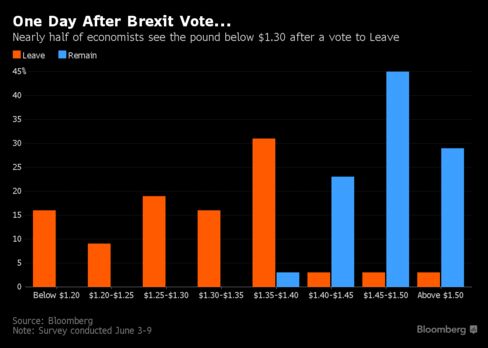
The day after next week’s referendum on European Union membership, the pound will either sink to the lowest level in more than three decades or climb toward the highest this year, according to a Bloomberg survey of economists. Most see a drop below $1.35 if Britons decide to leave the bloc on June 23, while the median estimate following a victory for the status quo is for it to jump to as high as $1.50.
A Brexit vote “would certainly be a shock event for currency markets in a way that’s pretty unusual outside of major financial crises,” said Michael Bell, a global market strategist at JPMorgan Asset Management in London, which manages $1.7 trillion in assets. “The pound would fall very sharply.”
The median estimate in the survey was for the pound to drop to between $1.30 and $1.35 a day after a vote to ‘Leave,’ while a range of $1.45 to $1.50 was seen if the ‘Remain’ campaign triumphs. Sterling was 0.9 percent weaker at $1.4122 as of 10:24 a.m. in London on Monday.
Preparing for either scenario is important for investors as polls suggest the result of the vote is too close to call. In the past few weeks, the currency has been jolted by a series of surveys showing one or the other side in the lead, while traders are bracing for even more volatility as June 23 approaches, with a two-week measure rising to a record high on Monday.
A decline to $1.30 would represent a drop of about 8 percent from the current level. A move of that degree on the day following the referendum would be the biggest on record, surpassing tumbles seen during the 2008 financial crisis and on Black Wednesday in 1992, when the British government decided to let the pound float freely. And that’s not even the worst case scenario -- 14 out of 32 economists surveyed expect sterling to fall below $1.30, with five of them seeing it lower than $1.20.
The U.K. currency has already dropped more than 4 percent this year as investors assess the risks of an exit. It fell to a seven-year low of $1.3836 in February after Prime Minister David Cameron announced the date of the vote, and has since fluctuated as polls suggested both sides may still prevail.

‘Leave’ Leads

Sterling plunged to its lowest since April against the dollar on Monday after polls published in the past week showed the ‘Leave’ campaign leading by as much as 10 percentage points. Others have shown a more balanced contest, with many voters still undecided.
A decline below $1.3503 would push the pound to the lowest since 1985. Such a severe depreciation in the currency risks causing repercussions for the wider U.K. economy, from the soundness of its current account to faster inflation. Weakness in the economy could also delay interest-rate rises from the Bank of England, according to JPMorgan AM’s Bell.
“Interest rates are likely to go up much later than they otherwise would” should the country leave the world’s largest single market, he said. Meanwhile a weaker economy would reduce the U.K.’s attractiveness for foreign investors, further weighing on the pound, he said.

Possible Bounce

While the upside to the currency if the U.K. votes to stay is set to be smaller, according to Bloomberg’s survey, a move to $1.50 still indicates a bounce of more than 6 percent from current levels. However, only nine out of 31 economists see it going above this level, and seven see it trading close to current levels between $1.40 and $1.45.
For more news on the Brexit referendum, click here.
Some strategists and investors predict the rally in the pound would be fleeting if there’s a “Remain” vote, as the U.K. economy faces difficulties beyond the referendum.
The pound’s rally may be even smaller if there’s a tight vote to stay, according to Richard Benson, managing director and co-head of portfolio investment in London at Millennium Global Investments, which manages about $16 billion. He sees sterlin
g strengthening 3 percent if Britons decide to stay on June 23 provided it’s a “solid” victory for the “Remain” camp.
“It could be less than that if the results are very close” as “people will talk about political squabbles” and speculate about the consequences for David Cameron’s political future, Benson said.

Survey Responses

Level one day after a vote to....Leave (32 Responses)Remain (31 Responses)
Below $1.2016%0%
$1.20-$1.259%0%
$1.25-$1.3019%0%
$1.30-$1.3516%0%
$1.35-$1.4031%3%
$1.40-$1.453%23%
$1.45-$1.503%45%
Above $1.503%29%

Friday, June 10, 2016

BBC News - Bond yields in UK and Germany fall to record low

A stock broker in LondonImage copyright
The return on benchmark UK government bonds has fallen to a record low as investors move in to safer assets on concerns about the global economy.
The yield on the UK's 10-year gilt dropped below 1.25% for the first time. The yield on the German equivalent also sank to a record low.
More buyers cause bond values to rise and yields to fall, hitting annuity rates, pension fund income, and debts.
Analysts see it as a "pessimistic" sign.
"The low yield on government bonds paints a pretty pessimistic picture of the global economy, and suggests we are set for an extended period of low or negative inflation, and weak economic performance," said Hargreaves Lansdown analyst Laith Khalaf.

Thin trading

Investors have been worried about a weakening Chinese economy, the outlook for US interest rates, and the UK's pending EU referendum vote. Investors typically buy bonds because they provide a long-term, predictable and - crucially - a secure income stream.
But yields have been falling for months. This time last year, the UK 10-year gilt yield was 2%.
Also on Thursday, the 10-year German Bund yield fell to a record low of 0.027%, while in the US, the yield on 10-year notes fell 1.671%, the lowest for three months.
Jason Simpson, fixed income strategist at Societe Generale, said gilt yields could fall further.
He added that trading in the bond market has been thin recently because investors were probably "sitting on their hands" ahead of the referendum, with the small number of trades exacerbating the size of moves in the market.

'Slipping fast'

Mr Khalaf said: 'While all eyes have been on the EU referendum campaign, gilt yields have been slipping, fast.
"The US Federal Reserve is backing away from interest rate rises following wavering employment data, and in Europe the central bank is pumping billions of euros into the bond market every month in the form of quantitative easing, both of which have served to drive yields down."
The demand for higher yields helped the US government raise $20bn on Wednesday from the sale of 10-year notes. The bond issue reportedly received record demand from investment funds and foreign central banks.
"The auction process shows large bidder participation. Those bidders are mostly international buyers who need the yield," said Tom Tucci, head of Treasuries trading at CIBC in New York