Tuesday, July 12, 2016

BBC News - Italy economy: IMF says country has 'two lost decades' of growth

Headquarters of Monte dei Paschi di Siena BankImage copyright
Image captionProblems with Italy's banks are not helping the economy
Italy's economy will not return to the levels seen before the 2008 financial crisis until the mid-2020s, the IMF has said, implying "two lost decades".
By the mid-2020s, it says the economies of other eurozone members will be 20-25% larger than levels seen in 2008.
The Fund's comments came as it cut its growth forecasts for the eurozone's third largest economy.
It now expects Italy's economy to grow by less than 1% this year, compared with an earlier estimate of 1.1%.
The IMF also cut its growth forecast for 2017 to about 1% from 1.25%.
Italy has an unemployment rate of 11% and a banking sector in crisis, with government debt second only to that of Greece.
Italian banks are weighed down by massive bad debts, and may need a significant injection of funds.
The IMF said any recovery in the Italian economy was likely to be "fragile and prolonged", adding that the authorities faced a "monumental challenge".
"The recovery needs to be strengthened to reduce high unemployment faster and buffers need to be built, including by repairing strained bank balance sheets and decisively lowering the very high public debt."
Speaking after the release of the report, Italian Prime Minister Matteo Renzi said that Britain's vote to leave the European Union would add pressure to all countries in the eurozone.
"Growth estimates are down after the Brexit," he told Italian radio station RTL. "Europe's economy will slow briefly, but in the mid-term the English are the ones who will feel the damage the most."

Matteo RenziImage copyrigh
Image captionItalian Prime Minister Matteo Renzi says the country's banks are being singled out unfairly

Analysis: Julian Miglierini, BBC News, Rome

"Italy is not the sick man of Europe", Italian Prime Minister Matteo Renzi said on Tuesday - trying to fight back the perception that his country's economic woes constitute the most severe threat to the eurozone this summer.
On both main concerns - Italy's troubled banks and low growth estimates - the prime minister has this week deflected the attention (and blame) elsewhere.
On Monday, he said that the Italian banks were being unfairly singled out - since other European banks had much bigger problems. Many interpreted this as a swipe at Germany's Deutsche Bank, which is dealing with its own troubles.
And on Tuesday, Renzi blamed low growth estimates on the uncertainty that has followed the UK's decision to leave the European Union, and said it would be the UK, and not Italy or the EU, who would pay the highest cost.
The increasing fears over Italy's economy couldn't come at a worst time for Renzi.
He's fighting a rise in the polls of the Five Star protest party and the increasing prospects that he may lose a referendum over a major constitutional reform he has called for later this year.

Luring banks

Last week, the IMF cut its growth forecast for the eurozone as a whole because of the expected impact of the UK voting to leave the EU.
It now expects the eurozone's economy to grow by 1.6% this year and 1.4% in 2017. Before the referendum the IMF had predicted growth of 1.7% for both years.
Mr Renzi said that Italy would try to lure financial institutions who decide to leave London in the wake of Britain's departure from the EU.
There has been speculation that banks will move European headquarters out of London, currently Europe's largest financial centre, because they would no longer have access to the passporting system.
This allows them to offer financial services across all EU nations without having a permanent base in each country.
"We are trying with (Milan's mayor) Beppe Sala to bring to Milan a small part of the financial institutions that are in London," Mr Renzi said

Monday, July 11, 2016

Reuters News - May to replace Cameron Wednesday as pro-Brexit rival quits UK PM race

Interior minister Theresa May is set to become Britain's prime minister on Wednesday with the task of steering its withdrawal from the European Union after her only rival abruptly pulled out.
May, 59, will succeed David Cameron, who announced he was stepping down after Britons unexpectedly voted last month to quit the EU. Britain's planned withdrawal has weakened the 28-nation bloc, created huge uncertainty over trade and investment, and shaken financial markets.
May and energy minister Andrea Leadsom had been due to contest a ballot of around 150,000 Conservative party members, with the result to be declared by Sept. 9. But Leadsom unexpectedly withdrew on Monday, removing the need for a nine-week leadership contest.
Cameron told reporters in front of his 10 Downing Street residence that he expected to chair his last cabinet meeting on Tuesday and take questions in parliament on Wednesday before tendering his resignation to Queen Elizabeth.
"So we will have a new prime minister in that building behind me by Wednesday evening," he said.
May will become Britain's second female prime minister after Margaret Thatcher.
Her victory means that the complex process of extricating Britain from the EU will be led by someone who favored a vote to Remain in last month's membership referendum. She has said Britain needs time to work out its negotiating strategy and should not initiate formal divorce proceedings before the end of the year, but has also emphasized that 'Brexit means Brexit'.
In a speech early on Monday in the central city of Birmingham, May said there could be no second referendum and no attempt to rejoin the EU by the back door.
"As prime minister, I will make sure that we leave the European Union," she said.
RELATIVE UNKNOWN
Leadsom, 53, never served in cabinet and was barely known to the British public until she emerged as a prominent voice in the successful Leave campaign.
She had been strongly criticized over a newspaper interview in which she appeared to suggest that being a mother meant she had more of a stake in the country's future than May, who has no children. Some Conservatives said they were disgusted by the remarks, for which Leadsom later apologized, while others said they showed naivety and a lack of judgment.
Leadsom told reporters she was pulling out of the race to avoid nine weeks of campaign uncertainty at a time when strong leadership was needed. She acknowledged that May had secured much greater backing in a vote of Conservative members of parliament last week.
"I have ... concluded that the interests of our country are best served by the immediate appointment of a strong and well supported prime minister," she said. "I am therefore withdrawing from the leadership election and I wish Theresa May the very greatest success. I assure her of my full support."
Graham Brady, head of the Conservative party committee in charge of the leadership contest, said there were still constitutional procedures to be observed before her appointment could be confirmed, but he aimed to make a confirmation announcement as soon as possible.
"We're not discussing coronations, we're discussing a proper procedural process which should conclude very soon," he told reporters.
The pound, which has hit 31-year lows since the June 23 referendum vote on concern about potential damage to the British economy, bounced briefly on the news that the Conservative leadership question would be resolved much sooner than expected.
"Welcome news we have 1 candidate with overwhelming support to be next PM. Theresa May has strength, integrity & determination to do the job," finance minister George Osborne tweet.              
FORGING NEW ROLE
The 52-to-48 percent vote to quit the EU after 43 years of membership was a stunning rebuke to Britain's political leaders and especially Cameron, who had argued that breaking away would bring economic disaster.
Britons ignored his warnings, swayed by the arguments of the Leave campaign that 'Brexit' would enable them to regain 'independence' from Brussels and clamp down on high immigration, something hard to achieve under EU rules allowing people to live and work anywhere in the bloc.
May's leadership hopes had appeared at risk of being damaged by her failure, in six years as interior minister, to bring immigration down, and the fact she found herself on the losing side of the referendum campaign.
But her two best-known rivals on the Leave side were felled by political back-stabbing when Justice Secretary Michael Gove brought down former London mayor Boris Johnson and was then punished for his perceived treachery by being eliminated from a ballot of Conservative MPs.
In her speech in Birmingham on Monday, May set out her vision for the economy, calling for "a country that works for everyone, not just the privileged few".
In a pitch for the political center, she said she would prioritize more house-building, a crackdown on tax evasion by individuals and companies, lower energy costs and a narrowing of the 'unhealthy' gap between the pay of employees and corporate bosses.
"Under my leadership, the Conservative Party will put itself completely, absolutely, unequivocally, at the service of ordinary working people ... we will make Britain a country that works for everyone," she said.
LABOUR DISARRAY
More than 1,000 British lawyers said in a letter to Cameron that members of parliament, not lawyers, should decide whether Britain leaves the EU because the referendum was not legally binding.
Opposition members of parliament, responding to the impending appointment of May, demanded a general election.
"It is crucial, given the instability caused by the Brexit vote, that the country has a democratically elected prime minister," Labour party election co-ordinator Jon Trickett said.
Labour too has been thrown into upheaval by the referendum, with leader Jeremy Corbyn widely criticized for failing to make a sufficiently passionate case in favor of staying in the EU.
Minutes before Leadsom's announcement, Labour lawmaker Angela Eagle launched a leadership challenge to Corbyn.
"Jeremy Corbyn is unable to provide the leadership that this party needs -- I believe I can," Eagle said.
Corbyn was elected last year with overwhelming support from grassroots Labour activists. He has ignored a vote of no confidence from the party's lawmakers, saying he has a responsibility to carry out that mandate.

(Reporting by Mark Trevelyan; Editing by Sonya Hepinstall)

Friday, July 8, 2016

BBC News - Consumer confidence 'falls after Brexit vote'

Shoppers on Oxford StreetImage copyright
Consumer confidence has seen its sharpest drop in 21 years after the UK vote to leave the EU, a survey suggests.
The market research firm GfK conducted a one-off online survey of 2,000 people after the result was known.
Its confidence index fell by eight points to minus nine, a drop not since seen December 1994.
Less confident consumers tend to curb their spending, which accounts for about two-thirds of the UK economy.
It is also one measure watched by the Bank of England when deciding its next move on interest rates. Governor Mark Carney has already warned the UK's economic outlook is "challenging" following the decision to leave the EU.
The Gfk survey also suggested that 60% of consumers expect the general economic situation to worsen over the next year, compared with 46% in June. Just 20% expect it to improve, down from 27% last month.

Regional variations

The number of people who believe prices will rise rapidly in the next 12 months jumped to 33% from 13% in June.
It also showed regional differences in the fall in confidence - with the north of England seeing a 19 point drop and Scotland seeing an 11 point drop. The south of England saw just a two point drop.
The survey was run from 30 June to 5 July to capture the mood of consumers immediately after the referendum on 24 June.
"Our analysis suggests that in the immediate aftermath of the referendum, sectors like travel, fashion and lifestyle, home, living, DIY and grocery are particularly vulnerable to consumers cutting back their discretionary spending," said Joe Staton, head of market dynamics at GfK.
A separate survey indicated that retailers were already beginning to feel the impact.
The BDO's monthly High Street Sales Tracker showed a strong start to June, with sales growing 3.8% year on year. That decreased throughout the month and by the end of June, after the referendum, sales had fallen by 8.1% compared with last year.
Official economic figures from the Office for National Statistics that will reflect any Brexit impact will start being released in August.

Thursday, July 7, 2016

BBC News - FTSE and pound rise as markets rebound

Trader with headsetImage copyright
Shares on the FTSE 100 index have risen more than 1%, while sterling has recovered slightly from a 31-year low.
London's blue-chip share index was up 80 points in afternoon trade at 6,544 as the mood among traders brightened.
The pound rose 0.7% against the dollar to go back above $1.30 and was 0.9% higher against the euro at €1.1754.
"Sterling has recovered this morning in tandem with widespread gains across European stock markets," said Chris Saint of Hargreaves Lansdown.
The FTSE 250 of mid-cap UK firms was 1.3% higher, while stocks in Paris, Frankfurt and Madrid recovered some of their losses from Wednesday.

Rate cut

The recovery is "being led by a rebound in the sectors that have been hit the hardest over the past few days", said Michael Hewson of CMC Markets.
Major UK house builders, Taylor Wimpey and Persimmon, were among the big FTSE winners on Thursday morning, before falling back to gains of around 4%. Their shares are still more than 30% lower since the EU referendum result.
Analysts also pointed to strong economic data from the US on Wednesday and expectations that interest rates would remain low in the coming months.
In the UK, financial markets are now pricing in a 78% chance that the Bank of England will cut interest rates next week.
Mark CarneyImage copyright
nvestors are betting Bank of England governor Mark Carney and his team will cut interest rates from 0.5% on 14 July

Bank fears

Sterling has fallen 13% from the high of $1.50 seen before the referendum result - when investors bet heavily on a win for Remain - to lows not seen since 1985.
Despite a sharp sell-off after the Brexit vote, the FTSE 100 is up more than 3% since its close on 23 June. However, it is down around 10% in dollar terms as the slump in sterling has reduced the dollar value of the market.
While there were some tentative signs of recovery in riskier assets on Thursday, investors were still on edge over the fallout from the Brexit vote which helped extend a rally in gold prices.
The precious metal is trading near its highest price in more than two years. Gold tends to perform well when investors are worried about the performance of riskier assets like equities.
In other developments:
  • Minutes from the European Central Bank's meeting in early June showed it felt the impact from Brexit could be "significant" and have "negative spillovers" for the eurozone.
  • Italian bank shares continued to oscillate over concerns the banks do not have enough reserves to handle $389bn (£300bn; €350bn) of bad loans.

Retail

In a busy company announcement session, shares in Marks and Spencer were down 0.9% after it reported a steep fall in sales.
AB Foods, owners of Primark, saw shares rise 9.3% to be the biggest gainer on the FTSE.
The firm said it was sticking to plans to expand its Primark chain across Europe and the US, and was optimistic about continued growth despite uncertainty created by the Brexit vote.
Sports Direct shares rose 2.1% despite bad publicity about the retailer's working conditions prompting a heavy fall in annual profits.

Fed cautious

Late on Wednesday, the latest Federal Reserve minutes were released, showing that prospects of an interest rate hike have diminished.
This soothed investors who had feared that a rise in interest rates may hinder prospects for economic growth.
The US central bank's last meeting in June took place before the UK's EU referendum.
However, policymakers were concerned the vote would heighten global market uncertainty and potentially hurt the US economic outlook.

Tuesday, July 5, 2016

Bloomberg News - Pound Tumbles to 31-Year Low as Brexit Starts to Inflict Damage

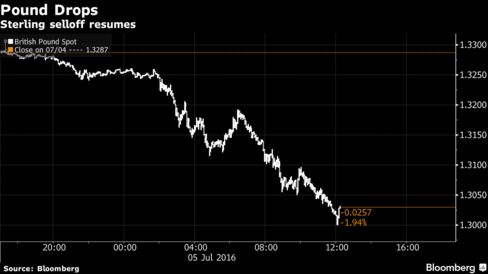
The pound fell to its weakest level in three decades against the dollar, surpassing lows reached in the aftermath of Britain’s vote to leave the European Union.
Sterling touched $1.30 and sank to its lowest since 2013 against the euro as evidence piled up that the Brexit vote is hurting confidence in the U.K. economy. M&G Investments suspended a 4.4 billion-pound ($5.7 billion) real-estate fund on Tuesday, following on the heels of Aviva Investors and Standard Life Investments after a flurry of redemption requests.
The U.K. currency briefly pared its losses as Bank of England Governor Mark Carney outlined more tools to contain the fallout from the U.K.’s decision to quit the bloc. Speaking in London, he said his concerns about pound declines had been borne outsince the Brexit vote, while adding that the weaker currency should help exporters. The pound soon resumed its drop, setting fresh lows.
“There’s a lot of nervousness in the sterling market,” said Thu Lan Nguyen, a currency strategist at Commerzbank AG in Frankfurt.
The pound dropped as much as 2.2 percent to $1.3000, the lowest since 1985, and was at $1.3015 as of 12:12 p.m. New York time. It slid 1.4 percent to 85.09 per euro, after touching 85.48 pence, the weakest since October 2013.
Almost all the analysts who changed their forecasts since the referendum are expecting the pound to remain weak. Of the 42 new predictions in a Bloomberg survey, all but five are for sterling to end the year at or below $1.30.
Data published by YouGov Plc and the Centre for Economics and Business Research on Tuesday indicated that pessimism about the economic outlook almost doubled following the June 23 referendum.
In its bi-annual Financial Stability Report, published Tuesday, the BOE sought to allay those concerns by cutting its capital requirements for U.K. lenders and pledging to implement any other measures needed. In a press conference to explain the report, Carney said the central bank’s post-Brexit plan is working but warned that officials can’t fully offset the volatility triggered by the referendum result.

Expecting Recession

Almost three quarters of economists surveyed by Bloomberg expect the U.K. to slide into recession. Investors are also digesting weaker-than-anticipated data which suggest the referendum was hindering the economy even before the shock vote to leave.
Reports this week have shown U.K. construction unexpectedly shrank at the fastest pace since 2009 in June, while growth in services output slowed. Shares of real-estate companies and housebuilders fell Tuesday even as the main stock market rallied.
“Carney stands ready to use all available tools,” said Nick Parsons, head of research for U.K. and Europe at National Australia Bank in London. “To the market, that means more easing and a weaker sterling.”

Monday, July 4, 2016

BBC News - Brexit: George Osborne pledges to cut corporation tax.

George Osborne
Image copyright

George Osborne has pledged to cut corporation tax to encourage businesses to continue investing in the UK following the EU referendum vote.
In an interview with the Financial Times, the chancellor said he would reduce the rate to below 15% - some 5% lower than its current 20% rate.
That would give the UK the lowest corporation tax of any major economy.
But former World Trade Organization chief Pascal Lamy said Mr Osborne had to consider what the EU would think.
He told the BBC the chancellor's plan would be seen as in effect the start of Brexit negotiations, and starting with tax was not the right way to go about it.
"The UK is already activating one of the weapons in this negotiation, which is tax dumping, tax competition. I can understand why he [Mr Osborne] does that, because obviously investors are flowing out from the UK, and he wants to provide them with some sort of premium that would make them think twice before they leave the United Kingdom.
"He has to think about the impact of this on the continent. This will be seen on the continent as the start of the negotiation.
"And I'm quite convinced that at the end of the day, if you want a proper balanced win-win relationship in the future, starting with tax competition is not the right way psychologically to prepare this negotiation."

'Open for business'

Mr Osborne said the cut was part of his plans to build a "super-competitive economy" with low tax rates.
A Treasury spokesperson confirmed the Financial Times's story was correct but said they did not know when the cut would happen.
In March, the chancellor said corporation tax would fall to 17% by 2020.
Mr Osborne told the FT it was important for "Britain to "get on with it" to prove to investors that the country was still "open for business".


Piles of coins and notesImage copyrightmage caption
The Bank of England could lower the amount of capital banks have to hold in case of unexpected risks

Shadow chancellor John McDonnell said the proposal was "counter-productive". He told the BBC the tax cut would not create the business investment that the UK needed.
He said it was "not constructive" to be "offering up Britain as a tax haven" to Europe and warned this could hit taxpayers.
Mr McDonnell accused the chancellor of being "chaotic" by bringing in "panic tax cuts" and instead called for a "steady strategy". He also warned that it was not the right way to open negotiations to get the best deal in Europe.
"I don't think it sends the right message to those countries that wish to establish a co-operative relationship with us in the future, so that we get some of the benefits we had in the EU, even though we're outside of it," he said.

Analysis: Theo Leggett, BBC business reporter

Before the referendum, George Osborne said that a vote to leave the EU would force him to introduce billions of pounds worth of tax increases and spending cuts in order to repair damage to the public finances.
It is now clear that his real strategy is very different.
The proposed cut to corporation tax, which would give the UK one of the lowest rates of any major economy, is designed to help the country attract new investment and court businesses which might otherwise have been put off by the uncertainty surrounding the country's relationship with the EU.

Mr Osborne's announcement comes amid reports that the Bank of England could this week lower the amount of capital banks have to keep aside as a safety net in case of unexpected risks.
On Tuesday, the Bank publishes the outcome of its bi-annual Financial Policy Committee meeting which looks at risks to the UK's financial stability.
Mr Carney said last week that the Bank would take "any further actions it deems appropriate to support financial stability".
One option could be to reduce the amount of capital banks are required to hold to help stimulate the economy.

'Signs of shock'

Mr Osborne has already abandoned his long-held target to restore government finances to a surplus by 2020 amid fears the uncertainty caused by the Leave vote could hold back the economy.
The chancellor said the economy was showing "clear signs" of shock following the vote to leave the European Union.
"How we respond will determine the impact on jobs and growth," he said at the time.
Economists have also warned about the impact of the Leave vote.
"Having voted for Brexit last week, the economy is clearly going to go into a down swing, that might be a full-blown recession, that might just be very very low growth," Paul Johnson, the director of the Institute for Fiscal Studies, said last week.

Friday, July 1, 2016

BBC News - Brexit vote leads S&P to cut European Union credit rating


Exit signImage copyright

Ratings agency Standard and Poor's has cut its credit grade for the European Union after the UK's Brexit vote.
S&P said the cut from AA+ to AA came after reassessment "of cohesion within the EU, which we now consider to be a neutral rather than positive".
The UK's Brexit vote had triggered "greater uncertainty" over long term economic and financial planning.
On Monday, S&P cut the UK's top AAA credit rating, saying Brexit could hit the economy and financial sector.
S&P said the change to its EU rating was because the previous assessment was based on all 28 states remaining in the bloc.
The agency said: "The rating action stems from S&P Global Ratings' view that the UK government's declared intention to leave the union lessens the supranational's fiscal flexibility, while reflecting weakening political cohesion.
"Our baseline scenario was previously that all 28 member states would remain inside the EU. While we expect the remaining 27 members to reaffirm their commitment to the union, we think the UK's departure will inevitably require new and complicated negotiations on the next seven-year budgetary framework.
"Going forward, revenue forecasting, long-term capital planning, and adjustments to key financial buffers of the EU will in our view be subject to greater uncertainty," S&P said.
On Monday, S&P stripped Britain of its top credit grade by two notches, from AAA to AA, warning the Brexit vote would lead to "a less predictable, stable and effective policy framework in the UK".
A number of economists have warned about the consequences of leaving the EU, with IHS Global Insight cutting its growth forecasts to 1.5% from 2% for 2016 and to 0.2% from 2.4% for 2017.
Also on Thursday, Bank of England governor Mark Carney signalled that interest rates could be cut over the summer to help boost the UK economy.
He said "some monetary policy easing" would be required in response to the Brexit vote.