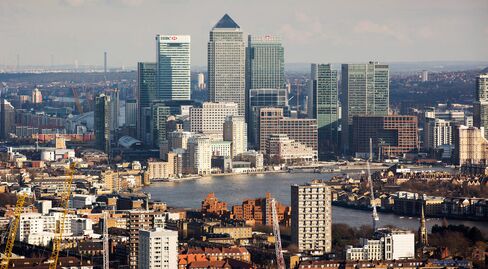
The vacancy rate fell for most of the first half of the year, as shops were demolished or used for other purposes faster than new buildings were put up.
However the vacancy rate for shops and leisure premises edged higher in June, rising to 11.2%.
"Whether this will be just a twitch in the statistics or the beginning of a long term reversal will become clear over the coming months," said Matthew Hopkinson from the LDC.
"For example, the 23% net growth in restaurants since 2010 is unlikely to continue.
Business, government and the media are all sniffing the air and scanning the horizon for any piece of news that might tell us what happens next," he added.
Following the financial crisis of 2007, the vacancy rate hit a high of 12.4% in 2011, and has only declined modestly since then.
Global banks based in the City of London will likely retain limited access to the European Union’s single market after Brexit even if they lose full passporting rights, according to Moody’s Investors Service.
That’s because most EU financial-services laws recognize that some non-EU countries’ rules and oversight of specific business lines are as tough as its own, the credit-ratings company said in a report Monday. While the U.K. leaving the single market would increase costs for the banks, it would likely be “manageable,” Moody’s said.
“In particular, we consider that the third-country equivalence provisions contained within the incoming MiFID II EU directive may provide firms with an alternative means of accessing the single market,” said Simon Ainsworth, senior vice president at Moody’s. “The complexity of (quickly) unwinding the status quo and a desire to minimize the initial impact on European domiciled banks will likely lead to the preservation of most cross-border rights to undertake business.”
Chancellor of the Exchequer Philip Hammond is said to be prepared to accept that Britain may have to give up membership of the single market to achieve the immigration restrictions that voters have demanded. Banks are pressing him to strike an interim agreement with the EU that would preserve their ability to provide services on broadly similar terms to now beyond the end of the official two-year negotiation period.
“The uncertainty around the outcome of any new arrangements mean that it is likely that some banks may choose to move some U.K.-based activities to the EU before the U.K.’s withdrawal negotiations are complete,” Ainsworth said.
London’s position as a financial hub in Europe may be threatened if the U.K. leaves the single market, Bundesbank President Jens Weidmann told the Guardian newspaper. A “hard Brexit” could strip banks of their ability to do business across the EU and open the door for Frankfurt, Weidmann said in an interview.
George Osborne says he will stay in the Commons to "fight for the things I care about" as he launches a think tank to promote his Northern Powerhouse plan.
Mr Osborne, who was sacked as chancellor by Theresa May, said: "I don't want to write my memoirs because I don't know how the story ends."
There had been a "bit of a wobble" by Mrs May over the project, he said.
No 10 says Mrs May is building on his plan to create a northern economy to rival London and the South East..
In his first major interview since being sacked, Mr Osborne told BBC Radio 4's Today programme: "Politics is a tough business." But he said he believed he could "push and fight for" ideas he backed from outside the cabinet.
The MP for Tatton in Cheshire returned to the back benches following Mrs May's cabinet reshuffle, and said chairing the new body - the Northern Powerhouse Partnership - would "now be a major focus of my political energies".
Analysis by Ben Wright, BBC political correspondent
A mere two months ago George Osborne was the second most powerful member of the government. Then he was the first cabinet minister Theresa May sacked when she became prime minister, dispatching him to the backbenches.
Politics is brutal. But if Mrs May hoped the former chancellor would disappear she was wrong. While David Cameron has opted for memoir writing and - it's safe to predict - a future on company and charity boards his old ally is staying in politics.
The board of the not-for-profit organisation will include business figures from across the north of England, as well as political figures. Its aim is to devolve powers and funds to northern city regions, improve transport links and create new regional mayors to act as figureheads.
Asked why he felt he had to say "the Northern Powerhouse is here to stay", Mr Osborne told the BBC: "To be honest, there was a little bit of a wobble about when we had the new administration about whether they were still committed to the concept of the Northern Powerhouse."
He said he supported economic development across the whole of the country and he had "sweated blood" to get a mayor for Birmingham - but he felt there was a particular opportunity in the North of England because the cities were close together.
Image captionThe Northern Powerhouse initiative aims to encourage economic growth outside London
Pressed on whether he intended, like his former Downing Street neighbour David Cameron, to quit politics, he said: "No, I'm not."
He said he wanted to "hang around and find out" how his story would end, adding: "There's an enormous opportunity now to take part in the decisions that are going to affect Britain... And I want to be there in ultimately, still the place where these decisions are made, the House of Commons, and be part of that decision-making process. Because I want to fight for the things that I care about."
He said he had voted for Mrs May and she was "the best person for the job of the candidates who put themselves forward" and she had made a "strong start".
She was "perfectly entitled to set the tone" of her administration, including "to take a pause and consider" big decisions like whether to go ahead with the £18bn Hinkley Point nuclear power station.
'Nothing changed'
But he added: "I don't think anything has fundamentally changed from the deal that we put together in government just a few months ago... it looks to me pretty much like the same deal."
On Mrs May's controversial plans to expand grammar schools, Mr Osborne said the new prime minister was "perfectly entitled to set out new ideas" and he supported her goals. But he said grammar schools focused "80% of the political discussion" on where 20% of the children go.
"I'm not against new grammar schools opening up where areas want them, but I think the real focus of education reform remains the academy programme, transforming the comprehensive schools that most people in this country send their children to."
'One of the grown-ups'
Asked about former energy secretary Ed Davey's comments that Mr Osborne and Mrs May had "really disliked each other" when in cabinet together, Mr Osborne responded: "That's genuinely not true. I've worked with Theresa for 20 years in opposition and in government. I actually think she's a person of integrity and real intelligence, and frankly in a Cabinet that included people like Ed Davey, she was one of the grown-ups."
Mr Osborne backed the Hinkley deal and championed the Northern Powerhouse project as chancellor, before being sacked from the cabinet by Mrs May when she became prime minister.
Earlier this month, Labour's mayoral candidates for Greater Manchester and the Liverpool city region urged Mrs May to "honour your promises to the north of England", amid reports that she intends to shift the focus to other areas.
However, Downing Street has denied any lack of commitment, saying Mrs May is building on Mr Osborne's project, having put Treasury aide Neil O'Brien in charge of it in her policy unit and appointing a Northern Powerhouse minister, Andrew Percy.
Crossbench peer Lord Kerslake, who chairs the Northern Powerhouse's advisory board, said it "remains unclear" which direction Theresa May would take the Northern Powerhouse and Mr Osborne wanted to "hold the new government's feet to the fire".
At a news conference, Mr Osborne said he had not spoken directly to Mrs May about the project but had spoken to Communities Secretary Sajid Javid who had been "very supportive".
Mr Javid said the government "realises the huge untapped potential of our great northern towns and cities" and he hoped the new partnership would "become an important part of the debate"
Economists have said the slight fall in UK unemployment to 1.63 million between May and July shows there is yet to be a "Brexit effect" on the jobs market.
Nearly three quarters of people who can work have jobs, a record high rate.
Employment was "resilient" before and after the EU vote, despite predictions of an economic shock, analysts said.
Kallum Pickering, an economist at Berenberg, said: "Although it is still early days, the UK labour market is yet to show any Brexit effect for the period immediately before and after the June 23 vote."
His analysis of the ONS data showed that unemployment fell to 4.7% in July, the first month since the vote.
Ben Brettell, senior economist at Hargreaves Lansdown, said: "The UK's labour market proved resilient in the immediate aftermath of the vote to leave the EU, ONS data has shown.
"This is the latest piece of evidence which shows the economy has fared better than expected since June's referendum."
John Hawksworth, chief economist at PwC, agreed the jobs data showed "no immediate impact from the Brexit vote".
Beneath the surface
The ONS said the figures, which only cover one month since the result of the EU referendum, show "continuing improvement" in the jobs market.
But Samuel Tombs, chief UK economist at Pantheon Macroeconomics, warned: "When you scratch beneath the surface, today's labour market figures are not as robust as they first appear."
The rise in people in work "remains supported by surging self-employment", Mr Tombs said.
"The strong growth also reflected a shift towards part-time working; total weekly hours rose by just 0.3% between April and July," he added.
Image copyrigh
Growth in average weekly earnings including bonuses also slowed slightly to an increase of 2.3% on last year. That is still ahead of inflation, which was 0.6% in the year to August.
In signs of a possible slowdown in employment, the claimant count, including Jobseeker's Allowance, went up from the previous month by 2,400 to 771,000.
It comes after a survey this week found employers in six out of nine sectors are less optimistic about adding jobs in the wake of the Brexit vote.
The claimant count is treated with some caution, though, by economists as the move to Universal Credit has made it much harder to calculate.
Analysis: BBC economics editor Kamal Ahmed
One interesting nugget in the employment figures concerns the number of people employed in the public sector.
It is down to 5.33 million, the lowest level since the Office for National Statistics started collecting the figures in 1999 and a drop of 13,000 since March.
The former chancellor, George Osborne, often spoke about the need to "rebalance" the economy.
To an extent, he meant away from financial services and towards manufacturing.
But, more privately, he was actually very comfortable with an economy that was "rebalancing" away from the public sector towards the private sector, where wealth, he would argue, is actually created.
As cuts and wage freezes bite, the public sector has become less attractive as a place to build a career.
Yes, employment is at record levels, but it is the private sector that is on the up.
The unemployment estimates come from the Labour Force Survey in which the ONS talks to 40,000 households every three months.
Although it is a very large survey, there is still a margin of error. The ONS says it is 95% confident that the figure of a 39,000 fall in unemployment is correct to within 78,000.
As the estimated change is smaller than the margin of error, it means the change in unemployment is not statistically significant.
Top City of London executives said banks will need more than two years to adapt to Britain's departure from the European Union if the market is to avoid disruption, while the EU's top official called for a prompt start to divorce talks.
Once Britain begins formal negotiations for exiting the EU, known as Article 50, it will have two years until it ceases to be a member of the bloc.
On Wednesday, three of the most senior executives in the City told lawmakers this was not long enough for banks to adapt and they would need more time before a trade deal is put in place.
"It's a multi-year process if it's going to be completed safely and not going to risk financial stability," Alex Wilmot-Sitwell, president of Bank of America Merrill Lynch in Europe (BAC.N) told a House of Lords committee. "I suspect it's two to three years."
HSBC (HSBA.L) Group Chairman Douglas Flint and Allianz Global Investors Vice Chair Elizabeth Corley also warned of the dangers posed by hasty change.
Seeking leeway from Brussels could be difficult, not least because there is disagreement in the British government about what concessions to make in negotiations.
The talks cannot start until Prime Minister Theresa May formally sets the two-year countdown to British departure.
In Strasbourg, Jean-Claude Juncker, who heads the EU's executive European Commission, urged that to be done quickly and repeated the EU negotiating position that Britain could not retain its full EU market access if it blocks free immigration from the EU.
"There can be no a la carte access to the single market," the Commission president told the European Parliament in his annual State of the Union address.
"Only those can have unlimited access to the internal market who accept that there will be free access for persons and goods."
Banks in Britain depend on an EU "passport" to serve clients across the 28-country bloc from one base and lenders worry that these passporting rights will end after Britain leaves the EU.
The European Commission has named a senior German trade negotiator to join France's former EU finance commissioner, Michel Barnier, at the head of the team negotiating Britain's departure from the European Union. [L8N1BQ21N]
In parliament on Wednesday, May said that the government is working for "the right deal" on trade relations with the EU, without giving further details.
NO 'LEGO SET'
Banks are making contingency plans to move some of their operations to continental Europe if Britain does not negotiate access to the bloc's single market after Brexit.
Wilmot-Sitwell said the financial sector is not a "Lego set", where you can pull up and move pieces without affecting clients and financial stability. "You don't move nuclear waste in a race," he added.
HSBC's Flint, who is on a panel advising the government on post-Brexit trading terms, said it would take several years for a bank in London to complete the "enormous task" of setting up a new subsidiary in the EU.
Tinkering with London's financial "eco-system" could undermine new rules regulators have put in place since the 2007-09 financial crisis, Flint said. It could also impact customers across Europe, he said.
London accounts for 69 percent, or $928 billion, of the off-exchange euro-denominated interest rate derivatives market and President Francois Hollande of France has said clearing in euro-denominated contracts should be moved to the euro zone.
That would bump up costs by forcing banks and users to have multiple piles of cash to back trades, Flint said.
There is no rush to raise interest rates, a Federal Reserve board member has said a week before the US central bank announces its latest decision.
Economic weakness "counsels prudence", said Lael Brainard, a member of the Fed's Open Market Committee, which decides interest rates.
Her comments come after several Fed officials recently suggested a rate rise this month should be considered.
Ms Brainard has consistently voted against an increase.
Speaking in Chicago, Ms Brainard said the risk that higher rates would damage a fragile US economy exceeded the risk that higher rates would increase inflation.
Her caution follows comments by Boston Fed chief Eric Rosengren on Friday that there was a case for higher rates.
Earlier on Monday, Dennis Lockhart, Atlanta Federal Reserve president, said he still believed that economic conditions justified considering a rate rise this month.
The Fed raised interest rates in December for the first time since 2006, but has held back from increasing them further amid concerns over persistently low inflation.
The speculation over the Fed's next move comes amid a claim from Donald Trump that the US central bank was keeping interest rates low to boost the popularity of President Barack Obama.
Image copyright
The US Republican presidential candidate said Ms Yellen was "obviously political" and had created a "false" stock market by keeping rates low.
Economists and commentators were quick to dismiss his comments, with academic and commentator Paul Krugman tweeting: "In ordinary times this combo of ignorance and paranoia would be shocking. In this election, who'll even notice."
Rates are unlikely to rise until there is a new president, according to Mr Trump. When that happens, the stock market is likely to go "way down", he told CNBC.
"[Ms Yellen] is obviously political and she's doing what Obama wants her to do," Mr Trump said.
Responding to his comments, Minneapolis Federal Reserve president Neel Kashkari told CNBC that at Federal Reserve meetings "politics simply does not come up".
"We look at the economic data," he said.
Image copyrightImage captionDonald Trump accused Fed chief Janet Yellen of being "obviously political"
When asked about political pressure on the Federal Reserve, Mr Lockhart said: "I don't see the world that way."
Earlier this month, Ms Yellen said the case for raising US interest rates had "strengthened".
Speaking at an annual meeting of central bankers, Ms Yellen was cautiously upbeat about the US economy.
She said economic growth and a stronger jobs market meant "the case for an increase in the federal funds rate has strengthened in recent months".
Savers hit
Mr Trump said that while low interest rates had been good for his property business, savers had been hit.
"The ones that did it right, they saved their money. They cut down on their mortgages... now they're getting practically zero interest on the money that they worked so hard for."
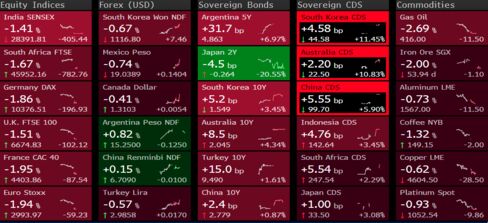
A selloff in fixed income is starting to snowball into a global market rout.
Shares in Europe and Asia dropped the most since the aftermath of the U.K. Brexit vote in June, and U.S. stock-index futures fell as concern spread that central banks are preparing to wean markets off unprecedented stimulus. Treasuries extended their slide into a fourth day as the U.S. prepared to sell three- and 10-year notes, and the yield on benchmark German bunds reached the highest since Britain’s decision to exit the European Union was confirmed. Oil sank toward $45 a barrel as nickel tumbled the most in four weeks. The yen advanced and the won slid. Samsung Electronics Co. tumbled after airlines and regulators warned against the use of its Note 7 smartphones.
Starting with a tumble in longer-dated government bonds, financial markets have been jolted out of a period of calm by an uptick in concern over the outlook for central bank policies. Lael Brainard, a member of the Federal Reserve’s board of governors, speaks Monday in Chicago, days after Fed Bank of Boston President Eric Rosengren said the economy could overheat. European Central Bank President Mario Draghi last week played down the prospect of further stimulus and Bank of England Governor Mark Carney said the chances of a U.K. recession had fallen. With the the Bank of Japan set to unveil the results of a comprehensive policy review at its its Sept. 20-21 meeting, traders are on tenterhooks.
“It was only a matter of time for this selloff,” said Ralf Zimmermann, a strategist at Bankhaus Lampe in Dusseldorf, Germany. “We had seen post Brexit a really notable rebound in markets even if fundamentals hadn’t improved accordingly. I expect some more downside going forward. There’s also the risk of the Fed meeting coming up."
Damage report: H-Shares -4% Hang Seng -3.4% NZ -2.5% Korea -2.3% Australia -2.2% Japan, China -1.7% Thailand -1.5% India -1.4% Taiwan -1.2%
The MSCI All-Country World Index of shares fell for a third day, dropping 0.8 percent at 10:19 a.m. London time. All major western-European stock markets dropped as the Stoxx Europe 600 Index lost 1.7 percent. The VStoxx Index tracking euro-area equity volatility headed for its biggest jump since January, signaling a return of instability after an extended period of stable prices.
Miners posted the worst performance of the 19 industry groups on the Stoxx 600 today as commodity prices retreated. Energy companies slid as oil extended declines after U.S. producers increased drilling.
Linde AG tumbled 8.4 percent after saying it terminated talks for a combination with Praxair Inc. EON SE slid 15 percent after spinning off its Uniper SE unit. RWE AG fell 3.1 percent after confirming plans for an initial public offering of Innogy SE shares in the fourth quarter. SVG Capital Plc jumped 15 percent after HarbourVest Global Private Equity Ltd. offered to buy it for about 1 billion pounds ($1.3 billion) in cash.
S&P 500 Index futures slipped 0.6 percent, indicating U.S. equities will slide for a fourth day, after ending last week lower.
The MSCI Emerging Markets Index slid 2.3 percent, the most since June 24. The gauge has slumped 4.2 percent in two days, poised for a one-month low. The Hang Seng China Enterprises Index of mainland companies listed in Hong Kong sank 4 percent, the most in seven months, and South Korea’s Kospi lost 2.3 percent.
Samsung plunged 7 percent after U.S. regulators joined the company in cautioning users to power down their Note 7s and refrain from charging them. Aviation authorities and airlines have called on passengers to stop using the gadgets during flights.
The company announced a recall of millions of big-screen smartphones on Sept. 2 after about three dozen of them were found to have batteries that caught fire or exploded.
Bonds
Germany’s 10-year yield climbed four basis points, or 0.04 percentage point, to 0.05 percent, and touched the highest level since June 24. Spanish bonds with a similar maturity dropped a fourth day, pushing the yield to the most in seven weeks.
Yields on benchmark Treasuries increased two basis points to 1.69 percent, before sales of a combined $44 billion of three- and 10-year notes. The three-year noes being sold later on Monday yielded 0.95 percent, an increase of 10 basis points compared with the previous auction on Aug. 9.
Brainard, seen as a leading opponent of rate increases for much of the past year, is the last scheduled Fed speaker before the self-imposed blackout period running up to the Sept. 20-21 policy meeting. Any hawkish shift in her rhetoric may stoke volatility in financial markets, which on Friday put the probability of a hike in borrowing costs this month at 30 percent.
Ten-year yields in Australia surged nine basis points to 2.05 percent, after gaining 10 basis points on Friday, and that for New Zealand debt with a similar due date jumped 11 basis points to 2.47 percent.
Japanese government bonds with maturities of less than a decade advanced and longer-dated securities declined. The moves follow a Reuters report on Friday that said the Bank of Japan was studying options to steepen the nation’s yield curve.
The cost of insuring corporate debt against default jumped the most since late June. The Markit iTraxx Europe Index of credit-default swaps on highly rated companies climbed four basis points to 72 basis points. A measure of swaps on junk-rated corporate issuers rose 16 basis points to 332 basis points. Both gauges are at the highest in about two months.
Commodities
The Bloomberg Commodity Index fell 0.6 percent, after sliding 1.3 percent on Friday.
Crude oil sank 1.6 percent to $45.14 a barrel in New York after American producers increased drilling, adding to a glut. U.S. rigs targeting crude rose to the highest since February, according to data from Baker Hughes Inc.
Nickel slid 3.4 percent in London, dropping for the first time in eight days, while tin tumbled by the most since May. Gold rose 0.1 percent, after retreating 1.6 percent over the last three sessions.
Iron ore fell in China to the lowest since June amid speculation the nation’s policy makers will tighten property curbs and so cool demand for steel. Steps should be taken to restrain bubble-like expansion in the housing market, Ma Jun, chief economist of the PBOC’s research bureau, said in an interview with China Business News.
Wheat in Chicago fell 0.7 percent to about $4 a bushel, approaching a decade-low of $3.8675 reached on Aug. 31. Money managers have their biggest-ever bet on price declines and a global stockpile estimate by the U.S. Department of Agriculture is forecast to still be at a record high after the figure is updated on Monday.
Currencies
The Bloomberg Dollar Spot Index fluctuated near a one-week high before Brainard’s speech, with regional Fed chiefs for Atlanta and Minneapolis also lined up to speak on Monday. The yen appreciated 0.6 percent versus the greenback.
There’s “growing caution over a rate hike as the day of the Fed’s decision draws closer,” said Masashi Murata, a currency strategist at Brown Brothers Harriman & Co. in Tokyo. “Markets had been too confident that a hike wouldn’t happen. But global economies are not in a critical phase, so there’s a limit to selling on risk aversion. Money will eventually seek yields and underpin high-yielding currencies.”
The won slumped 1.4 percent, the worst performance among major currencies, after Yonhap News reported that U.S. and South Korean intelligence authorities see a high chance that North Korea will conduct an additional nuclear weapons test after holding one on Friday.
The MSCI Emerging Markets Currency Index slid 0.4 percent, leaving it down 1.3 percent over two days.
Financial markets in Singapore, Malaysia, Indonesia and the Middle East were closed for a holiday.