Tuesday, October 11, 2016

BBC News - Scottish government backs Heathrow expansion

Plane flying over Heathrow signImage copyright
The Scottish government has said it is backing the plan to add a third runway at London's Heathrow airport.
The project has been heavily debated for a number of years, but Scottish ministers have said it offers significant strategic and economic benefits for Scotland.
The government said this would include up to 16,000 new jobs.
Heathrow Airport and the Scottish government have signed a Memorandum of Understanding.
This will highlight a number of commitments by Heathrow Airport, including the new jobs.
If the expansion goes ahead, about £200m would be spent on construction in Scotland, £10m for new domestic routes, and there would be a commitment to investigate Prestwick Airport as a potential site for a logistics hub to support the building of the third runway.
Keith Brown, the cabinet secretary for economy, jobs and fair work, told BBC Radio Scotland that it was the "best deal for Scotland".

Long haul

Speaking on the Good Morning Scotland programme, he said: "In the absence of action from the UK government, we have made this decision and we would urge them to act as quickly as possible."
The UK government said that it will "shortly announce" a decision on airport expansion, with another runway at Gatwick also in the running.
Environmental campaigners, local authorities near Heathrow and some MPs have raised concerns about the project.
Asked if this was a "green policy", Mr Brown said increasing the number of direct long-haul flights to Scotland could reduce the number of more "damaging" short-haul connections to Heathrow.
He said many people flying directly to Scotland would want to know about onward connections to London.
Mr Brown said the UK needs to have an international hub airport, but was facing "real pressure" from Schiphol, Istanbul and Dubai - and that short-haul connections with those airports would be "even more environmentally damaging" than those to Heathrow.
Graphic showing the proposed Heathrow expansion.
A spokesman for Gatwick Airport said he was "surprised" by the Scottish government's decision to back a third runway at Heathrow, which he said would "undermine Scotland's connections with the world, making it more dependent on London and the South East of England".
He added: "Some of the suggested benefits to Scotland are unlikely to bear serious scrutiny, which makes the decision all the more curious.
"However, we are confident that expansion will happen at Gatwick and that competition will prevail over the old-fashioned monopoly being planned by Heathrow. That would be the best outcome for Scotland."
The operators of Edinburgh Airport said they believed Gatwick "offered the better deal for Scotland" and described the Heathrow plan as "undeliverable" and potentially "bad for passengers".

'Greater clarity'

A spokesman added: "We are now urging the Scottish government to give greater clarity on their planned cut to Air Passenger Duty (APD) - and we are calling on them to confirm that proposals will deliver a 50% cut in one move to create the greatest growth, generate jobs and support the economy."
Richard Dixon, director of Friends of the Earth Scotland, said the Scottish government's announcement was disappointing.
He told Good Morning Scotland that a third runway at Heathrow would increase passenger traffic by about 70% by 2030.
"If you're concerned about climate change, the last thing you want to do is let aviation grow even more," he said.
"It's the fastest source of greenhouse gases, it's not really under control, and if we're to meet international targets... we can't possibly expand aviation much more than where it is today globally."
Artist's impression of expansion plans for Gatwick AirportImage copyright
Image captionGatwick Airport has also put forward proposals for another runway
Mr Dixon also raised questions over the promises of mass job creation.
"If you're better connected, if it's easier to fly somewhere else, then people will do their business elsewhere," he said.
"This actually takes business, jobs and money out of Scotland as well as bring it in and it kind of balances out."
Heathrow Airport has also committed to a reduction of £10 per passenger on landing charges paid by airlines operating services from Heathrow to Scotland from January.
This will benefit existing services from Aberdeen, Edinburgh, Glasgow and Inverness and incentivise the introduction of new services.
It has also agreed to a significant, long-term marketing campaign at Heathrow to promote Scotland and a procurement event in Glasgow to enhance opportunities for Scottish firms to win business with Tier 1 Heathrow suppliers.
Memorandum of Understanding
Image captionThe Scottish government and Heathrow Airport have signed a memorandum of understanding
Mr Brown said: "We have engaged extensively with both airports during this process and considered all options very carefully. Gatwick's proposals are also to be commended.
"However, Heathrow's plan offers significant job creation, major investment opportunities and, crucially, seeks to address how all of Scotland's airports benefit from the new runway capacity when it comes and also in the lead-up period.
"The potential for a logistics hub to be based at Glasgow Prestwick Airport is also an important part of the Heathrow offer. It would support the pre-fabrication of components for the construction phase, with potential for future work beyond the launch of the third runway, bringing strong economic benefits to the airport and the wider Ayrshire economy."
John Holland-Kaye, chief executive of Heathrow Airport, said: "It would facilitate more airlines flying routes to Scottish airports, meaning more flights, more competition and choice for families and businesses across the nation. That also means more visitors to Scotland, more destinations for Scottish tourists and more opportunity for Scottish businesses to reach new export markets.
"This partnership demonstrates how Heathrow expansion can work for every region and nation of the UK."

Monday, October 10, 2016

Bloomberg News - Titans of Finance Gather and Sulk Over Low Rates, Deutsche Bank

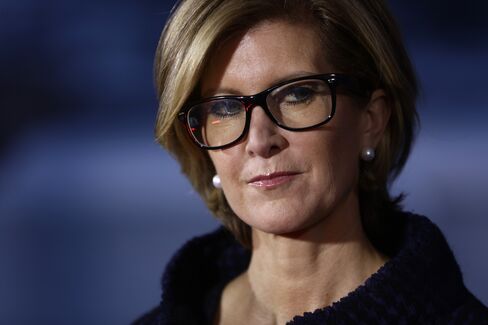
Mary Callahan Erdoes
 
Photographer: Simon 
Mary Callahan Erdoes, one of JPMorgan Chase & Co.’s most senior executives, summed up her industry’s mood like this: “There is no excitement,” she told throngs of bankers gathered in Washington. “There is a lot of handwringing.”
Again and again, speakers at the Institute of International Finance’s three-day meeting in Washington, which wrapped up Saturday, bemoaned the inability of central banks to rev up economic growth, as well as the drag of tougher regulations and the looming impact of Brexit. Concerns over Deutsche Bank AG’s mounting legal costs deepened the gloom.
Slow growth is leaving companies little reason to expand, fueling the public’s frustration and giving rise to extreme political views and nationalism, said Erdoes, 49, who runs JPMorgan’s asset-management operations. Low interest rates -- instead of better fiscal stimulus -- are taking a toll on the entire system, she said. “We had a very smart economist at JPMorgan ask me the following question: How do you have capitalism without any cost of capital? And therein lies the problem.”
The 1,600 finance executives attended panel discussions at the Ronald Reagan Building and International Trade Center, a short walk from the Washington Monument. Among their biggest targets for criticism were international stimulus efforts. Goldman Sachs Group Inc. President Gary Cohn called the world’s central banks an “ineffective cartel,” as actions in Europe and Japan lead to negative rates and hamstring other policy makers. The outlook for low growth is long-term, he said.
“I don’t see this changing,” Cohn said Friday. “We keep saying we’re getting closer to the end, but I don’t think we’re getting closer to the end.”

Getting Messier

Mohamed El-Erian, chief economic adviser to Allianz SE, agreed that central banks have lost an edge in an era of “ultra-low and negative interest rates.” He said companies have become more risk-averse.
“As we look to the next five years, I think that the world of low growth destroys itself,” El-Erian, who is also a columnist for Bloomberg View, said at a panel discussion on Saturday. “Politically it’s getting messier and messier,” influencing rate policy and leading to moves like Brexit.
Bank leaders including Morgan Stanley Chief Executive Officer James Gorman said tougher rules sparked by the 2008 financial crisis, while necessary, may now be another drag on the economy, and firms must figure out a way to prosper.
“If you want higher growth, you have got to let banks do what they do,” Gorman said. “This is an industry which is essential to global economic growth. The challenge is, we’re all in this together. So the banks have to collectively raise themselves to a standard of, not perfection, but global professionalism.”

Brexit Horror

The U.K.’s expected exit from the European Union after a referendum this year looks to be painful and “horrific,” Standard Chartered Plc CEO Bill Winters said at the conference. Others echoed his thoughts.
“I’m afraid I don’t see anything good here,” said David Wright, chair of EuroFi, during a Thursday discussion. “I see a host of second- and third-class decisions to be made. It’s bad for the U.K., for sure. It’s bad for Europe, for sure.”
Shares of the entire financial industry have swung in recent weeks on news that the U.S. Justice Department asked Deutsche Bank to pay $14 billion to settle an investigation into mortgage-backed securities. The bank has said it expects U.S. authorities to scale back their initial request, and that it has ample cash.

Deutsche Bank

Deutsche Bank is a counterparty to the largest European and U.S. banks. While the Frankfurt-based firm’s struggles weren’t the focus of the conference on stage, executives acknowledged there are financial and reputational risks whenever a member of the interconnected financial system flails.
Bankers huddled around coffee urns or over cocktails in the evening, discussing possible outcomes of the Deutsche Bank situation, whether the German government would be involved financially, what the repercussions for the European economy and their own firms could be. The latest rumors were shared, as well as advice for executives of the embattled firm.
The German lender hosted an opening-night reception for conference attendees at Smithsonian’s Renwick Gallery, a stone’s throw from the White House and several blocks from the Department of Justice. CEO John Cryan attended. Over the weekend, German newspaper Bild said he also went to Washington to help negotiate a settlement. The talks are continuing, according to people with knowledge of the matter.

Adjusting Businesses

“I have little doubt that Deutsche Bank will find its way through these problems,” Winters said in an interview during the conference. “John Cryan is doing exactly the right things to work through a difficult situation. I’m not saying it’s going to be easy, but they seem to be developing a relationship with their own government that’s intended to resolve their open issues.”
The bankers, who gathered from regions including Asia, Africa and Eastern Europe, heard from a panel that global recovery remains slow and uneven, with growth expected to pick up only slightly next year -- mostly on account of emerging markets. Persistently low growth has exposed “underlying structural weaknesses, and risks further dampening potential growth and prospects for inclusiveness,” the panel found.
Bank executives said they were trying to adapt to the new environment.
“We’re clearly aware of the need to adjust our business models,’’ Societe Generale SA CEO Frederic Oudea said. “We’re managing a transition that’s tough.”

Dimon’s Slogan

JPMorgan CEO Jamie Dimon said at a Friday discussion that “monetary authorities are trying to figure out” what to do, but that the system lacks coordination. Policy makers failed to pass immigration reform, aren’t spending enough on infrastructure and are enacting onerous regulations, he said.
“Fiscal policy and monetary policy -- if we got those things right I think we would have extra growth,” Dimon said. Instead, “wherever I travel in the world, I’m just overwhelmed by comments from clients on what they can’t do because of rules.”
Asked if he would want to enter politics one day, Dimon replied that he would “love” to be president but wouldn’t run. He flashed a smile -- a cheerful moment amid the downbeat proceedings.
“My slogan: Make America Fun Again.”

Friday, October 7, 2016

BBC News - World Bank admits some have lost out from free trade

Dollars and Yuan banknotes
The World Bank has admitted the growth of global free trade has not been a success for all.
An internal briefing document seen by the BBC says the effects of globalisation on advanced economies is "often uneven" and "may have led to rising wage inequality".
The bank, which provides loans to developing countries, also says that "adjustment costs", such as helping people who have lost their jobs, have been higher than expected.
Dr Jim Kim, the head of the World Bank, told the BBC that he understood why people were angry in advanced economies despite the fact that free trade was one of the "most powerful" drivers of growth and prosperity.
"I hear them and they are saying that my life is not better than my parents and my children's life does not look like it's going to be better than mine," he told me.
"So there is a real concern but the answer is to have more robust social security programmes, so you have a safety net. And then you need to get serious about getting the skills you need for the jobs of the future."

China effect

Dr Kim said that 20% of jobs lost in advanced economies could be linked to trade, with the rest down to automation and the need for new skills.
He said governments needed to do more to support those who had lost their jobs.
The document, written by World Bank economists, does say that "trade has played a powerful role in creating jobs and contributing to rising incomes in advanced economies", as well as in emerging economies.
But it highlights problems that have been created.
"Recent evidence for the US suggests that adjustment costs for those employed in sectors exposed to import competition from China are much higher than previously thought," the document says.
"While trade may have contributed to rising inequality in high income economies, so has technological change and the weakening of institutions that used to represent the interests of labour.
"Given overall efficiency gains, the dislocation effects of trade in advanced economies must be addressed through stronger safety nets and enhanced skills and flexible labour markets."

Target

Dr Kim said that if developed countries start throwing up trade barriers, ambitious targets to eradicate poverty by 2030 could be missed because global economic growth would be slower.
"It will be much, much harder to achieve [the poverty targets], there's no question," Dr Kim told me.
Containers in a portImage copyright
"We can build all the infrastructure we want and we can increase trade among the emerging market countries, [but] at the end of the day if global trade does not grow at a more robust rate it is going to be very hard to make those targets.
"If all the developed countries close their borders, it's going to be very difficult and it's going to be very difficult for those countries as well."
I asked him directly if the target could be missed.
"We very well could, absolutely, it's possible," he said.

More

Proposals to end extreme poverty - defined as anyone living on less than $1.25 a day - were put together by a United Nations committee chaired by David Cameron in 2013.
Dr Kim said that action by organisations like the World Bank, which provides loans to developing countries, as well as the growth of free trade had lifted millions of people out of poverty.
He said that international organisations had to do more to explain the advantages of global trade for advanced as well as emerging economies.

Thursday, October 6, 2016

Reuters News - U.S. jobless claims unexpectedly fall in latest week

A job-seeker completes an application at a career job fair in Philadelphia, Pennsylvania, U.S. July 25, 2013. REUTERS/Mark Makela/File Photo
WASHINGTON,The number of Americans filing for unemployment benefits unexpectedly fell last week to near a 43-year low, an indication of firmness in the labor market which may support an interest rate increase by the U.S. Federal Reserve this year.
Initial claims for state unemployment benefits declined 5,000 to a seasonally adjusted 249,000 for the week ended Oct.1, the Labor Department said on Thursday.Economists polled by Reuters had forecast first-time applications for jobless benefits rising to 257,000 in the latest week.
First-time claims were the lowest since April, when initial applications for aid were at levels not seen since November 1973.
The four-week moving average of new claims, seen as a better measure of labor market trends as it smoothes out volatility, fell 2,500 to 253,500 last week, the lowest level since December 1973.
It's the 83rd consecutive week claims have remained below 300,000, which is seen as indicative of a strong labor market.
The robust reading comes a day before the release of the closely watched September jobs report. Economists polled by Reuters forecast nonfarm payrolls increasing by 175,000.
The unemployment rate is seen holding steady at 4.9 percent.
Jobs growth has been slowing but is still well above the threshold needed to absorb new entrants into the labor market.

Thursday's claims report also showed continuing claims, which tallies how many people are still receiving benefits after an initial week of aid, fell 6,000 to 2.058 million in the week ended Sept. 24.
The four-week average fell 21,000 to 2.095 million.
Those levels were last seen in 2000.
(Reporting by Lindsay Dunsmuir; Editing by Andrea Ricci)

Wednesday, October 5, 2016

BBC News - IMF warns of financial stability risks

Nikkei share price boardImage copyright
The International Monetary Fund (IMF) has warned that risks to financial stability are growing.
It warns about what it calls "medium-term" dangers in both emerging and developed economies, in its twice-yearly report.
It expresses particular concerns about Europe, Japan and China.
On a more positive note, the fund does say that short-term risks have abated since its previous assessment of global financial stability in April.
Pressures on emerging markets have eased, the report says. Rising commodity prices (though they are still relatively low) have helped and so has the reduced uncertainty about China's prospects in the near term.

Bank profits

The report says investors were taken by surprise by the result of the British referendum on the European Union, but the political shock was absorbed by markets. They passed what it calls "this severe stress test".
But looking further ahead, the IMF sees growing risks. A key factor is bank profits.
The good news is that banks are in some respects stronger than they were before the financial crisis. They have more capital, a kind of financial buffer that enables them to survive losses. Their liquidity has improved, which means they have more chance of coping if they suddenly have to find funds quickly.
But they are struggling to make money.
Weak profitability makes it harder for them to build up their capital (which they can do by holding on to some profit rather than giving it all to shareholders as dividends). It also makes it harder for them to expand lending to business and consumers, as is needed to support economic recovery.
Chinese investors monitor share pricesImage copyright
China is highlighted as a "trouble spot"
The problems partly reflect the very low interest rate environment that developed-country banks have to operate in. The struggle to make profits also reflects the persistent economic weakness in the developed world, which means weaker demand for credit.
Some banks in the eurozone have a burden of problem loans, which are not being repaid and that they have still not dealt with.
The report identifies Italian and Portuguese banks as facing serious challenges of profitability and capital levels.
There is also a warning about Japanese banks and their expansion overseas, which the report says is the result of economic weakness and very low interest rates in their home market. That leaves them exposed to some risk in terms of access to the foreign currency funds they need to maintain that business.
The report warns about pension funds and insurance companies, whose position is also undermined by persistent low interest rates.

Recommended medicine

Outside the rich countries, China is seen as a potential trouble spot. The report says that rapid credit growth and the expansion of "shadow banking" (lending done by firms that are not banks) "pose mounting risks to stability".
The rapidly growing financial system in China is becoming increasingly "interconnected", the report says. The extent to which firms in the sector are interconnected - that is, have transactions with one another - was identified as a key factor in the financial contagion that was a feature of the international financial crisis.
The IMF's recommended medicine for these mounting risks is partly about generating a stronger economic recovery, including reforms to underpin growth. There are also calls for more specific financial steps, such as making it easier for banks to tackle problem loans and the banks themselves tackling high costs.
There's no sense in this report that another financial crisis is discernible on the horizon. But there certainly is a concern that the damage done by the last one is far from fully repaired.

Tuesday, October 4, 2016

BBC News - Is government spending on roads and railways a good idea?

Chancellor of the Exchequer, Philip Hammond, delivers a speech about the economy on the second day of the Conservative Party Conference 2016 at the ICC Birmingham on October 3, 2016 in Birmingham, England.Image copyright
The Conservative government seems to be taking a new tack.
It is already planning to spend lots of money on big projects like HS2, a new Hinkley nuclear power station, and maybe even a new airport runway in south east England.
Now the new Chancellor, Philip Hammond, is in favour of spending more money on houses and transport.
It seems that spending on infrastructure, as part of a plan of economic management, is back in vogue.
So, BBC news asked some experts to ponder the vital question: is this a sure-fire way to boost the economy, or can it be a waste of money?

Professor Michelle Baddeley, UCL

Michelle Baddeley is a professor of economics at University College London.
She points out that money spent on big projects gives an immediate short-term cash boost to the economy, which can last a few years.
But even if the projects seem obviously beneficial, the longer-term effects can be much harder to measure, with many unknowns.
"That's part of the debate about HS2 for instance. How is access to high speed rail going to affect people's productivity at work?" she asks.
"If they are sitting on a train doing nothing then it is not going to be good for their productivity, so the quicker the train journey and the quicker they get to work, the better.
"But if they work on the train that changes the calculations a bit," she adds.
The economic benefits of infrastructure spending can even be hard to spot, let alone measure, even if you are sure they must be there.
So what should a government, with competing demands on its money, do?
"The idea of an infrastructure commission is a good one," says Prof Baddeley.
"You can get people who are as impartial as possible to look carefully at each business case."
A electronic billboard promoting the HS2 transport link development and the city of Birmingham is seen during the annual Conservative Party Conference in Birmingham, Britain, October 2, 2016.Image copyrigh

Professor Nicholas Crafts, Warwick University

Nick Crafts is a professor of economic history, and he thinks that the results of spending on economic infrastructure have been a mixed bag.
Some projects, like the Channel Tunnel, have been extremely expensive compared with their benefits.
And he says there are obvious question marks about the benefits of HS2, the planned new rail link between London, Birmingham and the north of England.
Short term spending may pump money into the economy and then be re-spent, but Prof Crafts thinks this benefit can be overstated.
So what about improving the economic capacity of the economy, long term?
"It is possible to work out roughly what the right level of public spending is to sustain the growth of the economy and prevent bottlenecks," he says.
"Before the banking crisis the right number was about 2.5% of GDP spent on public capital each year and since then we have been spending about 1.5% of GDP.
"But since the crisis, the economy has not grown very much, so the question that is unresolved is whether there is a "new normal" in which the economy will never grow more than quite slowly - if so, the economy will not need so much public capital," he explains.

Dr Alex Trew, University of St. Andrews

Alex Trew, lecturer in economics, says that government money spent on infrastructure is not always a good thing and can certainly be wasted .
For a good example he suggests looking at China where six-lane interstate motor ways have been built but which are hardly used.
That points to a greater truth. A top-down approach can lead to wrong decisions.
"It is hard for a government to know what to spend its money on when it comes to infrastructure, which is why it gets into such a pickle when it comes to decide," he says.
"It doesn't know how to pick the right areas or best parts of the country to connect up."
Fundamentally, Dr Trew says, it is very complex to work out what the long term impact will be of any big spending decision.
"We still see the impacts today of investments made in the industrial revolution, so the effects can be very long-lasting" he says.
"But there are lots of complex relationships between things, because people's decisions about where to live, and business decisions about where to put factories and offices, change," he adds.
Hinkley Point C nuclear power station site is seen near Bridgwater in Britain, September 14, 2016.Image copyrigh

Christian Wolmar, transport writer and campaigner

Christian Wolmar, likes to point to the most recently opened new railway in the UK as a good example of the public good that can come from infrastructure investment.
He is referring to the resurrected Borders railway line which runs south from Edinburgh, through Midlothian, to Galashiels and Tweedbank.
It opened a year ago with passenger numbers already much higher than predicted.
Mr Wolmar says it is a good example of how railways create wider economic wealth.
"For tourism, it has been highly successful in attracting more people," he says.
"The northern bit of the line has clearly led to greater used by commuters so house prices are higher, making houses more desirable and stimulating housing demand.
"It has reduced the amount of traffic on the roads, which helps even those people who don't use it. So it has done everything a railway line is supposed to do," he adds.

Professor Anne Power, London School of Economics

Anne Power, professor of social policy, argues that the bigger the investment project, the larger the delays and thus the more problems that can be created.
As a result, she thinks that investment in smaller scale projects can in fact bring more benefits.
"Programmes such as Labour's Decent Homes investment, or investment in energy saving for existing housing stock, would be much more managed and dispersed," she argues.
"The work can be done at ground level by local companies and so there is more local impact on the local economy. It leads more directly into local jobs.
"Another example is investment in train rolling stock," says the professor.
"More modest investment in existing stock would have a much better economic impact than HS2 for example, the impact of which may not be felt for many years and the costs of which are huge."

Monday, October 3, 2016

Bloomberg News - European Governments Warn May Won’t Get Early Brexit Talks

European Union governments complained U.K. Prime Minister Theresa May’s plan to begin Brexit negotiations by April still lacks detail and said she will not get the informal talks she’s seeking before then.
May said on Sunday for the first time that she will trigger the U.K.’s two-year withdrawal from the EU in the first quarter and told the BBC that by giving such a timetable she hoped her EU counterparts will allow “some preparatory work” to ensure a “smoother process.”
That request received short shrift elsewhere in Europe as politicians reiterated that May must invoke Article 50 of the Lisbon Treaty -- which details how a nation leaves the EU -- before they engage. Investors may worry that raises the likelihood of a rupture rather than an easy break.
“No negotiations without notification,” said Raimundas Karoblis, Lithuania’s vice-minister for foreign affairs. Polish Deputy Foreign Minister Konrad Szymanski echoed that view, saying that any talks must include all 27 remaining members. Swedish EU Minister Ann Linde said in an interview that there “won’t be any national, separate negotiations.”
Officials from Denmark, Lithuania and the European Commission made the same point, while German Chancellor Angela Merkel’s spokesman Steffan Seibert said her position is “unchanged.”
The remaining nations may be taking a hard line as they worry early talks would allow the British to sow divisions among the 27 by meeting with individual governments, according to Charles Grant of the Center for European Reform.
Some nations also complained May was still not fleshing out her strategy. Czech Foreign Minister Lubomir Zaoralek told the state newswire CTK that “we are not much farther than we were before.”
“We need to know what kind of exit scenario the U.K. wants,” Danish Prime Minister Lars Lokke Rasmussen told reporters outside Parliament in Copenhagen. “The view among the EU27 remains that it’s the British who asked for the divorce and they have to set the terms. Then we’ll respond to that.”
Still, there was some gratitude that May had finally set a deadline for starting talks, more than 100 days after the referendum.
“Brexit is unfortunate, but it’s good that we got an idea on the timetable and the process can now be constructed on this basis,” Finnish Finance Minister Petteri Orpo said in a telephone interview. “We can now start building a clear path and that will serve to calm the situation.”

Safeguarding Interests

European Council President Donald Tusk said on Twitter that while he welcomed the clarity from May, the remaining 27 members of the EU “will engage to safeguard its interests” only when Article 50 is triggered.
Sign up to receive the Brexit Bulletin, a daily briefing on the biggest news related to Britain's departure from the EU.
Meanwhile, Prime Minister Joseph Muscat of Malta, which will hold the EU’s rotating presidency in early 2017, said the link between tariff-free trade and single market membership “cannot be decoupled.” May has said she wants to end free movement of labor while keeping trade as free as possible.
Muscat told Politico that the “format” of the talks will be “more or less what happened with Greece” during its financial crisis.
Sweden’s Linde underscored Muscat’s view on migration. “Theresa May clarified yesterday that free movement of people is a main question for Britain, so that message was quite clear,” she said.
Irish Foreign Affairs Minister Charlie Flanagan told RTE that the negotiations will involve “give and take.” While welcoming the news on timing, he said avoiding the reintroduction of a hard border between Northern Ireland and the Republic -- a key concern of the Irish government -- would be a “challenge.”
by Marek Strzelecki Amanda Billner