Friday, March 17, 2017

BBC News - Reality Check: Are taxes going up to 1986 levels?

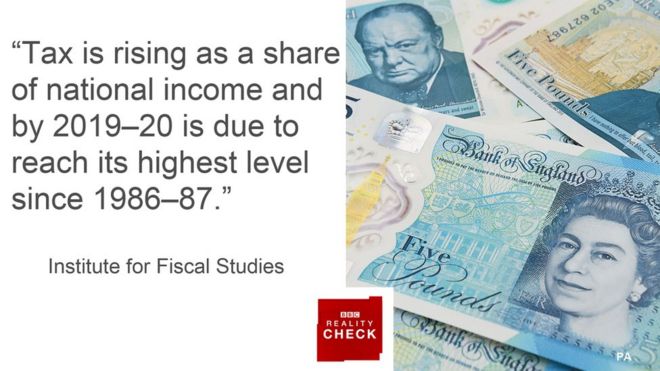
Quote from IFS: Tax is rising as a share of national income and by 2019-20 is due to reach its highest level since 1986-87.The claim: Taxes could rise to their highest level as a proportion of national income since 1986-87 by 2019-20.
Reality Check verdict: The Office for Budget Responsibility (OBR) forecasts suggest taxes could actually reach that level as soon as 2017-18. That may not happen if changes are made in this week's Budget and it is only a forecast, so unexpected events could prevent it happening.
The Institute for Fiscal Studies said in its Green Budget that tax is rising as a share of national income and by 2019-20 is due to reach its highest level since 1986-87.
It is important to stress that it is not saying taxes on all individuals or households are going up. The measure it is using is the government's total tax receipts (and the OBR's forecasts of those receipts) as a proportion of gross domestic product (GDP), which is the total amount of goods and services produced by the economy.
We will examine which taxes have been rising later, but it is true that the total take is expected to rise in the next few years to levels unseen since the mid-1980s.
It is in the next financial year, 2017-18, that the OBR expects the big jump in receipts to 36.9% of GDP, which take it above the peaks of 2011-12. Indeed it appears to be that year and not 2019-20 that first takes receipts to 1986-87 levels.
But it does not mean that everybody is paying more tax.
There have been gradual falls in revenue from income tax, for example, as the amount people have to be earning to pay it has been increasing.
The government said in the Autumn Statement that the increases in the basic rate threshold in the last parliament had meant four million of the lowest-paid people were not paying it at all.
Revenue raised by selected taxes
As a percentage of GDP
In addition to the taxes included on this chart are fuel duty, which has fallen gradually as successive governments have frozen it, and VAT, which got a boost when the government raised it from 17.5% to 20% at the start of 2011, but has been pretty constant since.
The category of tax that has been rising strikingly and is mainly responsible for the increase next year is "other".
That includes the new dividend tax regime, the increased insurance premium tax and a higher rate of stamp duty land tax for second homes.
But all of the forecasts for the coming years are from the OBR and are based on how things stood at the time of the Autumn Statement.
All this could change in Wednesday's Budget.

Thursday, March 16, 2017

BBC News - U-turn over Budget plan to increase National Insurance

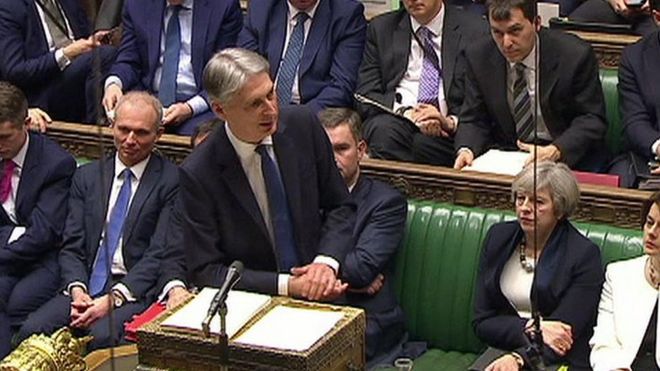
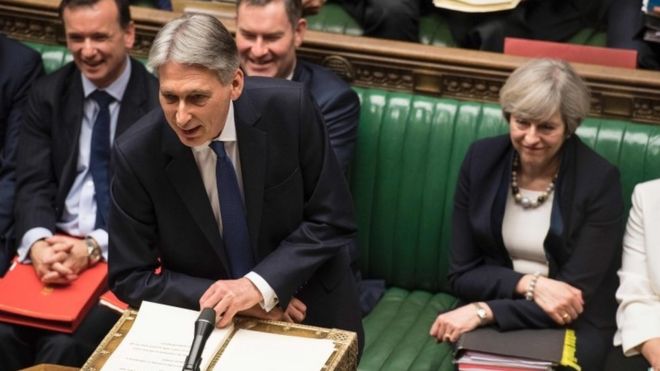
Chancellor Philip Hammond
Plans to increase National Insurance levels for self-employed people - announced in the Budget last week - have been dropped.
Chancellor Philip Hammond has said the government will not proceed with the increases which were criticised for breaking a 2015 manifesto pledge.
In a letter to Tory MPs, he said: "There will be no increases in... rates in this Parliament."
Labour's Jeremy Corbyn said the U-turn showed a government "in chaos".
Mr Hammond had faced a backlash by Conservative backbenchers, who accused him of breaking a general election manifesto commitment not to put up National Insurance, income tax or VAT.
In his letter explaining his change of heart, the chancellor said: "It is very important both to me and to the prime minister that we are compliant not just with the letter, but also the spirit of the commitments that were made.
"In the light of what has emerged as a clear view among colleagues and a significant section of the public, I have decided not to proceed with the Class 4 NIC measure set out in the Budget."

'Embarrassing U-turn'

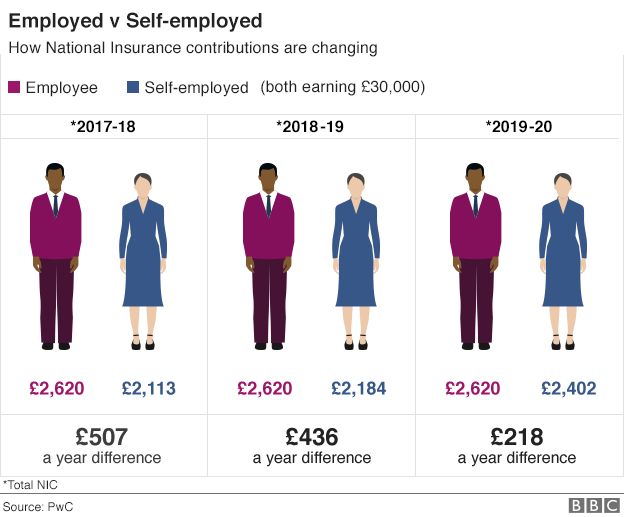
Mr Hammond's Budget announcement would have increased Class 4 NICs from 9% to 10% in April 2018, and to 11% in 2019, to bring it closer to the 12% currently paid by employees.
He said "most commentators" believed the "sharp increase" in self-employment over the last few years had in part been "driven by differences in tax treatment".
But during Prime Minister's Questions, Mr Corbyn said of the U-turn: "It seems to me like a government in a bit of chaos here - a Budget that unravelled in seven days."
He said the government should "apologise" for the stress the announcement had caused Britain's 4.8m self-employed.
In response Prime Minister Theresa May said that she would not take lessons from the Labour leader on many things, but on creating "chaos", she could.
The SNP's Westminster leader Angus Robertson accused ministers of a "screeching, embarrassing U-turn" - while Labour's shadow chancellor John McDonnell tweeted that the chancellor's authority had been "shredded".

Corbyn car crash?

Liberal Democrat leader Tim Farron, an advocate of Britain remaining in the EU, questioned whether the chancellor would "now U-turn on another broken election commitment to keep us in the single market".
Labour MP Louise Ellman said the government had been "very wise" in dropping the self-employed NICs hike now "rather than have it voted down".
"I would like to hear from the chancellor reassurances that the £2bn promised for social care that was going to come from these tax increases is not going to be withdrawn," she told the BBC.
BBC assistant political editor Norman Smith said the proposal suggested "a lack of political sophistication", with Mr Hammond not realising the storm his announcement would provoke.
He added he was surprised Mr Corbyn had not used all six of his questions at PMQs on what had been "a massive story - a huge, hulking U-turn" on a tax rise.
Alastair Campbell, Tony Blair's former director of communications, added: "Unless the Corbyn team actually planned for that to be a car crash, the inquest should be long, hard and honest. He just can't do it."
Mr Hammond is due to make a statement on the subject to MPs from about 13:45 GMT.

Wednesday, March 15, 2017

Bloomberg News - South African Banks on Offensive to Parry Political Attacks

South Africa’s banks have gone on the offensive after being criticized by some politicians over their lending practices and records in addressing racial inequality.
Attacks on the lenders have been led by President Jacob Zuma, who’s accused them of monopolizing the financial services industry, and questioned whether they colluded when closing accounts belonging to members of the wealthy Gupta family, who are his friends and are in business with his son. Parliament’s finance and trade and industry committees held hearings on racial transformation in the industry in Cape Town on Tuesday.
“The banking industry is not resistant to transformation,” Cas Coovadia, managing director of the Banking Association of South Africa, told lawmakers. “On access to financial services, we’ve made significant progress. We have training programs in place to fast-track junior and middle management. We must acknowledge the journey we have been through.”
The country’s financial system is becoming a battleground as Zuma seeks to drive a program of “radical economic transformation” that he says will move wealth to the majority black population in an economy still dominated by whites almost 23 years after apartheid ended. Criticism of the industry has intensified as the governing African National Congress prepares for a policy conference from June 30 to July 5.

Policy Debate

The banking association, which represents lenders including Standard Bank Group Ltd., Nedbank Group Ltd., FirstRand Ltd. and Barclays Africa Group Ltd., defended the industry’s record in extending services to black individuals and businesses.
While the proportion of people with access to a bank account has increased to 77 percent in 2016, from 44 percent in 2003, lenders still discriminated against the poor by refusing to provide financial services in certain areas because they are deemed too risky, Madoda Vilakazi, executive director of the National Economic and Development Council, said at the hearings.
“Class discrimination is on the rise,” he said. “Poor people are more likely to be poorly treated.”
The banking association said that between 2012 and 2015, banks made 94 billion rand ($7.1 billion) in financing available for affordable housing, 41 billion rand for small- and medium-sized black enterprises and 7 billion rand for black agricultural businesses. Total consumer credit at the end of September amounted to 1.67 trillion rand, of which 867.3 billion rand was tied up in mortgages, according to data from the National Credit Regulator.

New Financing

The industry intends making as much as 100 billion rand in additional financing available to support black-owned businesses over a period of about five years, said Thabo Tlaba-Mokoena, the bank association’s general manager for financial inclusion.
Banks have exceeded targets agreed with the government and labor unions to be 25 percent black-owned, 15 percent of which is directly held by black investors, the association said. Black people should own at least 50 percent of banks and insurers, said Floyd Shivambu, the deputy president of the opposition Economic Freedom Fighters.
“There isn’t significant black ownership of the financial-services sector,” he said. “We should legislate transformative targets.”
The Geneva-based World Economic Forum ranks South Africa’s banking system among the world’s best. The country has 37 licensed banks, which together hold about 4.8 trillion rand’s worth of assets. Foreigners hold about 49 percent of the shares in South Africa’s six biggest banks.

‘Meaningful Transformation’

“Meaningful transformation of the financial sector is not merely a question of ownership of financial firms,” Ismail Momoniat, a deputy director-general in the National Treasury, told lawmakers. “It’s much more than that. We need to look at how the sector supports real economic activity. Transformation must be mass-based and sustainable.”
While banks say they have done relatively well in diversifying their senior staff -- with an additional 22,800 black junior, middle and senior managers appointed between 2012 and 2015 -- they conceded that progress had been slow at a board and executive level, the association said. Of the five biggest lenders, which together control about 90 percent of the local banking market, only Standard Bank has a black co-chief executive officer, and he has a white counterpart, while the rest are all headed by whites.
“Some subsectors, like asset management, need to do far more to transform,” the Treasury’s Momoniat said, without elaborating.
The banking association’s Coovadia said a sound banking system was a crucial component of the economy and the industry intends countering its critics more proactively.
“We have been remiss in not introducing a narrative into the public space that actually begins to talk to real data and not to false data,” he told reporters on Monday. “You have got to ask whether there are certain interests that feel threatened by a well-regulated system.”
by Michael Cohen and Robert Brand
Tuesday, March 14, 2017

BBC News - Iceland to end capital controls from 2008 financial crisis

People bath in the 'Blue lagoon ' geothermal spa, one of the most visited attractions in Iceland
Iceland's economy has benefited from a tourism boom
Iceland will lift all capital controls on its citizens, businesses and pension funds from Tuesday.
Capital controls, such as those to restrict money flowing in and out of the country, were imposed in 2008 after the country's biggest banks collapsed.
The government thinks the economy has recovered sufficiently to end controls.
Controls were imposed after the collapse of the country's three biggest banks - Glitnir, Landsbanki and Kaupthing.
At the same time Iceland's national currency, the krona, fell in value.
The removal of the capital controls - which helped stabilise the currency and economy during the country's financial crash - represents the completion of Iceland's return to international financial markets.

Travel hotspot

Since the nation's financial collapse, the economy has seen a robust recovery, helped by a boom in tourism.
Last year around 1.8 million people visited the the nation, a 40% rise on 2015.
The UK accounted for 316,395 of last year's visitors, behind only US citizens in visitor numbers.
That tourism boom, coupled with strong investment by business and in the housing market, helped the economy grow 7.2% in 2016.
Central Bank of IcelandImage copyright
The decision has been made by the government and Central Bank of Iceland
"Iceland's careful, measured approach to lift capital controls was developed and approved with domestic and international support," said Benedikt Johannesson, minister of finance and economic affairs.
"As a result of this structured plan, our diversified economy is larger than ever before and expected to continue to grow at a robust pace this year."
Capital controls were implemented in 2008, with the support of the International Monetary Fund (IMF), to shield the economy from severe depreciation.
For the past year, the government and Central Bank of Iceland have been lifting controls through what they say has been an "incremental, measured process that focused on protecting the currency, addressing a balance of payments problem and tempering shocks to the Icelandic economy".
The country has also updated rules on foreign exchange and made special reserve requirements for new foreign currency inflows.

Monday, March 13, 2017

Reuters News - Washington state moves to block Trump's new travel ban in court

DAY 46 / MARCH 6: President Donald Trump signed a revised executive order banning citizens from six Muslim-majority nations from traveling to the United States but removing Iraq from the list, after his controversial first attempt was blocked in the courts.REUTERS/Kevin Lamarque
DAY 46 / MARCH 6: President Donald Trump signed a revised executive order banning citizens from six Muslim-majority nations from traveling to the United States but removing Iraq from the list, after his controversial first attempt was blocked in the courts. REUTERS/Kevin Lamarque
By Mica Rosenberg
Washington state on Monday moved to block President Donald Trump's revised travel ban, filing a new complaint in federal court and asking a judge to stop the executive order from going into effect on Thursday.
It was the latest legal move in a series of court challenges to a new travel order signed by Trump last week that temporarily blocks refugees and travelers from six Muslim-majority countries from entering the United States.
His order replaced a more sweeping ban issued on Jan. 27 that caused chaos and protests at airports due to its abrupt implementation.
The first order was halted by U.S. District Judge James Robart in Seattle after Washington state sued, claiming the order was discriminatory and violated the U.S. Constitution.
Trump revised his order to overcome some of the legal hurdles by including exemptions for legal permanent residents and existing visa holders and taking Iraq off the list of countries covered by the order. The new order still applies to citizens of Iran, Libya, Syria, Somalia, Sudan and Yemen but has explicit waivers for various categories of immigrants with ties to the United States.
Washington state went back to Robart to argue that the new ban is essentially the same as the first one and that the emergency halt, which was upheld by a federal appeals court, should still apply.
The second executive order reinstates "provisions of the First Executive Order already enjoined by the Court," Washington state said in court papers filed on Monday. The state requested a hearing in the case on Tuesday.
The Department of Justice said it was reviewing the filings and would respond to the court.

California's attorney general said on Monday that it would be joining Washington in its lawsuit; other states like Minnesota, New York and Oregon have also signed on to the challenge.
"The Trump Administration may have changed the text of the now-discredited Muslim travel ban, but they didn't change its unconstitutional intent and effect," California Attorney General Xavier Becerra said in a statement.
Separately, Hawaii has sued over the new ban as well.
In response to Hawaii's lawsuit, the Department of Justice in court papers filed on Monday said the president has broad authority to "restrict or suspend entry of any class of aliens when in the national interest." The Justice Department said the brief suspensions will allow the country to review its screening process in an effort to protect against terrorist attacks.
(Reporting by Mica Rosenberg in New York; Editing by Jonathan Oatis)

Friday, March 10, 2017

BBC News - Institute for Fiscal Studies backs National Insurance increase

Philip Hammond at the dispatch box
The chancellor was right to raise National Insurance for the self employed in his Budget, the Institute for Fiscal Studies (IFS) said


And the independent think tank's director, Paul Johnson, said further rises were needed, calling Wednesday's announcement "baby steps".
Philip Hammond's move has been heavily criticised, but Mr Johnson said the current system needed reform.
"It distorts decisions, creates complexity and is unfair," he said.
"A tax system which charges thousands of pounds more in tax for employees doing the same job as someone else needs reform," he added.
The NI rise will see millions of self-employed workers pay an average of £240 a year more, but ministers say those earning £16,250 or less will see their NI contributions fall.

'Bung in the dyke'

The IFS traditionally dissects the government's tax and spending plans the day after the Budget, and its verdict is seen as one of the most authoritative comments.
Mr Johnson said: "These [NI changes] feel like like baby steps in the right direction.
"But they are sticking plasters not the fundamental look at the tax base as well as tax rates that is required."
NIC changes
He added that as more workers became self-employed and "incorporated" by starting up their own companies, it would reduce tax revenues for the government.
"[The Chancellor] has put a bung in the dyke as the water floods through. Ten years down the road the move to self employment and incorporation will create a serious erosion of the tax base.
"If he were to do a U-turn and give up on reform, I would be seriously worried," he said.
Mr Johnson added that the old National Insurance system also distorted the labour market, adding that there were huge incentives for companies to claim that people who work for them were self employed, rather than employees.

Wrong message

But Mr Hammond is facing a backlash against the Budget announcement, which breaks a 2015 manifesto pledge on tax rises.
Some Conservative MPs openly criticised Wednesday's announcement.
Stephen McPartland, MP, described the measure as "unacceptable", saying it sent out the wrong message to ordinary working families. He appealed to the chancellor to make a "U-turn" quickly before a manifesto promise was broken.
Former leader Iain Duncan-Smith said the move should be kept "under review".
And Labour's shadow chancellor, John McDonnell, said his party could even join forces with rebel Conservatives who say the increase does little to encourage enterprise and risk-taking.
The IFS said the chancellor's 2% increase in NICs for the self employed closed a small fraction of the gap between employees and the self employed.
It said the maximum loss, affecting those with profits over £45,000, would be £589 per year and that the tax advantage to being self employed would still run into thousands of pounds.

'Silly pledges'

The IFS was less happy about a Budget announcement that the £5,000 tax free dividend allowance, which was introduced less than a year ago, would be cut to £2,000.
That will mean a basic rate tax payer who receives more than £5,000 in dividends will have to pay an extra £225 tax. A higher rate tax payer will pay £975.
Many small traders and individuals set up businesses by forming a company and paying themselves through dividends as well as a salary.
The announcement comes less than a year after the last Chancellor George Osborne introduced the £5,000 tax free dividend allowance.
Mr Johnson said that to change this so quickly does not look like "coherent policy making".
He said it was never sensible to pledge no change to taxes: "These were silly pledges. To commit yourself to not raising the three main taxes - income tax, NI and VAT - ties your hands to an absurd extent. No party should repeat these sorts of promises."