Wednesday, March 22, 2017

Bloomberg News - Asia Stocks Set to Follow U.S. Selloff; Bonds Gain

Asian equities futures pointed toward losses after U.S. stocks fell the most since Donald Trump’s election as reflation trades that bolstered the dollar and Treasury yields faltered.

Futures on benchmark gauges in Japan, Australia and Hong Kong indicated declines of at least 0.8 percent when trading begins. The S&P 500 Index sank more than 1 percent for the first time since Oct. 11, with the selloff deepening in the final 30 minutes of trading after Reuters reported North Korea would pursue an acceleration in its nuclear program. Treasury yields tumbled and the dollar slumped for a fifth straight day. Oil retreated and gold held gains.

Financial shares sank and volatility soared amid the biggest drop for U.S. stocks since the November election as concern grew that pro-growth policies won’t sail through Congress. Trump met with House Republicans Tuesday morning to rally support for the repeal of Obamacare as investors look for signs that his plans to cut corporate taxes and boost spending will move forward. House Republicans warned failure to pass a health-care bill on Thursday could imperil tax and spending reforms.
North Korea will seek to accelerate its nuclear and missile programs, including developing "preemptive first-strike capability" and an ICBM, Reuters reported, citing the nation’s deputy ambassador to the UN. For its part, the U.S. is exploring a new range of diplomatic, economic and security measures, Trump’s spokesman Sean Spicer said.
What’s coming up the rest of this week:
  • There’s a steady lineup of U.S. Fed speakers this week, headlined by Janet Yellen on March 23, while central bank policy decisions are expected in New Zealand, the Philippines and Sri Lanka.
  • Earnings are due in Asia Wednesday from companies including Tencent Holdings Ltd.
  • The House of Representatives votes Thursday on the repeal of the Affordable Care Act.
  • March PMI for France is due Friday, along with final fourth-quarter GDP figures.
Here are the main moves in markets:
Stocks
  • Futures on the Nikkei 225 Stock Average were down 1.6 percent in Singapore, signaling a third day of losses for Japanese stocks. Contracts on Australia’s S&P/ASX 200 fell 0.8 percent. New Zealand’s S&P/NZX 50 dropped 0.5 percent.
  • Futures on the Hang Seng Index were off 0.8 percent, while those for a measure of Chinese shares traded in Hong Kong were down 1 percent. China’s central bank injected hundreds of billions of yuan into the financial system after some smaller lenders failed to make debt payments in the interbank market, according to people familiar with the matter.
  • The S&P 500 fell 1.2 percent, the biggest drop since Oct. 11. The index hadn’t fallen 1 percent in any session for 109 straight days. Banks sank 2.9 percent for the steepest slide since June 24, the day after the U.K. vote to leave the European Union. The Stoxx Europe 600 Index fell 0.5 percent.
  • Currencies
    • The Bloomberg Dollar Spot Index slipped by 0.3 percent.
    • The euro was steady after jumping 0.7 percent on Tuesday, rising versus all of its G-10 peers except sterling. The British pound traded 1 percent higher on Tuesday after U.K. inflation accelerated more than forecast to break through the Bank of England’s target for the first time since 2013.
    • The yen was little changed at 111.78 per dollar, after six straight days of gains.
    Bonds
    • The yield on 10-year Treasury notes fell four basis points to 2.42 percent. The rate is down 12 basis points in the past three sessions.
    • Australian 10-year yields dropped four basis points to 2.77 percent.
    Commodities
    • West Texas Intermediate oil held losses after dropping 1.8 percent to $48.24 a barrel on Tuesday.
    • Copper slumped 1.8 percent amid signs supplies are returning. Disruptions caused the metal to surge last month to the highest level since 2015. 
    • Gold was steady after five days of gains.

Tuesday, March 21, 2017

BBC News - UK inflation rate leaps to 2.3%

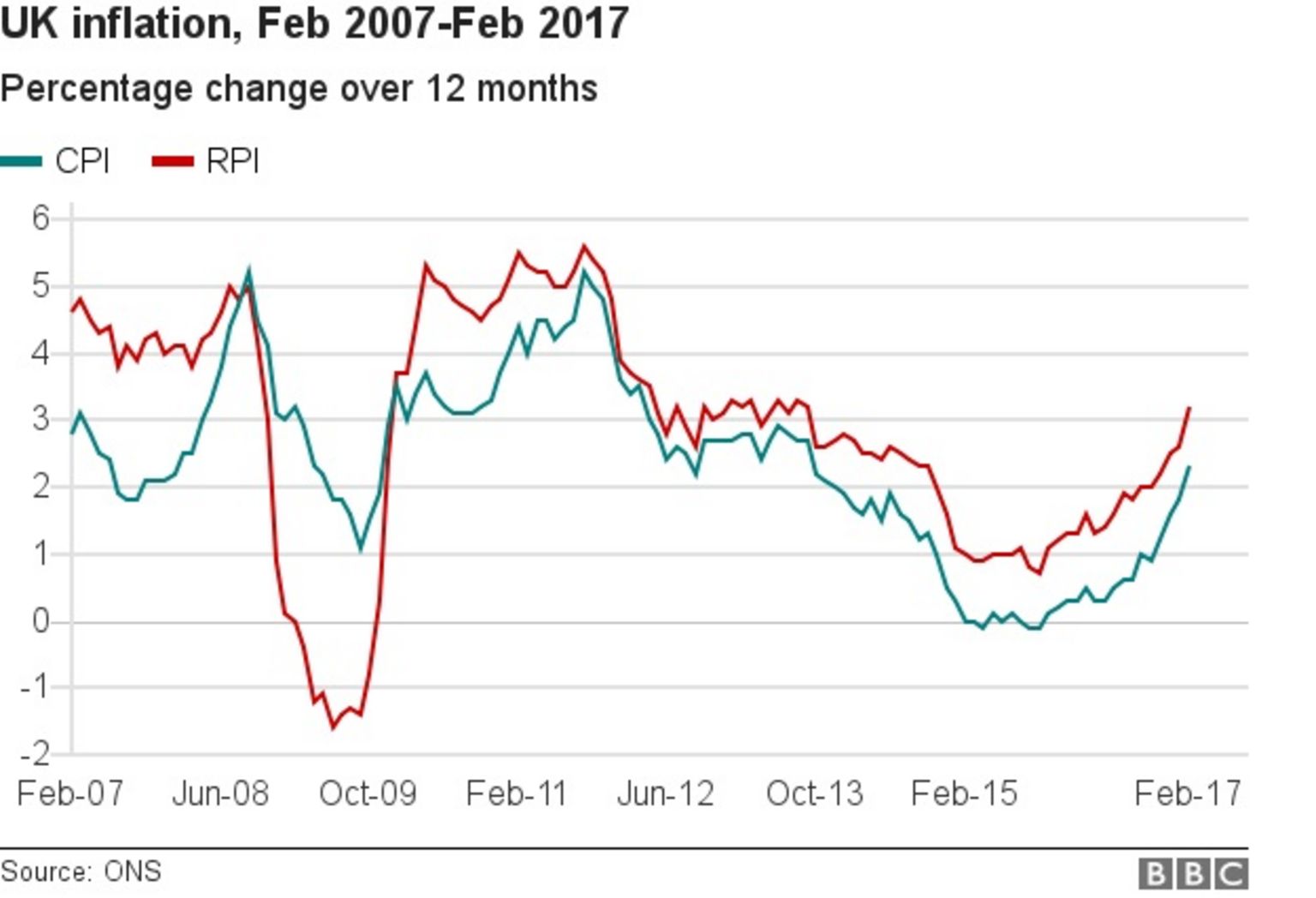
Inflation chart
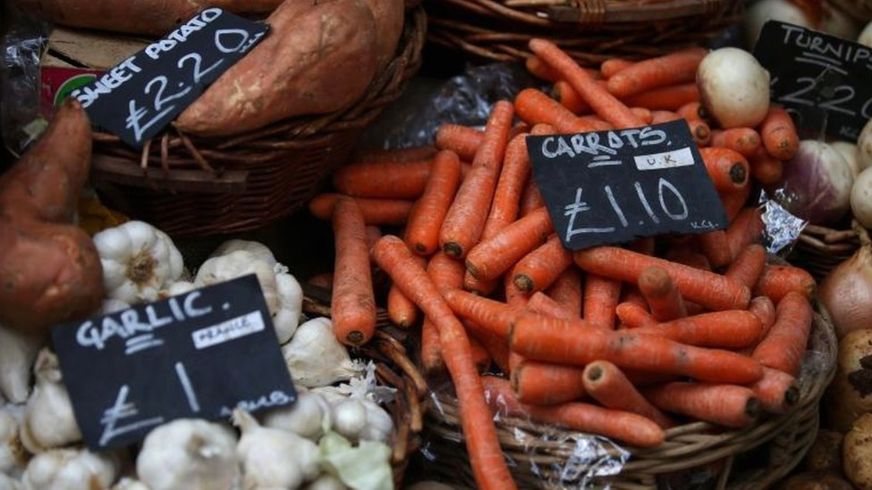
Rising fuel and food prices helped to push last month's inflation rate to the highest since September 2013.
Inflation as measured by the Office for National Statistics' Consumer Prices Index (CPI) jumped to 2.3% in February - up from 1.8% in January.
The increase has pushed the rate above the Bank of England's 2% target.
Food prices recorded their first annual increase for more than two-and-a-half years, standing 0.3% higher in February than a year earlier.
The Bank of England has said it expects inflation will peak at 2.8% next year, although some economists think the rate could rise above 3%.
Analysis: Jonty Bloom, business correspondent
Street market
"DON'T PANIC" are the words that will be written across the Bank of England's next inflation report, in large friendly letters. Well, maybe not, but the Bank's governor, Mark Carney, said pretty much the same when he was quizzed over today's jump in inflation. Actually, what he said was, "Look - single data point, you never overreact to a single data point," but then he is a central banker and not the author of the Hitchhiker's Guide to the Galaxy.
It does, however, amount to much the same thing. The Bank of England is not going to be panicked into increasing interest rates to try to control price rises just because of one month's figures. But that doesn't mean they aren't important.
They show fuel and food prices are rising, a situation not helped by the fall in the value of the pound, which makes imports more expensive. Prices at the factory gate are also rising quickly, suggesting more inflation is on the way to the High Street. And at 2.3%, inflation is increasing at the same rate as average earnings, meaning the average pay rise is being totally eaten up by increasing prices, not likely to make any of us feel better off.

The Brexit vote last June prompted a steep fall in the value of the pound, making imported goods more expensive.
Ben Brettell, senior economist at Hargreaves Lansdown, said the fall in the pound against the dollar had been pushing transport costs higher since last summer.
"Oil is priced in dollars, and sterling has fallen around 13%... since last June's referendum."
He said that transport costs accounted for more than a third of the inflation figure.

Consumer squeeze?

This month, the ONS has started to promote its preferred inflation statistic, CPIH, which includes a measure of housing costs and council tax. This was also measured as growing at a rate of 2.3% in February.
The Retail Prices Index (RPI) measure of inflation rose to 3.2% in February from 2.6% the month before.
At the last week's meeting of the Bank of England's interest rate setting committee, one member voted for interest rates to rise to curb the threat of inflation.
But despite inflation standing above the 2% target, some economists do not expect interest rates to rise any time soon.
Inflation is now running at the same rate as growth in wages, putting pressure on household income and spending.
Chris Williamson, chief business economist at Markit, said: "It remains likely that policymakers will adopt an increasingly dovish tone in coming months, despite the rise in inflation, as the economy slows due to consumers being squeezed by low pay and rising prices."

Analysis: Kevin Peachey, personal finance reporter
The latest inflation figures show that the squeeze on savers just got a little tighter.
Returns are creeping up - but only one of 793 openly available savings accounts matches or beats inflation, according to financial information service Moneyfacts.
That one requires savings to be locked in for some time.
The government's help for savers is a "market-leading" bond, available from NS&I from April. Even that three-year deal is now outstripped by inflation and the picture could worsen if the inflation rate keeps rising.
Wages had grown faster than prices for a while. For those who put some of that money aside, the reward may now not match the endeavour.

Friday, March 17, 2017

BBC News - Reality Check: Are taxes going up to 1986 levels?

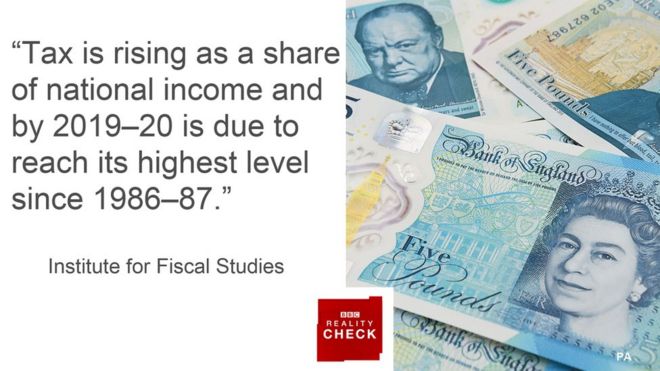
Quote from IFS: Tax is rising as a share of national income and by 2019-20 is due to reach its highest level since 1986-87.The claim: Taxes could rise to their highest level as a proportion of national income since 1986-87 by 2019-20.
Reality Check verdict: The Office for Budget Responsibility (OBR) forecasts suggest taxes could actually reach that level as soon as 2017-18. That may not happen if changes are made in this week's Budget and it is only a forecast, so unexpected events could prevent it happening.
The Institute for Fiscal Studies said in its Green Budget that tax is rising as a share of national income and by 2019-20 is due to reach its highest level since 1986-87.
It is important to stress that it is not saying taxes on all individuals or households are going up. The measure it is using is the government's total tax receipts (and the OBR's forecasts of those receipts) as a proportion of gross domestic product (GDP), which is the total amount of goods and services produced by the economy.
We will examine which taxes have been rising later, but it is true that the total take is expected to rise in the next few years to levels unseen since the mid-1980s.
It is in the next financial year, 2017-18, that the OBR expects the big jump in receipts to 36.9% of GDP, which take it above the peaks of 2011-12. Indeed it appears to be that year and not 2019-20 that first takes receipts to 1986-87 levels.
But it does not mean that everybody is paying more tax.
There have been gradual falls in revenue from income tax, for example, as the amount people have to be earning to pay it has been increasing.
The government said in the Autumn Statement that the increases in the basic rate threshold in the last parliament had meant four million of the lowest-paid people were not paying it at all.
Revenue raised by selected taxes
As a percentage of GDP
In addition to the taxes included on this chart are fuel duty, which has fallen gradually as successive governments have frozen it, and VAT, which got a boost when the government raised it from 17.5% to 20% at the start of 2011, but has been pretty constant since.
The category of tax that has been rising strikingly and is mainly responsible for the increase next year is "other".
That includes the new dividend tax regime, the increased insurance premium tax and a higher rate of stamp duty land tax for second homes.
But all of the forecasts for the coming years are from the OBR and are based on how things stood at the time of the Autumn Statement.
All this could change in Wednesday's Budget.