Wednesday, June 21, 2017

BBC News - Philip Hammond on Brexit: Prioritise jobs and living standards

Hammond
Jobs and living standards must come first as the UK negotiates its exit from the EU, Philip Hammond has said.
The chancellor said it would require "every ounce of skill and diplomacy" to get the right deal, warning that people didn't vote for Brexit to be poorer.
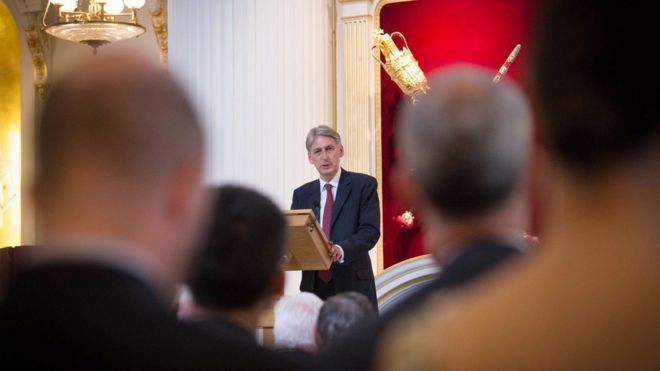
Speaking in London, he said changes to customs arrangements should be phased in and there should be transitional measures to protect key industries.
Labour said the chancellor was seeking to "distance himself" from Theresa May.
Mr Hammond's speech came as ministers deny the UK had caved in over the timetable for Brexit talks.
As the process began on Monday, the EU's chief negotiator Michel Barnier said the two sides had agreed to discuss the details of the UK's exit - such as the rights of citizens and any so-called "divorce bill" - before moving on to the UK's post-Brexit relationship with the EU.
The UK has always maintained that the two issues go hand in hand and should be dealt with simultaneously.
In his first major speech since the Conservatives failed to win a majority in the general election, Mr Hammond set out his priorities for the Brexit negotiations, placing the needs of the UK economy and businesses front and centre.
While the talks had got off to a promising start, he warned they would get "tougher" and the remaining 27 EU members would have their own agenda.
"The future of our economy is inextricably linked to the kind of Brexit deal we reach with the EU over the next 20 months," he told an audience of City leaders at the Mansion House.

By Economics Editor Kamal Ahmed

Philip Hammond said that no-one voted for Brexit to become poorer.
He also made it clear that he wants to put the economy at the heart of the Brexit negotiations. Rather than sovereignty or controlling immigration, which are the issues likely to motivate other colleagues in the Cabinet and certainly in the Conservative Party.
The tensions are clear. The chancellor - strengthened since the general election - gave the greatest detail yet about what his approach might mean for our future relationship with the EU. Yes, as he said at the weekend, the UK will be leaving the customs union.
But he made the case for a new form of customs agreement with "current border arrangements" - which presumably means agreeing to some form of EU oversight for some years following Britain's exit from the union. Read more

He added: "I am confident we can do a Brexit deal which puts jobs and prosperity first, that reassures employers that they will still be able to access the talent they need, that keeps our market for goods, services and capital open, achieves early agreement on transitional arrangements so trade can carry on flowing smoothly.
"The collective sigh of relief would be audible. The benefit to our economy would be huge."
Mr Hammond said every sector of the British economy, whether it be the car industry, pharmaceuticals or financial services, were dependent on a "smooth" transition to a post-Brexit world that was underpinned by a "comprehensive" free trade agreement in goods and services.
A deal "that protects jobs, prosperity and living standards in Britain will require every ounce of skill and diplomacy we can muster", he said, claiming that any alternative outcome would not be "delivering on the instructions" given by the public when they voted Leave in last year's referendum.

Border checks

Mr Hammond said the UK still planned to leave the single market and customs union despite calls for a rethink from business after the inconclusive election result. But he said border checks - particularly in Ireland - must remain as "frictionless as possible" as the UK moved to a different system.
"To do this in the context of our wider objectives will be challenging... It will almost certainly need an implementation period, outside the customs union itself but with current customs border arrangements remaining in place until new long-term arrangements are up and running."
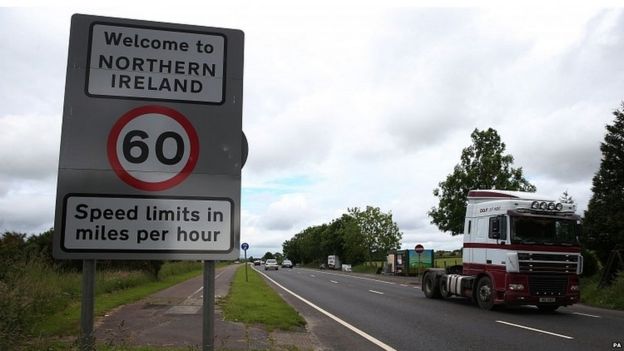
Border between Northern Ireland and the Republic of Ireland
The Irish land border is a major pre-occupation of the Brexit talks
Leaving the EU, he added, could not be to the detriment of investment, enterprise or increased productivity - which he said held the key to the UK's future economic growth and the government's ability to pay for increased funding for public services at a time of growing "weariness" over austerity.
"I thought we had won that argument. But I learnt in the general election that we had not. That we must make anew the case for a market economy and for sound money, the case for growth, we need to explain again how stronger growth must be delivered."
Barry Gardiner, the shadow secretary of state for international trade, said Mr Hammond had "swallowed Labour's playbook" by backing a "jobs-first Brexit, fair and managed migration and no deal being a bad deal".
"He has adopted the very wording," he told the BBC's Daily Politics.
Conservative MP Stephen Hammond told BBC Radio 4's The World at One there was a "changed dynamic" around Brexit since the general election, saying voters accepted the UK was leaving the EU but wanted to ensure the economy was protected.
His fellow Tory MP Iain Duncan Smith, a leading voice in the campaign to leave the EU, said the chancellor's speech was "fine", with little he disagreed with.
He agreed a short period of "interim measures" would be needed.
Speaking earlier on Tuesday, Transport Secretary Chris Grayling denied the UK had effectively conceded to the EU's timetable for talks - which will see discussions on a future trade deal come after those on the terms of exit.
"We've agreed to talk about the rights of EU citizens, which we've been saying all along was a top priority for us; something to deal with right at the start," he told BBC Radio 4's Today.
"We are also talking about the issue of the Irish border; that's a real priority for us. So as far as we're concerned we are dealing with things that are absolutely at the top of our list right now, and that people will expect to be on the top of our list."

Tuesday, June 20, 2017

Bloomberg News - The President Who Caused a Recession

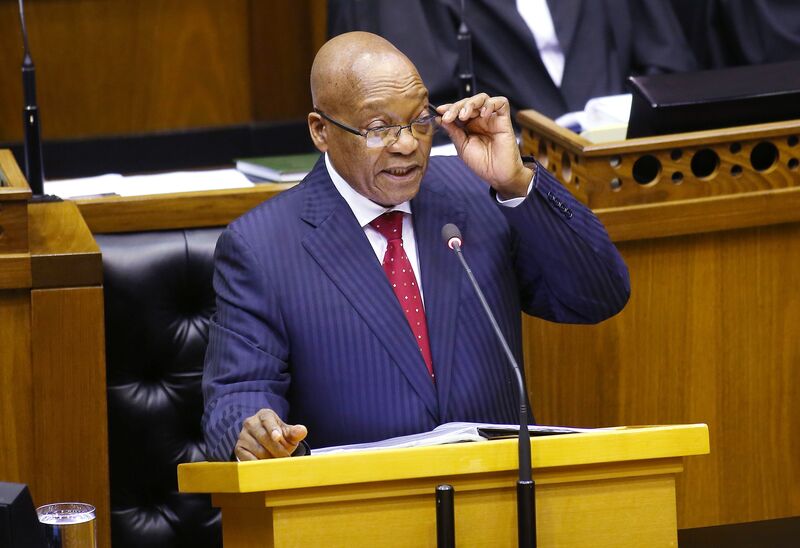
Jacob Zuma’s erratic political moves are breeding policy uncertainty and reluctance to invest, helping explain why the economy of the continent’s most industrialized nation contracted for a second straight quarter in the three months through March. Finance, real estate and business services shrank for the first time since the second quarter of 2009.
Business confidence has yet to recover after falling to a more than three-decade low in September and the rand has been the world’s most volatile currency in the past year. All the while, Zuma was waging a battle with Finance Minister Pravin Gordhan over how to manage the economy—until he fired him.
Companies across industries say the political and economic instability is cutting sales, hurting profit forecasts and even inducing consumers to gamble less.
“There is no other factor to explain the recession,” said Iraj Abedian, chief executive officer at Pan-African Investments and Research Services in Johannesburg. “The only factor is the political shenanigans, policy uncertainty and the lack of leadership, which has hollowed out confidence both in the consumer and the investment community.”
Gordhan, who had been driving efforts to trim the budget deficit, improve state firms’ performance and ward off junk credit ratings, was canned in a March 31 cabinet shuffle, prompting two ratings downgrades to non-investment levels within a week and nationwide demonstrations.
Pioneer Food Group Ltd. said it ended talks about a potential transaction because of the downgrades. Since April last year, companies including Old Mutual Plc, the continent’s largest insurer and which has a 173-year history in South Africa, packaging maker Nampak Ltd. and retailers including clothing and home furnishings specialist The Foschini Group Ltd. and Dis-Chem Pharmacies Ltd., have warned that the political situation is clouding economic prospects.
“There’s been a massive loss of confidence,” Graham O’Connor, the CEO of Spar Group Ltd., a food and liquor retailer with more than 2,000 outlets in southern Africa, said by phone. “All of us are disappointed by the firing of Gordhan, and the cabinet reshuffle just breeds uncertainty and that’s not what we want.”
Zuma spokesman Bongani Ngqulunga said that while other countries too have been struggling for growth and recovery from the financial crisis, there's little room for fiscal and monetary policy to support growth. South Africa's focus is structural reform, he said.
Reforms usually challenge the status quo and are necessary to change the structure of the economy,” he said in a text message. “There is very little doubt that once the reforms process is complete our economy will be set on a higher growth trajectory.
Companies were less optimistic. The “volatile socio-political outlook” will create more difficult trading conditions, and, because many government departments and state-owned enterprises are in flux, “the finalizing and closing of contracts is challenging,” Bidvest Group Ltd., which employs 114,000 people across its automotive, services and freight businesses, said June 8.
Signs of improvement in the economy were “washed away” by March’s political events, Massmart Ltd., the retailer controlled by Wal-Mart Stores Inc., said March 25, noting the “unfavorable impact on sales” of discretionary products.
Nedbank Ltd., a lender controlled by Old Mutual, plans to reduce its full-year earnings forecasts, citing slower-than-expected revenue growth in the first quarter caused by the weak socio-political and macroeconomic environment, it said.
People are so discouraged they’re even cutting back on wagering, said Marcel von Aulock, CEO of Tsogo Sun Ltd., the continent’s biggest gaming and hotel company and owner of  the Montecasino and Gold Reef City entertainment complexes in Johannesburg.
“April was very tough,” Von Aulock said by phone, adding that the biggest impact was at casinos, where fewer people came to gamble. “We put a lot of that down to a change in sentiment in the South African economy—everyone in South Africa got miserable.”
Fewer of them had jobs, too: Unemployment rose to a 14-year high of 27.7 percent in the first quarter. South Africa’s growth slowed to 0.3 percent last year, the lowest rate since 2009, after low commodity prices, the effects of the 2015 drought and weak demand for locally made goods weighed on output.
The country is likely to miss its 1.3 percent growth target this year and may have to curb spending to stick to its budget framework, Finance Minister Malusi Gigaba said June 15. This despite growth in agriculture, which is improving as the country recovers from the 2015 drought. Commodities, the nation's biggest export, are seeing rising prices, but neither was enough to prevent the downturn. 
Zuma, who’s due to step down as leader of the ruling African National Congress in December and whose term as the nation’s president ends in 2019, has survived a series of corruption scandals and presided over the party’s worst electoral performance since the end of apartheid in 1994 in municipal elections in August.
In November, the graft ombudsman implicated Zuma in unethical conduct in a 355-page report about how the Gupta brothers, who are his friends and are in business with his sons, influenced his cabinet appointments and contracts at state companies such as power utility Eskom Holdings SOC Ltd.
Zuma, who has defeated numerous efforts to get him to step down, now is facing a no-confidence motion called by opposition parties in parliament. The United Democratic Movement has asked the Constitutional Court to order a secret ballot, which it hopes will enable lawmakers for Zuma’s ANC, who occupy 62 percent of the 400 seats in the National Assembly, to vote against the president without fear of losing their jobs.
“Zuma being replaced sooner rather than later will certainly help rebuild the confidence needed to turn the economy into a positive direction,” Ivor Sarakinsky, a senior lecturer at the University of the Witwatersrand’s School of Governance in Johannesburg, said by phone June 13. “Investors just aren’t going to bring in money in under this kind of uncertainty.”
—With assistance from Aarti Bhana, John Bowker and Simbarashe Gumbo.

Monday, June 19, 2017

BBC News - Business bodies come together in call for softer Brexit

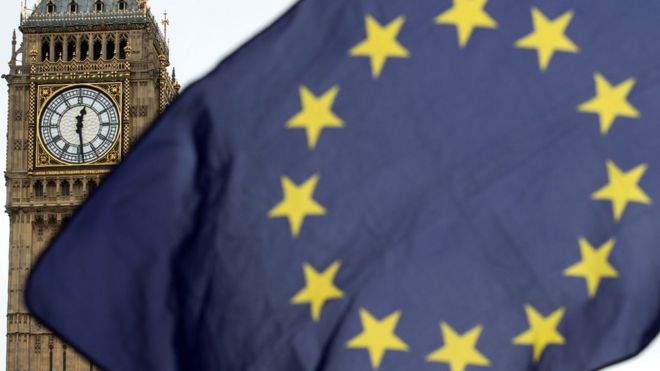
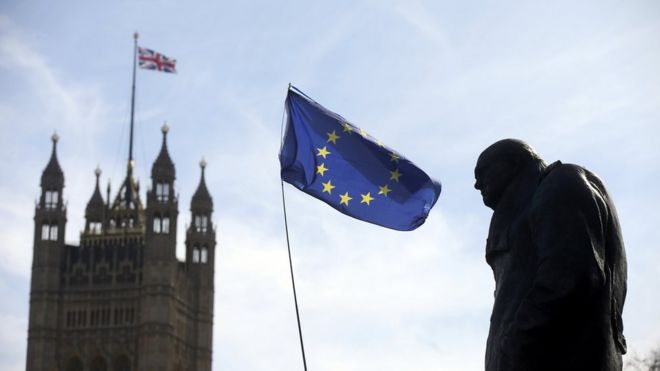
Europe flag outside parliament
Five major UK business bodies have come together to call for continued access to the European single market until a final Brexit deal is made with the EU.
In a letter to Business Secretary Greg Clark, they also ask the government to "put the economy first".
The letter is from the British Chambers of Commerce, Confederation of British Industry, EEF, Federation of Small Businesses and Institute of Directors.
Formal Brexit negotiations between the EU and the UK begin on Monday.

'Flexible'

The signatories say the "economic benefits" of the European Union single market, which allows free movement of goods, services, capital and people, and the customs union, which enables tariff-free trading within the EU, should be maintained until a final settlement between the UK and the EU is "agreed and implemented".
They have also called for a final trade deal that will allow tariff-free goods to be traded between the UK and the EU.
In addition, they want that deal to include "minimal customs formalities", mutual recognition of standards and regulation, and a "flexible system" for the movement of labour and skills.
"We have come together to urge the government to put the economy first as it prepares to start formal negotiations," says the letter to Mr Clark.
"This is a deal that when finally agreed will matter fundamentally for the UK economy, for UK companies and for citizens of the UK."
Monday's talks between Brexit Secretary David Davis and EU negotiator Michel Barnier follow preliminary negotiations in Brussels between officials.

Friday, June 16, 2017

Bloomberg News - Two Huge Diamonds Unearthed in Lesotho Mine

Thursday, June 15, 2017

BBC News - UK election result 'may delay Brexit talks'

The UK general election result could delay Brexit talks and be negative for the economy, credit ratings agencies Moody's and S&P have warned.
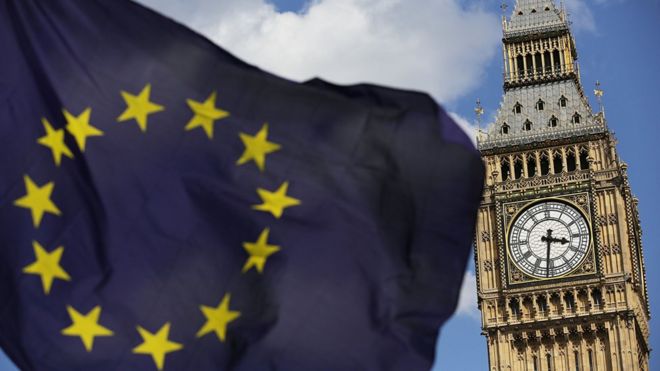
EU flag and Big Ben
The Brexit negotiations with the EU were due to start on 19 June but Moody's said the fact that the Conservatives had lost their majority would delay the start of the talks.
It will "complicate and probably delay Brexit negotiations", it warned.
Moody's said the election result could put pressure on the public finances.
The "inconclusive" outcome of the general election may mean the government placed less priority on cutting the budget deficit, the agency said.
This would be negative for the UK's credit rating and make it more expensive for the country to borrow money.
As a result, Moody's said it expected fiscal risks to increase because in its view the budget deficit will increase both this year and next.
"The election outcome, with significant gains for the Labour Party, which had campaigned for increased public spending, will likely be seen as a 'vote against austerity', it added.
"The public debt ratio will rise further and for longer than we had expected, placing the UK among the few highly rated European sovereigns whose public debt is still rising."
However, Moody's said the election result suggested an "electoral shift" away from the "hard Brexit" that Prime Minister Theresa May had ostensibly sought.
As a result, Moody's said the government may now consider "softer" Brexit options, which would be positive for the country's credit rating.
Earlier, Brexit Secretary David Davis told Sky News that negotiations on leaving the EU would begin next week. but not necessarily on 19 June.
"My permanent secretary is actually in Brussels today talking to them about the details," he said.
"It may not be on the Monday because we also have got the Queen's Speech that week and I will have to speak in that, and so on."

'Another snap election'

Meanwhile, S&P Global Ratings released a note saying the outcome of the snap election and the hung parliament should have no immediate impact on the UK's rating.
"Our ratings on the UK already take into account a less predictable policy framework following the vote to leave the EU in June 2016," it said.
It also said it believed the lack of an overall majority for any one part was likely to delay Brexit negotiations. "We do not exclude the possibility of another snap election."
Separately, S&P economist Jean-Michel Six said: "In terms of the [UK's] outlook for growth, it's clear that things are not going in the right direction."
"This latest bit of instability can only weaken the business environment and consumer confidence," he said.
S&P said the UK's outlook remained negative.
Moody's rates the UK as Aa1 negative - one notch above the other two big agencies, S&P and Fitch.

Wednesday, June 14, 2017

Reuters News - U.S. lawmakers to probe Tillerson on Russia, diplomacy budget cuts

U.S. Secretary of State Rex Tillerson stands at a press conference at the Australia-United States Ministerial Consultations (AUSMIN) at Government House in Sydney, Australia, June 5, 2017.   REUTERS/Jason Reed
U.S. Secretary of State Rex Tillerson stands at a press conference at the Australia-United States Ministerial Consultations (AUSMIN) at Government House in Sydney, Australia, June 5, 2017. REUTERS/Jason Reed
U.S. lawmakers will grill Secretary of State Rex Tillerson about President Donald Trump's unpopular budget, conflicting messages about foreign affairs and links between the administration and Russia, including his own ties, at congressional hearings starting on Tuesday.
The four hearings this week are a rare chance for members of the Senate and House of Representatives to question Tillerson, who has not testified publicly on Capitol Hill since his acrimonious confirmation hearing in January.
That hearing was dominated by Russia, as both Republicans and Democrats worried that the former Exxon Mobil executive, who had deep ties with Moscow, would be too soft on a country often at odds with the United States.
Forty-three members of the Democratic caucus voted against Tillerson's confirmation. It was the biggest "no" vote for a State nominee in decades.
Several senators planned to question Tillerson even more closely about his view of relations with Moscow. The Senate could vote on new sanctions on Russia as soon as this week.
"I haven't heard much from Mr. Tillerson, and what I've heard from him hasn't satisfied my concerns," Senator Ben Cardin, the top Democrat on the Senate Foreign Relations Committee, told reporters.
Tillerson testifies before Foreign Relations and a Senate Appropriations subcommittee on Tuesday, then before House Foreign Affairs and appropriations panels on Wednesday.
Lawmakers want to know where the administration stands after Trump seemed to side with Saudi Arabia and its allies in a dispute with Qatar, contradicting Tillerson, who sought to ease differences between the U.S. partners.
"The entire world has no idea where we stand with respect to the dispute between the GCC (Gulf Cooperation Council) and Qatar," said Democratic Senator Chris Murphy, a foreign relations committee member.

Lawmakers also promised close questioning about Trump's budget proposal, which features sharp cuts in spending on diplomacy and foreign aid, and big increases in military spending, a proposal several members of Congress dismissed as "dead on arrival."
Senator Lindsey Graham, the Republican chairman of the subcommittee that oversees the State Department budget, said he would argue against that proposal when Tillerson testifies to his panel on Tuesday afternoon.
"I'm going to make an argument that soft power is very important in winning the war against terrorism, it's important for our national security. When you look at the hard/soft power mix of this budget, it's way off kilter," Graham told reporters.
Separately, 16 retired four-star generals and other ex-military officers said they would submit joint testimony to the Senate on Wednesday about the importance of foreign aid to national security.
(Additional reporting by Amanda Becker; editing by Yara Bayoumy and Mary Milliken)

Tuesday, June 13, 2017

BBC News - Manufacturers call for Brexit strategy rethink

Big Ben, EU flag and Winston Churchill
The government should rethink its Brexit strategy, following last week's election, according to the engineering industry organisation, the EEF.
It said without a more pro-business stance, the resulting political instability may force more firms to alter their plans "away from the UK".
The EEF is the latest business organisation to call for a rethink of the government's Brexit plans.
It wants access to the single market to be at the heart of Brexit negotiations.
The EEF said even before the election firms were already altering or thinking about changing their business plans because of the Brexit vote.
Terry Scuoler, EEF chief executive, said the government had already "wasted a year" and needed to "move away from its previous rhetoric and start repairing relations with EU partners".
For the EEF that meant putting access to the single market and staying in a customs union at the centre of the government's negotiations and involving business groups in the talks over trade.
It is also calling for a "suitable" transition period to be "firmly back on the table" as part of the Brexit talks.
On Monday Carolyn Fairbairn, director-general of the CBI, called for the government to "reset" Brexit negotiations, which are due to start next week.
Meanwhile, the uncertainty caused by the general election has led business confidence to sink "through the floor", according to the Institute of Directors.
A snap poll of 700 members of the lobby group found a "dramatic drop" in confidence following the hung parliament.
The main priority for the new government should be striking a new trade deal with the European Union, according to the IoD.
Business groups such as the CBI and EEF believe the election result has weakened the hand of those wanting a "hard Brexit", which would involve leaving not just the EU but also the single market, customs union and escaping the jurisdiction of the European Court of Justice.
They favour a deal that would give British business much the same access to the rest of the EU as they enjoy now and seem to be freshly emboldened to press their case.