Monday, July 10, 2017

BBC News - Shoppers 'in the dark' about Brexit effect

UK shoppers are "completely in the dark" about the effect Brexit will have on their weekly shop, a former Sainsbury's boss has told BBC Panorama.
Justin King, who ran the supermarket for a decade, said the "last thing" any current supermarket boss would reveal was their intention to put up prices.
But he added it was "very clear" shoppers would face "higher prices, less choice and poorer quality".
The main supermarkets declined to speak to BBC Panorama.
Mr King, who ran Sainsbury's until 2014, said: "Brexit, almost in whatever version it is, will introduce barriers.
"That makes it less efficient which means all three of those benefits - prices, quality and choice - go backwards."
Food and farming combined are the UK's biggest manufacturing sector and the EU is involved all along the chain - from what grows in British fields to the labels in shops.
The EU also guarantees free trade across the continent and Mr King - who supported Remain - said this frictionless movement kept food prices down.
Mr King, who has said the weaker pound will push up prices, added that EU membership helped retailers find the best suppliers and markets throughout Europe.
He also said the EU had driven up standards and enabled the UK to get out-of-season vegetables all year round.

EU tariffs

But manufacturing boss and Leave campaigner John Mills believes the EU keeps prices artificially high for the shopper.
He said: "Food prices inside the EU vary from food product to food product, but the average is something like 20% higher than they are in the rest of the world - so there is very substantial scope for food prices coming down if we switch sources of supply outside the EU."
Mr Mills, chairman of consumer goods firm JML, said cheaper prices may not mean lower standards.
He said: "The reason why food prices are higher inside the EU is because they have got tariffs which keep the prices up.
"It's not anything to do with quality - it's due to the institutional arrangements which means the food prices are kept much higher to increase farmers' incomes."

'Scared of imports'

Some British farmers fear that a bad Brexit deal - which does not protect them - could drive them out of business.
John Davies, a livestock farmer from Powys in Wales, told Panorama: "I'm really scared of imports - produced to completely different standards [with] hormones, you know, feedlot beef, you know - we're based on green and pleasant land, high environmental standards. We really are proud of that."
Feedlots - places where cattle are fattened for slaughter - are common in the US, which is the world's largest beef producer.
It supplies one fifth of the beef eaten around the world.
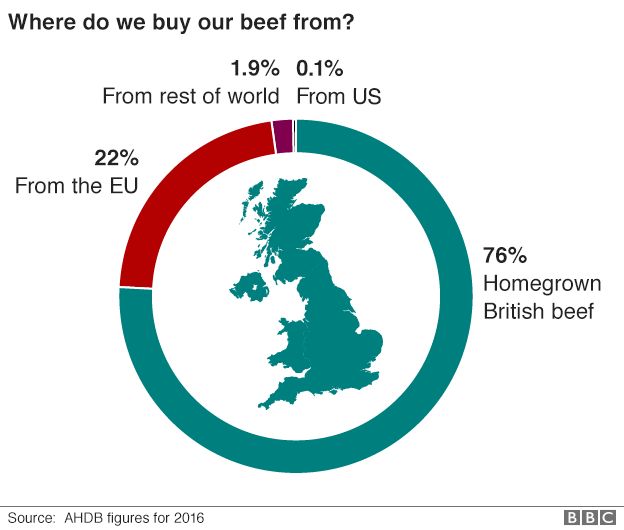
Where do we buy our beef from?
But in the UK, less than 1% of the fresh and frozen beef bought last year came from the US, according to the Agriculture and Horticulture Development Board (AHDB).
Possibly the most controversial difference in livestock farming either side of the Atlantic is the American use of growth hormones, which is banned in the EU.
The UK is largely self-sufficient when it comes to beef - with home-grown British beef accounting for 76% of purchases last year.
Brexit could change that.
Mr Davies said: "Brexit could have a massive effect on our food-producing ability in this nation, that's a key strategic decision to be made."
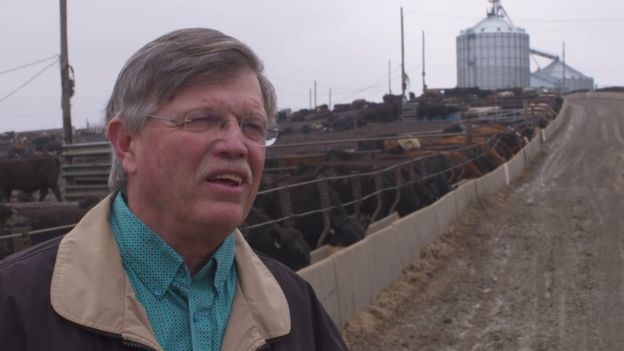
David Trowbridge
David Trowbridge from the Iowa Cattlemen's Association says US beef is "very competitive"
The prime minister has already been driving for new deals in America and the UK's special relationship with the US could provide a source of cheap food.
David Trowbridge, president-elect of the Iowa Cattlemen's Association in the US, told BBC Panorama: "We don't want to destroy an industry within another country, but you know... we are very competitive... It's up to your consumers on what they want to pay for the product."
In the UK, we spend roughly 8% of our income on food, according to the World Economic Forum.
Americans spend 6% - less than any other country in the world - and that is partly down to large-scale, cheap and efficient farming.

'Once in a lifetime'

Other farmers that Panorama spoke to welcomed Brexit.
Jacob Anthony, a 24-year-old fifth generation beef and sheep farmer who runs a 700-acre farm in Bridgend, Wales, voted to leave the EU.
"I'm a young farmer and I'm looking to the future," he said. "I think a lot of us in the industry were not happy with the way the sector was going and I thought it was a once-in-a-lifetime opportunity for realistic change."
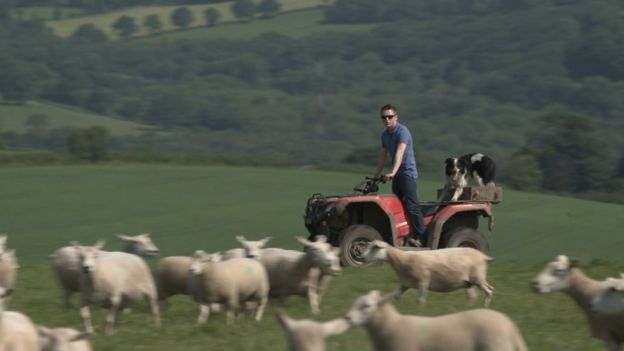
Welsh farmer Jacob Anthony
Farmer Jacob Anthony hopes that leaving the EU will open up export opportunities

Mr Anthony said leaving the EU would give British farmers a chance to strike new trade deals and push into new emerging markets.
Last year, 13% of UK-produced beef was exported, according to the AHDB, whose spokesman said it was largely the bits British shoppers did not want.

'Get on the agenda'

Conservative MP James Cleverly insists that the UK doesn't "have to just roll over" in Brexit negotiations.
He said: "We are a highly desirable market. That actually gives us some strength in the negotiations."
For Mr Mills, it is the establishment who "doesn't really like Brexit".
"And they are throwing up difficulties all over the place, which I don't think are going to materialise to anything like the extent to which they claim," he said.
Ex-Sainsbury's boss Mr King is concerned, however, that "there has been, in my estimation, almost no conversation about the potential impact of Brexit on the food supply chain by definition".
He said with less than two years to go until Brexit, "food needs to get on the agenda pretty soon".
The government has said little about plans for food and farming after Brexit, and the new Environment Secretary Michael Gove declined to speak to BBC Panorama.
The Department for Environment, Food and Rural Affairs said: "As the secretary of state has made absolutely clear, there will be no diminution or watering down of food standards.
"Leaving the EU provides us with a golden opportunity to develop a new farming and food policy.
"We will remain global leaders in environmental and animal welfare standards, maintain our high quality produce abroad and reduce pressure on the weekly household budget."
Image cap

Friday, July 7, 2017

Reuters News - Trump calls first Putin meeting an 'honor', cites 'very good' talks

U.S. President Donald Trump told Russian President Vladimir Putin on Friday that it was an "honor" to meet him for the first time and said he looked forward to "positive things" in the relationship between the former Cold War rivals.
The face-to-face encounter between Trump and Putin at a Group of 20 summit in Germany was one of the most eagerly anticipated meetings between two leaders in years.
Trump promised a rapprochement with Moscow during his campaign for the presidency last year. But he has been unable to deliver on that pledge because his administration has been dogged by investigations into allegations of Russian meddling in the U.S. election and ties between his campaign team and Moscow.
Moscow has denied any interference and Trump says his campaign did not collude with Russia.

Trump and Putin spoke through translators with their respective foreign ministers present for six minutes before reporters were allowed into the room for their statements. Afterwards the reporters were ushered out and the meeting continued.
U.S. President Donald Trump shakes hands with Russian President Vladimir Putin during the their bilateral meeting at the G20 summit in Hamburg, Germany July 7, 2017. REUTERS/Carlos Barria
"President Putin and I have been discussing various things, and I think it's going very well," Trump told reporters, sitting alongside the Russian leader.
"We've had some very, very good talks. We're going to have a talk now and obviously that will continue. We look forward to a lot of very positive things happening for Russia, for the United States and for everybody concerned. And it's an honor to be with you."
Putin, through a translator, said: "We spoke over the phone with you several times," adding: "A phone conversation is never enough."
"I am delighted to be able to meet you personally, Mr. President," he said, noting that he hoped the meeting would yield results.
Both men sat with legs splayed. Trump listened intently as Putin spoke.
Before the meeting, some feared the Republican president, a political novice whose team is still developing its Russia policy, would be less prepared for the talks than Putin, a former KGB agent who has dealt with the last two U.S. presidents and scores of other world leaders.
Amid criticism of Russia's actions in Ukraine and Syria and the investigations into its role in the U.S. campaign, Trump has come under growing pressure to take a hard line against the Kremlin.
On Thursday, Trump delivered some of his sharpest remarks about Moscow since becoming president, urging Russia to stop its "destabilizing activities" and end its support for Syria and Iran.
But Trump stopped short of any personal criticism of Putin and declined to say definitively whether he believed U.S. intelligence officials' assertion that Russia had interfered in the 2016 U.S. election.
"I think it was Russia but I think it was probably other people and/or countries, and I see nothing wrong with that statement. Nobody really knows. Nobody really knows for sure,” Trump said on a visit to Poland.
(Additional reporting by Patricia Zengerle, Susan Heavey and Doina Chiacu in Washington; Denis Pinchuk in Moscow and Denis Dyomkin in Hamburg; Writing by Noah Barkin; Editing by Ralph Boulton and David Stamp)

BBC News - Scottish economy rebounds in first quarter of 2017

Scotland's economy rebounded in the first quarter of this year, boosted by growth in production and services.
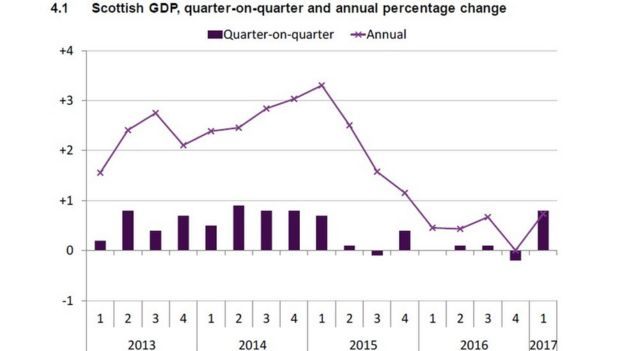
Official figures showed GDP grew by 0.8%, having shrunk by 0.2% in the previous three months.
Scotland outstripped the UK as a whole, which saw growth of just 0.2% in the first three months of the year.
Both the Scottish and UK governments welcomed the figures which saw Scottish production grow by 3.1% and the services industry expand by 0.3%.
However, construction contracted by 0.7%.
On an annual basis, the Scottish economy grew by 0.7%. Equivalent UK growth was 2%.
Some economic forecasters had warned that Scotland could slip into technical recession following contraction in the final quarter of last year.
Reacting to the latest data, Economy Secretary Keith Brown said the figures "reinforce the fact that the fundamentals of Scotland's economy are strong".
He said: "Since late 2014 our growth rate has been impacted significantly by the fortunes of the North Sea with around two-thirds of the slowdown in 2016 attributed to the onshore impact of lower oil prices.
"Today's figures show a rise in output in industries linked to the North Sea for the first time since 2014.
"While there is no room for complacency, these figures - alongside a number of recent business surveys - indicate that there is growing confidence in the sector."
Scottish government infographic
Mr Brown added: "Manufacturing output is also up, in part due to the resumption of steel production at the Dalzell plant after the Scottish government intervened to save this key strategic asset.
"The reopening of Dalzell is just one of the actions the Scottish government is taking to boost manufacturing - we are also supporting the expansion of the aluminium smelter at Lochaber and the development of a new manufacturing centre in Renfrewshire."
Scottish Secretary David Mundell described the figures as "very encouraging".
He said: "The Scottish economy is returning to growth and I am pleased to see that the manufacturing sector in particular is making the most of export opportunities. Scots economy rebounds in first quarter
"But, over the year, Scotland has continued to lag behind the UK as a whole - so there is still a lot of work to do.
"The Scottish government has extensive powers at its disposal to grow and support the economy and these figures underline the need for our two governments to work together as we prepare to leave the EU."
Scottish Labour's economy spokeswoman Jackie Baillie said: "It is a huge relief that Scotland has avoided recession, but this was a narrow escape for our fragile economy.
"The long-term trend paints a worrying picture of Scotland's economic performance, with the average annual change of just 0.5% - a quarter of the UK-wide growth.
"The rise in output from industries linked to the North Sea is very encouraging, but recent history should have taught the SNP the danger of relying solely on this sector."

'Fragile outlook'

A leading economic forecaster said the figures were "welcome progress" but added that policymakers would be "hoping for a few more quarters of growth at this pace before they are reassured".
Prof Graeme Roy, from the Fraser of Allander Institute at the University of Strathclyde, said: "While production output is up over 3% this quarter, it is still down -4.2% over the past two years.
"And taken with the contraction of -0.2% in the overall economy at the end of last year, and very weak growth during the earlier part of 2016, output in Scotland has still been weaker than the UK as a whole.
"So on balance, these data do not change the fact that the Scottish economy still faces a fragile outlook - particularly when you factor in likely effects of possible higher inflation and any Brexit uncertainty in the months to come."

'Positive signals'

Business leaders also welcomed the figures.
Scottish Chambers of Commerce said they represented the best quarter of growth for the Scottish economy since before the effects of low oil prices began to emerge in 2015.
Chief executive Liz Cameron said: "This is a huge sigh of relief for our economy.
"The most significant contributor to this recovery has been the production sector and this reflects the positive signals that we have been detecting from Scotland's manufacturers over recent months and, indeed, the returning signs of confidence from the oil and gas supply chain."
The Federation of Small Businesses called the figures "encouraging" but said the country needed to be put on "a much stronger economic footing".
Scottish policy convener Andy Willox said: "We need to develop diverse local economies, so that a single local closure or industry challenge doesn't hit a community, or the entire country, for six."

Thursday, July 6, 2017

Bloomberg News - The Flashpoints for World Leaders at the Hamburg G-20

By Alan Crawford and Sam Dodge
The Group of 20 summit that starts in Hamburg on Thursday is the most anticipated—and potentially turbulent—meeting of global leaders in years. An unpredictable U.S. president with a protectionist bent, a Russian leader subject to international sanctions and a Chinese president looking to assert a greater global role are just a few of the factors that might stoke tensions.
Sparks could really fly over the policy agenda of free trade, climate change and migration put forward by the German host. Angela Merkel is determined to avoid a repeat of May’s G-7 meeting in Italy, where it was six against one: Donald Trump. Yet she acknowledges that “the discord is obvious” and “it would be dishonest to paper over the conflict.”
Following are what look to be the main flashpoints at the summit and the relative positions of G-20 members with most at stake:
Trade
United States: Donald Trump has shown his disdain for the status quo on world trade. He often describes trade as a zero-sum proposition in which the U.S. has been losing ground for decades and lambasts nations such as Germany that export more to the U.S. than they import as “very bad.” He seeks an overhaul of the global trading order that would elevate the U.S. at the expense of other countries.
Germany: As head of Europe’s top exporting nation, Angela Merkel is under pressure to defend open markets and push back against criticism of Germany’s trade surplus. In the G-20 runup, the chancellor has tried to enlist countries from China and India to Mexico as free-trade allies and continues to push for completion of the TTIP trade deal between the EU and the U.S.
United Kingdom: Aside from holding on to Downing Street, Theresa May has one thing in her inbox: Brexit. Once the U.K. leaves the EU—its biggest market—in 2019, it will live or die by signing free-trade deals, so May is desperate to make the case that Brexit Britain is “open for business.”
Brazil: Says it is the best example of how protectionism has failed and that it now seeks open borders. President Michel Temer wants the final G-20 document to emphasize the importance of multilateral trade rules and contain a specific mention of the WTO (which a Brazilian heads).
Argentina: Only just reentered capital markets after 15 years of isolation, and President Mauricio Macri wants to strengthen trade ties with anyone willing to listen. He’s visited China, Japan, Germany and Davos, all in the name of business, and has expressed a desire to do more bilateral deals with or without the regional trade bloc Mercosur.
Climate
United States: The Trump administration has introduced measures to boost coal production and chipped away at environmental regulations while announcing the U.S. will withdraw from the Paris climate accords. At the G-7 last month, the U.S. declined to support a joint statement supporting global action against climate change.
China: The world’s biggest polluter aims to occupy the ground the U.S. is vacating, and President Xi intends to put climate at the core of his G-20 agenda.
France: Emmanuel Macron is a major defender of the Paris accord, frequently linking problems such as terrorism and migration to climate change and suggesting France may go further in its carbon targets as a result of the U.S. withdrawal.
Germany: Angela Merkel, a former environment minister who helped forge the precursor to the Kyoto accord, is pushing for G-20 members to hold to the Paris agreement. While keen not to isolate Trump, she will ultimately have to decide if she takes him on over climate change.
India: Prime Minister Narendra Modi has committed to the global agreement on curbing emissions and pledged to “go beyond the Paris accord,” saying “we have a common responsibility to protect our mother planet.”
Migration
United States: Trump, who proposed building a U.S. border wall and signed a ban on travel for refugees and nationals from six Muslim-majority countries, has called for nations to have the authority to control migration. He has criticized Europeans for taking in so many migrants.
Turkey: Hosts more refugees—almost 3 million—than any other country, mostly from war-torn neighboring Syria. That shared interest in migration means for all his public jibes at Merkel and threats to tear up a refugee deal with the EU, President Recep Tayyip Erdogan may have more in common with the German chancellor than with the U.S. president on this issue.
Mexico: Immigrant rights have moved to the top of Mexico’s agenda after the U.S. threatened mass deportations of its citizens. Mexico participates in global refugee programs and has worked to limit the illegal crossing of Central Americans at its southern frontier.
Italy: Migration is a priority for Italian Prime Minister Paolo Gentiloni, whose Mediterranean country is struggling to cope with arrivals of refugees from North Africa and the Middle East. Italy has long felt abandoned by its European Union and other partners, and Gentiloni will be seeking more support for Merkel’s summit attempts to boost growth in Africa through foreign investment to help stem the outward flows of people.
South Africa: For President Jacob Zuma, the issue of migration is about people from mostly sub-Saharan countries such as Nigeria, Malawi, Zimbabwe and Ethiopia who are fleeing war or grinding poverty. Recent years have seen outbreaks of deadly violence against foreigners by South Africans who say the migrants are taking their jobs and opportunities.
Trump
Russia: Vladimir Putin has repeatedly praised Trump, who campaigned on a pledge to build better relations with Russia. But Putin has watched with growing concern as investigations into alleged Russian meddling in the U.S. vote have further poisoned relations and Moscow’s opponents in the U.S. have pushed for new sanctions on Russia.
Japan: Abe was the first to visit Trump after Trump won the White House, even golfing with the president. But Abe has also taken care to stress Japan’s investments in the U.S. economy and defended the status of trade ties, including Japanese auto exports.
Saudi Arabia: Crown Prince Mohammed bin Salman was one of the first foreign officials to visit Trump as president, allowing Saudi Arabia to claim “a historic turning point” in relations. Trump chose Saudi Arabia as the first destination on his first foreign trip as president, saying that his meetings there with regional leaders were “beyond anything anyone has seen.”
France: Emmanuel Macron crushed Trump’s hand the first time they met and hasn’t hesitated to take him on since, almost trolling the U.S. leader when he announced his withdrawal from the Paris accords. But he’s invited the president to attend the July 14 Bastille Day celebrations—and Trump accepted.
Canada: Justin Trudeau may find himself a hot commodity at the G-20 with other leaders looking to pick the Canadian premier’s brain for how to deal with his neighbor. With Nafta talks due to begin in August, Trudeau’s cabinet has fanned out to lobby the White House, Congress and key U.S. governors to ward off proposals for a border tax or new trade tariffs.

Wednesday, July 5, 2017

BBC News - China's $9tn bond market opens up to foreign investors


A long-awaited scheme enabling foreign investors to buy and sell Chinese bonds has been launched.
The Bond Connect programme is Beijing's latest attempt to open up its financial markets and attract foreign capital.
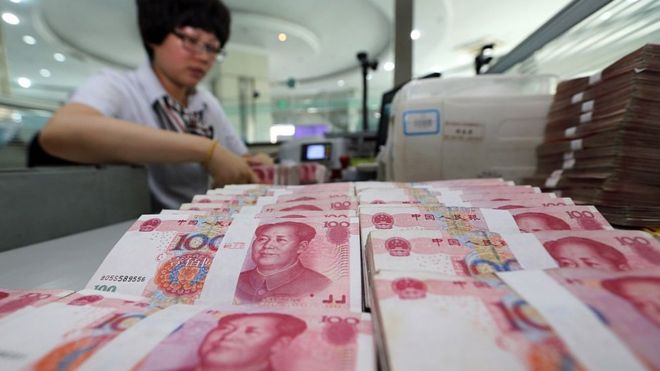
China's $9 trillion bond market is the third-largest in the world, but only 2% of Chinese bonds are foreign-owned.
The launch has been timed to coincide with the 20th anniversary of Hong Kong's handover to Chinese rule.
Bonds are glorified IOUs, typically sold by governments and companies to raise cash.
Their attraction to investors is that they usually offer a fixed rate of interest and come with the promise of eventual full repayment when the bond expires.
Initially, Chinese bonds can be bought by banks, insurers and fund managers via Hong Kong.
No date has been set for Chinese investment in foreign bonds.
HSBC Holdings and an asset management unit of Bank of China became the first institutions to trade using the scheme, with about $300m worth of bonds purchased in early trading.

Rating credibility

Buying Chinese bonds - essentially Chinese government and corporate debt - will give investors greater access to investments denominated in the Chinese currency, the yuan or renminbi.
Overseas investors have in the past been cautious about entering the market - partly over the stability of the Chinese currency as well as Beijing's perceived lack of urgency to reform its financial markets.
There has also been long-held concern about the credibility of credit ratings for bonds in China.
Similar systems to enable dealing in Chinese shares have been rolled out recently.
Since late last year, foreign investors in Hong Kong have been able to trade shares in about 900 firms in companies on the Shenzhen Stock Exchange and vice-versa following the official launch of the Shenzhen-Hong Kong trading link.
That link followed the launch of the Shanghai-Hong Kong Stock Connect in November 2014, which allowed international investors to trade in hundreds of Shanghai-listed A-shares as well as Hong Kong stocks.

Tuesday, July 4, 2017

Reuters News - Pressure builds on Trump at home over pledge for closer Moscow ties

U.S. President Donald Trump arrives at Joint Base Andrews, Maryland, U.S., upon his return to Washington after a weekend at the Trump National Golf Club in Bedminster, New Jersey, July 3, 2017. REUTERS/Yuri Gripas
During his presidential campaign, Republican Donald Trump praised Russian President Vladimir Putin as a "strong leader" with whom he would like to reset tense U.S.-Russian relations.
But as Trump heads to his first face-to-face meeting as president with Putin on Friday at the G20 summit in Germany, he is under pressure at home to take a tough line with the Kremlin.
Allegations of Russian meddling in last year’s U.S. election have alarmed both Republican and Democratic lawmakers, who are pushing to extend tough sanctions placed on Russia following its 2014 annexation of Crimea, a peninsula belonging to Ukraine.
Lawmakers including Republican Senator Cory Gardner are also concerned Russia has prolonged the civil war in Syria by backing its President Bashar al-Assad, a strongman whose forces have used chemical weapons against insurgents and civilians. The chaos has fueled instability in the region and a flood of migrants to Europe.
"President (Trump) needs to make it clear that the continued aggression by Russia around the globe ... is unacceptable, and that they will be held accountable," said Gardner, who was among six lawmakers invited by the White House last month to discuss foreign policy with Trump over dinner.
Meanwhile, the appointment of a special counsel who is investigating potential links between the Russian government and members of the Trump campaign has weakened the president’s ability to maneuver with Russia, foreign policy experts say.
The U.S. intelligence community has concluded Russia sponsored hacking of Democratic Party groups last year to benefit Trump over his Democratic challenger Hillary Clinton. Russia has denied those allegations while Trump has repeatedly dismissed the idea of any coordination between his campaign and Russia as a "witch hunt."
Still, just the optics of Trump meeting with Putin, a former KGB agent, are fraught with risk, foreign policy experts say.
"If (Trump) smiles, if he wraps his arm around Putin, if he says, 'I'm honored to meet you, we're going to find a way forward,' ... I think Congress is going to react extremely negatively to that," said Julie Smith, a former national security aide in the Obama administration.
EVOLVING U.S. POLICY
Trump has signaled an interest in cooperating with Russia to defeat Islamic State in Syria and to reduce nuclear stockpiles.
The White House has been mum on what Trump would be willing to give Russia in exchange for that help. But there has been speculation he could ratchet down sanctions, or even return two Russian diplomatic compounds in Maryland and Long Island. President Barack Obama seized those facilities and expelled 35 Russian diplomats just before he left office as punishment for the election hacks.
While some administration officials, including Secretary of State Rex Tillerson, also support engagement, others, such as Vice President Mike Pence and U.S. ambassador to the United Nations Nikki Haley, have taken a hawkish line on Russia.
The lack of a unified strategy has left U.S. allies anxious. And it has lowered expectations for American leadership to help resolve crises in Syria and Ukraine, where Russian cooperation would be critical.
"Trump is like a horse with his front legs tied," said a German diplomat, who spoke to Reuters on condition of anonymity. "He can’t make any big leaps forward on Russia. If he tried people would immediately suspect it was all part of some big conspiracy."
Trump's administration is still reviewing its Russia policy, a process that may not be wrapped up for a couple of months, a U.S. official said.
Speaking with reporters last week about Trump's upcoming meeting with Putin, White House national security adviser H.R. McMaster said his boss would like "the United States and the entire West to develop a more constructive relationship with Russia. But he’s also made clear that we will do what is necessary to confront Russia’s destabilizing behavior."
THIRD TRY AT A RESET
Trump is just the latest president to grapple with the complicated U.S.-Russia dynamic.

George W. Bush and Obama sought to improve the U.S. relationship with Russia early in their administrations only to see relations deteriorate later.
Among the concerns for this president is Trump’s apparent lack of interest in policy details and his tendency to wing it with foreign leaders.
McMaster told reporters that Trump has "no specific agenda" for his meeting with Putin and that topics would consist of "whatever the president wants to talk about."
Michael McFaul, who was U.S. ambassador to Russia under Obama, said he feared Trump might be headed to the meeting without clear objectives.
“I hope that he would think about first: what is our objective in Ukraine? What is our objective in Syria? And secondarily, how do I go about achieving that in my meeting with Putin?" McFaul said.
Other Washington veterans say Trump won't be able to make meaningful progress with Russia on anything until he confronts Putin about the suspected election meddling.
"(Trump) really has to raise the Russian election hacking last year, and has to say something like, 'Vladimir, don't do this again. There will be consequences,'" said Steve Pifer, a long-time State Department official focused on U.S.-Russia relations.
So far Trump has shown little inclination to do so, a situation that has heightened speculation about the potential impact from his coming encounter with the Russian leader.
“The shadow of all these investigations hangs over this,” said Angela Stent, a professor at Georgetown University and former National Intelligence Officer for Russia.
(Additional reporting by Patricia Zengerle, Arshad Mohammed, Warren Strobel, Richard Cowan, Jonathan Landay, John Walcott in Washington; John Irish in Paris; Noah Barkin in Berlin; Christian Lowe in Moscow; Editing by Caren Bohan and Marla Dickerson)

Monday, July 3, 2017

BBC News - India GST: Sweeping tax reform introduced

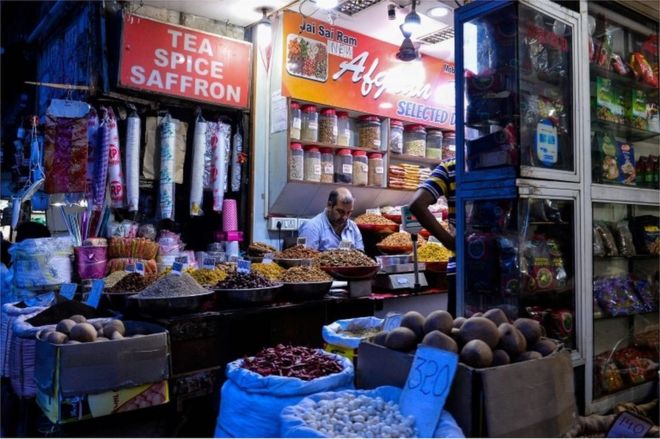
In this photograph taken on August 2, 2016, an Indian vendor works in his shop in the old quarters of New Delhi. India"s politicians are set to debate the Goods and Services Tax(GST) in the Rajya Sabha (Upper House) of the country"s parliament on August 3, potentially the biggest reform in India"s indirect tax structure in the last quarter century.
It is not clear whether small businesses are ready for the tax

India has replaced its numerous federal and state taxes with the Goods and Services Tax (GST), designed to unify the country into a single market.
The historic overhaul of the existing tax legislation was carried out at a special midnight session of parliament.
India says introducing GST will cut red tape and increase tax revenues, fuelling economic growth.
Finance Minister Arun Jaitley says the reform will help the economy grow by 2%.
But businesses have been asking for more time to implement changes, worried that they are not ready for the move to the new system.
Many do not even have a computer to register on the GST network.
"No country of comparable size and complexity has attempted a tax reform of this scale," Harishankar Subramanian, of Ernst and Young previously told the BBC.
Under the new system, goods and services will be taxed under four basic rates - 5%, 12% 18% and 28%.
Some items like vegetables and milk have been exempted from GST, but will still be subject to existing taxes.
The price of most goods and services are expected to increase in the immediate aftermath of the tax.
Analysts expect economic growth to slow down over the next few months, but say it should pick up after the tax is fully implemented.