Monday, September 11, 2017

BBC News - Eurozone set for fastest growth since 2007, says ECB

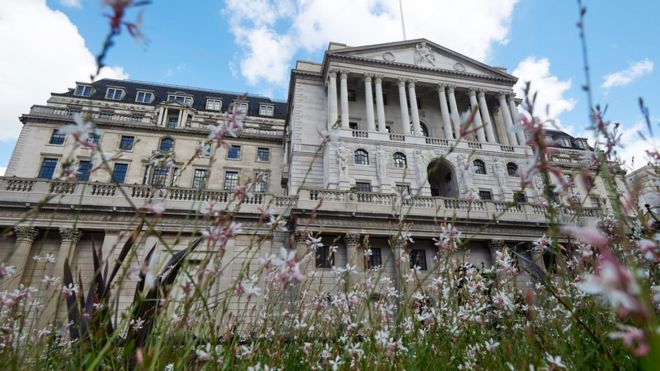
ECB officeImage copyrightREUTERS
Image captionThe ECB is facing scrutiny about how to wind down its stimulus programme
The European Central Bank (ECB) has raised its eurozone economic growth forecast for this year to 2.2%, the fastest growth in 10 years.
ECB president Mario Draghi said the 19-country bloc grew faster than expected in the first half of the year.
It came as the bank kept eurozone interest rates and its bond buying stimulus programme unchanged.
Mr Draghi said the ECB would probably make decisions about its stimulus measures next month.
The ECB is currently buying 60bn euros (£55bn) of bonds a month as part of its quantitative easing (QE) programme.
But analysts expect this to be scaled back in the months ahead given the eurozone's recovery.

Robust growth

The ECB raised its economic growth forecast from 1.9% to 2.2%, which would be the fastest rate since the 3.0% seen in 2007 before the financial crisis started to bite.
"There was a general recognition of the progress made by the eurozone recovery," Mr Draghi said.
"It's robust, it's broad-based, and it was recalled that six million jobs were created since 2013."
However, the bank also cut its forecast for eurozone inflation to 1.2% next year and 1.5% in 2019 - below the ECB's 2% target.
Analysts say this is making the decision on when the bank begins to rein in its stimulus more complicated.
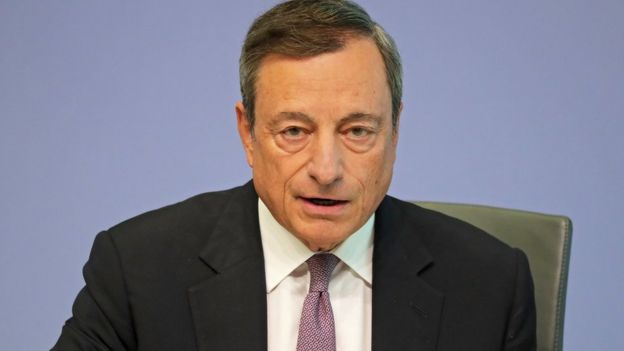
Mario DraghiImage copyrightEPA
Mr Draghi said "a very substantial degree of monetary accommodation" was still needed to help boost inflation.
He also said the rise in the euro - which has gained 13% in value against the dollar this year - was a source of "uncertainty".
However, his comments were not enough to suppress the euro, which rose 0.8% against the dollar to $1.20. It also increased 0.5% against the pound to almost hit 92 pence.

'Dialled down'

Patrick O'Donnell, an investment manager at Aberdeen Standard Investments, said: "There's no question that the ECB is worried about the euro's appreciation but there's little [Mr Draghi] can actually do about it."
He added the markets widely expected the bank to announce plans in October on winding back QE.
Claus Vistesen, chief eurozone economist at Pantheon Macroeconomics, said: "We think the central bank is trying to send the message that the degree of stimulus will be dialled down as the economy improves, but not removed altogether."
Figures released earlier on Thursday confirmed that the eurozone's economy grew by 0.6% in the three months to June, following growth of 0.5% in the first quarter of the year.
However, despite the pick-up in growth, inflation within the eurozone remains slower than the ECB's target of close to, but below, 2%. Inflation in the bloc was 1.5% in August.
The ECB kept all its main interest rates unchanged, with the benchmark refinancing rate staying at 0%. The deposit facility rate stayed at -0.4%, which means banks pay money to leave their cash at the ECB.
The ECB said it still expected rates to "remain at their present levels for an extended period of time".

Friday, September 8, 2017

Bloomberg News - Bob Diamond Sees Brexit's Impact More Profound Than Expected

Bob Diamond, the architect of Barclays Plc’s investment bank over more than a decade in London, said the British capital will be hurt more than people expect from Brexit, with lawyers likely to join bankers in moving away.
“People are beginning to understand Brexit is going to be far more profound and long-lasting than they thought,” Diamond said in a phone interview Thursday from New York. “I’d be very surprised if support services and legal services don’t move.”
Diamond, who now chairs African bank investor Atlas Mara Ltd., said he expects New York will benefit at London’s expense. Britain’s decision to leave the European Union has global banks establishing new bases within the trading bloc to ensure continued access to clients in the region. Some observers have said that given fragmentation between European trading centers, certain activities are more likely to gravitate to the bigger bulk of the U.S. financial capital.
Diamond’s comments contrast with a more upbeat take on Brexit from one of his successors as chief executive officer of Barclays. Jes Staley, an American who has run the bank since the end of 2015, has been adamantthat London will remain a financial hub, and has championed the city’s financial-technology scene as a source of jobs that will offset those leaving town. Still, he has picked Dublin for Barclays’s post-Brexit expanded EU base.

African Growth

Britain is due to leave the bloc in March 2019. Brexit talks have plodded forward over the summer, with the EU’s lead negotiator highlighting the depth of the division between the two sides this week. Goldman Sachs Group Inc. said on Thursday that it could increase its Frankfurt staffing as much as fourfold after Brexit, while Morgan Stanley, Citigroup Inc. and UBS Group AG are also all relocating jobs to Germany’s financial capital.
As for Atlas Mara, which trades in London, Diamond said his firm will benefit as global banks lower their exposure to emerging markets because of capital controls and regulation. Atlas Mara’s opportunities to boost market share have never been better, he said, and it plans to have a presence in 10 or more African countries in the next three to five years, up from the current seven. It also has a treasury and markets unit based in Dubai.
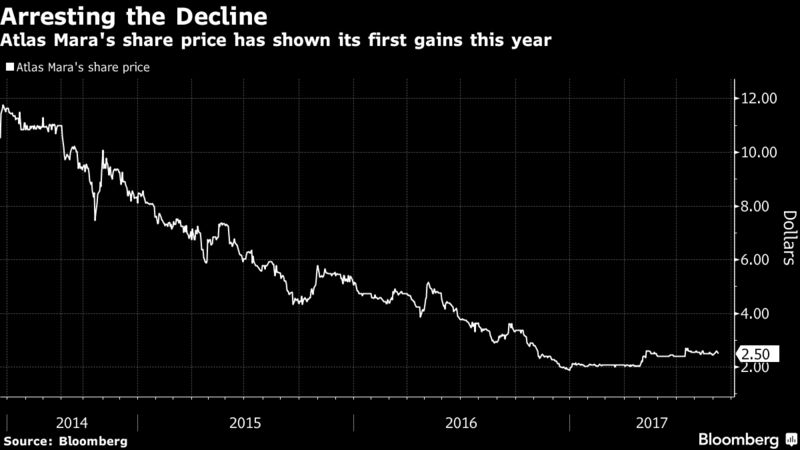
Earlier, Atlas Mara reported that first-half net income to June rose to a record $11.5 million from $1.2 million a year earlier. Its share price has rebounded 36 percent in 2017 after sliding 82 percent between its initial public offering in 2013 and the end of last year, as commodity prices and local currencies slumped. Its biggest investment is a stake in Union Bank of Nigeria Plc.
“We’ve delivered what we promised,” Diamond said, adding that Atlas Mara is on track to more than double 2016’s full-year profit, which was $8.4 million.
With cost cutting and a reduction in headcount, Atlas Mara says it will save about $20 million this year. Next year, it wants to take a controlling stake in UBN and have that bank expand by potentially buying another Nigerian lender.
“A core part of growing the balance sheet are the opportunities for UBN to make acquisitions,” Kenroy Dowers, Atlas Mara’s group managing director for strategy and investments, said on the same call. “We’re not indicating there’s a specific target in mind. But we do believe Nigeria is key to our strategy and we clearly want to increase our position there.”

Dubai’s Contribution

Atlas Mara’s treasury and markets business in the United Arab Emirates is another focus area with the group expecting the Dubai Financial Services Authority to authorize its operations before year end. Total revenue from this unit amounted to $27.5 million in the first half, which equates to 23 percent of the group’s total income.
The markets and treasury operations are a mix of bond business, including sovereign bonds, and currency services such as hedging, Diamond said. There’s no proprietary trading and with other banks retreating from emerging markets, there’s “lots more to go” for this business, he said.
Having completed the sale of a 42 percent stake in Atlas Mara to Fairfax Africa last month, Diamond now has the capital to pursue his African and Middle Eastern ambitions. The board of Atlas Mara will change as Fairfax Africa assigns four directors and further announcements on that will be made by October, Diamond said. With cash in the bank and new partners on board, “we’ll aspire to be as fabulous as we can be,” he said.

Thursday, September 7, 2017

BBC News - Top Federal Reserve official departs

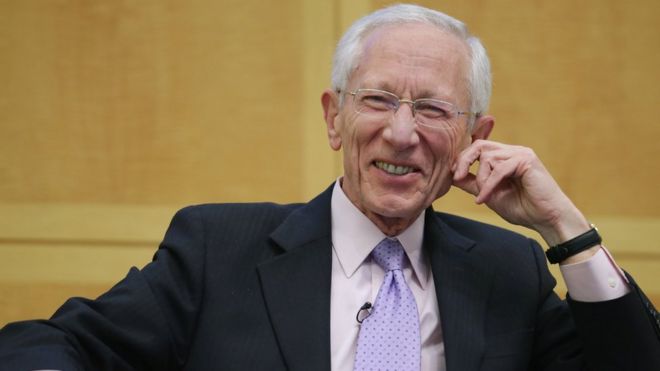
Former Bank of Israel Governor Stanley Fischer participates in an economic forum on 'Policy Responses to Crises' at the International Monetary Fund headquarters November 8, 2013 in Washington, DC.
One of the top bankers at the US Federal Reserve said he will retire next month from its governing board, citing personal reasons.
The resignation of Stanley Fischer, 73, creates another vacancy on the council that oversees the US central bank.
Three spots on the seven-member board were already vacant.
The term of Federal Reserve Chair Janet Yellen is also due to expire in 2018 and it is unclear whether President Donald Trump will reappoint her.
The openings provide Mr Trump with an opportunity to make a mark at the central bank, which sets key economic policies.
In July, he nominated investor Randal Quarles to fill one of the vacancies.
Mr Fischer had served on the board of governors since 2014. His term as vice-chair was set to expire next year.
A longtime professor of economics at the Massachusetts Institute of Technology, Mr Fischer previously was a governor at the Bank of Israel and vice-chairman at Citigroup.

Wednesday, September 6, 2017

Reuters News - U.S. trade gap edges up; deficit with China at 11-month high

WASHINGTON (Reuters) - The U.S. trade deficit increased less than expected in July as both exports and imports fell, suggesting that trade could contribute to economic growth in the third quarter.
The Commerce Department said on Wednesday the trade gap rose 0.3 percent to $43.7 billion. June’s trade deficit was revised down slightly to $43.5 billion from the previously reported $43.6 billion.
Economists polled by Reuters had forecast the trade shortfall widening to $44.6 billion in July. When adjusted for inflation, the trade deficit increased to $61.6 billion from $60.8 billion in June. The so-called real goods deficit in July was below the second-quarter average of $62.4 billion.
While that suggests trade could add to gross product in the third quarter, economists at Wrightson ICAP cautioned that Hurricane Harvey could significantly impact commodity prices and trade volumes, and push up the trade deficit in September.
The politically sensitive U.S.-China trade deficit increased to an 11-month high in July. That ongoing deficit has grabbed the attention of President Donald Trump, who has blamed it for helping to decimate U.S. factory jobs as well as stunting U.S. economic growth.
Trump, who argues that the United States has been disadvantaged in its dealings with trade partners, has ordered the renegotiation of the North American Free Trade Agreement (NAFTA), which was signed in 1994 by the United States, Canada and Mexico.
On Saturday, Trump threatened to withdraw from a free trade deal with South Korea.
Prices of U.S. Treasuries were little changed by the data on Wednesday. U.S. stock index futures were trading higher while the dollar was weaker against a basket of currencies .DXY.
The government reported last month that trade contributed two-tenths of a percentage point to the economy’s 3.0 percent annualized growth pace in the second quarter.
In July, real goods exports slipped despite petroleum exports hitting a record high.
Exports of goods and services fell 0.3 percent to $194.4 billion in July. Exports of motor vehicles and parts fell by $0.6 billion, but exports of capital goods rose by $0.9 billion.
Exports to China increased 3.5 percent, while those to the European Union tumbled 9.8 percent.
Imports of goods and services slipped 0.2 percent to $238.1 billion in July. Imports of motor vehicles and parts fell by $0.8 billion and crude oil shipments declined by $1.0 billion.
Imports of goods from China increased 3.1 percent. The U.S.-China trade deficit increased 3.0 percent to $33.6 billion in July, the highest level since August 2016.
The United States saw a 3.7 percent drop in goods and services imported from the EU in July. The trade deficit with the EU increased 7.9 percent to an eight-month high of $13.5 billion.
Reporting by Lucia Mutikani; Editing by Paul Simao
Our Standards:The Thomson Reuters Trust Principles.

Tuesday, September 5, 2017

Bloomberg News - Big Energy Backs Hydrogen Power Storage

The secret to switching the global energy system entirely to renewables may lay in the universe’s most abundant substance.
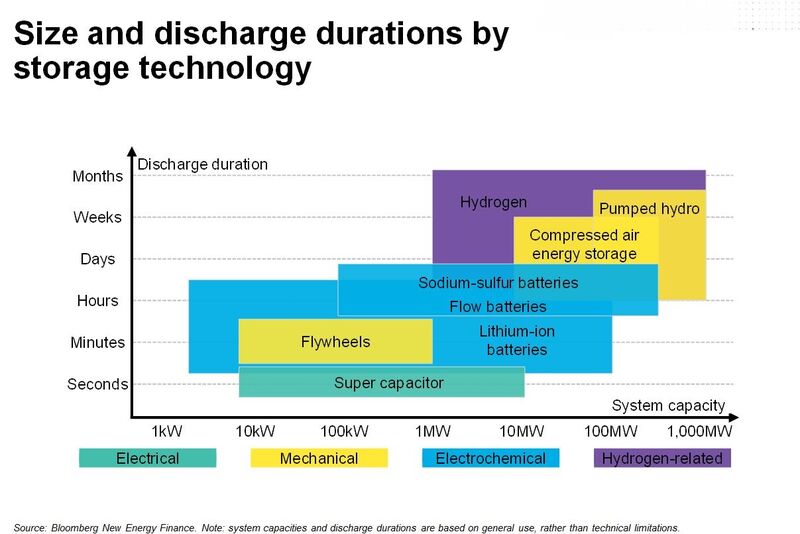
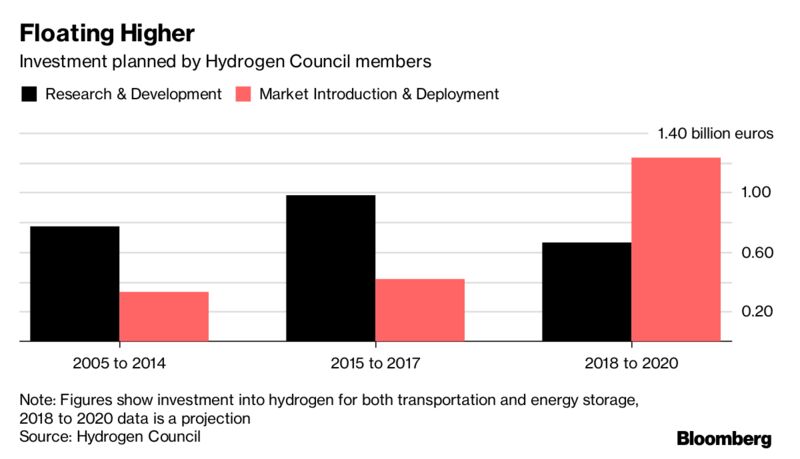
Hydrogen has drawn backing from big energy companies from Royal Dutch Shell Plc to Uniper SE in addition to carmakers BMW AG and Audi AG. They’re supporting research into how the element can be used to store energy for weeks or even months beyond what lithium-ion batteries can manage.
While industry’s investment in hydrogen is small at just $2.5 billion over the last decade, the work offers an answer to the elusive question of how electricity could be kept for use in the future. Batteries increasingly are shifting power from day to night, but they tend to go flat after a few weeks. Hydrogen can be kept indefinitely in tanks. That would allow, for example, voltage collected from solar panels in the summer to be used in winter.
“The years 2020 to 2030 will be for hydrogen what the 1990s were for solar and wind,” said Pierre-Etienne Franc and vice president of advanced business and technologies at the French industrial gas maker Air Liquide SA and initiative secretary of the Hydrogen Council, a trade group promoting the work. “It’s a real strategic shift.”
The technology to use hydrogen as energy storage is well known, although not yet demonstrated in a commercial setting.
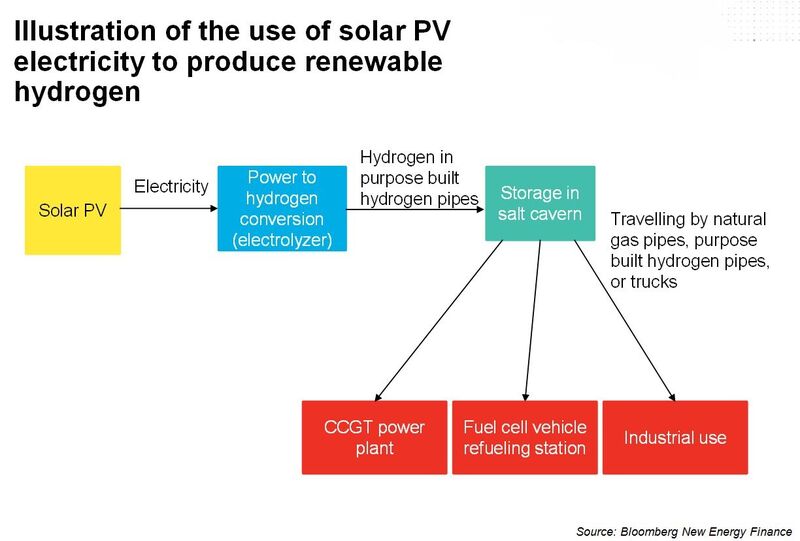
Excess power from wind or photovoltaics would drive electrolysis, separating water into its component hydrogen and oxygen elements. The hydrogen captured by that process could, whenever needed, feed natural gas power plants or fuel cells to make electricity. Industrial plants like oil refineries can also use hydrogen for chemical processes.
To date, the energy industry has focused mainly on hydrogen’s potential in fuel cells, which  use the element in a chemical reaction to generate electricity. On power-storage, most of the money is going into batteries like the lithium-ion cells widely used in mobile phones and laptop computers. But those tend to lose charge if not topped up and discharged frequently.
Hydrogen storage is attractive because it preserves energy for longer periods. The only real alternative at the moment is pumping water onto a hilltop reservoir, where it can dammed up until grid managers are ready to let it flow down through hydropower turbines. That so-called pumped storage requires the right geography.
If hydrogen could be made to store energy cheaply enough, it would allow utilities to scale back on fossil fuel plants by making it easier for the grid to handle intermittent power flows from wind and solar farms. For example, about $3.4 billion of revenue was lost in China last year because wind farms were forced to remain idle because of congested electric lines.
“If you want to get to 100 percent renewables, hydrogen could play a key role,” said Claire Curry, an analyst at Bloomberg New Energy Finance. “You could have natural gas plants, but that would, of course, not be 100 percent clean.”
The work on hydrogen is in its infancy, but support with big business is growing. The Hydrogen Council was formed at the last World Economic Forum in Davos, with 17 major companies looking for ways to integrate the gas into cleaner energy systems. Its members include Shell, Total SA, Engie SA, Toyota Motor Corp., Bayerische Motoren Werke AGAudi and the Japanese industrial gas supplier Iwatani Corp. General Motors Co. is in the process of joining.
The council is considering a fund for technology demonstration projects and will meet again in November at the next United Nations climate talks in Bonn. A handful of projects are now operating, supported by the German utility Uniper, the European Union and a diverse collection of industrial and energy companies.

Monday, September 4, 2017

BBC News - No rate rise until 2019, economists say


Most economists do not expect UK interest rates to rise until 2019 despite inflation remaining above target, according to a BBC survey.
Most of those surveyed think the Bank of England's Monetary Policy Committee (MPC) will be reluctant to raise rates during Brexit negotiations.
Inflation stood at 2.6% in July - well above the Bank's official target of 2%.
Half the economists surveyed by the BBC think wages growth will outpace inflation in the first half of 2019.
Last week, one MPC member, Michael Saunders, said a "modest rise" in rates was needed to curb high inflation.
The base rate has stood at a record low of 0.25% since August 2016 - the first move since March 2009, when it was reduced to 0.5%.
In June, three of the MPC's eight members voted for a rate rise - the first time since May 2011 that so many had wanted to tighten policy.
The same month the Bank's chief economist, Andy Haldane, also made a call for a rate rise this year.
However, Mark Carney, the Bank governor, said in his Mansion House speech in late June that "now is not yet the time" to start raising rates once more.

How do higher interest rates curb inflation?

  • Borrowing becomes more expensive, meaning consumers have less to spend, so some prices are less likely to increase
  • The cost of some mortgages rises, reducing disposable income
  • Higher interest rates also encourage saving, rather than spending
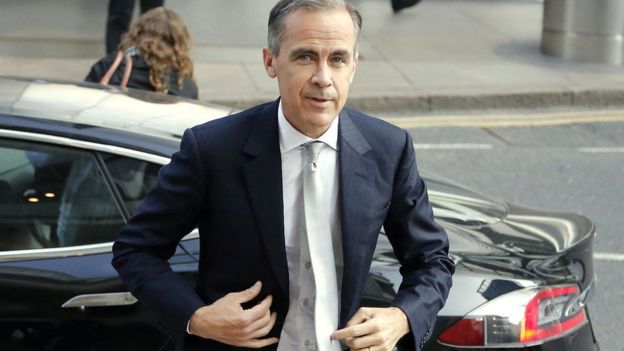
Mark CarneyImage copyrImage caption
Bank of England Governor Mark Carney has cast doubt on an imminent interest rate rise
Stuart Green, of Santander Global Corporate Banking, told the BBC he did not expect a rate hike to happen before 2019.
"We believe that policymakers will be reluctant to tighten monetary policy until greater clarity emerges around the UK's post-EU trading framework, and our expectation of declining inflation through 2018 should also reduce the pressure for an interest rate rise," he said.
Others expect it to be even longer, with economists at Morgan Stanley not expecting any movement until March 2019 at the earliest, with Andrew Goodwin at Oxford Economics suggesting it would not happen until the third quarter of that year.
Similarly, Fabrice Montagne, at Barclays, expects rates to stay on hold until "at least 2019".
But there are those who argue that the Bank will raise rates sooner. Howard Archer, chief economic adviser at the EY ITEM Club, said he had one increase, to 0.5%, pencilled in for late 2018, adding: "I would not be at all surprised if it was delayed until 2019."
Michael Lee, at Cambridge Econometrics, expects a rise to come in either the second or third quarter of next year as he thinks inflation will stay above the Bank's 2% target for the next two to three years.
Philip Rush, at Heteronomica, is more specific, settling on May 2018.
The one outlier is George Buckley at Nomura, who expects the MPC to jump in November.

Inflation

The BBC also asked the economists when they expect inflation to peak in the UK. Both Mr Rush and Mr Archer think it will hit 2.9% in October, with the latter predicting it will then start to fall back "as the impact of the sharp drop in sterling following the June 2016 Brexit vote increasingly wanes".
Several others, such as Mr Green, Mr Lee and Mr Goodwin, expect inflation to hit 3% in the final three months of the year before starting to retreat.
Morgan Stanley is more pessimistic, however, predicting a peak of 3.2% in Spring 2018.

Sterling

Holiday makers planning trips to the continent in the next few months should prepare themselves for more pain, according to Morgan Stanley.
Its currency strategy team expect sterling to weaken against the euro by a further 10% by March 2018.
Mr Green at Santander also forecasts more weakness for the UK currency over the course of the next year, with an average of $1.25 to the pound and just 96 euro cents in the final quarter of 2018.
Mr Archer thinks the pound will sink to about $1.25 by Christmas, but recover to trade about seven cents higher by the end of 2018.
Heteronomica's Mr Rush is also a little more optimistic about sterling, expecting it to be stronger within a year.

Analysis: Andrew Verity, economics correspondent

The last time interest rates went up was 5 July, 2007. They rose by a quarter of a percentage point to 5.75%. The next month the credit crunch struck, and so began a series of cuts, down to 0.5% in March 2009.
These were supposed to be emergency measures. Then came the Brexit vote, and in August 2016 the official rate dropped to a fresh record low of 0.25%. That compares to a typical range of between 5% and 13% for most of the 1990s.
Emergency rates are the new normal. That carries dangers. If we hit another slump, we've run out of road; there won't be much the Bank of England can do to help by cutting interest rates.
While some members of the Bank's Monetary Policy Committee think we should start restoring interest rates to non-emergency levels this year, that is a minority view, as our snapshot of economists' forecasts shows.
You could draw a number of conclusions. You might decide interest rates aren't effective on their own - so the government should rely less on the central bank stimulus and instead use fiscal policy such as cutting taxes or raising spending.
You might take the view that rates should rise to help savers and pension schemes.
Or you might take the view that an early rise could worsen the economic slowdown. You might even believe that we need to find ways to get the official rate below zero (so that I, the lender, pay you, the borrower, to take my money).
Take your pick, but whichever you choose, normality ain't what it used to be.

Friday, September 1, 2017

BBC News - Eurozone inflation rate rises to 1.5%

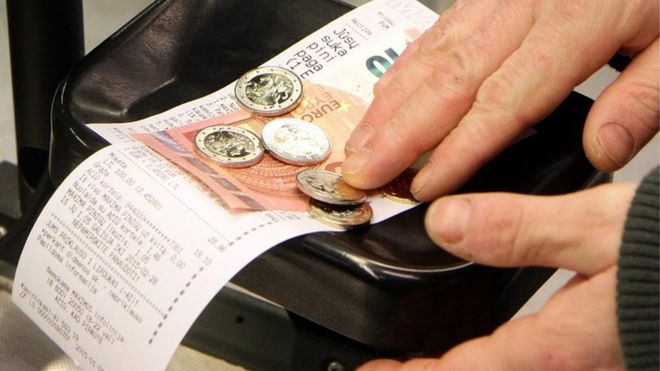
Euro spending
The inflation rate in the eurozone rose to a higher-than-expected 1.5% in August, according to Eurostat, the European Union's statistics office.
The preliminary estimate for the month was up from July's rate of 1.3%.
Inflation in the 19-nation bloc remains well below the European Central Bank's target of close to, but below, 2%.
Separately, the unemployment rate in the eurozone was unchanged at 9.1% in July, its lowest since February 2009, also according to Eurostat.

ECB meeting

The biggest driver of inflation was the cost of energy, which went up by 4%. Processed food, alcohol and tobacco prices increased by 2%.
Core inflation, which strips out those more volatile elements, was unchanged at 1.2%.
The figures could put pressure on the European Central Bank to tighten its monetary policy when policymakers meet next week.
A breakdown of the unemployment figure shows that some countries performed better than others. The jobless rate in Germany, the largest economy in the zone, fell from 3.8% in June to 3.7% in July, while Spain's jobless rate, the eurozone's highest, remained unchanged at 17.1%.
However, the French unemployment rate went up from 9.6% to 9.8%, while Italy's rate increased from 11.2% to 11.3%.