Friday, December 15, 2017

BBC News - Bank sees boost from Brexit progress

by Ben Morris
Bank of England
The Bank of England says confidence among households and businesses is likely to be supported by last week's progress in Brexit talks.
Last week the European Union agreed that sufficient progress had been made in Brexit negotiations to allow progress to the next stage and to put in place a transition period from 2019.
The Bank said that would reduce the likelihood of a "disorderly" Brexit.
Bank policy makers have also agreed to keep interest rates on hold at 0.5%.
In minutes from the latest meeting of the Monetary Policy Committee (MPC), the Bank said that since its previous meeting in early November there had been two "significant events": the Autumn Budget and progress in Brexit talks.
Last week's agreement between the UK and the European Union would "reduce the likelihood of a disorderly exit, and was likely to support household and corporate confidence," the MPC said.
However, it said the reaction of households, businesses and markets to developments on Brexit talks "remain the most significant influence on, and source of uncertainty about, the economic outlook".
Since their last meeting, members of the MPC have also assessed the potential impact of the November's Autumn Budget.
They believe it will lift the level of GDP by 0.3% by 2020, as Chancellor Philip Hammond eased up on austerity measures.
On Tuesday, the Office for National Statistics (ONS) reported that inflation as measured by the Consumer Prices Index hit 3.1% in November, the highest rate in nearly six years.
That rise above 3% means Bank of England governor Mark Carney has to write to the government and explain why inflation is so far above the target of 2%.
That letter will be revealed along with the Bank's next Quarterly Inflation report, next February.
The MPC today repeated its view that inflation was "likely to be close to its peak".
The Bank argues that the main reason behind rising inflation has been the decline in value of the pound, which fell sharply in June 2016 when the UK voted to leave the European Union.
Although the pound has recovered in recent months, it is still about 10% lower against the dollar and the euro, which makes imported goods, food and raw materials more expensive.
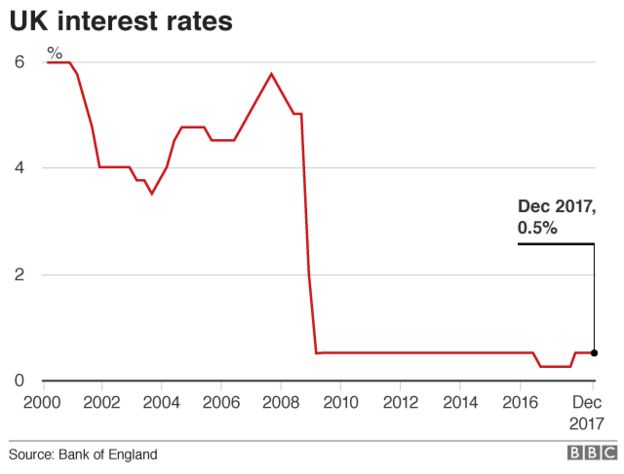
Interest rate graph
Last month the MPC decided to raise interest rates for the first time in 10 years.
It attributed the 0.25% rise to record-low unemployment, rising inflation and stronger global growth.
It also indicated there would be two more rises over the next three years.
In the minutes from its latest meeting the Bank said "modest" increases in interest rates would be needed over the next few years, but repeated previous promises that those rises would be "gradual and to a limited extent".
Higher interest rates have a big impact on the economy.
Of the 8.1 million households with a mortgage, 3.7 million - or 46% - are on either a standard variable rate or a tracker rate - which generally move in line with the official bank rate.
A move higher can also give savers a lift as High Street banks generally have to raise their rates of interest.

Thursday, December 14, 2017

Bloomberg News - New Africa Gas Comes at the Right Time for Europe

A week ago, Cameroon was getting ready to jostle for space in a global liquefied natural gas market already crowded with new supplies from the U.S. and Russia. Now the extra output couldn’t come at a better time.
France’s Perenco SA and U.S.-traded Golar LNG Ltd. will start shipments from their $1.2 billion LNG project off Cameroon in February, according to people familiar with the plans. That’ll be just in time for a surge of almost a third in European imports, according to consultants Energy Aspects Ltd., after a cold snap and disruptions at supply hubs in Austria, the U.K. and Norway sent gas prices to a four-year high.
“It’s good to see a new African exporter coming into the market,” Trevor Sikorski, head of natural gas and carbon research at Energy Aspects, said by phone. “An obvious market is Europe, particularly when the markets can be a bit stressed.”
Cameroon enjoys a geographical advantage in the European market. It takes about 11 days to ship a cargo to Britain, while a tanker from Qatar, Europe’s biggest supplier of LNG, takes about two weeks. Saving a few days may prove crucial during freezing weather or a sudden supply crisis -- a growing risk as the region’s own gas infrastructure ages and becomes vulnerable to breakdown.

Floating Facilities

The Cameroon project -- named Hilli Episeyo after its production vessel -- is only the second floating LNG facility to come into production worldwide, after Malaysia launched a vessel last year. While the latter was built from scratch, the Cameroon unit is a converted LNG tanker. Its success could trigger more investments in the technology, potentially helping companies such as Ophir Energy Plc, which needs funds for a project off Equatorial Guinea.
“Once this project demonstrates its technical, operational and commercial viability, smaller E&P companies and funding sources should become more willing to develop and finance such projects,” said Claudio Steuer, senior visiting research fellow at the Oxford Institute for Energy Studies.
The recent price jump on the continent has made northwest Europe a more attractive destination for tankers carrying the super-chilled fuel. The U.K. is now set to take the first LNG from Russia’s Yamal project, rather than Asia as initially expected. The $27 billion plant in northern Siberia started production earlier this month, while Cove Point in Maryland is readying for operations too.

Net Exporter

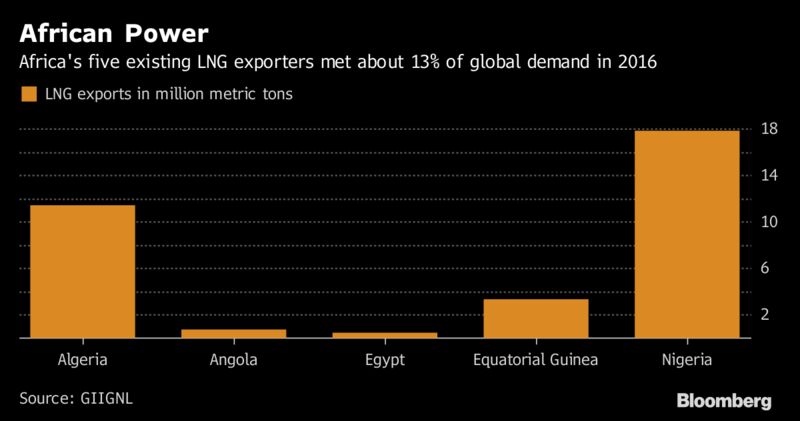
Russia’s Gazprom PJSC has an eight-year contract to sell Hilli Episeyo’s LNG. While the project is reasonably small -- 2.4 million tons a year compared with 5.5 million tons from Yamal’s first of three planned units -- it will make Cameroon a net gas exporter and the sixth African nation to supply LNG. Neighboring Nigeria is the biggest, while Angola, Algeria, Equatorial Guinea and Egypt also produce the liquefied fuel.
Perenco declined to comment, while Golar LNG didn’t return calls. Gazprom also didn’t immediately respond to a request for comment.
LNG projects such as Hilli Episeyo, while small, could be vital for meeting accelerating demand, according to OIES’s Steuer.
“Demand for LNG is growing three times faster than pipeline gas,” he said by email. “The industry needs a technically and economically feasible solution for smaller-capacity projects.”
Ship tracker Pan Eurasian Enterprises Inc. agrees, saying all extra production capacity will help to feed expanding need, especially in Europe.
For consumers on the continent, the Cameroon supply “won’t be a game changer,” Pan Eurasian President Zach Allen said. “But every little bit adds up.”

Friday, December 8, 2017

Reuters News - In break with decades of U.S. policy, Trump to recognize Jerusalem as Israel's capital

by Steve Holland
WASHINGTON (Reuters) - President Donald Trump will announce on Wednesday that the United States recognizes Jerusalem as the capital of Israel and will move its embassy there, breaking with longtime U.S. policy and potentially stirring unrest.

Despite warnings from Western and Arab allies, Trump in a 1 p.m. (1800 GMT) White House speech will direct the State Department to begin looking for a site for an embassy in Jerusalem as part of what is expected to be a years-long process of relocating diplomatic operations from Tel Aviv.
Trump is to sign a national security waiver delaying a move of the embassy, since the United States does not have an embassy structure in Jerusalem to move into. A senior administration official said it could take three to four years to build an embassy.
Still, Trump’s decision, a core promise of his campaign last year, will upend decades of American policy that has seen the status of Jerusalem as part of a two-state solution for Israelis and Palestinians, who want East Jerusalem as their capital.
Washington’s Middle East allies all warned against the dangerous repercussions of his decision when Trump spoke to them on Tuesday.
“The president believes this is a recognition of reality,” said one official, who briefed reporters on Tuesday about the announcement. “We’re going forward on the basis of a truth that is undeniable. It’s just a fact.”
Senior Trump administration officials said Trump’s decision was not intended to tip the scale in Israel’s favor and that agreeing on the final status of Jerusalem would remain a central part of any peace deal between Israel and the Palestinians.
In defending the decision, the officials said Trump was basically reflecting a fundamental truth: That Jerusalem is the seat of the Israeli government and should be recognized as such.
The Palestinians have said the move would mean the “kiss of death” to the two-state solution.
The political benefits for Trump are unclear. The decision will thrill Republican conservatives and evangelical Christians who make up a large share of his political base.
But it will complicate Trump’s desire for a more stable Middle East and Israel-Palestinian peace and arouse tensions. Past presidents have put off such a move.
The mere hint of his decision to move the embassy in the future set off alarm bells around the Middle East, raising the prospect of violence.
    “Our Palestinian people everywhere will not allow this conspiracy to pass, and their options are open in defending their land and their sacred places,” said Hamas chief Ismail Haniyeh.
Islamist militant groups such as al Qaeda, Hamas and Hezbollah have in the past tried to exploit Muslim sensitivities over Jerusalem to stoke anti-Israel and anti-U.S. sentiment.
‘SERIOUS IMPLICATIONS’
The decision comes as Trump’s senior adviser and son-in-law, Jared Kushner, leads a relatively quiet effort to restart long-stalled peace efforts in the region, with little in the way of tangible progress thus far.
“The president will reiterate how committed he is to peace. While we understand how some parties might react, we are still working on our plan which is not yet ready. We have time to get it right and see how people feel after this news is processed over the next period of time,” one senior official said.
Trump spoke to Palestinian President Mahmoud Abbas, Israeli Prime Minister Benjamin Netanyahu, Jordan’s King Abdullah and Saudi King Salman to inform them of his decision.
The Jordanian king “affirmed that the decision will have serious implications that will undermine efforts to resume the peace process and will provoke Muslims and Christians alike,” said a statement from his office.
Israel captured Arab East Jerusalem in the 1967 Middle East war and later annexed it. The international community does not recognize Israeli sovereignty over the entire city, home to sites holy to the Muslim, Jewish and Christian religions.
“We have always regarded Jerusalem as a final-status issue that must be resolved through direct negotiations between the two parties based on relevant Security Council resolutions,” United Nations spokesman Stephane Dujarric told reporters.
No other country has its embassy in Jerusalem.

Thursday, December 7, 2017

BBC News - First tax havens blacklist published by EU

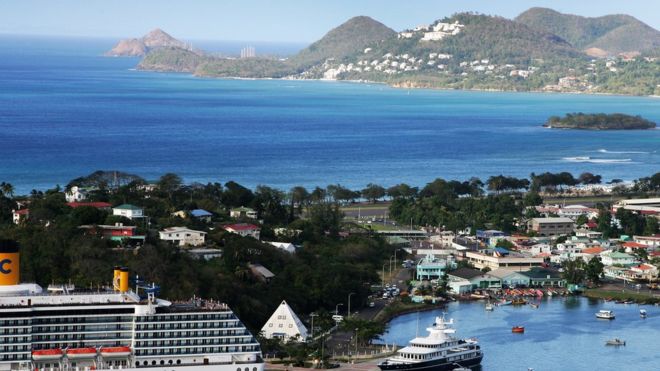
The European Union has published its first blacklist of tax havens, naming 17 territories including Saint Lucia, Barbados and South Korea.
Saint LuciaImage copyrightGETTY IMAGES
Image captionSaint Lucia is on the EU's 17 "non-cooperative jurisdictions"
A "watchlist" of 47 countries promising to change their tax rules to meet EU standards has also been issued.
The "grey list" includes several with UK links, including Hong Kong, Jersey, Bermuda and the Cayman Islands, as well as Switzerland and Turkey.
Both lists have been criticised as omitting the most notorious tax havens.
The lists follow the leaking of the Panama Papers and the Paradise Papers, revealing how companies and individuals hid their wealth from tax authorities around the world in offshore accounts.
EU tax commissioner Pierre Moscovici said the blacklist represented "substantial progress", adding: "Its very existence is an important step forward. But because it is the first EU list, it remains an insufficient response to the scale of tax evasion worldwide."
To determine whether a country is a "non-cooperative jurisdiction" the EU index measures the transparency of its tax regime, tax rates and whether the tax system encourages multinationals to unfairly shift profits to low tax regimes to avoid higher duties in other states. In particular these include tax systems that offer incentives such as 0% corporate tax to foreign companies.
EU members have been left to decide what action to take against the offenders. Ministers ruled out imposing a withholding tax on transactions to tax havens as well as other financial sanctions.
Some states, such as Luxembourg and Malta, opposed stricter sanctions, according to officials. EU Commission Vice-President Valdis Dombrovskis said "stronger countermeasures would have been preferable".
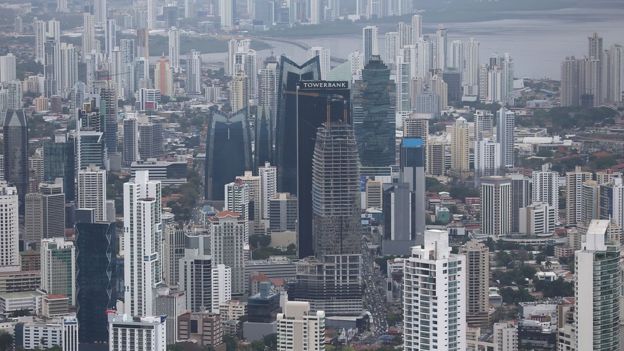
Panama is one of the 17 countries listed by the EU but its president, Juan Carlos Varela, said the country was "not in any way a tax haven".
Panama CityImage copyrightGETTY IMAGES
Image captionPanama is on the EU's tax havens blacklist
The EU is encouraging member states to take what it calls "defensive actions" against those countries that do not reform their tax systems.
The UK-based charity Oxfam last week published its own list of 35 countries that it said should be blacklisted.
Oli Pearce, Oxfam's inequality and tax policy advisor, said: "It is disturbing to see mostly small countries on the EU blacklist, while the most notorious tax havens - UK-linked places like Bermuda, the Cayman Islands, Jersey and the Virgin Islands - escape with a place on the 'grey list'.
"Although we recognise this is a step in the right direction, if EU leaders let too many tax havens off the hook we'll all lose out. A place on the grey list must not mean tax havens get off scot-free."
However, tax campaigner Richard Murphy said some countries on the grey list could still face heavy sanctions if they failed to reform their tax systems.
He said EU countries will be encouraged to disallow payments made to these places for tax purposes, or to charge withholding taxes on interest payments to them.
That tactic could "utterly neuter their so-called status as 'tax neutral international financial centres' by ensuring that all monies they receive have been taxed before getting there", Mr Murphy said.
"The EU is also saying to the UK that it is taking real measures against British Overseas Territories and Crown Dependencies, and the message is - if you go the same way as them with a similar low-tax regime after Brexit, you'll be sanctioned too."

The 17 blacklisted territories are:
  • American Samoa
  • Bahrain
  • Barbados
  • Grenada
  • Guam
  • South Korea
  • Macau
  • The Marshall Islands
  • Mongolia
  • Namibia
  • Palau
  • Panama
  • Saint Lucia
  • Samoa
  • Trinidad and Tobago
  • Tunisia
  • United Arab Emirates
The EU made exceptions for countries faced with natural disasters such as hurricanes, and put the process temporarily on hold.

Wednesday, December 6, 2017

Bloomberg News - A 709-Carat Diamond Found in Sierra Leone Sells for $6.5 Million


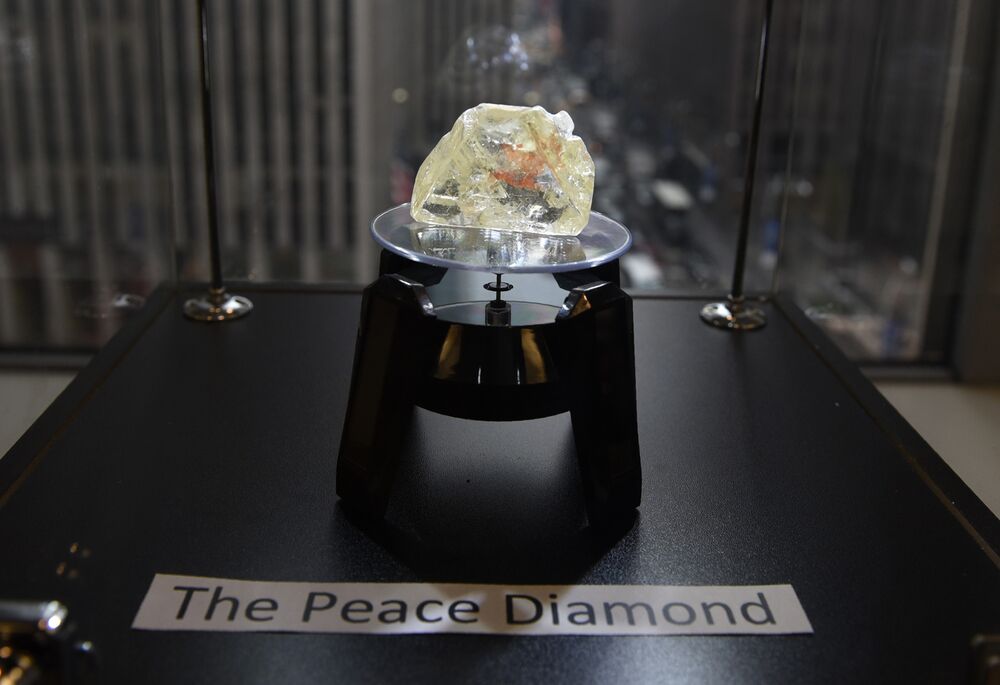
The Peace Diamond is displayed in New York on Dec. 4, 2017.
 Photographer: Timothy A. Clary/AFP/Getty Images

Freetown, Sierra Leone (AP) -- Officials say a 709-carat diamond found in Sierra Leone has been sold for more than $6.5 million.
The diamond is said to be the 14th-largest ever discovered, according to the Rapaport Group, which auctioned the stone in New York on behalf of Sierra Leone's government.
The company says 59 percent of the money will go to the government of the West African nation, while 26 percent will benefit the artisanal diggers who found the diamond. Its discovery in March caused a sensation.

The Rapaport Group has dubbed the stone the "peace diamond" and says its sale "will provide vital lifesaving infrastructure to the area where the diamond was found."

Tuesday, December 5, 2017

BBC News - UK economy to remain sluggish, says CBI

UK factory worker
Economic growth in the UK this year has been "timid" and will stay "steady but sluggish" in 2018, the CBI has said.
The business group says growth will be "tepid" amid Brexit uncertainty, while household spending will remain under pressure from squeezed wages.
The CBI expects subdued quarterly GDP growth of 0.3% until the end of 2019 - almost half the growth rate since 2013.
The body expects GDP to expand by 1.5% in both 2017 and next year, and fall to 1.3% in 2019.
It also argues that CPI inflation peaked at 3% in October, and should now ease gradually.
"After a timid 2017, UK economic growth is set to remain steady but sluggish, with less pep than we've seen over the past few years," said Rain Newton-Smith, the CBI's chief economist.
While domestic demand would remain soft, she said there were encouraging economic signs, including more support from exports, which have been buoyed by the lower pound and a resurgent global economy.
"The lacklustre rates of growth that we're expecting come against the backdrop of several years of persistently weak productivity, which is pushing down on the UK's supply potential," added Ms Newton-Smith.
"The government's newly announced Industrial Strategy can help address this challenge and boost living standards, but the recent White Paper is just a first step - consistency and determination is needed to make this a long-lasting success."
The CBI said it was clear Brexit was affecting business investment plans, with companies having to prepare for a "no-deal" scenario.

'Exporting opportunities'

Alpesh Paleja, the CBI's principal economist, added: "The global economy is firing on all cylinders, with the upturn in growth becoming more broad-based. We expect this to continue in the near-term, which will provide a supportive backdrop for trade and economic growth in the UK.
"Coupled with a lower pound, now is a good time for businesses to look at new exporting opportunities across the world."
It comes as a study by manufacturers' organisation the EEF found that demand for goods from European markets in particular was compensating for a weaker position in the UK.
Lee Hopley, EEF chief economist, said: "Stronger global growth has cemented the foundations for growth in manufacturing this year, but the sector's contribution to the UK economy has been greater than most expected."
She added: "There is some confidence that this momentum will carry into 2018, but as we head towards the Brexit end game we need manufacturing to produce the same trick."

Friday, December 1, 2017

Bloomberg News - The Blockchain Is Bigger Than Any Bubble

An influential new recruit has joined the chorus of bitcoin skeptics. The chief investment officer of UBS, the world’s biggest wealth manager, says it’s too risky to be added to the firm’s portfolios -- and his assessment is relatively mild. Others have called it “the very definition of a bubble” and even “a fraud.”
Those stronger terms are justified, especially after the latest spell of wild price volatility. But the idea underlying bitcoin -- blockchain, or distributed-ledger technology -- could be transformative.
The problem with bitcoin and other so-called digital currencies is that they’re a misuse of this technology. As either a new form of money or an investment, bitcoin has fatal disadvantages.
Tokens that are privately created -- "mined,” if you insist -- can succeed in a limited way as a means of exchange and be used to execute certain kinds of transactions. (Cigarettes in prison are a kind of currency.) But as a reliable store of value, bitcoin is much less useful, because its volatility is so extreme. The value of ordinary currencies is underwritten by governments and stabilized by central banks acting as trusted monopoly producers. Bitcoin and its rivals leave those vital roles vacant.
Moreover, bitcoin has no fundamental value as an asset -- no stream of future income, no ultimate assurance of liquidity or security, and (unlike gold, say) no alternative use. Its scarcity (hence some floor on its value) is purportedly guaranteed by the underlying technology, but most of its buyers simply take that on trust. Should they come to doubt that guarantee, its price will collapse.
In the meantime, bitcoin’s utility as a means of exchange depends on official tolerance -- a point rightly emphasized by UBS’s Mark Haefele. That tolerance cannot be taken for granted, especially as bitcoin’s appeal rests so much on the anonymity of its users. At the moment, its comparative advantage is its usefulness for illicit purposes.
All this said, the distributed-ledger technology that underlies bitcoin is potentially very powerful. By reducing the need for central intermediaries, it holds out the promise of processing transactions of various kinds more efficiently than today. Many banks and exchanges are exploring these applications.
Blockchain technology might also be used one day to produce new kinds of central-bank money. Central-bank digital currency could start to replace the electronic payment systems that financial institutions use with each other. A more radical idea is to use digital currency, issued and supervised by the central bank, at the retail level to replace physical cash.
All these ideas are worth study now. And they’ll still be worth pursuing after the bitcoin bubble bursts.
    To contact the senior editor responsible for Bloomberg View’s editorials: David Shipley at davidshipley@bloomberg.net .