Wednesday, January 10, 2018

BBC News - Global growth back at pre-crisis levels, says World Bank


The World Bank says global economic growth is likely to speed up this year, after a stronger than expected 2017.
The bank's new forecast is that the world economy will expand by 3.1% this year before slowing slightly.
It will be the first time since the financial crisis that growth is operating at its full potential.
However, the report warns the upswing will be short term, with gains in improving living standards and reducing poverty levels at risk long term.
For the immediate future, the bank sees a reasonably upbeat prospect.
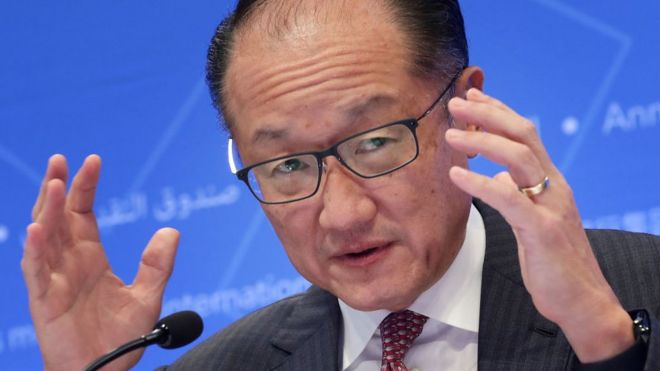
The bank's president Jim Yong Kim said: "The broad-based recovery in global growth is encouraging".
The forecast is better than what the bank was expecting in its previous assessment last June.
Among the large economies, the up-rating is especially marked for the eurozone, though the bank still thinks it will slow somewhat this year, but by less than its previous forecast.

Long-term growth

Emerging and developing economies will grow slightly faster than last year in this forecast.
However, the bank is worried about the longer term.
The issue is whether the world economy will have the capacity to maintain decent growth beyond the current upturn.
Its potential is growing more slowly than it used to, the bank says.
That's the result of years of lacklustre improvements in productivity - the amount each worker can produce - weak investment and an ageing workforce.
This slowdown in longer term prospects is widespread, the bank says. It affects countries that account for about two thirds of global economic activity.

The fact that in the bank's view the economy is close to operating at full capacity means that there's little scope to stimulate further growth with the standard policy tools that work by boosting demand for goods and services - interest rate or tax cuts or increased government spending.
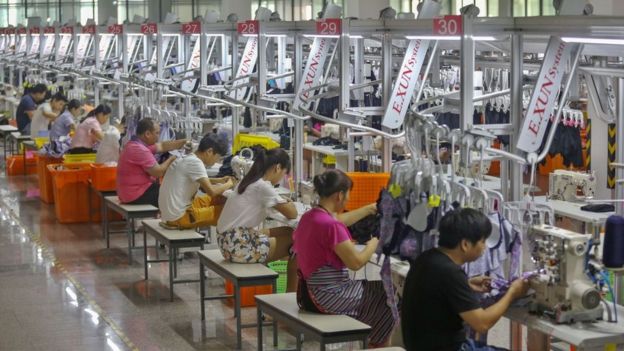
China's economy is expected to continue slowingImage copyrightGETTY IMAGES
Image captionChina's economy is expected to continue slowing
It says government should promote reforms to improve education and health services and infrastructure - such as roads ports, electricity supplies and telecommunications networks.
A healthier and better educated workforce is likely to be more productive, and better infrastructure makes it easier for business to be more productive too.
The weaker growth of the capacity of the economy is an increasingly persistent theme in the analysis of official economic agencies such as the World Bank and the International Monetary Fund
There are some marked variations in the forecasts between different regions. Africa and India are seen as likely to pick up a bit of speed this year.
China's slowdown, which began at the start of the decade, is predicted to continue, though with expected growth of 6.4% it's still strong.

Tuesday, January 9, 2018

Bloomberg News - China Changes the Way It Manages Yuan After Currency's Jump

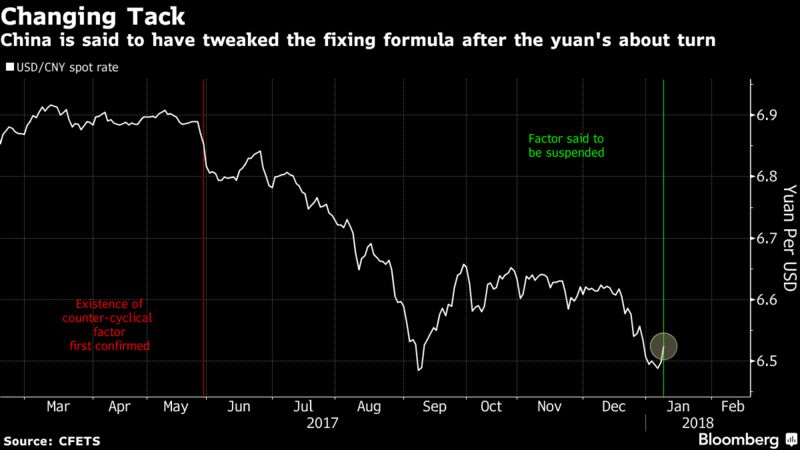
China’s central bank has made a change to the regime used to manage the yuan, effectively removing a component used by banks to calculate their submissions to the currency’s daily reference rate, according to people familiar with the matter.
The People’s Bank of China recently told some lenders that contribute to the rate -- known as the fixing -- to adjust their use of the “counter-cyclical factor” in such a way that it would have no impact on the mechanism, said the people, who asked not to be identified as the details are private. They said the change has already taken effect.
The yuan, which headed for its biggest drop in two months on the news, is allowed to move a maximum of 2 percent either side of the fixing. Analysts said the change shows China is confident in the yuan’s current trajectory, which has been one of steady appreciation.
China introduced the counter-cyclical factor last year in a bid to reduce volatility in the yuan, which had weakened for three straight years, triggering the introduction of capital controls.
Market watchers said it gave the PBOC more control over the currency, but undermined earlier efforts to make the yuan more accessible and market-driven. Greater control over the fixing -- along with a steady economy and a retreat in the dollar -- helped ignite a rally in the yuan in the second half.

PBOC Response

“This is not surprising as the expectation for depreciation has waned,” said Raymond Yeung, chief greater China economist at Australia & New Zealand Banking Group Ltd. in Hong Kong. “This suggests that the authorities expect to see the exchange rate to float within a reasonable range in the near term.”
In an email to Bloomberg News, the PBOC said that it’s up to the banks that contribute to the fixing to handle their own calculations. Lenders look to fundamentals when determining adjustments to the components that make up the factor, the central bank said.
The factor counteracts sentiment-driven volatility in the market and the potential for “herd behavior,” China Foreign Exchange Trade System, which falls under the central bank, said on its website around the time it was introduced.
It’s also typically been seen as a tool to address yuan depreciation without draining foreign-currency reserves. Goldman Sachs Group Inc. estimates that on most days since October, the fixing ended up stronger after the factor was incorporated.

Dollar Weakness

The onshore yuan fell 0.4 percent to 6.5258 per dollar as of 6:28 p.m. in Shanghai, set for its biggest one-day decline since Nov. 3. Offshore, the currency dropped 0.5 percent, the most since September. The change to the fixing is likely to boost volatility in the currency as it will allow for great flexibility, analysts at Nomura Holdings Inc. said.
The yuan’s strength over the past year paved the way for the policy shift. With the dollar in a protracted decline, outflows from China have slowed resulting in the yuan’s turnaround. The currency strengthened for the first time in four years in 2017, and reached a four-month high on Monday.
Until this shift, the yuan’s fixing was calculated based on the previous day’s closing price as of 4:30 p.m., its moves against a basket of currencies, and the counter-cyclical factor. The latter counteracted the impact of the previous day’s trading and any significant currency moves globally, people familiar with the matter told Bloomberg last May, thereby curbing excessive volatility.
The easing in depreciation pressure has allowed China to take a step toward making yuan trading more market-based.
“This is one direction to go -- and an easy way out -- if the authorities want to proceed with FX reform,” said Frances Cheung, head of Asia macro strategy at Westpac Banking Corp. in Singapore. “The recent yuan fixing pattern also suggests that the factor has not been utilized. That said, they reserve the flexibility to re-deploy the CCF if needed.”
— With assistance by Ran Li, Qizi Sun, Justina Lee, Tian Chen, Xiaoqing Pi, and Helen Sun

Monday, January 8, 2018

BBC News - Firms may face upfront VAT after Brexit

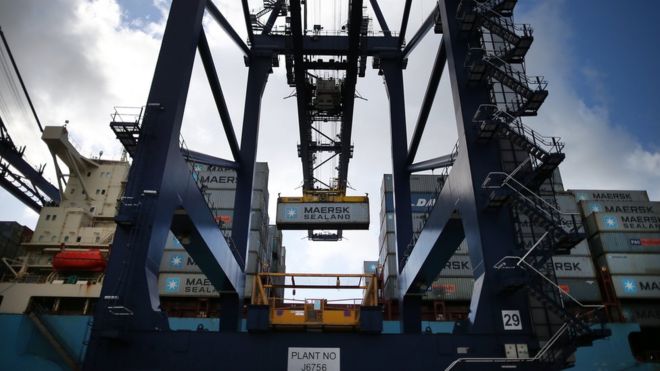
Container ship
The chair of the Treasury select committee has written to HMRC seeking clarification on what proposed new VAT rules will mean for companies.
Legislation that plans to change how imports from EU countries will be treated after Brexit has been drafted.
The Customs Bill will have its second reading in the House of Commons on Monday.
It could force tens of thousands of firms to pay VAT upfront in cash to HMRC.
Nicky Morgan, chair of the Treasury committee, said she would contact HMRC and will propose that MPs investigate the matter.
As Brexit comes closer, "we are beginning to see the reality of how it will bite", she said.
Under existing rules, goods imported from the EU are referred to as "acquisitions" for tax purposes.
No VAT is paid until the products have been sold to the final customer and paid for.
But unless the UK remains in the Customs Union, goods from the EU will have to be treated like all other imports after Brexit and will attract VAT by the 15th day of the following month.
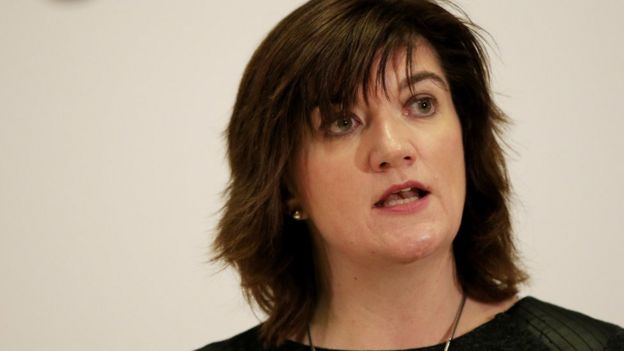
Nicky MorganImage copyrightPA
Image captionNicky Morgan chairs the Treasury select committee
The British Retail Consortium said it was concerned about the government's lack of strategy about VAT.
Helen Dickinson, its chief executive, said: "It's ridiculous to assume that it would be easy to bring forward the timings on such significant amounts of cash.
"To plan ahead, retailers need to know what their liability on tax will be, and what measures are going to be taken to avoid this hit to cash flow with new costs on importing goods from Europe and higher potential pressure on prices for ordinary shoppers."
She added: "Resolving this uncertainty can be achieved by securing a deal between the UK and EU on VAT and through policy measures adopted by HMRC like self-assessment."
The Treasury acknowledged in the Budget in November that businesses benefit from postponed accounting for VAT when importing goods from the EU.
"The government recognises the importance of such arrangements to business, due to the cash-flow advantage they provide.
"The government will take this into account when considering potential changes following EU exit and will look at options to mitigate any cash-flow impacts for businesses," the Budget statement said.
The Budget also stated that ministers aimed to keep tax arrangements "as close as possible to what they are now" after Brexit.

Friday, January 5, 2018

Bloomberg News - China to Set Economic Growth Target ‘Around 6.5%’

China will set its economic growth target at “around 6.5 percent” this year, according to people familiar with the outcome of a recent high-level planning meeting.
Top officials decided to maintain the same numerical goal as in 2017 at the Communist Party’s Central Economic Work Conference last month, according to the people, who asked not to be identified as the talks weren’t public. 
It’s not clear what the final wording of the target will be, including any qualification such as 2017’s commitment to seek faster growth, “if possible,” the people said. The final wording will be released at a meeting of the National People’s Congress in March, they said.
Economists surveyed by Bloomberg project 6.5 percent growth this year, though some observers including JPMorgan Chase & Co. have recently upgraded their outlook amid strong external demand. The growth target is usually officially unveiled following a meeting of the nation’s legislature in the spring.
At the work conference, Chinese leaders criticized regulators and finance officials for not having done enough to prevent disorder in financial markets, a buildup of leverage and the growth of local debt that had escaped central government scrutiny. An official statement following the conclave echoed the need to do more, and declared a three-year campaign against financial risk, pollution and poverty.
The world’s second-largest economy easily surpassed last year’s growth goal even amid Beijing’s broad crackdown on financial risk, and is poised for its first full-year acceleration since 2010. Fourth-quarter growth edged down to 6.7 percent, according to a Bloomberg survey before the report due for release on Jan. 18, from 6.8 percent in the third quarter.
The information office for the State Council, China’s cabinet, didn’t respond to a fax requesting comment. Reuters reported the growth target on Jan. 4.

Thursday, January 4, 2018

BBC News - TPP: Could UK really join Pacific trade group?

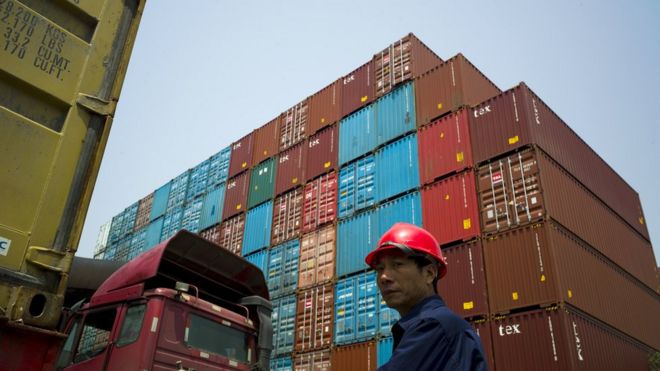
A worker stands in front of shipping containers
Britain is reportedly exploring joining the Trans Pacific-Partnership (TPP), as part of efforts to map out its trade future after Brexit.
Ministers have held informal talks on joining the proposed free trade group that includes 11 countries bordering the Pacific Ocean, according to the Financial Times.
And International Trade Secretary Liam Fox has not ruled out the UK joining the TPP.
Britain would be the first member of the trade agreement to not border the Pacific Ocean or the South China Sea.
Mr Fox said the UK wanted to see how the TPP evolved after America's exit from it before making such a move.
However, even mention of Britain entering negotiations has been met with scepticism from some trade experts who argue it's unlikely to lead to a deal - and even if it did happen, the UK would not have much clout.

What is the TPP?

The TPP pact is designed to deepen economic ties between member nations, by slashing tariffs and fostering trade to boost growth. The idea is to create a new single market not dissimilar to the EU.
Following eight years of negotiations an agreement had been reached, but that was thrown into doubt after President Trump honoured a campaign pledge and pulled out of the trade pact last year.
But the remaining 11 members - Canada, Australia, Chile, New Zealand, Brunei, Singapore, Japan, Malaysia, Mexico, Peru and Vietnam - have pressed on and are working towards ratifying an agreement which does not include the US.
  • TPP talks move ahead despite Canada wobble
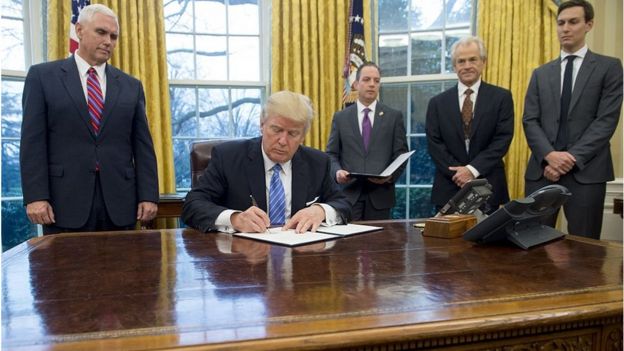
US President Donald Trump signs an executive order ending the US participation in the Trans-Pacific Partnership, alongside former White House Chief of Staff Reince Priebus, US Vice President Mike Pence and Senior Advisor Jared Kushner in the Oval Office of the White House
Mr Trump signs an executive order to pull out of the TPP

What would be in it for the UK?

Put simply, fresh trade opportunities after Brexit.
However, the very possibility of the UK entering into these talks has drawn criticism.
Labour MP and Open Britain supporter Chuka Umunna says new trade deals "would not come close to making up for lost trade with the EU after a hard Brexit".
And if the UK did join the TPP, it risks holding "little leverage" in talks, according to Aaron Connelly, research fellow at the Lowy Institute for International Policy.
He says nations are highly unlikely to reopen negotiations on sensitive matters, simply to accommodate the UK.
Given the urgency to seal a deal, Mr Connelly warns the UK would be a "price taker" on the terms of the pact, particularly in areas like pharmaceuticals, state-owned enterprises, labour and the environment.
"If Brexit was about symbolically taking back control in these areas, then joining the TPP would do little to accomplish that," he added.
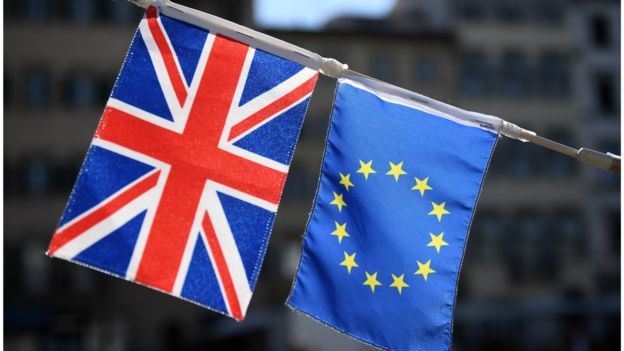
A UK flag appears next to a European Union flag

So is a deal likely?

A Department for International Trade spokesman says it is "early days" in the UK's quest to sign new deals.
"We have set up 14 trade 'working groups' across 21 countries to explore the best ways of progressing our trade and investment relationships across the world."
The government was "not excluding future talks" on trade agreements with group of countries.
If included, the UK would expand the reach of the TPP to countries beyond those that border the Pacific Ocean.
"It had always been the idea that the TPP would expand," says James Crabtree, associate professor of practice at the Lee Kuan Yew School of Public Policy in Singapore.
But he argues practical constraints make the UK's inclusion in the pact unlikely.
"The problem is there are all sorts of barriers to this happening," Mr Crabtree says.
Those include the TPP having not yet been ratified and the considerable uncertainty over the UK's final deal with the EU.
"It all sounds like a fairly desperate attempt by the British government to show that it has a vision for what happens after Brexit.
"They don't have many options, and trying to get into this symbolises that Britain is serious about trying to build trade relationships."

Analysis: By Andrew Walker, BBC economics correspondent

For some supporters of leaving the EU the opportunity to do new trade deals was one of the great attractions.
The members of TPP currently account for about 8% of British exports. The biggest single destination for UK goods and services in that group is Japan.
Easier access would certainly be worth having for many British exporters although they already have it with some TPP countries through deals done by the EU, and it's very unlikely to be enough on its own to compensate if there were to be any significant losses to trade with the remaining EU countries.
The British government is looking at other possibilities, the most important of which is the US.
At the time of the referendum, a negotiation with TPP would have encompassed the US as it was a member.
That would have made TPP a very important negotiating partner though still smaller than the EU as a British export destination.
But President Trump withdrew the US from TPP so the British government will have to negotiate separately.

Wednesday, January 3, 2018

Reuters News - Exclusive: South Korea to look at boosting outflows if won rally continues - sources

SEOUL (Reuters) - South Korea will look at ways to direct capital flows offshore if the won KRW= continues to soar, people familiar with the matter said, a move that could take heat out of the currency without upsetting Washington over the thorny topic of foreign exchange management.
Asia’s fourth largest economy is highly reliant on shipments of high-end goods such as ships, automobiles and electronics for its growth but also had one of the region’s hottest currencies in 2017, which has weighed on its export competitiveness.
People familiar with matter told Reuters on Wednesday the nation’s foreign exchange authorities may look into ways to spur investment abroad should the local currency appreciate on a consistent basis.
This would be separate to regulators’ market operations to curb the won’s volatility, which would still be conducted when required.
A spokesperson for the finance ministry, which is responsible for foreign exchange regulation, declined to comment on the matter.
The sources did not provide details on the potential measures and declined to elaborate when asked if the steps could include tax breaks similar to those announced in 2015.
Back then, South Korea offered up to 10 years in tax exemptions on investment gains from funds that put more than 60 percent of assets into overseas stocks. The scheme took effect in February 2016 and expired in December.
Rising domestic interest rates, strong exports and heightened U.S. scrutiny on South Korea’s foreign exchange regime have made it harder for Seoul to tame the won, which rose 13 percent last year, its best annual gain in 13 years.
Measures that encourage capital out of the country could help policymakers remove some of the upward pressure on the currency without needing to use direct intervention in the foreign exchange market, a sticking point in Seoul’s relations with the Washington.
South Korea posted current account surpluses for 68 straight months through to October last year, data from the Bank of Korea showed.
In October, the U.S. Treasury Department kept South Korea on a “monitoring list” of countries in its report on foreign exchange policies of its major trading partners, along with China, Japan and Germany.
In value terms, South Korean exports surged to their highest on record in 2017 thanks to soaring global demand for memory chips, cars and petrochemical products.
The government sees exports growing 4 percent this year, slowing from the 15.8 percent growth in 2017. In terms of the value of goods sold, South Korea exported $573.9 billion in 2017, marking it the best year since 1956 when such records began.
At the same time, the strong won has been a point of pain for local manufacturers.
A think tank from Hyundai Motor (005380.KS) last month flagged risks from the won’s strength against the Japanese yen, warning current levels could hurt demand for South Korean cars in markets such as Europe and the U.S. in the year ahead.
Citing its Hyundai Sonata sedan as example, Lee Bo-sung, a director at the think tank, said the model was only 2 percent cheaper than Honda’s Accord as of 2017 in the U.S. market, compared with 10 percent in 2011.
The won snapped six days of gains and weakened 0.3 percent against the dollar on Wednesday but closed just below its three-year high of 1,064.5 per dollar, hit on Tuesday.
Reporting by Cynthia Kim, Shin-hyung Lee; Additional reporting by Yena Park; Editing by Sam Holmes

Tuesday, January 2, 2018

BBC News - Saudi Arabia and United Arab Emirates introduce VAT for first time

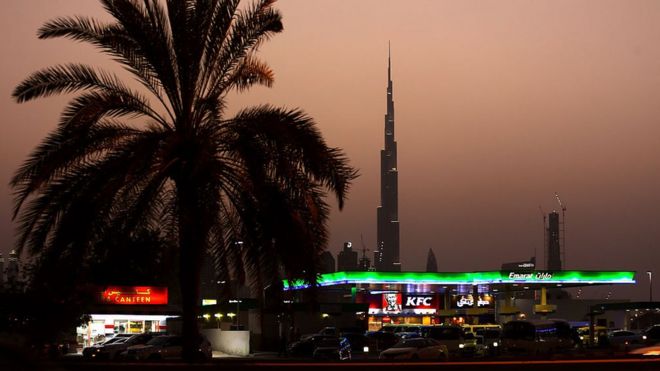
A petrol station and fast food restaurant in DubaiFood and fuel are among the things subject to VAT

Value Added Tax (VAT) has been introduced in Saudi Arabia and the United Arab Emirates for the first time.
The 5% levy is being applied to the majority of goods and services.
Gulf states have long attracted foreign workers with the promise of tax-free living.
But governments want to increase revenue in the face of lower oil prices.
The tax kicked in on 1 January in both countries.
The UAE estimates that in the first year, VAT income will be around 12 billion dirhams (£2.4bn; $3.3bn).

No plans for income tax

Petrol and diesel, food, clothes, utility bills and hotel rooms all now have VAT applied.
But some outgoings have been made exempt from the tax, or given a zero-tax rating, including medical treatment, financial services and public transport.
Organisations such as the International Monetary Fund have long called for Gulf countries to diversify their sources of income away from oil reserves.
In Saudi Arabia more than 90% of budget revenues come from the oil industry while in the UAE it is roughly 80%.
Both countries have already taken steps to boost government coffers.
In Saudi Arabia this included a tax on tobacco and soft drinks as well as a cut in some subsidies offered to locals. In the UAE road tolls have been hiked and a tourism tax introduced.
But there are no plans to introduce income tax, where most residents pay 0% tax on their earnings.
The other members of the Gulf Co-operation Council - Bahrain, Kuwait, Oman, and Qatar - have also committed to introduce VAT, though some have delayed plans until at least 2019.
Image copyright


Image captionFood and fuel are among the things subject to VAT