Friday, January 19, 2018

BBC News - China's economy grows by 6.9% in 2017

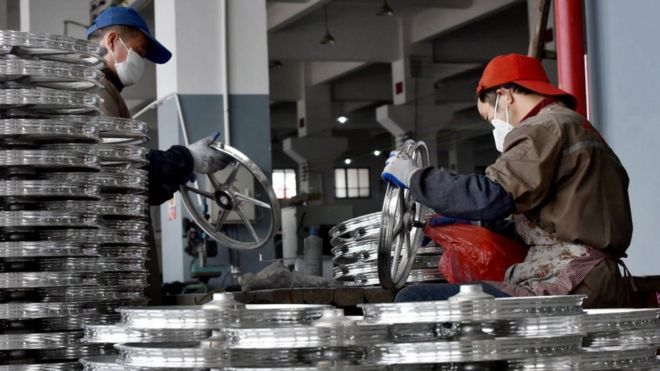
China bicycle factory
China's economy grew by 6.9% in 2017 according to official data - the first time in seven years the pace of growth has picked up.
The figure beats Beijing's official annual expansion target of about 6.5%.
China is a key driver of the global economy and so the better-than-expected data is likely to cheer investors around the world.
But many China watchers believe the GDP numbers are much weaker than the official figures suggest.
This month alone, the governments of Inner Mongolia and of the large industrial city of Tianjin have admitted their economic numbers for 2016 were overstated.
Taking the figures at face value, the 2017 growth rate is China's highest in two years. And it represents the first time the economy has expanded faster than the previous year since 2010.
However as Beijing ramps up efforts to reduce risky debt and to increase air quality, analysts said this may impact 2018 growth.
The numbers released on Thursday also showed that in the last three months of 2017, the economy grew at an annual rate of 6.8% - slightly higher than analysts had been expecting.

Analysis

Robin Brant, BBC China Correspondent, Shanghai

Two things stand out.
First, it looks like stronger exports - as the world economy picked up - and the final sputter of (another) government infrastructure investment spurt helped make 2017 better than expected.
But that's the model China is trying - gently - to get away from.
Second, is it true?
China's figures can be so stable, so in line with government targets, that it's hard to really believe them.
In the run up to these figures being published there's also been an unusual spate of honesty from several provincial governments, who've admitted faking their GDP or fiscal figures. All of which fed into the national picture.

China's debt has risen significantly in recent years, with worrying numbers around local government loans, corporate and household debt and non-performing bank loans.
The International Monetary Fund (IMF) said recently that the country's debt had ballooned and was now equivalent to 234% of the total output. It said Beijing needed to concentrate less on growth and instead help improve banks' finances, among other efforts.
Beijing meanwhile says it has been taking steps to contain risky debt despite the impact that might have on economic growth - efforts the IMF said it recognised.
The government has promised to continue tackling local government debt, among other efforts, and on Thursday vowed to help state-owned enterprises "leverage and cut debt ... and to repay their bonds on time this year".
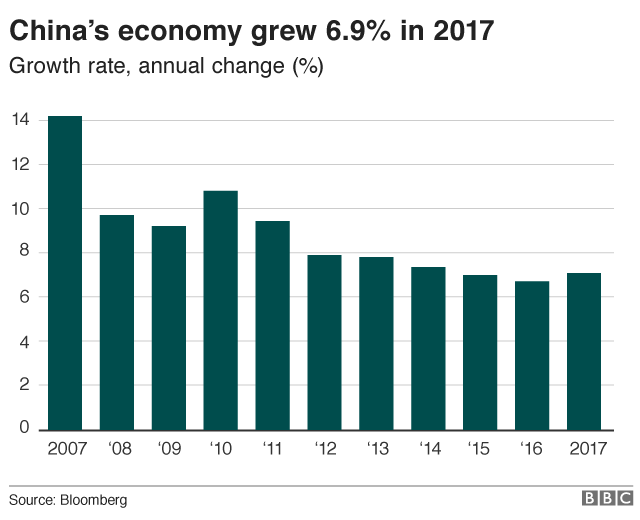
China's economic growth

Blue skies v economic growth

China's strict anti-pollution measures, which were introduced across 28 cities last year, are also expected to hurt economic growth in the short term.
The measures have included shutting down or cutting back production at factories in heavy industry like cement and steel.
Households have also been asked to switch to natural gas and electricity from coal, in an effort to curb pollution.
However this policy left millions without proper heating, and so was temporarily abandoned in December.
Chinese officials have said Beijing's air quality improved sharply in the winter of 2017 and heralded their efforts as a "new reality" for the country.

Thursday, January 18, 2018

Reuters News - U.S. financial crime fighters eye overseas virtual currency platforms: official

by Michelle Price
WASHINGTON (Reuters) - Financial crime fighters at the U.S. Treasury are “aggressively” pursuing virtual currency platforms that lack strong internal safeguards against money laundering, a top official told a Senate panel on Wednesday


With more criminals using the emerging asset class to store and transmit their ill-gotten gains, Treasury’s Financial Crimes Enforcement Network (FinCEN) will pursue malfeasant virtual currency platforms even if they are located overseas, Sigal Mandelker, the U.S. Treasury Department’s under secretary for terrorism and financial crimes, told the Senate Banking Committee.
U.S.-based platforms for bitcoin and other virtual currencies are required to comply with antimoney laundering (AML) rules including filing suspicious activity reports, with around 100 such platforms registered with FinCEN. But many other countries have no such requirements.
“The real vulnerability that we all have to address is that while we have regulatory authorities in place here in the United States and we do enforce those ... we need other countries to do the same,” Mandelker told the committee’s hearing on U.S. antimoney laundering laws.
Mandelker said the U.S. government would also encourage other countries to introduce stricter regulation of virtual currencies, which law enforcement officials say are attractive to criminals making illegal transactions because they can be used anonymously.
In July, the Treasury moved to shut down the website of Russia’s BTC-e exchange, one of the world’s largest bitcoin platforms, and ordered it to pay a $110 million fine for allegedly facilitating transactions involving ransomware, computer hacking, and drug trafficking, among other crimes.
A U.S. jury also indicted a Russian man in July in connection with the alleged crimes perpetrated by the platform.
Regulators and governments around the world are still debating how to address risks posed by cryptocurrencies. In recent weeks, South Korea, Japan and China have all made noises about a regulatory crackdown while officials in France vowed to investigate the emerging asset class.
Senators on Wednesday expressed concerns over the risks posed by cryptocurrencies to the global financial system with Democratic Senator Mark Warner saying the U.S. had “a lot of work to do” to get a grip on the issue.
U.S. markets regulators said this month they plan to take more aggressive enforcement action against exchanges that may be defrauding investors or allowing market manipulation.
The price of bitcoin slumped to $10,000 on Wednesday, halving in value from its peak price of almost $20,000 hit just in December, with investors gripped by fears regulators could clamp down on the volatile currency.
Reporting by Michelle Price; Editing by David Gregorio

Wednesday, January 17, 2018

BBC News - UK inflation rate drops back to 3%

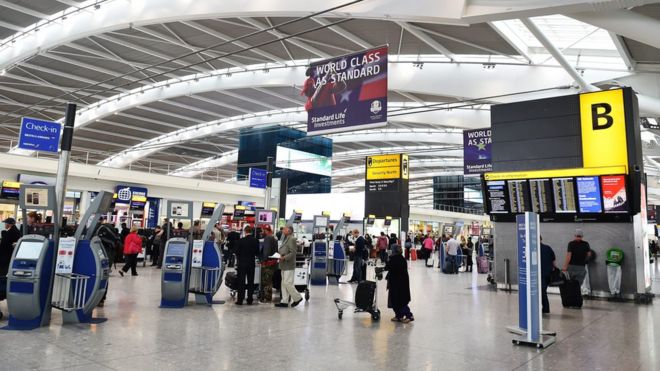
Passengers in Terminal 5 at Heathrow Airport
The UK's inflation rate has fallen for the first time since June, mainly because of the impact of air fares.
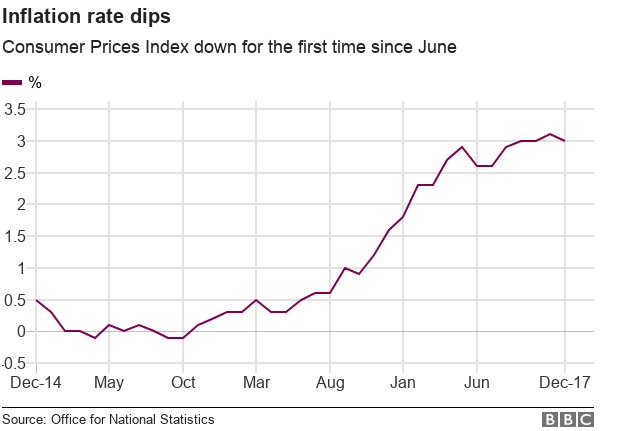
The inflation rate dipped to 3% in December, down from November's rate of 3.1% - a six-year high.
The Office for National Statistics (ONS) said that while air fares rose last month, it had a smaller impact than at the same point in 2016.
It added that a drop in the price of toys and games also contributed to December's fall.
The ONS said it was too early to say whether this was the start of a longer-term reduction in the rate of inflation.
The Bank of England has said it thinks inflation peaked at the end of 2017 and will fall back to its target of 2% this year.
The rate had been rising over the past year, partly due to the fall in the value of the pound since the Brexit vote which has pushed up the cost of imported goods.
Graph of inflation rate changes over three years
In November, the Bank's Monetary Policy Committee (MPC) raised its key interest rate for the first time in more than a decade from 0.25% to 0.5%.
But Samuel Tombs, chief UK economist at Pantheon Macroeconomics, said: "The continued weakness of underlying price pressures means that the MPC has little need to rush the next rate hike."
Aberdeen Standard Investments chief economist Lucy O'Carroll agreed there was no need for another quick rise in interest rates, but said: "What matters most for the long-term health of the UK economy is improving its productivity performance.
"If we can do that then the Bank of England may be able to keep rates low for a lot longer. But on recent experience, improving productivity is much easier said than done."

Analysis: Andy Verity, economics correspondent

Money
What a difference a 10th of a percentage point makes.
Inflation in the year to December was 3%, rather than the previous 3.1%, naturally generating predictions that it has now peaked.
One of the biggest factors driving inflation has been the inflated price of imports following the Brexit vote feeding through to the shops.
Yes, the vote and the devaluation of the pound following it was more than a year-and-a-half ago. But because many retailers buy their stock a year or two ahead, they have only felt the impact of costlier imports in the last few months.
For the same reason the recent rally in sterling, which if it lasts should bring down the cost of imports, isn't yet benefiting consumers. In fact, taking goods prices separately from services, inflation at 3.4% is higher than it's been for more than five years.
Even if inflation more broadly has peaked, the Bank of England has to bring it down over the next two to three years closer to its 2% target.
On that basis trading in the City currently forecasts the next interest rate rise will take place in August.

Wage growth

Laith Khalaf, senior analyst at Hargreaves Lansdown, said that the drop in inflation was not enough to "significantly ease the pressure on UK household spending" because wages were still rising by less than the rate of inflation.
However, he said that if that situation changed then "a sustained trend of falling inflation and better wage growth could spell happier times for the UK consumer, and the UK economy".
Howard Archer, chief economic adviser to the EY Item Club, said: "We suspect that relatively lacklustre economic growth will continue to limit domestic price pressures.
"Earnings growth seems likely to pick up only gradually as some firms remain keen to limit their total costs in a challenging and uncertain environment.
"Fragile consumer confidence may also deter some workers from pushing hard for increased pay rises, despite recent higher inflation and a tight labour market."
The Retail Prices Index (RPI), a separate measure of inflation, rose to 4.1% last month from 3.9% in November.
The ONS's preferred measure of inflation, CPIH, which includes owner-occupiers' housing costs, fell to 2.7% in December, down from 2.8% the month before.

Tuesday, January 16, 2018

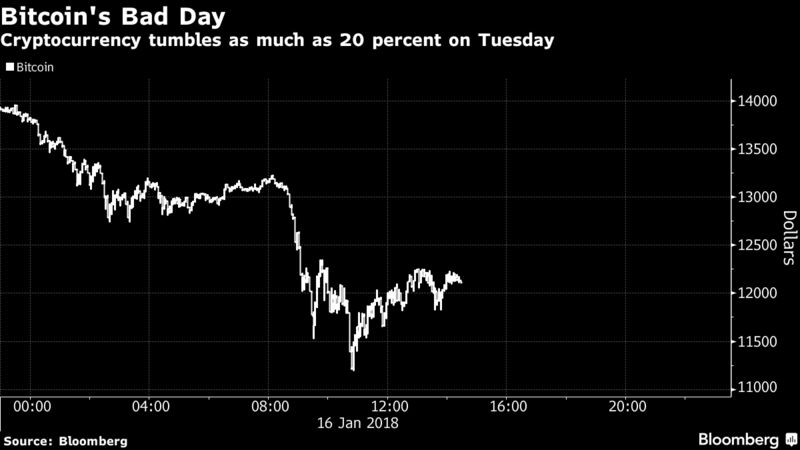
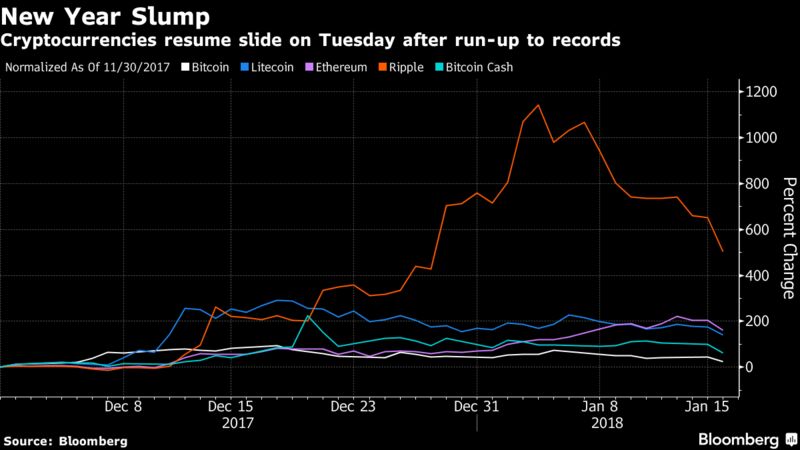
Bloomberg News - Bitcoin Tumbles 20% as Fears of Cryptocurrency Crackdown Linger

Monday, January 15, 2018

BBC News - Chile complains of World Bank unfair treatment

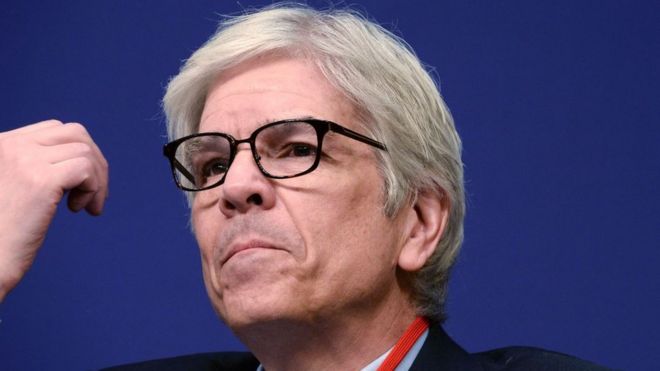
Paul Romer
Paul Romer is the World Bank's chief economist
Chilean officials have accused the World Bank of treating the country unfairly for several years.
Foreign Minister Heraldo Muñoz, tweeted "fake news was becoming fake statistics".
He was responding to an interview given by the bank's chief economist, Paul Romer, who said indicators for Chile may have been manipulated for political reasons to show a decline in Chile's business conditions.
The World Bank has ordered an enquiry.
In an interview given to the Chilean newspaper El Mercurio, the World Bank economist who had been responsible for the rankings, Augusto Lopez-Claros, said changes in methodology "took place in a transparent and open context," denying any political bias.
Chile currently ranks 55th out of 190 countries on the World Bank's closely watched annual "Doing Business" competitiveness rankings.
It had been 34th in 2014, the year socialist President Michelle Bachelet took office.
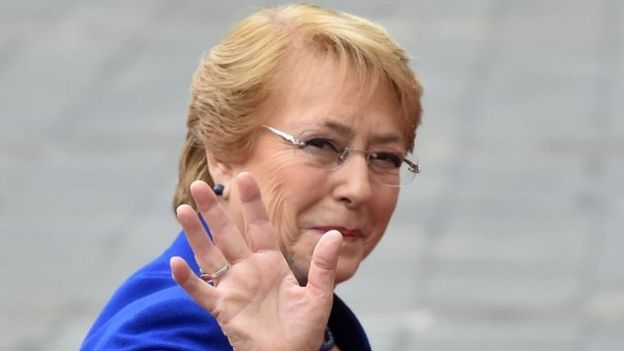
Chilean President Michelle Bachelet, July 2017
Ms Bachelet has been criticised by both the left and the right
"What happened with the World Bank's competitiveness rankings is very concerning, "said President Bachelet, whose four-year term ends in March.
"Rankings that international institutions conduct should be trustworthy, since they impact on investment and a country's development." she said, asking for a formal investigation.
Mr Muñoz called on Twitter for the bank to "calculate the possible loss in foreign investment because of the doubts caused by a lower competitiveness ranking during the administration of President Bachelet".
Chile's presidential elections last month were won by the conservative business tycoon, Sebastián Piñera against Ms Bachelet's preferred candidate, Alejandro Guillier, in part on promises to slash red tape and boost investment.
The World Bank's "Doing Business" rankings weigh factors such as the ease of starting a business, obtaining credit, paying taxes and getting construction permits.

Friday, January 12, 2018

Reuters News - Corporations may dodge billions in U.S. taxes through new loophole: experts

by David Morgan
WASHINGTON (Reuters) - A loophole in the new U.S. tax law could allow multinational corporations like Apple Inc to avoid paying billions of dollars in taxes on profits stashed overseas, according to experts.
Stemming from a Republican overhaul of international business taxes, the loophole involves the tax rates - 15.5 percent or 8 percent - that companies must pay on $2.6 trillion in profits they are holding abroad.
By manipulating their foreign cash positions, a determining factor under the new law, a U.S. multinational could potentially save money by shifting profits to the lower rate from the higher one, according to Stephen Shay, a senior lecturer at Harvard Law School.
The savings could amount to more than $4 billion in Apple’s case alone, he said.
An Apple spokesman declined to speak on the record about Shay’s analysis. U.S. Treasury Department and Internal Revenue Service officials did not respond to Reuters’ queries seeking comment.
“This is clearly the result of rushed legislation,” said Shay, formerly a top Treasury Department tax official.
The sweeping Republican tax law was President Donald Trump’s first major legislative triumph since he took office almost a year ago. Rushed through Congress, and approved over the unanimous opposition of Democrats, it took effect this month, delivering tax cuts and tax code changes that large, U.S.-based multinationals had sought for years.
One of those changes was a one-time tax break on about $2.6 trillion in profits that multinationals have socked away overseas in recent years under a “deferral” rule that let companies hold profits offshore tax-free, as long as the money was not brought into the United States, or repatriated.
There is no such deferral under the new law and accumulated overseas profits will now be taxed at either 15.5 percent for cash holdings or at 8 percent for more illiquid investments.
Both rates are far below the 35 percent rate that would have been charged on repatriated foreign profits before the law was passed, and below a new 21 percent corporate income tax rate.
To knock their taxes even lower, experts said, multinationals could have leeway to shift foreign earnings into the 8 percent tax bracket and out of the 15.5 percent bracket.
“Even before the legislation was unveiled in November, multinationals were planning to convert cash to non-cash assets, although it wasn’t entirely clear what would constitute cash for this purpose,” said Reuven Avi-Yonah, a leading tax expert at the University of Michigan Law School.
The loophole that makes the bracket-shifting possible involves a formula for calculating how much foreign earnings are subject to the higher tax rate. The benchmark is a company’s foreign cash position, calculated as the greater of either the average of the past two tax years, or the cash balance at the end of the last tax year begun before Jan. 1, 2018.
Companies would pay the 15.5 percent rate on sums up to the calculated foreign cash position. Anything over that would get the 8 percent rate.
Shay said some multinationals could reduce their cash positions, and the amount of money subject to the higher rate, through legitimate distributions including dividend payments.
He estimated Apple could have as much as $289 billion in foreign cash at the end of its current fiscal year on Sept. 30. Averaged across the last two tax years, the figure would be $234 billion.
To avoid paying 15.5 percent on the higher of those two figures, he said, Apple could distribute some of its cash through dividends or other means. Reducing its 2018 position by $55 billion to the lower, two-year average would save the company more than $4 billion in taxes, according to Shay.
The new law says transactions meant principally to reduce taxes due on foreign profits can be disregarded by U.S. tax authorities. But tax experts said this anti-abuse measure does not apply automatically and that corporate tax lawyers could argue it does not apply to legitimate corporate actions.
Reporting by David Morgan; Editing by Kevin Drawbaugh and Tom Brown

Thursday, January 11, 2018

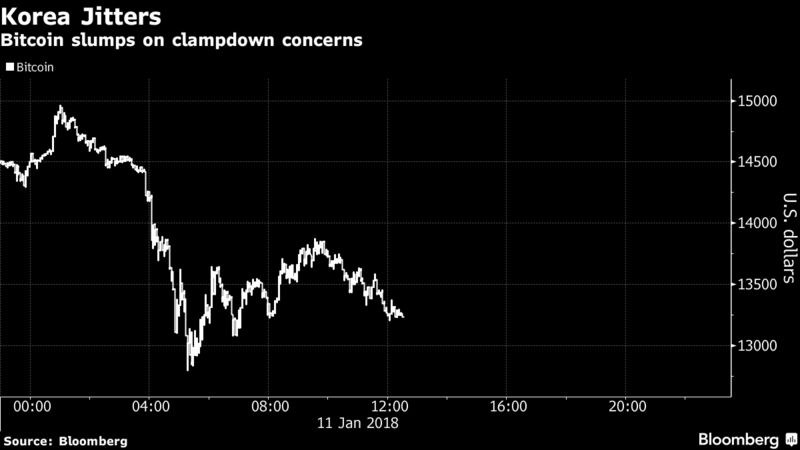
Bloomberg News - Cryptocurrencies Retreat Amid Concern of South Korean Clampdown