Wednesday, May 23, 2018

Reuters News - Small banks trump Wall Street on Dodd-Frank rewrite

by Michelle Price, Peter Schroeder

WASHINGTON (Reuters) - Congress on Tuesday rolled back some of the restraints imposed on banks after the 2007-2009 global financial crisis, but big players like Goldman Sachs Group Inc (GS.N), Morgan Stanley (MS.N) and JPMorgan Chase & Co (JPM.N), will not be breaking out the champagne.

While Wall Street banks lobbied hard for a range of provisions that would have weakened the 2010 Dodd-Frank reform law and boosted their profits, they got trumped by their smaller rivals, according to lobbyists, Congressional staff, bankers and disclosure records.
For example, the bill reduces federal oversight of banks between $50 billion and $250 billion in assets, and eases lending, capital and trading rules for smaller lenders, but big bank lobbyists and analysts agree it does little to help the nation’s largest lenders.
Large banks sought to raise that oversight threshold to $500 billion, or adopt a more flexible approach to big bank scrutiny, but small banks fought to fix the cap at $250 billion, concerned about alienating Democrats whose votes were needed to pass the bill in the Senate.
“We fought anything that would be added to the bill for the mega banks that would jeopardize the effort,” said Paul Merski, executive vice president at the Independent Community Bankers of America (ICBA), the main small bank lobby group, whose members have around $430 million in assets on average.
“We managed to get this legislation done in spite of the mega banks.”
Tuesday’s vote marks a major bipartisan legislative victory for President Donald Trump’s administration, which has promised to spur more economic growth by rolling back regulations.

OUTFOXED ON CAPITOL HILL

But while Trump-appointed regulators have been cutting Wall Street some slack in how they apply the rules, the rewrite showed how small banks outmaneuvered their big rivals on Capitol Hill, where Wall Street is still struggling to shake off its negative image.
One such accomplishment was the change in the bill that eased capital, lending and trading rules based on asset-size limits, rather than by firm type or activities, making it tougher for big banks to sneak in under the radar. In many cases this was set at $10 billion.
Dodd-Frank aimed to protect consumers from predatory lenders and mitigate systemic risk, but banks of all sizes have argued its burdens were excessive and have lobbied to reform the law.
Yet since the crisis, small banks have fought aggressively to distance themselves from the “too-big-to-fail” Wall Street titans bailed out to the tune of $700 billion in 2008.
This tension has sometimes spilled into public view, with JP Morgan Chief Executive Jamie Dimon calling Camden Fine, who retired from his longtime role as ICBA chief this month, a “jerk” during a 2016 TV interview.
Banks’ lobbying gained momentum after Republicans took control of Congress and the White House in 2016, but it was community banks which were able to wage a grassroots campaign to win over skeptical Democrats and secure their votes.
Armed with government data that showed the number of community lenders fell from around 8,400 in 2007 to around 5,500 today, they targeted moderates in states with many small banks but ideally no big players.
“This bill was perfectly crafted to allow greater flexibility for small community banks and credit unions...so it is purposeful that this bill does not include provisions for the largest banks,” North Dakota’s Senator Heidi Heitkamp, a key sponsor of the bill, told Reuters on Tuesday.
“The highest priorities for the largest institutions are nowhere to be found,” said Heitkamp, adding she had not committed to further easing of capital markets rules sought by banks.
Many of the Democratic backers, including Heitkamp, Montana’s Jon Tester and Indiana’s Joe Donnelly, are facing tough mid-term races in which pro-growth credentials and endorsements from small businesses could help swing votes, said analysts.
The Montana Bankers Association recently fielded its members to star in a commercial urging watchers to vote for Tester because he put politics aside “to cut red tape”.
“We wrote this bill to defend Montana businesses from overreaching government regulations,” Tester said in a statement on Tuesday evening.
Donnelly’s office recognized the support of the ICBA among a raft of other local business groups and said the bill “maintains the key elements of Dodd-Frank”.
Congress has not handed the small banks everything they asked for. For example, a farm bill including measures helpful to small banks was voted down by the House this month.
Many Democrats and consumer advocates, including Senators Elizabeth Warren and Sherrod Brown, also say the bill’s provisions on custody banks and bonds could be exploited by the big banks, potentially increasing systemic risk.
Still, big bank lobbyists privately say the Dodd-Frank rewrite, though a positive signal, did not go far enough.
Among the changes Wall Street banks sought, but did not get were: anointing a single regulator to oversee the Volcker Rule banning proprietary trading; weakening the top U.S. consumer watchdog; loosening liquidity rules and requirements for “living wills.”
“Banks of all sizes have spent eight years explaining to lawmakers and regulators why the rules put in place by Dodd-Frank were not all working as intended,” Ian McKendry, a spokesman for the American Bankers Association, which represents banks big and small, said in a statement.
“We think this is an important step forward, but there is more to do.”
Reporting by Michelle Price and Pete Schroeder; additional reporting by Katanga Johnson; Editing by Tomasz Janowski and Lisa Shumaker

Tuesday, May 22, 2018

BBC News - US and China halt imposing import tariffs

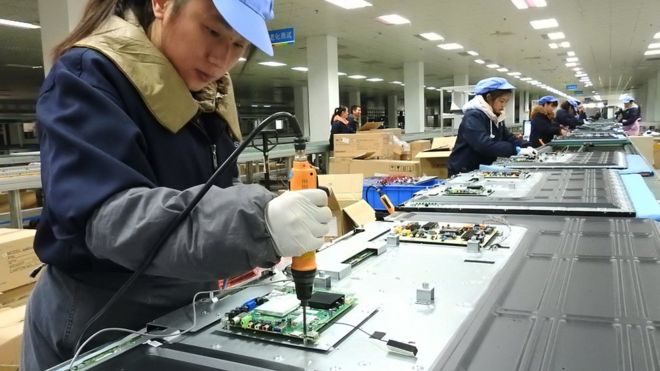
China television factoryImage copyrightGETTY IMAGES
Image captionChina's exports to the US far outweigh what it imports
China and the US say they will halt imposing punitive import tariffs, putting a possible trade war "on hold".
The deal came after talks in the US aimed at persuading China to buy $200bn (£148bn) of US goods and services and thereby reduce the trade imbalance.
US Treasury Secretary Steven Mnuchin did not give figures, but said the US would impose tariffs worth $150bn if China did not implement the agreement.
He said dialogue was the way to resolve such issues and "treat them calmly" in the future.

How did the prospect of a trade war come so close?

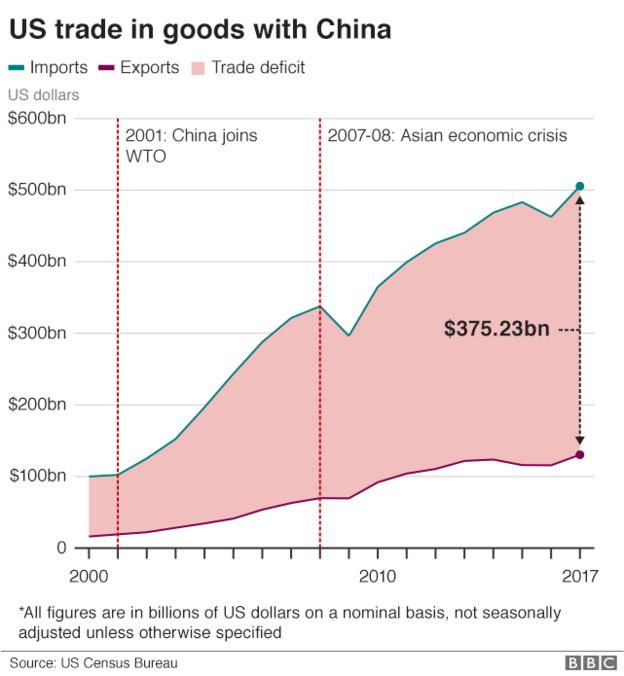
The US has a $335bn annual trade deficit with Beijing.
Before being elected, President Donald Trump had spoken of China "raping" the US, and promised to label it a currency manipulator on his first day in office.
This did not happen, but he ordered a review of the trade imbalance last August. It found a range of "unfair" practices in China, including restrictions on foreign ownership that pressured foreign companies into transferring technology, unfair terms on US companies, Chinese investments in US strategic industries and Chinese cyber-attacks.
In March this year, Mr Trump announced plans to impose tariffs on Chinese imports - mainly steel and aluminium.
Beijing threatened equal retaliation, including tariffs on a number of US imports - among them aircraft, soybeans, cars, pork, wine, fruit and nuts.

Is that threat now over?

Two days of talks ended in Washington DC on Friday with a framework agreement.
Mr Mnuchin told Fox News Sunday that China would buy more US goods "to substantially reduce the trade deficit".
Concrete numbers had been agreed, he said, although he refused to disclose if this meant China was buying $200bn in return for the US threat to be lifted. US Commerce Secretary Wilbur Ross would travel to China soon, he said, to work on details, which would involve industries - not just the two governments.
"We are putting the trade war on hold. Right now we have agreed to put the tariffs on hold while we try to execute the framework" of the agreement, Mr Mnuchin said.
But he warned that failure to implement it would result in the imposition of the threatened US tariffs.

Is China happy, too?

The Chinese vice-premier Mr Liu said his visit to the US had been "positive, pragmatic, constructive and productive".
US trade in goods with ChinaImage copyrightGETTY IMAGES
Presentational white space
He described a "healthy development of China-US economic and trade relations" which would result in enhanced co-operation in areas such as energy, agriculture products, healthcare, high-tech products and finance.
"Such co-operation is a win-win choice as it can promote the high-quality development of the Chinese economy, meet the people's needs, and contribute to the US effort to reduce its trade deficit," he added.
Mr Mnuchin said the new framework agreement included structural changes to Chinese economy to enable fair competition for US companies, but this would take time, China's vice-premier said.
And, perhaps because of that, he said the two countries "should properly handle their differences through dialogue and treat them calmly in the future".

Monday, May 21, 2018

Reuters News - Wall Street advances on trade war truce; Russell 2000 hits record

(Reuters) - U.S. stocks rallied on Monday after the United States and China put their trade differences “on hold” to work on a wider agreement, while sentiment was also boosted by the nearly $28 billion worth of merger deals.

The truce sparked a broad rally, with the Dow Jones Industrial Average .DJI touching a session high of more than two months and the small-cap Russell 2000 hitting a record high for the fourth straight session.
U.S. Treasury Secretary Steven Mnuchin said on Sunday the United States and China had agreed to drop their tariff threats, while China on Monday praised a significant dialing back of tensions.
“I suspect that we’ll continue to trend higher sans some major disappointing news,” said Gordon Charlop, managing director at Rosenblatt Securities in New York.
“This is an indication of what we’ll see near term, because we are through earnings, relatively light on macro data, and with geopolitics, it seems like some of the emotion has been reduced between now and the Korean summit.”
The S&P industrial sector .SPLRCI advanced 0.8 percent. Boeing (BA.N), which sells about a fourth of its commercial aircraft to Chinese customers, jumped 3.4 percent, the biggest percentage gainer on the Dow and lifting the blue-chip index higher.
At 12:41 a.m. EDT the Dow Jones Industrial Average .DJI was up 301.93 points, or 1.22 percent, at 25,017.02, the S&P 500 .SPX was up 20.44 points, or 0.75 percent, at 2,733.41 and the Nasdaq Composite .IXIC was up 41.91 points, or 0.57 percent, at 7,396.25.
General Electric (GE.N) advanced 2.6 percent on an $11.1 billion deal to merge its transportation business with rail equipment maker Wabtec (WAB.N), which jumped about 4.2 percent.
Still, not all U.S. business leaders were happy with the trade war truce, with some cautioning that Washington would find it tough to rebuild momentum to address what they see as troubling Chinese policies.
AK Steel (AKS.N) and U.S. Steel (X.N) both fell more than 4 percent following a delay in implementing tariffs on Chinese imports.
Micron (MU.O) rose 3.9 percent, the most on the S&P, after the chipmaker lifted its current-quarter forecast.
The easing of the trade dispute also boosted the chipmakers, whose major clients include Chinese firms, with the Philadelphia chip index .SOX gaining 0.9 percent. The technology sector .SPLRCT rose 0.8 percent.
Tesla (TSLA.O) jumped 2.9 percent on pricing of Model 3’s fully-loaded version and after brokerage Berenberg raised its already bullish price target.
Regional lender MB Financial (MBFI.O) jumped 13.3 percent after agreeing to be bought for $4.87 billion by Fifth Third Bancorp (FITB.O), which fell 7.8 percent, the biggest percentage decliner on the S&P.
On the downside, Celgene fell 3.6 percent and hit a four-year low, dragging on the Nasdaq Biotech index .NBI 0.8 percent lower.
Advancing issues outnumbered decliners by a 2.67-to-1 ratio on the NYSE. Advancing issues outnumbered decliners by a 1.64-to-1 ratio on the Nasdaq.
The S&P index recorded 32 new 52-week highs and 3 new lows, while the Nasdaq recorded 149 new highs and 26 new lows.
Reporting by Medha Singh in Bengaluru; Editing by Sriraj Kalluvila

Friday, May 18, 2018

BBC News - Iran nuclear deal: EU moves to avoid impact of US sanctions

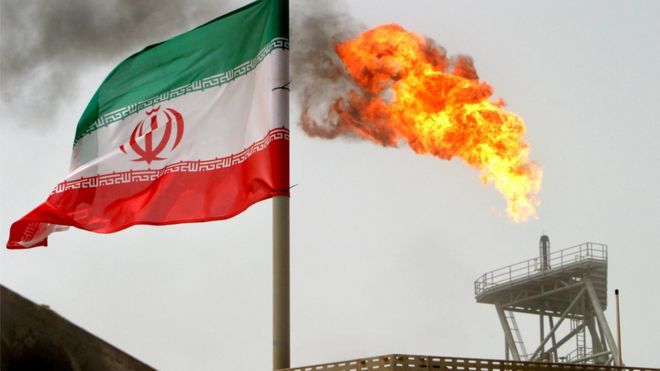
A gas flare on an oil production platform in the Soroush oil fields is seen alongside an Iranian flag in the Persian Gulf, Iran
European companies have invested heavily in Iran's energy sector

The EU has begun reviving legislation that will allow European companies to continue doing business with Iran, despite US sanctions, officials say.
The so-called "blocking statute" was introduced in 1996 to circumvent US sanctions on Cuba but was never used.
An updated version of the measure should be in force before 6 August, when the first sanctions take effect.
It will prohibit European companies from complying with the penalties and permit compensation for affected firms.
Washington is re-imposing strict sanctions on Iran, which were lifted under a 2015 international deal to control the country's nuclear ambitions.
"We have the duty, the Commission and the European Union, to do what we can to protect our European businesses, especially SMEs," European Commission President Jean-Claude Juncker said in a statement, referring to small and medium-sized companies.
The Commission - the EU executive - said the European Parliament and member states could raise objections to the statute. But the measure could also be activated sooner if there was strong political support.
It also announced:
  • The start of the formal process of allowing the European Investment Bank to lend to EU projects in Iran
  • It would urge EU governments to explore "one-off" transfers to Iran's central bank to help authorities to receive their oil-related revenues
  • It would continue and strengthen the assistance to Iran with Energy Commissioner Miguel Arias Cañete travelling to Tehran this weekend

What do the sanctions mean for Europe?

European businesses are worried that their ties with the US could be damaged if they continue doing Iranian deals.
Some of Europe's biggest firms had rushed to do business with Iran after the nuclear deal took effect.
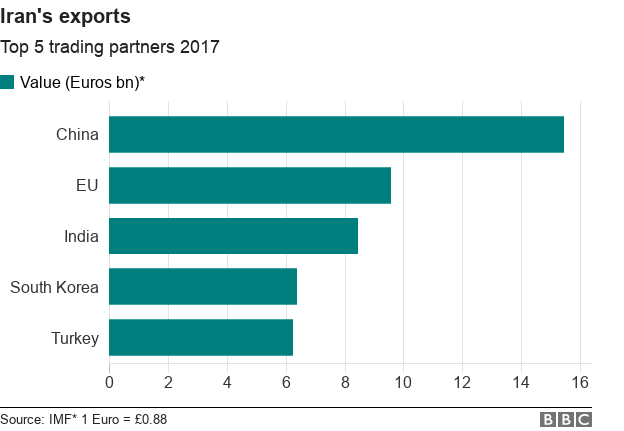
Iran's exports
In 2017, EU exports to Iran (goods and services) totalled €10.8bn (£9.5bn; $12.9bn), and imports from Iran to the bloc were worth €10.1bn. The value of imports was nearly double the 2016 figure.
Now, there are fears that billions of dollars' worth of trade and thousands of jobs could be jeopardised.
Some of the biggest deals that are at risk include:
  • French energy giant Total's deal, worth up to $5bn, signed to help Iran develop the world's largest gas field. Total now plans to unwind those operations by November unless the US grants it a waiver
  • Norwegian firm Saga Energy's $3bn deal to build solar power plants
  • An Airbus deal to sell 100 jets to IranAir

Why is the US imposing sanctions on Iran?

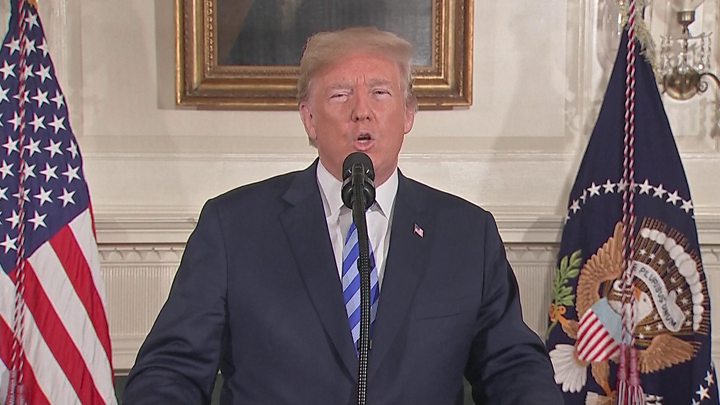
Media captionIran nuclear deal: Trump announces US pull-out
President Donald Trump pulled the US out of the Iran nuclear deal earlier this month and pledged to ramp up pressure on the country.
The agreement was signed by six world powers, alongside Iran, to curbed Iranian nuclear activities in return for the lifting of UN, US and EU sanctions.
But Mr Trump has denounced the "horrible" deal, and now Washington is re-imposing the strict sanctions.
Last week, the US sanctioned six people and three companies it said had ties to Iran's elite military force.
US individuals and entities are barred from doing business with them following the move.
The US position is at odds with that of France, Germany and the UK, which say they are committed to the agreement and to expanding trade with Iran.

Tuesday, May 15, 2018

Bloomberg News - World's Happiest Place Has Women to Thank for Big Wealth Gains

By Frances Schwartzkopff

Pedestrians walk across a waterway in the Aker Brygge district of Oslo. Photographer: Kyrre Lien/Bloomberg
The Nordic countries have grown considerably richer thanks to decades of policies designed to improve gender equality, according to the Organization for Economic Cooperation and Development.
The region, which consistently tops world happiness indexes, has spent the past 50 years bringing more women into the workforce in a shift that has added as much as 20 percent to economic growth per capita, the OECD said in a study published this week. The Paris-based organization says continued progress on gender equality in the labor market could add up to 30 percent to economic growth rates by 2040.
“The Nordic countries are an inspiration,” Angel Gurria, secretary general of the OECD, said in prepared comments. He pointed to structures designed to support families as being key.
“Nordic countries provide a continuum of support to families with children, consisting of generous paid leave for new parents; subsidized and high-quality early childhood education and care; and out-of-school-hours care.”
Female employment rates in the Nordic region range from 68 percent to 83 percent, according to the study. That compares with an OECD average of 59 percent. Higher Nordic employment rates follow official steps in the region to punish discrimination. For example, it’s illegal to fire women after they have children.
Perhaps it’s no coincidence that people living in the Nordic region, where schools and health care are free and parental-leave packages generous, are among the world’s happiest. Finland, Norway, Denmark and Iceland took the top spots in the 2018 World Happiness Report, with Sweden occupying ninth place.