Monday, June 11, 2018

BBC News - Economic growth struggles as manufacturing dips

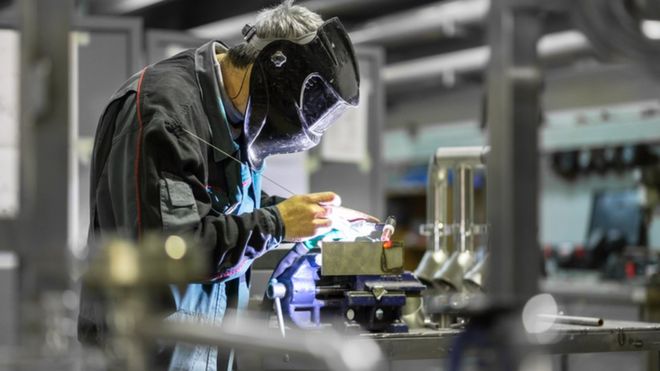
Factory worker
The economic "bounce-back" expected by the Bank of England is struggling to materialise, according to a leading economic forecaster.
The National Institute for Economic and Social Research (NIESR) said growth between March and May was just 0.2%,
The Office for National Statistics' official figures put growth at 0.1% for the first three months of the year.
Amit Kara, head of macro-economic forecasting at NIESR, said that the economy continued to "remain weak".
"Economic growth has slowed materially since the start of this year," Mr Kara said.
"One reason for sluggish growth is the disruption caused by severe weather in March, particularly to the construction sector.
"The latest data also shows a notable slowdown in manufacturing sector output that appears to be driven by both domestic and external conditions. By contrast, the retail sector and the dominant services sector may be recovering.
"Looking ahead, we expect the economy to strengthen from here mainly because monetary policy in the UK and elsewhere continue to remain accommodative.
"The risks to that outlook are, however, weighed to the downside.
"The most important of these remains Brexit but there are others, most notably an escalation of tensions in international trade and a potential flare-up in uncertainty in the Euro area because of political developments in Italy."

'Subdued'

NIESR 's growth figure follows new statistics from the ONS which reveal that manufacturing and construction output fell between February and April, the former at its fastest rate since 2012, raising fears the economy was not just hit by the bad weather of February and March.
"International demand continued to slow and the domestic market remained subdued," said Rob Kent-Smith, Head of National Accounts at the ONS.
Oil and gas production did bounce back following the re-opening of the key Forties pipeline which was shut down by technical problems in February.
The poor economic figures are likely to reduce the chances of an interest rate rise in August.
The Bank of England suggested last month that gradual interest rate rises were ahead if the economy strengthened after the poor 0.1% growth of January to March.
With that bounce-back now looking less likely, the chance of an imminent interest rate rise has receded and the pound weakened 0.3% in morning trading.

Friday, June 8, 2018

BBC News - Starting salaries rise at fastest rate for three years

by Lucy Hooker

Female workers at computers
Severe staff shortages are leading to rapidly rising starting salaries for those moving into new jobs, according to new research.
Employers are paying more "to attract the right people", the Recruitment and Employment Confederation said.
Salaries for workers moving into new permanent roles rose at their fastest rate for three years in May, the REC found.
Pay for workers moving into temporary jobs also continued to rise.
The REC's report is produced by IHS Markit and based on data from 400 UK recruitment and employment consultancies across all sectors of the economy.
This year it has shown an increase in demand for both permanent and temporary staff. But the data also pointed to a continued fall in the number of suitable candidates available.
Tom Hadley, REC policy director, said the rise in appointments meant employers were feeling confident, but a lack of candidates remained a major challenge for recruiters - particularly in areas such as nursing, engineering, manufacturing and IT.
He said staff shortages were becoming "business critical" in many key sectors and employers were having to "radically re-imagine" the way they recruit staff.
While in recent months employers had resorted to paying higher salaries to attract suitable candidates, Mr Hadley said it was time they considered other ways to achieve this such as more flexible working environments and better progression opportunities.
"Government can help by ramping up the UK skills base and ensuring a balanced and evidence-based immigration system," he added.

Gear change

The CBI, which representing employers, said salaries across the economy were rising only gradually when those staying in their existing jobs were included alongside those taking up new jobs - who tend to see faster salary rises.
Rain Newton-Smith, CBI chief economist, said it remained a puzzle as to why a shortage of skilled labour had failed to translate into greater wage growth.
While some areas such as engineering were seeing above inflation wage rises, salaries were not yet increasing rapidly across the economy.
The CBI's June economic forecast, published on Friday, suggested the UK risked remaining "in the slow lane" for economic growth, while other economies "motor ahead".
It said the economy could "shift up a gear" if the UK focused on improving productivity and taking advantage of the weak pound to boost exports.
The CBI is predicts economic growth of 1.4% for 2018 and 1.3% in 2019, down slightly from the 1.5% growth it predicted at the end of last year, in part due to the freezing weather this winter.

Thursday, June 7, 2018

Reuters News - Billions in U.S. solar projects shelved after Trump panel tariff

by Nichola Groom
(Reuters) - President Donald Trump’s tariff on imported solar panels has led U.S. renewable energy companies to cancel or freeze investments of more than $2.5 billion in large installation projects, along with thousands of jobs, the developers told Reuters.

That’s more than double the about $1 billion in new spending plans announced by firms building or expanding U.S. solar panel factories to take advantage of the tax on imports.
The tariff’s bifurcated impact on the solar industry underscores how protectionist trade measures almost invariably hurt one or more domestic industries for every one they shield from foreign competition. Trump’s steel and aluminum tariffs, for instance, have hurt manufacturers of U.S. farm equipment made with steel, such as tractors and grain bins, along with the farmers buying them at higher prices.
White House officials did not respond to a request for comment.
Trump announced the tariff in January over protests from most of the solar industry that the move would chill one of America’s fastest-growing sectors.
Solar developers completed utility-scale installations costing a total of $6.8 billion last year, according to the Solar Energy Industries Association. Those investments were driven by U.S. tax incentives and the falling costs of imported panels, mostly from China, which together made solar power competitive with natural gas and coal.
The U.S. solar industry employs more than 250,000 people - about three times more than the coal industry - with about 40 percent of those people in installation and 20 percent in manufacturing, according to the U.S. Energy Information Administration.
“Solar was really on the cusp of being able to completely take off,” said Zoe Hanes, chief executive of Charlotte, North Carolina solar developer Pine Gate Renewables.
GTM Research, a clean energy research firm, recently lowered its 2019 and 2020 utility-scale solar installation forecasts in the United States by 20 percent and 17 percent, respectively, citing the levies.
Officials at Suniva - a Chinese-owned, U.S.-based solar panel manufacturer whose bankruptcy prompted the Trump administration to consider a tariff - did not respond to requests for comment.
Companies with domestic panel factories are divided on the policy. Solar giant SunPower Corp (SPWR.O) opposes the tariff that will help its U.S. panel factories because it will also hurt its domestic installation and development business, along with its overseas manufacturing operations.
“There could be substantially more employment without a tariff,” said Chief Executive Tom Werner.

Wednesday, June 6, 2018

BBC News - Pound boosted as service sector growth picks up

Person pouring tea
The pound has risen after a closely watched survey suggested that growth in the UK's key services sector was faster than expected in May, renewing talk of a possible interest rate rise.
The purchasing managers' index (PMI) from IHS Markit/CIPS hit a three-month high of 54.0, up from 52.8 in April. A figure above 50 indicates expansion.
The PMI reading prompted a 0.6% rise in sterling against the dollar to $1.3386.
However, the survey also warned that growth could slow in the months ahead.
It found weak growth in new orders among companies, and also said that worries over Brexit remained.

Mixed outlook

The services sector accounts for about 80% of the UK economy. The latest PMI survey "signalled a solid upturn in overall business activity across the service economy", IHS Markit said.
Some of the improvement last month was due to companies catching up on work after heavy snow in early 2018. However, the survey also found that growth in new orders "continued to rise at a relatively subdued rate".
Chris Williamson, chief business economist at IHS Markit said: "The improvement in service sector activity adds to evidence that the economy is on course to rebound in the second quarter but... raises questions about the outlook.
"Disappointing inflows of new work suggest that growth could wane in coming months as Brexit-related uncertainty continues to weigh on spending decisions and dampen business confidence."
The services PMI comes after similar surveys of the manufacturing and construction sectors. Mr Williamson said that, taken together, the surveys indicated growth of 0.3-0.4% in the second quarter of the year, compared with just 0.1% in the first quarter.
He added that signs of economic growth rebounding could raise the chances of the Bank of England increasing interest rates again, "but with the forward looking indicators suggesting that the economy could relapse, a rate rise is by no means assured".

Cost pressures

The survey found that job creation growth was the second weakest since March of last year, with anecdotal evidence that it was being hampered by a lack of skilled candidates for jobs.
Meanwhile, costs were being pushed higher by rising oil prices and wages, "although subdued demand means firms are struggling to pass these higher costs onto customers", Mr Williamson said.
Samuel Tombs, chief UK economist at Pantheon Macroeconomics, said a second-quarter recovery for the UK's economy was "on track", giving the Bank of England a brief window to raise interest rates.
"May's services report increases our conviction that GDP growth will recover in Q2 following weather-related weakness in Q1," he said.
Howard Archer, chief economic adviser to the EY Item Club, said the latest batch of PMI surveys pointed to "a reasonable but hardly dynamic pick-up in UK economic growth in May".
"Furthermore, weakened new business growth maintains concerns over the outlook for the economy," he added.

Tuesday, June 5, 2018

Bloomberg News - S. Africa Economy Shrank Most in Nine Years as Zuma Era Crumbled

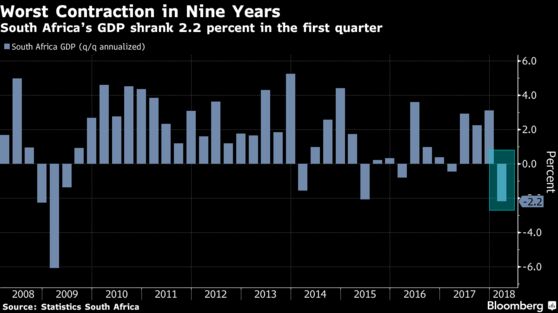
South Africa’s economy shrank the most in nearly a decade as Jacob Zuma handed the reins of power to Cyril Ramaphosa, racking up the worst performance of the former president’s tenure.
Output slumped at mines, factories and farms in the first quarter, with overall gross domestic product dropped by an annualized 2.2 percent compared with the prior three months, Statistics South Africa said on Tuesday in the capital, Pretoria. That’s the biggest decline in nine years, much larger than economists forecast.
Africa’s most-industrialized economy hasn’t grown at more than 2 percent a year since 2013 and is struggling to gain momentum despite political changes that bolstered investor confidence. Ramaphosa’s rise to power since December initially boosted sentiment and the rand following Zuma’s scandal-ridden tenure of almost nine years, but confidence indexes have now returned to levels they were at late last year as businesses seek real reforms.
Ramaphosa replaced Zuma as leader of the ruling party in December and as president in the middle of February.
“Ramaphoria has to be followed by concrete policy and concrete change, and I think that many want to see faster change,” Thabi Leoka, an independent economist, said by phone. “Currently I think we are still grappling with the demise and destruction and disruption of the past nine years.”
When measured against the first quarter of 2017, the economy expanded 0.8 percent.

First-Quarter Contractions

The economy has contracted in each first quarter for four of the past five years, and some economists say that this GDP report should be read with caution.
“The base that these numbers are coming off is really high,” Jeffrey Schultz, an economist at BNP Paribas in Johannesburg, said by phone. “This is going to be transitory in nature -- I expect a big bounce in the second-quarter figure.”
Mining and manufacturing, which comprise about a fifth of the economy, both declined in the period as prices for commodities such as gold and platinum were stagnant and producers closed operations.
Highlights from the release include the following:
  • Mining production contracted 9.9 percent from the previous quarter
  • Manufacturing shrank 6.4 percent
  • Agriculture declined the most, recording an annualized 24.2 percent contraction
  • Expenditure on GDP fell an annualized 2.5 percent
The South African Reserve Bank forecasts the economy will expand 1.7 percent this year and 2019 and 2 percent in 2020.
“The tertiary, secondary and primary sectors all performed worse, which means there was a broad-based slowdown across the economy,” Gina Schoeman, an economist at Citibank Inc., said by phone from Johannesburg. “This means we have to be concerned because they are probably going to have to revise down GDP forecasts this year.”
— With assistance by Simbarashe Gumbo, and Ana Monteiro

Monday, June 4, 2018

BCC News - Brexit 'weighing on business investment'

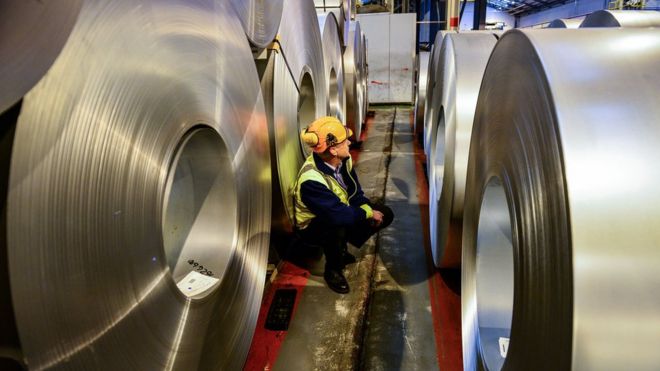
A worker inspects rolls of steel

Political uncertainty over Brexit is weighing on business investment, which has fallen to the lowest level for a year, a survey indicates.
The research, from manufacturing body EEF and accountancy advisers BDO, said the outlook for UK manufacturers was "slightly more subdued than it has been for some time".
The poll of more than 300 firms found they were "cautiously optimistic".
However, the EEF said growth was looking "fragile".
"Manufacturers are still seeing a positive picture and business confidence indicators are holding up looking forward to the second half of the year," it said.
But it pointed to "the easing of global growth" and suggested that "the continued political uncertainty of Brexit negotiations is weighing on investment".

'Crunch time'

EEF chief economist Lee Hopley said: "We continue to see signs of growth across manufacturing and, given weaknesses elsewhere in the UK economy, it is vitally important that we sustain this.
"However, the durability of this upturn is looking somewhat more fragile as many of the positive forces driving expansion last year, such as a resurgent eurozone, a surge in global manufacturing investment and competitive pound, are starting to fade."
Ms Hopley added: "New or heightened uncertainties have also come into play, not least what feels like crunch time in the Brexit negotiations, which have led to amber lights flashing again on the business investment outlook.
"This matters both for growth now and our longer-term productivity prospects."
BDO's Tom Lawton called on the government not to "lose sight of the needs of manufacturing, or indeed the wider economy, during the continuing EU negotiations".
He added: "I have no doubt that UK manufacturing will continue to be successful, but the right support and trading environment will make a huge difference to manufacturers."

Friday, June 1, 2018

Reuters News - U.S. job growth surges, unemployment rate falls to 3.8 percent

by Lucia Mutikani
WASHINGTON (Reuters) - U.S. job growth accelerated in May and the unemployment rate dropped to an 18-year low of 3.8 percent, pointing to rapidly tightening labor market conditions, which could stir concerns about inflation.

The closely watched employment report released by the Labor Department on Friday also showed wages rising solidly, cementing expectations that the Federal Reserve will raise interest rates this month. The bullish report also raises the possibility that the economy could overheat.
Overall, the U.S. economy looks strong,” said Paul Ashworth, chief economist at Capital Economics in Toronto. “In that environment, we still expect the Fed to hike interest rates an additional three times this year.”
Nonfarm payrolls increased by 223,000 jobs last month as warm weather boosted hiring at construction sites. There were also big gains in retail and leisure and hospitality payrolls. The economy created 15,000 more jobs than previously reported in March and April.
Last month’s one-tenth of a percentage point drop in the unemployment rate pushed it to a level last seen in April 2000. The jobless rate is now at a level that the Fed forecast it would be at by the end of this year.
Average hourly earnings rose eight cents, or 0.3 percent last month after edging up 0.1 percent in April. That lifted the annual increase in average hourly earnings to 2.7 percent from 2.6 percent in April.
The strong employment report added to a string of upbeat economic data, including consumer spending, industrial production and construction spending, that have suggested economic growth was regaining speed early in the second quarter after slowing at the beginning of the year.
The strength comes even as the stimulus from a $1.5 trillion income tax cut package and increased government spending is yet to filter through the economy. Renewed fears of a trade war after the Trump administration imposed tariffs on steel and aluminum imports from Canada, Mexico and the European Union, however, cast a dark cloud over the economic outlook.
Inflation is running just below the Fed’s 2.0 percent target. The U.S. central bank increased borrowing costs in March and forecast at least two more rate hikes for this year.
After the employment report, traders increased bets that the Fed would raise interest rates four times this year. U.S. Treasury yields rose and the dollar gained versus a basket of currencies. Stocks on Wall Street were trading higher.

BROAD JOB GAINS

Economists polled by Reuters had forecast nonfarm payrolls increasing by 188,000 jobs last month and the unemployment rate steady at 3.9 percent.
Monthly job gains have averaged about 179,000 over the last three months, more than the roughly 120,000 needed to keep up with growth in the working-age population. Though the labor market is viewed as being close to or at full employment, there is still some slack remaining.
The labor force participation rate, or the proportion of working-age Americans who have a job or are looking for one, fell to 62.7 percent last month from 62.8 percent in April. It has declined for three straight months.
Still, the labor market is getting tighter. A broader measure of unemployment, which includes people who want to work but have given up searching and those working part-time because they cannot find full-time employment, fell to 7.6 percent last month, the lowest since May 2001, from 7.8 percent in April.
With job growth expected to slow as employers struggle to find qualified workers, economists expected wage growth will pick up significantly.
The Fed’s latest Beige Book report of anecdotal information on business activity collected from contacts nationwide showed labor market conditions remained tight across the country in late April and early May. The Fed said contacts continued to report difficulty filling positions across skill levels.
There were notable shortages of truck drivers, sales personnel, carpenters, electricians, painters, and information technology professionals, the central bank said in its report published on Wednesday.
Job gains in May were across all sectors. Construction payrolls increased by 25,000 after rising by 21,000 jobs in April. Construction employment fell in March for the first time in eight months.
Manufacturers added another 18,000 jobs last month on top of the 25,000 created in April. Further gains are likely, with a survey from the Institute for Supply Management on Friday showing a pickup in factory activity in May. But some manufacturers said the steel tariffs were pushing up prices.
Government payrolls increased by 5,000, reversing April’s 3,000 drop. Retailers boosted employment by 31,100 jobs last month. Employment in the leisure and hospitality sector increased by 21,000 jobs.
Reporting by Lucia Mutikani; Editing by Andrea Ricci