Wednesday, June 20, 2018

Bloomberg News - South Africa May Hike Rates If Weak Rand Boosts Inflation, Central Bank Says

By Matthew Miller

The rand’s plunge to the weakest in almost seven months against the dollar may push up South African inflation and require interest-rate increases, central bank Deputy Governor Kuben Naidoo said.
While the South African Reserve Bank doesn’t target a specific level of the rand, it responds to second-round effects on prices from currency weakness, Naidoo said in an interview with Bloomberg TV in Sintra, Portugal, on Tuesday.
“If we do think there is a risk of second-round effects, we will have to act,” he said. Inflation was 4.5 percent in April, in the middle of the central bank’s target range. “But if it rises and if it’s forecast for rise, we will have to act.”
The Reserve Bank held its key rate at 6.5 percent last month after cutting in July and March, citing the cost of oil and wage increases as risks to the outlook for the pace of price increases. It sees inflation staying in its target range of 3 percent to 6 percent until at least the end of 2020. A government report on Wednesday will probably show the rate increased to 4.6 percent in May, according to the median estimate in a Bloomberg survey.
Forward-rate agreements starting in six months, used to speculate on borrowing costs, show traders are now pricing in a 66 percent chance of a 50 basis-point rate increase before the end of the year.

Inflation Expectations

After strengthening to a three-year high against the dollar following Cyril Ramaphosa’s ascent to the presidency, the rand has wiped out all those gains and at 13.7231 per dollar at 7:13 a.m. on Wednesday, it’s at levels last seen in early December. That adds to price-pressure risks, with inflation expectations -- as measured by the five-year breakeven rate -- now at the highest level in seven months.
The effect of the rand on prices will depend on how long it remains weak, Naidoo said.
“If you have much weaker currency persisting for a long time, it will have a much greater likelihood of causing inflation,” he said. “If the currency is back to 12.50 in a month’s time, it will have a much lower chance of causing inflation.”

Tuesday, June 19, 2018

BBC News - Brexit barriers could cost households £1k each, report argues

A lorry drives past an EU sign in Dover
Households could be left up to £1,000 a year worse off because of Brexit trade barriers, a report will suggest.
Global consultancy firm Oliver Wyman will say that under the most negative scenario of high import tariffs and high regulatory barriers the cost to the economy could total £27bn.
Business profits for supermarkets and restaurants could be wiped out because of supply chain disruption.
A rise in costs would likely be passed on to consumers, the report will argue.
The analysis, to be published next week and seen by the BBC, will make clear that even under the most favourable scenario of no tariffs and few regulatory barriers, there are likely to be increased "red tape" costs.
It will suggest that increased paperwork and delays for customs checks are likely to increase household costs by 1% a year, or £250 per household. The total cost to the economy would be £6.8bn.
Economists who support Brexit said that reports of significant economic costs post-Brexit were "alarmist" and that by focusing on the domestic economy, Britain outside the European Union could flourish.
The government has also made it clear that it wants a relationship with the EU that is as "frictionless" as possible when it comes to trade.
"While the outcomes of Brexit remain unclear, our analysis shows that any scenario will increase costs for UK households," said Duncan Brewer of Oliver Wyman, a consultancy firm that has done major pieces of work on the economic impact of Brexit for the financial services sector and retailers.
It has also worked for the government.
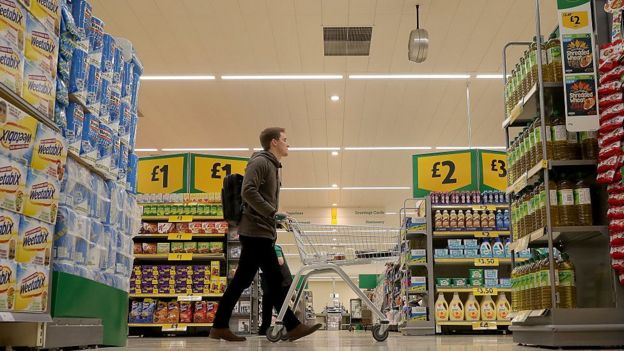
Supermarket shopperImage copyrightGETTY IMAGES
Image captionThe analysis warns that supermarket chains could see profits drop substantially
"A Brexit deal that results in no new tariffs with the EU is still likely to increase the red tape costs of imports, driving down profits for businesses, and driving up prices for consumers," Mr Brewer continued.
"Looking across the whole supply chain and taking into account multiple different Brexit outcomes, one thing is clear: Brexit will decrease profits for consumer businesses.
"The only question is by how much, which will depend on what deal is negotiated.
"While businesses will do all they can to absorb rising costs, we expect they will be forced to gradually put up prices for shoppers. If they don't, profits could vanish."
The Oliver Wyman analysis looks at different sectors and the possible consequences of Britain's new relationship with the EU.
It will suggest that a supermarket chain with annual takings of £10bn would see profits fall by a third under the most benign Brexit scenario modelled.
Prices would need to rise by 2.3% to compensate and ensure the business made as much profit as it did pre-Brexit.

'Too pessimistic'

The report follows a number of studies, including by government officials, that say there is likely to be a negative economic impact from Brexit.
Gerard Lyons, of the Economists for Brexit group, which supports Britain leaving the EU, said that although there might be a short-term "hit" from leaving the EU and the political process had not been "ideal", the greater room for manoeuvre for Britain once out of the union would have economic advantages.
"We need pro-growth policies, and should remember that 90% of global growth in the future will come from outside the euro-area," said Mr Lyons, a former chief economist of Standard Chartered bank and now chief economic strategist for Netwealth.
He said: "Judgements such as this [by Oliver Wyman] are far too pessimistic.
"Without the constraints that come from being a member of the EU, our economy can flourish."

Monday, June 18, 2018

Reuters News - China's tariffs on U.S. oil would disrupt $1 billion monthly business

SINGAPORE (Reuters) - China’s threat to impose duties on U.S. oil imports will hit a business that has soared in the last two years, and which is now worth almost $1 billion per month.

In an escalating spat over the United States’ trade deficit with most of its major trading partners, including China, U.S. President Donald Trump said last week he was pushing ahead with hefty tariffs on $50 billion of Chinese imports, starting on July 6.
China said Friday it would retaliate by slapping duties on several American commodities, including oil.
Investors expect the spat to come at the expense of U.S. oil firms, pulling down the share prices of ExxonMobil and Chevron by 1 to 2 percent since Friday, while U.S. crude oil prices fell by around 5 percent.
“This escalation of the trade war is dangerous for oil prices,” said Stephen Innes, head of trading for Asia/Pacific at futures brokerage OANDA in Singapore.
“Let’s hope cooler heads prevail, but I’m not overly optimistic,” he added.
Reuters Graphic
The dispute between the United States and China comes at a pivotal time for oil markets.
Following a year and a half of voluntary supply cuts led by the Middle East-dominated Organization of the Petroleum Exporting Countries (OPEC), as well as the non-OPEC producer Russia, oil markets have tightened, pushing up prices.
The potential drop-off in American oil exports to China would benefit other producers, especially from OPEC and Russia.
The OPEC kingpin Saudi Arabia and Russia indicated on Friday they would loosen their supply restraint and were starting to raise exports.
A cut in Chinese purchases of U.S. oil may also benefit Iran’s sales, which Washington is trying to curb with new sanctions it announced in May.
“The Chinese may just replace some of the American oil with Iranian crude,” said John Driscoll, director of consultancy JTD Energy Services.
“China isn’t intimidated by the threat of U.S. sanctions. They haven’t been in the past. So in this diplomatic spat they might just replace U.S. crude with Iranian oil. That would obviously infuriate Trump,” he said.
Reuters Graphic

BOOMING BUSINESS

China’s aggressive riposte to Trump took some in the industry by surprise.
U.S. crude exports to China have been rising sharply, thanks to a production surge in the past three years that was a welcome alternative to make up for the cut in supplies from OPEC and Russia.
“We’re caught by surprise that crude oil is on the list,” said an official with a Chinese state oil major, asking not to be named as he was not authorized to speak to media.
“We were actually preparing to raise imports according to an earlier government line,” he added, referring to a Beijing policy enacted earlier this year to help reduce the U.S. trade deficit with China.
U.S. oil exports, which have been surging thanks to a sharp increase in production in the past three years, were seen as a viable alternative to make up for the cut in supplies from OPEC and Russia.
Shipping data in Thomson Reuters Eikon shows that U.S. crude oil shipments to China have soared in value recently, jumping from just $100 million per month in early 2017 to almost $1 billion per month currently.
The threatened tariff would make U.S. oil more expensive versus supplies from other regions, including the Middle East and Russia, and likely disrupt a business that has soared recently.
“With Trump’s politics, we’re in a world of re-aligning alliances. China will not just swallow U.S. tariffs,” said Driscoll.
“This is tit-for-tat petroleum diplomacy,” he added. “The OPEC/non-OPEC cartel is the big beneficiary of all this oil diplomacy, as it will squeeze global spare oil capacity and likely push up crude prices.”

Friday, June 15, 2018

BBC News - China vows fast response to US tariffs

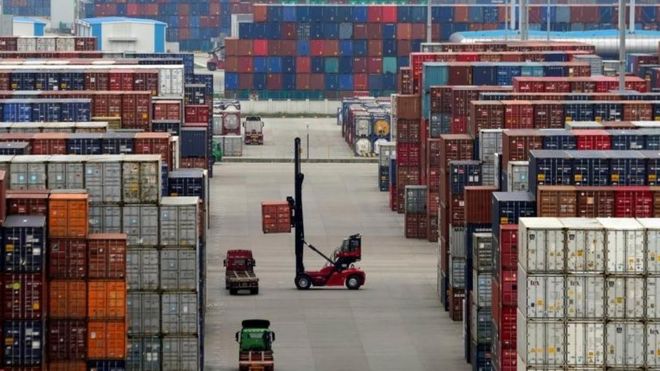
Containers at the Yangshan Deep Water Port in ShanghaiImage copyrightREUTERS
China will respond quickly to protect itself if the US hurts its interests with fresh trade tariffs, a foreign ministry spokesman has said.
The warning from Beijing comes as the US prepares to levy new tariffs on $50bn worth of Chinese imports.
On Thursday, US officials met at the White House to trim the original list of 1,300 categories to about 800.
Duties on foreign steel and aluminium, announced in March, have already gone into effect.
Those tariffs have already prompted Europe, Mexico, Canada and China to introduce or announce plans for counter-measures in retaliation.
The move threw the G7 meeting last weekend into disarray, with US President Donald Trump retracting his endorsement of the joint statement and lashing out at host Canada.
The US says its tariffs on Chinese goods come in response to what it categorises as theft of intellectual property.
The US wants China to stop practices that allegedly encourage transfer of intellectual property - design and product ideas - to Chinese companies, such as requirements that foreign firms share ownership with local partners to access the Chinese market.
In Beijing on Friday, Chinese foreign ministry spokesman Geng Shuang repeated earlier warnings that all trade talks between China and the US would be void if Washington imposed trade sanctions.
"Our position is still the same," he said.
"If the US takes unilateral and protectionist measures that harm Chinese interests, we will respond immediately by taking the necessary decisions to safeguard our legitimate rights and interests."

'Serious' impact

On Thursday, International Monetary Fund (IMF) director Christine Lagarde warned that the Trump administration's trade policies were likely to hurt the US economy and undermine the world's trade system.
She said a trade war would lead to "losers on both sides" and could have a "serious" impact.
While the IMF expects the trade dispute to have relatively minor economic consequences - slowing GDP by a fraction of a percentage point - Ms Lagarde said she was concerned about how the fight would affect sentiment.
"What is more critical and more difficult to factor in at the moment... is the actual impact on confidence," she said at a news conference in Washington.
The IMF said the White House, which has also threatened to withdraw from the North American Free Trade Agreement (Nafta), was responding to rising concerns about the side-effects of free trade.
"These measures, though, are likely to move the globe further away from an open, fair and rules-based trade system, with adverse effects for both the US economy and for trading partners," the IMF said

Thursday, June 14, 2018

Bloomberg News - Draghi Ends ECB Bond-Buying Era Saying Economy Can Beat Risk

Mario Draghi said the euro-area economy is strong enough to overcome increased risk, justifying the European Central Bank’s decision to halt bond purchases and close an extraordinary chapter in the decade-long struggle with financial crises and recession.
The euro fell after the central bank also pledged to keep interest rates unchanged at current record lows at least through the summer of 2019, a longer timeframe than investors had priced in. Policy makers will phase out bond purchases by the end of this year in what Draghi described as a unanimous decision.
By pushing ahead with a stimulus exit, officials are betting that the euro-area economy is robust enough to ride out an apparent slowdown amid risks including U.S. trade tariffs and nervousness that Italy’s populist government will spark another financial crisis.
“We’ve taken these decisions knowing that the economy is in a better situation, with an increase in uncertainty,” Draghi said at a briefing in Riga, where the Frankfurt-based ECB held its annual out-of-town meeting. While the recent economic “soft patch” may last longer, that doesn’t change the view of underlying momentum, he said.
The announcement came only hours after the Federal Reserve raised U.S. interest rates for the second time this year, highlighting how a decade of easy money in Europe and America is gradually coming to an end. Still, the People’s Bank of China opted not to follow the Fed in tightened borrowing costs, and the Bank of Japan is expected to maintain its stimulus when it meets on Friday.
The euro traded 1.2 percent lower at $1.1647 at 5:12 p.m. Frankfurt time. Economists in a Bloomberg survey had expected borrowing costs would rise around the middle of next year. Almost half of them had predicted the announcement on the end of net asset purchases to be put off until July.
ECB INTEREST RATES
Deposit rateMinus 0.4 percent
Main refinancing rateZero
Marginal lending rate0.25 percent
Draghi kept his options open. He said rates will stay at record lows for “as long as necessary” to keep inflation on a sustained path toward the goal of just under 2 percent over the medium term. The Governing Council didn’t discuss changing borrowing costs and ending asset purchases will be subject to incoming data.
“The rates will be changed depending on what is the state of the convergence process” of inflation, Draghi said. “I hope that in the next year, we will be giving an assessment of convergence that is positive and confident.”

Updated Projections

ECB cuts 2018 growth forecast and lifts inflation outlook for this year and next
Current risks to the economy “warrant monitoring,” but the president reiterated the view that the softening is partly due to temporary factors, and represents a pullback from the decade-high growth in 2017.

Wednesday, June 13, 2018

BBC News - Why US rates have a global impact

US central bankers are expected to raise a key interest rate again this week in response to healthy growth and low unemployment.
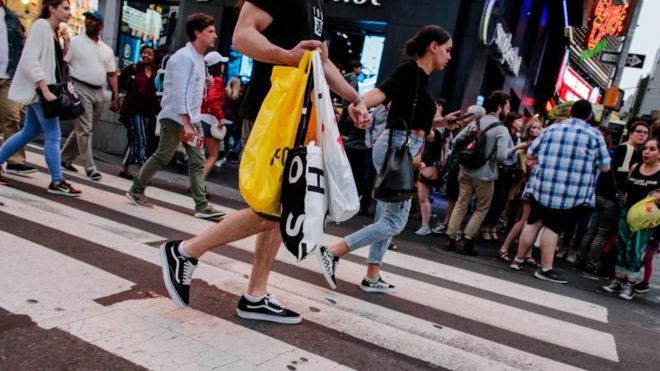
Shoppers Times Square
Policy makers at the US Federal Reserve are expected to raise the target for the Federal Reserve's benchmark rate by 0.25%, taking it to the highest since 2008, at 1.75% to 2%.
Fed officials are due to announce their decision later.
A rise would mark the Fed's seventh rate increase since 2015.
Officials aim to head off excessive inflation with higher rates and think the US economy can handle higher borrowing costs.
They are also shrinking the Fed's massive holdings of government debt and mortgage-backed securities, which were purchased to lift the economy out of the recession that ran from late 2007 to 2009.
As higher rates start to take hold, the repercussions are being felt in the US and overseas.

Global pain

Some of the most dramatic effects have appeared in emerging markets, as higher US rates lure back investors who had turned overseas in recent years in search of returns.
The retreat from emerging markets remains relatively modest, with weekly flows to bond and equity funds down less than 10% from their peaks, according to EPFR Global, part of research firm Informa.
But it has coincided with - and partially fuelled - a stronger dollar, contributing to currency crises in countries such as Argentina, Turkey and Brazil.
It has also prompted central banks elsewhere, including in Indonesia, Malaysia and Hong Kong, to raise their own interest rates in defence.
Countries that have seen the worst market turmoil have also faced political and financial problems of their own.
But the Fed may be underestimating its role, said Desmond Lachman, a fellow at the American Enterprise Institute and former head of emerging market strategy Salomon Smith Barney.
If the turbulence persists, it could hurt economies abroad, eventually reducing demand for US products and services, he added.
"Fed tightening is causing all sorts of problems for many emerging market countries and those problems can then come back to impact the United States," he said. The Fed "should be focused on it, but I don't know how much it is".

Consumer caution

In the US, banks are passing on higher borrowing costs to customers, raising the rates they charge for items such as credit cards, mortgages and car loans.
Consumer spending - a major driver of the US economy - has held up, as a strong economy gives people confidence they can shoulder the added cost.
But with US incomes still relatively flat, higher rates could eventually induce greater caution.
Signs of strain are already visible in parts of the economy dependent on borrowing, like the housing market, where the pace of home sales has weakened, amid low supply and high prices.
A strong job market has helped to limit the effects, but economists say rate rises could cause buyers to retreat, even though average mortgage rates - which topped 4.5% this spring - remain several points lower than before the financial crisis.
Fed officials are well aware wage growth has been sluggish, of course. They often cite it as a reason to be cautious about raising rates.
But they want to prevent dramatic price inflation, which many economists expect to accelerate after the US passed a massive tax cut last year.

Bank windfall

Higher interest rates should be a boon to savers, who stand to earn more on the money they have squirreled away in bank accounts.
But US banks by and large have been slow to boost the interest paid on savings and other accounts.
Banks offered an average interest rate of 0.15% for a typical savings account in March 2018, up just 0.03 percentage points from three years prior, according to data from the National Credit Union Administration.
So far, the paltry rates have helped to lift bank profits, without costing them accounts.
But analysts say customers will look for better terms if they see inflation start to eat away at their stockpiles.
Data suggests that inflation, which has lagged the Fed's target 2% rate in recent years, may be starting to pick up, so banks may have to start moving if they want to keep deposits

Tuesday, June 12, 2018

Reuters News - Historic Trump-Kim summit ends with promise, light on substance

SINGAPORE (Reuters) - U.S. President Donald Trump said North Korean leader Kim Jong Un pledged at a historic summit on Tuesday to move toward complete denuclearization, while the United States promised its old foe security guarantees.

The start of negotiations aimed at banishing what Trump described as North Korea’s “very substantial” nuclear arsenal could have far-reaching ramifications for the region, and in one of the biggest surprises of the day, Trump said he would stop military exercises with old ally South Korea.
But Trump and Kim gave few other specifics in a joint statement signed at the end of their summit in Singapore, and several analysts cast doubt on how effective the agreement would prove to be in the long run at getting North Korea to give up its cherished nuclear weapons.
“President Trump committed to provide security guarantees to the DPRK and Chairman Kim Jong Un reaffirmed his firm and unwavering commitment to complete denuclearization of the Korean Peninsula,” the statement said, referring to North Korea by the initials of its official name, the Democratic People’s Republic of Korea.
The two leaders had appeared cautious and serious when they arrived for the summit at the Capella hotel on Singapore’s Sentosa, a resort island with luxury hotels, a casino and a Universal Studios theme park.
Body language expert said they both tried to project command as they met, but also displayed signs of nerves.
After a handshake, they were soon smiling and holding each other by the arm, before Trump guided Kim to a library where they met with only their interpreters. Trump had said on Saturday he would know within a minute of meeting Kim whether he would reach a deal.
Trump later told a news conference he expected the denuclearization process to start “very, very quickly” and it would be verified by “having a lot of people in North Korea”.
U.S. Secretary of State Mike Pompeo and North Korean officials would hold follow-up negotiations “at the earliest possible date”, the statement said.