Wednesday, July 11, 2018

Reuters News - Judge rejects Trump request for long-term detention of immigrant children

(Reuters) - A U.S. federal judge on Monday rejected the Trump administration’s request to allow long-term detention of illegal immigrant children, a legal setback for President Donald Trump’s push to detain immigrant families taken into custody at the U.S.-Mexico border.
Los Angeles U.S. District Court Judge Dolly Gee dismissed as “dubious” and “unconvincing” the U.S. Justice Department’s proposal to modify a 1997 settlement known as the Flores Agreement, which says that children cannot be held in detention for long periods.
The government made its request in June after public outcry over its policy of separating children from parents who entered the United States illegally. A judge in a different case in San Diego ordered the government last month to reunite the families it had separated.
The government asserted in its Flores filing that the San Diego ruling would necessitate longer-term detention of children, since that would be the only way to both reunite them with their parents and keep the parents incarcerated during their immigration proceedings.
Gee rejected that argument.
“Defendants advance a tortured interpretation of the Flores Agreement in an attempt to show that the … injunction permits them to suspend the Flores release and licensure provisions,” she wrote.
Previous administrations often released families apprehended at the border to pursue their immigration claims while living freely in the United States. But Trump has vowed to end what he calls “catch-and-release.”
In a statement, U.S. Justice Department spokesman Devin O’Malley said the administration disagreed with the ruling but said it appeared to allow the government to continue some practices.
“Parents who cross the border will not be released and must choose between remaining in family custody with their children pending immigration proceedings or requesting separation from their children so the child may be placed with a sponsor,” he said.
The plaintiff’s attorney Peter Schey disputed that interpretation, saying the judge’s ruling deals with children and “does not address laws, regulations or rules dealing with the release of parents.”
Gee called the administration’s request for relief from the Flores agreement “a cynical attempt... to shift responsibility to the judiciary for over 20 years of congressional inaction and ill-considered executive action.”
Last week John Mendez, a U.S. District Court Judge in Sacramento appointed by former President George W. Bush, struck a similar note in a ruling on a case challenging California’s sanctuary law.
Mendez said he was joining an “ever-growing chorus” of judges to urge “elected officials to set aside the partisan and polarizing politics dominating the current immigration debate and work in a cooperative and bi-partisan fashion toward drafting and passing legislation that addresses this critical political issue.”
Additional reporting by Eric Walsh; Editing by Leslie Adler, Sue Horton and Neil Fullick.

Tuesday, July 10, 2018

Bloomberg News - Emerging-Market Carry Trade Makes Comeback

It’s looking like a good month for investors in the emerging-market carry trade.
Having been pummeled in the second quarter as the dollar strengthened and capital flooded out of developing nations, currency-arbitrage returns are turning positive again as the dollar loses ground. Traders borrowing greenbacks to buy the Mexican and Argentine pesos and the South African rand have been especially well-rewarded.

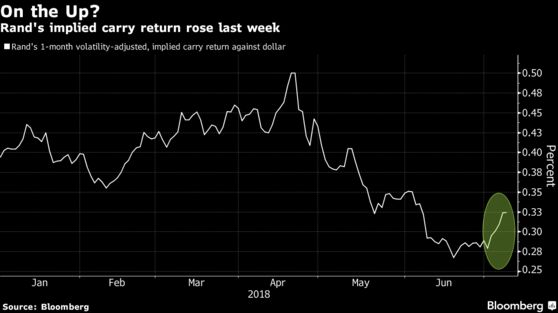
Coming Back

EM carry traders have had a good quarter so far
While most carry trades for major emerging currencies are still loss-making this year, their recovery in the past week could be a signal that fears over trade wars are ebbing and that central banks in developing nations are winning back the confidence of investors. Mexico raised its key interest rate to the highest level since 2009 on June 21, following similarly hawkish moves from Argentina, India, Indonesia, Philippines and Turkey.
Others, including South Africa, Brazil and Russia, have signaled that they’re ending rate-cutting cycles or are prepared to hike rates if their currencies come under more pressure. The Bloomberg Dollar index has dropped 1.7 percent from a one-year high on June 27, further boosting emerging-market currencies.
Investors are pricing in more good times to come in some cases. The rand’s implied carry return over the next month, adjusted for volatility, posted the biggest gain in a year last week and is now at the highest since early June.

Monday, July 9, 2018

BBC News - China and Russia hit back at Trump tariffs

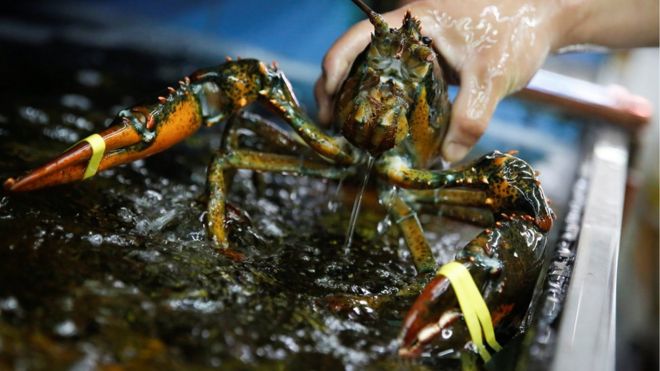
Lobster in Beijing imported from USImage copyrightREUTERS
Image captionUS lobsters are among goods subject to Chinese retaliatory tariffs
China has hit back after US tariffs on Chinese goods came into effect and President Donald Trump threatened to impose more.
China's commerce ministry said it had lodged a new complaint with the World Trade Organization (WTO).
Meanwhile, Russia has announced extra duties on US imports in retaliation for earlier US steel tariffs.
Beijing has accused the US of starting the "largest trade war in economic history".

What tariffs are now in effect?

US tariffs on $34bn (£25.7bn) of Chinese goods came into effect on Friday.
China retaliated by imposing a similar 25% tariff on 545 US products - including cars, soya beans and lobsters - also worth a total of $34bn.
Russia is introducing extra duties on a range of products imported from the US that can be replaced by locally made equivalents.
They include road-building equipment, products for the oil and gas industry, and tools used in mining.
Mr Trump has already imposed tariffs on imported washing machines and solar panels, and started charging levies on the imports of steel and aluminium from the European Union, Mexico and Canada.
The US tariffs imposed so far would affect the equivalent of 0.6% of global trade and account for 0.1% of global GDP, according to Morgan Stanley.

What is President Trump threatening?

The US president said America might target Chinese goods worth $500bn - the total value of Chinese imports in 2017.
The White House had previously said it would consult on tariffs on another $16bn of products, which Mr Trump has suggested could come into effect later this month.
Mr Trump said: "You have another 16 [billion dollars] in two weeks, and then, as you know, we have $200bn in abeyance and then after the $200bn, we have $300bn in abeyance. OK? So we have 50 plus 200 plus almost 300."
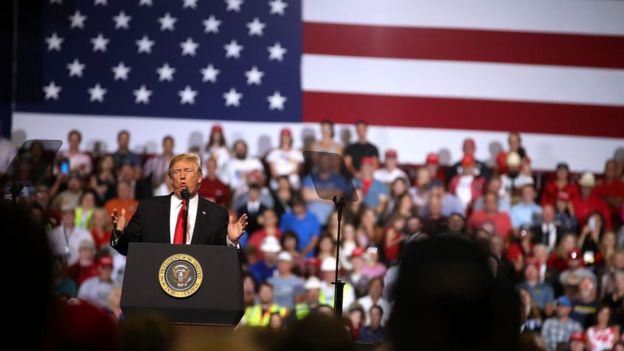
Donald TrumpImage copyrightGETTY IMAGES
Image captionDonald Trump says US tariffs will protect US jobs
The American tariffs are the result of Mr Trump's attempt to protect US jobs and stop what he calls "unfair transfers of American technology and intellectual property to China".
Presentational grey line

A conflicted administration

By Tara McKelvey, White House reporter
Behind the trade war, there is conflict within the Trump administration. Hardliners such as Peter Navarro, a trade policy adviser, says the US is defending itself against an "aggressive" China. Meanwhile, some of the officials who previously worked for the Obama administration - known as "holdovers" - are hoping to tamp down the US-China conflict.
The tension between these factions is occasionally on display in the West Wing. I've seen two hardliners struggle over a podium, vying for a chance to broadcast Trump's harsh message on economic issues, while the holdovers sit quietly at the side of the room.
This reflects a larger division in the White House: Trump and his closest aides are trying to bring about radical change, while those who support a more cautious approach find themselves sitting in silence.
Presentational grey line

What do China and Russia say?

"Trade war is never a solution," said Chinese Premier Li Keqiang. "China would never start a trade war, but if any party resorts to an increase of tariffs then China will take measures in response to protect development interests."
The government-run English language China Daily newspaper said: "The Trump administration is behaving like a gang of hoodlums with its shakedown of other countries, particularly China."
Russia says US tariffs on steel and aluminium, introduced in March, will cost its companies more than half a billion dollars.

Will there be a full-scale trade war?

Analysts at Bank of America Merrill Lynch forecast only a modest escalation in the US-China battle, adding: "However, we can't rule out a full-blown, recession-inducing 'trade war'."
Rob Carnell, chief Asia economist at ING, said: "This is not economic Armageddon. We will not have to hunt our food with pointy sticks.
"But it is applying the brakes to a global economy that has less durable momentum than appears to be the case."
Carmaker BMW said it could not absorb all of the 25% tariff on the cars it exports to China from a plant in Spartanburg, South Carolina and would have to raise prices.
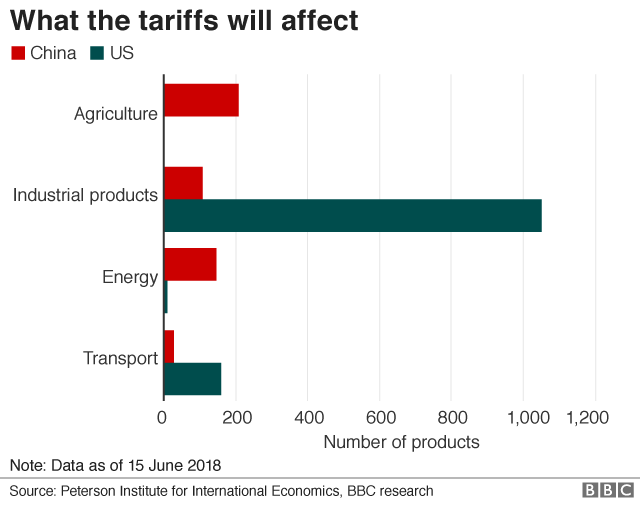
list of products
The new tariffs had little impact on Asian stock markets. The Shanghai Composite closed 0.5% higher, but ended the week 3.5% lower - its seventh consecutive week of losses.
Tokyo closed 1.1% higher and European markets were up more than 1% in morning trading before turning negative on Friday afternoon,

Friday, July 6, 2018

BBC News - Banks told to reveal tech meltdown plans

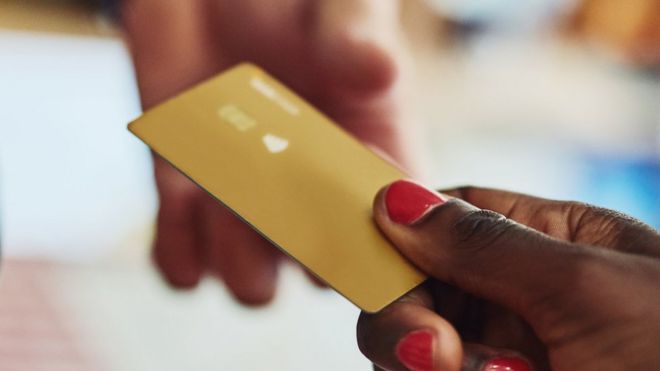
Person handing over a credit cardImage copyrightGETTY IMAGES
UK banks have been told to explain how they would cope with a technology failure or cyber-attack.
The Bank of England and the Financial Conduct Authority have given financial firms three months to detail how they would respond if their systems failed.
Some TSB customers were left unable to access online banking for more than a month following a botched systems upgrade in April.
Banks could be ordered to take action if their plans are judged to be poor.
The Bank of England and FCA have emphasised that senior management at banks will be held accountable for prolonged disruption to services.
The two organisations have launched a consultation seeking the views of customers as well as banks, insurers and other financial institutions.
The regulators have warned that upgrading computer systems to match services provided by newer financial start-ups could lead to service disruption.
In certain conditions, they have suggested that two days is an acceptable limit for disruption to service.
"Operational disruption can impact financial stability, threaten the viability of individual firms and financial market infrastructures, or cause harm to consumers," said FCA chief executive Andrew Bailey and the Bank of England's Jon Cunliffe, in a statement.
If the contingency plans put forward by banks and other financial institutions are judged to be unsuitable, they could be ordered to make their systems more resilient.

Wednesday, July 4, 2018

Bloomberg News - Merkel Raises Specter of Finance Crisis in Trade War Warning

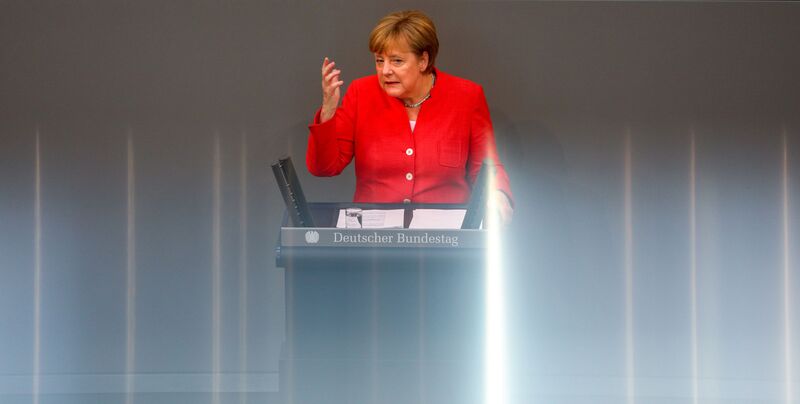
Angela Merkel on July 4 Photographer: Omer Messinger/AFP via Getty Images
German Chancellor Angela Merkel raised the specter of the global financial crisis as she warned of potential fallout from a trade war with the U.S., saying tariffs on European cars would be “much more serious” than levies on steel and aluminum.
Addressing the lower house of parliament in Berlin, Merkel said the global response to the market meltdown a decade ago showed that cooperation works better than one-sided measures. Faced with President Donald Trump’s threat to target U.S. imports of cars from Europe, German and French government officials plan to meet next week in Paris to coordinate strategy.
“The international financial crisis, which ensured that we now act in the framework of the G-20, would never have been resolved so quickly, despite the pain, if we hadn’t cooperated in a multilateral fashion in the spirit of comradeship,” Merkel said on Wednesday. “This has to happen.”
As the leader of Europe’s biggest economy, Merkel underscored her resolve to fight for the survival of post-World War II global institutions under attack by the Trump administration. Renewing an argument against U.S. criticism of German exports, she said the U.S. has a trade surplus with the EU if services are included.
Trump threatened in June to slap a 20 percent tariff on imported cars from Europe unless the EU removes tariffs and barriers “long placed on the U.S.,” a move that would hit Germany’s most important export machine. Mercedes-Benz maker Daimler AG revised its profit forecast last month, saying its exports are being hurt by global trade conflicts.
As the EU seeks talks with the U.S. to avert car tariffs, German Economy Minister Peter Altmaier will meet his French counterpart, Bruno Le Maire, to discuss trade during a visit to Paris on July 11-12, a German Economy Ministry spokeswoman said by email.
The U.S. Commerce Department is investigating whether imports of foreign cars threaten national security, an allegation the EU rejects.
Commerce Secretary Wilbur Ross said on Monday that it’s a “little premature” to discuss a U.S. withdrawal from the World Trade Organization, after Axios reported that the White House has drafted a bill that would allow Trump to ignore basic WTO rules.
Merkel, along with China, is at the forefront of efforts to counter Trump’s protectionist bent. While the EU retaliated against the U.S. levies on metals imports, it’s still pursuing talks to try to deflect car tariffs.

It Takes Two

European Commission President Jean-Claude Juncker said Friday he plans to meet Trump in Washington in July to “present the European point of view,” though he’s “not sure we will find an agreement.”
In her speech, Merkel said she’s reluctant talk about a trade war just yet.
“It’s worth every effort to try to defuse this conflict so it doesn’t turn into a war,” she said. “But of course it takes two sides to do that.”
By Patrick Donahue, Arne Delfs, and Birgit Jennen
(Updates with French-German talks on trade in second paragraph.)

Tuesday, July 3, 2018

Reuters News - Trump makes veiled WTO threat after EU warning on car tariffs

WASHINGTON/BRUSSELS (Reuters) - U.S. President Donald Trump warned the World Trade Organization on Monday that “we’ll be doing something” if the United States is not treated properly, just hours after the European Union said that U.S. automotive tariffs would hurt its own vehicle industry and prompt retaliation.

Trump, speaking to reporters during a meeting with Dutch Prime Minister Mark Rutte at the White House, said, “The WTO has treated the United States very, very badly and I hope they change their ways.”
His comments came after the Axios news website reported that Trump’s administration has drafted proposed legislation that would allow Trump to raise tariffs at will and negotiate special tariff rates with specific countries — two basic violations of WTO rules.
The United States has “a big disadvantage with the WTO. And we’re not planning anything now, but if they don’t treat us properly, we’ll be doing something,” Trump said, without elaborating.
Last week, a source familiar with Trump’s thinking told Reuters that the president has privately expressed a desire to quit the WTO, but that it was not a serious proposal.
Later on Monday, White House spokeswoman Sarah Sanders said Trump was focused on fixing problems in global trade, not on leaving the trade organization that has been a foundation of the postwar global trading system.
“Right now he’d like to see the system get fixed, and that’s what he’s focused on doing,” Sanders said. “He’s been clear that he has concerns, that there are a number of aspects that he doesn’t believe are fair. And China and other countries have used the WTO to their own advantage. We’re focused on fixing the system.”

U.S., EU TRADE TALKS?

During his meeting with Rutte, Trump also said that his administration would be meeting with EU officials to “work something out” on trade. The United States has imposed tariffs on European steel and aluminum imports and is conducting another national security study that could lead to tariffs on autos and auto parts.
“I think the E.U. — we’re going to be meeting with them fairly soon, Trump said. “They want to see if they can work something out, and that’ll be good, and if we do work it out, that’ll be positive, and if we don’t, it’ll be positive also, because we’ll just think about those cars that pour in here, and we’ll do something, right?”
A spokeswoman for the U.S. Trade Representative’s office could not be immediately reached for comment on further details about such talks.
The EU on Friday submitted comments warning the U.S. Commerce Department that U.S. import tariffs on cars and car parts were unjustifiable and would harm America’s automotive industry and likely lead to counter-measures by its trading partners on $294 billion of U.S. exports.
The Commerce Department launched its investigation, on grounds of national security, on May 23 under orders from Trump, who has frequently complained about the EU’s 10 percent car tariff being four times that of the United States, apart from the 25 percent U.S. levy on pickup trucks.
Trump said last week that the government would complete its study soon and suggested the United States would take action, having earlier threatened to impose a 20 percent tariff on all EU-assembled cars.
The European Commission, the EU executive body that handles trade for the bloc, said on Monday it was trying to convince its U.S. counterparts that imposing such tariffs would be a mistake.
“We’ll spare no effort, be it at the technical or political level, to prevent this from happening,” a spokesman for the commission told reporters, adding that commission President Jean-Claude Juncker’s trip to Washington later this month would seek to stop any new U.S. tariffs.
The EU exported 37.4 billion euros ($43.6 billion) of cars to the United States in 2017, while 6.2 billion euros worth of cars went the other way.
Trade graphic tmsnrt.rs/2MUPYOo
In its submission, the EU said EU companies make close to 2.9 million cars in the United States, supporting 120,000 jobs, or 420,000 if car dealerships and car parts retailers are included.
Imports had not shown a dramatic increase in recent years, it said, and had grown largely alongside overall expansion of the U.S. car market, with increased demand that could not be met by domestic production.
The submission said that tariffs on cars and car parts could undermine U.S. auto production by imposing higher costs on U.S. manufacturers. The EU calculated that a 25 percent tariff would have an initial $13 billion-$14 billion negative impact on U.S. gross domestic product with no improvement to the country’s current account balance.
The trade group representing Detroit automakers General Motors Co, Ford Motor Co and Fiat Chrysler, also warned the Commerce Department that a 25 percent import tariff on autos and parts would lead to a total new tax burden of $90 billion annually when combined with the steel and aluminum tariffs.
“Imposing tariffs will increase costs for consumers, lessen consumer choice, lower consumer demand, reduce car and light truck production and sales, lower investment levels, and lead to job losses in the U.S. auto sector,” Matt Blunt, president of the American Automotive Policy Council, said in a statement.
($1 = 0.8582 euros)
Reporting by Jan Strupczewski and Jeff Mason; Additional reporting by David Lawder; Writing by David Lawder, Philip Blenkinsop and Robert-Jan Bartunek; Editing by Alison Williams and Leslie Adler

Monday, July 2, 2018

BBC News - Canada retaliatory tariffs on US goods come into force

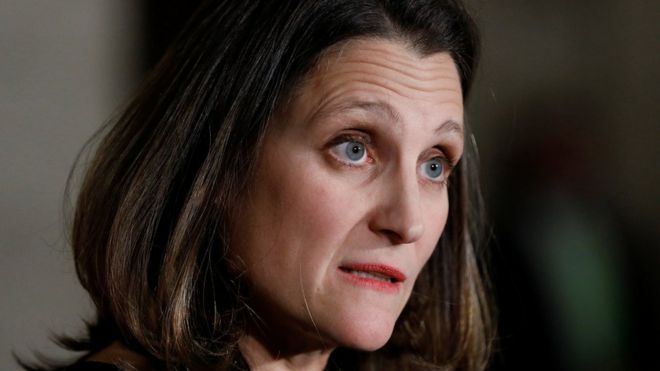
Canada's Foreign Minister Chrystia Freeland takes part in a news conferenceImage copyrightREUTERS
Image captionCanada's Foreign Minister Chrystia Freeland said the country 'won't back down' in the trade dispute
Canada's countermeasures against the Trump administration's steel and aluminium levies have come into effect.
On Sunday, the day the country celebrates its national holiday, Canada imposed a 25% tariff on assorted US metals products.
Tariffs of 10% have also been imposed on over 250 other US goods like beer kegs, whiskey and orange juice.
Canada-US trade tensions are high amidst the metals levies and North American Free Trade Agreement talks.
The tit-for-tat duties are estimated to total C$16.6bn (£9.5bn), representing the 2017 value of Canadian metals exports affected by the US measures.
Senior Canadian officials say the list is designed to exert political pressure on the US and make it take notice of how this will affect trade.
They have called the steel and aluminium levies against Canada, the European Union and Mexico imposed a month ago by the Trump administration "illegal" and "unjustified".
On Friday, Canada also announced it would make C$2bn available to defend the steel and aluminium industry, including funds to support affected businesses.
"Our approach is and will be this: we will not escalate and we will not back down," Foreign Minister Chrystia Freeland said while announcing the funds.
The EU and Mexico have already imposed their own counter-tariffs on American goods.
EU's duties on £2.4bn ($3.1bn) of products such as bourbon whiskey, motorcycles and orange juice took effect on 22 June.
Mexico put tariffs on $3bn worth of American products ranging from steel to blueberries and bourbon.
The tariffs, which provoked international outrage, have also triggered complaints against the US to the World Trade Organization (WTO) and to North American Free Trade (Nafta) dispute panels.
The relationship between Canada and the US is strained following attacks this month by US President Donald Trump against Justin Trudeau after the Canadian prime minister declared that his country would not "be pushed around" by the Americans on trade.
Beyond Nafta and the metals levies, there have been disputes over issues such as lumber, dairy and wine.
More tariffs could be on the horizon.
In May, Mr Trump ordered a national security probe into vehicle imports, which could bring tariffs on autos and auto parts.
Earlier this week, US Trade Representative Robert Lighthizer criticised the retaliatory tariffs imposed by the EU and other countries against the US measures.
"These retaliatory tariffs underscore the complete hypocrisy that governs so much of the global trading system," he said.