Thursday, July 26, 2018

BBC News - Trump and EU's Juncker pull back from all-out trade war

The US and EU have agreed to avoid an all-out trade war and work to lower tariffs, in talks that US President Donald Trump hailed as "a very strong understanding".
He and European Commission chief Jean-Claude Juncker announced a "new phase" in EU-US relations, after more than two hours of talks at the White House.
Mr Trump's threat to impose tariffs on European cars was put aside.
The EU plans to buy more US liquefied natural gas (LNG) and soybeans.
A joint statement said the two leaders agreed to "work together toward zero tariffs, zero non-tariff barriers, and zero subsidies on non-auto industrial goods".
US import tariffs of 25% on steel and 10% on aluminium, imposed in March, will however remain in place.
The two sides will launch an expert working group to facilitate trade and lower barriers, and they pledged to refrain from new trade restrictions during those negotiations.
A full-blown trade war had been looming, fuelled by the tariffs introduced by Mr Trump.
EU-US relations had been further frayed by Mr Trump's tributes to Russian President Vladimir Putin and his attacks on Nato and the EU.
Mr Trump's language after meeting Mr Juncker was enthusiastic, in contrast with the angry tone he adopted previously towards the EU, calling it a "foe" on trade.
Mr Trump has come under pressure domestically because of retaliatory tariffs imposed on US goods by China, the EU, Canada and Mexico.
US chipmaker Qualcomm Inc appeared to be the latest casualty of the trade row with China, as Beijing made no announcement on Qualcomm's proposed takeover of NXP Semiconductors, a deal valued at $44bn.
On Tuesday the Trump administration announced up to $12bn in aid for US farmers hurt by the Chinese tariffs.

What was agreed?

Speaking at the White House, Mr Trump declared a "new phase in the relationship" between the US and the EU, calling it a "very big day for free and fair trade".
"We are starting the negotiation right now but we know very much where it's going," he said.
Mr Juncker thanked the president and hailed a "constructive meeting".
Mr Trump said the EU would become a "massive buyer" of US liquefied natural gas and the joint statement said EU imports of LNG would increase, to diversify Europe's energy supply.
Mr Trump has condemned Germany's project to expand imports of Russian natural gas, via a new Baltic pipeline.
"The EU is going (...) to buy a lot of soy beans from our farmers, primarily in the Midwest," Mr Trump said.

Presentational grey line

Some relief after months of turbulence

The BBC's Adam Fleming in Brussels writes:
This is a ceasefire, not a peace treaty. Long-term, both sides have agreed to talk about trade issues. In the meantime neither will introduce any new tariffs, which presumably means Donald Trump will not follow through on his threat to target cars imported from the EU.
Brussels' pledges to import more soybeans and to upgrade Europe's infrastructure to buy more gas from the US cover some things that were probably going to happen anyway.
Mr Juncker will need the approval of the member states, which have different national interests and does he actually have the power to make the European economy gobble up more beans? Without details, it's all just warm words, but after a turbulent few months of transatlantic relations those are worth something.
The pair also agreed to work towards reform of the World Trade Organization (WTO). Mr Trump accuses the WTO of treating the US unfairly - though mostly the US has won in arbitration cases there.
Mr Juncker said striking a deal on zero tariffs on industrial goods was his "main intention".
"I had one intention today, to make a deal, and we made a deal. We have a number of areas on which to work together," he said.
No announcement was made on car tariffs, and it was not clear whether any progress had been made on resolving the issue. Mr Trump had threatened to impose 25% import tariffs on European cars.

What's been the reaction to the agreement?

On Twitter, EU Trade Commissioner Cecilia Malmstrom said the two were "turning a page" on trade, while German Economy Minister Peter Altmaier hailed it as a "breakthrough".
German Foreign Minister Heiko Maas tweeted (in German): "Juncker showed in Washington that it's really not about who tweets most aggressively, but about whether one offers real solutions. Because Trump's grassroots also feels that it only loses when we impose more and more senseless tariffs on each other."
Mr Trump's "America First" policy made him a fierce critic of the proposed EU-US Transatlantic Trade and Investment Partnership (TTIP), which is at a standstill. But his "deal" with Mr Juncker echoes some of TTIP's ambition.
A former US Ambassador to the EU, Anthony Gardner, made that point in a tweet.

How did we get here?

Mr Trump imposed tariffs on steel and aluminium products from the EU, Canada and Mexico on national security grounds - something the EU is challenging at the WTO.
Mr Trump has railed against what he believes are unfair trade practices by US allies.
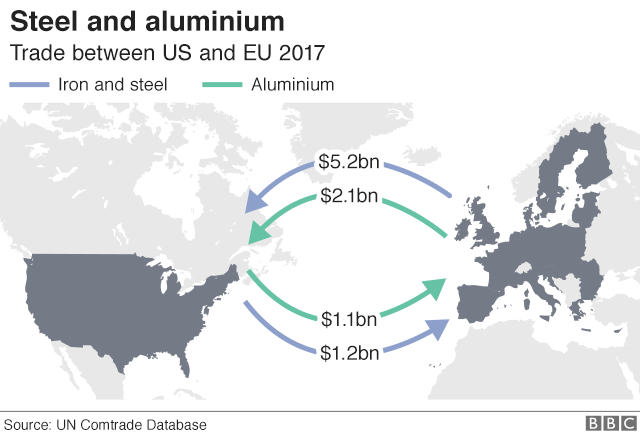
Steel and aluminium map
The EU has in turn retaliated with tariffs on iconic US goods ranging from Harley Davidson motorbikes to bourbon.
Harley Davidson and US car manufacturers have recently warned of the financial cost these tariffs are causing to their businesses.

Wednesday, July 25, 2018

BBC News - US to give farmers $12bn trade war bailout

The Trump administration has unveiled a $12bn (£9.1bn) plan aimed at helping US farmers hurt by the intensifying trade war.
The aid is intended to protect the industry as countries raise taxes on US products such as soybeans in response to the president's new tariffs.
The US plans to provide subsidies to farmers and buy unsold crops, among other measures.
Tariffs have irked farmers, a crucial voting bloc for President Donald Trump.
Mr Trump has said his tariffs - which he described on Tuesday in a tweet as "the greatest" - are intended to pressure countries to change their policies toward US exports.
In a speech on Tuesday, he said farmers would be the "biggest beneficiary" of the disputes after countries strike new trade deals.
But the agriculture industry, which draws about 20% of its income from exports, said the president's approach is hurting demand for its goods and causing long term damage to relationships with buyers.
Prices for soybeans have already fallen by more than 15% since April, when China - a major buyer of the crop - announced its plans to retaliate.
"Farmers need stable markets to plan for the future," said Brian Kuehl, executive director of the industry group Farmers for Free Trade, which represents pork producers, corn growers and others.
"As such, we urge the administration to take immediate action to stop the trade war and get back to opening new markets."
Image copyrightGETTY IMAGES
Image caption
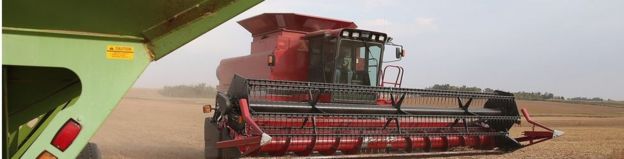
soybeans in the US being farmed
Most of the $12bn in aid will go direct to farmers

Tariffs at a glance

March: US announces tariffs on foreign steel and aluminium. The US imported roughly $46bn of the two metals in 2017.
April: China retaliates for metals tariffs by raising duties on $3bn-worth of US products.
June: Exemptions to US metals tariffs for EU, Canada and Mexico expire. The three countries retaliate with tariffs on a total of almost $20bn in US products.
July: US and China impose tit-for-tat tariffs of $34bn on the other country's products. A second round of $16bn-worth of tariffs on goods is delayed.
Coming up: The US is also considering additional tariffs of more than $200bn on Chinese products, as well as duties on foreign cars and car parts, which represent more than $300bn in annual trade. Canada, Mexico and the EU have said they are prepared to respond.
Presentational grey line
The US Agriculture Department said it expects losses of about $11bn as a result of the trade disputes.
Much of the $12bn in emergency relief, which does not need congressional approval, will go towards direct payments to farmers of commodities such as soybeans, sorghum, and wheat, officials said.
The US also plans to buy crops such as fruits and nuts, distributing them to food banks and other government nutrition programmes.
Some of the money will also go to boosting export efforts.
The first assistance is expected to be distributed by the beginning of September.
The programme, which will be deployed using powers created during the Great Depression, is not intended to extend beyond this year, officials said.
"This is a short-term solution that will give President Trump and his administration time to work on long-term trade deals that benefit agriculture and all sectors of the economy," US Agriculture Secretary Sonny Perdue said.
Some Republicans and even Democrats backed the aid package.
But industry groups that represent agriculture, as well as politicians from agricultural states, criticised the relief as a short-term solution to a self-inflicted problem.
"Time and time again I've heard from farmers that they want trade, not aid," said Senator Ron Johnson, a Republican from Wisconsin.
"Instead of throwing money at a problem we've helped create, the better option is to take action to make it easier for our farmers - and manufacturers - to sell their goods at fair prices to consumers around the world."
Senator Rand Paul, a Kentucky Republican, tweeted on Tuesday: "If tariffs punish farmers, the answer is not welfare for farmers. The answer is remove the tariffs."
Senator Ben Sasse, a Nebraska Republican, said in a statement: "This trade war is cutting the legs out from under farmers and White House's 'plan' is to spend $12 billion on gold crutches."

Tuesday, July 24, 2018

Reuters News - Threat from Trump trade wars gives fresh purpose to BRICS bloc

by Joe Bavier
JOHANNESBURG (Reuters) - As Donald Trump’s tariff salvos threaten global trade wars, leaders from the BRICS bloc - Brazil, Russia, India, China and South Africa - are expected to band together in defense of the multilateralism the United States once championed.


The heads of the major emerging nations meet in Johannesburg from Wednesday for their first summit since Trump’s administration launched a push to rebalance trade relationships that the U.S. President has deemed unfair.
From threatening to tear up existing trade deals to hiking steel and aluminum tariffs, the U.S. move toward unilateral action has rattled traditional allies and rivals alike. And BRICS nations have been on the frontline of the global tensions.
Last week Trump said he was ready to impose tariffs on all $500 billion of imported goods from rival economic superpower China. But even South Africa - a tiny exporter of steel, aluminum and automobiles to the United States - is facing barriers.
“If you don’t have an agreed rules-based trade system then it’s a matter of power. And unilateralism is not something you want to contemplate,” Rob Davies, trade minister of the bloc’s current chair, South Africa, told Reuters.
BRICS’ dominant member China has stressed the need to fight protectionism and promote multilateral global trade.
“We are against unilateralism - we are in favor of free trade,” Chinese Premier Li Keqiang said earlier this month in response to Trump’s trade moves.
From its origin as an acronym coined in 2001 by then-Goldman Sachs chairman Jim O’Neill, BRICS has struggled to take shape as a body voicing cohesive positions on politics and forging deeper trade ties.
Its collective gross domestic product grew more than six-fold from $2.7 trillion in 2000 to over $17 trillion last year, eclipsing that of the European Union.
However, the value of trade between its members has actually fallen nearly 9 percent to $312 billion over the past five years, according to Johannesburg-based Standard Bank.
Analysts say global trade turmoil could give the group a shot in the arm.
“BRICS knew what they weren’t - i.e. Western - without quite knowing what they were,” said Martyn Davies, Deloitte Managing Director for emerging markets and Africa. “Now with the Trump administration, suddenly there’s an emerging common interest, ironically around trade.”

“SPECIAL TIMES”

Though they will not condemn the United States, BRICS leaders will staunchly defend multilateralism and organizations including the World Trade Organisation, according to a diplomat involved in drafting the summit’s final statement.
“The language of the statement will not be standard language because we live in special times,” the diplomat said.
A push to foster trade flows between BRICS member states is also expected, officials and analysts said.
Those efforts include bolstering the New Development Bank (NDB), the grouping’s financial institution.
Russia said this month it was in talks with the bank about borrowing more than $1 billion. On Monday, it approved loans totaling $600 million for energy and transportation projects in South Africa and China.
The NDB is expected to lend $4 billion to BRICS members this year. And South African deputy foreign minister Luwellyn Landers said this week the bank would begin lending to non-members, giving BRICS more clout as representative of the “global South”.
South Africa has invited the leaders of 22 additional countries to participate in this week’s summit, including 19 from Africa.
“There is a pretty big space for the BRICS nations to work together ... to create economic heft and ease the negative impacts of unilateralism and trade protectionism,” said Mei Guanqun of the China Center for International Economic Exchanges, a state-backed think-tank.
As the member hardest-hit by Trump’s trade moves, China is looking to diversify its trade ties to mitigate fallout.
Some analysts say agreeing preferential trade policies between BRICS members is a logical next step. But that may prove to be a bridge too far, at least for now.
Beijing already dominates BRICS and is involved in 80 percent of trade within the bloc. Opening the door to more and cheaper Chinese imports could be seen as too great a risk for the group’s smaller, less industrialized members.
“All those who are affected by lesser access into the U.S. market are likely to want to diversify their exports and just push everything into everybody else’s backyard,” said South Africa’s Davies. “I don’t think that would be desirable.”
Additional reporting by Christian Shepherd in Beijing, Anthony Boadle in Brasilia and Katya Golubkova in Moscow, Editing by Ros Russell

Monday, July 23, 2018

Bloomberg News - U.K. Says It Won't Blink First on Brexit So EU Must Back Down

By Patrick Donahue and  Tim Ross
British Foreign Secretary Jeremy Hunt said the U.K. will not “blink” in Brexit negotiations, as he warned the European Union it risks forcing the country to crash out of the bloc with no deal.
On his first trip to Berlin since he replaced Boris Johnson earlier this month, Hunt appealed for more flexibility from his European counterparts as time for talks runs out. He said failure to strike a deal would poison British attitudes to Europe for a generation and cause major economic challenges for the U.K.
“When it comes to Brexit, there is now a very real risk of a Brexit no-deal by accident,” Hunt said at a press conference on Monday alongside German Foreign Minister Heiko Maas. “And this is because, I think that many people in the EU are thinking that they just have to wait long enough and Britain will blink, and that’s not going to happen.”
Hunt’s visit marks the start of a week of intense diplomatic efforts by the U.K. government in an attempt to step up the pace of negotiations. Talks in Brussels have stalled as EU negotiators awaited a clear plan from the U.K. for its future relationship with the EU.
Prime Minister Theresa May published her compromise proposals on July 12 but has been struggling to win support for them among members of her own government.
Hunt said he wanted the U.K. and Germany to remain “best friends” after Brexit but warned that British relations with the continent will inevitably suffer if the EU’s negotiators do not change their attitude.
“Without a real change in approach from the EU negotiators, we do now face the real risk of a no-deal by accident and that would be incredibly challenging economically,” he said. “My real concern is that it will change British public attitudes to Europe for a generation – and it will lead to a fissure to relations which would be highly damaging for that great partnership that we’ve had for so many years.”
Speaking alongside Hunt, Maas said “we don’t want a disorderly Brexit; we want an agreement.”

Thursday, July 19, 2018

BBC News - Unlikely partners? China and Israel deepening trade ties

By Dave Gordon
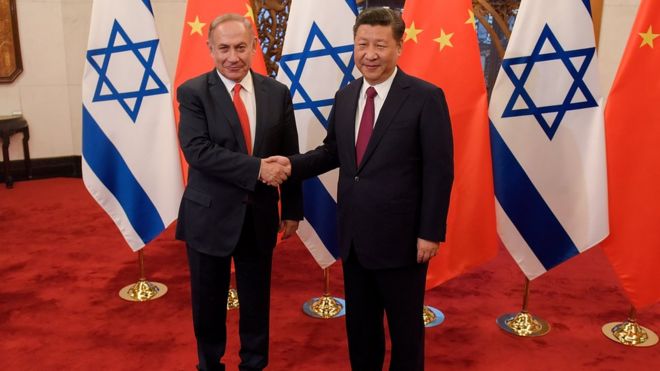
Chinese President Xi Jinping and Israeli Prime Minister Benjamin NetanyahuImage copyrightGETTY IMAGES
Image captionIsraeli Prime Minister Benjamin Netanyahu and Chinese President Xi Jinping have met on a number of occasions to boost ties between the two countries
On paper Israel and China are unlikely close trading partners.
China, the world's second-largest country, is the biggest exporter on the planet. While Israel, a tiny strip of land in the Middle East, is only in 45th place on the global exporting league table.
And importantly - Israel has always been a steadfast ally of the US.
So given the current trading spat between the US and China, you would expect Israel to be firmly on the American side.
Yet what many people don't know is that Chinese investment in Israel is continuing to boom, at the same time as a growing number of Israeli firms are entering the Chinese marketplace.
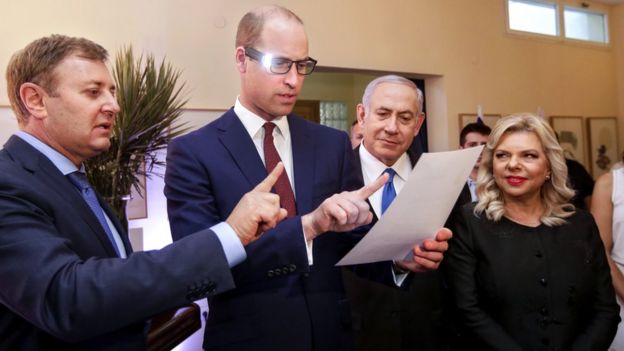
The UK's Prince William tests out some Israeli technology on his recent visit to IsraelImage copyrightGETTY IMAGES
Image captionThe UK's Prince Williams was shown some examples of Israeli technology on his recent visit to the country, such as these AI glasses that help people with limited sight more easily read
So while President Trump is slapping tariffs on Chinese exports and talking tough, Israel's Benjamin Netanyahu is happily encouraging his country's firms to accept Chinese investments, as the figures show.
In 2016 China's direct investment in Israel almost tripled to $16bn (£12bn), according to a report in the South China Morning Post newspaper.
Meanwhile, the Jerusalem Post predicts that China will overtake the US as the number one source of overseas investment in Israel.
So what has brought the two countries together, and should Israeli firms be cautious?
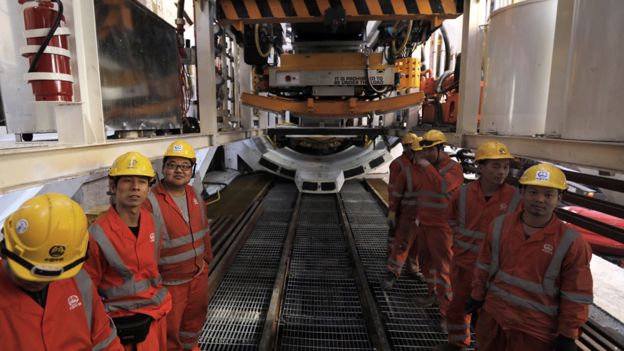
Chinese workers building the Tel Aviv undergroundImage copyrightGETTY IMAGES
Image captionChinese firms are not just buying up Israeli firms, they are also working on Israeli construction projects, such as the Tel Aviv Metropolitan Area Mass-Transit System
Over the past two decades the Israeli economy has established itself as a leading hub of technological development.
Commentators say that Chinese firms want to get their hands on that technology, at the same time as Israeli companies want better access to the giant Chinese marketplace.
"The Chinese are leveraging Israeli tech to fuel their economy, Israel is held in high esteem as a hub of innovation," says Hagai Tal, chief executive of Taptica, an Israeli mobile advertising company.
"China is set on learning as much as it can in order to position itself as an innovation economy.
"[Meanwhile], Israeli companies also see important opportunities in the East, and the meeting point of these two approaches is what produces such successful business partnerships."
Technicians at an Israeli drone companyImage copyrightGETTY IMAGES
Image captionIsrael has built a hi-tech economy over the past two decades
To help bring Israeli and Chinese companies together, a number of business events are now held every year, such as Silicon Dragon Israel, which took place in Tel Aviv at the start of the year, and the China-Israel Innovation Summit, which was held earlier this month in Guangdong.
Rebecca Fannin, a founder of Silicon Dragon Israel, says Israeli tech start-ups that have secured Chinese investment tell her they "are progressing faster with Chinese capital, and through introductions, collaborations, and easier access to the large China mainland markets".
In recent years Israeli firms that have either been bought outright by Chinese companies, or sold them share of their business, include medical lasers operation Alma Lasers, and medical devices group Lumenis. Others are Israeli dairy business Tnuva, image recognition firm Cortica, and gesture control group Extreme Reality.
Royi Benyossef, an Israel-based manager at investment fund Samsung Next, says that the Chinese are "mesmerized by Israel and its technology exporting capabilities".
Other commentators say that the different national characteristics of the two countries complement each other.
Peggy Mizrahi, a Chinese citizen who lives in Israel, says: "The Chinese are known for long-term planning, and being conservative and hierarchical, unlike the commonly recognised Israeli mindset of [being] fast, innovative, flexible, and having a lack of respect for authority."
Daniel Galily, an Israeli expat who has lectured in business at Beijing Geely University, adds that: "The educational system in China places great emphasis on discipline and obedience to superiors, while the Israeli educational system and the Israeli army encourage students and soldiers to think about new ideas, and to solve problems in situations of uncertainty.
"The Chinese understand that, and so they strive to integrate the Israeli creativity into their economy."
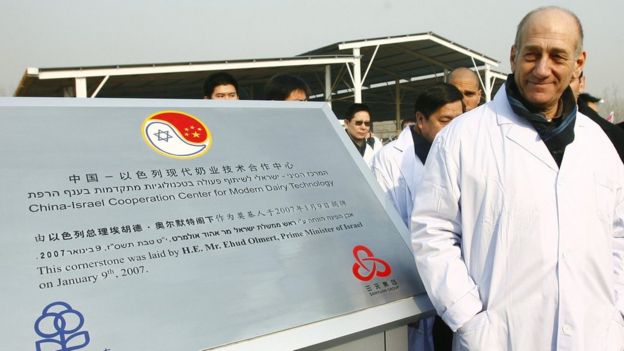
Former Israeli Prime Minister Ehud OlmertImage copyrightGETTY IMAGES
Image captionFormer Israeli Prime Minister Ehud Olmert also worked to establish closer trade and business ties between Israel and China
However, it is not just Chinese firms that are benefiting from closer trade ties between the two countries.
Spotad, an Israeli digital advertising firm, entered the Chinese market last year after securing funding from a Hong Kong-based private equity firm.
The company now works with all the major Chinese online advertising exchanges.
Other Israeli firms that are continuing to make inroads into the Chinese market include mobile marketing firm AppsFlyer, and diamond trading platform Carats.

Global Trade

More from the BBC's series taking an international perspective on trade:

Yet while both Chinese and Israeli firms seem pleased with their continuing cooperation, some commentators are anxious.
"One of the biggest drawbacks that I see here for Israel is that China is notorious for not respecting the intellectual property laws of other nations, so Israel has to be very careful about what kind of manufacturing they outsource to China," says Jason McNew, founder and boss of Pennsylvania-based Stronghold Cyber Security.
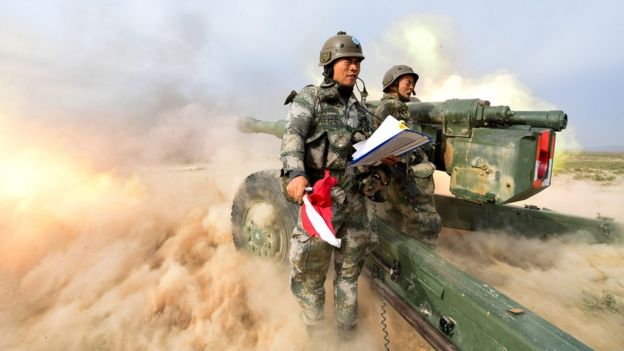
Chinese solders on a training exerciseImage copyrightGETTY IMAGES
Image captionSome analysts fear that Israeli technology could end up being used by Chinese troops, such as these two soldiers, pictured on a training exercise
Lee Branstetter, professor of economics and public policy at Carnegie Mellon University's Heinz College, says that the concern in the US is that Israeli technology could ultimately find its way into the hands of the Chinese military.
"The Pentagon is increasingly worried that artificial intelligence capabilities acquired by Chinese firms through civilian investments or licensing deals could find their way into a new generation of Chinese weapons that would threaten American troops and American allies.
"The Pentagon is also worried that Israel could become a back door through which China could acquire capabilities that it could not get in the US due to regulatory scrutiny.
"I suspect that this will place some limits on the extent and magnitude of the emerging Israel-China relationship. If an American pilot were ever shot down by a Chinese missile powered by Israeli technology, it would be a real problem for the Israeli government."
The Israeli government declined to comment on these security and defence sector issues.