WASHINGTON (Reuters) - U.S. President Donald Trump said on Friday he has asked the U.S. Securities and Exchange Commission to study the impact of allowing companies to file reports with the financial regulator every six months instead of every quarter. “That would allow greater flexibility & save money,” he said in a post on Twitter on Friday. Publicly traded companies in the United States currently file their earnings reports every three months, or four times a year. The potential shift would allow them to reduce these filings to two a year.
Trump said he called on the SEC to consider the change after talking with various business leaders. He said one executive suggested the change as a way to boost business, although he did not name the individual or the company.
Trump recently hosted a number of top company leaders while on vacation at his private golf club in Bedminster, New Jersey, including the heads of Apple Inc (AAPL.O), Fiat Chrysler Automobiles NV (FCHA.MI), Boeing Co (BA.N), FedEx Corp (FDX.N), and Honeywell International Inc (HON.N).
The lira rose 3%, also helped by measures aimed at deterring foreign investors speculating on the lira.
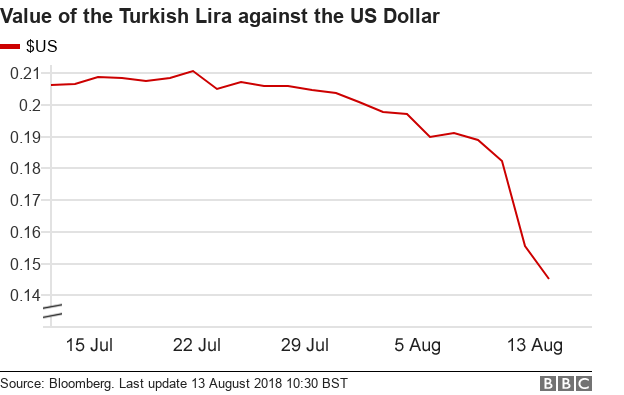
Despite the rise, Turkey's currency has lost almost a third of its value against the dollar since January, pushing up the price of everyday items and raising fears that its weakness could infect other emerging market currencies.
Explaining the new tariffs, Turkish Vice-President Fuat Oktay said the rises were ordered "within the framework of reciprocity in retaliation for the conscious attacks on our economy by the US administration".
Tariffs were also increased on cosmetics, rice and coal. Turkey had previously said it would boycott US electronic products.
Turkish Trade Minister Ruhsar Pekcan told the state run Anadolu news agency that the doubling of tariffs on some imported US products would amount to $533m.
Inflation
The lira had plunged to record lows on Monday, but has since clawed back some of its losses, not only after the retaliation on tariffs, but also after the Turkish Central Bank announced banks would be given help to keep money moving around the system.
Measures to restrict the amount of currency that can be exchanged with foreign banks were also said to be boosting the currency.
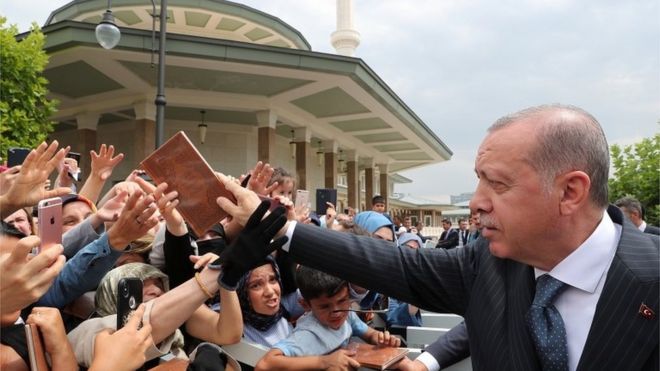
President Erdogan said earlier this week that Turkey should not "give in to the enemy" by investing in foreign currencies.
He has presided over soaring inflation and borrowing levels, but insists the lira's plight is the result of a "campaign" led by foreign powers.
Mr Erdogan has accused the US of trying to "bring Turkey to its knees through threats over a pastor".
But the US insists Andrew Brunson, a long-time Turkish resident who ran the tiny Izmir Resurrection Church, is "a victim of unfair and unjust detention".
An evangelical from North Carolina, he has been held in Turkey for nearly two years over alleged links to the outlawed Kurdistan Workers Party and the Gulenist movement, which Turkey blames for a failed coup in 2016.
On Wednesday, a Turkish court rejected his latest appeal to be released from house arrest. A higher court is still to rule, his lawyer told Reuters.
White House press secretary Sarah Sanders said the US had seen "no evidence that Pastor Brunson has done anything wrong".
Mr Brunson has denied charges of espionage, but faces up to 35 years in jail if found guilty.
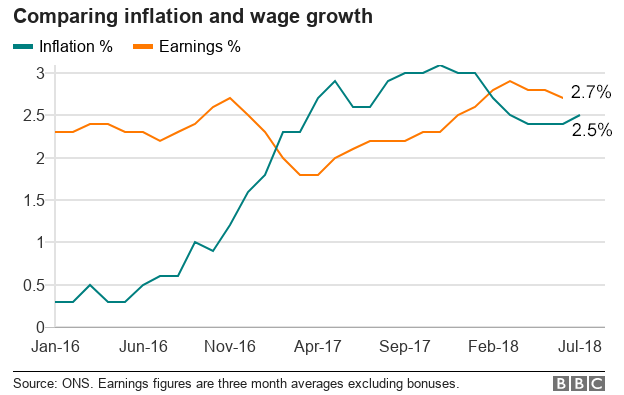
UK inflation rose to 2.5% in July, after holding steady at 2.4% in the previous three months, as the cost of transport and computer games increased.
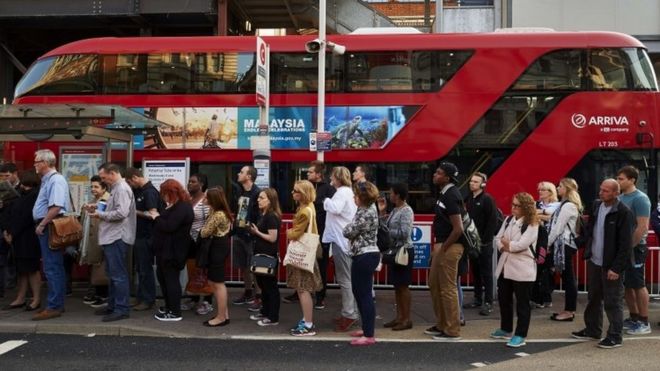
Higher transport costs contributed to the rise in inflation last month
It was the first jump in the Consumer Prices Index (CPI) measure since November and was in line with forecasts.
Meanwhile the Retail Prices Index (RPI) measure of inflation fell to 3.2%.
The Department for Transport uses the RPI figure to set the maximum annual increase for regulated rail fares.
Despite the rise for CPI, wage growth is still outstripping inflation. On Tuesday, the Office for National Statistics said that average earnings, excluding bonuses, rose by 2.7% for the three months to June.
Wednesday's inflation figures show that increases in computer games and transport - up 5.6% in the year ending July 2018 - were partially offset by falls in the price of clothing.
For manufacturers, the cost of raw materials was 10.9% higher than in July 2017, the biggest rise in more than a year.
Much of that cost pressure has been caused by oil price increases of more than 50% over the period.
The CPI figure had hit a five-year high of 3.1% in November, when the inflationary effect of the pound's fall following the June 2016 Brexit vote reached its peak.
Earlier this month the Bank of England forecast inflation would rise to 2.6% in July before falling back.
The Bank expects inflation will settle down to just above its 2% target in two years' time as it gradually increases interest rates.
'Little respite'
Tej Parikh, senior economist at the Institute of Directors, said the rise in inflation showed the cost of living squeeze was not yet a thing of the past.
"For households this isn't good news, as the already weak growth in their pay packets is being further eroded by high prices. This is likely to weigh down consumer spending, posing fresh problems for embattled high street businesses," he said.
"As the temporary factors pushing prices up fade away, inflation is expected to slowly fall back close to the target rate, but that will offer little respite for workers without a significant pickup to their salaries in tandem."
Samuel Tombs at Pantheon Macroeconomics added: "Unless inflation in the services sector strengthens dramatically, CPI inflation will fall below the 2% target in the first half of next year.
South Africa just had its strongest bond auction since March, a sign investors see value in the country’s debt after a sell-off sparked by Turkey’s currency woes.
Traders placed 9.77 billion rand ($694 million) of orders, or more than four times the 2.4 billion rand of securities on sale, at the scheduled weekly Treasury auction on Tuesday, according to data published by the central bank.
South African yields surged to two-month highs on Monday as Turkey’s currency meltdown sapped demand for emerging-market assets. Rates on benchmark 2026 government notes climbed to 9.02 percent, the highest among investment-rated peers, attracting local buyers even as foreign investors dumped the debt at the fastest rate since June. Nine South Africa-based primary dealers participate in the weekly auctions.
“The auction cleared strong today as investors took advantage of higher yields to add risk to their portfolios,” said Michelle Wohlberg, a trader at FirstRand Bank Ltd. in Johannesburg. “Local investors are seeing this as a perfect opportunity to buy bonds at attractive yields. as the panic seen yesterday is perceived as slightly overdone"
Yields on 2026 government securities fell eight basis points on Tuesday to 8.94 percent, paring the rise in the past three trading sessions to nine points. The bonds have lost 11 percent this month in dollar terms, the worst performance after Turkish debt, which is down 36 percent, according to Bloomberg Barclays indexes.
Moves to ease Turkey's economic woes have failed to stop market turmoil as the country's row with the US deepens.
Turkey's President, Recep Tayyip Erdogan, said on Monday that the US was seeking to "stab it in the back".
The US last week imposed sanctions on Turkey over its refusal to extradite a US preacher imprisoned in the country.
The sanctions caused market turmoil, which the central bank attempted - but failed - to soothe with a series of market-boosting measures.
Mr Erdogan told a news conference in the Turkish capital, Ankara: "You act on one side as a strategic partner, but on the other, you fire bullets into the foot of your strategic partner.
"We are together in Nato and then you seek to stab your strategic partner in the back."
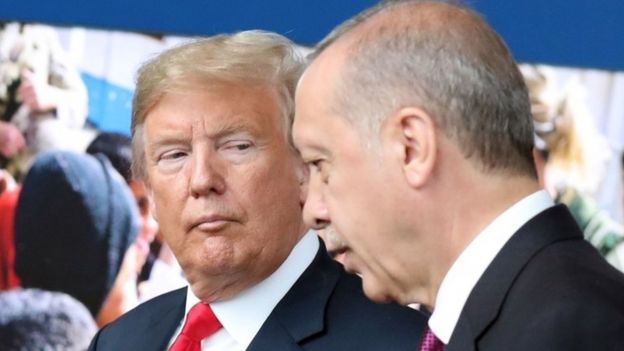
The pastor is only one of a number of issues dividing Mr Trump and Mr Erdogan
As the crisis deepened at the end of last week, the lira and the Turkish stock market slid sharply. Mr Erdogan, who has presided over soaring inflation and borrowing levels, says the lira's fall is the result of a plot rather than prevailing economic conditions.
Turkey's interior ministry said it was taking legal action against 346 social media accounts it claimed had posted comments about the weakening lira "in a provocative way".
The dispute centres on Turkey's refusal to release American pastor Andrew Brunson.
Mr Brunson has been detained for nearly two years, accused of links to the outlawed Kurdistan Workers' Party and the Gulenist movement, which Turkey blames for a failed coup in 2016.
The Turkish president is angry that the US has not taken more action against the Gulenist movement and what he said was a failure "to unequivocally condemn" the 2016 coup attempt. The US has refused to extradite Fethullah Gulen, who lives in Pennsylvania.
US support for Kurdish rebel groups fighting Islamic State (IS) fighters in northern Syria is another major difficulty, given Turkey's battle against a Kurdish insurgency in its own country.
Mr Erdogan has also been getting closer to Russia. That creates an awkward triangle, given that Turkey is a Nato member, Russia is Nato's number one threat and the organisation is obliged to defend any member that is attacked.
Nato uses the Incirlik Air Base in Turkey to fight against IS and there has been some domestic pressure on Mr Erdogan to close it.
What is happening to the lira?
The lira's worst day was Friday, when US President Donald Trump approved the doubling of tariffs on Turkish steel and aluminium, following Turkey's refusal to free an American pastor who has been in detention there for nearly two years.
Turkey's stock market has also fallen 17%, while government borrowing costs have risen to 18% a year. Meanwhile, inflation has hit 15%.
Investors are worried that Turkish companies that borrowed heavily to profit from a construction boom may struggle to repay loans in dollars and euros, since the weakened lira means there is now more to pay back.
Although the lira rose slightly after the central bank's move to support the economy, it still hit a new record low against the dollar.
Investors globally fear the damage spreading and have been prompted to sell riskier assets, including other emerging market currencies.
In midday trading in Europe, London's 100-share index was down 0.6%, while the German and French share markets were down by 0.3% and 0.7%.
What are Turkish officials doing about the lira?
The Turkish Central Bank announced on Monday that banks would be given all the liquidity - help to keep money moving - they needed.
But the bank did not increase interest rates, which would help contain inflation while supporting the lira.
It is not clear if this comes after Mr Erdogan's pressure. The president is famously averse to interest rate rises.
He has dismissed the fall of the currency as "a storm in a tea cup" and urged Turks to sell dollars and buy lira to help boost the currency.
Analysis:
Andrew Walker, BBC economics correspondent
President Erdogan sees Turkey's problems as the result of a plot rather than economic fundamentals. That kind of talk might play well politically with some audiences in Turkey, but it won't wash in the markets.
Turkey has underlying problems in the form of a fairly large international trade deficit, high levels of foreign currency debt owed by the private sector and a persistent inflation problem.
Certainly the situation has been aggravated by the deterioration in political relations with the United States and the higher tariffs that Turkey now faces on its steel and aluminium sales in the US. But the scale of the apparent impact was due to the fact that Turkey was already economically and financially vulnerable.
What do people in Turkey think about this?
Business executive Kemal, who lives in Istanbul, said: "It is not unusual or unexpected to see some companies go under when there is such a sudden devaluation of the currency. However, I do not believe it will crumble the economy."
British holidaymaker Paul Fothergill, who is staying in Dalyan, says he has been holidaying in Turkey for the last 30 years. He said: "Since we arrived on Thursday the Turkish lira has nosedived. It's very sad for locals and investors, but incredibly good for us, the Brits.
"You can imaging how cheap our evening meals and trips have been. The most expensive meal, including drinks and tip, so far was £12 for me and my wife."
Heather, a Briton who has lived in Turkey for 15 years with her family, said: "This last year has seen ridiculous price rises and price differences in shops and supermarkets. Prices of basics like butter, cheese, fruit and vegetables are so expensive that we think twice about putting them in our baskets.
"Petrol and utilities have also seen price rises. Wages have not gone up, so we worry about where this will end. It may be beneficial for those with pounds, dollars or euros but rest of us are struggling."
by Andrew Osborn, Andrey Otroukh MOSCOW (Reuters) - Russia warned the United States on Friday it would regard any U.S. move to curb the activities of its banks as a “declaration of economic war” and would retaliate, as new sanctions took their toll on the ruble and U.S. lawmakers threatened more.
The warning, from Prime Minister Dmitry Medvedev, reflects Russian fears over the impact of new restrictions on its economy and assets, including the ruble RUB= which has lost nearly six percent of its value this week on sanctions jitters.
Economists expect the Russian economy to grow by 1.8 percent this year. If new sanctions proposed by the U.S. Congress and the State Department are implemented in full, which remains uncertain, some economists fear growth could weaken to almost zero.
President Vladimir Putin discussed what the Kremlin called “possible new unfriendly steps by Washington” with his Security Council on Friday.
Moscow’s strategy of trying to improve battered U.S.-Russia ties by attempting to build bridges with President Donald Trump is backfiring after U.S. lawmakers launched a new sanctions drive last week because they fear Trump is too soft on Russia.
That in turn has piled pressure on Trump to show he is tough on Russia ahead of mid-term elections. The State Department announced new sanctions on Wednesday, blaming Moscow for the poisoning of a Russian ex-spy in Britain in March.
On Friday, the White House strongly condemned the poisoning incident, which a spokesman for Trump’s National Security Council called “a reckless display of contempt for the universally held norm against chemical weapons”.
The new sanctions pushed the ruble to two-year lows and sparked a wider sell-off over fears Russia was locked in a spiral of never-ending sanctions. Russian Foreign Minister Sergei Lavrov complained about the new sanctions in a phone call on Friday to U.S. Secretary of State Mike Pompeo.
Pompeo and Lavrov discussed sanctions and Syria’s civil war during the call, State Department spokeswoman Heather Nauert said in a statement. Pompeo reiterated that Washington wanted a better relationship with Moscow and he and Lavrov agreed to future dialogue, she said, without elaborating.
Separate U.S. legislation introduced last week in draft form by Republican and Democratic senators, dubbed “the sanctions bill from hell” by one of its backers, proposes curbs on the operations of several state-owned Russian banks in the United States and restrictions on their use of the dollar.
Medvedev, speaking on a trip to Russia’s far east, said: “I can say one thing: If some ban on banks’ operations or on their use of one or another currency follows, it would be possible to clearly call it a declaration of economic war.”
“And it would be necessary, it would be needed to react to this war economically, politically, or, if needed, by other means. And our American friends need to understand this.”
Pro-Putin lawmaker Vyacheslav Nikonov who in 2016 prompted the Russian parliament to erupt in applause when he announced Trump had won the White House, called for a tough response.
“War is war,” Nikonov wrote on Twitter. “We need to rid ourselves of any dependency on our rival as much as possible and stop helping them. Our response must not just be symmetrical but preventative. We need to respond now and toughly.”
FEW GOOD RETALIATORY OPTIONS
In practice however, there is little Russia can do to hit back at the United States without damaging its own economy. Officials in Moscow have made clear they do not want to get drawn into what they describe as a mutually damaging tit-for-tat sanctions war.
The threat of more U.S. sanctions kept the ruble under pressure on Friday, sending it crashing to its lowest since June 2016 before it recouped some losses.
“The Russian currency has been caught in a perfect storm of weakening crude oil prices and the new U.S. sanctions, in addition to the threat of even tougher punitive measures in the coming months,” said Lilit Gevorgyan, economist at IHS Markit.
The Russian central bank said the ruble’s fall to multi-month lows on news of new U.S. sanctions was a “natural reaction” and that it had the necessary tools to prevent any threat to financial stability.
Central bank data showed on Friday it had started buying less foreign currency on Wednesday, the first day of the ruble’s slide, to try to tamp down volatility.
Analysts doubt, however, that the authorities will take much action to support the falling ruble, as they decided not to intervene during a similar sell-off in April, which was also driven by U.S. sanctions.
The fate of the U.S. bill that would tighten sanctions much further is not certain. The full U.S. Congress will not be back in Washington until September, and congressional aides said they did not expect the measure to pass in its entirety.
While it was difficult to assess so far in advance, they said it was more likely that only some of its provisions would be included as amendments in another piece of legislation, such as a spending bill Congress must pass before Sept. 30 to prevent a government shutdown.
Additional reporting by Tom Balmforth in Moscow and Patricia Zengerle and Lesley Wroughton in Washington Writing by Andrew Osborn; Editing by Peter Graff and James Dalgleish
by Andrew Walker Financial markets are uneasy about President Erdogan's views on economic policy Is Turkey heading for an economic and financial crisis?
Recent developments in the country's financial markets have certainly been alarming.
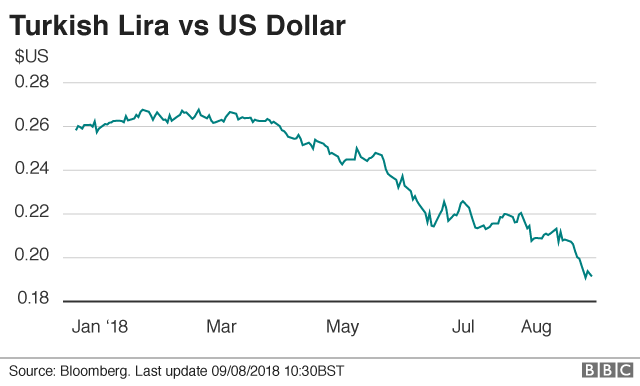
The Turkish currency, the lira, has lost about 30% of its value against the US dollar since the New Year.
The stock market has fallen 17%, or if you measure it in dollars as some foreign investors would do, the decline is 40%
Another measure often watched in the markets is government borrowing costs.
Borrowing for 10 years in its own currency now costs 18% a year. Even borrowing in dollars is expensive for Turkey at a cost of around 7%.
So what is going on?
Debt dangers
Turkey has a deficit in its international trade. It imports more than it exports. Or to put it another way, it spends more than it earns. That deficit has to be financed, either by foreign investment or by borrowing.
In itself that is neither unusual nor dangerous. But Turkey's deficit is quite large at 5.5% of national income, or GDP, last year.
There are two features of Turkey's foreign debt that also increase its vulnerability.
First, it has a high level of debt due for repayment in the near future - loans that have to be repaid and the money borrowed anew. To use the language of the financial markets, the debt has to be refinanced. Credit rating agency Fitch estimates that Turkey's total financing needs this year will be almost $230bn.
Second, many Turkish companies have borrowed in foreign currency. Those loans become more expensive to repay if the value of the national currency declines - which it has.
The currency weakness also aggravates Turkey's persistent inflation problem. The weaker lira makes imports more expensive.
The central bank has an inflation target of 5%. A year ago, inflation was well above that, at about 10%. Since then the situation has deteriorated further with prices now rising at an annual rate of about 15%.
Financial market investors are also very uneasy about President Erdogan's views on economic policy and the pressure he is seen as exerting on the country's central bank.
There is an obvious policy option open to a central bank that wants to bear down on inflation - raising interest rates.
That can curb inflation in two ways. It can weaken demand at home, and by increasing financial returns in Turkey encourage investors to buy lira - which strengthens the currency and reduces the cost of imports.
Turkey's central bank has taken several such moves, but without any lasting impact on the problem.
US relations
What bothers the markets is the president's well known - and most economists would say, ill-informed - opposition to higher rates. He has described himself as the enemy of interest rates.
The result is that investors are not convinced that the central bank will do what is needed to stabilise the currency and bring inflation under control. In turn, that makes them more wary about the outlook for Turkish financial assets.
Confidence has been further undermined by Turkey's strained relations with the United States.
Turkey has detained an American evangelical pastor and there are differences over the approach to Syria. In addition, the US is reviewing Turkey's eligibility for a programme that gives many exports from developing countries duty-free access to the US market.
Turkey is also at risk from developments in the US. The Federal Reserve continues to raise interest rates, which encourages investors to pull money out of emerging markets. The impact has been moderate, but it is potential aggravating factor for countries such as Turkey with other vulnerabilities.
In some respects the recent performance of the Turkish economy looks reasonable. It has grown every year this century apart from 2001 (the country's last economic crisis when it received an IMF bailout) and 2009 (in the aftermath of the global financial crisis). In some years growth has been very strong.
Unemployment is on the high side - the most recent figure is 9.9% - but it has been relatively stable.
One important difference compared with the country's crisis at the beginning of the century is that there is now no exchange rate target, unlike in 2001.
Back then, the pressure in the currency markets forced Turkey to abandon the targets. This time there is no currency peg so the lira has simply been allowed to depreciate.
That said, credit rating agency Moody's says that economic growth has been boosted to unsustainable levels by spending and tax policies. Policies for long-term growth have been sidelined, the agency says, given the focus on election cycles.
Fitch warns that the risk of a hard landing for the economy, meaning a sharp slowdown or even a recession, has increased.