Tuesday, December 11, 2018

Reuters News - Foreign investors spurn U.S. Treasuries as curve threatens to invert

TOKYO/LONDON (Reuters) - A worrying sign of inversion in the U.S. Treasury bond curve is dulling the appeal of the developed world’s highest-yielding bond market for foreign investors.
Overseas investors are reviewing their investments or shunning Treasuries as rates at the short end rise above those at the longer end and make it unprofitable for holders of these bonds to hedge their currency risks.
The difference between short- and long-term bond rates, or the yield curve, has contracted in recent weeks as rising U.S. interest rates meet growing doubts the world’s biggest economy may be slowing down, weighing on longer-dated yields.
And as short-term yields move higher than longer-term yields, the cost of hedging exposure to the U.S. dollar has gone up.
“There is the whole issue of hedging costs. That is the one thing that was inconsequential at the start of the year but now it is sizeable,” said Paul O’Connor, head of multi-asset at Janus Henderson in London, whose firm manages $378.1 billion in assets.  
“You are knocking off a substantial part of U.S. yields when you buy from the UK perspective and hedge back that exposure. When we buy government debt, we always hedge it. You don’t want to take the FX risk,” he said.
The U.S. Federal Reserve has raised rates eight times since late 2015 and looks set to hike them again next week even as other global central banks stay shy of normalizing policy, causing a significant gap to open up in short-dated interest rates.
The European Central Bank and the Bank of Japan have both kept interest rates below zero percent, while the Bank of England has raised rates only twice from its record low near zero percent set in 2016 after the shock Brexit vote.
As U.S. short-term rates climb, currency forward markets which are closely linked to the differences in interest rates between currencies have moved to price in the higher cost of holding dollars.
For yen-based investors, they must pay around 3.3 percent of their principal investment to hedge the risk of holding dollars. The picture is similar for euro-based investors.
“We won’t buy U.S. Treasuries with currency hedge. The return would be negative after hedging,” said Kazuyuki Shigemoto, general manager of investment planning at Dai-ichi Life Insurance, which oversees assets of 35.6 trillion yen ($316 billion).
Higher hedging costs would not have discouraged investors if longer-term bond yields had risen as much as short-term yields.
The yield on 10-year U.S Treasuries, however, has only risen to 2.8 percent compared with 2.1-2.3 percent before the start of the Fed’s tightening in late 2015. Two-year yields have meanwhile risen 160 basis points, to 2.7 percent.
Last week, a section of the curve inverted when the five-year bond yield dropped below two-year and three-year yields.
Dai-ichi Life’s Shigemoto believes it is only a matter of time before the two- and 10-year yield spread turns negative.
Japanese and European investors hunting for yield among top-rated government bonds are starting to look elsewhere.
“We have seen a real decline in flows, especially from Japan in particular and a lot of them have been directed to European and even Asian assets,” said Bob Michele, head of global fixed income at JPMorgan Asset Management, whose firm manages $491 billion in asset, in New York.
Even emerging markets are offering some value after a violent sell-off earlier this year on trade war concerns.
A JPMorgan global emerging market bond index denominated in U.S. dollars now offers a yield of over 7 percent versus around 5.5 percent at the start of the year, Refinitiv data shows.

TO HEDGE OR NOT

One option is to give up currency hedging. Still, increasing the holding of dollars just when the Fed may be about to slow its pace of monetary tightening could be risky.
“We want to buy dollars on dips. But an inverted yield curve may portend a future recession and there are many other uncertain factors. So we need to carefully look at economic fundamentals,” said Toshinori Kurisu, deputy general manager of investment planning at Nippon Life, which has total assets of 66.7 trillion yen ($592 billion).
Institutional investors are reluctant to take on too much currency risk for regulatory reasons. The U.S.-China trade war and possible U.S. slowdown are also reasons for investors to lower, rather than raise, their risk exposure.
In that case, the ultimate choice appears to be going back to their home markets.
“The attraction of U.S. Treasuries investment with a full currency hedge has declined. So we have been buying investment grade corporate bonds in the hedged U.S. debt space,” said Ryosuke Fukushima, general manager of investment planning at Japan Post Insurance, or Kampo, which has 76.8 trillion yen ($681.3 billion) of assets under management.
Fukushima said Kampo does not plan to radically change its stance because the firm is on course to meet its internal investment income target for the current financial year ending in March.
“But in the plan for next year, which we have just started contemplating, we will consider whether to flip back to JGBs from hedged foreign bonds, which we see as substitute for JGBs,” he said.
Reporting by Tomo Uetake and Hideyuki Sano in Tokyo, Saikat Chatterjee in London; Writing by Hideyuki Sano; Editing by Jacqueline Wong

Monday, December 10, 2018

BBC News - Pound falls further after Brexit vote delayed

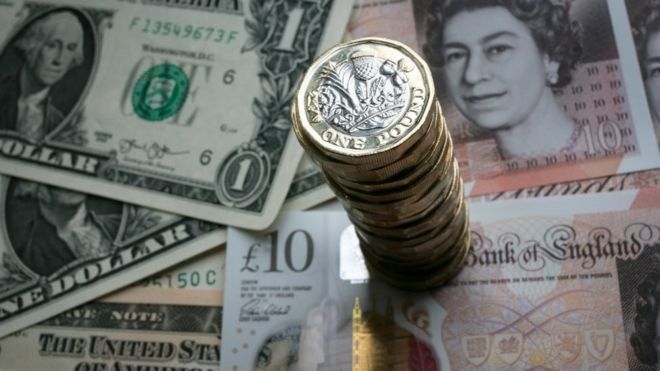
stack of coinsImage copyrightGETTY IMAGES
The pound's fall has accelerated after the prime minister confirmed she would defer the vote on her Brexit deal.
Sterling had already slumped 1% earlier in the day on reports of the delay, but fell further as Theresa May addressed Parliament this afternoon.
At about 16:00, it was down almost two cents against the dollar at $1.2608, its lowest level since April 2017.
It had also fallen 1.3% against the euro to €1.1064, its lowest level since August.
Meanwhile, the domestically focused FTSE 250 share index fell 1.5%, hitting its lowest since December 2016.
The steep falls reflect mounting uncertainty about the terms of the UK's exit from the European Union, analysts said.
"Until the market knows what will happen with respect to Brexit one way or the other then they [traders] will remain extremely anxious," said Jane Foley, head of foreign exchange strategy at Rabobank.
Ms Foley said the threat of a hard Brexit, under which the UK leaves the EU without a deal, as well as the continuing political uncertainty was "an extraordinary and toxic mix" for the pound.
"Once we know what is happening, things will be more settled," she added.
This week had always been expected to be a volatile one for the pound because of the vote on Tuesday, which has also heightened political uncertainty.
Dozens of Conservative MPs had been planning to join forces with Labour, the SNP, the Lib Dems and the DUP to vote down Mrs May's deal.
Neil Mellor, currency strategist at BNY Mellon, said the pound's movements were directly linked to the current political uncertainty.
But he said there was also a question of valuation and how investors "price in Brexit".
The pound's movements over the past decade suggested that the pound could be spared a "drastic fall" over a prolonged period, he said.
Mrs May made a statement to MPs at 15:30 GMT, confirming that the vote would be delayed because it "would be rejected by a significant margin".
She said MPs backed much of the deal she had struck with the EU, but there was concern over the Northern Irish backstop.
She said she believed she could still get the deal through if she addressed MPs' concerns.
And that, she added, was what she intended to do in the next few days.
However, Speaker John Bercow - who chairs debates in the House of Commons - called on the government to give MPs a vote on whether Tuesday's vote should be cancelled, saying it was the "right and obvious" thing to do given how angry some MPs were about the cancellation.
Eoin Murray, head of investment at Hermes Investment Management, said: "The vote could be delayed for as little as a week, or even put off until January. At this stage, it is unlikely to directly impact the timing of the Article 50 process, as Prime Minister May has repeatedly refused to countenance shifting that from the 29 March date."
However, there is a theory in the market that the turbulence could work in the government's favour, encouraging MPs to back Theresa May's deal to avoid a no-deal Brexit.
Silvia Dall'Angelo, senior economist at Hermes Investment Management, said: "In our - admittedly low confidence - base case, stress in financial markets and pressure from businesses should lead to a last-minute approval of the deal in Parliament."
Dr Adam Marshall, director-general of the British Chambers of Commerce, said: "Avoiding a messy exit from the EU is a matter of national urgency. Efforts must be redoubled to find a route forward, while at the same time ensuring that preparations are stepped up to help businesses and communities deal with any potential scenario."

Thursday, December 6, 2018

BBC News - Pound drops to 2017 lows after government contempt vote

Pound coins and notes
The pound briefly dropped to April 2017 lows against the dollar on Tuesday.
This was after MPs found the government in contempt of Parliament for not publishing its full legal advice on Theresa May's Brexit deal.
Sterling then recovered after an amendment on handing Parliament a greater say, should the Brexit deal be defeated on 11 December, was approved.
The pound briefly dropped against the dollar to $1.2660, before climbing back to $1.2709 to trade flat.
Over the past few months the pound has been rocked by political turmoil as Theresa May tries to win support for her Brexit deal.
In November, the pound and shares in housebuilders and banks fell sharply after Brexiteer cabinet ministers Dominic Raab and Esther McVey quit.
Meanwhile, concerns about growth, doubts about a US-China trade truce, and the recovery of the pound drove the FTSE 100 down on Tuesday.

British Pound

CUR

  • 1.27785
    Current price
  • 0.35%
    Percentage change
  • 0.0
    Price change

Wednesday, December 5, 2018

Bloomberg News - Ivory Coast Is Said to Sell More Cocoa as Crop Beats Estimates

By Baudelaire Mieu

Ivory Coast sold an additional 200,000 metric tons of cocoa from the current crop after arrivals from the harvest’s first two months exceeded the period’s pre-allocated deals by more than a third, according to two people familiar with the matter.
Le Conseil du Cafe-Cacao, the industry’s regulator, disposed of the extra volumes through direct sales after farmers produced more than the 450,000 tons that were auctioned prior to the season’s beginning at the start of October, said the people, who asked not to be identified because they’re not authorized to speak publicly about the matter. The additional sales didn’t cover any default contracts, which will be tallied and reviewed by the middle of December, said the people.
Producers in the world’s top cocoa grower sent an estimated 676,509 tons of cocoa to ports from Oct. 1 to Dec. 2, compared with about 504,000 tons a year earlier, according to a person familiar with government data. The recent sales lifted Ivory Coast’s obligations for the bigger of the two annual harvests, which ends in March, to 1.7 million tons from 1.5 million tons, said the people.
A spokeswoman for the regulator didn’t answer calls seeking comment.
While the cocoa harvest in West Africa got off to a record start, farmers’ fortunes will depend on the intensity of the looming Harmattan, desert winds in the Sahara that usually bring dryness to growing regions from December to February. Weather forecasters have also warned of the risk of an El Nino formation, which may affect the pace of deliveries for the rest of the season.

Tuesday, December 4, 2018

Reuters News - Dollar drops as U.S. Treasury yield curve inversion sparks recession fears

NEW YORK (Reuters) - The dollar fell broadly on Tuesday as U.S. Treasury yields slipped, feeding fears that the Federal Reserve could pause in its rate-hike cycle, while an inversion in part of the yield curve was taken as a red flag for a potential recession.

The dollar, which started the week on a weak footing as a thaw in trade tensions between Washington and Beijing sapped demand for the safe-haven greenback, extended its fall as investors fretted about an inversion of the short end of the U.S. yield curve in bond markets.
The curve between U.S. three-year and five-year Treasury notes and between two-year and five-year notes inverted on Monday - the first parts of the Treasury yield curve to invert since the financial crisis, excluding very short-dated debt.
Analysts expect the two-year, 10-year yield curve - seen as a predictor of a U.S. recession - to follow suit.
While interest rate hikes have sent short-dated yields higher, tepid inflation and slowing economic growth expectations have kept longer-dated yields pinned down.
The dollar was 0.65 percent lower against the Japanese yen, which tends to benefit during geopolitical or financial stress as Japan is the world’s biggest creditor nation. The euro was 0.17 percent higher.

Monday, December 3, 2018

BBC News - Global shares jump on US-China trade 'truce'


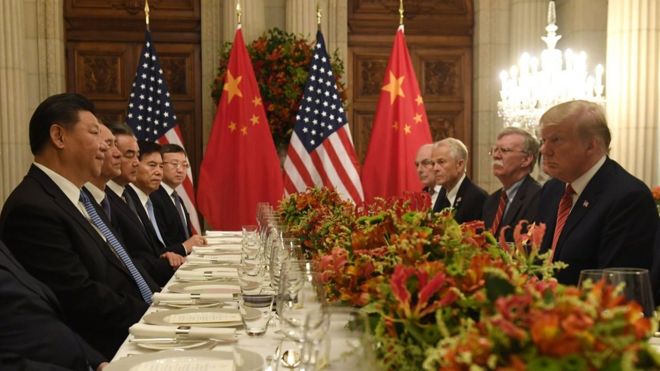
US President Donald Trump, US Secretary of the Treasury Steven Mnuchin and members of their delegation hold a dinner meeting with China's President Xi Jinping and Chinese government representatives, at the end of the G20 Leaders' Summit in Buenos Aires, on December 01, 2018. -Image copyrightGETTY IMAGES

Global stock markets have jumped following the truce in the US-China trade war.
US indexes rose about 1% on Monday, following gains in Europe and Asia.
The increases come after the US and China said they had agreed to not increase tariffs for 90 days to allow for talks.
It remains uncertain how the two sides will resolve underlying US concerns over trade barriers, subsidies and alleged technology theft.
Despite the questions, US President Donald Trump was in an ebullient mood, promising benefits to US farmers and car companies.
On Twitter, he said farmers would be a "very BIG and FAST beneficiary" and described the meeting with Chinese President Xi Jinping as "extraordinary"
Both farmers and the auto industry have been struck in the trade war, as the US and China hit each other with escalating tariffs.
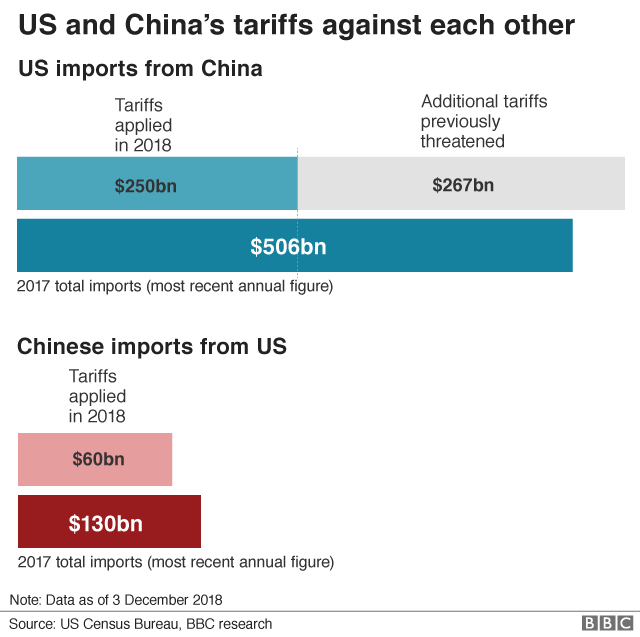
Since July, the US has imposed tariffs on $250bn (£195.9bn) worth of Chinese goods. China has retaliated with duties on some $110bn of US goods over the same period.

What was agreed at the G20?

The US agreed to postpone further tariffs on Chinese goods - a halt that applies to its plans to raise tariffs from 10% to 25% on almost 6,000 items, starting 1 January.
In exchange, the two countries agreed to re-start talks on the US concerns that triggered the dispute, including "forced technology transfer, intellectual property protection, non-tariff barriers, cyber intrusions and cyber theft", according to the White House.
In addition, the US said China agreed to "purchase a not yet agreed upon, but very substantial, amount of agricultural, energy, industrial, and other products from the United States".
Mr Trump later wrote on Twitter that China would "reduce and remove" tariffs on US-made cars, which had been raised to 40% over the summer as tensions escalated.
He did not provide a new level for the Chinese tariffs, and Beijing did not immediately confirm the statement.

US-China tariffs graphic
Presentational white space
Presentational grey line

What's missing in China's official statement?

Zhaoyin Feng, US Correspondent, BBC Chinese Service
Beijing has offered limited details regarding the truce deal made during the Trump-Xi meeting in Buenos Aires, a move to downplay China's compromises in the negotiation and to save face in front of its own people.
China's official statement underlines that no higher tariffs will be imposed on January 1, 2019, but it does not mention the 90-day deadline.
The US statement also lays out major issues for discussion in the coming 90 days and types of American products that China promises to purchase, while the details are not disclosed by the Chinese government and barely reported by the heavily regulated Chinese domestic media outlets.
The not-so-subtle disparities between the US and Chinese official statements highlight how much a gap needs to closed in the three-month trade war time-out.
Also, Beijing has neither echoed nor rebutted Trump's claim about China agreeing to "reduce and remove" tariffs on American vehicles. China's silence indicates that the two leaders likely discussed the issue and reached a tentative agreement during their dinner meeting.
On the non-trade issues, Beijing was more open, announcing that China will tighten supervision of Fentanyl and review rules on the drug. Pledging to crack down Fentanyl is considered a low-hanging fruit in the Trump-Xi meeting, as China has previously pledged to work with the US to stop opioid imports.

Presentational grey line

What pushed the two sides to the table?

China had previously offered to increase its purchases of US products, only to have Mr Trump reject the deal.
However, he has faced fierce criticism from US business groups, as the tariffs lead to reduced exports of crops such as soybeans, while raising costs for businesses that rely on Chinese imports.
Worries about the economic impact of the tariffs have pushed stock markets lower in recent months.
In China, tariffs have also weighed on the economy.
On Monday, China's foreign ministry said economic teams in both countries had been instructed to "intensify talks" towards removing all tariffs following the G20 meeting.
However, it did not indicate if that was a plan with specific goals or something that was merely desirable.

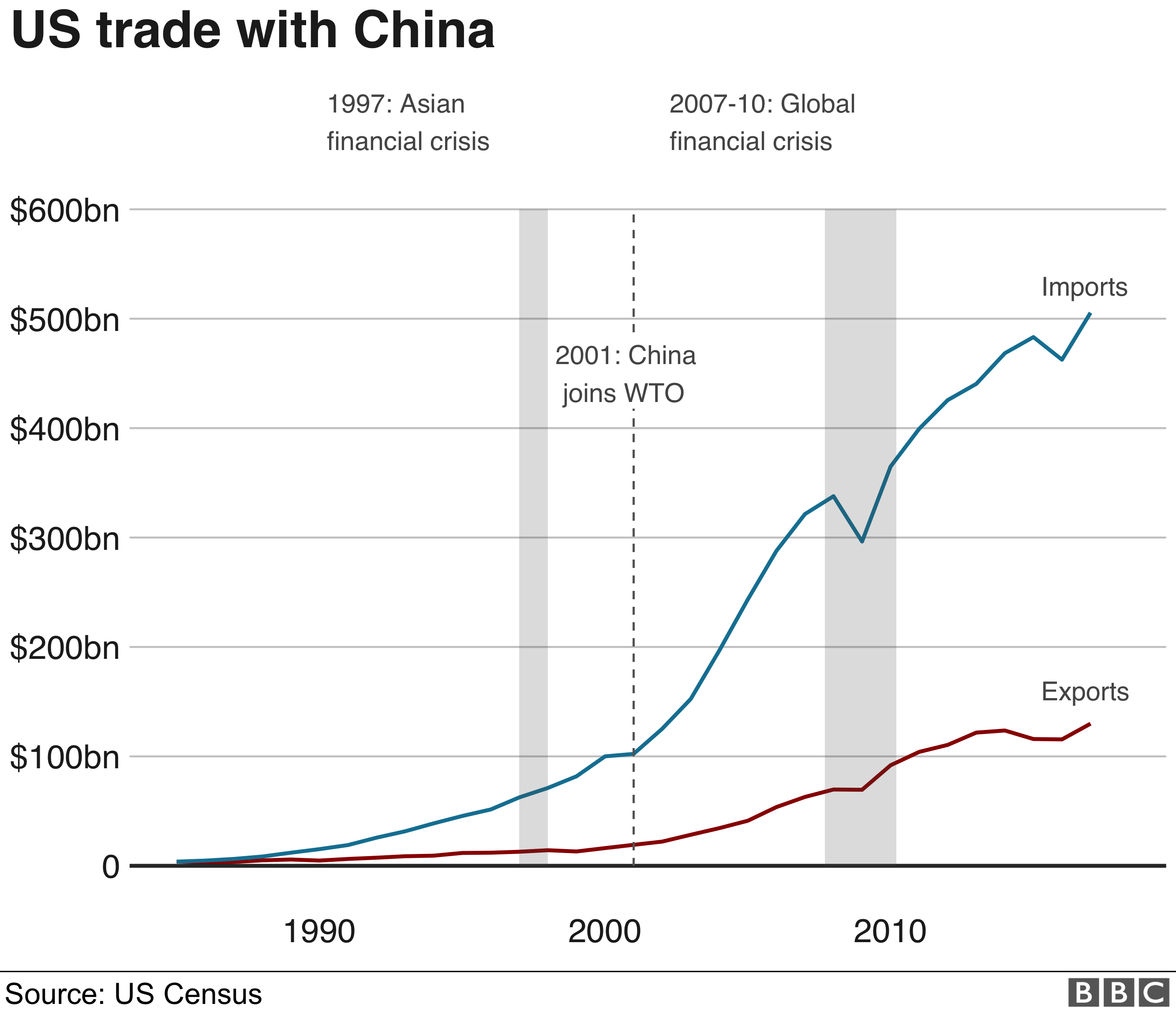
US trade with China graphic
Presentational white space

Will this resolve the dispute?

US markets initially gained more than 1% on Monday, but the enthusiasm dimmed a bit later, as it remained unclear how the two countries will resolve their underlying differences.
"There should be no wishful thinking that the truce would end the trade war between the world's two largest economies," DBS strategist Philip Wee wrote in a research note.
He said it "remains to be seen if real progress could be achieved during this narrow window to resolve the contentious issues, not just on trade, but also intellectual property".
However, Andrew Hunter, US economist for Capital Economics, said he is optimistic that the apparent "ceasefire" will hold, even though the two sides have been in similar positions before.
"With Trump himself having personally negotiated the latest deal, this one has a much greater chance of leading to a lasting truce," he wrote in a research note.
Mr Trump has been willing to declare victory with only modest concessions in the past, pointing to new trade deals with South Korea, Canada and Mexico, he added.
"Trump's latest tweets this morning, which touted the benefits of the agreement for US farmers and his own prowess as a dealmaker, suggest he will be reluctant to walk away from negotiations for a second time," he said.