Friday, March 8, 2019

Reuters News - China February exports tumble the most in three years, spur fears of 'trade recession'

BEIJING (Reuters) - China’s exports tumbled the most in three years in February while imports fell for a third straight month, pointing to a further slowdown in the economy and stirring talk of a “trade recession”, despite a spate of support measures.

While seasonal factors may have been at play, the shockingly weak readings from the world’s largest trading nation added to worries about a global slowdown, a day after the European Central Bank slashed growth forecasts for the region.
Asian stock markets and U.S. futures extended losses after the data. Chinese stocks sank over 4 percent in their worst day in five months.[MKTS/GLOB]
Global investors and China’s major trading partners are closely watching Beijing’s policy reactions as economic growth cools from last year’s 28-year low. But the government has vowed it will not resort to massive stimulus like in the past, which helped revive demand worldwide.
February exports fell 20.7 percent from a year earlier, the largest decline since February 2016, customs data showed. Economists polled by Reuters had expected a 4.8 percent drop after January’s unexpected 9.1 percent jump.
“Today’s trade figures reinforce our view that China’s trade recession has started to emerge,” Raymond Yeung, Greater China chief economist at ANZ, wrote in a note.
Imports fell 5.2 percent from a year earlier, worse than analysts’ forecasts for a 1.4 percent fall and widening from January’s 1.5 percent drop. Imports of major commodities fell across the board.
That left the country with a trade surplus of $4.12 billion for the month, much smaller than forecasts of $26.38 billion.
Analysts warn that data from China in the first two months of the year should be read with caution due to business disruptions caused by the long Lunar New Year holidays, which came in mid-February in 2018 but started on Feb. 4 this year.
But many China watchers had expected a weak start to the year as factory surveys showed dwindling domestic and export orders and the Sino-U.S. trade war dragged on.
“Seasonal distortions around the Chinese New Year holiday has added noise to the export data in the past two months, and in our view explain most of the surprise (relative to consensus),” said analysts at Goldman Sachs, whose estimate for a 20 percent export drop was the most pessimistic in the Reuters poll.
But they noted that export momentum on a three-month basis has moderated significantly since the third quarter last year and said “growth is likely to remain soft in the near future.”

TRADE WAR

The increasingly weak China data comes amid months of intense negotiations between Washington and Beijing aimed at ending their trade dispute.
On Wednesday, the U.S. reported its goods trade deficit with China surged to an all-time high last year, underlining one of the key sticking points.
China’s data on Friday showed its surplus with the United States narrowed to $14.72 billion in February from $27.3 billion in January, and it has promised to buy more U.S. goods such as agricultural products as part of the trade discussions.
U.S President Donald Trump said on Wednesday that trade talks were moving along well and predicted either a “good deal” or no deal between the world’s two largest economies.
Trump postponed a sharp U.S. tariff hike slated for early March as the talks progressed, but both Washington and Beijing have kept previous duties in place.
The Chinese government’s top diplomat, State Councillor Wang Yi, said on Friday that talks had made substantive progress, and that the two countries’ relations should not descend into confrontation.
But the New York Times reported that Chinese officials are leery of continued discussions and don’t want to commit China to structural changes in its economy.

WORLD’S GROWTH ENGINE SLOWING

China’s economy was already slowing last year before trade tensions escalated, due in part to a regulatory clampdown on riskier lending that starved smaller, private companies of financing and stifled investment.
Even if a trade deal is reached, its exporters will have to contend with weakening demand globally, particularly in Europe. China’s exports to all of its major markets fell across the board last month.
The government is targeting economic growth of 6.0 to 6.5 percent in 2019, Premier Li Keqiang said at Tuesday’s opening of the annual meeting of parliament, a lower target than set for 2018.
Actual growth last year slowed to 6.6 percent, and is expected to cool further to 6.2 percent this year. Many analysts expect a rocky first half before a flurry of stimulus measures start to stabilize activity around mid-year.
China’s slowdown and the trade war are having an increasing impact on other trade-reliant countries and businesses worldwide.
Imports from Japan sank 19.3 percent in February compared with a month earlier, Chinese customs data showed.
On Thursday, automotive chipmaker Renesas Electronics Corp said it plans to halt production at six plants in Japan for up to two months this year as it braces for a further slowdown in Chinese demand.
Taiwan reported its biggest export drop in over 2-1/2 years on Friday, with shipments to China down 10.4 percent. Like China, Japan and South Korea, its hi-tech manufacturers are also being hurt by a global downturn in demand for electronics from memory chips to smartphones.
Reporting by Yawen Chen, Stella Qiu and Kevin Yao; Editing by Richard Borsuk and Kim Coghill

Thursday, March 7, 2019

BBC News - Trump dealt blow as US trade deficit jumps

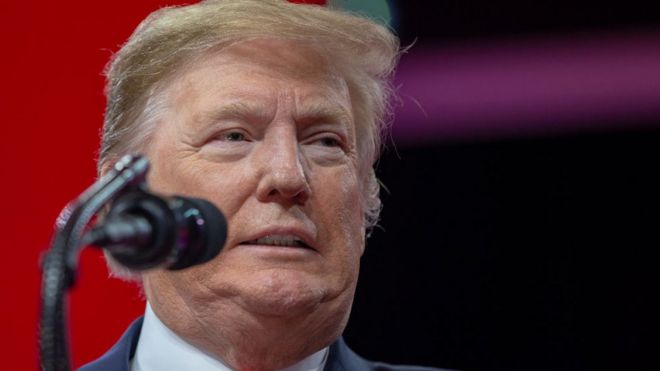
US President Donald TrumpImage copyrightGETTY IMAGES
The US trade gap with the rest of the world jumped to a 10-year high of $621bn (£472.5bn) last year, dealing a blow to President Donald Trump's deficit reduction plan.
The trade deficit is the difference between how much goods and services the US imports from other countries and how much it exports.
Reducing the gap is a key plank of Mr Trump's policies.
But in 2018, the US exported fewer goods compared with how much it bought.
Mr Trump claims that the US is being "ripped off" by other nations and wants countries to lower their tariffs on US goods and buy more of them.
However, official data shows that while exports of US goods and services rose by $148.9bn last year, imports jumped by $217.7bn.
It means that the gap is the widest since 2008, when the global financial crisis hit and the US fell into recession.
The deficit in goods and services during December also hit a near 10-year high of $59.8bn.
Exports to the rest of the world fell 1.9% to $205.1bn, while imports rose by 2.1% to $264.9bn.

'Tariff man'

The US is currently locked in a trade battle with China over what it claims are unfair trade practices, resulting in tit-for-tat tariff increases on each others' goods.
Both nations are in discussions and there is speculation they could reach an agreement by the end of March.
New data shows that the trade gap between the US and China widened last year by $43.6bn to $419.2bn as exports of American products and services fell, but imports from China rose.
Presentational grey line

Analysis: Michelle Fleury, BBC North America business correspondent

It was one of Donald Trump's signature campaign promises.
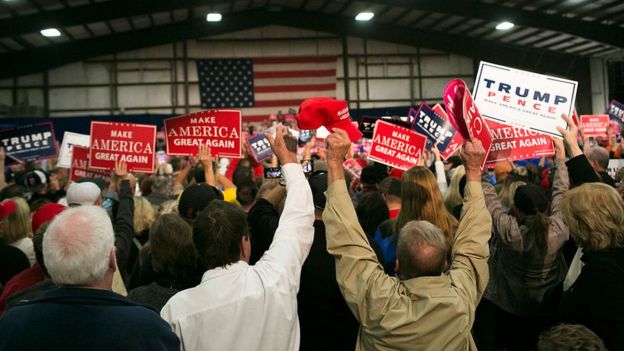
Back in June 2016, he stood before a large crowd in Monessen, Pennsylvania and said that as President, he would reduce America's ballooning trade deficit.
Trump rallyImage copyrightGETTY IMAGES
He called it "a political and politician-made disaster" and said "it can be corrected".
Only it hasn't exactly turned out that way.
Last year, Mr Trump introduced tariffs on steel and aluminium from around the globe and on a range of imports from China.
The idea was that the tariffs would make imports more expensive, thereby discouraging Americans from buying foreign goods and services and shrinking the trade deficit.
But the opposite has happened.
Instead, Donald Trump goes into the presidential re-election race having failed to deliver on his campaign promise to close the US trade deficit.
Part of the problem is Mr Trump's own tax policies. They boosted US consumption and a lot of that spending went abroad.
This happened as growth was slowing in other parts of the world, contributing to a rising dollar. That made US exports more expensive and less competitive.
Of course, an economic downturn would help reduce the trade deficit.
But who wants that?
Presentational grey line
Mr Trump warned in December that if the two countries failed to reach an agreement on trade, he would take action, dubbing himself "a Tariff Man".

'National security'

The deficit between the US and the European Union also increased in 2018, up by $17.9bn to $169.3bn.
Following the same trend as with China, US export growth to the EU was eclipsed by imports of European goods and services to America, which last year rose to $487.9bn.
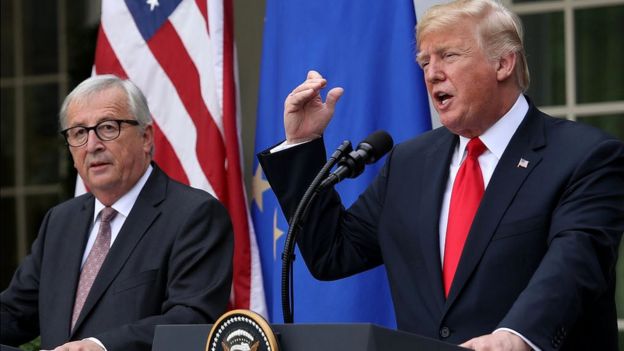
Donald Trump and Jean-Claude JunckerImage copyrightGETTY IMAGES
Image captionDonald Trump and Jean-Claude Juncker reached a truce on trade last year
Following a spat between the US and the EU when America lifted tariffs on steel and aluminium, Mr Trump and European Commission President Jean-Claude Juncker last year reached a truce.
However, Mr Trump may choose to lift tariffs on European cars and parts after the US Commerce Department produced a report examining whether the imports threaten national security.
Meanwhile, US Trade Representative Robert Lighthizer and EU Trade Commissioner Cecilia Malmstrom are meeting on Wednesday in Washington, where the issue of allowing America's agriculture industry access to Europe is expected to be discussed.

Wednesday, March 6, 2019

Reuters News - U.S.-UK relationship will prosper after Brexit - U.S. ambassador

LONDON (Reuters) - Britain’s relationship with the United States is more important than ever and will prosper as Britain leaves the European Union, Washington’s ambassador to London Woody Johnson said on Wednesday.
He added that the chances of a future trade deal between the two countries should not be damaged by false concerns over U.S. farming practices which he said had been largely driven by the European Union to create barriers to U.S. farm products.
“I have confidence that whatever way you decide to go that the U.S. and our special relationship will continue and prosper, no matter what,” he told BBC Radio.
Asked if that included in a no deal Brexit scenario, he replied: “In any situation I know that our two countries have to be together in this free world. There’s a lot of danger out there, so our relationship is more important now than ever whatever happens with Brexit.”
Johnson said he could not confirm if U.S. President Donald Trump would make a state visit to Britain in June - the 75th anniversary of the allies D-Day Landings in France during World War Two.
“I think it’s been presented but I don’t have any of the details right now. He’s got a very, very big schedule...but we’d love to have him over here,” he said.
“His mother was born here so he has a great affection for this country.”
Trump last visited the UK in July 2018.
Reporting by Kate Holton and James Davey. Editing by Andrew MacAskill

Tuesday, March 5, 2019

Bloomberg News - Wars, Coups and Protests Don’t Stop Gas Flowing to Europe

By Salma El Wardany
Arab Spring-style protests have rocked Europe’s third-biggest natural gas supplier. Thousands of young Algerians have taken to the streets, fed up with an octogenarian president who’s been in power for 20 years and a weak economy that doesn’t generate enough jobs. While the rare public display of dissatisfaction has sparked a political crisis in the authoritarian state, the country’s energy exports haven’t been disrupted.

What’s going on in Algeria?

Protesters say their 82-year-old President Abdelaziz Bouteflika should not seek a fifth term in the April elections. Bouteflika, who had a stroke in 2013 and is rarely seen in public, quelled smaller protests when he ran in 2014, using a mixture of water cannons and enhancements to subsidies and salaries. Handouts would be more painful this time for Africa’s biggest oil and gas producer because its economy is still struggling to cope with four years of lower crude prices. Inflation is rising and the country’s reserves are projected to plummet to $67 billion this year from $177 billion in 2014, according to the International Monetary Fund.

Economic Slump

Lower oil prices have slowed Algeria's growth rate and depleted its coffers

Will oil and gas exports be affected?

It’s unlikely. “With the vast majority of oil and gas facilities located in remote areas far from urban centers and very scarcely populated, the risk of disruption is low,” according to Riccardo Fabiani, an analyst with research consultants Energy Aspects. Algeria is one of OPEC’s smaller producers, pumping about a million barrels of crude a day. It plans to boost natural gas output, which it exports by ship and via pipelines to Italy and Spain.

Big Four

These countries supply 95 percent of the European Union's natural gas imports

What does history tell us about Algeria?


A decade-long civil war that that erupted after the military canceled an Islamist electoral victory in 1991 was brutal on civilians, but didn’t hinder the energy industry. Foreign companies including BP Plc, Total SA and Repsol SA continued to invest in projects, and the $2.3 billion pipelineto Spain was completed in 1996. Even so, the country is no stranger to security risks. In 2013, Islamist militants linked to al-Qaeda killed 40 workers at the In Amenas gas plant, which is operated by Statoil ASA, BP and Algeria’s state-owned Sonatrach.

What’s the impact on energy projects?

Algeria plans to develop onshore and offshore gas fields, start a trading business, revamp and build refineries and boost output of petrochemicals. This expansion hinges on a stable political leadership and a new set of laws that can attract foreign investors. Algeria’s energy industry has cycled through five ministers and six Sonatrach chief executives since 2010. The current upheaval increases the risk of “paralysis in the oil and gas sector and a series of reshuffles aimed at placating protesters,” Fabiani said. “That could undermine those officials that have been trying to restructure the sector.”

Monday, March 4, 2019

BBC News - Post-Brexit migration rules disastrous, say manufacturers

Border controlImage copyrightGETTY IMAGES
Proposed new post-Brexit immigration rules will "decimate" factory workforces, the UK's main manufacturing association has warned.
Plans to introduce a £30,000 minimum salary threshold would have "disastrous impacts", said Make UK.
Some 88% of skilled workers would not be receiving that level of pay, said the organisation.
Currently skilled roles such as engineering technicians are largely filled by EU nationals.
In December the government published a White Paper on immigration proposing a £30,000 salary requirement, which would apply to skilled migrants seeking five-year visas.
Make UK said the move would cause shortages of welders, robotics workers, toolmakers and maintenance technicians.
"Few of these roles initially pay more than the £30,000 necessary under the new rules to qualify to work in the UK," said the organisation, formerly known as the EEF.
Its director of employment and skills policy, Tim Thomas, urged the government to "urgently reconsider" the salary threshold plans.
He said that as a minimum, it should "reduce the rate and offer a phased approach to any salary threshold introduction".
This would "allow businesses to adapt and train a different cohort of employees", he said.
"As yet, the UK does not have the home-grown talent and expertise to fill what will soon become vacant job roles."
The White Paper - a document setting out proposed new laws before they are formalised in a government bill - also includes:
  • Scrapping the current cap on the number of skilled workers such as doctors or engineers from the EU and elsewhere
  • Plans to allow lower-skilled migrants to come to the UK to work for up to a year until 2025
  • Visa exemptions for visitors from the EU
  • Plans to phase in the new system from 2021.
Make UK also objected to the rule change for lower-skilled migrants, saying it would hit EU jobseekers looking to fill roles such as plant and machine operators.

Friday, March 1, 2019

BBC News - US economic growth continues to slow

US shoppersImage copyrightGETTY IMAGES
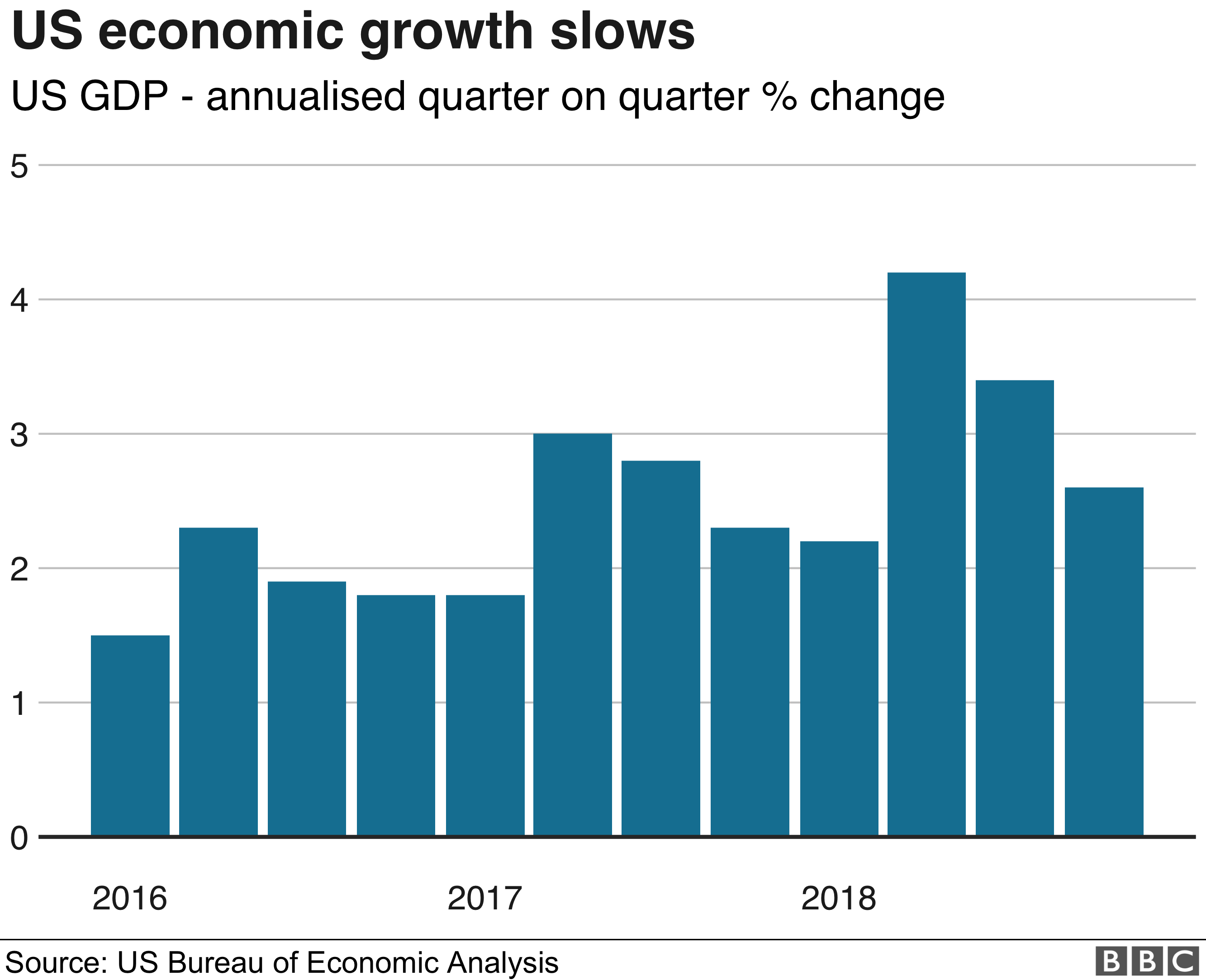
US economic growth slowed to an annualised rate of 2.6% in the final three months of 2018, figures show.
However, the reading was ahead of expectations for a rate of between 1.8% and 2%.
The pace of growth was below the 3.4% rate seen in the third quarter thanks to a slowdown in consumer spending.
The growth figures had originally been due to be released in January, but were delayed because of the 35-day US government shutdown.
The US economy was boosted last year by a big tax cut and an increase in government spending.
Ian Shepherdson, chief economist at Pantheon Macroeconomics, said that the fourth quarter was "not a bad performance" given that the economic boost from the Trump administration's tax cuts is now fading.
For the full year, GDP grew by 2.9% - just shy of President Donald Trump's 3% target - compared with 2.2% in 2017.
US GDP
Mr Shepherdson said he expected that growth in 2019 would revert to the "post-crash trend" of between 2% and 2.5%, "demonstrating that the personal tax cuts offered nothing more than a sugar high, and that the business tax cuts did nothing to lift trend growth. Though they did make shareholders richer".
Capital Economics chief US economist Paul Ashworth said he expected growth of 2.2% this year and 1.2% in 2020.
Presentational grey line

Analysis:

By Andrew Walker, BBC World Service economics correspondent
It has certainly been a significant slowdown. But that figure of 2.6% is still reasonably strong.
It is actually more than most independent economists think the US can sustain over the long term. Many think there was a short-term boost from President Trump's tax cuts which is now fading.
In the coming years, the economy will face further headwinds from an ageing population. The view that long-term prospects are rather more modest is shared by policymakers at the Federal Reserve.
They consider the long-run growth of the US economy is likely to be somewhere between 1.7% a year and 2.2%.
President Trump by contrast has suggested that 4% is doable, and his administration is aiming for 3%.
Growth for the full year 2018 was very close to the latter figure. But sustaining it will be a serious challenge.
Presentational grey line

Consumer slowdown

Consumer spending, which accounts for more than two-thirds of US economic activity, increased at an annual rate of 2.8% in the final three months of last year.
That was a slowdown from the 3.5% rate set in the previous quarter.
Recent figures showed that retail sales fell by 1.2% in December while demand for new vehicles dropped by 1% in January compared to the same month last year, with car sales particularly hard hit with a 4% drop.
US carsImage copyrightGETTY IMAGES
Image captionA fall in US car sales could add slower consumer spending in the first quarter
Mr Ashworth said that both factors mean that "consumption growth could fall below 2%" in the first quarter of 2019.
Also, while business investment growth reached 6.2%, he said "the first quarter won't be this good".
"We already know that lower oil prices will depress mining investment, while the weakness of underlying durable goods orders points to a softer equipment showing."