Tuesday, March 19, 2019

BBC News - UK employment at highest since 1971

Men working in a factoryImage copyrightPA
The number of employed people in the UK has risen again, to a new record number of 32.7 million people between November and January, figures from the Office for National Statistics (ONS) show.
The 76.1% employment rate is the highest since records began in 1971.
Unemployment fell by 35,000 to 1.34 million in the period, putting the rate below 4% for the first time since 1975.
The figure is 112,000 lower than a year ago, giving a jobless rate of 3.9%, well below the EU average of 6.5%.
Average weekly earnings, excluding bonuses, were estimated to have increased by 3.4%, before adjusting for inflation, down by 0.1% on the previous month but still outpacing inflation.
ONS senior statistician Matt Hughes said: "The employment rate has reached a new record high, while the proportion of people who are neither working nor looking for a job - the so-called 'economic inactivity rate'- is at a new record low."
Employment Minister Alok Sharma said: "Today's employment figures are further evidence of the strong economy the chancellor detailed in last week's Spring Statement, showing how our pro-business policies are delivering record employment."

Where are the new jobs being added?

The number of men in employment increased by 77,000 to a record high of 17.32 million.
The number of employed women rose by 144,000 to a record high of 15.40 million - the largest increase since February-to-April 2014.
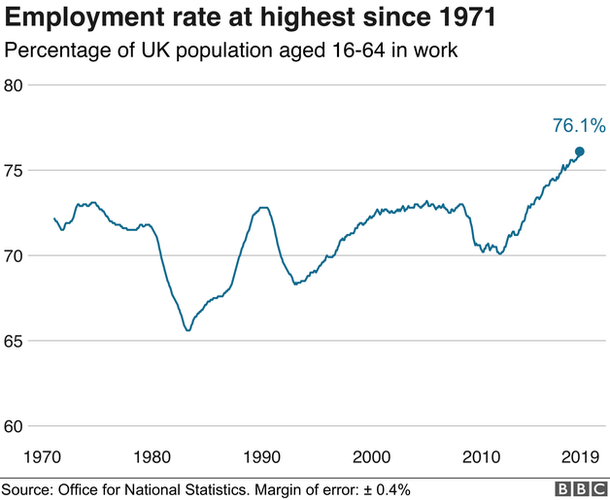
Graph of employment figures
The UK's highest regional employment rate was in the south-west of England (79.9%), while the largest estimated increase in workforce jobs was in the south-east of England (59,000).
In December, London (91.5%) had the highest estimated proportion of people working in the services sector, while the East Midlands had the biggest proportion of production jobs (14.5%).
The ONS figures also reveal a record number of 1.67 million people working for the NHS in December - 32,000 more than a year earlier.

What has happened to unemployment?

The unemployment rates for both men and women aged 16 years and above have been generally falling since late 2013.
Men's unemployment then stood at 7.4% and women's at 6.9%.
The new total unemployment rate of 3.9% has not been lower since the November 1974 to January 2015 period.
The 4% figure for men is at its lowest since April to June 1975, while the 3.8% for women is the lowest since comparable records began in 1971.
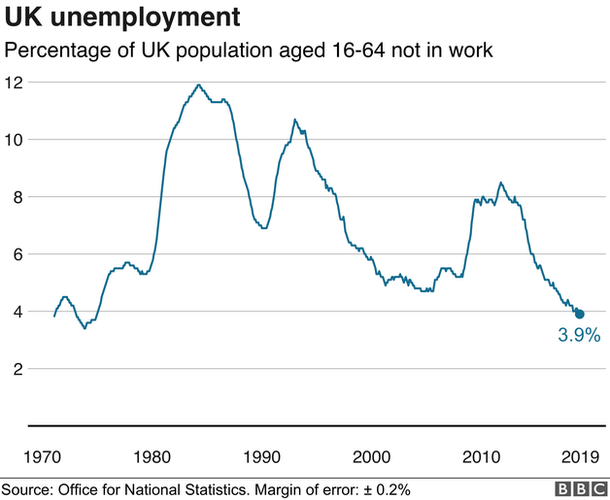
Graph of unemployment figures
Meanwhile, the number of economically inactive people fell by 117,000 to 8.55 million, a rate of 20.7%, the lowest on record.
The number of job vacancies in the economy increased by 4,000 to 854,000.

Presentational grey line

Why are jobs, but not investment, flourishing?

By Andy Verity, BBC economics correspondent
If you were being uncharitable to politicians, you might say today's jobs figures demonstrate how little they matter. "Crisis, what crisis?" said recruiters as they hired 220,000 people in the three months to the end of January.
How can you reconcile all that job creation with talk of a Brexit-induced slowdown?
One answer is that the jobs market lags behind the rest of the economy.
Recruiting people takes time; it can be months between noticing you need some new staff and their starting work, so the recruitment decisions reflect recruiters' sentiments months ago.
Another reason may be that our jobs market is highly flexible, which is to say the risks fall on employees.
In uncertain times, a company whose order book is expanding may prefer to take on people who can be "let go" later if things go wrong.
That can be less costly than investing large sums in new plant and machinery, for example - investment which might prove wasted if demand for your goods shudders to a halt in a few months' time.
If that story is right, it helps explain why the economy is generating jobs, but not much investment.
And although there are more of us working, notably women and older people joining the workforce, the amount we each produce is barely growing. That puts a question mark over the sustainability of real wage growth of 1.4% - the strongest in more than two years.
Presentational grey line

Are companies ignoring Brexit uncertainty and continuing to hire?

It appears that Brexit is not stopping firms hiring staff - at least, not yet.
Tej Parikh, senior economist at the Institute of Directors, said: "Businesses have been steadfast in bringing on board new staff and in creating vacancies, despite question marks over the future path of the economy.
"But with uncertainty around Brexit reaching a crescendo, firms are becoming more and more cagey over their hiring decisions."
Andrew Wishart, UK economist with Capital Economics, said: "There was no sign in the labour market data of Brexit concerns at the start of the year, as the data beat expectations in every regard."
Stephen Clarke, senior economic analyst at the Resolution Foundation think tank, said that Britain was closing in on Nordic employment rates and added: "While business investment has stagnated, firms are choosing instead to invest heavily in new staff."
Wages are still ahead of inflation, despite a lower increase than last month.
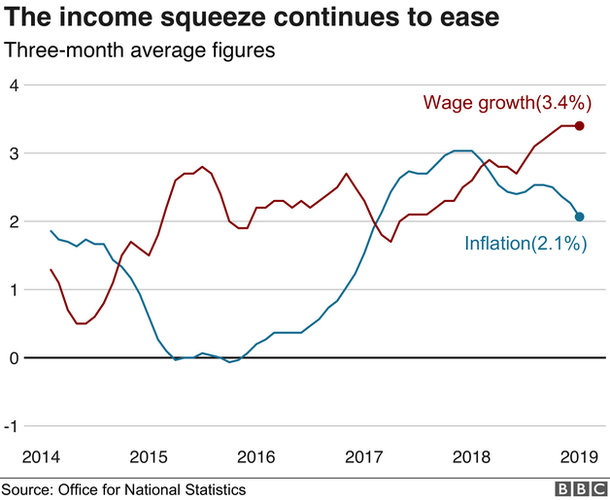
Wages v inflation graph

What does this all mean for interest rates?

Analysts think that the outcome of Brexit could lead to an interest rates rise later this year.
Mr Wishart said: "If there is a long delay to Brexit or a deal is struck, we suspect the [Bank of England's] Monetary Policy Committee will raise interest rates this summer."
And Mr Parikh added: "Employers will want to avoid a disorderly withdrawal from the EU and will above all be urging policymakers to return some much-needed oxygen to the skills and productivity agenda."

Monday, March 18, 2019

Bloomberg News - U.S. Stocks Climb at Start of Busy Week; Bonds Dip: Markets Wrap

By Yakob Peterseil and Sarah Ponczek
U.S. equities gained at the start of a week filled with potentially significant catalysts from central bank meetings, geopolitical developments and economic data. Treasuries and the dollar drifted lower.
The S&P 500 and Nasdaq opened slightly higher, while Dow contracts slipped as Boeing Co. declined on reports that the U.S. Transportation Department was examining the 737 Max’s design certification.
Equities are grinding higher and volatility is declining on expectations the Fed will point the way to just one rate hike in 2019 when it meets later this week. Other central bank gatherings, including for the Bank of England, will give further clues on monetary policy. In politics, investors are keeping an eye on this week’s Brexit developments as the British prime minister works to win support for her divorce agreement.
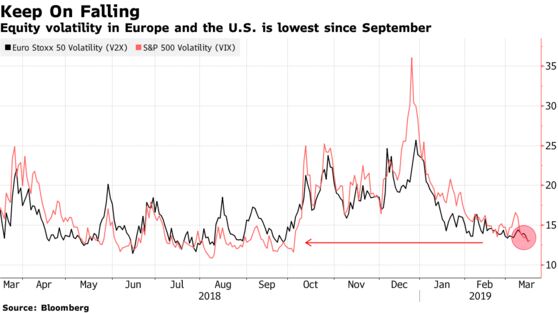
Equity volatility in Europe and the U.S. is lowest since September
“The stock market has priced in a very dovish Fed and a stabilization of U.S. and global growth,” Tom Essaye, a former Merrill Lynch trader who founded “The Sevens Report” newsletter, wrote to clients. “Both expectations need to be met by the events this week in order for this rally to keep going.”
European stocks nudged up, led by miners and lenders as Deutsche Bank AG and Commerzbank AG got the green light to proceed with negotiations on a tie-up. In Asia, Chinese and Hong Kong shares led the advance. The pound fell as Prime Minister Theresa May continued to face opposition to her Brexit plans.
Elsewhere, oil fluctuated as OPEC and its allies recommended deferring a decision on whether to extend oil production cuts until June. Emerging market currencies and shares climbed. Gold gained.
Here are some key events coming up:
  • Company earnings include FedEx, China Telecom, Tencent, Porsche, BMW, Hermes, Tiffany, Micron, Nike and PetroChina.
  • The Fed is expected to hold interest rates steady, announce the end of asset roll-off from its balance sheet, and lower projections for the number of interest-rate hikes this year. The decision is due Wednesday.
  • Central banks in Thailand, the Philippines and Indonesia are all scheduled for policy meetings.
  • In the euro zone, purchasing manager survey numbers on Friday will give an indication of the health of the region’s industrial and service sectors at the end of the first quarter.
These are the main moves in markets:

Stocks

  • The S&P 500 Index advanced 0.2 percent as of 9:35 a.m. New York time.
  • The Stoxx Europe 600 Index climbed 0.1 percent.
  • The U.K.’s FTSE 100 Index gained 0.6 percent.
  • Germany’s DAX Index declined 0.3 percent, the biggest drop in more than a week.
  • The MSCI Emerging Market Index advanced 1.1 percent to the highest in almost seven months.

Currencies

  • The Bloomberg Dollar Spot Index decreased 0.1 percent.
  • The euro gained 0.2 percent to $1.1345, the strongest in more than two weeks.
  • The British pound dipped 0.4 percent to $1.3243.
  • The Japanese yen fell less than 0.05 percent to 111.53 per dollar.

Bonds

  • The yield on 10-year Treasuries increased one basis point to 2.60 percent.
  • Germany’s 10-year yield climbed one basis point to 0.09 percent, the highest in more than a week.
  • Britain’s 10-year yield fell less than one basis point to 1.209 percent.

Commodities

  • West Texas Intermediate crude advanced less than 0.05 percent to $58.54 a barrel.
  • Gold climbed 0.2 percent to $1,305.44 an ounce.
— With assistance by Sophie Caronello, and Adam Haigh

Friday, March 15, 2019

BBC News - Contactless card use surges as doubts ease

By Kevin Peachey
The number of transactions using contactless rose 31% in 2018 compared with the previous year, banking trade body UK Finance data shows.
Adoption of this technology on public transport and by more retailers has led, in part, to the rise.
The contactless payment limit, before entering a four-digit Pin, is £30.
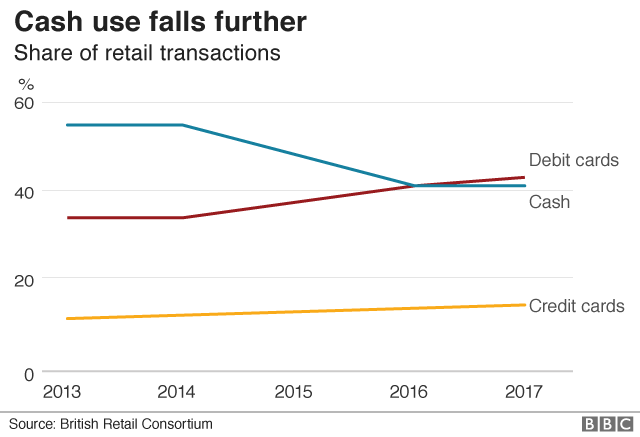
Debit card use had already been rising dramatically at the expense of cash.
In 2017, debit card use overtook the number of payments made in cash in the UK for the first time.
Cash v plastic graph
The growth in contactless in 2018 is expected to lead to to a widening of this gap.
Some 6.3 billion payments were made using contactless debit cards last year, a 29% increase on the previous year, the UK Finance data shows. These purchases were worth a collective total of £58bn.
The increase in the use of contactless on credit cards was even greater - with 44% more purchases of this kind in 2018 compared with the previous year.
More consumers have been sent replacement credit cards with a contactless facility, but they are still used far less than debit cards. There were 1.1 billion credit card payments on contactless last year, valued at nearly £11bn.
Card paymentImage copyrightGETTY IMAGES
The average amount spent in a transaction of any kind on a debit or credit card last year was £35.
Eric Leenders, managing director of personal finance at UK Finance, said: "Many of us are now reaching for our cards or mobiles rather than cash to make low-value purchases, as customers opt for the convenience and security of paying with contactless.
"There has also been an increase in credit card use although growth in outstanding balances has slowed, suggesting many consumers are using their cards for day-to-day spending rather than as a means of borrowing."
A major report, published earlier this month, found that cash was at risk of disappearing without action from regulators and the government.
The system which underpins the use of notes and coins was at risk of falling apart, the Access to Cash Review concluded.

Thursday, March 14, 2019

Reuters News - Spring Statement: Hammond promises 'deal dividend'

Rail workers
Philip Hammond vowed to free up more money to help end austerity in a "deal dividend".
However, he said tax cuts and spending rises depended on a smooth Brexit.
Mr Hammond used his Spring Statement to warn that a disorderly Brexit would deal a "significant" blow to economic activity in the short term.
He said the decision by MPs to reject Theresa May's Brexit deal for a second time had left a "a cloud of uncertainty hanging over our economy".

Growth slowdown temporary

The latest figures from the Office for Budget Responsibility (OBR) forecast that the UK economy will grow at the slowest pace since the financial crisis this year.
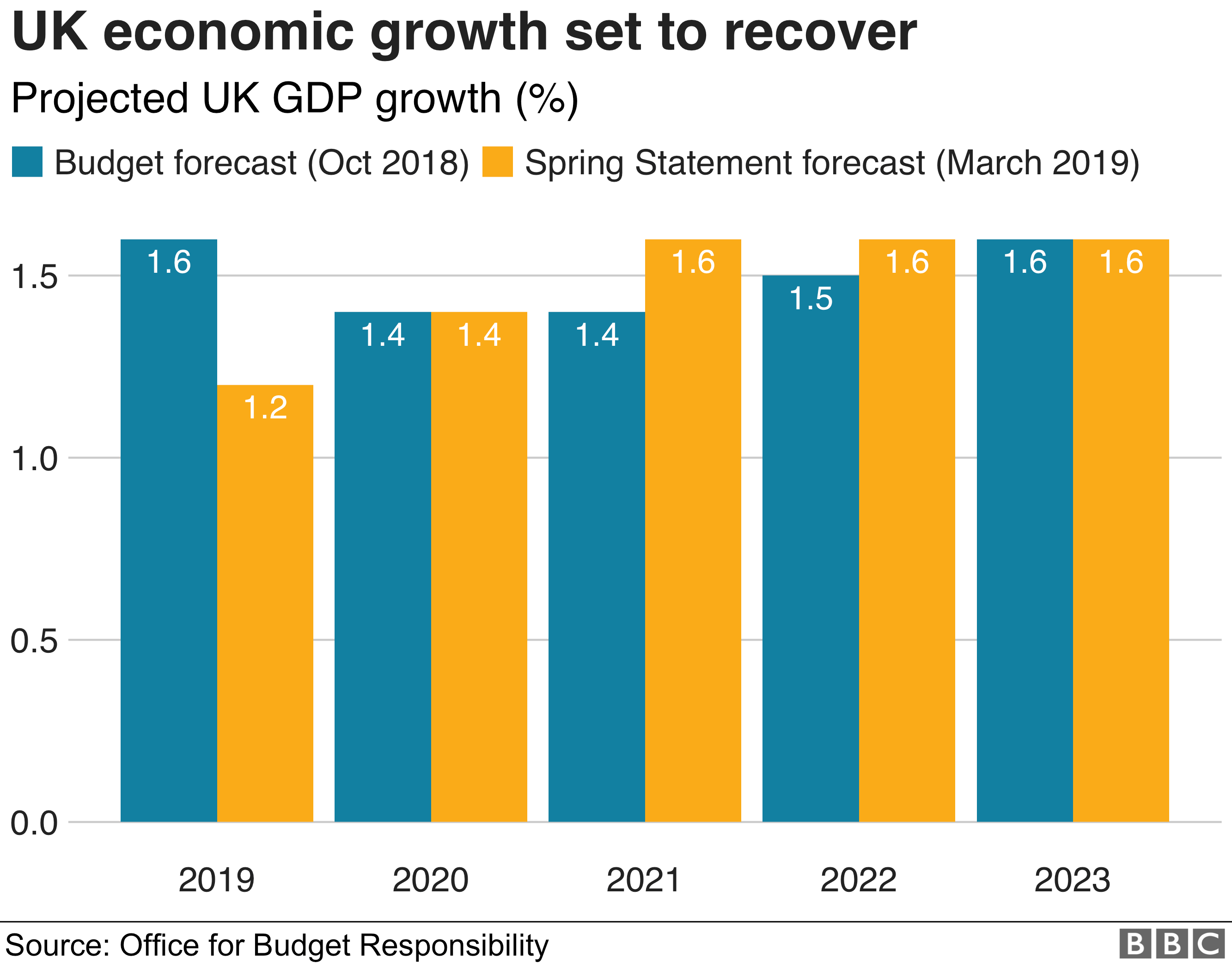
The OBR cut its 2019 growth forecast to 1.2%, the weakest growth rate since 2009.
That is a significant cut from the 1.6% expansion predicted by the government's economic watchdog last October.
After that growth is expected to rebound.
Chart showing UK growth projections
Mr Hammond said the economy had "defied expectations" as wages were expected to keep growing at rates of above 3% over the next five years
He hinted that the government would have up to an extra £26.6 billion to spend if MPs voted to leave the EU with a deal, while still meeting self-imposed limits on government borrowing.
This is almost double the £15.4bn estimated by the OBR in October.
The statement left the forecast for GDP growth in 2020 at 1.4% and now expects the UK economy to expand by 1.6% a year in the following three years.
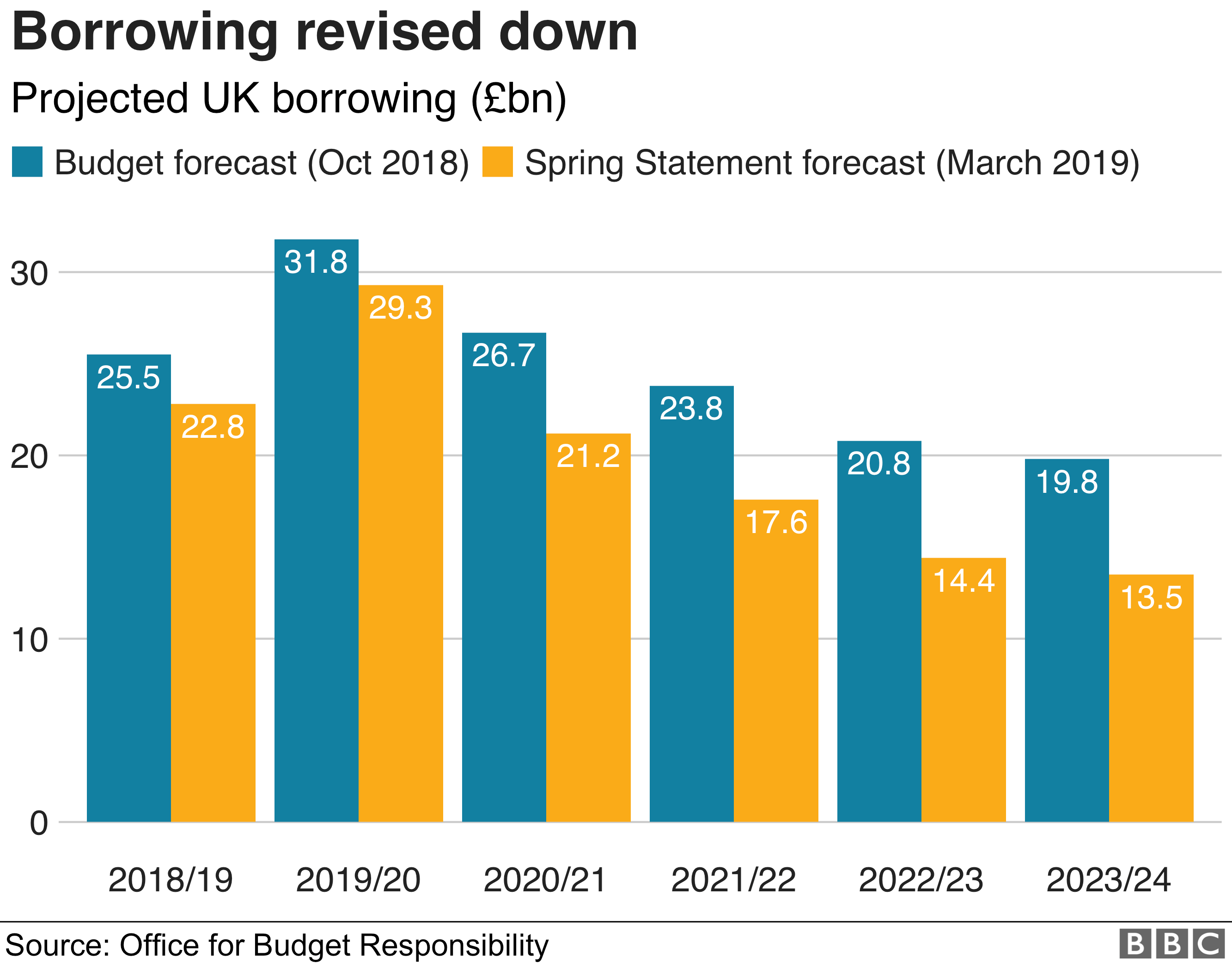
Chart showing UK borrowing projections

Healthy public finances

The government is expected to borrow £22.8bn this financial year to plug the gap between the money it spends on public services and the tax revenues it collects.
This is almost £3 billion lower than the £25.5bn predicted by the OBR in the October Budget.
The watchdog expects the improvement in the public finances to continue in future years, helped by stronger tax receipts and lower spending on debt interest.
While borrowing is expected to rise to £29.3bn next year, it is then predicted to fall over the next four years.

Boost for public services

Mr Hammond announced a £800m increase in non-NHS spending by the middle of the next decade to keep pace with inflation
In January the government announced it would pump a similar amount into the NHS to maintain real-terms spending.
The chancellor also said he was making an additional £100m available over the course of the next year to help deal with the surge in knife crime.
The cash is to be used for police overtime and to fund new 'Violent Crime Reduction Units' to help respond to the increase.

Student loans headache

Mr Hammond is expected to set out detailed plans about how money will be allocated to different government departments beyond 2020 in a spending review starting this summer.
However, changes to the way student loans are treated on the government's books will eat away at the Brexit war chest that Mr Hammond has set aside.
The changes, which reflect the fact that many students will never fully repay their loans, are expected to reduce the pot of available cash by around £12bn this autumn.
The watchdog said this would also make an ongoing aspiration of eliminating the deficit "harder to achieve".
Robert Chote, the chairman of the OBR, said the Chancellor could respond to the statistical shake up by changing his borrowing targets, or by tweaking other tax and spending measures.
Students pictured at a graduation ceremonyImage copyrightNURPHOTO
Image captionChanges to the way the Office for National Statistics treats student loans in the autumn will reduce the cash Hammond has to spend
The government's fiscal rules state that it must keep borrowing, adjusted for the ups and downs of the economy, below 2% of GDP in 2020-21.
The OBR said there was a 40% chance that the government would eliminate borrowing entirely by 2023/24.

Brexit costs

Mr Chote also highlighted that the OBR's forecasts were based on a smooth Brexit, with employment expected to remain steady and business investment predicted to rise.
He said the economic outlook remained uncertain, with the Spring Statement sandwiched between crucial votes that will determine the UK's exit from the EU.
Mr Chote said no deal would probably lead to a "short-term shock to the economy" which would have implications for taxes and spending.
However, he said the hit to the country's longer term growth prospects and UK living standards would be a bigger concern.
While Mr Chote said the government was likely to spend more money to support the economy, he said the direct effects of this on the economy were "presently unknowable".

Wednesday, March 13, 2019

Reuters - Venezuela seeks to restore power amid looting; China offers help

CARACAS (Reuters) - President Nicolas Maduro’s government scrambled on Wednesday to return power to western Venezuela following heavy looting in the second largest city, while China offered to help the South American nation end its worst blackout on record.

Power had returned to many parts of Venezuela after a nationwide outage last week that Maduro’s ruling Socialist Party blamed on an act of U.S. sabotage, though it had not fully reached the western state of Zulia, where temperatures are high.

Looters smashed shop windows and made off with merchandise in more than 300 businesses across the state, located along the border with Colombia, the Zulia chapter of business organization Fedecamaras said in a statement.
“This has truly been a tragedy,” opposition legislator Nora Bracho, who represents Zulia in the National Assembly, said in a text message on Wednesday. “Not having power is already a burden with the temperature at 104 degrees. In addition, there’s no potable water and no food.”
The country’s top food company, Empresas Polar, said four facilities in Maracaibo, the biggest city after the capital Caracas, had been sacked this week, with looters making off with water, soft drinks and pasta.
The Information Ministry did not immediately reply to a request for comment.
China on Wednesday said it was willing to provide help and technical support to restore electricity, and backed Maduro’s assertion that the problem was the result of sabotage.
Maduro’s critics have scoffed at the sabotage explanation, insisting that rampant corruption and a decade of incompetent management by state authorities were to blame.
A technical problem with transmission lines linking the Guri hydroelectric plant in southeastern Venezuela to the national power grid likely caused the blackout, experts said.
With no electricity, hospitals struggled to keep equipment running, food rotted in the tropical heat and exports from the country’s main oil terminal were shut down. On Monday, Venezuelans unable to obtain potable water for home use formed lines to fill containers from a sewage pipe.
The United States is preparing to withdraw its remaining diplomats in Venezuela, an effort that will not involve the U.S. military.
Venezuela authorities on Tuesday night released reporter Luis Carlos Diaz, who had been seized by intelligence agents the day before amid state-media accusations he had been involved in the blackout.
A judge ordered him not to leave the country and prohibited him from making public statements - a move rights groups slammed as another example of a growing crackdown on media and free press.
“The prohibition on speaking to the media constitutes a new form of censorship that seeks to prevent the public from knowing what happened during the arbitrary detention of Luis Carlos Diaz,” rights group Public Space wrote on Twitter.
Reporting by Brian Ellsworth and Vivian Sequera; Editing by Daniel Flynn and Paul Simao

Tuesday, March 12, 2019

Bloomberg News - Stocks Extend Gains; Pound Advances on Brexit Hope: Markets Wrap

By Todd White
Stocks in Europe and Asia extended Monday’s gains and U.S. futures advanced as the broad risk-on mood across markets continued. Treasuries fell and the dollar edged lower, while the pound strengthened ahead of a crucial Brexit vote.
Real estate and financial-services shares spurred the Stoxx Europe 600, while Asian stocks headed for their biggest gain since January and emerging-market shares jumped. U.S. futures advanced after the S&P 500 and Nasdaq 100 indexes surged a day earlier, helped by news of a technology merger, an upgrade to Apple Inc. and signs of stabilization in American retail sales. Crude oil climbed after Saudi Arabia was said to extend deep supply cuts.

In the U.K., the pound headed for a second day of gains after Prime Minister Theresa May struck a deal to revise the terms of Britain’s divorce from the European Union. It’s unclear whether she’s done enough to win Parliament’s support in a crucial vote later on Tuesday.
Alongside Brexit developments, indicators on U.S. inflation and Chinese production and retail sales as well as a Bank of Japan policy decision will be closely watched in the coming days as investors seek to maintain their rediscovered appetite for risk. Global stocks have been mostly on the rebound after their worst week since December.
Meanwhile, airline shares remain in focus as regulators and carriers from Singapore to Australia move to ground or block Boeing’s 737 Max jet following two deadly crashes in five months. The company’s shares slipped 1.8 percent in premarket trading.
Here are some key events coming up:
  • U.S. consumer-prices data for February are due Tuesday.
  • The U.K. House of Commons votes Tuesday on May’s revised Brexit deal, just weeks before Britain is scheduled to leave the EU.
  • Chinese retail sales and industrial production data are scheduled for release this week. The National People’s Congress is set to wrap up on Friday.
  • Bank of Japan Governor Haruhiko Kuroda will speak on Friday, after he and his board meet to decide on monetary policy.
These are the latest moves in markets:

Stocks

  • Futures on the S&P 500 Index gained 0.2 percent as of 9:31 a.m. London time to the highest in a week.
  • The Stoxx Europe 600 Index increased 0.1 percent.
  • The U.K.’s FTSE 100 Index fell 0.3 percent.
  • The MSCI Asia Pacific Index jumped 1.1 percent, the biggest surge in almost six weeks.
  • The MSCI Emerging Market Index climbed 1 percent.

Currencies

  • The Bloomberg Dollar Spot Index dipped 0.1 percent to the lowest in a week.
  • The euro advanced 0.3 percent to $1.1282.
  • The British pound climbed 0.5 percent to $1.3212, the strongest in more than a week.
  • The Japanese yen fell 0.2 percent to 111.43 per dollar, the largest fall in more than a week.

Bonds

  • The yield on 10-year Treasuries advanced three basis points to 2.67 percent, the biggest gain in more than a week.
  • Germany’s 10-year yield gained three basis points to 0.10 percent, the largest climb in more than a week.
  • Britain’s 10-year yield climbed six basis points to 1.24 percent, the highest in a week on the biggest increase in almost two weeks.

Commodities

  • Gold increased 0.3 percent to $1,297.09 an ounce.
  • West Texas Intermediate crude gained 1.1 percent to $57.39 a barrel, the highest in 16 weeks.
— With assistance by Chikako Mogi, Katherine Greifeld, and Andreea Papuc

Monday, March 11, 2019

BBC News - Turkey's economy slides into recession

People on Bosphorus bridgeImage copyrightEPA
Turkey went into recession at the end of last year, according to the country's official statistics office.
The Turkish Statistical Institute said the economy shrank by 2.4% in the fourth quarter of 2018, from the previous quarter.
It followed a 1.6% drop the previous quarter, making two quarters of falling growth - the definition of recession.
A trade war with the US sparked a steep fall in Turkey's currency, making imports far more expensive.
The two countries are opposed on a range of issues including how to fight the Islamic State group in Turkey's neighbour Syria, Turkey's plans to buy Russian missile defence systems and how to punish the alleged plotters of a failed coup in Turkey in 2016 which attempted to topple President Recep Tayyip Erdogan.
Turkey also wants the extradition of a US pastor who is facing terror and espionage charges in Turkey.
Turkey's lira fell by 30% against the dollar last year, making imports on average a third more expensive.
That prompted the central bank to raise interest rates, making borrowing more expensive.
Car and housing sales suffered as a result and industrial production was also hit.
The final quarter's data leaves economic growth of 2.6% overall for 2018, the slowest since 2009, and a marked reverse from 2017's growth rate of 7.4%.

Worst over?

The news comes as President Erdogan, fights to keep his party in control of key cities Ankara and Istanbul in nationwide local elections.
Rising prices, especially for food, and high unemployment, are major election issues.
Turkey's finance minister, Berat Albayrak, said the worst was over and he expects the economy to return to growth by the end of this year.
But analysts at Capital Economics expect the economy to perform poorly this year.
"While the worst of the downturn may now have passed, the weak carryover means that we expect GDP to decline by 2.5% this year," the firm said in a research note.
It adds, though, that is it more gloomy than other commentators.