Wednesday, May 15, 2019

Reuters News - No easy options for China as trade war, U.S. pressure bite

BEIJING (Reuters) - China is running out of options to hit back at the United States without hurting its own interests, as Washington intensifies pressure on Beijing to correct trade imbalances in a challenge to China’s state-led economic model.

China said this week it would impose higher tariffs on most U.S. imports on a revised $60 billion target list. That’s a much shorter list compared with the $200 billion of Chinese products on which Washington has hiked tariffs.
Washington has also turned up the heat on other fronts, from targeting China’s tech firms such as Huawei and ZTE to sending warships through the strategic Taiwan Strait.
As the pressure mounts, Chinese leaders are pressing ahead to seal a deal and avoid a drawn-out trade war that risks stalling China’s long-term economic development, according to people familiar with their thinking.
But Beijing is mindful of a possible nationalistic backlash if it is seen as conceding too much to Washington.
Agreeing to U.S. demands to end subsidies and tax breaks for state-owned firms and strategic sectors would also overturn China’s state-led economic model and weaken the Communist Party’s grip on the economy, they said.
“We still have ammunition but we may not use all of it,” said a policy insider, declining to be identified due to the sensitivity of the matter.
“The purpose is to reach a deal acceptable to both sides.”
The State Council Information Office, finance ministry and commerce ministry did not immediately respond to Reuters’ requests for comment.
Of the retaliatory options available to China, none come without potential risks.

RESTRICTING U.S. IMPORTS

Since July last year, China has cumulatively imposed additional retaliatory tariffs of up to 25 percent on about $110 billion of U.S. goods.
Based on 2018 U.S. Census Bureau trade data, China would only have about $10 billion of U.S. products, such as crude oil and big aircraft, left to levy duties on in retaliation for any future U.S. tariffs.
In contrast, U.S. President Donald Trump is threatening tariffs on a further $300 billion of Chinese goods.
The only other items Beijing could tax would be imports of U.S. services. The United States had a services trade surplus with China of $40.5 billion in 2018.
But China does not have as much leverage over the United States as it might seem because large parts of that surplus are in tourism and education, areas that would be more difficult for the Chinese government to significantly roll back, James Green, a senior adviser at McLarty Associates, told Reuters.
China is more likely to further erect non-tariff barriers on U.S. goods, such as delaying regulatory approvals for agricultural products, said Green, who until August was the top U.S. Trade Representative official at the embassy in Beijing.

HURTING U.S. FIRMS

Trade analysts say China could reward other global companies at the expense of U.S. firms, replacing for example Boeing planes with Airbus jets where possible.
But there is considerable risk for China in transitioning its retaliation from tariffs to non-tariffs barriers on U.S. companies because doing so would intensify perceptions of an uneven playing field in China and incentivise some firms to shift sourcing or investment outside the country, they say.
Trump has called for U.S. firms to move production back to the United States.
“The medium- to long-term ramifications on supply chains are being deeply underestimated. I would be severely concerned if I was China,” Robert Lawrence, a nonresident senior fellow at the Peterson Institute for International Economics, recently told journalists in Beijing, where a group from the think-tank met with senior Chinese officials.
After trade negotiations hit a wall last week and led to the imposition of new tariffs, Chinese state media has stepped up nationalist rhetoric, vowing that China won’t be bullied.
But analysts say Beijing, at least for the time being, is trying to keep the trade war from seeping into the larger political arena.
“I don’t think they see that as in their interests, and are worried that anti-Americanism becomes anti-regime very quickly,” said Green.

DEVALUING THE YUAN

A weaker yuan could help mitigate the impact on China’s exports from higher U.S. tariffs, but any sharp yuan depreciation could spur capital flight, analysts say.
Chinese leaders have repeatedly said they will not resort to yuan depreciation to boost exports, and the central bank has said it will not use the currency as a tool to cope with trade frictions.
The yuan has lost just over 2 percent against the dollar so far this month as the trade war intensifies, but analysts said the depreciation is likely to be market-driven.

DUMPING U.S. TREASURIES

Investors are concerned that China, which is the largest foreign U.S. creditor, may dump Treasury bonds and send U.S. borrowing costs higher to punish the Trump administration.
But most analysts say such an action by China is unlikely as it risks starting a fire sale that would burn its own portfolio too.
China’s massive Treasury holdings totaled $1.131 trillion in February, according to the latest U.S. data.

CIRCUMVENTING THE U.S.

The near-term shock to China’s economy from higher U.S. tariffs could be mitigated by increased policy stimulus to spur domestic demand.
Chinese exporters are diversifying overseas sales, helped in part by Beijing’s Belt and Road initiative to recreate the old Silk Road.
To meet its demand for raw materials, China is also seeking alternative overseas suppliers.
Chinese purchases of U.S. soybeans - once China’s biggest import item from the United States - came to a virtual halt after Beijing slapped 25% tariffs on U.S. shipments last year.
Beijing has since scooped up soybeans from Brazil.
Reporting by Kevin Yao and Michael Martina; Additional reporting by Hallie Gu; Editing by Ryan Woo & Shri Navaratnam

Tuesday, May 14, 2019

BBC News - UK economy rebounds in first quarter

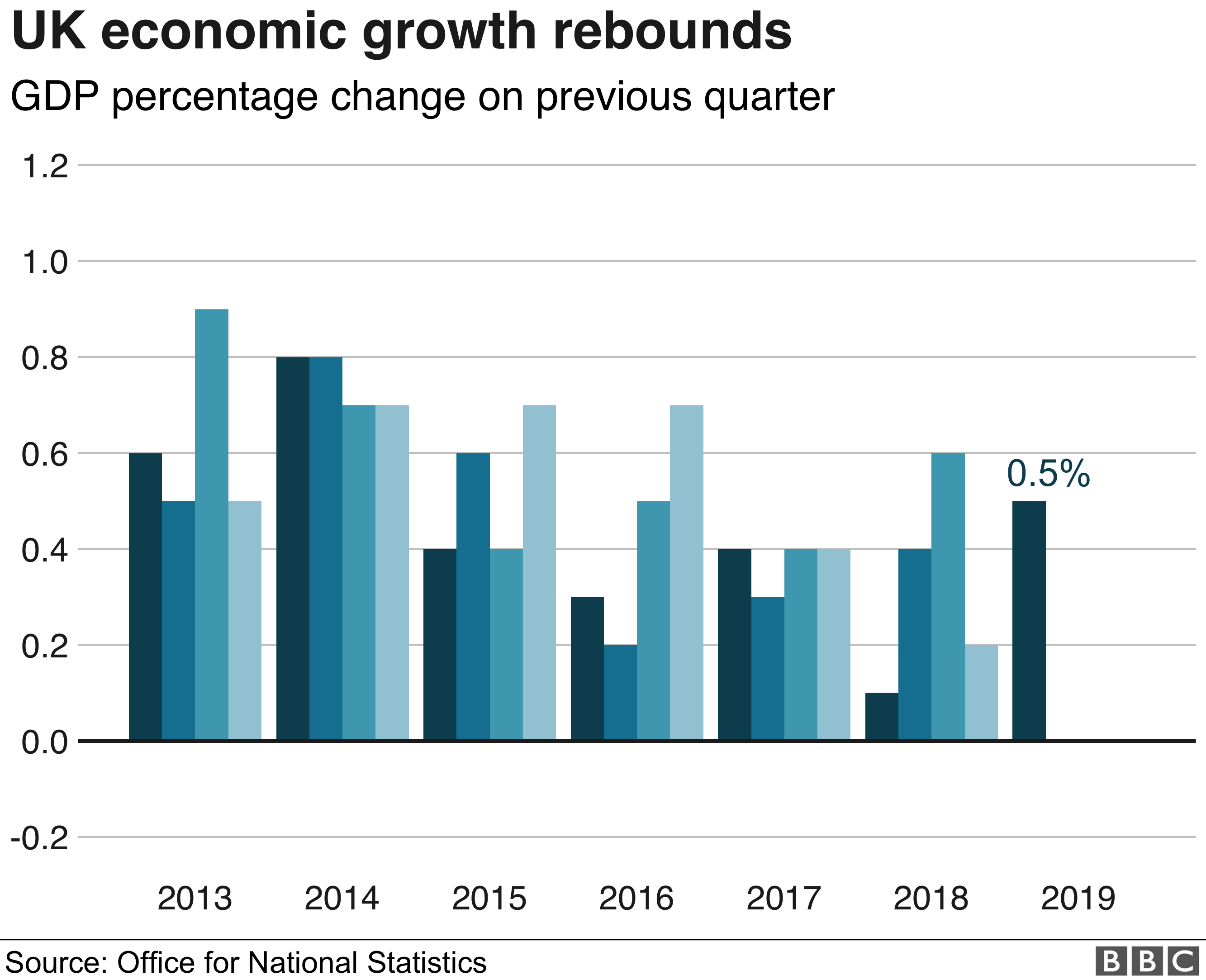
The UK economy picked up in the first three months of the year after manufacturers' stockpiling ahead of Brexit helped to boost growth.
Growth was 0.5% in the quarter, up from 0.2% in the previous three months, the Office for National Statistics said.
The manufacturing sector grew at its fastest rate since 1988 in the period.
The ONS said this was driven by manufacturers rushing to deliver orders before the original Brexit deadline of 29 March.
Pharmaceuticals was one of the sectors most affected, expanding 9.4% between January and March.
Previous business surveys had shown manufacturers stockpiling goods for Brexit in case the UK left the EU without a transition deal, which they feared could lead to delays at UK borders.

What impact has Brexit had on the figures?

As well as manufacturers rushing to deliver orders before the UK was due to leave the EU, firms also stockpiled parts.
This drove a surge in imports, with the total trade deficit - the gap between what the UK imports and exports - doubling in the first quarter to a record high, separate data from the ONS showed.
The total trade deficit widened from £8.9bn to £18.3bn, driven partly by a sharp increase in imports of cars and gold.
UK growth
However, the UK's deadline to exit the EU has since been extended until the end of October after Prime Minister Theresa May asked the EU for more time to negotiate a deal.

Is the economy stabilising?

Chancellor Philip Hammond said the figures showed the economy remained "robust".
"These GDP figures this morning show again that the UK economy is performing robustly, despite the evidence of slowing global growth and the continued Brexit uncertainty at home - so it's good news," he told the BBC.
But analysts have warned the impact of Brexit could mean the pick-up in growth is short-lived.
Tej Parikh, senior economist at business lobby group the Institute of Directors, said it could well be just "a flash in the pan".
"Some businesses brought activity forward early this year in preparation for leaving the EU, so higher stocks and earlier orders have artificially bumped up the growth numbers.
"In the second quarter, many firms will be keen to run down their Brexit caches, which will drag on economic growth," he said.
But Ruth Gregory, senior UK Economist at Capital Economics, said the figures offered some "encouraging signs that underlying growth gained some pace".
She said household consumption growth was "solid" and pointed out that business investment grew "for the first time in four quarters".

What do the trade figures tell us about the economy?

Analysis box by Andy Verity, economics correspondent
There's something upbeat in today's figures and also something downbeat, quite possibly with the same cause.
In spite of all the political fuss, the economy grew better than it has in a while. At 1.8% for the year, it is almost at pre-financial crisis rates, when growth of 2-3% a year was normal.
The figures can be taken to confirm predictions that there would be a boost to economic growth from "stockpiling" - firms spending more than usual building up their stocks of supplies, just in case a no-deal Brexit meant cross-border trade seized up.
Manufacturing enjoyed a boost and more cars were imported than usual. You can't tell from these figures alone, but that may also be due to stockpiling: a "buy-now-while-stocks-last" effect in case the pound dropped (making imported cars more expensive) and tariffs were imposed (ditto).
But here's the downer. Partly due to higher imports, the trade deficit doubled, from £8.9bn to £18.3bn. Because we enjoy a surplus in services, exporting more than we import, it looks even worse when you strip out services.
The trade in goods deficit in the first quarter widened to a record: £43.3bn including non-monetary gold, which rose by £6bn.
We know from numerous economic studies: people buy gold when they're worried. It looks like, in the first quarter of the year, economic growth was lifted - by anxiety. It's small, but you might call it a mini "worry-boom".

Monday, May 13, 2019

BBC News - China hits back in trade war with US

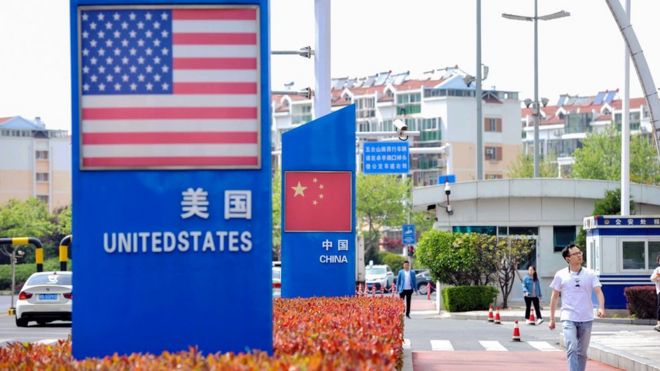
Signs with the US flag and Chinese flag are seen at the Qingdao free trade port area in Qingdao in China's eastern Shandong province on May 8, 2019.Image copyrightGETTY IMAGES
China has said it will impose tariffs on $60bn (£46bn) of US goods from 1 June, extending a bilateral trade war.
The move comes three days after the US more than doubled tariffs on $200bn of Chinese imports.
Earlier, US President Donald Trump denied that US consumers would pay for higher tariffs on Chinese imports and warned China not to follow suit.
But Beijing said it would not swallow any "bitter fruit" that harmed its interests.
China has raised tariffs on more than 5,000 US products, with the new rates ranging from 5% to 25%.
Items affected include beef, lamb and pork products, as well as various varieties of vegetables, fruit juice, cooking oil, tea and coffee.
US China trade war graphic
Presentational white space
The move was announced in a statement by the Tariff Policy Commission of China's cabinet, the State Council.
Chinese foreign ministry spokesman Geng Shuang told a news briefing in Beijing that China would "never surrender to external pressure".
US markets reacted badly to the move. Within minutes of opening, the Dow Jones Industrial Average was down more than 460 points, or 1.8%, while the broad-based S&P 500 also fell 1.8% and the Nasdaq shed 2.3%.
Markets in Europe were also depressed by latest round of tit-for-tat tariffs, with London's FTSE 100 down about 0.5%, while the main indexes in Frankfurt and Paris were more than 1% lower.
"China should not retaliate - will only get worse!" Mr Trump tweeted shortly before news of the Chinese decision came.
Mr Trump also said China had "taken so advantage of the US for so many years".
He added that US consumers could avoid the tariffs by buying the same products from other sources.
"Many tariffed companies will be leaving China for Vietnam and other such countries in Asia. That's why China wants to make a deal so badly!" he said.
The US argues that China's trade surplus with the US is the result of unfair practices, including state support for domestic companies. It also accuses China of stealing intellectual property from US firms.
The latest round of US-Chinese trade negotiations ended in Washington on Friday without a deal.
Mr Trump's approach in the dispute has put him at odds with his own top economic adviser, Larry Kudlow, who has said "both sides will suffer".

Friday, May 10, 2019

Reuters News - U.S. escalates trade war amid negotiations, China says will hit back

WASHINGTON/BEIJING (Reuters) - The United States escalated a tariff war with China on Friday by hiking levies to 25% for $200 billion worth of Chinese goods in the midst of last-ditch talks to rescue a trade deal.

But even as Beijing threatened retaliation, negotiators in Washington agreed to stay at the table for a second day, keeping alive hopes of an eventual agreement.
U.S. President Donald Trump, who has adopted protectionist policies as part of his “America First” agenda, issued orders for the tariff increase, saying China had “broke the deal” by reneging on commitments made during months of negotiations.
Trump also said he would start the “paperwork” on Friday for 25% duties on another $325 billion in Chinese imports.
In Beijing, China’s Commerce Ministry said it “deeply regrets” the U.S. decision, adding that it would take necessary countermeasures, without elaborating.
Chinese Vice Premier Liu He, U.S. Trade Representative Robert Lighthizer and U.S. Treasury Secretary Steven Mnuchin talked for 90 minutes on Thursday and were expected to resume efforts on Friday to rescue a deal that could end a 10-month trade war between the world’s two largest economies.
The Commerce Ministry said negotiations were continuing, and that it “hopes the United States can meet China halfway, make joint efforts, and resolve the issue through cooperation and consultation”.
With negotiations in progress and no action from the Trump administration to reverse the increase, U.S. Customs and Border Protection imposed the new 25% duty on more than 5,700 categories of products leaving China after 12:01 a.m. EDT (0401 GMT) on Friday.
The Office of the U.S. Trade Representative separately said seaborne cargoes shipped from China before midnight were not subject to the new tax as long as they arrive in the United States prior to June 1. Those cargoes will be charged the original 10% rate.
The grace period was not applied to three previous rounds of tariffs imposed last year on Chinese goods, which had much longer notice periods of at least three weeks before the duties took effect.
“This delay might create an unofficial window during which the U.S. and China can continue to negotiate,” investment bank Goldman Sachs wrote in a note, adding that it was a “somewhat positive sign” that talks were continuing.
Trump gave U.S. importers less than five days notice about his decision to increase the rate on the $200 billion category of goods to 25%, which now matches the rate on a prior $50 billion category of Chinese machinery and technology goods.
U.S. stock futures fell and Asian shares pared gains after the United State went ahead with its threatened tariff hike, reflecting investors worries that a protracted trade war would hit global economic growth.
E-mini futures for U.S. S&P500 slipped, was last down 0.2% in volatile trade. MSCI’s broadest index of Asia-Pacific shares outside Japan was more than 1% lower. Chinese share markets fell on their reopen after the lunch break but quickly recovered ground, as investors took heart from the continuation of talks.
The yuan also strengthened against the dollar.

RETALIATE HOW?

“I think the Chinese in the end will want to keep negotiations going. The question is: where do they go for retaliation?” said James Green, a senior adviser at McLarty Associates who until August was the top USTR official at the embassy in Beijing.
Green expected China to increase non-tariff barriers on U.S. companies, such as delaying regulatory approvals, as it couldn’t hit the same amount of imported U.S. goods with higher tariffs.
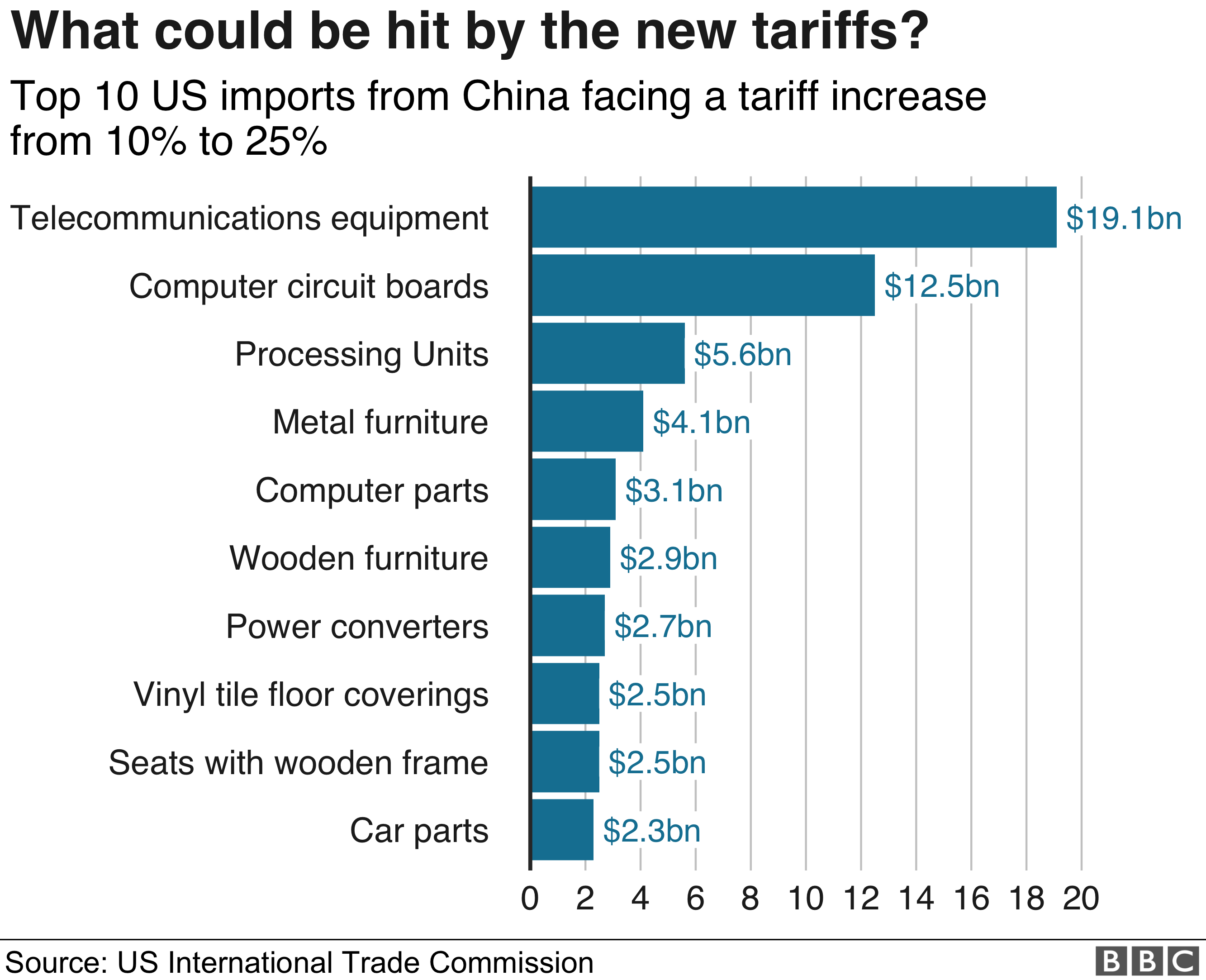
The biggest Chinese import sector affected by the latest tariff hike is a $20 billion-plus category of internet modems, routers and other data transmission devices, followed by about $12 billion worth of printed circuit boards used in a vast array of U.S.-made products.
Furniture, lighting products, auto parts, vacuum cleaners and building materials are also high on the list of products subject to the higher duties.
Gary Shapiro, chief executive of the Consumer Technology Association said the tariffs would be paid by American consumers and businesses, not China, as Trump has claimed.
“Our industry supports more than 18 million U.S. jobs – but raising tariffs will be disastrous,” Shapiro said in a statement.
“The tariffs already in place have cost the American technology sector about $1 billion more a month since October. That can be life or death for small businesses and startups that can’t absorb the added costs.”
Economists and industry consultants have said it may take three or four months for American shoppers to feel the pinch but retailers will have little choice but to raise prices on a wide range of goods to cover the rising cost of imports before too long, according to economists and industry consultants.
Even without the trade war, China-U.S. relations have continued to deteriorate, with an uptick in tensions between the two countries over the South China Sea, Taiwan, human rights and China’s plan to re-create the old Silk Road, called the Belt and Road Initiative.
Reporting by David Lawder in Washington, and Yawen Chen, Michael Martina, Ryan Woo and Ben Blanchard in Beijing; Editing by Simon Cameron-Moore

Thursday, May 9, 2019

BBC News - Trade war: US-China trade battle in charts

By Daniele Palumbo & Ana Nicolaci da Costa
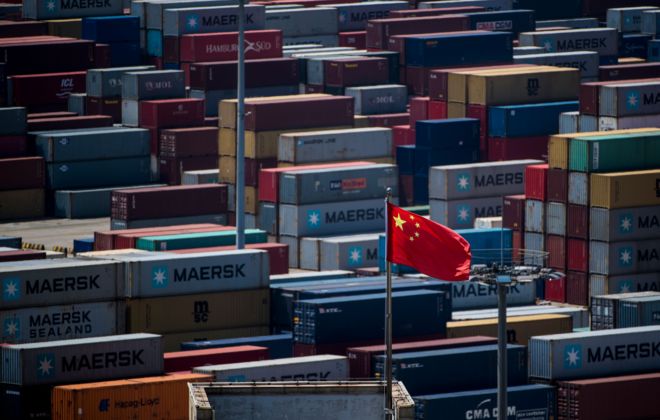
A Chinese flag is seen in front of containers at the Yangshan Deep-Water Port, an automated cargo wharf, in Shanghai on April 9, 2018.Image copyrightGETTY IMAGES
The trade war between the US and China - which seemed to be nearing an end - has suddenly escalated with the threat of new tariffs.
US President Donald Trump vowed to more than double tariffs on $200bn (£153bn) of Chinese goods on Friday and to introduce fresh ones "shortly".
Despite this, the Chinese are starting two days of negotiations with the US.
The US president's threat to raise tariffs comes amid claims Beijing is trying to row back on a trade deal.
The world's two largest economies have already imposed duties on billions of dollars worth of one another's goods.
A further escalation in the trade dispute would create renewed uncertainty for businesses and consumers, hurting the world economy.
Here are some of the central issues in the US-China trade dispute:

1) How has the US trade deficit grown?

The US, which accuses China of unfair trading practices, launched a trade war against China last year.
Not only does the US accuse China of stealing intellectual property, but it wants Beijing to make changes to its economic policies, which it says unfairly favour domestic companies through subsidies.
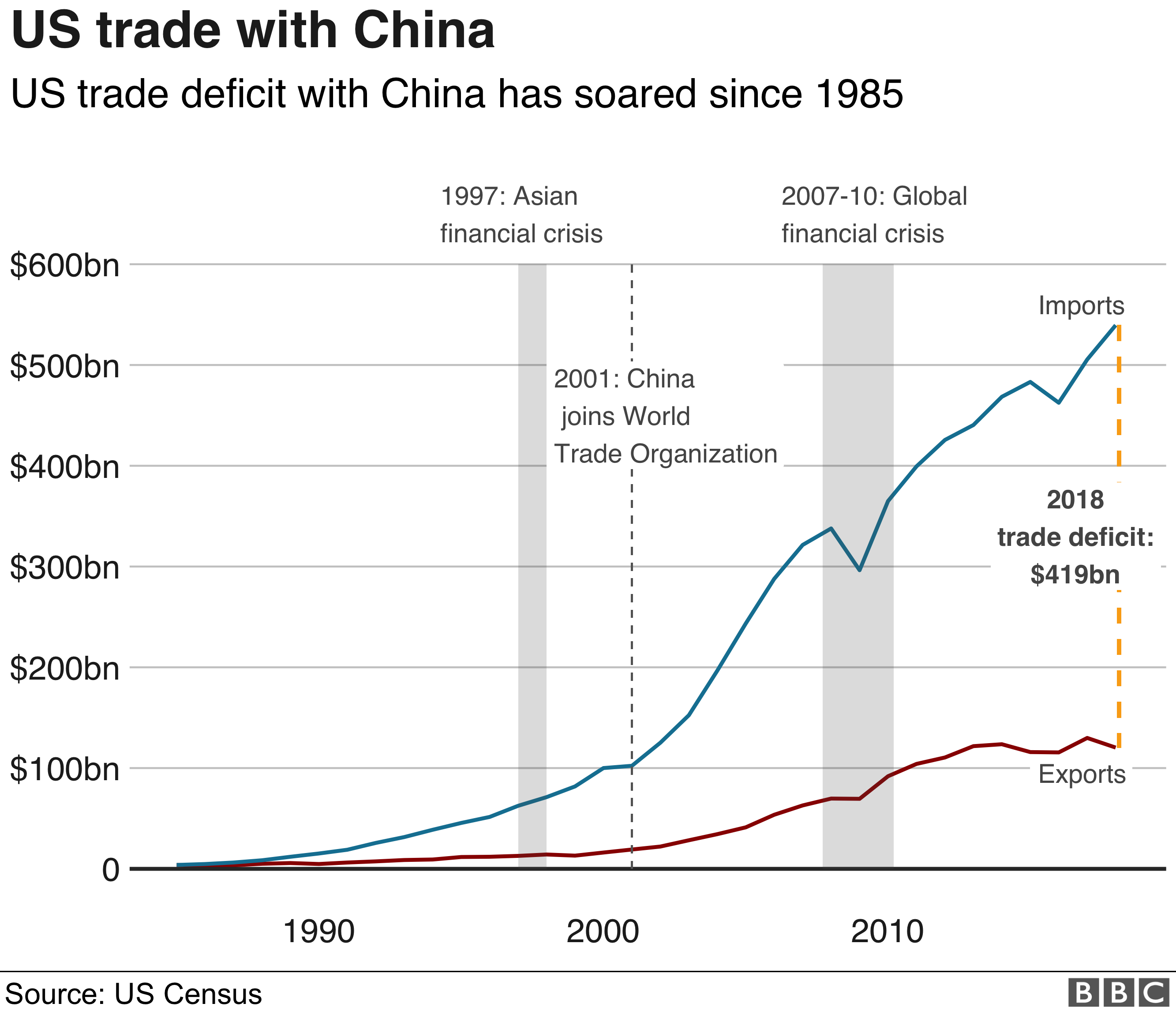
trade deficit
The US also wants China to buy more US goods to rein in its lofty $419bn (£321.2bn) trade deficit with China.
The trade deficit is the difference between how much the US imports from other countries and how much it exports. Reducing the gap is a key part of Mr Trump's trade policies.

2) What tariffs have been imposed so far?

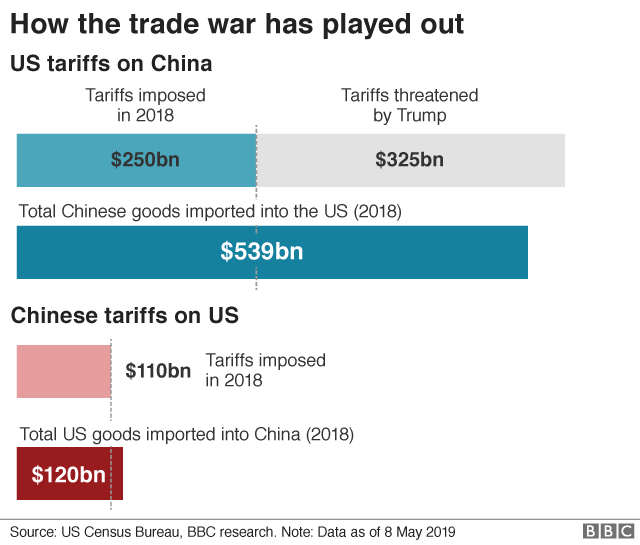
The US imposed tariffs on $250bn worth of Chinese products last year. Beijing has retaliated with duties on $110bn worth of American products.
Tariffs on $200bn worth of Chinese goods were due to rise to 25% from 10% at the start of this year, but this hike was delayed.
How the trade war has played out
Now, Mr Trump is saying this increase will go ahead on Friday because talks with Beijing are progressing "too slowly".

3) What products could be affected?

The Chinese products hit by US tariffs since the beginning of the trade war have been wide-ranging, from machinery to motorcycles.
In the latest round, the US imposed 10% duties on $200bn worth of Chinese products including fish, handbags, clothing and footwear.
Those products will be the ones targeted with a tariff hike from 10% to 25%, if it goes ahead this week.
products with possible new tariffs
China accuses the US of starting the biggest trade war in economic history. It has targeted US goods ranging from chemicals, to vegetables and whiskey.
It has also strategically targeted products made in Republican districts, and goods that can be purchased elsewhere, like soybeans.

4) Has the trade war hit the markets?

The US-China trade war has been a great source of uncertainty for financial markets over the past year. That uncertainty has weighed on investor confidence around the world, and has contributed to losses.
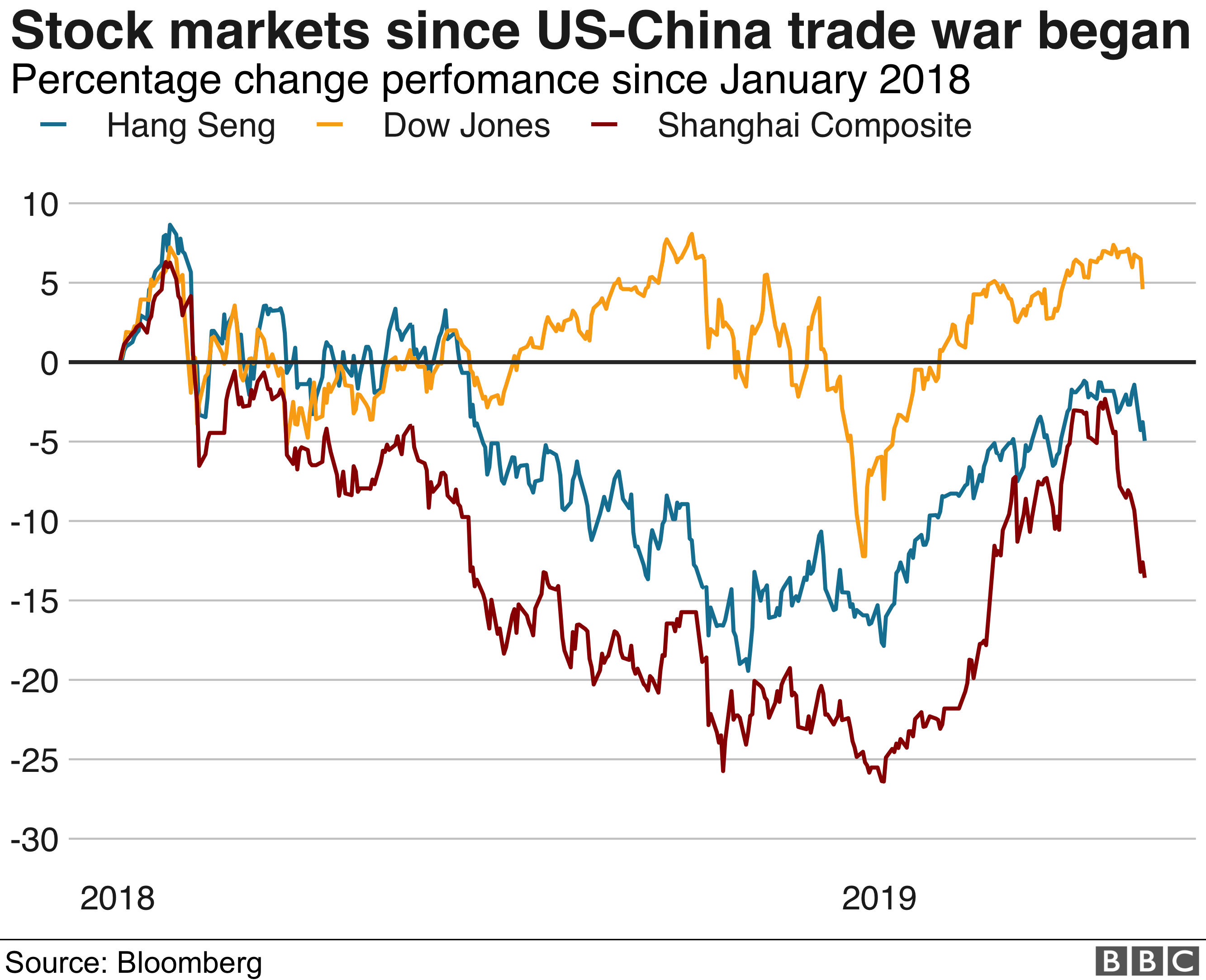
In 2018, Hong Kong's Hang Seng index fell more than 13% and the Shanghai Composite slumped nearly 25%.
Both indices have recovered some ground this year and are up 12% and 16% respectively so far in 2019.
Stock markets reaction to trade war
By comparison, the Dow Jones Industrial Average fell nearly 6% in 2018 and is already up some 11% this year.
The yuan fell over 5% against the US dollar last year, before broadly stabilising in 2019, according to Reuters.

5) What other trade battles are going on?

The US-China trade war has had a knock-on effect on other countries, and the global economy.
The International Monetary Fund (IMF) said the escalation of US-China trade tension was one factor to have contributed to a "significantly weakened global expansion" late last year as it cut its 2019 global growth forecast.
Some countries may also be indirectly impacted - especially those that are important trading partners for the US or China - or play key roles in their supply chains.
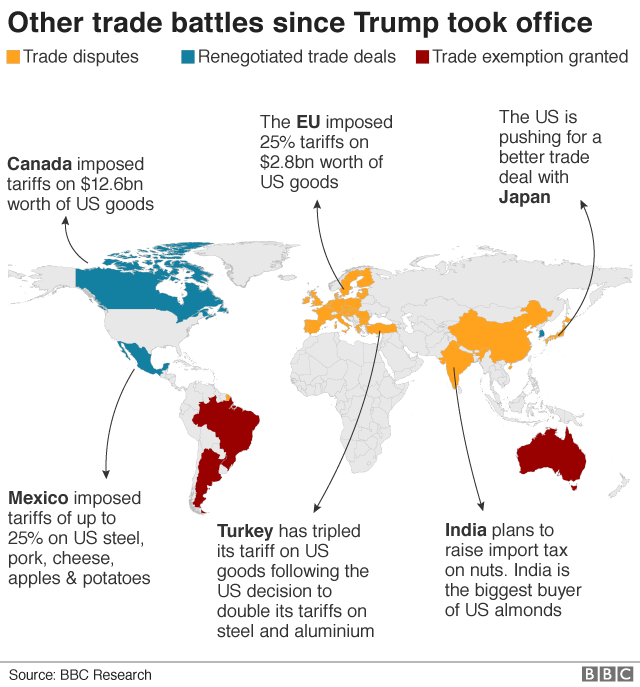
Other trade battles since Trump took office
The battle with China is one of a series of trade fights the US has waged with other countries over the past year.
Mr Trump has imposed taxes on imports from Mexico, Canada and the European Union, to encourage consumers to buy American products. All of these countries retaliated with tariffs on US goods.