Monday, July 22, 2019

BBC News - Government offers 'inflation-busting' pay rises

Teacher in classroomImage copyrightGETTY IMAGES
Chancellor Philip Hammond has handed public sector workers a pay rise that is above the UK's 2% inflation rate.
The move comes just days before Theresa May leaves office, which could lead Mr Hammond to resign as chancellor.
The deals will affect almost one million public sector workers from prison officers to dentists.
Teachers will get a 2.75% salary boost, the equivalent to £1,000 extra a year, for those on an average salary.
On average, doctors working in hospitals will get an extra £1,500 in their pay packet, while police constables will earn an extra £978.
The pay rise will be backdated to the start of each department's financial year.
"We are able to afford these pay rises because our balanced approach means we have reduced our debt while investing in public services, including pay," Mr Hammond said.
Signing-off on the pay increases could be one of Mr Hammond's final acts as chancellor.
Over the weekend, Mr Hammond told the BBC that he planned to tender his resignation on Wednesday if Boris Johnson won the Tory leadership race.
The pay rises cover armed forces across the UK; police in England and Wales; school teachers in England, and senior civil servants in England, Scotland and Wales.
Doctors and dentists in England are also included, but GPs are subject to a separate pay deal.
The NHS pay review body recommends pay for doctors and dentists in Wales, Northern Ireland and Scotland and it is up to the devolved administrations to respond.
Public sector pay was frozen for two years in 2010, except for those earning less than £21,000 a year, and after that rises were capped at 1% - below the rate of inflation.
The cap was ended last year.

Pay reaction: 'Does little to redress previous cuts'

Police officerImage copyrightPA MEDIA
Police officer Christopher Lemm said he was expecting a "much larger" increase.
"Our pay has fallen approximately 19% in real terms since 2010 and inflation is currently running at 2% so this is a tiny increase which does little to redress previous cuts," he said.
Another police officer, who did not want to be identified, told the BBC that his colleagues were only likely to receive an extra £50 per month as a result of the pay rise.
The officer said it would do little to repair the relationship between government and the police because they had received "little or nothing by way of a pay rise" for nine years.

The pay rise will be one of Mrs May's final acts as prime minister.
She said: "Whether it's keeping us safe, saving lives or educating the next generation, our public sector workers deserve this pay rise in recognition of the brilliant job they do on a daily basis.
"In 2017 we ended the public sector pay cap and I'm pleased that we can build on this today by giving almost a million of our dedicated public servants an above-inflation salary increase."

'Shameful'

But Labour's shadow chancellor John McDonnell said the pay increases were "insulting" after reports of the salary rises emerged last week.
"After years of holding back the pay of our dedicated public sector workers, it is shameful for the government to pay for ending the public sector pay cap with more cuts," he said.
Around a quarter of all public spending goes on pay. The Treasury said its wage bill was £191bn last year, up from £171.6bn three years earlier.

Friday, July 19, 2019

Reuters News - Allies play hard to get on U.S. proposal to protect oil shipping lanes

DUBAI/PARIS (Reuters) - The United States is struggling to win its allies’ support for an initiative to heighten surveillance of vital Middle East oil shipping lanes because of fears it will increase tension with Iran, six sources familiar with the matter said.

Washington proposed on July 9 stepping up efforts to safeguard strategic waters off Iran and Yemen where it blames Iran and its proxies for tanker attacks. Iran denies the charges.
But with Washington’s allies reluctant to commit new weaponry or fighting forces, a senior Pentagon official told Reuters on Thursday that the United States’ aim was not to set up a military coalition but to shine a “flashlight” in the region to deter attacks on commercial shipping.
Because of fears of confrontation, any involvement by Washington’s allies is likely be limited to naval personnel and equipment already in place - near the Strait of Hormuz in the Gulf and the Bab al-Mandab strait in the Red Sea, two Gulf sources and a British security source said.
“The Americans want to create an ‘alliance of the willing’ who confront future attacks,” a Western diplomat said. “Nobody wants to be on that confrontational course and part of a U.S. push against Iran.”
Addressing such concerns or possible misunderstandings, Kathryn Wheelbarger, one of the most senior policy officials at the Pentagon, told Reuters in an interview that the new initiative was “not about military confrontation.”
Under Washington’s proposal, the United States would provide coordinating ships and lead surveillance efforts while allies would patrol nearby waters and escort commercial vessels with their nation’s flags.
Iran has said foreign powers should leave securing shipping lanes to Tehran and other countries in the region.
France, which has a naval base in the United Arab Emirates, does not plan to escort ships and views the U.S. plan as counterproductive to easing tensions because Tehran would see it as anti-Iran, a French official said.
The British security source said it was not viable to escort every commercial vessel, a view shared by several other countries.
A senior Western official based in Beijing said there was “no way” China would join a maritime coalition. A South Korean official said Washington had yet to make any official request.
A decision by Japan to join such an initiative would be likely to inflame a divide in Japanese public opinion over sending troops abroad. Japan’s military has not fought overseas since World War Two.
“The Americans have been talking to anyone interested about setting something up, mainly looking to Asia as it’s of vital importance to their security of (oil) supply and asking for ships, but it’s gone a bit quiet,” a Gulf official said.
India has deployed two ships in the Gulf to protect Indian-flagged vessels since June 20. Other Asian oil importers are unlikely to have anything but a symbolic presence, such as the involvement of a liaison officer, officials and diplomats said.
“It’s just impossible. The Strait is already too crowded,” an Asian official said of an escort system in the Strait of Hormuz which is 21 miles (33 km) wide at its narrowest point.
A second Gulf official said: “We’re not going to do anything like that, we are not going to do anything on our own.”

RISING TENSION

Tensions rose further on Thursday after Iran’s Revolutionary Guards said they had seized a foreign tanker smuggling fuel. A U.S. military commander in the region said the United States would work “aggressively” to ensure free passage of vessels in and around the Strait of Hormuz.
Tension has mounted since U.S. President Donald Trump last year quit a 2015 nuclear pact under which Iran agreed to curtail its atomic program in return for relief from economic sanctions crippling its economy.
France, Britain and Germany, which with Russia and China are party to the agreement, have tried to rescue the deal and defuse tensions.
Failure to secure support for the maritime initiative would be a blow to efforts by the United States, and its Sunni Muslim allies Saudi Arabia and the United Arab Emirates, to isolate Shi’ite Muslim Iran and Iran-backed forces in the Middle East.
Saudi Arabia and the UAE are already patrolling the coastline off Yemen where they are leading a coalition battling the Iran-aligned Houthi movement, though the UAE has said it is scaling down its presence there.
Asked what role Riyadh could play in the U.S. initiative, a Saudi military official said it would be the role that the Saudi-led coalition has been playing for the past few years in the Red Sea as part of the war in Yemen, including escorting and securing commercial shipping.
The United States does not want to go it alone.
“There are enough resources in the region now for the job at hand. The Americans want an international stamp on this effort,” one of the Gulf sources said. “They (the United States) also don’t want to bear the financial burden.”
Technical and financial aspects, such as refueling, bunkering and maintenance costs, still need to be ironed out before countries sign up, the source said.
Policing burdens would largely fall on the United States, which has protected shipping lanes in the region for decades with its Bahrain-based Fifth Fleet. It also heads the Combined Maritime Forces, a 33-nation naval alliance that carries out security and counterpiracy operations in the region.
Britain has a base in Oman and China has a military base in Djibouti, which lies off the Bab al-Mandab strait. Beijing has had to tread softly in the region because it has close energy ties with both Iran and Saudi Arabia.

SMALL SHIPS

Riyadh and Abu Dhabi support U.S. sanctions on Iran, which lacks a strong conventional naval fleet but has many speed boats, portable anti-ship missile launchers and mines.
A U.S. State Department official, who asked not to be named, said Bahrain would host a working group meeting on maritime and aviation security in the autumn as part of a follow-up to a global conference in Warsaw in February that gathered some 60 nations to discuss stability in the Middle East.
Gulf states, which are big purchasers of Western arms, have invested more in air and land capabilities than in naval assets, and have little experience coordinating large naval missions.
The majority of vessels are small patrol craft and corvettes that would struggle on extended missions, said Tom Waldwyn, research associate for The Military Balance at the International Institute for Strategic Studies.
Wheelbarger, the U.S. Pentagon official, suggested small, quick ships would be helpful. She said several countries has expressed interest in the initiative but did not name them.
Additional reporting by Phil Stewart and Lesley Wroughton in Washington, Guy Faulconbridge and Jonathan Saul in London, Ben Blanchard and Cate Cadell in Beijing, Hyonhee Shin in Seoul, Alexander Cornwell and Ghaida Ghantous in Dubai and Stephen Kalin in Riyadh; Editing by Ghaida Ghantous and Timothy Heritage

Thursday, July 18, 2019

BBC News - No-deal Brexit likely to cause UK recession, says watchdog

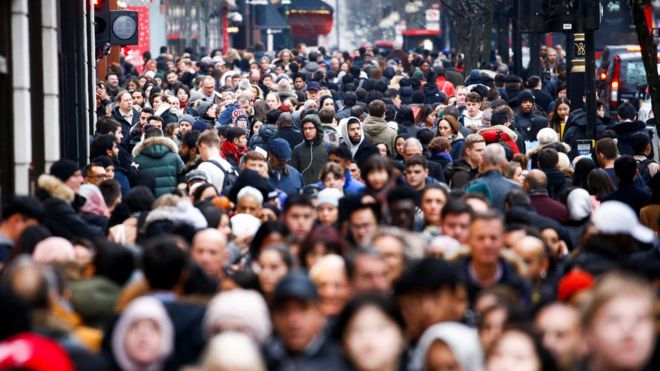
Shoppers on Oxford Street, LondonImage copyrightREUTERS
The UK is likely to fall into recession next year if there is a no-deal Brexit, the country's spending watchdog says.
The Office for Budget Responsibility (OBR) said economic growth could fall by 2% by the end of 2020 if it left the bloc without an agreement.
This would effectively forgo about 18 months of growth in Britain.
Chances of a no-deal outcome have risen recently, after both Tory leadership contenders said they would be willing to leave the EU without a deal.
The UK is set to leave the European Union on 31 October.
The OBR was created in 2010 to give independent analysis of the UK's public finances.
In its first assessment of the economic impact of a no-deal scenario, the OBR said the UK economy could contract in 2020 before recovering in 2021.
This would come as tariffs of 4% were imposed on goods traded with the EU - up from zero currently - although it does not expect there to be disruption at the border.
In this scenario, "heightened uncertainty and declining confidence" would deter investment, while higher trade barriers with the EU would "weigh on exports".
"Together, these push the economy into recession, with asset prices and the pound falling sharply," it said.
It added this could push up public sector borrowing by £30bn a year, leaving debt 12% higher by 2024.
Presentational grey line

Analysis:

By Faisal Islam, BBC economics editor
The government's official independent budgetary watchdog has for the first time put a price on the impact to the public finances of leaving the European Union without a deal.
The numbers come at a sensitive time politically when both likely future Prime Ministers suggest that a no-deal Brexit is possible this year.
The OBR is legally obliged to consider all threats to the public finances, and today's new numbers come as part of its biannual Fiscal Risks report.
The fall in tax revenue is forecast to significantly outweigh any benefit from no longer paying the UK's subscription fee as a member of the EU.
The numbers show a deep crisis-like impact on the public finances, and are based on the IMF's projections for the economy.
But they go further, showing a long-run hit to the economy.
Presentational grey line
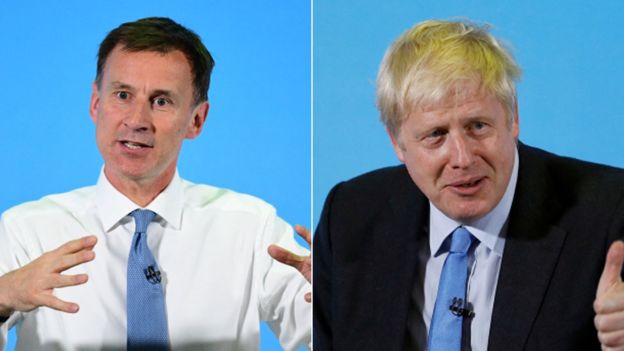
Jeremy Hunt and Boris JohnsonImage copyrightGETTY IMAGES/REUTERS
Image captionBoth Jeremy Hunt and Boris Johnson say they are prepared to leave the EU without a deal
The forecast is less severe than those of the Bank of England and the Treasury, although the OBR said it was "by no means a worst-case scenario".
In November, the Bank said a no-deal outcome could send the pound plunging and trigger a worse recession than the 2008 financial crisis.
The economy would shrink 8% in the immediate aftermath if there was no transition period, the Bank said.
The Treasury meanwhile predicts a £90bn hit to the economy by 2035 - although prominent eurosceptics dispute this view.
In a comment piece for the Telegraph newspaper earlier this week, Conservative backbencher Jacob Rees-Mogg called the forecast "silliness", adding that a no-deal scenario could instead boost the economy by £80bn.
Chancellor Philip Hammond later tweeted that he found this view "terrifying", given Mr Rees-Mogg is tipped for a role in government in the future.
The chances of a no-deal appear to have risen in recent weeks after both candidates in the race to replace Theresa May hardened their positions on the controversial Irish backstop - an insurance policy to prevent a hard border on the island of Ireland after Brexit.
Jeremy Hunt and Boris Johnson both said the backstop was "dead", but the EU said it would not support any deal that excludes it.
In an interview with the BBC's Panorama programme - conducted in May before the start of the Conservative leadership contest - the EU's chief Brexit negotiator, Michel Barnier, said the UK would have to "face the consequences" if it opted to leave without a deal.
Mr Barnier said the thrice-rejected withdrawal agreement negotiated by Theresa May was the "only way to leave the EU in an orderly manner".

Wednesday, July 17, 2019

Reuters News - Republican support for Trump rises after racially charged tweets: Reuters/Ipsos poll

NEW YORK (Reuters) - Support for U.S. President Donald Trump increased slightly among Republicans after he lashed out on Twitter over the weekend in a racially charged attack on four minority Democratic congresswomen, a Reuters/Ipsos public opinion poll shows.

The national survey, conducted on Monday and Tuesday after Trump told the lawmakers they should “go back and help fix the totally broken and crime infested places from which they came,” showed his net approval among members of his Republican Party rose by 5 percentage points to 72%, compared with a similar poll that ran last week.
Trump, who is seeking re-election next year, has lost support, however, with Democrats and independents since the Sunday tweetstorm.
Among independents, about three out of 10 said they approved of Trump, down from four out of 10 a week ago. His net approval - the percentage who approve minus the percentage who disapprove - dropped by 2 points among Democrats in the poll.
Trump’s overall approval remained unchanged over the past week. According to the poll, 41% of the U.S. public said they approved of his performance in office, while 55% disapproved.
The results showed strong Republican backing for Trump as the Democratic-led U.S. House of Representatives passed a symbolic resolution on Tuesday, largely along party lines, to condemn him for “racist comments” against the four Democratic lawmakers.
All four U.S. representatives - Alexandria Ocasio-Cortez of New York, Ilhan Omar of Minnesota, Ayanna Pressley of Massachusetts and Rashida Tlaib of Michigan - are U.S. citizens. Three were born in the United States.
The public response to Trump’s statements appeared to be a little better for him than in 2017, after the president said there were “very fine people” on both sides of a deadly white nationalist rally in Charlottesville, Virginia.
In that instance, Trump’s net approval dropped by about 10 points a week after the Charlottesville rally.
This time, while Democrats and some independents may see clear signs of racial intolerance woven throughout Trump’s tweets, Republicans are hearing a different message, said Vincent Hutchings, a political science and African-American studies professor at the University of Michigan.
“To Republicans, Trump is simply saying: ‘Hey, if you don’t like America, you can leave,” Hutchings said. “That is not at all controversial. If you already support Trump, then it’s very easy to interpret his comments that way.”
By criticizing liberal members of the House, Trump is “doing exactly what Republicans want him to do,” Hutchings said. “He’s taking on groups that they oppose.”
The Reuters/Ipsos poll was conducted online in English and gathered responses from 1,113 adults, including 478 Democrats and 406 Republicans in the United States. It has a credibility interval, a measure of precision, of 3 percentage points for the entire group and 5 points for Democrats or Republicans.
Reporting by Chris Kahn; Editing by Colleen Jenkins and Peter Cooney

Tuesday, July 16, 2019

Scottish wind power output at record high

Wind turbinesImage copyrightGETTY IMAGES
Wind power output in Scotland hit a record high during the first six months of 2019, according to figures from Weather Energy.
It has calculated the energy produced by turbines could power every home in Scotland and part of the north of England.
The period to June, it claimed, saw the equivalent of 4.47 million homes' consumption supplied by wind power.
WWF Scotland has described the trend as a "wind energy revolution".
Its climate and energy policy manager Robin Parker, said: "These are amazing figures; Scotland's wind energy revolution is clearly continuing to power ahead.
"Up and down the country, we are all benefiting from cleaner energy and so is the climate.
"These figures show harnessing Scotland's plentiful onshore wind potential can provide clean, green electricity for millions of homes across not only Scotland, but England as well.
Alex Wilcox Brooke, of Severn Wye Energy Agency, added: "These figures really highlight the consistency of wind energy in Scotland and why it now plays a major part in the UK energy market."

Monday, July 15, 2019

BBC News - China's economy grows at slowest pace since 1990s

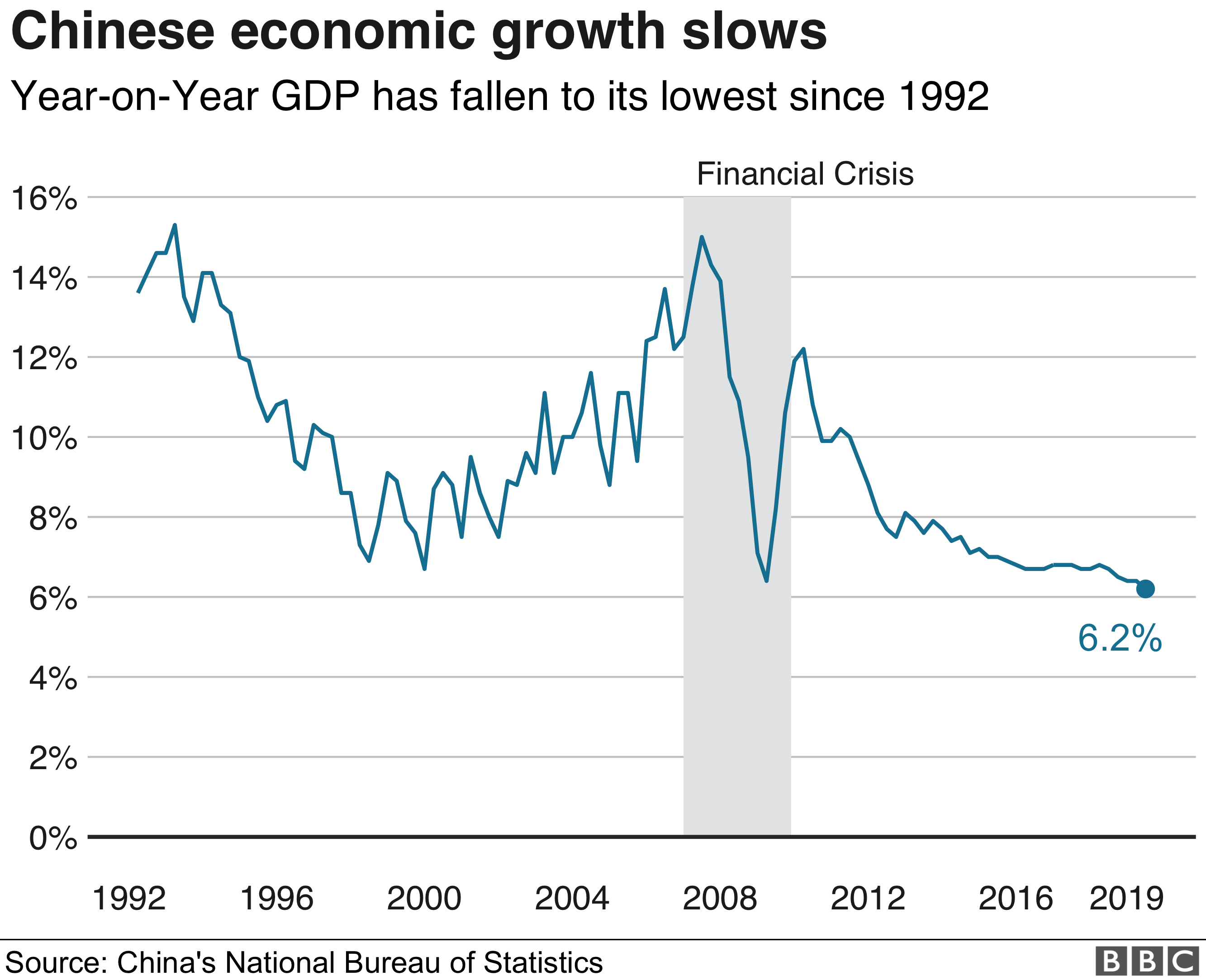
China's economy grew at its slowest pace since the early 1990s in the second quarter, official figures showed.
In the three months to June, the economy grew 6.2% from a year earlier. The result was in line with forecasts.
China has moved to stimulate its economy this year by boosting spending and delivering tax cuts.
The country is also fighting a trade war with the US which has hurt businesses and weighed on growth.
China's GDP
The data released on Monday showed China's economic growth rate slowed from 6.4% in the first three months of the year.
US President Donald Trump tweeted that US trade tariffs were having "a major effect" on the Chinese economy.
China's national statistics bureau said the figures pointed to a "complex environment" both at home and abroad.
It said the economy had "performed within the reasonable range" in the first half of 2019, but that it faced "new downward pressure".
Presentational grey line

Analysis

Andrew Walker, business correspondent
The figures do show some impact from the trade conflict with the US. Growth has probably slowed a little more than it would have done had China been facing a more tranquil international commercial environment. The longer-term picture, though, is one of an economy continuing a reasonably orderly and intended slowdown in growth.
The average growth rate over the three decades to 2010 was 10%. The Chinese leadership - and every economist I have ever heard expressing a view on this - did not regard that as sustainable for the long term. The aim was to see the economy less dependent on investment and exports and an increased role for spending by consumers.
There has been some progress, though the rates of saving and investment remain very high. There are dangers, however, notably the high level of company debt. The authorities encouraged strong credit growth in the aftermath of the global financial crisis. That has helped prevent a more rapid and potentially disruptive slowdown, but at the price of creating additional financial risks.
Presentational grey line
While China-watchers advise caution with Beijing's official gross domestic product numbers, the data is seen as a useful indicator of the country's growth trajectory.
Other data showed some signs of improvement in the world's second-largest economy.
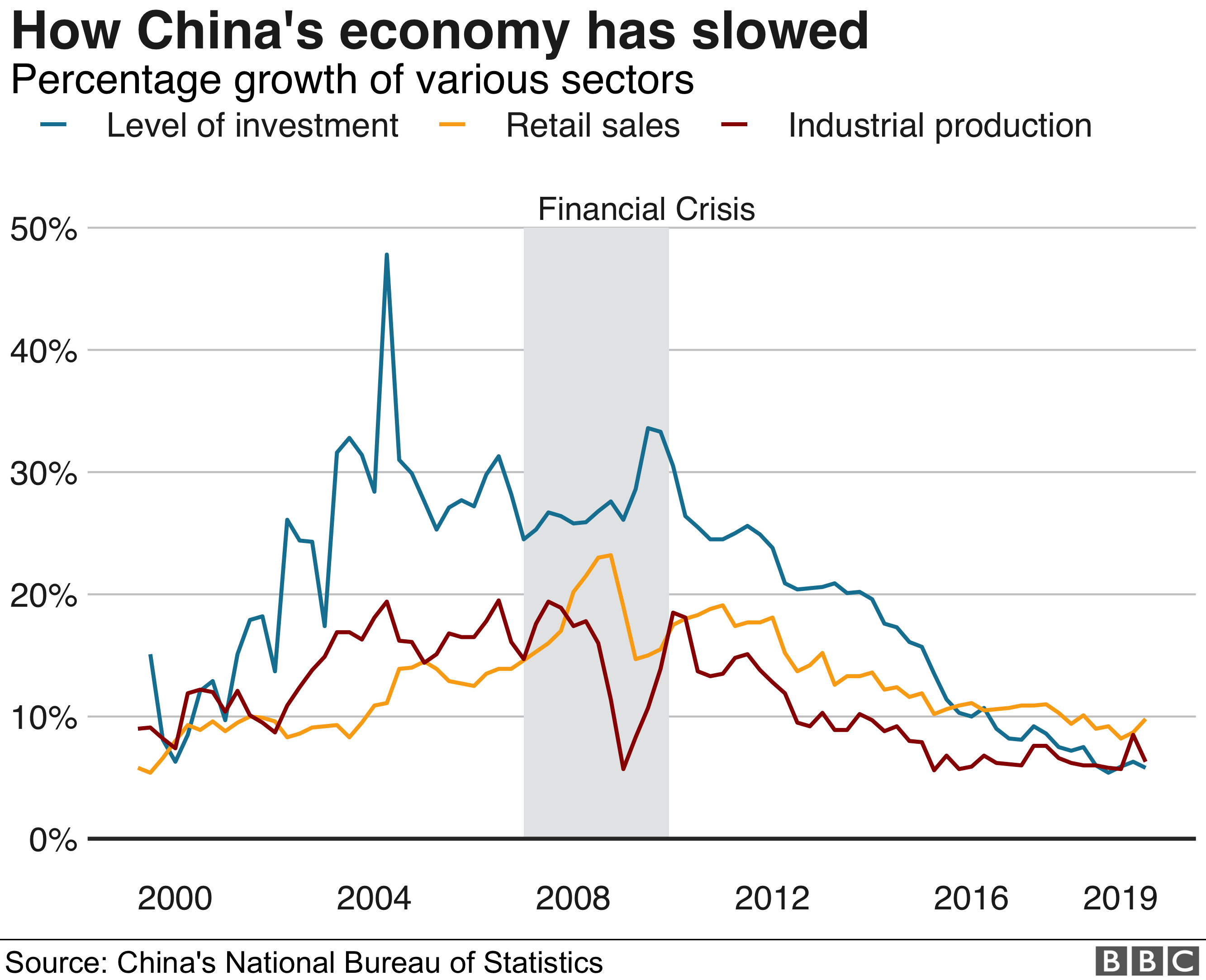
Industrial production rose 6.3% in June from a year earlier, while retail sales rose 9.8% year-on-year - both above forecasts in Reuters polls.
China's economic performance

Global impact

Slowing growth in China has raised concerns about the potential knock-on effect on the global economy.
Earlier this year Beijing announced plans to boost spending and cut billions of dollars in taxes in an effort to support the economy.
It has also moved to provide a liquidity boost by reducing the amount of cash banks must hold in reserve.
Edward Moya, senior market analyst at Oanda, said the latest economic data "shows the slowdown remains intact and markets should expect further stimulus" from China's central bank later this year.
The US-led trade war is another factor weighing on growth.
"The trade war is having a huge impact on the Chinese economy, and with no end sight as trade negotiations struggle for meaningful progress, we are probably not near the bottom for China's economy," he said.
While both sides agreed to resume trade talks at a recent G20 summit in Japan, they have already placed tariffs on billions of dollars worth of one another's goods, hurting businesses and casting a shadow over the world economy.

Friday, July 12, 2019

Reuters News - U.S. to hold hearing on French tax investigation Aug. 19

WASHINGTON (Reuters) - The U.S. Trade Representative’s (USTR) Office will hold a hearing on Aug 19 in its probe of France’s new planned tax on big technology companies, calling the proposal “unreasonable.”
President Donald Trump on Wednesday ordered an investigation into the tax, which could lead to the United States imposing new tariffs or other trade restrictions.
USTR said in a public notice the levy was an “unreasonable tax policy.” The plan departs from tax norms because of “extraterritoriality; taxing revenue not income; and a purpose of penalizing particular technology companies for their commercial success,” it said.
USTR added that statements by French officials suggest the tax will “amount to de facto discrimination against U.S. companies... while exempting smaller companies, particularly those that operate only in France.”
The tax is due to apply retroactively from the start of 2019. USTR said that calls into question the fairness of the tax.
On Thursday, the French Senate approved the 3% levy that will apply to revenue from digital services earned in France by firms with more than 25 million euros in French revenue and 750 million euros ($845 million) worldwide.
The French Embassy in Washington declined to comment.
Other EU countries including Austria, Britain, Spain and Italy have also announced plans for their own digital taxes.
They say a levy is needed because big, multinational internet companies such as Facebook (FB.O) and Amazon (AMZN.O) are currently able to book profits in low-tax countries like Ireland, no matter where the revenue originates. Political pressure to respond has been growing as local retailers in high streets and online have been disadvantaged.
Reporting by David Shepardson and Andrea Shalal in Washington; Editing by Cynthia Osterman