Thursday, August 15, 2019

Reuters News - Markets register a shock, but is Trump right to blame the Fed?

WASHINGTON (Reuters) - It takes a lot to kill an economic expansion, typically requiring a major shock to bring growth to a halt and trigger a U.S. recession.

This week investors signaled that moment may have arrived, and one big question is whether that shock has come from President Donald Trump’s trade war or a mistake by policymakers at the U.S. Federal Reserve.
As bond markets flashed concern about recession on Wednesday and major stock indices cratered, Trump put the blame squarely on the Fed for continuing to raise rates through the end of last year. Even Trump foe and New York Times economics columnist Paul Krugman dinged the Fed for “a clear mistake.”
In raising interest rates four times last year “the Federal Reserve acted far too quickly, and now is very, very late,” in reversing itself and cutting borrowing costs only modestly so far, Trump tweeted. “Too bad, so much to gain on the upside!”
Earlier on Wednesday, White House trade adviser Peter Navarro told Fox Business Network the U.S. central bank should cut rates by half a percentage point “as soon as possible,” an action he claimed would lead “to 30,000 on the Dow.”
A cut of that magnitude would typically be associated with serious economic risk, not an economy with record low unemployment and ongoing growth.
As it stood, major U.S. stock indices slumped by around 3% by Wednesday’s close with the blue chip Dow Jones Industrial Average suffering its largest percentage loss of the year. Bond investors pushed the yield on the 30-year Treasury bond to a record low.
Causing even more concern: The yield on the 2-year Treasury note briefly went above the yield on the 10-year Treasury note, the sort of “inversion” that, when it proves durable, has preceded prior U.S. recessions.
Trump himself took note of the development, blasting the Fed chair he appointed - Jerome Powell - as “clueless” in a tweet citing the “CRAZY INVERTED YIELD CURVE.”

FROM AS GOOD AS IT GETS TO GLOOMY

It was perhaps the most dramatic bit of evidence yet of just how the landscape for the Fed has changed over the past few months, from one that Powell deemed “remarkably positive” as of last October, to one of rising risks for the United States’ record-setting, decade-long expansion.
As of last fall, the Fed thought the economy, fueled by the Trump administration’s massive $1.5 trillion tax cut package and spending plans, would grow strongly enough to justify steadily higher rates.
At that point the threat of a recession seemed distant unless some sort of outside event intervened to throw the economy off course - something like the collapse of the dot-com stock market bubble ahead of the brief 2001 recession, or the implosion of the U.S. housing and credit markets ahead of the more serious 2007-2009 Great Recession.
Yet, as Trump’s trade rhetoric and his imposition of tariffs on trading partners ratcheted up this year, particularly since May, investors have acted as if a breaking point had been reached.
Global trade flows have dropped. Economic growth in Germany, a bellwether economy of sorts given its reliance on exports, contracted in the second quarter. Data also showed industrial output in China fell to more than a 17-year-low in July. Indices of uncertainty also have spiked.
If Fed policy suddenly seemed out of step, it was perhaps inevitable given the difficulty of keeping up with Trump’s whipsaw approach to trade policy, and the growing sense that the fallout may be deeper and longer lasting than expected.
“The challenge is that Trump’s trade policy has proven so erratic that you cannot relieve the sense of uncertainty,” as firms adjust to what may be a years-long rearrangement of global supply chains and cost structures, said Tim Duy, an economics professor at the University of Oregon. “So the question becomes is policy going to be easing enough ... or remain so tight that the economy remains vulnerable?”
Investors in federal funds futures contracts are currently pricing in a quarter-point rate cut at each of the Fed’s remaining three policy meetings in 2019. That would take the benchmark fed funds rate to a range of between 1.25% and 1.50%.
Along with the rate cut at the last Fed meeting in July, it would also mean the U.S. central bank will have used up almost half the rate-cut “ammunition” assembled during a slow-moving, and ultimately truncated series of rate increases begun in 2015.
For Trump, who is hoping to make the economy a central part of his case for his 2020 re-election campaign, further rate cuts could not come fast enough. He has been berating the Fed for its rate increases for more than a year - since even before his trade rift with China morphed from being considered an economic annoyance to a larger and potentially durable risk.

AHEAD OF CURVE?

Compared to the prior two recessions, the Fed may actually be ahead of the curve.
In both the 2001 and 2007 downturns, the Fed raised rates even after the yield curve inverted and did not cut until just a few months before the start of recession about a year later.
In the current case, it signaled a policy shift in January, when it removed the expectation of further rate hikes from the table, and then cut rates two weeks before Wednesday’s yield curve inversion.
Whether that proves adequate is another matter.
In an interview scheduled to air on Fox Business Network on Friday, former Fed chief Janet Yellen said she felt the U.S. economy remained “strong enough” to avoid a downturn, but “the odds have clearly risen and they are higher than I’m frankly comfortable with.”
Reporting by Susan Heavey, Tim Ahmann and Howard Schneider; Editing by Chizu Nomiyama, Paul Simao

Wednesday, August 14, 2019

BBC News - German economy slips back into negative growth

carsImage copyrightGETTY IMAGES
Germany's economy shrank during the April-to-June period of this year.
A decline in exports dampened growth, according to official data, which comes amid concerns of a global slowdown.
Gross domestic product (GDP) fell by 0.1% compared with the previous quarter, according to the Federal Statistics Office.
That takes the annual growth rate down to 0.4%. Germany, Europe's largest economy, narrowly avoided a recession last year.
Early signs for the third quarter "look ominous", said Andrew Kenningham, chief Europe economist at Capital Economics. "Manufacturing business surveys for July were all gloomy.
"And while the services sector should continue to hold up better, there are some signs that the slump is spreading to the labour market."

Trade war woes

While the overall figures were negative, household and government expenditure increased, as did investment outside the construction sector.
Construction itself fell after an unusually good first three months, boosted by a mild winter.
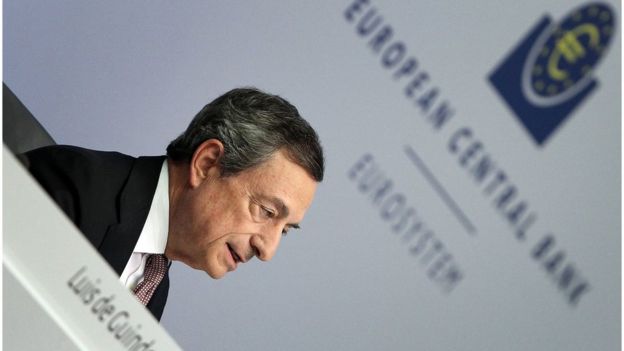
Mario DraghiImage copyrightGETTY IMAGES
Image captionThe European Central Bank, led by Mario Draghi, may be tempted to cut rates or buy more bonds to stimulate the eurozone economy, which includes Germany
Presentational grey line

Analysis: Andrew Walker, economics correspondent

This is the downside of being an exporting powerhouse. When the international economic environment clouds over, you get rained on.
The German statistical office hasn't given a detailed breakdown, but they have confirmed that exports declined and did so by more than imports.
China is at the centre of the trade storms and it's also an important export market for Germany. So trade held the economy back, in contrast with consumer spending and investment in Germany which both rose.
The economy contracted back in the third quarter of last year, and the subsequent rebound was not all that powerful.
Looking ahead, one question is whether Germany will see another decline in the current quarter, which would make it a recession as the term is often defined.
Some recent surveys of business confidence have been decidedly downbeat so the "R" word is certainly a possibility.
That said, Germany could still avoid it, and even if not, the country would at least be going into recession with unemployment that is among the lowest in the world.
Presentational grey line
"The development of foreign trade slowed down economic growth because exports recorded a stronger quarter-on-quarter decrease than imports," the statistics office said.
The US-China trade war and the UK's departure from the EU, especially if it happens without a deal, are among factors affecting global economic confidence.
Last month, the International Monetary Fund cut its growth forecasts for the global economy for this year and next, citing US-China tariffs, US car tariffs and no-deal Brexit.
China's own economic slowdown has weakened demand for foreign goods. It is an important market for Germany, since it buys plenty of luxury cars.
Only the much larger economies of the US and China export more goods than Germany.
The results may make authorities consider more monetary stimulus, said Neil Wilson, chief market analyst for Markets.com.
Meanwhile, the European Central Bank has hinted it could cut interest rates to tackle a slowdown in the eurozone economy.
The ECB said last month that a weak manufacturing sector and uncertainty over Brexit and trade threatened to derail growth. It forecast rates at current or lower levels until mid-2020.

Tuesday, August 13, 2019

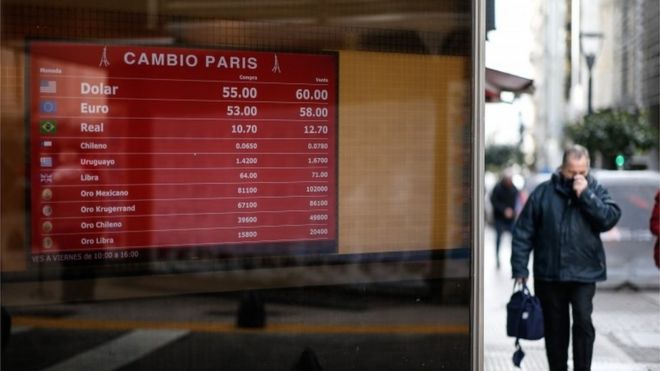
BBC News - Argentine peso and markets plunge after shock vote

trading boardImage copyrightEPA
Argentine stock markets and its currency have both plunged after conservative Argentine President Mauricio Macri suffered a shock defeat in primary elections on Sunday.
The peso fell 15% against the dollar on Monday after earlier plunging around 30% to a record low.
Some of the country's most traded stocks have also lost around half of their value in one day.
Mr Macri, in response, has pledged to "reverse" Sunday's election result.
At a news conference on Monday, the president also said that the drop suggested the market lacked confidence in an opposition governmen.
"This [market meltdown] is just a small demonstration of what can happen," said Mr Macri.
"We have much to do still. Every election is a message and we understood it."
At end of trading on Monday, Argentina's main Merval index closed down 31% as some of the country's largest companies saw their market values plummet.
Cement producer Loma Negra was among those worst affected, with its share price down around 55%. Financial services firm Galicia Financial also saw a 46% drop in its stock value.
The embattled president was defeated by his centre-left rival, Alberto Fernández, who is now seen as the frontrunner for October's presidential race.
Cristina Fernández de Kirchner and AlbertoImage copyrightAFP
Image captionAlberto Fernández's running mate is ex-President Cristina Fernández
His running mate is former President Cristina Fernández de Kirchner, who presided over an administration remembered for a high degree of protectionism and heavy state intervention in the economy.

Analysis by Daniel Gallas, BBC South America Business Correspondent
Argentina is a country that has suffered with all sorts of economic problems that are taught in textbooks.
But even by its standards, this market meltdown is unprecedented.
In just two hours, a third of the Merval index (which accounts for the most traded stocks in the country) was wiped out in value.
Investors are now pushing the "sell" button, as many believe it will be impossible for President Mauricio Macri to win the upcoming election in October.
If he loses, this will be the end of a pro-business agenda to save Argentina's economy that has been implemented since Mr Macri came to power in 2015, which includes IMF loans, austerity measures and the end of capital controls.
Sunday's primaries were seen as vindication for "Kirchnerismo" which have for years denounced Mr Macri's plan as ineffective. The country is in recession and still suffering with inflation and poverty.
There are still two more months to go until the election - but few believe there will be surprises as big as this one coming up again.

Edward Glossop, from the London-based consultancy Capital Economics, said Mr Macri's government could pull out all the stops to try to shore up popular support.
This could include easing budget curbs imposed as part of Argentina's agreement with the International Monetary Fund.
"An outright loosening of the purse strings is possible. The IMF would probably turn a blind eye to this, since it is in its interest for President Macri to secure re-election," he said, but added: "We doubt that these efforts would be enough to change voter perception."
President Macri was elected in 2015 on promises to boost Argentina's economy with a sweep of liberal economic reforms.
But his promised recovery has yet to materialise - Argentina is currently in a recession and posted 22% inflation for the first half of the year, one of the highest rates globally.
More than a third of the country's population is currently living in poverty, according to official figures.

Monday, August 12, 2019

Reuters News - Fed remains a target as economy falls short of Trump's ambitious goals

WASHINGTON (Reuters) - It has become a jarring and frequent contradiction. President Donald Trump blames the Federal Reserve for putting the U.S. economy at risk while data shows an economy in “reasonably good” shape, as the head of the central bank recently said.
But behind that confusing dance between a norm-breaking Republican president and a stick-to-its-knitting Fed lies a dilemma for Trump.
“Reasonably good” is not what Trump promised to deliver during his 2016 campaign, and at this point he heads into a reelection year short of the key economic goals he set and worried a recession could undermine his bid for a second term.
Growth is ebbing and well below the 3% annual rate he said his administration would hit; the trade deficit has widened and there is no sign of the “easy” victory he said would come in a trade war with China; far from the surge in investment he promised would follow a corporate tax cut, business capital spending of late has been a drag on growth overall.
Each month there are more jobs. But that has been true for nearly nine years, and as on many fronts the best days of “Trumponomics” may be in the past as the economy’s performance reverts to an Obama-era trend of around 2% annual growth.
“He is so focused on the Fed because in terms of avoiding a recession that is truly in his eyes his biggest obstacle,” to reelection, said a source in regular communication with the White House, explaining that Trump wants to take no chances, even if the risk of a downturn is low.
It’s in that context that Trump scorns a central bank whose longer-term approach to policy has clashed with his more immediate interests - the same tension apparent in other battles between the president and government agencies with their own institutional powers or culture.
In the Fed’s case, while its chairman and Washington-based governors are appointed by the president, its responsibility is to a “mandate” established by Congress.
The Fed’s goals of “maximum employment, stable prices, and moderate long-term interest rates” are distinct from, and sometimes in conflict with, the economic or political priorities of the party in power, whether it’s maximizing annual growth, gaining leverage in a trade negotiation or, gaining economic momentum in an election year with interest rates lower than the data would warrant.
Other things equal, lower interest rates can boost economic activity by encouraging households and businesses to borrow, spend and invest, but can also lead to financial excesses as happened in the early 2000s in the U.S. mortgage market, and - less of a concern today - inflation.
Managing those mandated goals, Fed officials note, can require tradeoffs, involves looking further ahead than can be forecast with certainty, and always includes a judgment about whether the lower unemployment and other benefits that might come with easier monetary policy are worth the risks involved.
Trump’s demands that the Fed stimulate the economy, by contrast, have covered a gamut of immediate needs, and moved well beyond convention to suggest, for example, that the Fed restart crisis-era asset purchases at a time of historically low unemployment.
One day it’s to support a wobbly stock market. The next to boost growth, and then later to gain an upper hand in trade talks through a cheaper dollar, as Trump demanded twice last week when he said the U.S. central bank should not allow the rate cuts and currency moves of other nations to offset the impact of tariffs he has imposed.
When rates remained low through President Barack Obama’s reelection campaign and second term, Trump said the Fed had “become very political.” Advisers familiar with his thinking say he now expects the same treatment, even if the economy is in a different place.

RATE CUT ‘INSURANCE’

It’s debatable whether the Fed-bashing has had much influence.
The source close to the administration said Trump believes his “relentless” public criticism of Fed Chairman Jerome Powell “has gotten him to play ball.” The central bank cut rates by a quarter of a percentage point at its July 30-31 policy meeting.
Fed officials see it differently.
Powell, the private equity lawyer handpicked by Trump to head the Fed only to be blasted later by the president as an incompetent “nobody,” has emphasized that he was “not going to make mistakes of character or integrity” - in other words, that he would not take Trump’s election prospects into consideration in setting policy.
The Fed has in fact steadily shifted gears since late last year but for a variety of reasons, including a sense that the fallout from trade wars may be greater than expected, and that its own estimate of the appropriate interest rate for the current state of the U.S. economy was too high.
Perhaps above all was evidence that the faster growth produced by the $1.5 trillion tax cut package passed in late 2017 and higher federal government spending in 2018 was fading quicker than expected.
Early last year “we were looking for growth above trend and continued improvement in the unemployment rate,” Chicago Fed President Charles Evans said last week. By later in the year “we began to wonder if things were playing out in a softer fashion ... The tax bill’s influence on business fixed investment was harder to see, it was sort of waning ... Trade negotiations were taking place with a brinkmanship style and that led to more uncertainty.”
In response, the Fed first shelved its plans to steadily raise rates this year. That decision came on the heels of four rate increases in 2018.
At the most recent policy meeting, the Fed’s rate-setting committee decided to go even further by cutting the central bank’s benchmark overnight lending rate.
The move was, arguably, a response to Trump - but to his actions, not his direct demands. In May, the president unnerved investors by threatening to impose tariffs on Mexico unless it curbed the flow of migrants heading north into the United States.
Although a deal was reached to avert the tariffs, the linkage of trade policy to a largely non-economic goal resonated deeply among Fed officials, who became convinced they needed some rate cut “insurance” to protect the U.S. economic expansion from an increasingly uncertain global environment.
But if the rate cut raised questions about whether the central bank was now tethered to Trump’s tweets - destined to consider rate cuts when any threatened tariffs sent markets into a tailspin - Fed policymakers last week tried to put some distance between themselves and the Oval Office.
From here on, said St. Louis Fed President James Bullard, among the stronger advocates for lower rates, “tit-for-tat” trade actions wouldn’t warrant Fed action.
Although traders are expecting the Fed to cut rates two more times this year, and some bond pricing may reflect a rising risk of a recession, Fed officials feel a downturn is unlikely and that they have matters in hand.
“It certainly became clear to me with the Mexico situation ... that trade policy uncertainty is going to be high. It is going to be high into the foreseeable future,” Bullard said. “We’ve adjusted for the ratcheting up ... Let’s wait and see how the economy responds to that.”
Reporting by Howard Schneider and Ginger Gibson; Editing by Paul Simao

Friday, August 9, 2019

Reuters News - Trade war escalation nudges U.S. closer to recession: Reuters poll

BENGALURU (Reuters) - The recent escalation in the U.S.-China trade war has brought forward the next U.S. recession, according to a majority of economists polled by Reuters who now expect the Federal Reserve to cut rates again in September and once more next year.

Despite expectations for further easing, the Aug 6-8 poll gave a median 45% probability of the U.S. economy slipping into a recession in the next two years, up from 35% in the previous poll and the highest since that question was first asked in May 2018.
A closely-watched bond market gauge of U.S. recession risk flashed its biggest warning since March 2007 on Monday, underscoring concerns the spillover from the battle between the world’s two biggest economies over trade will accelerate a global downturn.
For a Reuters poll graphic on U.S. recession probability, click tmsnrt.rs/2O50W4M?eikon=true
Last week, U.S. President Donald Trump said a 10% tariff on an additional $300 billion of Chinese goods will be added, starting Sept. 1 and Washington on Monday branded China a currency manipulator.
Beijing warned that move would “severely damage international financial order and cause chaos in financial markets,” while preventing a global economic recovery.
Nearly 70% of economists responding to an additional question said the latest developments had brought the next U.S. recession closer.
“Certainly, escalating trade tensions through higher tariffs and restricted access to markets is hurting sentiment, increasing costs, damaging supply chains and weakening corporate profitability,” wrote James Knightley, chief international economist at ING.
“This then feeds through into consumer sentiment and spending more broadly in the economy with recession risks mounting.”
With the Fed’s preferred gauge of inflation - core PCE prices - not expected to rise significantly, the central bank is forecast to cut rates by 25 basis points in September, taking the fed funds rate to 1.75-2.00%. It is then expected to ease again late next year.
Last month, economists predicted a follow-up rate cut after July’s in the fourth quarter, but no more through next year.
ADVERTISEMENT
Financial market traders have ramped up bets for more rate cuts, pricing in September, followed by another 25 basis point cut in October, and a more than a 40% chance of another in December.
But it is not clear policymakers are keen to cut rates again, let alone several, especially after Fed Chair Jerome Powell downplayed the latest reduction as “a mid-cycle adjustment to policy.”
“By cutting rates, the Fed is unintentionally underwriting the trade war,” said Aditya Bhave, senior global economist at Bank of America Merrill Lynch.
“We worry about an adverse feedback loop in which the Fed eases and things get better: financial markets, the economy and so on. That encourages more escalation in the trade war - things get worse and then the Fed eases again.”
Indeed, Federal Reserve Bank of St. Louis President James Bullard said this week that the central bank would not deliver an interest rate cut each time there were policy threats or announcements on the trade war that roiled markets.
Asked if the U.S. economy needs more rate cuts this year nearly three-quarters of respondents said yes. But the rest did not.
“The Fed is under the illusion that this is a mid-cycle adjustment, and that by delivering a few insurance cuts they can defer the recession,” said Philip Marey, senior U.S. strategist at Rabobank.
“They don’t need to cut at the moment. But in their calculation they think if they do it now then they won’t have to later, and I think that will all be in vain.”
According to the latest Reuters poll, U.S. economic growth was forecast to slow to an annualised rate of 1.8% by end-2020 from the 2.1% reported for last quarter and well below the 3.1% rate in the first.
That consensus was little changed from last month, even though a higher number of economists now predict a substantial slowdown despite the shift in expectations for Fed easing.
The more difficult prediction is trying to gauge what President Trump will do or say next.
“Trump is playing a game of chicken. He thinks by adding more punitive measures...he will bring down the Chinese economy and force them to act quickly,” Rabobank’s Marey said.
“He hopes in the end the Chinese will blink and come to the table and give him what he wants.”
Additional reporting by Mumal Rathore; Polling by Sarmista Sen and Anisha Sheth; Editing by Ross Finley and Alistair Bell

Thursday, August 8, 2019

BBC News - China exports rise despite simmering US trade row

Chinese exports rose unexpectedly in July, beating expectations for a fall, as trade tensions with the US continued to simmer.
Official figures showed exports rose 3.3% last month, compared to forecasts for a 2% drop.
Imports fell 5.6% in July, less than the expected 8.3% decline.
Still, analysts tip China's economy will remain under pressure as Washington prepares to hit Beijing with a fresh round of tariffs next month.
"Looking ahead, exports still look set to remain subdued in the coming quarters," Capital Economics' Senior China Economist Julian Evans-Pritchard said.
The US has vowed to impose duties on $300bn (£246bn) worth of Chinese products on 1 September, after long-running trade negotiations between the two countries broke down.
Tensions between the world's two largest economies intensified this week after the US officially named China a "currency manipulator" following a sharp drop in the value of the yuan against the US dollar.
The People's Bank of China said on Monday that the slump in the Chinese currency was driven by "trade protectionism measures and the imposition of tariff increases on China".
But central bank governor Yi Gang later said China would not engage in "competitive devaluations".
A weaker yuan makes Chinese exports more competitive, or cheaper to buy with foreign currencies.
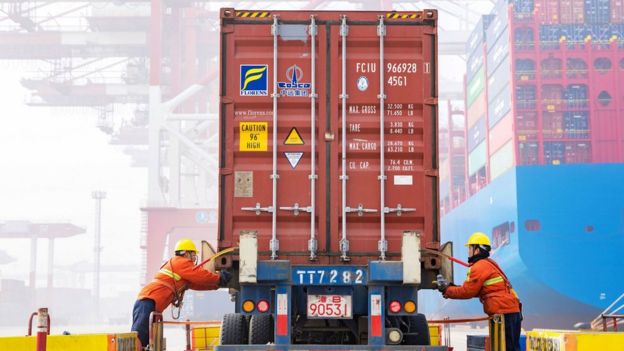
Workers prepare a container at a Chinese port in 2019Image copyrightGETTY IMAGES
Nonetheless, fears of a currency war rattled markets earlier this week.
On Thursday, the PBOC set its official yuan midpoint below the key 7 level to the US dollar for the first time since 2008.
But the trading point was firmer than traders had expected, and was seen as a signal that authorities wanted to stabilise the decline in the currency.
The yuan steadied and stock markets moved higher in Asian trading hours.
Capital Economics' Mr Evans-Pritchard said that in the coming months, "any prop from a weaker [yuan] should be overshadowed by further US tariffs and broader external weakness".