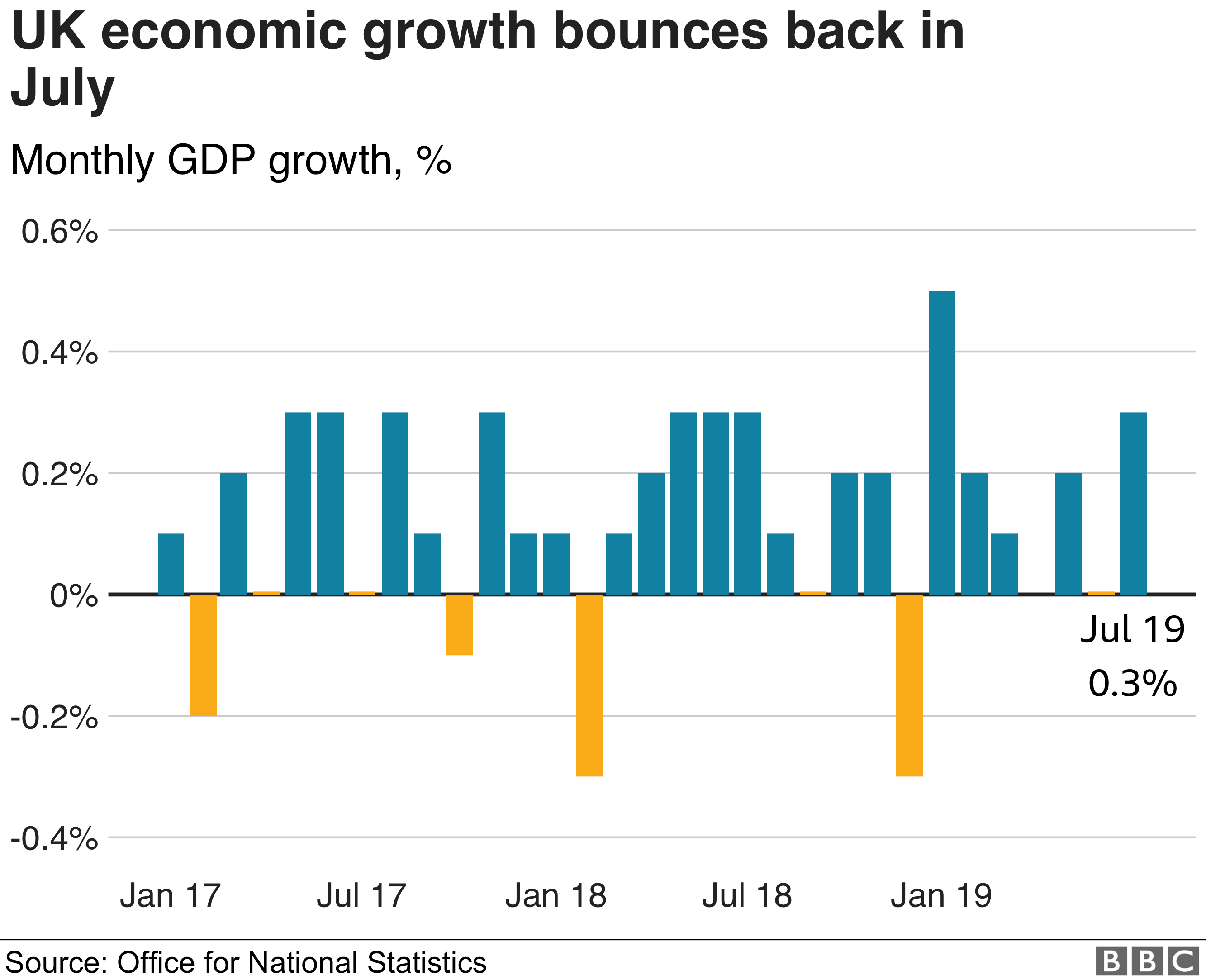
An economy is generally deemed to be in recession if it contracts for two quarters in a row.
However, while growth in the services sector - which accounts for about 80% of the UK economy - helped to drive July's stronger-than-expected growth figure, the Office for National Statistics (ONS) warned that the sector remained weak.
"While the largest part of the economy, the services sector, returned to growth in the month of July, the underlying picture shows services growth weakening through 2019," the ONS said.
Last week, a series of downbeat surveys of various sectors of the economy had raised fears that the UK was at risk of slipping into recession.
However, analysts said the latest GDP figures appeared to have dampened these concerns.
"The pick-up in GDP in July is a reassuring sign that the economy is on course to grow at a solid - perhaps even above-trend - rate in Q3," said Samuel Tombs, chief UK economist at Pantheon Macroeconomics, adding that figures "substantially" weakened the case for any cuts in UK interest rates "before Britain's Brexit path is known".
"The upside surprise came from the services sector, which displayed broad-based strength and did not seemingly benefit from any one-off stimuli," Mr Tombs said.
Analysts also noted that August's growth figure should be boosted by car manufacturers, which were operating last month, contrary to normal practice. Many carmakers had brought their annual shutdown forward for the original Brexit date in March.
"GDP will get a further boost of about 0.2% in August, when car manufacturers will be at work when they are usually on holiday," said Paul Dales, chief UK economist at Capital Economics.
"Overall, the economy is still fairly weak - we estimate that the underlying pace of growth is around +0.2% quarter-on-quarter - but it's not in recession. Political chaos, yes. Economic chaos, no."
LONDON (Reuters) - U.S. Defense Secretary Mark Esper said that European nations should consider funding projects in their countries after the Pentagon diverted money to pay for a border wall with Mexico.
The Pentagon said on Wednesday it would pull funding from 127 Defense Department projects abroad and at home, including schools and daycare centers for military families, as it diverts $3.6 billion to pay for President Donald Trump’s wall along the U.S. border.
Trump has made immigration a signature issue of his presidency. He declared a national emergency over the issue earlier this year in an effort to redirect funding from Congress to build a wall along the U.S. southern border, which he originally said would be paid for by Mexico.
“The message that I’ve been carrying, since when I was acting secretary to today, has been about the increase in burden sharing,” Esper told reporters in London late on Thursday.
“So part of the message will be ‘Look, if you’re really concerned then maybe you should look to cover those projects for us’ because that’s going to build infrastructure in many cases in their countries,” he added.
“Part of the message is burden sharing, ‘Maybe pick up that tab.’”
Some of the projects affected are in Europe, like $21.6 million for port operation facilities in Spain and $59 million for munitions storage in Slovakia.
The defunded projects also include schools for the children of military personnel in Germany and the United Kingdom.
The fund diversion has been heavily criticized by U.S. lawmakers, who say it puts national security at risk and circumvents Congress.
Esper will meet his British and French counterparts in the coming days.
The Trump administration has repeatedly called on NATO countries to pay at least 2 percent of their gross domestic product for defense.
The Pentagon has been increasing its attention toward Europe in recent years, concerned about a resurgent Russia.
Earlier this week Vice President Mike Pence said allies should “remain vigilant” about Moscow’s election meddling and work toward independence from Russian energy supplies.
Reporting by Idrees Ali; Editing by Chris Sanders, Mary Milliken and Dan Grebler
usterity" as it set out plans to raise spending across all departments.
Chancellor Sajid Javid outlined £13.8bn of investment in areas including health, education and the police in what he said was the fastest increase in spending for 15 years.
The plans cover one year and come amid intense political turmoil over Brexit.
Labour criticised the spending plans as "grubby electioneering".
Mr Javid said: "No department will be cut next year. Every single department has had its budget for day to day spending increased at least in line with inflation.
"That's what I mean by the end of austerity."
But the shadow chancellor, John McDonnell, accused Mr Javid of "meaningless platitudes".
"Do not insult the intelligence of the British people," he said.
He accused the government of "pretending to end austerity when they do nothing of the sort".
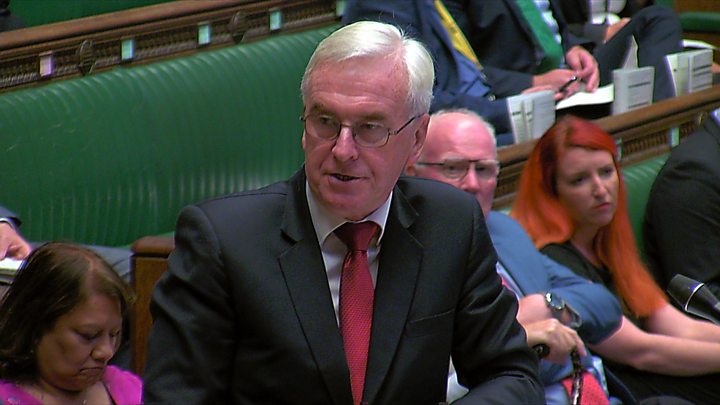
Media captionShadow chancellor John McDonnell criticised the spending plans as "grubby electioneering"
Is this really the end of austerity?
Mr Javid is not first chancellor to claim that austerity is on the way out.
His predecessor Philip Hammond said that the "era of austerity is finally coming to an end" in his autumn Budget last year, when he promised a £30bn boost in public spending by 2024.
The director of the Institute for Fiscal Studies, Paul Johnson, said Mr Javid's plan signalled a "real change in direction on spending but most areas of public service spending were still much below 2010 levels".
"Health is the big exception," he said.
Overall, the IFS said spending would still be 3% below its level a decade ago, and more than 9% lower in per person terms.
"Non-health budgets have also lost out to rising NHS funding: real spending outside the Department of Health will still be 16% lower (21% lower in per person terms) next year than in 2010−11," it added.
Mr Johnson also warned that the current weakness in the UK economy could weigh on the government's declaration of the end of austerity.
"We of course live in a time of extreme economic uncertainty and I think the big risk in saying that austerity is over is that the economy starts to do significantly worse, which it might if we have a no-deal Brexit," he said.
"Then the deficit and debt will start rising and we are in danger of having another dose of austerity to get that over with for a second time."
What were the big announcements?
£13.8bn in extra day-to-day spending for 2020-21, representing a 4.1% uptick
NHS funding increase of £6.2bn next year, most of which was already announced under Theresa May's government
Education spending increase of £7.1bn by 2022-23 compared to the current fiscal year
Secondary schools to be allocated a minimum £5,000 per pupil, primary schools will get £3,750
£750m for 20,000 police officers including £45m to hire 2,000 police by March next year
Home Office day-to-day spending to increase by 6.3%
Ministry of Defence funding to increase by £2.2bn or 2.6%
Confirmation of an additional £2bn in Brexit preparation funding, on top of £2.1bn already announced.
Won't Brexit change the plans?
This was a spending round not a review.
The difference is that Mr Javid's plans are only for one year and not the usual three-year strategy set out by the chancellor because of the ongoing uncertainty over the impact of Brexit.
Mr Javid's was also a very political speech.
He laid out the spending plans against the possibility that the UK is heading for another general election - the country's third in five years.
Prime Minister Boris Johnson said Britain will go to the polls if he is forced to request an extension to the 31 October deadline for the UK to leave the European Union.
Mr Javid was criticised twice during his speech by the Speaker of the House of Commons John Bercow for talking about a bill - which MPs will vote on later today - that would force Mr Johnson to ask the EU for a delay in Britain's exit, instead of focusing on the spending round.
Mr Bercow said that it was "very, very unseemly", adding: "It bothers me greatly that the right honourable gentleman in the course of a statement seems to be veering into matters, not even tangential but unrelated to the spending round upon which he is focused."
What does the government's independent watchdog say?
The Office for Budget Responsibility (OBR) hasn't said anything because this is a separate spending round and has been sperated from the Budget.
As a result, there are no new forecasts from the independent fiscal watchdog which means the chancellor's spending plan is based on predictions published back in March by the OBR
Under those forecasts, the government had around £15bn to borrow within its self-imposed overdraft limit of 2% of the value of the national economy.
If it contracts again between July and September, the country will officially be in recession, which is defined as two consecutive quarters of negative growth.
On Wednesday, data measuring activity in the UK's dominant services sector, which accounts for nearly three quarters of GDP, showed that growth slowed in August following poor figures from both manufacturing and construction during the same month.
If the UK falls into recession, it would mean that the government would break its own fiscal rules.
Although Mr Javid said on Wednesday that ahead of the Budget later this year he will review its fiscal framework: "To ensure it meets the economic priorities of today not of a decade ago".
Separately, Bank of England governor Mark Carney said on Wednesday that the worst case hit to the economy of a no-deal Brexit is now "less severe" thanks to preparations made since the end of last year.
In a Treasury Select Committee hearing, Mr Carney said if the UK left the EU with no deal, the economy would shrink by 5.5% rather than the 8% slump it had predicted in November.
The big message the government will try to send with its spending round is about the austerity decade ending.
In particular the thing it will want to get across is that funding is pouring into those public services most visibly problematic for the Conservatives in the 2017 general election, ahead of yet another fairly imminent visit to the polls.
Health, education, and the police will be boosted just in time.
Total departmental spending will rise for the first time since before the crisis.
The political strategy will be clear: neutralise the toxicity of visible spending cuts made to shrink the deficit since the crisis - in order to help win over Leave voters in traditionally Labour seats.
And the good news for the Chancellor and the First Lord of the Treasury, the PM, is that there is some space for this spending.
Borrowing costs are low. And deficits have not been lower for 17 years too.
So we will hear a lot about the phrase "fiscal headroom".
This is not extra money that can be spent, it is extra borrowing. It is room to borrow more within the government's self-imposed overdraft limit of 2% of the value of the national economy.
How much headroom?
The magic number is £15bn. It had been £27bn, but there have been some changes in the way student loans are accounted for, that have served the purpose of helping the Treasury apply at least some limits.
So £15bn it is, and already the bulk of that has been allocated in announcements to fund the NHS, schools, further education, defence, policing, and foreign aid.
We will get further detail on the rest of it, and there is enough space essentially to provide at least inflation-terms rises for all departmental spending. It will be quite a moment.
But the real question is for just how long?
Firstly this is not the ordinary three-year spending review. That has effectively been delayed until after Brexit. This is a one-year spending round.
It is also being separated from the Budget. This has the happy coincidence that there are no new independent fiscal forecasts from the Office of Budget Responsibility.
If there had been, it turns out that - both because the economy has slowed since March, and also because the deficit is running larger than forecast - the £15bn number could be considerably smaller, perhaps more than halved.
No-deal war chest
On top of that, one has to note that the headroom was left by the previous Chancellor to help deal with the consequences of a no-deal Brexit.
The OBR said in July that even in a modest scenario that could mean a £30bn annual hit to the public finances.
And yet the plan is not to just to spend the headroom that might not exist, but to go further in the coming weeks and cut taxes on fuel, housing and beyond.
Small wonder that at the next Budget the government's tax and spending constraints - its fiscal rules - will be reviewed.
Generally speaking, new Chancellors want to establish fiscal credibility in their first fiscal events. In some ways, at least for a few hours, the shadow chancellor, whose plans are, on paper, funded from tax rises, will.
The very point of the fiscal framework that has been created over the past few decades was to try to inject some long-term thinking, some stability, and avoid the temptation to rig forecasts to enable unsustainable pre-election giveaways.
A pre-election spending round risks undermining that.
But that's a small price for the greater prizes sought by politicians within weeks of a possible election.
PARIS/DUBAI (Reuters) - France has proposed offering Iran about $15 billion in credit lines until year-end if Tehran comes fully back into compliance with its 2015 nuclear deal, a move that hinges on Washington not blocking it, Western and Iranian sources said.
French Foreign Minister Jean-Yves le Drian said talks on the credit arrangement, which would be guaranteed by Iranian oil revenues, were continuing, but U.S. approval would be crucial.
The idea is “to exchange a credit line guaranteed by oil in return for, one, a return to the JCPOA (Iran nuclear deal)...and two, security in the Gulf and the opening of negotiations on regional security and a post-2025 (nuclear program),” le Drian told reporters. “All this (pre)supposes that President Trump issues waivers.”
European leaders have struggled to dampen brewing confrontation between Tehran and Washington since U.S. President Donald Trump pulled out of the deal, which assures Iran access to world trade in return for curbs on its nuclear program.
The United States reimposed sanctions on Iran last year and tightened them sharply this year. Iran has responded by breaching some of the limits on nuclear material in the deal, and has set a deadline for this week to take further steps.
French President Emmanuel Macron has spent the summer trying to create conditions that would bring the sides back to the negotiating table. At a G7 meeting in France last month, Trump appeared open to the idea of credit lines, though U.S. officials later ruled out lifting sanctions as a condition for new talks.
An Iranian delegation was in Paris on Monday, including oil and finance officials, for talks to fine-tune details of credit lines that would give Iran some respite from sanctions that have crippled its economy and cut off its oil exports.
“The question is to know whether we can reach this $15 billion) level, secondly who will finance it, and thirdly we need to get at the very least the tacit approval of the United States. We still don’t know what the U.S. position is,” said a source aware of the negotiations.
A senior Iranian official familiar with the negotiations said: “France has offered the credit line of $15 billion but we are still discussing it. It should be guaranteed that we will have access to this amount freely and also Iran should be able to sell its oil and have access to its (own) money.”
“President Macron is trying hard to resolve the issue and help to save the deal .. and we have overcome some issues and narrowed gaps but still there are remaining issues.”
A second Iranian official said: “Although the EU and particularly France have goodwill, they should convince the U.S. to cooperate with them .. If not, Iran is very serious about decreasing its nuclear commitments. There is no logic to respect the (2015) deal, if it has no benefits for us.”
A European diplomatic source confirmed the $15 billion figure.
LE MAIRE IN WASHINGTON
French Finance Minister Bruno Le Maire will be in Washington on Tuesday in part to discuss the credit mechanism. One diplomat said that might be when the United States gives its response to French proposals.
Iranian President Hassan Rouhani said on Tuesday the Islamic Republic would never hold bilateral talks with the United States - the two have had no diplomatic relations for four decades - but said that if all U.S. sanctions imposed on Iran were lifted, Washington could join multilateral talks between Tehran and the other parties to the 2015 pact.
The Trump administration says the nuclear deal is deficient as many of its terms expire after a decade and it does not cover non-nuclear issues such as Iran’s ballistic missile program and its support of proxy forces around the Middle East.
Iran says it aims to keep the 2015 deal alive, but cannot abide by it indefinitely unless the European countries that signed it ensure it receives the promised economic dividends.
Tehran has called on the Europeans to accelerate their efforts to alleviate the impact of U.S. sanctions. Rouhani stressed on Tuesday that Iran would take its next step in scaling back its nuclear commitments by Thursday unless the Europeans keep their promises to salvage the deal.
Behrouz Kamalvandi, spokesman for the Atomic Energy Organization of Iran (AEOI), said on Tuesday that Iran was capable of resuming enrichment of uranium to 20% fissile purity within two days. Twenty percent purity is considered an important intermediate stage on the road to producing the 90% pure fissile uranium needed for an atomic bomb.
The first source said talks for now did not go into how the credit lines would be repaid, although it would require Iranian oil exports to resume eventually. Certain countries were discussing with France possible involvement in such a mechanism.
“Importing the oil at some point is essential, but we need to have the agreement of the Americans. We are trying to persuade them (the Iranians) not to do more (reductions in commitment to the nuclear deal), but it’s not the end of the story for the mechanism if they do,” the source said, adding that for now Iranian backtracking was reversible.
Iran has asked for $3 billion a month to extend the proposals beyond the end of this year, the source said.
Macron has said that as a condition of any credits, Iran must return fully to the terms of the nuclear deal and open a negotiation on those other issues. French officials declined to comment on the details of the plan.
“It’s extremely sensitive and we don’t want the opponents of this idea to make it fail. It’s extremely volatile,” said a French diplomatic source.
Reporting by John Irish and Parisa Hafezi with additional reporting by Tuqa Khalid in Dubai; Editing by Mark Heinrich
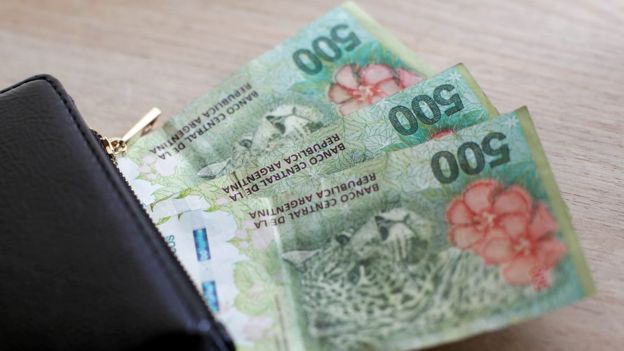
Argentina has imposed currency controls in an attempt to stabilise markets as the country faces a deepening financial crisis.
The government will restrict foreign currency purchases following a sharp drop in the value of the peso.
Firms will have to seek central bank permission to sell pesos to buy foreign currency and to make transfers abroad.
Argentina is also seeking to defer debt payments to the International Monetary Fund (IMF) to deal with the crisis.
What has the government said?
In an official bulletin issued on Sunday, the government said that it was necessary to adopt "a series of extraordinary measures to ensure the normal functioning of the economy, to sustain the level of activity and employment and protect the consumers".
The central bank said the measures were intended to "maintain currency stability".
It also said that while individuals can continue to buy US dollars, they will need to seek permission to purchase more than $10,000 (£8,223.50) a month.
The measures will apply until the end of this year.
What triggered the current crisis?
Argentina has been struggling with a financial crisis, which was exacerbated by the president's defeat in a recent primary poll.
The peso fell to a record low last month after the vote showed that the business-friendly government of President Mauricio Macri is likely to be ousted in elections in October.
Mr Macri was elected in 2015 on promises to boost Argentina's economy with a raft of liberal economic reforms.
But the country is in a deep recession. It has one of the world's highest inflation rates, running at 22% during the first half of the year.
Argentina's economy contracted by 5.8% in the first quarter of 2019, after shrinking 2.5% last year. Three million people have fallen into poverty over the past year.
How is the move likely to be received?
Ordinary Argentines have traditionally had little faith in their own currency, preferring to convert their spare pesos into dollars as soon as they can.
Image copyrightGETTY IMAGES
They don't trust financial institutions much either, so they resort to what is locally known as the "colchón bank" - that is, stuffing their dollars under the mattress.
Anecdotal stories abound of people keeping money buried in the garden, hidden in the walls or even stuffed in heating systems - occasionally with disastrous consequences if there is an unexpected cold snap.
When you consider Argentina's history of rampant inflation and currency volatility, they arguably have a point.
But it does mean that any restrictions on people's ability to buy dollars have an enormous psychological impact.
How does this compare with previous crisis measures?
The $10,000 ceiling for dollar transactions is certainly generous in comparison with past actions.
People still have bad memories of the "corralito", imposed in 2001, which stopped all withdrawals of dollars from bank accounts for a whole year.
The only serious attempt to wean Argentines off their dollar dependency dates back to the 1990s under President Carlos Menem, when the peso's value was fixed by law at parity with the dollar.
But that put the financial system under severe strain, leading to the economic meltdown of 2001-02.
How bad can Argentina's crisis get?
The country is struggling to stave off its fifth debt default in 30 years.
Last week, it said it would seek to restructure its debt with the IMF by extending its maturity. This would give the country more time to pay back the money it owes to the IMF.
Rating agencies, including Standard & Poor's and Fitch, decided that amounted to a default and downgraded the country's credit ratings.
Whatever happens in Argentina, the risk of financial contagion is low, say analysts.
Even in the rest of Latin America, markets are unlikely to suffer. The US-China trade war and the slowdown in global growth are much more of a threat.
 GETTY IMAGES