Tuesday, September 17, 2019

Reuters News - Trade talks seen as unlikely to mend U.S.-China divide

BEIJING/WASHINGTON (Reuters) - U.S. and Chinese officials will restart trade talks at the end of this week, but any agreement the world’s largest economies carve out is expected to be a superficial fix.
The trade war has hardened into a political and ideological battle that runs far deeper than tariffs, trade experts, executives, and officials in both countries say.
China’s Communist Party is unlikely to budge on U.S. demands to fundamentally change the way it runs the economy, while the U.S. won’t backtrack on labeling Chinese companies national security threats.
The conflict between the two countries could take a decade to resolve, White House economic advisor Larry Kudlow warned on Sept. 6. Yu Yongding, an influential former policy adviser to China’s central bank, told Reuters that China was in no rush to make a deal.
Presidents Donald Trump and Xi Jinping may hammer out an interim agreement in October to soothe stock markets and claim political victory after this week’s lower-level talks.
But any final agreement is “extremely unlikely to meaningfully address the Chinese structural reforms” sought by the U.S. and other countries, said Kellie Meiman Hock, a former U.S. Trade Representative official and managing partner with McLarty Associates, a policy and government consultancy.
Negotiators have made little discernable progress on the many points of disagreement since negotiations broke down in May, sources briefed on the talks say.

ISSUES DIVIDE

Beijing is unwilling to address the way it supports state-owned companies and subsidizes their products in coming talks, sources in China and the U.S. say. The U.S. continues to label Chinese tech company Huawei a national security threat, and dangle the threat of new tariffs against China.
“The ultimate result of talks must be the dropping of all tariffs,” said He Weiwen, senior fellow, Chongyang Institute for Financial Studies at Renmin University. “This is the baseline for China.” He is not optimistic about the talks’ prospects.
Since trade negotiations between the world’s largest economies collapsed in May, both countries have also broken promises and traded public insults. The mood is upbeat, but a single Trump tweet could turn that around, analysts say.
“They’re locked in this uncomfortable embrace,” said William Reinsch, a former senior Commerce Department official and Center for Strategic and International Studies fellow.
“Both presidents have undercut their negotiators and neither side can rely on what the other has said,” he said.

‘TECTONIC SHIFT’

Trump’s “tough on China” stance has swept in a new way of thinking about Beijing in Washington, despite the unpopularity of many of his other policies. The U.S. Congress, bitterly divided along partisan lines on most issues, is united about the need for systemic reform in China.
Democrats running against Trump aren’t likely to repair the China relationship if they take the White House in 2020. In a debate on Sept. 12, presidential candidates used terms like corruption and theft to discuss China’s trade practices.
“There’s been a tectonic shift,” said Warren Maruyama, former general counsel for the U.S. Trade Representative’s office and a partner with law firm Hogan Lovells.
“The old idea that China was in the middle of free market economic reforms that would lead them our way is effectively dead,” Maruyama said. “There’s bipartisan support for a tougher China policy.”
Lawmakers are responding, with several China-related bills making their way through Congress, from legislation to punish Beijing for human rights abuses against Muslims in Xinjiang and to support protesters in Hong Kong.
Additionally, the 2020 National Defense Authorization Act, or NDAA, could include provisions targeting China on issues ranging from technology transfers to the sale of synthetic opioids.

POLITICAL PRESSURE

Trump faces a worsening economy and recession fears at home, thanks in part to the tariffs he has enacted, but key constituencies have stood by him so far. U.S. executives in China say Beijing is miscalculating if it thinks the trade war will undermine Trump’s political support.
“If anything, the trade war has unified support in the business community,” one senior American executive in China said.
“The problems are deep, and they are structural,” said Craig Allen, a former senior U.S. Commerce Department official who now heads the US-China Business Council. The countries’ high-tech sectors may be permanently decoupled, he said, thanks to concerns about Chinese espionage, cyber hacking and intellectual property theft.
China’s Communist Party also faces a slowing economy as it prepares to celebrate on Oct. 1 70 years of ruling the country.
Many in Beijing believe that Trump’s erratic approach to the trade war this year has provided Xi with convenient short-term political cover, allowing him to blame White House tariff increases instead of domestic policies for the slowdown. 
In a throwback to the Mao Zedong era, Xi told cadres this month that there must be a “resolute struggle” against any risks and challenges to the party’s leadership, the country’s sovereignty and security and anything that threatens the country’s core interests.
Investments between China and the U.S. dropped to the lowest six-month level in five years in the first half of this year, a study by the research firm Rhodium Group shows.
Foreign direct investment and venture-capital deals between the two countries fell to $13 billion in the period, down 49% from the first half of 2018.
Reporting by Michael Martina, Andrea Shalal, Tim Aeppel, and Patricia Zengerle. Editing by Heather Timmons and Gerry Doyle

Monday, September 16, 2019

BBC News - Oil prices soar after attacks on Saudi facilities

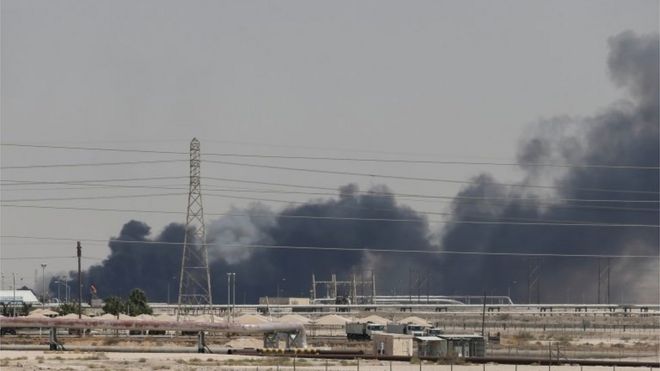
Smoke is seen following a fire at Aramco facility in the eastern city of AbqaiqImage copyrightREUTERS
Image captionSmoke is seen following a fire at Aramco facility in the eastern city of Abqaiq
Oil prices surged after two attacks on Saudi Arabian facilities on Saturday knocked out more than 5% of global supply.
Brent crude jumped 10% to $66.28 a barrel, while West Texas Intermediate rose 8.9% to $59.75 in Asian trading.
Prices pulled back slightly after US President Donald Trump authorised the release of US reserves.
The strike, which the US blames on Iran, has sparked fears of increased risk to energy supplies in the region.
The drone attacks on plants in the heartland of Saudi Arabia's oil industry included hitting the world's biggest petroleum-processing facility.
It could take weeks before the facilities are fully back on line. State oil giant Saudi Aramco said the attacks cut output by 5.7 million barrels per day.
Jeffrey Halley, senior market analyst at Oanda said the price spike across oil markets was a reaction to the "political and geopolitical implications" of the attacks.
"The bigger issue is just how secure is Saudi's infrastructure from attacks?," Mr Halley said.
US Secretary of State Mike Pompeo said Tehran was behind the attacks. Iran accused the US of "deceit."
Later Mr Trump said in a tweet the US knew who the culprit was and was "locked and loaded" but waiting to hear from the Saudis about how they wanted to proceed.

What will be the impact on oil supply?

The Saudis have not gone into any detail about the attacks, barring saying there were no casualties, but have given a few more indications about oil production.
Energy Minister Prince Abdulaziz bin Salman said some of the fall in production would be made up by tapping huge storage facilities.
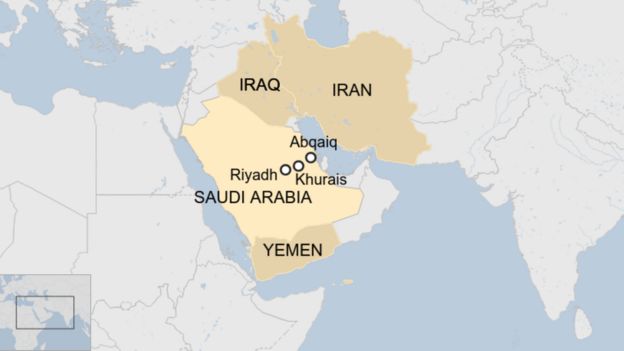
Saudi Arabia with capital Riyadh, the two oil facilities Abqaiq and Khurais, Yemen to the south and Iraq and Iran to the north
Image captionThe attacks struck Abqaiq and Khurais in central Saudi Arabia
The kingdom is the world's biggest oil exporter, shipping more than seven million barrels daily. Saudi stocks stood at 188 million barrels in June, according to official data.
"Saudi authorities have claimed to control the fires, but this falls far short of extinguishing them," said Abhishek Kumar, head of analytics at Interfax Energy in London. "The damage to facilities at Abqaiq and Khurais appears to be extensive, and it may be weeks before oil supplies are normalised."
Saudi Arabia is expected to tap into reserves so that exports can continue as normal this week.
However, Michael Tran, managing director of energy strategy at RBC Capital Markets in New York, said: "Even if the outage normalises quickly, the threat of sidelining nearly 6% of global oil production is no longer a hypothetical, a black swan or a fat tail. Welcome back, risk premium."

What are the US accusations?

Mr Pompeo said Tehran was behind the damaging attacks but gave no specific evidence to back up his accusations.
He has rejected claims by Yemen's Iran-backed Houthi rebels that they carried out the attacks.
Iran accused the US of "deceit" and its Foreign Minister Javad Zarif said that "blaming Iran won't end the disaster" in Yemen.
Yemen has been at war since 2015, when President Abdrabbuh Mansour Hadi was forced to flee the capital Sanaa by the Houthis. Saudi Arabia backs President Hadi, and has led a coalition of regional countries against the rebels.
The US meanwhile has blamed Iran for other attacks on oil supplies in the region this year, amid continuing tension following Mr Trump's decision to reinstate sanctions after abandoning the landmark international deal which limited Tehran's nuclear activities.

Friday, September 13, 2019

BBC News - Eurozone gets fresh help to bolster flagging growth

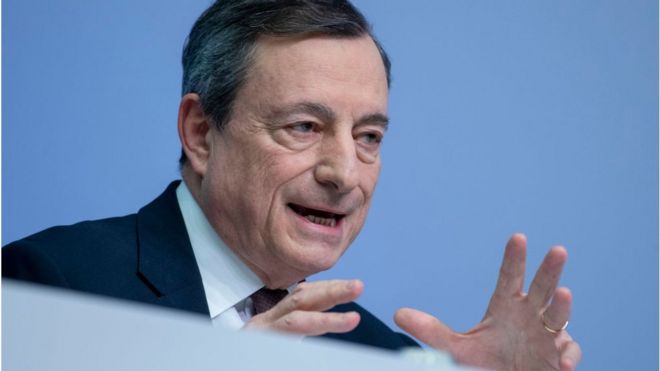
ECB chief Mario DraghiImage copyrightGETTY IMAGES
Image captionMario Draghi said the ECB had cut its forecasts for both inflation and economic growth
The European Central Bank has unveiled fresh stimulus measures to bolster the eurozone, including cutting a key interest rate.
The deposit facility rate, paid by banks on reserves parked at the ECB, was already negative, but has now been cut from minus 0.4% to minus 0.5%.
The ECB also said it was re-starting quantitative easing. It will buy €20bn of debt a month from 1 November.
The eurozone's main interest rate has remained unchanged at zero.
The moves come as the ECB combats an economic slowdown. The bank said its asset purchase programme would "run for as long as necessary", while interest rates would remain "at their present or lower levels" until eurozone inflation reached its target rate of 2%.
Quantitative easing, or QE, is a way for central banks to pump money into the financial system when interest rates are ultra-low and conventional stimulus methods no longer work.
The central bank buys assets, usually government bonds, with money it has "printed" - or, more accurately, created electronically.
Making more money available in this way is supposed to encourage financial institutions to lend more to businesses and individuals.
Under its previous QE programme, the ECB bought €2.6 trillion of bonds between 2015 and 2018.
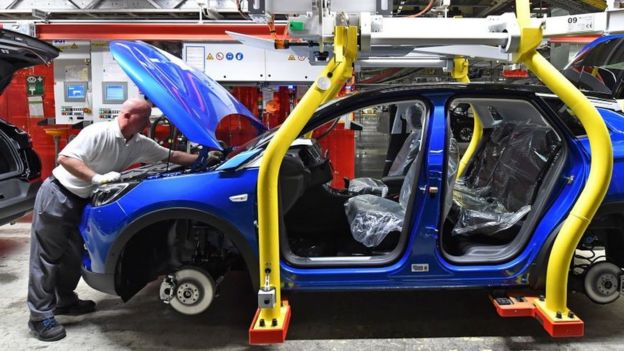
Car manufacturing in GermanyImage copyrightGETTY IMAGES
Image captionThe eurozone's biggest economy, Germany, is thought to be on the brink of recession
ECB chief Mario Draghi told a news conference that the inflation outlook had been further downgraded.
"Headline inflation is likely to decline before rising again towards the end of the year," he said.
Mr Draghi also announced that the ECB had lowered this year's and next year's GDP growth forecasts for the eurozone. It now expects growth of 1.1% this year and 1.2% in 2020.
He said the eurozone was suffering from the "prevailing weakness of international trade in an environment of prolonged global uncertainties".
The eurozone's biggest economy, Germany, is widely thought to be on the brink of recession.
The ECB's decisions drew a swift reaction from US President Donald Trump, who tweeted that the ECB was "trying, and succeeding, in depreciating the euro against the VERY strong dollar".
Responding to Mr Trump's comments, Mr Draghi referred to him as "the First Tweeter".
"We have a mandate, we pursue price stability, and we do not target exchange rates, period," he said.

'Serious policy easing'

Mr Draghi is due to make way for incoming ECB President Christine Lagarde on 1 November.
The ECB's main refinancing rate has been at zero since March 2016.
"At first glance, the ECB has not quite thrown the kitchen sink at the eurozone economy," said Ranko Berich, head of market analysis at Monex Europe.
"The QE package is shy of market expectations, which were €30bn a month. But the Bank is clearly back in the business of serious policy easing and more aggressive action could easily be taken in response to a worsening in conditions."

Analysis

By Andrew Walker, BBC economics correspondent
So the ECB has fired off another volley of its monetary policy ammunition. But will it hit the target? Will it get inflation up towards the ECB's target and will it stimulate the eurozone's flagging economy? Many people are very sceptical.
The interest rate move takes us even further into the strange world of negative rates. There is a view that that measure is actually counterproductive, that it has an adverse impact on bank profitability. Perhaps ECB policy more widely has reached the limit of its ability to stimulate economic activity.
The other main weapon against economic weakness is in the hands of governments - fiscal policy, or public spending and taxation. For some governments in the eurozone, their scope to use that weapon is constrained by the amount of debt they already have and by eurozone rules. But the likely next head of the ECB, Christine Lagarde has called for more action in that area.
Countries such as Germany have strong government finances, but so far have been wary of departing from what they see as prudent financial management. There is, however, a growing debate about what the eurozone needs.

Thursday, September 12, 2019

BBC News - Trump delays tariff hikes on Chinese goods ahead of talks

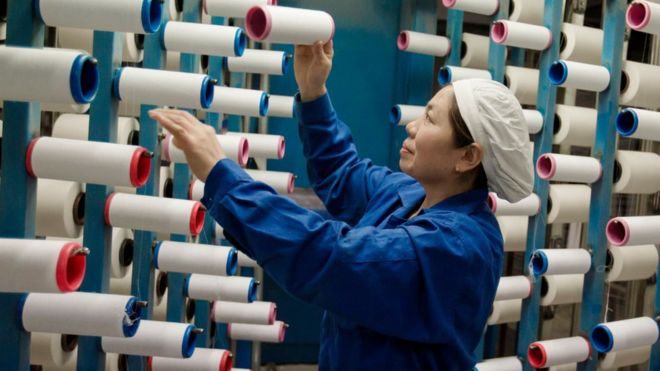
This photo taken on February 22, 2018 shows a woman working at a textile factory in Haian in China's eastern Jiangsu provinceImage copyrightGETTY IMAGES
US President Donald Trump will delay a planned tariff hike on $250bn (£202.8bn) of Chinese goods as a "gesture of good will".
In a tweet, Mr Trump said a 5% increase to duties scheduled for 1 October will be postponed for two weeks.
He said the delay had been requested by China, and also follows a move by Beijing to scrap some US tariffs.
It comes as the two sides prepare to hold fresh talks aimed at resolving their long-running trade dispute.
Last month, the US said it would increase the tariff rates on all Chinese goods, which included raising a 25% tax on $250bn of Chinese imports to 30%.
On Wednesday, Mr Trump said China's Vice Premier Liu He had asked him to postpone the upcoming tariff increase from 1 October as the date coincided with the anniversary of the People's Republic of China.
Earlier, China released a list of 16 US imports that will be exempted from tariffs including anti-cancer drugs and animal feed.
Significant US exports to China, like pork, soybeans and American-made cars, are among the goods that will still be hit by the hefty taxes.

Growing tensions

The world's largest economies have been locked in a bruising trade fight for the past year that has hurt businesses and weighed on the global economy.
Tensions escalated in recent months and Washington said it would target all Chinese imports to the US with new duties by the end of the year.
Against that backdrop, both sides are preparing to return to the negotiating table.
Preliminary meetings are set to take place later this month in Washington before US treasury secretary Steven Mnuchin and trade representative Robert Lighthizer meet China's Mr Liu in October.
Still, some analysts argue the latest gestures by the US and China have not brought a resolution to their trade row much closer.
"A broad settlement is not in sight," Gary Hufbauer of the Peterson Institute for International Economics said.
"Beijing is prepared for a continuation of tariffs and hostile rhetoric through 2020. And Trump cannot back down without getting a storm of criticism from the hawks, both Democrats and Republicans."

Wednesday, September 11, 2019

Reuters News - U.S. corporate bond, IPO markets heat up as recession fears persist

NEW YORK (Reuters) - Corporate America appears to be rushing to get the most out of the decade-long bull market in stocks and bonds before a possible recession and election-year stock market volatility slam the IPO and credit windows shut.
Approximately 70 companies have registered with the U.S. Securities and Exchange Commission to go public, according to estimates from Renaissance Capital, while $72 billion in investment-grade corporate debt – a figure nearly as large as the total issuance in August - was issued last week, according to data from Dealogic.
The rash of new deals comes as the U.S.-China trade war weighs on the global economy, helping push 30-year Treasury yields to record lows and increasing fears of a global economic slowdown. U.S. manufacturing activity contracted for the first time in three years in August, while construction spending barely rose in July, helping send business confidence lower, according to the Institute for Supply Management.
As a result, even companies like Apple Inc (AAPL.O) and Walt Disney Co (DIS.N) that have billions of cash on hand are taking on new corporate debt, taking advantage of the opportunity to lock in historically low borrowing costs while investor demand for yield remains high.
“Companies might as well take advantage while they can. Corporations are getting in while the credit window remains wide open as you just never know when it slams shut,” said Greg Peters, head of multisector and strategy at PGIM Fixed Income, which oversees more than $809 billion in assets under management.
The increase in corporate debt on the heels of a 24% decline in borrowing in 2018 will likely be a key topic of discussion at the Federal Reserve’s policy meeting scheduled to begin Sept. 17. While the market is currently predicting a 91% chance that the Fed cuts interest rates, according to data from the CME Group, signs that corporate lending remains robust may undermine the economic need for lower rates, fund managers and analysts say.
“From where I sit obviously money is very cheap right now and bond prices reflect a full-blown recession, but I don’t think that’s in the offing,” said Eddy Vataru, a portfolio manager at the Osterweis Total Return fund. “We are going through a weak patch now but it feels like as the days pass and it’s clear that inflation is not obsolete, the market will have to re-price for that.”

IPO FEVER

Expectations for increased stock market volatility and a desire for liquidity on the part of venture capital and private equity firms are helping fuel the packed slate of upcoming IPOs through the end of the year, said Kathleen Smith, principal at Renaissance Capital, a provider of institutional research and IPO ETFs. Food delivery company Postmates Inc and fitness startup Peloton Interactive are among the companies expected to go public by the end of 2019.
“The IPO market hasn’t shut down, and won’t shut down until returns are poor,” she said, as companies such as plant-based meat maker Beyond Meat Inc (BYND.O) and video conferencing company Zoom Video Communications Inc (ZM.O) have helped send Renaissance Capital’s IPO-focused ETF (IPO.P) up nearly 30% for the year to date.
Jordan Stuart, a client portfolio manager at Federated Kaufmann who focuses on newly-public companies, said that any volatility around the 2020 presidential election could weigh on healthcare companies that have their stock market debuts next year, prompting some companies to go public by the end of this year instead. Healthcare is widely seen as the industry most likely affected by a Democratic victory in the presidential election.
Yet more companies are making the call that they have a “window of liquidity” through the end of this year, and are rushing at the chance to take it, Stuart said.
“These companies are looking for capital to grow and they’re reasonably certain that they can get it now,” he said.
The pushback on IPO valuations in the wake of the disappointing performance of hyped debuts from Uber Technologies Inc (UBER.N) and Lyft Inc (LYFT.O) is also putting pressure on companies to go public now because they do not expect to get a better deal in the future, said Kevin Landis, a portfolio manager at Firsthand Funds.
The We Company, for instance, could go public with a valuation as low as $18 billion, roughly a third of the $47 billion the company was valued at in a previous private funding round.
“There’s a natural bias toward taking the money when it’s available,” he said.
Reporting by David Randall; Editing by Jennifer Ablan and Tom Brown

Tuesday, September 10, 2019

Reuters News - Technology hands start ups key to $5.1 trillion FX market

LONDON (Reuters) - More than five years since global foreign exchange (FX) trading was tainted by a rigging scandal, a handful of banks are more dominant than ever and show no sign of weakening their grip on the $5.1 trillion (4.13 trillion pounds)-a-day electronic market.
But below the radar a new breed of start-ups is seeking to break their hegemony by pursuing the smaller but higher-margin customer-facing FX business used by asset managers, pension funds and insurance companies.
Data analytics firm Coalition estimates the bulk of daily flows are between banks and the majority are likely to remain with the big lenders, notably Citi, JPMorgan, Bank of America Merrill Lynch, HSBC and UBS who together hold almost 45% of worldwide FX trading, up from around 35% in 2012.
The upstarts say banks can read trading patterns to obtain higher prices from asset managers, who should instead save millions of dollars a year, as much as 50% in FX trading costs, by trading directly with each other.
The cost of trading depends on size, currency, liquidity and the time of day. For a $25 million transaction in euro/dollar, a mid-sized asset manager can pay a spread of 1 to 2 “pips” for trading via a large bank, which equates to $5,000.
Banks, who often use FX trading to win more lucrative business such as structured products, hedging solutions and treasury services, say that their dominance and creditworthiness allow them to offer clients the best prices in the safest way.
“We can also match more liquidity internally, allowing us to secure better pricing for clients than if we always had to go out to the market as those smaller companies have to,” said Richard Anthony, HSBC’s Global Head of FX eRisk.
Nevertheless, there are now 80 or more venues trading FX, with one or two launching each year, Marketfactory, a firm that offers clients an interface to trade on them, says.
This is largely because technology costs, previously a major barrier to entry, have dropped, with the Bank of International Settlements estimating that developing a trading platform costs $5-$10 million, versus $100-$150 million in the early 2000s.
One preparing to go live this year is New York-based FX HedgePool whose founder Jay Moore said banks include costs such as credit and market risk transfer, capital, technology, platform fees and staff salaries in their quotes. 
“We seek to significantly reduce these costs by allowing institutions to source liquidity from each other,” said Moore, who will face competition from platforms like London-based 24 Exchange, which began operating in August.

CAUGHT IN THE NET

Investors betting on currencies or hedging stock and bond exposure do so mostly on bank platforms, where they choose from continuously streamed quotes.
Alternatively, they use multi-dealer platforms such as those from Refinitiv or CME, where banks compete on price.
Although a breakdown of bank market shares for serving buy-side customers is not easily available, in London, the world’s biggest forex trading hub, six dealers accounted for 74% of all spot transactions in October 2018, Bank of England data shows.
And in New York four dealers corner three-quarters of spot trading, New York Federal Reserve data shows.
The start-ups argue that while transaction “spreads” on currency trading have plummeted in recent years, investors often pay significantly for “market impact”, the degree to which large, staggered orders can skew market pricing.
Claude Goulet, CEO of London-based Siege FX, another start-up set to launch in 2019, says his analysis shows the costs associated with market impact for a recent large euro/dollar transaction totalled 2.5 times the cost of the spread paid.
Siege is building a matching system to check when one asset manager’s currency needs can be “netted” against another’s, which would eliminate the need to trade through banks.
Goulet reckons large investors netting 20% of their forex flows through Siege would save millions of dollars a year.
“If you are systematically trading with the same banks you can assume the bank knows what you are doing,” he said. “That doesn’t correspond with reducing your footprint.”

NICHE PROVIDERS

The biggest challenges facing FX start ups are settlement risk and operational differences, where an asset manager’s system is not compatible in matters such as legal documentation.
Because FX is traded bilaterally “over-the-counter” rather than on exchanges, there is a credit exposure for two days after the trade is executed before funds are exchanged.
While this is not a concern for a major fund manager trading with a big bank as its counterparty, it puts them off dealing with start ups, said David Mercer, CEO of LMAX Exchange said.
“The large banks still dominate FX trading for this reason (operational issues such as legal documentation). That might change in the next 10 years but for now, the new providers are very much niche providers,” Ugo Lancioni, managing director of currency management at Neuberger Berman, said.

BIG BANKS DOMINANT

None of the half a dozen funds canvassed by Reuters appeared concerned yet about market concentration, saying they were open to trading with start ups but the credit issue needed solving.
If anything, the squeeze on forex trading profitability since the 2008 financial crisis has made it difficult for smaller banks to compete with the giants on price.
Andreas Anschperger, European head of FX trading at Allianz Global Investors said he had not observed an adverse impact. His company has opted to receive FX quotes from 10-15 banks, down from as many as 20 some years ago.
“(The big banks) have the ability to support us, we can select a full suite of services,” he told Reuters.
Reporting by Saikat Chatterjee and Tommy Wilkes; Editing by Sujata Rao and Alexander Smith