Monday, October 7, 2019

BBC News - US set to impose tariffs on $7.5bn of EU exports in Airbus row

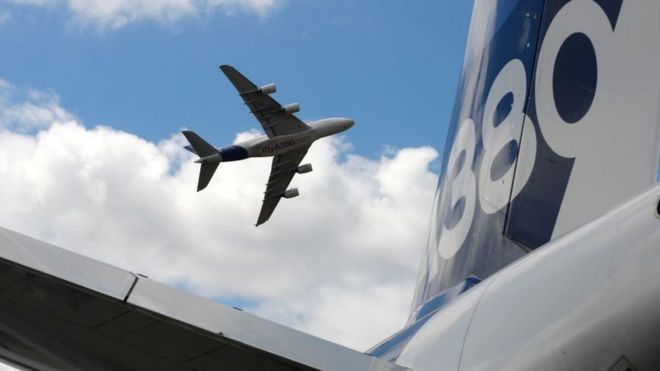
A380 planeImage copyrightGETTY IMAGES
Image captionAirbus' A380 was unfairly subsidised, WTO says
The US has been given the go-ahead to impose tariffs on $7.5bn (£6.1bn) of goods it imports from the EU.
It is the latest chapter in a 15-year battle between the US and the EU over illegal subsidies for planemakers Airbus and rival Boeing.
The World Trade Organization (WTO) ruling will mean tariffs on EU goods ranging from aircraft to cheese, olives and jumpers from 18 October.
Brussels has threatened to retaliate similarly against US goods.

What happens next?

US trade officials said the tariffs would be set at a 10% rate on aircraft and 25% on agricultural and other items.
They have published a list of all the items that will be subject to the additional tariffs, most of which will apply to imports from France, Germany, Spain and the UK.
The US said it had the authority to increase the tariffs "at any time" or change the products affected.
Meanwhile, the two sides are waiting for the WTO to decide on what tariffs the EU can impose against the US in retaliation for US state aid given to Boeing. That ruling is expected next year.
The European Commission, which has proposed tariffs on $20bn (£15bn) of US goods, said it hopes to reach a settlement.
"But if the US decides to impose WTO authorised countermeasures, it will be pushing the EU into a situation where we will have no other option than do the same," the European Commission said.

How did this row start?

The US first filed the case in 2004, arguing that cheap European loans for Airbus amounted to illegal state subsidies.
The WTO decided in favour of the US, which subsequently complained that the EU and certain member countries were not in compliance with the decision, prompting years of further wrangling.
The US had sought to impose tariffs on about $11bn in goods. Though the WTO cut that figure to $7.5bn, Wednesday's decision still marks the largest penalty of its kind in the organisation's history.
The WTO's dispute settlement body must formally adopt the ruling but is not expected to overturn the decision.

Could there be a settlement?

US trade officials said the EU's settlement offer came years too late and did not resolve US concerns about ongoing subsidies. Imposing tariffs is intended to produce a better proposal, they added.
"For years, Europe has been providing massive subsidies to Airbus that have seriously injured the US aerospace industry and our workers.
"Finally, after 15 years of litigation, the WTO has confirmed that the United States is entitled to impose countermeasures in response to the EU's illegal subsidies," said US Trade Representative Robert Lighthizer.
He said the US expected to "enter into negotiations with the European Union aimed at resolving this issue in a way that will benefit American workers."
But governments across the EU, including the UK, called for the dispute to be resolved without the new tax.
"Resorting to tariffs is not in the interests of the UK, EU or US," the UK said. "We are working closely with the US, EU and European partners to support a negotiated settlement to the Airbus and Boeing disputes".
Bruno Le Maire, France's finance minister, said the country was "ready to respond firmly with our European partners".
"A friendly resolution to the Boeing/Airbus dispute is the best solution, and all the more so given that Europe could impose sanctions on the US next year," he said.
Germany's Chancellor Angela Merkel said: "A decision has been made based on international law through which Airbus will be affected unfortunately and we will see how the Americans will react".
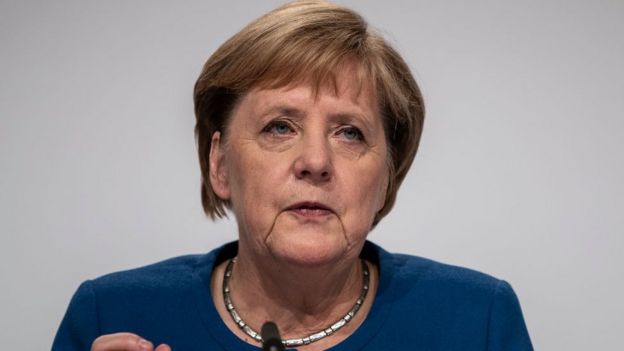
German Chancellor Angela MerkelImage copyrightGETTY IMAGES
Image captionGerman Chancellor Angela Merkel says the EU will watch to see how the US reacts

How does this relate to Donald Trump's trade fights?

These tariffs are separate to US President Donald Trump's ongoing trade disputes with countries around the world.
Those were sparked in March 2018 when his administration announced tariffs of 25% on steel and 10% on aluminium imported into the US.
It prompted the EU to impose €2.8bn (£2.4bn) of duties on US goods such as bourbon whiskey, motorcycles and orange juice last June.
Mr Trump is also considering raising import duties on European cars.

Is there an economic impact?

While the Boeing-Airbus fight pre-dates Mr Trump, another wave of tariffs adds to concerns about global trade, which has slowed significantly amid the many disputes.
On Wednesday, Airbus chief executive Guillaume Faury warned that hitting aircraft with the import duties would disrupt the industry, raise costs and hurt the broader economy - including in the US.

Airbus chief executive Guillaume Faury warned the tariffs could impact US jobsImage copyrightGETTY IMAGES
Image captionAirbus chief executive Guillaume Faury warned the tariffs could impact US jobs
Close to 40% of Airbus's aircraft-related procurement comes from US aerospace suppliers, which it said it supports 275,000 American jobs in 40 states.
"Airbus is therefore hopeful that the US and the EU will agree to find a negotiated solution before creating serious damage to the aviation industry as well as to trade relations and the global economy," Mr Faury said.
BBC economics correspondent Andrew Walker said tensions in global trade had already risen since President Trump took office.
"It's worth remembering that the International Monetary Fund and others see trade conflict as one of the biggest risks to the global economic outlook," he added.

Friday, October 4, 2019

BBC News - UK economy facing 'heightened risk of recession'


Female baristaImage copyrightGETTY IMAGES

The UK's economy may have tipped into recession following a downturn in the dominant service sector, according to closely-watched figures.
The IHS Markit/CPS purchasing managers' index for services fell to a six-month low of 49.5 in September. The 50 level divides growth from expansion.
It suggests the economy shrank 0.1% in the three months to September, after a 0.2% fall in the previous quarter.
Some experts urged caution, as official data last month eased recession fears.
Combined with even weaker manufacturing and construction purchasing managers' indexes (PMI) earlier this week, September's all-sector PMI sank to 48.8 from 49.7. This was its lowest since the month after the referendum decision to leave the EU in June 2016, and before that 2009.
"Coming on the heels of a decline in the second quarter, [this] would mean the UK is facing a heightened risk of recession," said IHS Markit economist Chris Williamson. A recession is normally defined as when an economy contracts over two consecutive quarters.
"September's decline is all the more ominous, being the result of an insidious weakening of demand over the past year rather than a sudden shock," Mr Williamson added. He highlighted Brexit uncertainty, worries about trade tensions between the US, China and Europe, and weaker growth in the eurozone.
Separate PMI figures on Thursday showed Germany's services sector sharply lost momentum in September, fuelling fears that contraction in the country's manufacturing sector was spilling over into the rest of Europe's largest economy. Germany's services PMI fell to 51.4 from 54.8 in August, the lowest reading for three years.
Although the PMI data is closely followed it is not considered foolproof. Immediately after the Brexit referendum, the data indicated a sharper downturn than was actually the case.
Last month, latest figures from the Office for National Statistics (ONS) pointed to the UK economy growing faster than expected in July, easing fears that it could fall into recession.
Growth was flat over the three months to July, but this was an improvement on the 0.2% contraction seen in the April-to-June quarter. ONS growth data for August is due for publication on 10 October."

Analysis box by Dharshini David, economics correspondent

This survey has sounded the recession alarm bells - pointing to a second quarter of shrinking GDP. Not only does it imply one of the biggest slumps in activity in the dominant service sector since the financial crisis but, taken with its counterparts for manufacturing and construction, signals output falling across the economy.
Should we be worried? These surveys are the first monthly insight into the health of major parts of our economy. But in these tumultuous times, they may be more of a mood check rather than a whole-body MOT.
The authors refer to Brexit-related anxiety: sentiment, rather than activity, may be clouding or obscuring the picture. It wouldn't be the first time. Earlier this year (because of course we've been here before) these surveys failed to fully reflect the flurry in Brexit preparations. Nor do they cover retail or the public sector - two areas that have underpinned the growth we have seen. The surveys can and do deviate from official growth numbers.
But it'd be dangerous to ignore the warnings. Sentiment can dictate all sorts of business plans - from investment to hiring. The impact of those can last longer than one quarter's GDP.

Presentational grey line

'Too downbeat'

Economists said Thursday's PMI figures were a warning. Ruth Gregory, senior UK economist at Capital Economics, said they reignited concerns the economy is in recession as it "suggests that growth in the biggest part of the economy has fizzled out".
However, while Dean Turner, UK economist for UBS Global Wealth Management, said the figures were "gloomy", he added that the PMIs "have had a tendency to overreact relative to reality. It is too early to conclude that the UK is heading for a recession on these numbers alone."
And Samuel Tombs, chief UK economist at Pantheon Macroeconomics, went further. "The survey's poor track record recently means its recession signal should not be believed," he said. "Markit's services survey has been far too downbeat over the last year.

Thursday, October 3, 2019

Reuters News - Swiss banks benefit as rich Britons line up escape route from Brexit chaos

ZURICH (Reuters) - Swiss private banks have seen a sharp rise in British clients who are moving assets offshore to escape a chaotic Brexit, several sources familiar with the situation told Reuters.
“In recent months the number of accounts opened from Britain has trebled,” one person at the wealth management arm of a large international bank in Switzerland said.
Swiss banks do not disclose details of their clients but the sources said that most of the accounts opened by British-based clients were for high net worth British nationals wanting to shift some assets to safe-haven Switzerland.
This trend had clearly intensified in recent weeks, a source at a large Swiss bank said.
Wealthy Britons wanted to protect their assets also against the possibility of a high-tax Labour government coming to power soon, another source said.
The British pound has lost 17-18% against the dollar and the euro since the UK’s vote on EU membership in June 2016. With just weeks to go before Britain’s deadline to leave the EU on Oct. 31, the terms of the UK’s departure, and possible ramifications for its economy, are still unclear.
One Swiss private banker said his bank had also drawn more customers from Britain over the past three to six months.
A source at the Swiss wealth management arm of a second international bank said rich Britons were particularly afraid that the Labour Party led by Jeremy Corbyn would win an expected UK election soon and find ways to get a share of their money.
“More than anything else, people are afraid of Corbyn,” the person said.
Swiss banks like UBS and Credit Suisse are among the world’s biggest wealth managers, favored in part for Switzerland’s economic and political stability. The Swiss franc is also popular as a safe-haven investment at times of uncertainty.
Statistics compiled by the Bank for International Settlements (BIS) show Britons held nearly $19 billion in Switzerland as of the end of March, the most recent figures available. That is off peaks of around $30 billion during the financial crisis.
Luxembourg is another attractive offshore market for wealthy Britons. British residents had parked more than $14 billion in Luxembourg as of the end of March, and the trend had been on the rise since in the past three years, BIS data shows.
Reporting by Angelika Gruber and Oliver Hirt; Additional reporting by Saikat Chatterjee; Writing by Michael Shields; Editing by Susan Fenton

Wednesday, October 2, 2019

BBC News - China anniversary: How the country became the world's 'economic miracle'

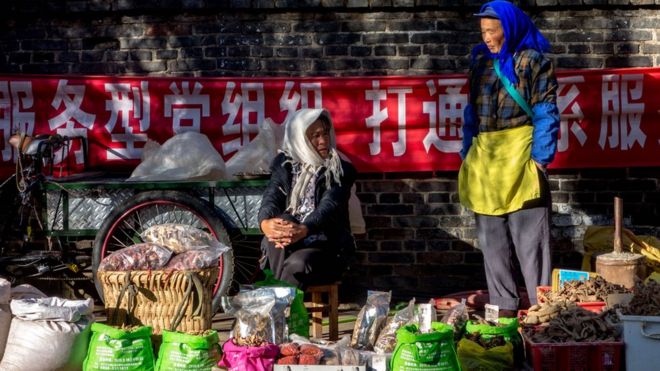
Local women sell produce in the market. Zhongyi market, located at the southern gate of Dayan ancient city, in Lijian, Yunnan Province in ChinaImage copyrightGETTY IMAGES
It took China less than 70 years to emerge from isolation and become one of the world's greatest economic powers.
As the country celebrates the anniversary of the founding of the People's Republic of China, we look back on how its transformation spread unprecedented wealth - and deepened inequality - across the Asian giant.
"When the Communist Party came into control of China it was very, very poor," says DBS chief China economist Chris Leung.
"There were no trading partners, no diplomatic relationships, they were relying on self-sufficiency."
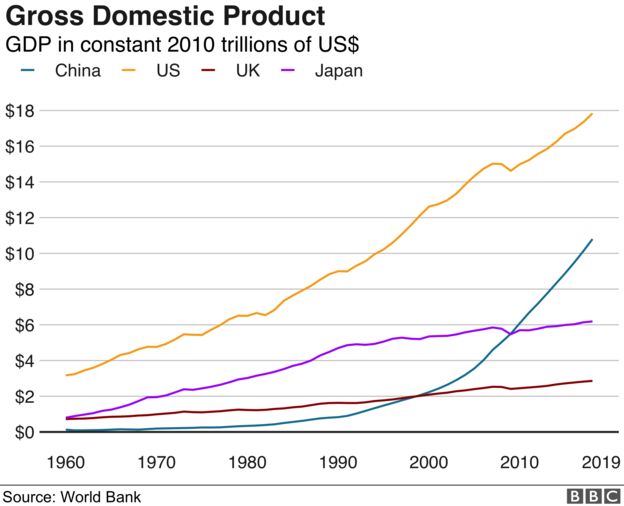
Over the past 40 years, China has introduced a series of landmark market reforms to open up trade routes and investment flows, ultimately pulling hundreds of millions of people out of poverty.
Chart showing gross domestic product of US, China, Japan and the UK
The 1950s had seen one of the biggest human disasters of the 20th Century. The Great Leap Forward was Mao Zedong's attempt to rapidly industrialise China's peasant economy, but it failed and 10-40 million people died between 1959-1961 - the most costly famine in human history.
This was followed by the economic disruption of the Cultural Revolution in the 1960s, a campaign which Mao launched to rid the Communist party of his rivals, but which ended up destroying much of the country's social fabric.

'Workshop of the world'

Yet after Mao's death in 1976, reforms spearheaded by Deng Xiaoping began to reshape the economy. Peasants were granted rights to farm their own plots, improving living standards and easing food shortages.
The door was opened to foreign investment as the US and China re-established diplomatic ties in 1979. Eager to take advantage of cheap labour and low rent costs, money poured in.
"From the end of the 1970s onwards we've seen what is easily the most impressive economic miracle of any economy in history," says David Mann, global chief economist at Standard Chartered Bank.
Through the 1990s, China began to clock rapid growth rates and joining the World Trade Organization in 2001 gave it another jolt. Trade barriers and tariffs with other countries were lowered and soon Chinese goods were everywhere.
"It became the workshop of the world," Mr Mann says.
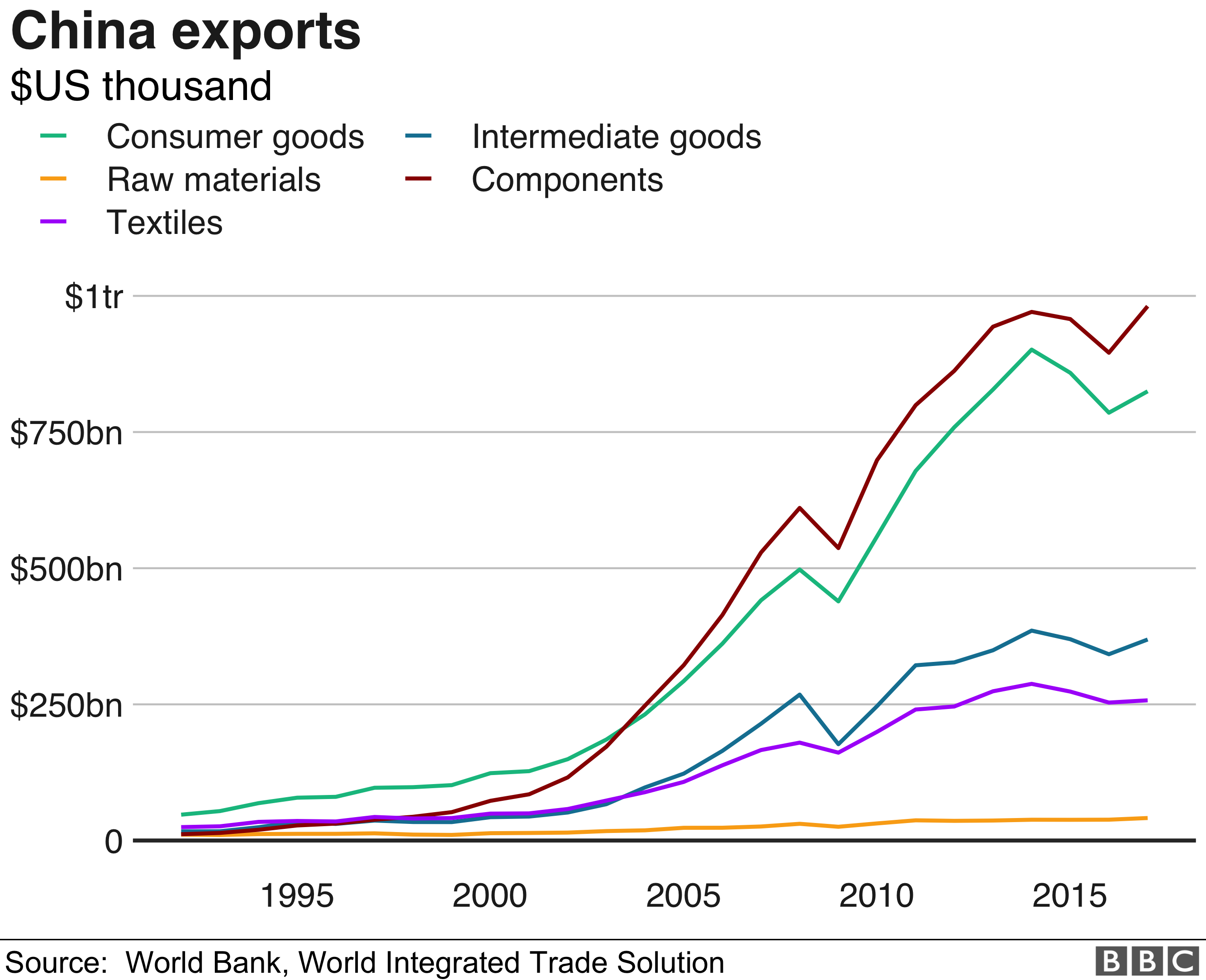
Chart showing China exports
Take these figures from the London School of Economics: in 1978, exports were $10bn (£8.1bn), less than 1% of world trade.
By 1985, they hit $25bn and a little under two decades later exports valued $4.3trn, making China the world's largest trading nation in goods.

Poverty rates tumble

The economic reforms improved the fortunes of hundreds of millions of Chinese people.
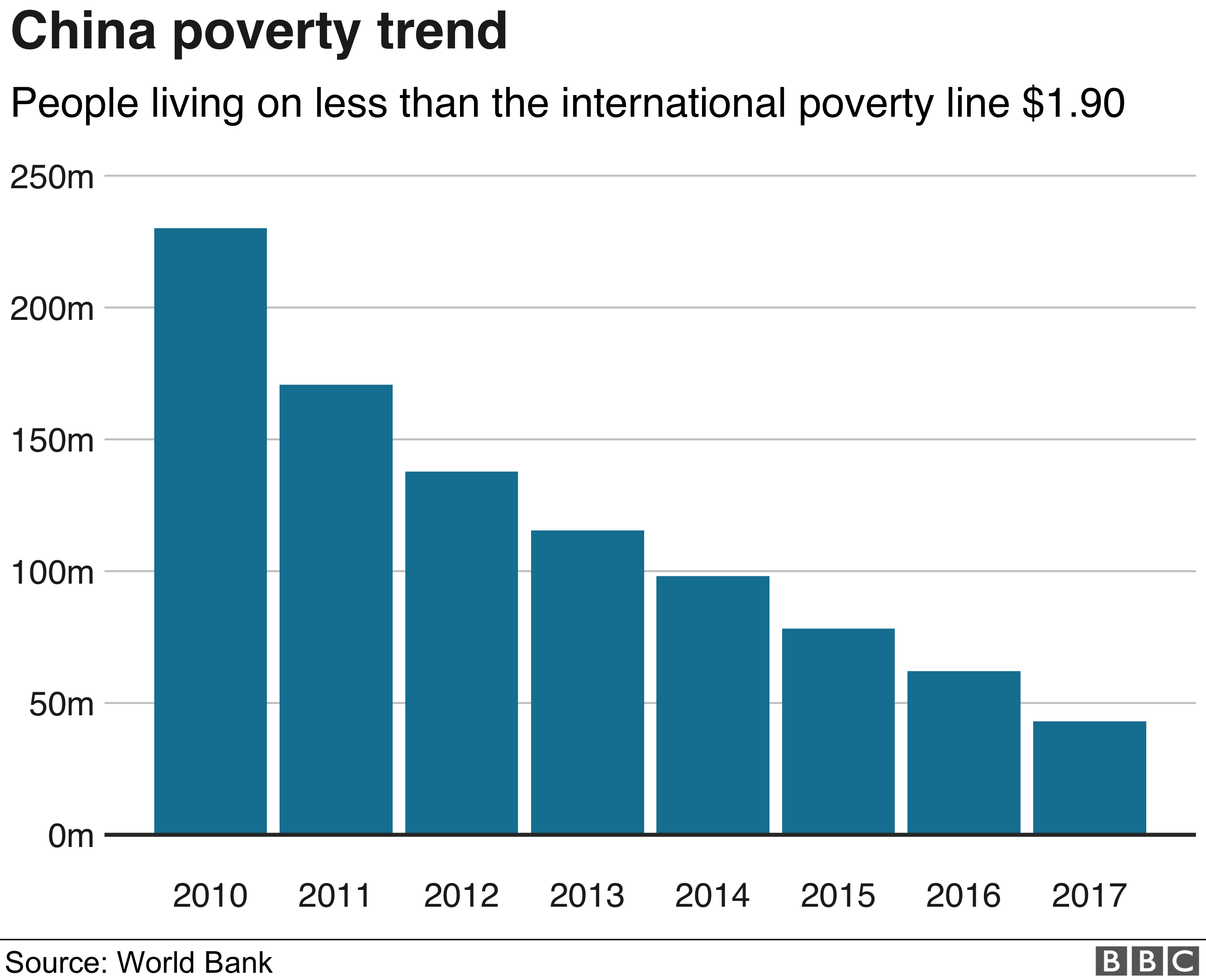
The World Bank says more than 850 million people been lifted out of poverty, and the country is on track to eliminate absolute poverty by 2020.
At the same time, education rates have surged. Standard Chartered projects that by 2030, around 27% of China's workforce will have a university education - that's about the same as Germany today.
China poverty rates

Rising inequality

Still, the fruits of economic success haven't spread evenly across China's population of 1.3 billion people.
Examples of extreme wealth and a rising middle class exist alongside poor rural communities, and a low skilled, ageing workforce. Inequality has deepened, largely along rural and urban divides.
"The entire economy is not advanced, there's huge divergences between the different parts," Mr Mann says.
The World Bank says China's income per person is still that of a developing country, and less than one quarter of the average of advanced economies.
China's average annual income is nearly $10,000, according to DBS, compared to around $62,000 in the US.
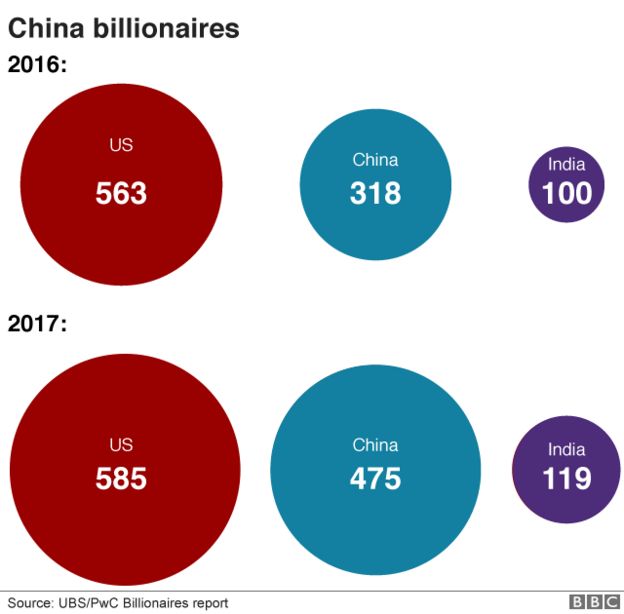
Billionaires in China, the US and India

Slower growth

Now, China is shifting to an era of slower growth.
For years it has pushed to wean its dependence off exports and toward consumption-led growth. New challenges have emerged including softer global demand for its goods and a long-running trade war with the US. The pressures of demographic shifts and an ageing population also cloud the country's economic outlook.
Still, even if the rate of growth in China eases to between 5% and 6%, the country will still be the most powerful engine of world economic growth.
"At that pace China will still be 35% of global growth, which is the biggest single contributor of any country, three times more important to global growth than the US," Mr Mann says.

The next economic frontier

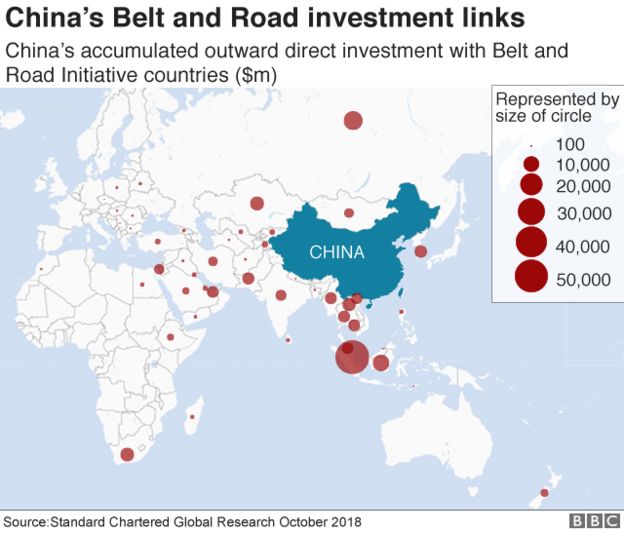
China is also carving out a new front in global economic development. The country's next chapter in nation-building is unfolding through a wave of funding in the massive global infrastructure project, the Belt and Road Initiative.
Map showing Chinese investment as part of the Belt and Road initiative
The so-called new Silk Road aims to connect almost half the world's populations and one-fifth of global GDP, setting up trade and investment links that stretch across the world.

Tuesday, October 1, 2019

Reuters News - U.S. House impeachment probe intensifies as Trump rages about inquiry

WASHINGTON (Reuters) - The U.S. House of Representatives’ impeachment probe into President Donald Trump intensified on Monday, as Trump raged about the inquiry and news reports suggested he had used additional diplomatic channels to go after his adversaries.


Three House committees said a subpoena for documents had been sent to Trump’s lawyer Rudy Giuliani. The former New York mayor had said on television he asked the government of Ukraine to “target” former Vice President Joe Biden, who is seeking the Democratic nomination to run against Trump in the 2020 election.
Giuliani said in a tweet the subpoena raised legal issues including attorney-client privilege. “It will be given appropriate consideration,” he added.
The Democratic-led House initiated an impeachment inquiry against Trump last week after a whistleblower report raised concerns that Trump tried to leverage nearly $400 million in U.S. aid in exchange for investigating Biden from Ukraine’s leader in July.
U.S. Secretary of State Mike Pompeo took part in the July 25 phone call between Trump and Ukrainian President Volodymyr Zelenskiy in which the matter was discussed, the Wall Street Journal reported, something likely to draw the attention of House investigators.
The New York Times reported that Trump had sought the help of another world leader, Prime Minister Scott Morrison of Australia, with a U.S. Justice Department probe into the origins of what became Special Counsel Robert Mueller’s investigation into Russian interference in the 2016 election.
In a recent telephone call, Trump asked Morrison to assist Attorney General William Barr with the probe, which Trump hopes will discredit Mueller’s now-closed investigation, the Times reported.
“The Democrats clearly don’t want the truth to come out anymore as it might hurt them politically, but this call relates to a DOJ inquiry publicly announced months ago to uncover exactly what happened,” White House spokesman Hogan Gidley said in response to the Times story.
An Australian government spokesperson said in an email:
“The Australian Government has always been ready to assist and cooperate with efforts that help shed further light on the matters under investigation. The PM confirmed this readiness once again in conversation with the President.”
Barr has held private meetings overseas with foreign intelligence officials in Britain and Italy to seek their assistance as well with that investigation, the Washington Post reported.
In the Giuliani document request, the chairmen of three House committees said he had “stated more recently that you are in possession of evidence - in the form of text messages, phone records, and other communications - indicating that you were not acting alone and that other Trump Administration officials may have been involved in this scheme.”
He was given until Oct. 15 to respond.
SUPPORT FOR IMPEACHMENT RISES -POLL
A Sept. 26-30 Reuters/Ipsos opinion poll found that 45% of American adults believed Trump “should be impeached,” compared with 37% in a similar poll that ran last week. Forty-one percent said Trump should not be impeached and 15% said they “don’t know.”
Republican Senate Majority Leader Mitch McConnell appeared on Monday to put to rest speculation he would use his position to derail any impeachment effort by the Democratic-led House by avoiding a trial at all. The Republicans control the Senate and have been largely muted about the allegations and inquiries into fellow-Republican Trump.
If the House approves bringing charges, known as “articles of impeachment,” against a president, the process moves to the Senate, where there would be a trial.
“I would have no choice but to take it up,” McConnell told CNBC. “Under the Senate rules, we are required to take it up if the House does go down that path. “The Senate impeachment rules are very clear.”
Trump spent much of the day directing his ire at the Democrat leading the House inquiry, suggesting on Twitter that U.S. Representative Adam Schiff, chairman of the House Intelligence Committee, should be arrested for “treason.”
Later, speaking to reporters at the White House, Trump accused Schiff of distorting his conversation with Zelenskiy at a House hearing last week.
“Adam Schiff made up a phony call and he read it to Congress and he read it to the people of the United States and it’s a disgrace,” Trump said.
In those comments, Schiff said the call to Zelenskiy “reads like a classic organized crime shakedown” and parodied the president’s remarks.
A spokesman for Schiff did not respond to a request for comment on Trump’s remarks.

TRUMP SEEKS WHISTLEBLOWER’S IDENTITY

A U.S. intelligence official filed a whistleblower complaint citing the July 25 telephone call in which Trump asked Zelenskiy to investigate Biden and his son Hunter, who sat on the board of a Ukrainian gas company.
The whistleblower has not been publicly identified, but Trump said on Monday that “we’re trying to find out about a whistleblower. We have a whistleblower who reports things that were incorrect.”
Trump has also accused the whistleblower and White House officials who gave the whistleblower information of being spies and suggested they may be guilty of treason.
“The Intel Community Whistleblower is entitled to anonymity,” Andrew Bakaj, an attorney for the whistleblower, said on Twitter shortly after the president’s remarks. “Law and policy support this and the individual is not to be retaliated against. Doing so is a violation of federal law.”
Democrats on the Senate Judiciary Committee on Monday called on the committee’s Republican chairman, Lindsey Graham, a close ally of Trump, to convene hearings to investigate the administration’s handling of the whistleblower’s complaint, and said the panel should act to “protect witnesses from intimidation.”
“This Committee should not sit idly by as the President threatens potential witnesses, whose testimony may be crucial to congressional investigations into credible allegations against him,” the Democrats wrote in a letter to Graham.
House Speaker Nancy Pelosi has said she wants to move “expeditiously” on the impeachment inquiry, perhaps paving the way for an impeachment vote on the House floor early next year.
While McConnell said on Monday that he would be forced to hold a trial, he did not commit to letting it run its full course.
“How long you’re on it is a whole different matter,” McConnell told CNBC.
According to a Senate Republican leadership aide, any senator could attempt to have the articles dismissed in the early stages of the trial, which would trigger a vote with a majority of the Senate needing to be in favor for it to succeed.
Democrats accuse Trump of pressuring a vulnerable U.S. ally to get dirt on a rival for personal political gain. The phone call with Zelenskiy came after Trump froze nearly $400 million in aid intended to help Ukraine deal with an insurgency by Russian-backed separatists in the eastern part of the country. The aid was later provided.
Schiff said on Sunday he expected the whistleblower to appear before the panel very soon.

MOVING AHEAD

The U.S. Congress is on a two-week recess but members of the Intelligence Committee will return to Washington this week to carry out an investigation likely to produce new subpoenas for documents and other material.
The committee is scheduled to hold a closed-door hearing on Friday with the intelligence community’s inspector general, Michael Atkinson, who has concluded that the whistleblower complaint was of urgent concern and appeared credible.
House investigators are set to take the first witness testimony from two people mentioned in the whistleblower’s complaint.
On Wednesday, three House committees - Intelligence, Foreign Affairs and Oversight - are due to get a deposition from former U.S. Ambassador to Ukraine Marie Yovanovitch, whom Trump labeled “bad news” during his call with Zelenskiy.
On Thursday, the committees are set to get a deposition from Kurt Volker, who resigned last week as Trump’s special representative for Ukraine after the whistleblower complaint named him as one of two U.S. diplomats who followed up with Ukrainian officials a day after Trump’s call to Zelenskiy.
Reporting by David Morgan and Roberta Rampton and Patricia Zengerle; Additional reporting by Makini Brice and Doina Chiacu; Writing by James Oliphant; Editing by Grant McCool and Peter Cooney