Monday, December 16, 2019

BBC News - Three key economic questions for Boris Johnson

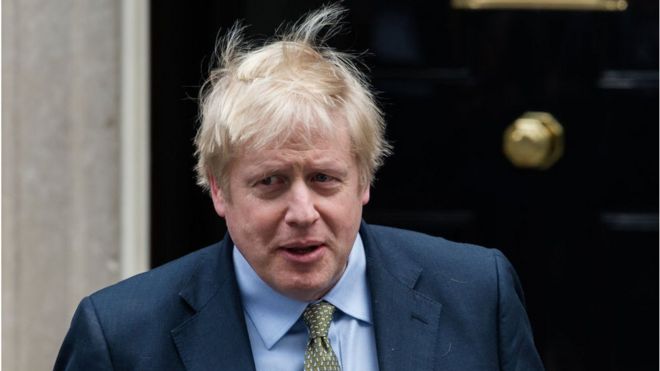
Boris JohnsonImage copyrightGETTY IMAGES
Prime Minister Boris Johnson has won a decisive majority, that will last the full five-year term, on the back of a fairly thin list of detailed economic promises.
But he now has the power to complete the Brexit process, pass budgets, and, if he chooses, start to address long term challenges that require tough up-front decisions.
But the fact that his chancellor can now safely mint the 50p coin for Brexit Day - 31 January - does not detract from some very difficult issues in the economic in-tray.
I've identified three economic issues that the PM will now have to address: the trading relationship with the EU, trade with the US, and keeping his new electorate happy.

1. The trading relationship with the EU

The most fundamental decision for the PM, after the UK legally leaves the European Union next month, is where to land our relationship with our biggest trade partner.
The public backing for his renegotiated deal creates the room to go for a straightforward Canada-style free trade agreement, detached from European regulation and standards.
That will mean trade frictions, such as checks on goods trade, across the Channel with Europe and within the UK across the Irish Sea.
If the UK does not sign up to "level playing field" arrangements on worker rights, the environment, and tax, it might also mean some trade taxes, known as tariffs, payable at the border.
This has a clear downside for advanced manufacturers dependent on seamless trade and supply of parts.
If this is the aim, and indeed if the PM continues to argue that the UK might leave the implementation phase without a trade deal at the end of next year, substantial uncertainty might still hang over the economy, affecting investment.
The new government is under significant pressure from industry to immediately rule out a World Trade Organisation terms exit in December 2020, so that stalled investment in, for example, car factories can indeed be "unleashed" as the PM has put it.
His manifesto did promise not to "extend the implementation period", which is a one-to-two year option in the Brexit deal.
But some fudge may be available here, if required. He also promised that manufacturing supply chains would be "protected".
And here is the rub. What does the PM actually want?
If he defines Brexit as "done" by the end of January, does his new coalition of voters care about how far from the EU the UK ends up?
The further the distance, the bigger the risk of immediate economic dislocation, but the more the freedom to do deals elsewhere.
Into this mix walked President Trump, with a congratulatory tweet to his friend the Prime Minister.

2. Trade with the US

A "massive new trade deal" that could be "far bigger and more lucrative than any deal that could be made with the EU" rather sounds like an invitation to contemplate rejecting a close deal with the EU in order to strike a quick one with the US.
The PM in the campaign vowed that the NHS and the prices it paid for pharmaceuticals were off the table in any US discussion, and that he would be willing to walk away from a US negotiation too, raising questions about what exactly would be negotiated.
The economic models contradict the assertion that a US deal would be more lucrative. But the PM has enough votes to ignore the modelling.
Indeed pursuing a full-blooded trade deal with President Trump, who would like to brandish progress ahead of his own elections next year, may be seen as a way to get the best possible offer out of the EU.
This is a vitally important new reality in this parliament.
It will decide the trade-off between economic alignment with the EU and the US.
Changing Britain's trade stance is a process that will create winners and losers up and down the country.

3. Making sure his economic policies keep his new voters onside

And yet, the UK parliamentary system does not lend itself to local MPs aggressively representing regional or sectoral interests, as occurs in the US Congress, for example. The PM has a majority to push through almost whatever he wants.
And this is the other fascinating consequence of this political earthquake.
The Conservatives' political DNA has changed. It now owes its majority to former mining towns, manufacturing centres, and towns considered victims of deindustrialisation.
Votes were won not just on Brexit promises, but on commitments to investment in health, in infrastructure, and in investment.
They will have to be delivered too. There is no more long grass left to kick the social care crisis into. That somehow needs to be reconciled with not putting up taxes, or VAT, lowering business rates, and not requiring anyone to have to sell their homes.
If he is to make tough decisions on this, on Brexit, and on trade, he needs to move quickly.

Friday, December 13, 2019

Reuters News - Futures up on trade deal hopes; tariff deadline closes in

(Reuters) - U.S. stock index futures rose on Friday on hopes that the United States and China could reach an initial deal to end their trade war after Washington set its terms for an agreement, just days before fresh levies on Chinese goods kick in.
The United States has offered to suspend some tariffs on Chinese goods and cut others in exchange for Beijing’s buying more American farm goods, U.S. sources said, although there has been no official announcement on the deal from either side.
China, however, has remained silent, raising questions over whether the two countries can agree to a truce before a new round of tit-for-tat tariffs takes effect on Sunday.
Still, a positive tone on trade so far helped Wall Street’s main indexes touch record levels on Thursday, while futures also hit all-time highs earlier in the session on Friday.
Three interest rate cuts this year by the U.S. Federal Reserve, along with better-than-expected corporate earnings, have pushed the S&P 500 index .SPX up more than 26% so far in 2019, putting it on track for its best annual performance in six years.
Shares of chipmakers that are heavily exposed to China for revenues were up in premarket trading. Micron Technology Inc (MU.O), Advanced Micro Devices Inc (AMD.O) and Nvidia Corp (NVDA.O) rose 1%.
Apple Inc (AAPL.O), often considered sensitive to news around trade, also edged up 0.5%.
At 7:04 a.m. ET, Dow e-minis 1YMcv1 were up 122 points, or 0.43%. S&P 500 e-minis EScv1 were up 11.75 points, or 0.37% and Nasdaq 100 e-minis NQcv1 were up 41.75 points, or 0.49%.
Data at 8:30 a.m. ET from the U.S. Commerce Department is expected to show retail sales rose 0.5% last month, after having gained 0.3% in October.
Adobe Inc (ADBE.O) rose 3% after the company beat analysts’ estimates for fourth-quarter revenue and profit.
Oracle Corp (ORCL.N) slipped 2.2% as the company fell short of quarterly revenue estimates.
Reporting by Shreyashi Sanyal in Bengaluru; Editing by Anil D'Silva

Thursday, December 12, 2019

BBC News - Brexit: Free trade deals 'won't offset leaving EU'

Post-Brexit trade deals will not make up for the economic damage inflicted on the UK from leaving the EU, analysis for BBC Newsnight has suggested.
Independent trade experts from the UK Trade Policy Observatory (UKTPO) looked at the likely impact of US, Australian and New Zealand free trade deals.
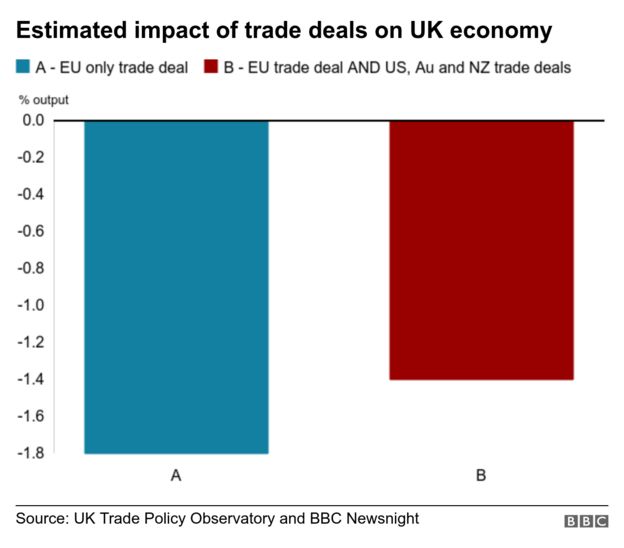
They found that even combined, new tariff-cutting agreements were likely to boost the UK economy by just 0.4%.
A simple free trade deal would also depress the economy UKTPO said.
The body said that moving from full EU membership to a simple deal with our closest trading partner - the objective enshrined in Boris Johnson's Withdrawal Agreement - would depress the size of the economy by at least 1.8%.
A Conservative spokesperson said: "The prime minister's fantastic deal makes clear that we will have a future relationship based on free trade and friendly cooperation. By striking trade deals around the world we will create exciting new opportunities for British businesses."
The Conservative manifesto claims free trade is the "best way" to increase exports, cut prices and increase investment.
The upshot from this analysis is that there is no realistic prospect of new trade deals with other countries, even the "ambitious" deals touted by ministers, offsetting the economic hit from Brexit itself.
Moving to an EU free trade deal and striking new free trade agreements with the US, Australia and New Zealand has an estimated negative impact on the UK economy of 1.4% in the UKTPO results - equivalent to £28bn, or £1,000 per household.
graph
Presentational white space
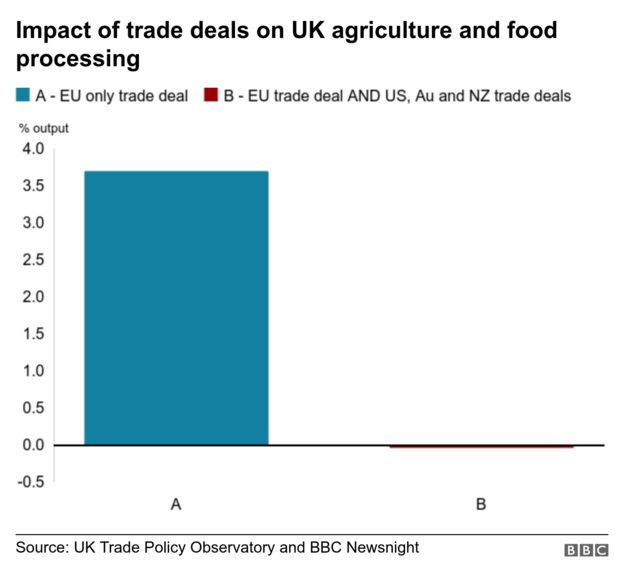
The results from the UKTPO, which is based at the University of Sussex, show that moving to a free trade deal with the EU is beneficial overall for the UK agriculture and food processing sector, due to reduced competition from Continental farmers.
But that benefit is wiped out if US, Australian and New Zealand trade deals slash import tariffs and quotas, resulting in a surge of agricultural imports.
Mr Johnson, in a Commons statement presenting his Brexit Withdrawal Agreement deal on 19 October, stated: "For the first time in almost five decades the UK will be able to strike free trade deals with our friends across the world to benefit the whole country - including Northern Ireland."
But Newsnight understands that internal UK government impact assessments show that, in fact, only the South East will benefit from US, Australian and New Zealand trade deals, and that the rest of the country will see negative consequences
Northern Ireland is, sources say, particularly badly affected due to its agriculture industry being severely hit.
The UKTPO used what is known as a partial equilibrium trade model to look at the likely impact on 148 individual UK industrial sectors of slashing tariff and non-tariff barriers.
graph
Presentational white space
Prof Michael Gasiorek led the modelling project for UKTPO. He was unsurprised by the results.
"It's arithmetic," he said. "Tariffs on many goods are already quite low or zero so there are no great gains from lowering them.
"Also relative to how much we trade with the EU, we do much less with the US, Australia and New Zealand, so the overall impact on output is not massive.
"It certainly doesn't offset the negative impact of leaving the EU. Further, agreeing on the removal of regulatory barriers will be difficult - as the EU had found in its negotiations with the US."
The UKTPO results are in line with the findings of a Treasury modelling exercise in 2018, which estimated the benefit of any new trade deals would only be between 0.1 and 0.2% of GDP - a benefit dwarfed by the negative impact of leaving the EU's single market and customs union.
Newsnight understands the Department for International Trade has now completed fresh impact assessments of US, Australian and New Zealand trade deals, which show results similar to the UKTPO findings, but that these are not due to be published until after Brexit and ahead of the publication of mandates for trade negotiators.

Wednesday, December 11, 2019

BBC News - Investors rush to pull millions from UK property funds

Stock image of an officeImage copyrightGETTY IMAGES
Investors shaken by the suspension of withdrawals from a leading UK property fund pulled nearly £100m from similar investments in the subsequent two days.
M&G froze withdrawals from its property portfolio fund on Wednesday, after it was unable to sell assets fast enough to meet investors' demands for money.
It prompted the biggest day of outflows from other UK property funds of the year on Thursday, according to funds transaction network Calastone.
The flight continued on Friday.
Investors' response was described as "understandable", but those whose money remains in these funds were reminded that property should always be considered as a long-term investment.
Withdrawals of £61m on Thursday and £36m on Friday, revealed by the Calastone data, came after a tough year for the sector. M&G blamed its temporary suspension - a decision taken by its official monitor - on "Brexit-related political uncertainty" and difficulties among retailers.
The M&G Property Portfolio has invested in 91 UK commercial properties - including shopping centres, and other retail and industrial properties - on behalf of UK investors.
Some investors have consistently wanted to cash out from many of the UK property funds during the year. Figures from financial data business Morningstar shows net outflows in all but one month - May - so far this year, in contrast to similar funds in the EU.
Ramsgate high streetImage copyrightGETTY IMAGES
Commentators said M&G was particularly exposed owing to a lack of liquidity and a greater concentration on retail property.
However, when it last announced a temporary suspension in November 2016, following the UK's referendum on EU membership, other property funds followed suit. Investors may be concerned that history will repeat itself, but they have been warned against creating such a scenario with their actions.
Edward Glyn, head of global markets at Calastone, said: "Fears of further fund suspensions have spooked investors in property funds.
"Investor reaction is understandable though counterproductive as it may result in a self-fulfilling prophecy. Investors should be mindful that property is a long-term investment, and buildings are not ATMs dispensing cash.
"If you think you need rapid access to your savings, there are may be other, more suitable savings products you should consider first."

Significant sector

Billions of pounds of UK investors' money is tied up in property funds. M&G was one of the biggest - with a value of £2.5bn, although this had fallen by £1.1bn so far this year before withdrawals were temporarily suspended.
The level of investment is dwarfed by equity and fixed income funds, for example, but remains a significant area of interest for both armchair investors and institutional investors such as pension funds.
Analysts have mixed views on the immediate future, with some expecting other funds to freeze withdrawals. Prudential has already done so with its property fund, although this is linked to M&G's fund. A temporary suspension, analysts say, can be healthy, to allow some stability and prevent the need to sell assets quickly for well under their real value.
Other analysts suggest that the specific set of circumstances faced by M&G meant others would not need to follow suit.
Some of the other funds have said that they have prepared a cash buffer owing to the current uncertainty in the market.
M&G has waived 30% of its annual charge to investors unable to access their money.

Tuesday, December 10, 2019

Reuters News - Drowning in uncertainty: Trade questions slow investment, squeeze profits across U.S.

WASHINGTON (Reuters) - From a denim plant in rural Georgia to a St. Paul, Minneapolis loudspeaker maker, nagging uncertainty over when President Donald Trump’s trade wars might end, if ever, is confounding many U.S. manufacturers.
A strong consumer base is keeping the U.S. economy humming, but businesses are struggling to make crucial investment and hiring decisions given questions about relations with each of the top 10 U.S. trading partners.
This month alone, Trump announced higher tariffs on U.S. imports of steel and aluminum from Argentina and Brazil here; threatened 100% tariffs on $2.4 billion of French cheese, Champagne and other goods here; and vowed to further hike tariffs on other European Union products over aircraft subsidies here
Meanwhile, progress on talks to resolve the 17-month trade dispute with China remains illusive and a trade deal signed with Mexico and Canada is still awaiting ratification by the U.S. Congress.
“We are drowning in uncertainty. This guessing game is chilling investment, putting hiring plans on hold, and sowing sourcing chaos throughout our industry,” said Steve Lamar, executive vice president of the American Apparel & Footwear Association, whose members have been hit especially hard by tariffs on Chinese imports.
Trump has said China would pay for the higher tariffs. But a study by the New York Federal Reserve found that Americans are feeling most of the pain. Tariffs Hurt the Heartland, a campaign grouping more than 150 trade groups that oppose tariffs, said U.S. consumers and businesses have paid an extra $42 billion due to the tariffs since the trade war began.
Just ask Win Cramer, president of privately held JLab Audio.
The San Diego-based maker of Bluetooth headphones has paid out millions of dollars in tariffs since September to keep consumers from bearing the cost, Cramer said. Now, Trump's recent threat to impose even higher tariffs here "scares the hell out of me."
“The uncertainty makes it nearly impossible to make mid- to long-term business decisions,” he said. “We have to make really short-term decisions almost week by week by week, because that’s how quickly it’s changing.”
JLab, which builds 100% of its products in China, is now investing more in expanding its sales and marketing operations in Europe than in the United States because the climate there is more stable.
Cramer visited factories in Vietnam in October, but found the infrastructure and capacity insufficient to ensure production of the 65,000 pieces of equipment per day he needs.
“The scale we need doesn’t exist,” he said. It would take five to seven years to set up outside of China fabrication of the silicon chip sets needed for JLab’s air buds and headsets, the second-best selling in the world behind Apple’s Air pods.

UNCLEAR WHERE TARIFFS WILL HIT NEXT

Phil Marfuggi, president of Ambriola, a U.S.-based unit of Italian cheesemaker Auricchio SpA based in West Caldwell, New Jersey, said he has put off spending $1.5 million for two cheese-cutting and wrapping machines because it’s unclear how long tariffs on Italian cheese will last and whether they could go higher.
“It’s all speculative. You really can’t invest in your future,” he said. He had paid over $350,000 in tariffs on five recent Italian cheese shipments, money that he cannot easily recoup.
Marfuggi is also holding off adding imported Italian pasta to his lineup, since it may be zapped next under Trump’s “carousel” approach to tariffs.
For now, he has slashed marketing and sponsorship outlays by 30% to 40% to offset higher tariffs that have cut revenues by 25% to 30%.

R&D SPENDING DOWN

MISCO President Dan Digre said his Minnesota-based company, an audio equipment maker with 100 employees, has paid hundreds of thousands of dollars in tariffs on Chinese parts since September 2018, instead of using the money to launch a new line of higher-end speakers that would be built in the United States.
“It’s probably set us back by two years,” said Digre, who has retained U.S. production long after other rivals moved to Asia. The new line was expected to boost sales and generate 20 more jobs at the plant.
“It just seems wrong. We’re not creating anything new. We’re spending all this time and money trying to deal with a problem that’s more or less self-inflicted,” he said.
Business spending in the United States declined for the second straight quarter in the July through September period as the trade war eroded confidence. Factory activity contracted for a fourth consecutive month in November as new orders slid, and U.S. factory executives predict here capital expenditures will drop 2.1% in 2020 vs. 2019.
The labor market has remained resilient, however, in part due to companies’ reluctance to let go of workers.
Digre, whose father started the company 70 years ago after serving in World War Two as a B-17 gunner, has tried to stave off any job cuts. “That’s the last resort, so you cut in other areas, like innovation and R&D.”

“STRAIGHT UP WASTE OF TIME”

On the East Coast, Jeff Greenstein, president of Boston-based Delta Cycle, a privately owned maker of bike racks, padded seats and other accessories, said he has cut his marketing budget by a quarter.
“Our sales are probably lower than they would have been, our margins are squeezed and we’re definitely spending less on advertising,” Greenstein said.
One of the biggest problems for Delta, which has annual revenues of $5 million to $10 million, is that tariffs keep changing, often with short notice.
The tariff increases have cascaded through the 35-year-old business, forcing time-consuming and complex changes to the pricing schedule and negotiations with customers and suppliers about how to split the extra costs.
“For a company of our size to have five or six pricing changes in a year is a straight up waste of time,” he said.

FABRIC OF AMERICA

For Mount Vernon Mills, a South Carolina-based manufacturer of apparel fabrics, uncertainty about congressional passage of a new U.S.-Mexico-Canada trade deal has raised questions about investments in new automation equipment.
The private company, founded in 1847, produces 75 million yards of denim and other fabrics each year, much of it in the rural towns of Trion and Alto, Georgia. Most is shipped to Mexico to be sewn into jeans and other apparel, which is then shipped back for sale to American consumers.
There have been some signs of progress on the USMCA trade deal. Mexican President Andres Manuel Lopez Obrador said this week the country’s senators had accepted proposed changes to the pact, perhaps smoothing the way toward ratification by U.S. lawmakers. That’s good news for the companies that make jeans, and the people who wear them.
Scott Deitz, vice president of Greensboro, North Carolina-based Kontoor Brands (KTB.N), one of MVM’s biggest customers, said the price of the Wrangler and Lee jeans it produces in Mexico could rise by $10 to $15 if Trump makes good his threat to cancel the current North American Free Trade Agreement if Congress fails to pass the replacement accord.
MVM President David Hastings said the yearlong stalemate has stalled investment by his customers and could fuel interest in shifting production from Latin America to Asia and elsewhere, a move that would pose huge challenges for his firm.
“It’s important for Congress to adopt this agreement so that these companies have the incentive to continue to invest in this hemisphere,” he said. “We’re worried. We’re the last major denim manufacturer in the United States.”
Reporting by Andrea Shalal; Editing by Dan Burns and Andrea Ricci

Monday, December 9, 2019

BBC News - China exports fall again as US trade war continues

Men stand on a port in ChinaImage copyrightGETTY IMAGES
China's exports fell in November as shipments to the US slowed sharply, adding to concerns about the effects of the two nations' trade war.
November exports from the world's second largest economy fell 1.1% from a year earlier, the fourth straight fall.
Exports to the US were down 23%, the worst such result since February and the twelfth monthly decline in a row.
Another round of US tariffs on Chinese goods is due next Sunday, as part of the ongoing trade dispute.
On Friday, White House economic adviser Larry Kudlow said the 15 December deadline - to impose a new round of tariffs on some $156bn of Chinese exports - remained in place.
Beijing and Washington are negotiating a potential deal aimed at de-escalating their trade dispute but so far have failed to agree on details.
Economists say that even if negotiations aimed at avoiding the new American duties are successful, many US buyers will have already found alternative suppliers.
US President Donald Trump said on Thursday that trade talks are "moving right along".
But China says existing tariffs must be scrapped as part of any interim deal.
The 17-month-long trade war has increased the risks of a global recession. China's policymakers may seek more stimulus measures after growth in the economy cooled to near 30-year lows.
Meanwhile, China's imports unexpectedly rose 0.3% in November from a year earlier, marking the first year-on-year growth since April.
China's trade surplus with the rest of the world fell, but was still more than $38bn for the month.

Friday, December 6, 2019

Reuters News - France says U.S. proposal on international tax reform unacceptable

PARIS (Reuters) - France rejects a U.S. proposal this week that would let companies opt out of a proposed international tax reform, Finance Minister Bruno Le Maire said on Friday, urging Washington to negotiate in good faith.
U.S. Treasury Secretary Steven Mnuchin raised serious questions about OECD international tax reform proposals in a letter made public on Wednesday, jarring international officials by floating the idea of a “safe harbor regime”.
Le Maire said that would mean U.S. companies could opt in or out as they pleased, which he said would be unacceptable to France and other OECD countries.
He urged Washington therefore to negotiate on the basis that the new tax rules be binding, and said if the efforts at the OECD fell through EU countries should revive talks for a European digital tax.
Reporting by Leigh Thomas; Editing by Catherine Evans