Thursday, March 12, 2020

Reuters News - Special Report: Italy and South Korea virus outbreaks reveal disparity in deaths and tactics

MILAN/SEOUL (Reuters) - In Italy, millions are locked down and more than 1,000 people have died from the coronavirus. In South Korea, hit by the disease at about the same time, only a few thousand are quarantined and 67 people have died. As the virus courses through the world, the story of two outbreaks illustrates a coming problem for countries now grappling with an explosion in cases.
It’s impractical to test every potential patient, but unless the authorities can find a way to see how widespread infection is, their best answer is lockdown.
Italy started out testing widely, then narrowed the focus so that now, the authorities don’t have to process hundreds of thousands of tests. But there’s a trade-off: They can’t see what’s coming and are trying to curb the movements of the country’s entire population of 60 million people to contain the disease. Even Pope Francis, who has a cold and delivered his Sunday blessing over the internet from inside the Vatican, said he felt “caged in the library.”
Thousands of miles away in South Korea, authorities have a different response to a similar-sized outbreak. They are testing hundreds of thousands of people for infections and tracking potential carriers like detectives, using cell phone and satellite technology.
Both countries saw their first cases of the disease called COVID-19 in late January. South Korea has since reported 67 deaths out of nearly 8,000 confirmed cases, after testing more than 222,000 people. In contrast, Italy has had 1,016 deaths and identified more than 15,000 cases after carrying out more than 73,000 tests on an unspecified number of people.
Epidemiologists say it is not possible to compare the numbers directly. But some say the dramatically different outcomes point to an important insight: Aggressive and sustained testing is a powerful tool for fighting the virus.
Jeremy Konyndyk, a senior policy fellow at the Center for Global Development in Washington, said extensive testing can give countries a better picture of the extent of an outbreak. When testing in a country is limited, he said, the authorities have to take bolder actions to limit movement of people.
“I’m uncomfortable with enforced lockdown-type movement restrictions,” he said. “China did that, but China is able to do that. China has a population that will comply with that.”
The democracies of Italy and South Korea are useful case studies for countries such as America, which have had problems setting up testing systems and are weeks behind on the infection curve. So far, in Japan and the United States particularly, the full scale of the problem is not yet visible. Germany has not experienced significant testing constraints, but Chancellor Angela Merkel warned her people on Wednesday that since 60% to 70% of the populace is likely to be infected, the only option is containment.
South Korea, which has a slightly smaller population than Italy at about 50 million people, has around 29,000 people in self-quarantine. It has imposed lockdowns on some facilities and at least one apartment complex hit hardest by outbreaks. But so far no entire regions have been cut off.
Seoul says it is building on lessons learned from an outbreak of Middle East Respiratory Syndrome (MERS) in 2015 and working to make as much information available as possible to the public. It has embarked on a massive testing program, including people who have very mild illness, or perhaps don’t even have symptoms, but who may be able to infect others.
This includes enforcing a law that grants the government wide authority to access data: CCTV footage, GPS tracking data from phones and cars, credit card transactions, immigration entry information, and other personal details of people confirmed to have an infectious disease. The authorities can then make some of this public, so anyone who may have been exposed can get themselves - or their friends and family members - tested.
In addition to helping work out who to test, South Korea’s data-driven system helps hospitals manage their pipeline of cases. People found positive are placed in self-quarantine and monitored remotely through a smartphone app, or checked regularly in telephone calls, until a hospital bed becomes available. When a bed is available, an ambulance picks the person up and takes the patient to a hospital with air-sealed isolation rooms. All of this, including hospitalization, is free of charge.
South Korea’s response is not perfect. While more than 209,000 people have tested negative there, results are still pending on about 18,000 others - an information gap that means there are likely more cases in the pipeline. The rate of newly confirmed cases has dropped since a peak in mid-February, but the system’s greatest test may still be ahead as authorities try to track and contain new clusters. South Korea does not have enough protective masks - it has started rationing them - and it is trying to hire more trained staff to process tests and map cases.
And the approach comes at the cost of some privacy. South Korea’s system is an intrusive mandatory measure that depends on people surrendering what, for many in Europe and America, would be a fundamental right of privacy. Unlike China and the island-state of Singapore, which have used similar methods, South Korea is a large democracy with a population that is quick to protest policies it does not like.
“Disclosing information about patients always comes with privacy infringement issues,” said Choi Jaewook, a preventive medicine professor at Korea University and a senior official at the Korean Medical Association. Disclosures “should be strictly limited” to patients’ movements, and “it shouldn’t be about their age, their sex, or their employers.”
Traditional responses such as locking down affected areas and isolating patients can be only modestly effective, and may cause problems in open societies, says South Korea’s Deputy Minister for Health and Welfare Kim Gang-lip. In South Korea’s experience, he told reporters on Monday, lockdowns mean people participate less in tracing contacts they may have had. “Such an approach,” he said, “is close-minded, coercive, and inflexible.”

ITALY “AT THE LIMIT”

Italy and South Korea are more than 5,000 miles apart, but there are several similarities when it comes to coronavirus. Both countries’ main outbreaks were initially clustered in smaller cities or towns, rather than in a major metropolis - which meant the disease quickly threatened local health services. And both involved doctors who decided to ignore testing guidelines.
Italy’s epidemic kicked off last month. A local man with flu symptoms was diagnosed after he had told medical staff he had not been to China and discharged himself, said Massimo Lombardo, head of local hospital services in Lodi.
The diagnosis was only made after the 38-year-old, whose name has only been given as Mattia, returned to the hospital. Testing guidelines at the time said it was not necessary to test people who had no link to China or other affected areas. But an anaesthetist pushed the protocols and decided to go ahead and test for COVID-19 anyway, Lombardo said. Now, some experts in Italy believe Mattia may have been infected through Germany, rather than China.
Decisions about testing hinge partly on what can be done with people who test positive, at a time when the healthcare system is already under stress. In Italy at first, regional authorities tested widely and counted all positive results in the published total, even if people did not have symptoms.
Then, a few days after the patient known as Mattia was found to have COVID-19, Italy changed tack, only testing and announcing cases of people with symptoms. The authorities said this was the most effective use of resources: The risk of contagion seemed lower from patients with no symptoms, and limited tests help produce reliable results more quickly. The approach carried risks: People with no symptoms still can be infected and spread the virus.
On the other hand, the more you test the more you find, so testing in large numbers can put hospital systems under strain, said Massimo Antonelli, director of intensive care at the Fondazione Policlinico Universitario Agostino Gemelli IRCCS in Rome. Testing involves elaborate medical processes and follow-up. “The problem is actively searching for cases,” he said. “It means simply the numbers are big.”
Italy has a generally efficient health system, according to international studies. Its universal healthcare receives funding below the European Union average but is comparable with South Korea’s, at 8.9% of GDP against 7.3% in South Korea, according to the World Health Organization.
Now, that system has been knocked off balance. Staff are being brought into accident and emergency departments, holidays have been canceled and doctors say they are delaying non-urgent operations to free up intensive care beds.
Pier Luigi Viale, head of the infectious disease unit at Sant’ Orsola-Malpighi hospital in Bologna, is working around the clock - in three jobs. His hospital is handling multiple coronavirus cases. His doctors are shuttling to other hospitals and clinics in the area to lend their expertise and help out with cases. In addition, his doctors also have to deal with patients with other contagious diseases who are struggling to survive.
“If it drags on for weeks or months we’ll need more reinforcements,” he told Reuters.
Last week, the mayor of Castiglione d’Adda, a town of about 5,000 people in Lombardy’s “red zone” which was the first to be locked down, made an urgent online appeal for help. He said his small town had had to close its hospital and was left with one doctor to treat more than 100 coronavirus patients. Three of the town’s four doctors were sick or in self quarantine.
“Doctors and nurses are at the limit,” said a nurse from the hospital where Mattia was taken in. “If you have to manage people under artificial respiration you have to be watching them constantly, you can’t look after the new cases that come in.”
Studies so far suggest that every positive case of coronavirus can infect two other people, so local authorities in Lombardy have warned that the region’s hospitals face a serious crisis if the spread continues - not just for COVID-19 patients but also for others whose treatment has been delayed or disrupted. As the crisis spreads into Italy’s less prosperous south, the problems will be magnified.
Intensive care facilities face the most intense pressure. They require specialist staff and expensive equipment and are not set up for mass epidemics. In total, Italy has around 5,000 intensive care beds. In the winter months, some of these are already occupied by patients with respiratory problems. Lombardy and Veneto have just over 1,800 intensive care beds between public and private systems, only some of which can be set aside for COVID-19 patients.
The government has asked regional authorities to increase the number of intensive care places by 50% and to double the number of beds for respiratory and contagious diseases, while reorganizing staff rosters to ensure adequate staffing. Some 5,000 respirators have been acquired for intensive care stations, the first of which are due to arrive on Friday, deputy Economy Minister Laura Castelli said.
The region has already asked nursing institutes to allow students to bring forward their graduation to get more nurses into the system early. Pools of intensive care specialists and anaesthetists are to be set up, including staff from outside the worst affected regions.
To add to the burden, hospitals in Italy depend on medical personnel to try to trace the contacts that people who test positive have had with others. One doctor in Bologna, who asked not to be named, said he had spent a 12-hour day tracing people who had been in contact with just one positive patient, to ensure those who next need testing are found.
“You can do that if the number of cases remains two to three,” the doctor said. “But if they grow, something has to give. The system will implode if we continue to test everyone actively and then have to do all this.”

“MAXIMUM POWER”

In South Korea as in Italy, an early case of COVID-19 was identified when a medical officer followed their intuition, rather than the official guidelines, on testing.
The country’s first case was a 35-year-old Chinese woman who tested positive on Jan. 20. But the largest outbreak was detected after the 31st patient, a 61-year-old woman from South Korea’s southeastern city of Daegu, was diagnosed on Feb. 18.
Like the patient named Mattia in Italy, the woman had no known links to Wuhan, the Chinese province where the disease was first identified. And as in Italy, the doctors’ decision to recommend a test went against guidelines at the time to test people who had been to China or been in contact with a confirmed case, said Korea Medical Association’s Choi Jaewook.
“Patient 31,” as she became known, was a member of a secretive church which Deputy Minister for Health and Welfare Kim Gang-lip said has since linked to 61% of cases. Infections spread beyond the congregation after the funeral of a relative of the church’s founder was held at a nearby hospital, and there were several other smaller clusters around the country.
Once the church cluster was identified, South Korea opened around 50 drive-through testing facilities around the country.
In empty parking lots, medical staff in protective clothing lean into cars to check their passengers for fever or breathing difficulties, and if needed, collect samples. The process usually takes about 10 minutes, and people usually receive the results in a text reminding them to wash their hands regularly and wear face masks.
A total of 117 institutions in South Korea have equipment to conduct the tests, according to the Korea Centers for Disease Control and Prevention (KCDC). The numbers fluctuate daily, but an average of 12,000 is possible, and maximum capacity is 20,000 tests a day. The government pays for tests of people with symptoms, if referred by a doctor. Otherwise, people who want to be tested can pay up to 170,000 won ($140), said an official at a company called Seegene Inc, which supplies 80% of the country’s kits and says it can test 96 samples at once.
There are also 130 quarantine officers like Kim Jeong-hwan, who focus on minute details to track potential patients. The 28-year-old public health doctor spends his whole working days remotely checking up on people who have tested positive for COVID-19, the disease caused by the virus.
Kim, who is doing military service, is one of a small army of quarantine officers who track the movements of any potential carriers of the disease by phone, app or the signals sent by cell phones or the black boxes in automobiles. Their goal: To trace all the contacts people may have had, so they too can be tested.
“I haven’t seen anyone telling bad lies,” Kim said. “But lots of people generally don’t remember exactly what they did.”
Underlining their determination, quarantine officers told Reuters they located five cases after a worker in a small town caught the virus and went to work in a “coin karaoke,” a bar where a machine lets people sing a few songs for a dollar. At first, the woman, who was showing symptoms, did not tell the officers where she worked, local officials told Reuters. But they put the puzzle together after questioning her acquaintances and obtaining GPS locations on her mobile device.
“Now, quarantine officers have maximum power and authority,” said Kim Jun-geun, an official at Changnyeong County who collects information from quarantine officers.
South Korea’s government also uses location data to customize mass messages sent to cellphones, notifying every resident when and where a nearby case is confirmed.
Lee Hee-young, a preventative medicine expert who is also running the coronavirus response team in South Korea’s Gyeonggi province, said South Korea has gone some of the way after MERS to increase its infrastructure to respond to infectious diseases. But she said only 30% of the changes the country needs have happened. For instance, she said, maintaining a trained workforce and up-to-date infrastructure at smaller hospitals isn’t easy.
“Until we fix this,” Lee said, “explosions like this can keep blowing up anywhere.”
Reporting by Emilio Parodi, Stephen Jewkes, Angelo Amante, Sangmi Cha and Ju-min Park; Additional reporting by James Mackenzie in Milan and Josh Smith in Seoul, Julie Steenhuysen in New York; Edited by Sara Ledwith and Jason Szep

BBC News - Coronavirus: FTSE 100, Dow, S&P 500 in worst day since 1987

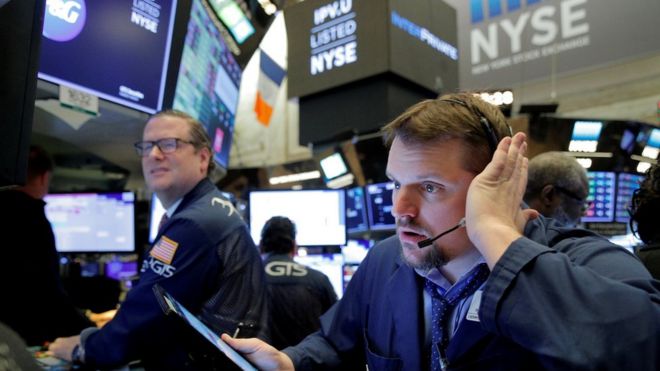
NYSE tradersImage copyrightREUTERS
Shares around the world have plunged as investors fear the spread of the coronavirus will destroy economic growth with government action insufficient to arrest the decline.
The main UK index dropped more than 10% in its worst day since 1987.
In the US, the Dow and S&P 500 were also hit by their steepest daily falls since 1987.
The declines came despite actions by the Federal Reserve and European Central Bank to ease financial strains.
At the start of US trading, plummeting shares triggered an unusual automatic suspension in trading for the second time this week.
When trade resumed 15 minutes later, shares continued to fall, taking cues from the slide in European markets.
The S&P 500 fell 9.5% and the Nasdaq ended 9.4% lower, while losses on the UK's FTSE 100 wiped some £160.4bn off the market. In France and Germany, indexes cratered more than 12%.
"Markets are at a breaking point," said Neil Wilson, chief market analyst at Markets.com. "No one knows what a total economic shutdown, however temporary, looks like."
The declines came after the US restricted travel from mainland Europe.
Losses on European indexes accelerated after the eurozone's central bank failed to cut interest rates, although it did pledge fresh stimulus measures.
The New York branch of the Federal Reserve said it was pumping $1.5tr to ease strains in the debt markets, offering increased overnight loans to banks and expanding the kinds of assets it will buy to keep firms lending.
The announcement, which came after European markets had closed, briefly sent shares higher, but they dropped back by the end of the day.
Rate cuts by the US central bank last week and the Bank of England on Wednesday also did little to soothe investors.
"What we really need is some huge confidence that this isn't going to cause the kind of stress and horrible loss of life [it has] in Italy everywhere else in the world," said former Goldman Sachs chief economist Lord Jim O'Neill.
Stocks in Asia also saw big falls earlier, with Japan's benchmark Nikkei 225 index closing 4.4% lower.
Panicked selling led to trading halts in Brazil, while not a single company in the FTSE 100 index gained on Thursday.
Travel companies saw some of the biggest falls, driven by US President Donald Trump's 30-day ban on travellers from mainland Europe.
Shares in Delta Air Lines and United Airlines - among the most affected by the ban - dropped more than 20%. In the UK, airline group IAG was down more than 15% and Tui fell 17%.
Other companies warning on the impact of Covid-19 on Thursday included:
  • BT Group announced that chief executive Philip Jansen had tested positive for coronavirus. It said he had "relatively mild" symptoms and would work remotely
  • Broadcom said uncertainty about demand was prompting it to withdraw its 2020 growth forecast
  • Norwegian said it would ground 40% of its long-haul fleet and cancel up to 25% of its short-haul flights until the end of May
  • WH Smith issued a profit warning after the outbreak hit sales in its travel division, which includes store at airports and train stations
  • Cineworld shares fell by more than 20%. It said that in a worst-case scenario, there was a risk it might not be able to repay its debts
  • Estate agent Savills said the outbreak had caused a big drop in transactions in China and across Asia
  • Princess Cruises, a line owned by Carnival, said it would suspend operations for 60 days. Viking announced a similar move
  • Disney closed its California parks until the end of March
Oil prices also fell, with Brent crude down more than 8% at about $33 a barrel.
On the floor of the New York Stock Exchange, tensions were high. Some traders were speculating the tumbles could trigger a second trading suspension - something that has never happened, not even during the financial crisis.
Since the start of the market turmoil, indexes in the US and elsewhere have fallen more than 20% from their recent highs - a threshold that is a red flag for a recession.
"It looks increasingly likely that the coming contraction will be deeper and more protracted than we were anticipating just a few days ago," said Jay Bryson, acting chief economist at Wells Fargo. "The airline and hotel industries are in free fall, and there will be multiplier effects."
Investors in the US are now watching the US government response.
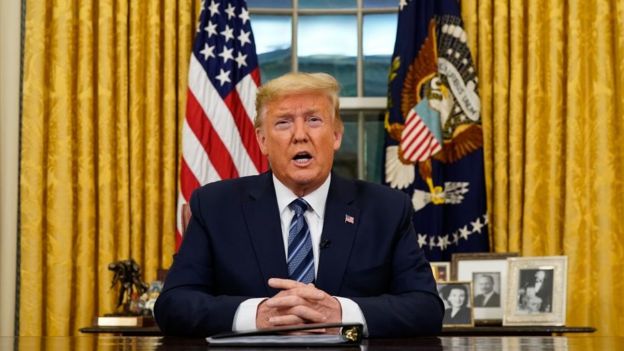
US President Donald TrumpImage copyrightAFP VIA GETTY IMAGES
Image captionUS President Donald Trump said new, temporary travel restrictions would not apply to the UK
In a presidential address on Wednesday, Mr Trump said he would extend deadlines for tax payments for those affected, increase low-cost loans to small businesses and provide financial relief for US workers who are ill, quarantined or caring for others due to the illness.
But Republicans and Democrats in Congress appear at odds over additional steps while Mr Trump's favoured approach - a tax cut for workers - has failed to garner widespread support.
"The stock market at least is saying it's not been enough yet," said Liz Ann Sonders, chief investment strategist at Charles Schwab.
Presentational grey line

Why should I care if stock markets fall?

Many people's initial reaction to "the markets" is that they are not directly affected, because they do not invest money.
Yet there are millions of people with a pension - either private or through work - who will see their savings (in what is known as a defined contribution pension) invested by pension schemes. The value of their savings pot is influenced by the performance of these investments.
So big rises or falls can affect your pension, but the advice is to remember that pension savings, like any investments, are usually a long-term bet.
Analysis box by Dominic O'Connell, business correspondent
The Western world's three largest central banks have now pitted their collective firepower against the economic chill caused by the coronavirus - to little effect.
Stock markets continue to slide. The FTSE 100 has had its worst day since Black Monday in October 1987.
Observers again might wonder what new information is spooking investors, given that central banks have in the last 10 days done their best to halt the slide. In truth, there is little new - most traders already knew that the virus is likely to cause significant economic disruption likely to push most Western economies into recession.
What may have spooked them again is President Donald Trump's decision to stop most travel between continental Europe and the United States - a big enough factor in itself, but more importantly, the manner in which it was done. There was no consultation, and Mr Trump looked uncharacteristically uncertain, as if he, too, had finally been panicked by the virus.
There is also a small, but telling detail - Mr Trump first said the ban would apply to cargo flights, but then corrected himself to say it would not. A big proportion of cargo, however, is carried in the belly holds of passenger aircraft. If there are no passenger flights, there will be much less cargo, an enormous disruption to exporters and manufacturers on both sides of the Atlantic.

Wednesday, March 4, 2020

Reuters News - Fossil fuels for power at turning point as renewables surged in 2019: data

TOKYO (Reuters) - The use of fossil fuels such as coal and oil for generating electricity fell in 2019 in the United States, the European Union and India, at the same time overall power output rose, a turning point for the global energy mix.
Those countries and regions are three of the top four largest producers of power from fossil fuels. The declines suggest the end of the fossil fuel era could be on the horizon, said Tomas Kaberger, an energy professor at Chalmers University of Technology in Sweden, who provided the power generation data to Reuters.
Kaberger, who is also the chair of the executive board for Japan’s Renewable Energy Institute and a member of the board at Swedish utility Vattenfall AB, provided data covering more than 70% of the world’s power generation that showed for most of 2019 the amount of power sourced from fossil fuels dropped by 156 terawatt hours (TWh) from the year before. That is equal to the entire power output of Argentina in 2018.
The data also indicates that renewable power generation increased at a faster rate than the overall growth in power output for the first time, rising by 297 TWh versus 233 TWh for overall output, Kaberger said.
“It is economics driving this as low-cost renewable electricity outcompetes against fossil and nuclear power plants,” said Kaberger.
With electric vehicle usage surging and their batteries being increasingly recharged by renewable electricity supplies the decline of fossil fuels is likely to accelerate, he said.
“New renewables are even cheaper than oil per unit of energy electricity generated and even fuels produced from electricity will outcompete against fossil fuels at increasing speed in transport, heating and industry,” he said.
“Peak oil demand is close,” Kaberger said.
Kaberger relied on data from official sources such as the International Energy Agency and the U.S. Energy Information Administration that covered China, India, the EU, the U.S., Japan and the rest of the Organization for Economic Co-operation and Development (OECD), or around 75% of global electricity output. The data for Japan and the OECD members outside of the EU and the U.S. were only through to November.
China, the world’s biggest power producer, was the exception to the decline, with power produced by fossil fuels rising by 120 TWh in 2019, though renewables outpaced that with an increase of 157 TWh, the data showed.
Fossil fuel power generation last declined in 2009 after the global financial crisis, at the same time that overall global electricity output fell, according to BP’s Statistical Review of World Energy. That year was the first time overall power output dropped since BP began publishing the review in 1985.
The shift from fossil fuels, especially coal, has been driven by countries trying to implement their commitments under the Paris Agreement on climate change and reduce pollution.
In the U.S., power companies closed down 15.3 gigawatts of coal capacity last year as renewables surged, while in India electricity generation from coal fell in 2019 for the first time in a decade.
The contribution of nuclear to the global power mix rose last year by 91 TWh as Japan restarted more reactors following the shutdown of sites after the 2011 Fukushima nuclear crisis, the data showed.
Reporting by Aaron Sheldrick; Editing by Christian Schmollinger

Tuesday, March 3, 2020

BBC News - Brexit: UK vows to seek 'hard bargain' in US trade talks

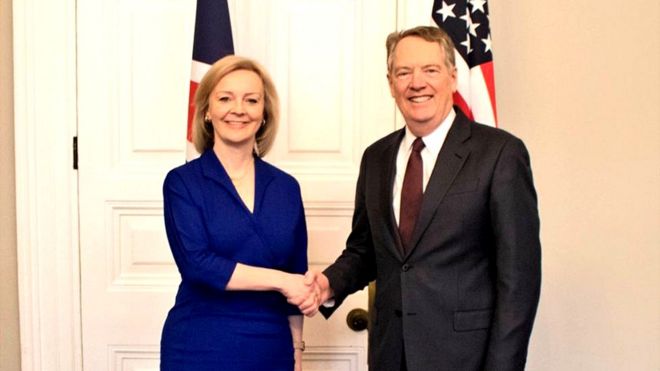
Photograph of Liz Truss shaking hands with US trade representative Robert LighthizerImage copyright@TRUSSLIZ/TWITTER
Image captionInternational Trade Secretary Liz Truss welcomed US trade representative Robert Lighthizer to London last week
Boris Johnson has promised to "drive a hard bargain" as he set out the UK's negotiating position for a post-Brexit free trade deal with the US.
The government said a deal would boost the UK economy by £3.4bn and particularly benefit Scotland, England's north-east and the Midlands.
It pledged to maintain food standards and said the NHS would not be for sale.
Meanwhile, talks between the UK and EU aimed at reaching a trade agreement formally kick off in Brussels later.
The talks on a free trade agreement with the US are expected to begin later this month.
The discussions will take place in both the UK and US and be overseen by the government's chief negotiation adviser Crawford Falconer - formerly New Zealand's chief negotiator and ambassador to the World Trade Organization.

'Salmon for Stetsons'

A government statement said manufacturers of ceramics, cars, food and drink would be "the biggest winners" from a deal, along with the professional services, including architects and lawyers.
"We're going to drive a hard bargain to boost British industry," said Mr Johnson.
"Trading Scottish smoked salmon for Stetson hats, we will deliver lower prices and more choice for our shoppers."
In what appears to be a bid to push back against accusations made by Labour during the election that the health service would be up for sale under the Conservatives, the government also said any future deal "must protect our NHS".
International Trade Secretary Liz Truss told BBC Breakfast: "We will not diminish our food safety standards and we will also not put the NHS on the table, or the price the NHS pays for drugs on the table."
"Those are two very clear red lines in our trade deal."
Turning to the EU trade talks, Ms Truss attempted to address concerns over fishing rights - the EU is demanding continued access to British waters, while the UK wants quota deals like the EU has with Norway or Iceland.
Ms Truss told BBC Breakfast: "We are not going to trade away our fishing in a deal with the EU or any other negotiating partner.
"We are going to get a deal with the EU that does not involve selling out our fishing."
Confederation of British Industry director general Carolyn Fairbairn said it was "encouraging to see the government's ambitions to make it easier for skilled people to move between the UK and US" and "support small business exporters".
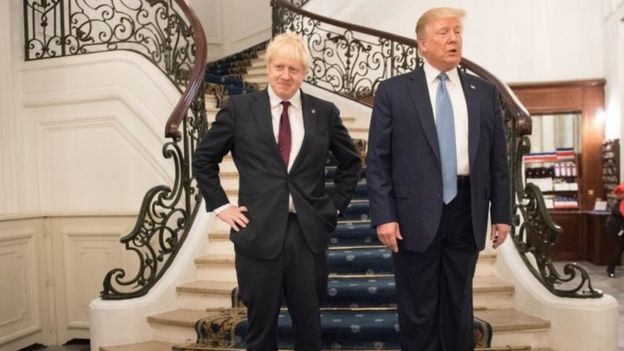
Boris Johnson and Donald TrumpImage copyrightGETTY IMAGES
Image captionBoris Johnson and Donald Trump met at a G7 summit in France in August
But Frances O'Grady, general secretary of the Trades Union Congress, said: "The government should be focused on getting a good trade deal with the EU - not cosying up to Donald Trump."
She said a bad trade deal with the US would "put working people's jobs and rights on the line... and it will undermine our vital public services, environment and food standards".
Ms O'Grady referred to fears from farming leaders that an agreement could see the import of food that would be illegal to produce in the UK, such as chlorinated chicken.
According to recent media reports, the EU will demand that the UK maintains a ban on washing chicken in chlorine and other disinfectants as the price for a trade agreement with the bloc. But the US has expressed frustration at the ban, arguing that it is not based on scientific evidence.
Shadow international trade secretary Barry Gardiner accused the government of making "false promises" over commitments to protect the NHS and consumer standards, adding "there must be a full and proper scrutiny process for this and all trade agreements".

Round one

The US is the UK's largest trading partner after the EU, accounting for nearly 19% of all exports in 2018 and 11% of imports. The EU accounted for 45% of all exports and 53% of imports.
On Monday, a hundred British negotiators will travel to Brussels to start talks on a trade deal with the EU.
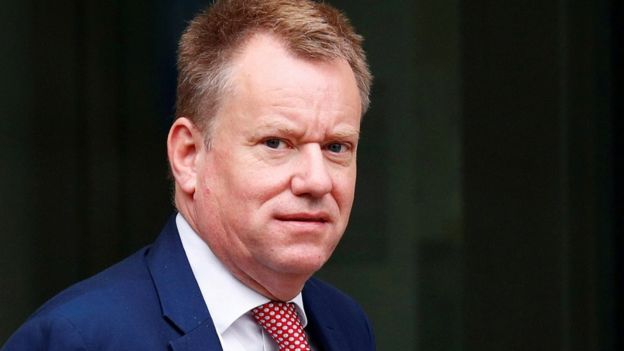
The four days of discussions will be led by David Frost on the UK side and Michel Barnier for the EU, and there will be up to 11 different groups discussing different aspects of the deal.
David FrostImage copyrightREUTERS
Image captionDavid Frost will lead the UK's negotiations in Brussels
Potential flashpoints could include the UK's wish to diverge from EU employment and environmental standards in future, its ruling out of any role for the European Court of Justice, and the level of EU access to UK fishing waters.
The UK has signalled that it could walk away from trade talks in June unless there is a "broad outline" of a deal.
French Europe Minister Amelie De Montchalin told the BBC that the EU was prepared to abort a post-Brexit deal if European fishermen were denied access to British waters.
Details of what will be discussed and when have been published, with topics to be covered in the first round of negotiations including trade in goods and services, transport, energy, fisheries and "fair and open competition" in future dealings.
Further rounds of negotiations will take place every two to three weeks, alternating between London and Brussels.
Liberal Democrat acting leader Sir Ed Davey has called on the prime minister to pause trade talks with the EU and extend the Brexit transition period in order to focus on dealing with the coronavirus.
Presentational grey line
Analysis box by Katya Adler, Europe editor
Even trade buffs admit their area of expertise can be pretty dry and detail-heavy.
And it would certainly suit the government if we all looked the other way during these negotiations because trade deals generally include trade-offs. On both sides.
Neither Boris Johnson, nor his predecessor, Theresa May, have been wholly transparent about this with the UK public.
So surely it is of interest to those who voted for Brexit, to keep a keen eye on whether the benefits they've been led to believe will be coming the UK's way for farmers, fishermen and slashing immigration numbers, will now materialise in the way they'd imagined.
And what do both sides - the EU and Boris Johnson's government - want from a trade deal? Very different things.

Monday, March 2, 2020

Reuters News - U.S. bank lobby economist predicts global rate cut coming ... this Wednesday

WASHINGTON (Reuters) - Investors battered by the breathtaking drop in global stock markets on coronavirus fears are ever more convinced the world’s big central banks, including the Federal Reserve, will soon step in to try to quell the storm.
Against that, the top economist for the U.S. bank lobby - a former Fed insider - issued a remarkably specific prediction on Sunday that the rescue is nigh.
In a blog titled "Don't keep your powder dry" here, Bill Nelson, chief economist at the Bank Policy Institute who worked on the Fed's responses to the 2007-2008 financial crisis, predicted:** A coordinated global interest rate cut by the top central banks, such as the one executed at the height of the crisis in October 2008 by the Fed and five other central banks. They will possibly include in this action the People's Bank of China and the Hong Kong Monetory Authority, the two banks whose economies have so far suffered most from the outbreak
** It will happen this Wednesday, March 4. Nelson noted that the previous big coordinated actions in December 2007, October 2008 and November 2011 all occurred on a Wednesday.
** It will happen before the U.S. stock market opens, either 7 a.m. or 8 a.m. ET (1200 or 1300 GMT).
** It will be big: half a percentage point at least. The Fed’s current benchmark lending rate is set in a range of 1.50-1.75%, and rate futures markets are pricing in a cut of at least a quarter percentage point at the Fed’s next scheduled meeting March 17-18. “The only way to get a positive market reaction is to deliver more than expected,” he wrote.
** It will include “forward guidance” - a central bank term for some form of pledge regarding future policy action. Nelson said he would not be surprised to see something aimed at preventing a further erosion of inflation, something the Fed and other central banks have been battling for most of the past decade. His suggestion: The Fed pledges not to raise rates or take other policy tightening actions until its preferred measure of inflation is above its formal target of 2% for six months.
Alongside his predictions for a globally coordinated move - something many investors and economists worry could well fall short of what's needed because of depleted tool kits at the world's big central banks - Nelson in a related post here said the Fed could loosen a number of requirements and other regulations on U.S. banks to help keep credit moving.
Regarding the rate cut, however, Nelson does offer one big caveat: “If markets are calm Monday and Tuesday, I’m not sure what will happen.”
Reporting by Dan Burns; Editing by Daniel Wallis