Monday, May 11, 2020

Reuters News - Portugal plans new hydrogen plant in post-coronavirus 'green' future

LISBON (Reuters) - Looking to a more environmentally-friendly future after the coronavirus, Portugal is preparing a handful of multi-billion projects including a new hydrogen plant and will revive a delayed solar auction in June, a minister said.

Work to build the solar-powered hydrogen plant near the port of Sines will start within a year and could attract up to 5 billion euros ($5.43 billion) in private investment, Environment Minister Joao Matos Fernandes told Reuters.
The plant could start producing “green” hydrogen, a cleaner energy source than fossil fuels, by 2023 via electrolysis - a process using electricity to split water - and the aim is for one gigawatt by 2030, he said in the telephone interview late on Wednesday.
“The economy cannot grow along the lines of the past and our post-coronavirus vision is to create wealth from projects that reduce carbon emissions and promote energy transition and sustainable mobility,” Fernandes said.
The Dutch government and firms such as utility EDP-Energias de Portugal (EDP.LS) and oil group Galp Energia (GALP.LS) have already shown interest in the project, he added, saying the plant was one of the nation’s biggest industrial projects.
Fernandes, 52, who used to chair a water board and run a ports’ association, also said Portugal will launch its second solar energy licensing auction on June 8 after it was delayed due to the coronavirus pandemic.

SOLAR, LITHIUM PROJECTS

Spared the calamitous outbreaks of other European nations including neighbouring Spain, Portugal has suffered 973 confirmed deaths and 24,505 infections from COVID-19. It plans to gradually lift a lockdown from early May.
Initially scheduled to kick off in April, the licensing auction for 700 megawatts (MW) of new solar energy capacity would help Portugal - one of Europe’s sunniest nations - towards its ambition of 7,000 MW of renewable energy by 2030.
It will auction up to 16 potential sites for investors to build solar plants in the southern Algarve and Alentejo regions.
Final bidding is scheduled for the end of August.
Portugal’s first mega auction of 1,150 MW of solar energy capacity last June attracted mainly international players, such as Spain’s Iberdrola, France’s Akuo Energy, Britain’s Aura Power and Germany’s Enerpac Projects.
It set a record minimum price per megawatt-hour of 14.8 euros, while the average auction price was 20 euros MWh, less than half the base price.
Fernandes said the government will also launch its delayed international licensing tender for lithium exploration as soon as it approves “within some months” a new mining law to tighten environmental rules.
Without giving further details, he said the tender would cover seven lithium-rich locations dotted across the country, which is already Europe’s biggest lithium producer.
Portugal’s miners sell almost exclusively to the ceramics industry and are only now preparing to produce higher-grade lithium used in electric cars and electronic appliances.
Anti-lithium protest movements have emerged across the country, expressing concern about irreversible environmental damage such as soil pollution to destruction of the natural habitat of various endangered species.
“Whenever the local negative impacts are greater than the global gain from decarbonisation, there will be no exploitation of lithium”, Fernandes said.
Reporting by Sergio Goncalves; Editing by Catarina Demony and Andrew Cawthorne

Friday, May 8, 2020

BBC News - Bank of England warns of sharpest recession on record

The Bank of England has warned that the UK economy is heading towards its sharpest recession on record.
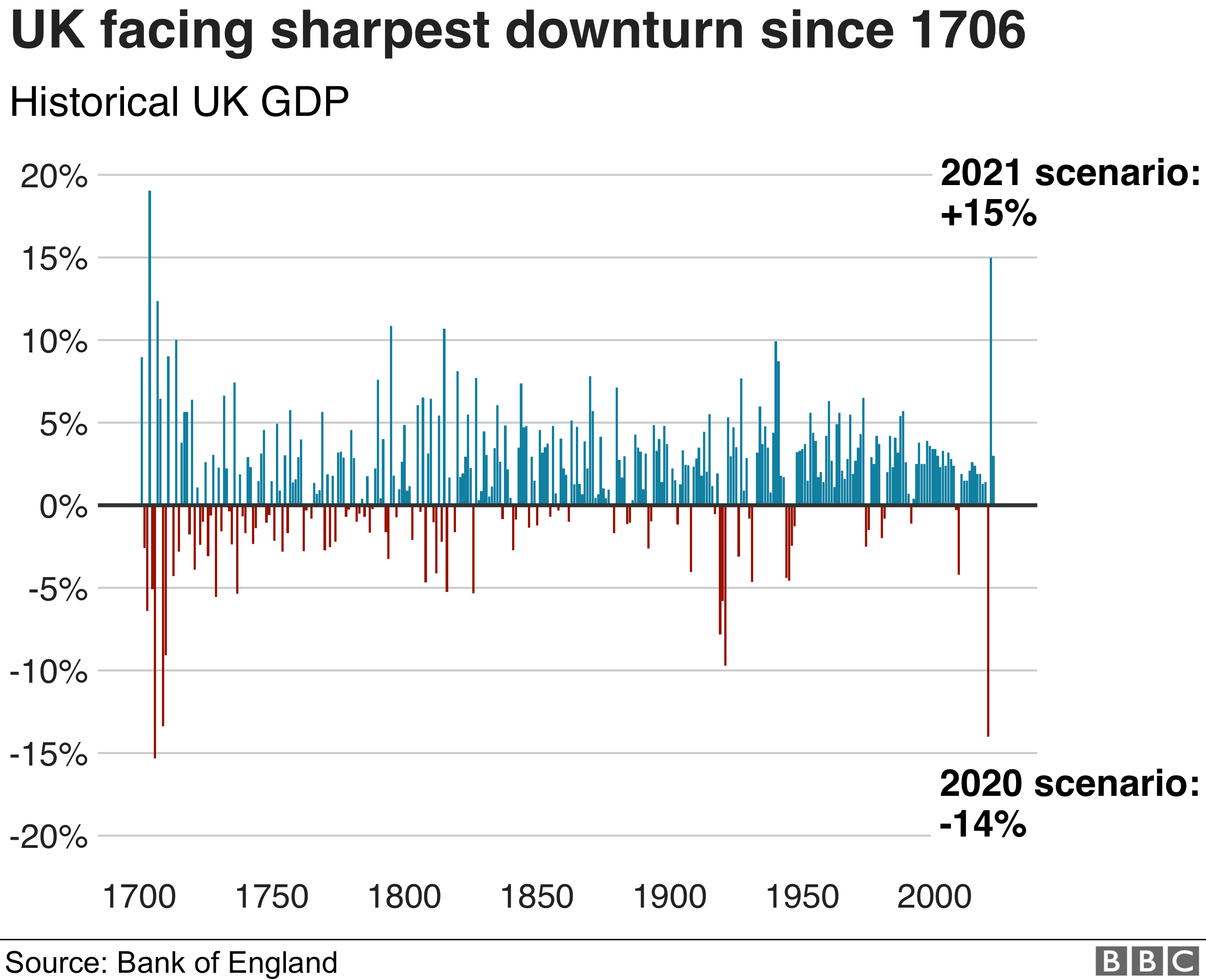
The coronavirus impact would see the economy shrink 14% this year, based on the lockdown being relaxed in June.
Scenarios drawn up by the Bank to illustrate the economic impact said Covid-19 was "dramatically reducing jobs and incomes in the UK".
Bank governor Andrew Bailey told the BBC there would be no quick return to normality.
He described the downturn as "unprecedented", and said consumers would remain cautious even when lockdown restrictions are lifted.
Mr Bailey said: "Not all of the economic activity comes back. There's quite a sharp recovery. But we've also factored that people will be cautious of their own choice.
"They don't re-engage fully, and so it's really only until next summer that activity comes fully back."
Also on Thursday, policymakers voted unanimously to keep interest rates at a record low of 0.1%. However, the Monetary Policy Committee (MPC) that sets interest rates was split on whether to inject more stimulus into the economy.
Two of its nine members voted to increase the latest round of quantitative easing by £100bn to £300bn.
The Bank's analysis, published on Thursday, was based on the assumption that social distancing measures are gradually phased out between June and September.
Its latest Monetary Policy Report showed the UK economy plunging into its first recession in more than a decade. The economy shrinks by 3% in the first quarter of 2020, followed by an unprecedented 25% decline in the three months to June.
This would push the UK into a technical recession, defined as two consecutive quarters of economic decline.
The Bank said the housing market had come to a standstill, while consumer spending had dropped by 30% in recent weeks.
UK GDP scenario on course for an unprecedented decline
For the year as a whole, the economy is expected to contract by 14%. This would be the biggest annual decline on record, according to Office for National Statistics (ONS) data dating back to 1949.
It would also be the sharpest annual contraction since 1706, according to reconstructed Bank of England data stretching back to the 18th Century.
While UK growth is expected to rebound in 2021 to 15%, the size of the economy is not expected to get back to its pre-virus peak until the middle of next year.
The Bank stressed that the outlook for the economy was "unusually uncertain" at present and would depend on how households and businesses responded to the pandemic.
It also assumes:
  • The government's jobs retention scheme covering 80% of wages is phased out with the lockdown.
  • Companies stop or scale back their operations for some time.
  • Cautious consumers voluntarily maintain social distancing until mid-2021.

'Bold action'

Mr Bailey said he expected any permanent damage from the pandemic to be "relatively small". The economy was likely to recover "much more rapidly than the pull back from the global financial crisis," he said.
He also praised the action by the government to support workers and businesses through wage subsidies, loans and grants. He said the success of these schemes and the Bank's own stimulus meant there would be "limited scarring to the economy".
"The furloughing scheme really does enable people to come back into the economy more quickly so it's a much quicker recovery that we've seen in the past."
James Smith, research director at the Resolution Foundation, said the hit to the economy this year was equivalent to £9,000 for every family in Britain.
He said: "Faced with this huge economic hit, both the Bank and the government have made the right call in taking bold action to protect firms and families as much as possible."
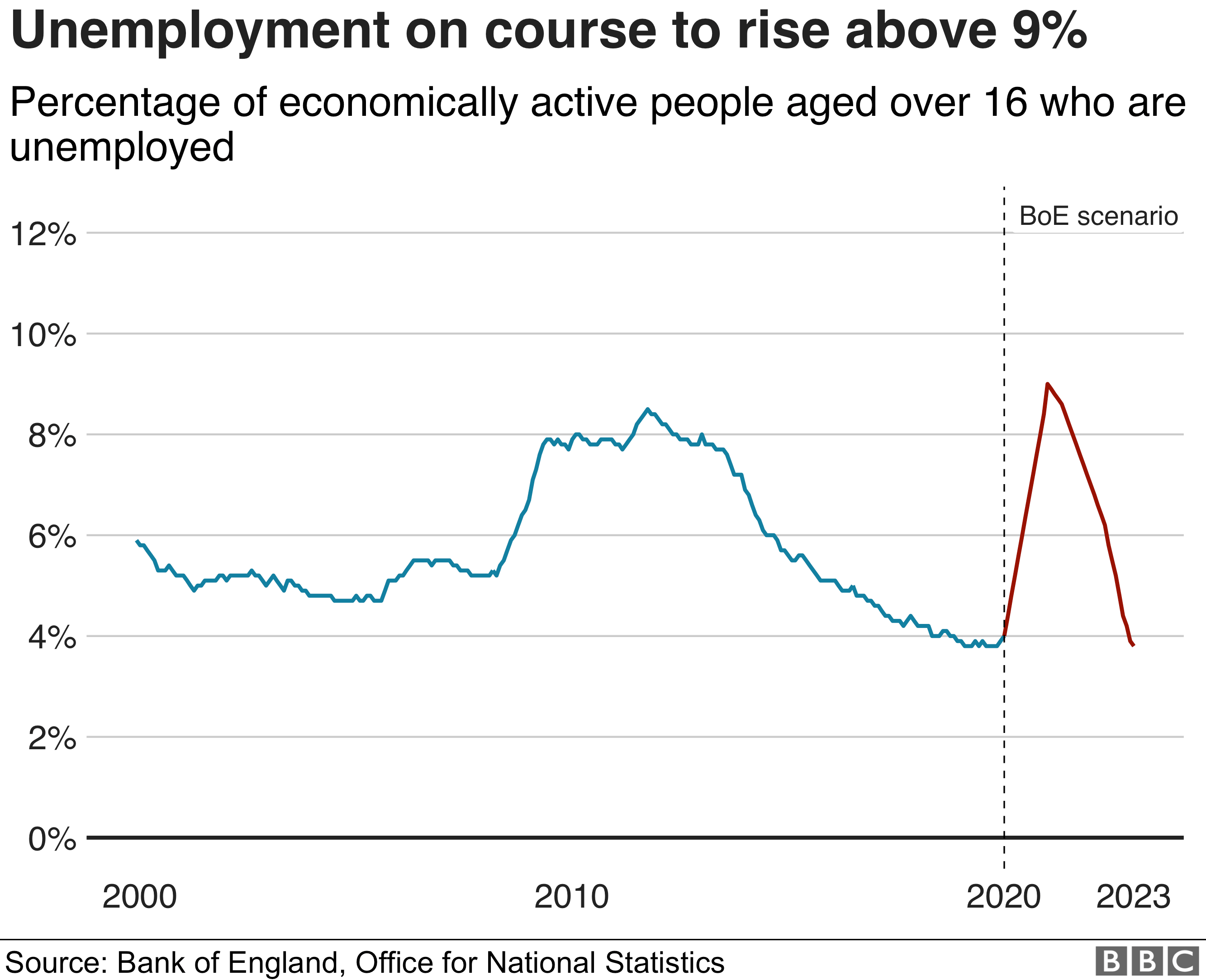
Unemployment scenario will climb above the rate seen in the financial crisis
Average weekly earnings are expected to shrink by 2% this year, reflecting the fall in wages for furloughed workers.
The Bank said sharp increases in benefit claims were "consistent with a pronounced rise in the unemployment rate", which is expected to climb above 9% this year, from the current rate of 4%.
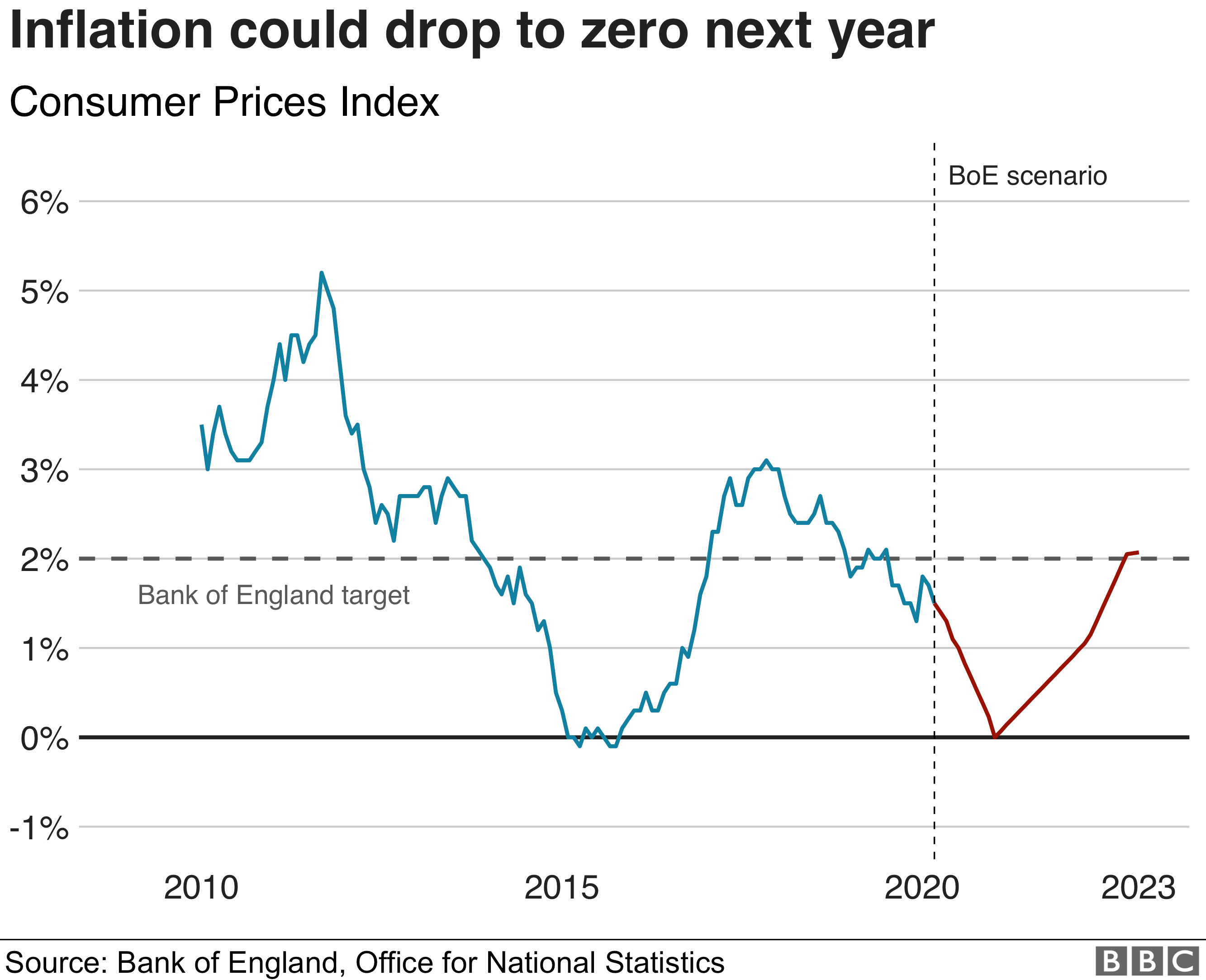
Under the Bank's scenario, inflation, as measured by the consumer prices index (CPI) falls to zero at the start of next year amid the sharp drop in energy prices.It is also expected to remain well below the Bank's 2% target for the next two years.
Inflation scenario

Cautious consumers

The Bank's latest Financial Stability Report said the Bank's scenario was consistent with a 16% drop in house prices. Latest figures published by UK finance show one in seven mortgage holders has taken a payment holiday due to the coronavirus.
The Bank said the number of new mortgage deals on offer had halved in just over a month as banks focused on the deluge of payment holiday requests. This includes a huge contraction in deals for buyers with a deposit of less than 40% of the purchase price.
The MPC also highlighted the stark drop in consumer spending. It said spending on flights, hotels, restaurants and entertainment had dropped to a fifth of their previous levels.
Shopping at High Street retailers had dropped by 80%, while business confidence was described as "severely depressed".
Philip Shaw, an economist at Investec, described the Bank's scenario as "optimistic", particularly its assumption that unemployment would fall back to its pre-crisis low in two years.
"Exactly how the economy evolves will depend critically on how the government calibrates its policies and how they are unwound and tapered," he said. "There is plenty that could go wrong."
Presentational grey line
Analysis box by Faisal Islam, economics editor
The Bank of England itself has minimal staff, but they have applied themselves to try to work out what is happening in the economy. They are not sufficiently confident that the numbers they have run, the charts that they have published, constitute what they would call a "forecast".
But they do give the clearest indication that we are in recession, after the sharpest, fastest economic contraction in the three-century history of the Bank looking at these things.
Faster than the financial crisis, and the Great Depression, and the earlier 1920s depression just before, the only things which come close.
"It is unprecedented in the recent history of this institution," Governor Andrew Bailey told me. "What it really means is that obviously the very sharp sort of downturn, a product of the situation we've been in since March, and the restrictions that are in place, affect economic activity very severely,"
A recession? "Yes," he replied.

Thursday, May 7, 2020

BBC News - Coronavirus: EU facing 'deep and uneven recession

Basque company makes rubber glovesImage copyrightGETTY IMAGES
The European Union faces a deep and uneven recession, according to a new forecast from the EU's Commission.
The bloc's executive arm predicts a recovery in 2021 but warns that the uncertainty is exceptionally high.
The Commission predicts a decline in economic activity this year of 7.5%, and slightly more than that for the eurozone.
It warns the outcome could be worse if the pandemic turns out to be longer or more severe than currently envisaged.
European and other governments are intentionally blocking economic activity to contain the virus, so a sharp downturn is inevitable.
That said, the Commission's forecasts do put some rather stark numbers on the extent of the damage the EU can expect to sustain.

'Great Depression'

The Commission describes the downturn as a recession of historic proportions. Paolo Gentiloni, the Commissioner for the Economy called it "a shock without precedent since the Great Depression".
The impact will be uneven, Mr Gentiloni said, conditioned by how quickly the lockdowns can be lifted and by the importance of services such as tourism in the national economies.
The forecasts for specific countries do indeed point to an especially severe impact in some that that are popular tourist destinations.
The deepest predicted contraction of all is for Greece. At 9.7% that would be more than the worst in single year during the financial crisis, although the country did have a succession of bad years that added up to a much larger decline than is likely in 2020.
Spain and Italy are also forecast to have declines in excess of 9%. The revisions to the forecasts for two other Mediterranean countries- Malta and Cyprus - were also relatively large.

Severe

Inevitably, such an extensive impact on economic activity will mean job losses.
The Commission says that policies such as short-time working schemes, job subsidies and support to businesses should help to limit the damage to employment, but the impact on the labour market will nonetheless be severe.
The report predicts an increase in unemployment in every EU state. That said, the predicted highs are not as bad as they were in the aftermath of the financial crisis.
The two worst for predictions for this year are unemployment rates of 19.9% for Greece and 18.9% for Spain. Those figures are annual averages so there would be peaks during the year that are significantly higher.
But those annual figures are still well below the equivalent levels, which were in the high twenties, that the two countries suffered as a result of the following the financial crisis.

Trade threat

It will be harder, the Commission says, for young people to get their first jobs.
The growth predicted for 2021 at 6.1% is less than the contraction the Commission envisages for this year. It would therefore be 2022 at the earliest when the EU economy gets back to the level of activity it experienced last year.
The report also notes that unsuccessful trade negotiations with the UK could further impede any recovery:
"The threat of tariffs [on traded goods] following the end of the transition period between the EU and United Kingdom could also dampen growth, albeit to a lesser extent in the EU than in the UK."

Wednesday, May 6, 2020

Reuters News - As central banks break the junk debt barrier, investors will follow

May 6 (Reuters)- Recent central bank bond-buying to calm market turmoil has breached the wall dividing top-grade debt from so-called junk-rated issues, raising the likelihood of the investment industry and even regulators eventually dismantling the barrier.

Central banks had until recently baulked at buying sub-investment grade debt — which is rated BB+ or lower — in their emergency programmes or accepting it as collateral, given the higher risk of default.
But with the coronavirus crisis roiling economies as well as markets, companies at the lower end of the investment-grade scale are at risk of losing those prized ratings and becoming so-called “fallen-angels”.
To prevent markets from seizing up if a slew of such ratings downgrades hits simultaneously, pushing billions of dollars of corporate debt to sub-investment grade, the Federal Reserve said last month it would take the revolutionary step of buying junk bonds, so long as they had been deemed investment grade on March 22.
That offered a lifeline to companies such as Ford (F.N), shielding it a from loss of funding after S&P cut it from BBB- to BB+ in late March. As Moody’s already assigned it a junk rating, $35 billion of the carmaker’s debt became ineligible for investment grade indexes, which are tracked by passive funds.
The Fed also said it would buy exchange-traded funds that hold high-yield debt, while the European Central Bank may also eventually adopt outright purchases of high-yield bonds. In March it included BB-/B1 rated Greek bonds in emergency asset-buying schemes and started accepting fallen angel debt as collateral last month.

A RECORD MONTH

The interventions unclogged frozen junk markets, with U.S. companies issuing more than $30 billion of new high-yield debt in April in one of the 10 busiest months on record. But longer-term ramifications are potentially bigger for a global investment industry where much capital allocation is still shaped by credit ratings.
Although some investment-grade fund managers have ventured into junk bonds since the 2008-9 financial crisis, the latest move may well turbo-charge the departure from ratings-defined investment processes, especially the cliff-edge division between high-yield and high-grade debt.
“What active managers have been doing since the financial crisis is increasing the flexibility of their mandates,” said James Vokins, head of investment-grade UK credit at Aviva Investors.
“(Central bank moves) should accelerate the momentum among active managers to go to clients and trustees for some kind of waiver on high-yield holdings so they are not forced to sell at the worst possible time.”
Reflecting the interest in investing across the ratings spectrum, fund rating firm Morningstar says it now tracks 206 European credit funds that can hold investment-grade (IG) as well as high-yield (HY), versus 180 five years ago.
Vokins said several of Aviva’s IG-only funds had the ability to hold some BB-rated credits.
“These are restrictions we asked to be slightly softened, to allow us hold the bonds a bit longer,” he said.
Legal & General Investment Management was among those going into the latest crisis with a number of funds able to hold 5%-20% in high-yield debt.
“We have seen an increasing desire for funds over the year to increase their flexibility to invest off-benchmark,” said portfolio manager Justin Onuekwusi.

RATINGS MATTER

Nonetheless, ratings assessments still carry huge clout.
Indexes reserved for top-grade bonds and the passive funds that track them have little leeway and investors such as insurers face strict regulatory constraints on holding lower-rated securities.
Agencies say they merely score borrowers’ creditworthiness based on objective criteria, with boundaries between the BBB and BB baskets usually reinforced by markets. Fitch for example notes how investors rushed to sell BBB- debt during the current crisis as market stress built, even before a downgrade.
They also say their ratings aim to guide investors on default probabilities tmsnrt.rs/3b4l1Sz -- for instance, the five-year default probability for credits on the lowest investment grade rung, BBB- is 2.8%, but 3.7% for BB+, the top junk category, according to S&P Global.
For a graphic on Default rates down the credit spectrum, click here
Reuters Graphic
Among other hurdles, flexible strategy funds usually need to hire high-yield specialists for the additional legal and covenant analysis junk bond investing requires, Morningstar analyst Mara Dobrescu said.
And “while central bank actions have improved liquidity in high-yield, over the long-term it’s unlikely they will become as liquid as investment grade,” Dobrescu added.
That means investors, especially in closely regulated sectors, are unlikely to discount credit scores altogether.
Yet central bank support could be a powerful impetus for more flexibility, especially as yields, or returns, on high-grade debt tumble further and junk markets swell — S&P Global predicts around $640 billion of European and U.S. bonds will turn fallen angel this year.
“You are going to get some people that are forced to sell these bonds. But when you have another buyer and a buyer of last resort, it does make it easier (to hold fallen angels),” said Iain Stealey, international CIO, fixed income at JPMorgan Asset Management.
“You are going to see more of a broad remit that will start looking at high-yield. Once we can see light at the end of the tunnel it will happen.”
(This story refiles to correct byline)
Reporting by Sujata Rao; additional reporting by Dhara Ranasinghe and Tommy Wilkes; graphics by Saikat Chatterjee and Ritvik Carvalho; Editing by Mike Dolan and Kirsten Donovan

Monday, May 4, 2020

BBC News - Coronavirus: Treasury rolls out small business 'bounce back' loans

MoneyImage copyrightGETTY IMAGES
Businesses will be able to apply for loans of up to £50,000 from Monday in a scheme backed by the Treasury.
The new scheme, dubbed bounce back loans, will offer smaller amounts than the existing Coronavirus Business Interruption Loan Scheme (CBILS).
But the Treasury says they will be quicker and easier to apply for and will have a 2.5% interest rate.
The form will be seven questions long and the loan is 100% guaranteed by the government.
The CBILS provide loans of up to £5m for companies with a turnover of less than £45m.
The CBIL scheme loans have come in for criticism by some businesses, especially smaller ones. Banks can often apply their usual lending criteria, which makes it harder for smaller enterprises to qualify while locked down.
On Thursday, the number of CBILs agreed was 8,638, down from more than 9,000 the previous week.
Of 52,807 loans applied for, almost 28,000 have still to be approved.
Banks have been criticised for delays in handing out loans but have blamed the heavy workload, the need to complete the necessary credit checks and a shortage of staff.
The government insists these new loans will be easier to apply for.

Who can apply?

While the loans are aimed at smaller businesses, with £2,000 to £50,000 on offer, there is no limit of business size which can apply.
Sole traders and limited companies affected by the coronavirus lockdown may apply.

When will the money be available?

Businesses should apply through the bank with which they have a business account. The Treasury says funds should then be available "within days".
Borrowers answer seven questions including information about turnover and tax details.

What are the terms?

The government will cover the cost of fees and interest for 12 months and businesses get this year as a holiday.
All lenders will charge a flat rate of 2.5% and the loans will last up to six years.

I've applied for a CBILS loan

You can still apply for one of these new loans. You can switch your CBILS application to a bounce back one if it was under £50,000.
Or, if you already have a CBIL you can convert it, the Treasury says.

Friday, May 1, 2020

Reuters News - Trump threatens new tariffs on China as U.S. mulls retaliatory action over virus

WASHINGTON (Reuters) - U.S. President Donald Trump said on Thursday his hard-fought trade deal with China was now of secondary importance to the coronavirus pandemic and he threatened new tariffs on Beijing, as his administration crafted retaliatory measures over the outbreak.
Trump’s sharpened rhetoric against China reflected his growing frustration with Beijing over the pandemic, which has cost tens of thousands of lives in the United States alone, sparked an economic contraction and threatened his chances of re-election in November.
Two U.S. officials, speaking on condition of anonymity, said a range of options against China were under discussion, but cautioned that efforts were in the early stages. Recommendations have not yet reached the level of Trump’s top national security team or the president, one official told Reuters.
“There is a discussion as to how hard to hit China and how to calibrate it properly,” one of the sources said as Washington walks a tightrope in its ties with Beijing while it imports personal protection equipment (PPE) from there and is wary of harming a sensitive trade deal.
Trump made clear, however, that his concerns about China’s role in the origin and spread of the coronavirus were taking priority for now over his efforts to build on an initial trade agreement with Beijing that long dominated his dealings with the world’s second-largest economy.
“We signed a trade deal where they’re supposed to buy, and they’ve been buying a lot, actually. But that now becomes secondary to what took place with the virus,” Trump told reporters. “The virus situation is just not acceptable.”
The Washington Post, citing two people with knowledge of internal discussions, reported on Thursday that some officials had discussed the idea of canceling some of the massive U.S. debt held by China as a way to strike at Beijing for perceived shortfalls in its candidness on the COVID-19 pandemic.
Trump’s top economic adviser denied the report. “The full faith and credit of U.S. debt obligations is sacrosanct. Period. Full stop,” White House economic adviser Larry Kudlow told Reuters.
Asked whether he would consider having the United States stop payment of its debt obligations as a way to punish Beijing, Trump said: “Well, I can do it differently. I can do the same thing, but even for more money, just by putting on tariffs. So, I don’t have to do that.”

WAR OF WORDS

Seeking to quell a damaging trade war, Trump signed a first phase of a multibillion-dollar trade deal with China in January that cut some U.S. tariffs on Chinese goods in exchange for Chinese pledges to purchase more American farm, energy and manufactured goods and address some U.S. complaints about intellectual property practices.
Tariffs of up to 25% remain on some $370 billion worth of Chinese goods imports annually.
Trump has touted his tough stance on China trade as a key differentiator from Democratic challengers in the presidential race. Keeping tariffs in place on Chinese goods allows him to say he is maintaining leverage over China for a Phase 2 trade deal.
Speaking to reporters, Trump declined to say whether he held Chinese President Xi Jinping responsible for what he feels is misinformation from China when the virus emerged from Wuhan, China, and quickly spread around the world.
A senior Trump administration official, speaking on condition of anonymity, said on Wednesday that an informal “truce” in the war of words that Trump and Xi essentially agreed to in a phone call in late March appeared to be over.
Washington and Beijing have traded increasingly bitter recriminations over the origin of the virus and the response to it.
Trump and his top aides, while stepping up their anti-China rhetoric, have stopped short of directly criticizing Xi, whom the U.S. president has repeatedly called his “friend.”
Among the other ideas under consideration for retaliation against China are sanctions, new non-tariff trade restrictions and a possible effort to lift China’s sovereign immunity, two sources familiar with the matter said.
Lifting sovereign immunity could allow the U.S. government and American citizens to file lawsuits seeking damages from Beijing in U.S. courts.
The options are being discussed, informally for now, across government agencies including the State Department, White House National Security Council, Treasury Department and Pentagon, two of the sources said.
The strongest pressure for action is coming from the National Security Council, including deputy national security adviser Matthew Pottinger, while Treasury officials are advising caution, the sources said.
Conversations are at a very preliminary stage and significant action is not considered imminent, the sources said. When asked, U.S. Secretary of State Mike Pompeo has repeatedly said Washington’s priority at the moment is to fight the virus but that the time to hold China accountable would come.
Reporting by Humeyra Pamuk, Matt Spetalnick, Jeff Mason, David Brunnstrom, Andrea Shalal and Tim Ahmann; Editing by Jonathan Oatis and Peter Cooney