Wednesday, May 20, 2020

BBC News - Coronavirus: World Bank warns 60m at risk of 'extreme poverty'

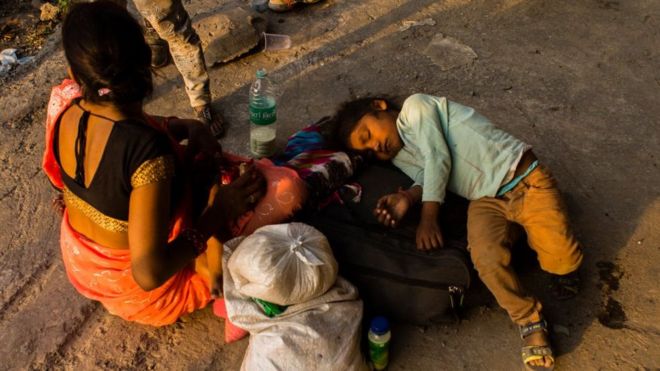
Millions of livelihoods have been destroyed and healthcare systems are under strain worldwide by the virus.Image copyrightGETTY IMAGES
Up to 60m people will be pushed into "extreme poverty" by the coronavirus warns the president of the World Bank.
David Malpass said the bank expects global economic growth to shrink by 5% this year as nations deal with the pandemic.
This has already led to millions losing their jobs and businesses failing, with poorer countries feeling the brunt.
"Millions of livelihoods have been destroyed and healthcare systems are under strain worldwide," he said.
"Our estimate is that up to 60 million people will be pushed into extreme poverty - that erases all the progress made in poverty alleviation in the past three years," Mr Malpass warned on Tuesday.
The World Bank defines "extreme poverty" as living on less than $1.90 (£1.55) per person per day. 
The Washington-based lender is offering $160bn in grants and low-interest loans to help poor countries tackle the crisis. Mr Malpass said that 100 countries, home to 70% of the world's population, had already been granted emergency finance.
"While the World Bank is providing sizeable resources, it won't be enough," he added.Mr Malpass said he was also frustrated with commercial lenders dragging their heels on offering debt relief to poor nations. "I have been somewhat frustrated by the slow pace. Commercial creditors are still, by and large, taking payments from even the poorest countries and there needs to be faster movement."
The World Bank worked with the International Monetary Fund (IMF) on a scheme to allow poorer countries to request debt relief on repayments of loans owed to G20 members until the end of this year.
At the same time, Jamie Dimon, chief executive of JP Morgan bank, said that the coronavirus pandemic must serve as a "wake-up call" to build a fairer society.
"It is my fervent hope that we use this crisis as a catalyst to rebuild an economy that creates and sustains opportunity for dramatically more people, especially those who have been left behind for too long," he wrote ahead of the bank's annual shareholder meeting on Tuesday.

Tuesday, May 19, 2020

Reuters News - Fed, Treasury chiefs face heat over uneven U.S. coronavirus response

WASHINGTON (Reuters) - Federal Reserve Chair Jerome Powell and Treasury Secretary Steven Mnuchin found themselves in the hot seat on Tuesday as U.S. lawmakers grilled them about the uneven nature of the fiscal response to the fallout from the coronavirus pandemic.
Powell and Mnuchin were testifying to the Senate Banking Committee as Congress considers whether to roll out trillions of dollars of additional aid to bolster an economy that was brought to a virtual standstill by lockdowns imposed in March and April.
The Trump administration has been criticized for initially downplaying the pandemic, which has now killed more than 90,000 Americans, and not ensuring that enough medical supplies were in place to battle the virus.
Essential workers “put their lives on the line for very low wages, and they’re still worried about paying their bills. Is that fair?,” Sherrod Brown, a Democratic senator from Ohio, asked Mnuchin.
When Mnuchin started to thank “all the essential workers,” Brown interrupted him. “Thanking is great, but is it fair our economy pays the essential workers so little in such work conditions?”
Senators are also expected to have sharp questions about the additional actions needed to keep the world's largest economy afloat, and missteps in rolling out some $3 trillion in aid so far. (See graphic here showing how the money moved.)
The hearing https://www.banking.senate.gov started at 10 a.m. (1400 GMT) and was expected to last two hours.
As more states reopen businesses, the government is closing in on the end of an eight-week program to funnel money to small businesses to avoid layoffs, prompting calls to extend the $660 billion Paycheck Protection Program. President Donald Trump said on Monday that such an extension “should be easy.”
Fiscal relief so far has been lopsided, with big banks getting easy access to Fed backstops, but mom-and-pop businesses initially shut out of paycheck lending programs. Meanwhile, some of the country’s lowest-paid workers are doing the most dangerous jobs.
While over 30 million unemployment claims have been processed since March, workers are reporting delays of weeks or months in getting checks, with others saying they are locked out here of claiming benefits.
Mnuchin, in written testimony published on Tuesday, said he sees high unemployment during the second quarter, but that the overall situation is expected to improve as the economy starts to reopen.
“Working closely with governors, we are beginning to open the economy in a way that minimizes risks to workers and customers,” Mnuchin said. “We expect economic conditions to improve in the third and fourth quarters.”

EXPANDING CREDIT

Powell, in prepared remarks for the hearing, said the Coronavirus Aid, Relief and Economic Security (CARES) Act passed in March was “critical” to the U.S. central bank’s ability to expand credit throughout the economy to offset the blow from the coronavirus.
Other programs aimed at helping larger companies and municipal bond issuers through a sharp recession are just getting started.
The U.S. central bank has slashed interest rates to near zero and set up a broad network of programs to ensure financial markets continue to function during the pandemic. It has also established precedent-setting lending facilities for companies and the first-ever corporate bond purchases.
In remarks broadcast on Sunday night, Powell said unemployment may hit 25% before it begins to fall, with a contraction in gross domestic product of 20% or more. He added that positive “medical metrics” that can build consumer confidence would be critical.
Senators are also likely to try to elicit the two officials’ views on the $3 trillion aid bill crafted by Democrats in the House of Representatives. It narrowly passed the Democratic-controlled chamber on Friday, but is opposed by Republicans in the Republican-controlled Senate.
Before the hearing on Tuesday, Mnuchin met with Vice President Mike Pence, Senate Majority Leader Mitch McConnell and House Minority Leader Kevin McCarthy at the U.S. Capitol, according to the White House.
Mnuchin also will face questions by the Senate banking panel over processing glitches that held up small-business loan applications as the Paycheck Protection Program was rushed into service in early April, as well as on abrupt policy changes that required many larger, publicly traded restaurant chains with access to capital markets to return their funds under the threat of audits.
A separate congressional oversight board issued its first report here on the response, consisting largely of questions that could be asked in Tuesday's hearing.
Among them are how the agencies will measure success and isolate the effects of the measures from other state and federal efforts.
Reporting by David Lawder and Heather Timmons; Additional reporting by Susan Heavey and Lindsay Dunsmuir; Editing by Peter Cooney, Chizu Nomiyama and Paul Simao

Monday, May 18, 2020

BBC News - Coronavirus pushes German economy into recession


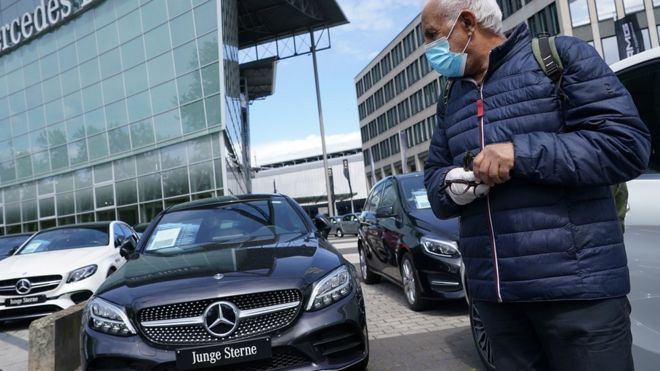
A man wearing a surgical mask stands at a Mercedes-Benz dealership where he said he is considering buying a car during the coronavirus crisis on May 05, 2020 in Berlin, Germany.Image copyrightGETTY IMAGES
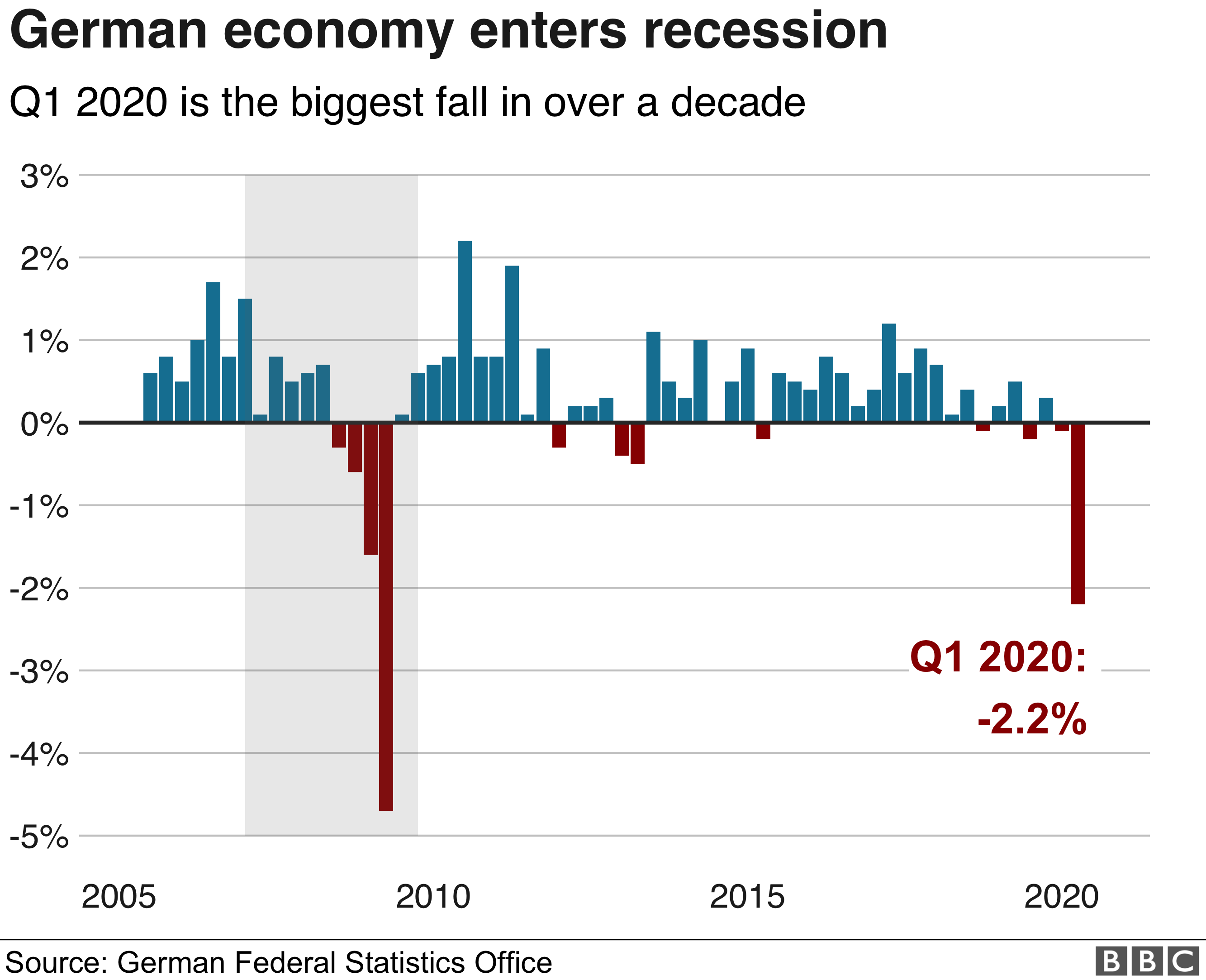
Image captionGerman GDP growth has been negative for two successive quarters, the definition of a recession.
Germany's economy shrank by 2.2% in the first three months of this year as the coronavirus pandemic pushed it into recession, official figures indicate.
It was the biggest quarterly fall since 2009, when the country was engulfed in the global financial crisis.
The figures from the Federal Statistics Office come as Germany takes its first tentative steps to exit lockdown.
Shops are reopening, pupils will gradually return to class and football is restarting behind closed doors.
At the same time, figures for the final three months of 2019 were revised to show a contraction of 0.1%.
That means German GDP growth has been negative for two successive quarters, the technical definition of a recession.
German GDP
The figures are in line with market expectations, says BBC global trade correspondent Dharshini David.
The German economy was already lacklustre before the onset of the pandemic, as the US-China trade war cast a shadow over activity, our correspondent points out.
The statistics office warned that the figures were subject to extreme uncertainty, with the next estimate due out on 25 May.
Germany is Europe's largest economy, but the drop is not as bad as in some of its neighbours, such as France, which has seen a decline of 5.8%, and Italy, which reported a 4.7% fall.
This effect is partly due to a decision by Germany's 16 states to allow factories and construction sites to stay open, as well as an unprecedented rescue package by the government.
Economists expect a deeper slump in the second quarter of the year, as the full effects of the lockdown become apparent.
Presentational grey line
Analysis box by Andrew Walker, Economics correspondent
Germany, along with just about every other economy on the planet, has been hit by the combination of official restrictions on movement and commercial activity, as well as by personal choices to avoid the risk of infection.
Consumer spending was down and so was investment (apart from construction which, along with government spending, softened the economic blow). Germany is a big power in global trade and imports and exports were both lower.
It was a sharp contraction overall, but so far at least, the blows to the German economy have not generally been as severe as those suffered by the rest of the eurozone. The other three largest economies - France, Italy and Spain - were all hit much harder by the health crisis and have seen much larger declines in the first three months of 2020.
For the quarter now under way, Germany will take a hit, but it has an advantage compared to those others. Tourism is a smaller part of the economy and it's a sector that is facing an extremely challenging 2020 summer season.
Presentational grey line
Separate growth figures released by EU statistics office Eurostat for the eurozone as a whole confirmed an earlier estimate showing a record decline of 3.8% in the January-to-March period.
For the 27-nation EU, the equivalent figure was 3.3%.
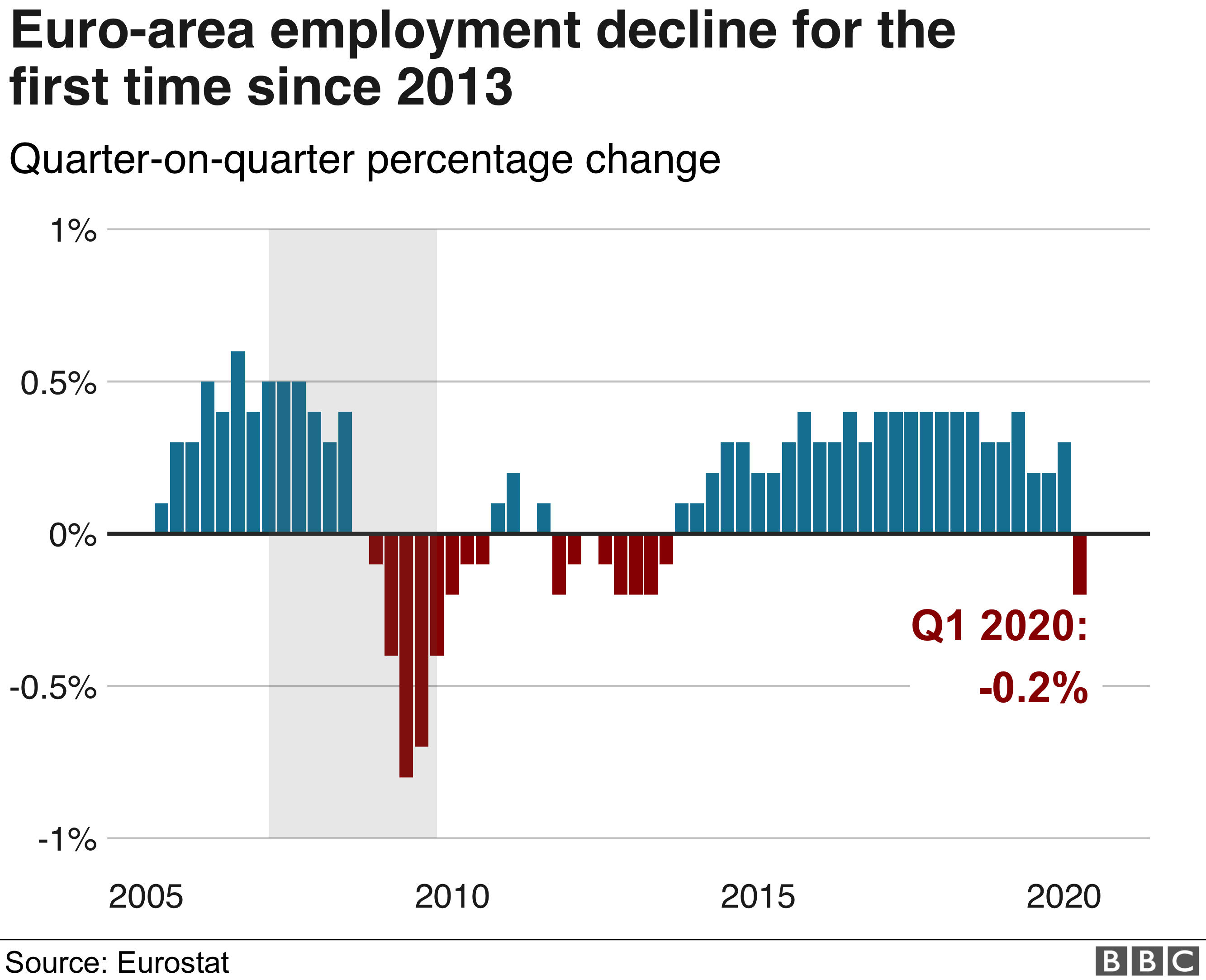
Eurostat also issued figures showing a 0.2% fall in eurozone employment, the first such decline since 2013.
Eurozone employment
"The German economy has been tiptoeing on the edge of recession since the beginning of 2019, but it can hide no longer," said Claus Vistesen, chief eurozone economist at Pantheon Macroeconomics.


"The German business cycle expansion, which started in 2013, ended decisively in Q1, and more pain is ahead in the near term before the recovery."

Thursday, May 14, 2020

Reuters News - As China pushes back on virus, Europe wakes to 'Wolf Warrior' diplomacy

LONDON/BRUSSELS (Reuters) - Earlier this month, Europe’s ambassador in Beijing submitted to Chinese censorship.

Seeking to mark an anniversary of the European Union’s relations with China on May 6, he and the EU’s 27 ambassadors co-wrote an opinion piece titled “EU-China ties vital amid global crisis,” for publication on embassy websites and in China Daily, an English-language newspaper controlled by the state.
“The outbreak of the coronavirus in China, and its subsequent spread to the rest of the world over the past three months,” said the carefully orchestrated piece, had “temporarily side-tracked” plans for meetings.
But in the China Daily version, the reference to the virus starting in China was deleted.
The change emerged as the article appeared on EU embassy websites, causing alarm among representatives of member states. Diplomats said the ambassador, French diplomat Nicolas Chapuis, had not consulted his bosses in Brussels or his fellow envoys about the change. He had, the EU executive said on May 7, unilaterally decided to accept it, with “considerable reluctance.”
Chapuis told a news conference the omission was “regrettable;” his boss, EU foreign policy chief Josep Borrell, subsequently spoke out against censorship by China’s state controlled media. Borrell also said that accepting the cut “was not the right decision to take,” though Chapuis kept his job.
China Daily did not respond to requests for comment, but the paper’s bureau chief in Brussels, Chen Weihua, responded to the EU ambassador on Twitter, saying, “You did nothing wrong. I don’t think those people should make a big fuss of the editing out of such a phrase.”
As the new coronavirus casts its shadow over geopolitics, the episode highlights concern among European diplomats over what they see as an increasingly conflictual relationship with Beijing.
As China is seeking to control the damage the pandemic threatens to its global reputation, the government of President Xi Jinping is pushing hard to control the story from Berlin to Bratislava, diplomatic cables seen by Reuters and interviews with more than a dozen diplomats, advisers and officials show.
In a campaign of increasingly assertive and at times aggressive diplomacy, China has sought to pressure European countries that criticise its handling of the outbreak, Reuters found. At a time when Europe’s ties with the United States are already strained by President Donald Trump’s ‘America First’ policy, the fallout from the coronavirus underscores how the EU is caught between two powers - needing both, but reluctant to side with either.
On the one hand, officials in Brussels and European capitals argue they need to show China that the European Union – the world’s largest trading bloc and a wealthy market of 450 million consumers – won’t be pushed around.
On the other, countries within Europe are rarely unanimous. States such as Germany have large trade relationships with China that they don’t want to jeopardise. German manufacturers, for example, depend on China, Germany’s biggest trading partner, to both supply components and to buy their cars.
“We don’t have the structure or culture to reciprocate the assertiveness or use power plays like China,” one diplomat said. “The aim of European diplomacy since the Second World War has been all about finding a compromise. China doesn’t necessarily look at things the same way at all.”
China’s foreign ministry and its officials declined to respond to questions posed by Reuters for this story. The European Commission, the EU’s executive body, declined to comment on the diplomatic contacts.

CREATE A NARRATIVE

This year was meant to be an important one for Sino-EU ties. Until the virus emerged in Wuhan in December, the EU had started to make progress with Beijing after tense summits in 2016 and 2017 ended without any joint declarations. Last year, the European Commission dubbed China an economic competitor and “systemic rival.”
Beijing in April 2019 acquiesced for the first time on key issues such as equal treatment of European companies in China, after months of negotiations, according to senior EU officials. That accord was to be followed this year by an EU-China summit in Beijing and a meeting between Chinese leader Xi and EU national leaders in Leipzig, Germany, in September.
But now, besides practical obstacles to such meetings from social distancing, both sides are pushing back against each other.
In China, the virus has compounded an already more pugnacious approach to international affairs - dubbed “Wolf Warrior” diplomacy in both Western and Chinese media - after two popular Chinese movies in which the action hero outguns and outsmarts nefarious U.S. special agents.
Spurred by Xi’s calls for the country to be more imposing, Chinese diplomats have pushed back against criticism of its handling of the outbreak, in every forum from social media to TV, newspaper op-eds, and diplomatic correspondence.
A striking example was on April 12, when the Chinese embassy in Paris posted an unsigned article on its website that suggested care workers in Western nursing homes had abandoned their jobs, leaving residents to die. China’s ambassador in Paris, Lu Shaye, was summoned by the French foreign ministry and wrote a post saying ties between China and France remain strong, but did not withdraw the comments, which France rejected.
Chinese foreign ministry officials told EU diplomats that the issue was one for France and China, not the wider EU, and that “it was now at an end,” according to a diplomatic cable from the EU delegation in Beijing to Brussels from April 22.
On April 26, China’s embassy in France posted another article on its website complaining of “China bashing” and claiming that “some Westerners are beginning to distrust liberal democracy.” The article said that “in the response to the epidemic, socialism with Chinese characteristics has demonstrated its ability to concentrate resources in the service of great achievements.”
Janka Oertel, head of the Asia programme at the European Council on Foreign Relations, said China is transferring its domestic approach to controlling public perception to the diplomatic arena.
“China is desperately trying to get its coronavirus story out there and as far as it’s concerned set the record straight,” she said. “It’s trying to do what it does domestically, which is create a narrative and protect its reputation.”

DIVIDE AND RULE

Chinese diplomats have also approached German government officials to persuade them to make positive statements on how Beijing is handling the pandemic, a letter dated April 22 from the German interior ministry to a German parliamentarian Margarete Bause showed.
The letter, reviewed by Reuters, said the diplomats had made individual contact with German officials to seek “positive public statements about the coronavirus management of the People’s Republic of China.” It said Germany had not complied.
And senior Chinese foreign ministry officials on several occasions pressured EU diplomats to block publication of an EU report analysing alleged Chinese disinformation online about the virus, according to documents seen by Reuters and diplomatic sources. The Chinese foreign ministry said the report would be “very bad for cooperation,” according to the April 22 EU diplomatic cable.
The internal version of the report, dated April 20 and reviewed by Reuters after parts were previewed by Politico, noted as a main finding that “China has continued to run a global disinformation campaign to deflect blame for the outbreak of the pandemic and improve its international image.”
In the public version, published on April 24 as a “snapshot overview,” criticism of China was given less prominence.
Top EU diplomat Borrell, called before the European Parliament on April 30 to explain the discrepancy between the versions, said there had been no watering-down, the published document was directed at a different public and while diplomatic pressures always exist, “We have not bowed to anyone.”
Beijing has long played on tensions between the EU’s founding states and its newer, formerly Communist members, through a special contact group of mostly east European countries called the 17+1, in which China is the 1. China has promised billions of dollars to countries which otherwise rely on EU development funds or outside investment to build railways, roads, airports and power stations.
China’s close relationships with such states make it harder for them to stand up to Beijing when Brussels wants them to, EU officials and diplomats say.
Even before the pandemic in the first two months of 2020, one diplomat said, Slovenia and Slovakia had requested help from the European Commission in pushing back against China’s pressure to take its side on issues including human rights. He said the states had effectively sent the message: “Help us: We don’t have the political clout to stand up to the Chinese.”
Slovenia’s foreign ministry said it had not sought such help, but did not know if others had. In a statement to Reuters, it said “very intensive” talks had been going on for an accord to be agreed at the EU-China summit which “will balance out the relations between the EU and China.” Slovakia did not respond to a request for comment.

MASK DIPLOMACY

When COVID-19 hit Italy and Spain, two large and influential member states, fellow EU members such as Germany initially came under fire for offering scant help. But China sent hundreds of thousands of testing kits and facemasks to them and other countries.
Italy, in particular, has been grateful. A poll of 800 people in Italy, carried out by the SWG research institute between March 20 and April 12, showed more than 50% of Italians consider China a friendly country, while other polls have shown once-solid support for EU membership falling.
China’s ‘mask diplomacy’ also spurred a dramatic change of tone from Czech Prime Minister Andrej Babis. Before the pandemic, he had called for the removal of the Chinese ambassador after a threatening letter from the embassy over a Czech lawmaker’s planned visit to Taiwan.
But as COVID-19 infections spread, Babis raced to the airport to personally greet a planeload of medical supplies from China, and publicly thanked the ambassador he had wanted withdrawn.
Babis said there was no connection between those actions. “When I did not like the communication of the ambassador, I said so,” he said in a statement to Reuters. “The same way, I did not have any problem to thank him publicly when he did his share.”
Not all responses have been as simple. Dutch, Spanish and other European authorities have questioned the quality of equipment sent - the Netherlands recalled some masks that had been distributed to hospitals on the grounds that they were not surgical, the Dutch health ministry said.
China rejected such complaints, saying for example that faulty test kits in Spain were provided by a company without a proper licence that had nothing to do with government shipments.

SUMMITRY

In the EU headquarters in Brussels and in European capitals, discussions are underway about how to respond to China’s toughening line.
Europe is intent on ensuring closer cooperation with Beijing on landmark issues like climate policy, especially after the U.S. withdrawal from the Paris climate accord. EU and Chinese representatives spoke on May 11 about opening up on trade. But there is little clarity on the diplomatic road.
The EU-China summit may take place on June 3, according to a European Commission planning note, but by video conference, rather than in person in Beijing.
The last time China policy was discussed by the EU’s 27 envoys in Brussels in March, Ireland’s envoy expressed concern that China’s “huge propaganda machine” may win the narrative on trade, cooperation and the summit, according to the minutes seen by Reuters.
France’s representative to Brussels urged the EU to demand China be more transparent on such issues, as well as coronavirus.
“We need to preserve our position,” he said.
Luke Baker reported from London, Robin Emmott from Brussels; with additional reporting by Liz Piper in London, Andreas Rinke in Berlin, Crispian Balmer in Rome, John Irish in Paris, Marja Novak-Vogric in Ljubljana, Tomas Mrva in Bratislava, Michael Kahn in Prague, Michel Rose in Paris, Ben Blanchard in Taipei and Yew Lun Tian in Beijing; Edited by Sara Ledwith
Tuesday, May 12, 2020

BBC News - UK furlough scheme extended by four months

The UK scheme to pay wages of workers on leave because of coronavirus will be extended to October, Chancellor Rishi Sunak has said.
Mr Sunak confirmed that employees will continue to receive 80% of their monthly wages up to £2,500.
But he said the government will ask companies to "start sharing" the cost of the scheme from August.
A quarter of the workforce, some 7.5 million people, are now covered by the scheme, which has cost £14bn a month.
The chancellor said that from August, the scheme would continue for all sectors and regions of the country but with greater flexibility to support the transition back to work.
Employers currently using the scheme will then be able to bring furloughed employees back part-time.

Cliff edge

Mr Sunak said: "I'm extending the scheme because I won't give up on the people who rely on it.
"Our message today is simple: we stood behind Britain's workers and businesses as we came into this crisis, and we will stand behind them as we come through the other side."
There has been growing concern about the cost of the scheme, and last week Mr Sunak said it could not continue in its current form.
However, he was under pressure to announce changes soon to avoid a so-called "cliff edge" in which employers begin mass redundancies.
Any company seeking to cut more than 100 job must run a 45-day consultation, meaning 18 May was the last date employers could start this process before the furlough scheme ended in June.
The chancellor rejected suggestions some people might get "addicted" to furlough if it was extended.
"Nobody who is on the furlough scheme wants to be on this scheme," the chancellor said. "People up and down this country believe in the dignity of their work, going to work, providing for their families, it's not their fault their business has been asked to close or asked to stay at home.
Shadow chancellor Anneliese Dodds said she had only learned of the changes "in the last few seconds" and would examine them "very, very carefully".
But she added that it was "critically important" that workers who had to continue on furlough "are not penalised for that choice".

No 'silver bullet'

Businesses largely welcomed the extension, with business group the British Chambers of Commerce saying the move would bring "significant relief" to employers and workers,
And Stephen Phipson, chief executive of manufacturing group Make UK, said it would avoid "a looming cliff edge triggering significant redundancies for many companies and recognises the need for greater flexibility as the economy fires up."
However, he warned that there was no "silver bullet" and that both government and industry would have to be flexible.
There was also support from the TUC, with general secretary Frances O'Grady saying the extension "will be a big relief for millions".
But she added: "As the economic consequences of Covid-19 become clear, unions will keep pushing for a job guarantee scheme to make sure everyone has a decent job."
Paul Johnson, director of the Institute of Fiscal Studies economic think tank, estimates the scheme will have cost nearly £100bn by October. It is thought that about 935,000 businesses signed up for the scheme in total.
Presentational grey line
Analysis box by Faisal Islam, economics editor
Reports of the demise of the furlough scheme have been somewhat exaggerated. It was never going to be scrapped, especially after the Bank of England stressed the scheme's importance for economic recovery.
Over a quarter of all jobs - 27%, 7.5 million in total - are now paid for by the taxpayer, potentially for eight months. After that, the level of subsidy from taxpayer will be lowered, with employers expected to pay a contribution.
By August, the scheme could start to look quite similar to longer standing wage subsidy schemes seen in continental Europe. The cost of the scheme to date is already over £10bn. This extension will be tens of billions more, but difficult to put a precise number on this given the lack of detail on the "employer contribution".
Expensive yes. But what is also costly is letting unemployment sky rocket, as, without the extension, many businesses would have begun 45-day redundancy consultations this week.
The question now is how many businesses still see this as a bridge to some sort of normality where furloughed staff can be phased back into their old jobs. Unfortunately some in industries which will not return to normal have already started to fire staff. This announcement buys most workers more time.