Monday, June 15, 2020

BBC News - Bank of England 'ready to act' as economy shrinks record 20%

Andrew BaileyImage copyrightGETTY IMAGES
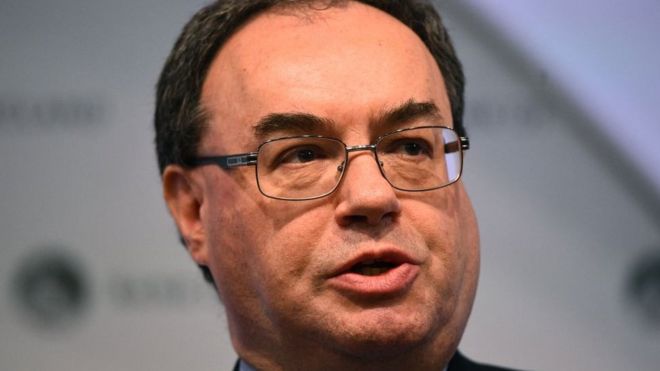
Bank of England governor Andrew Bailey has said he will be "ready to take action" to help the UK economy weather the coronavirus crisis.
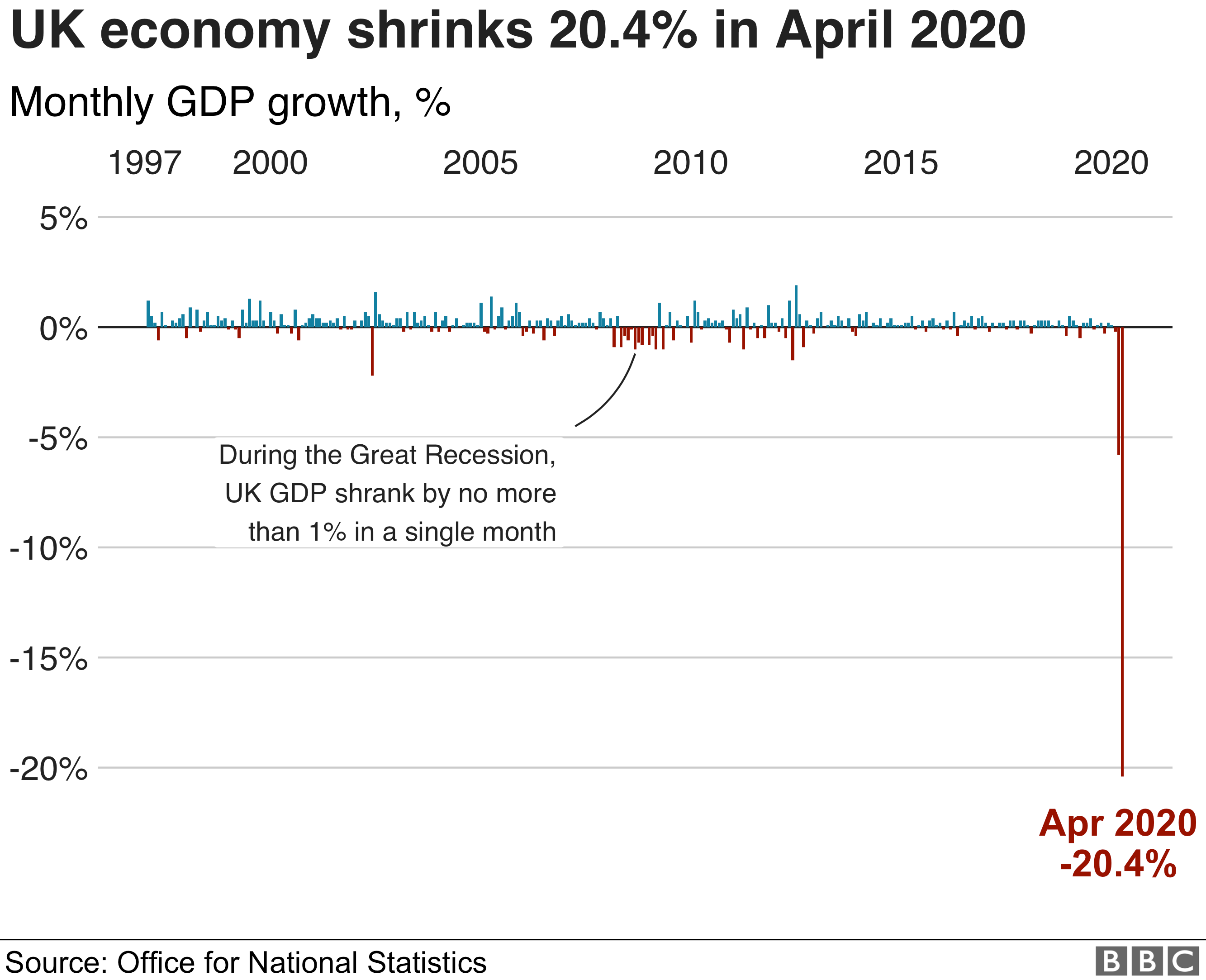
He was speaking after figures showed that the country's economy shrank by 20.4% in April - the largest monthly contraction on record - as the country spent its first full month in lockdown.
"We are still very much in the midst of this," Mr Bailey said.
But he said the figure was "pretty much in line" with what the bank expected.
"Obviously it's a dramatic and big number, but actually it's not a surprising number," he said.
The Office for National Statistics (ONS) said April's "historic" fall affected virtually all areas of activity, as large parts of the economy remained shut to battle the pandemic.
Quarterly GDP growth over time
The contraction is three times greater than the decline seen during the whole of the 2008 to 2009 economic downturn.
But analysts said April was likely to be the worst month, as the government began easing the lockdown in May.

What else did the governor say?

Mr Bailey said there were "signs of the economy now beginning to come back into life", but the big question was how much long-term damage the pandemic would cause.
"That's the thing we've got to be very focused on, because that's where jobs get lost," he said.
"Now we hope that will be as small as possible, but we have to be ready and ready to take action, not just the Bank of England, but more broadly on what we can do to offset those longer-term and damaging effects."
The ONS also published figures for the three months from February to April, which showed a decline of 10.4% compared with the previous three-month period.
News of the slump comes as almost nine million UK workers are having their wages paid by the government, while the number of people claiming unemployment benefit rocketed by 856,500 to 2.1 million in April.

What was the political reaction?

Prime Minister Boris Johnson warned of a "tough" few months ahead, but added: "We will get through it."
"We've always been in no doubt this was going to be a very serious public health crisis but also have big, big economic knock-on effects.
"The UK is heavily dependent on services, we're a dynamic creative economy, we depend so much on human contact. We have been very badly hit by this."
chancellorImage copyrightGETTY IMAGES
Image captionChancellor Rishi Sunak expects life to get "a little bit more back to normal" when shops reopen
Chancellor Rishi Sunak said life would get "a little bit more back to normal" once High Street shops could reopen.
That is set to happen on Monday in England, while shops in Northern Ireland have already been allowed to resume trading. Scotland and Wales have their own timetables for easing restrictions.
In response, shadow chancellor Anneliese Dodds warned that the UK's economy was shrinking faster than those of other countries.
She said the UK would need "strong action to help us climb out of this as quickly as possible".

What has happened to the economy?

In normal times, a country's Gross Domestic Product (GDP) - the value of the goods and services it produces - increases, making its citizens on average slightly richer. However, the ONS said April's fall in GDP was the biggest the UK had ever seen.
"[The fall was] more than three times larger than last month and almost 10 times larger than the steepest pre-Covid-19 fall," said Jonathan Athow, the agency's deputy national statistician for economic statistics.
"In April, the economy was around 25% smaller than in February."
He said virtually all areas of the economy had been hit, with pubs, education, health and car sales all seeing marked falls in activity.
Carmakers and housebuilders were also badly affected, although Mr Athow told the BBC's Today programme: "It's highly likely April will be the low point.
"Our own surveys and wider indicators have suggested a pick-up in economy activity, but I think it's really too early to know how quickly economic activity will recover in the coming months."
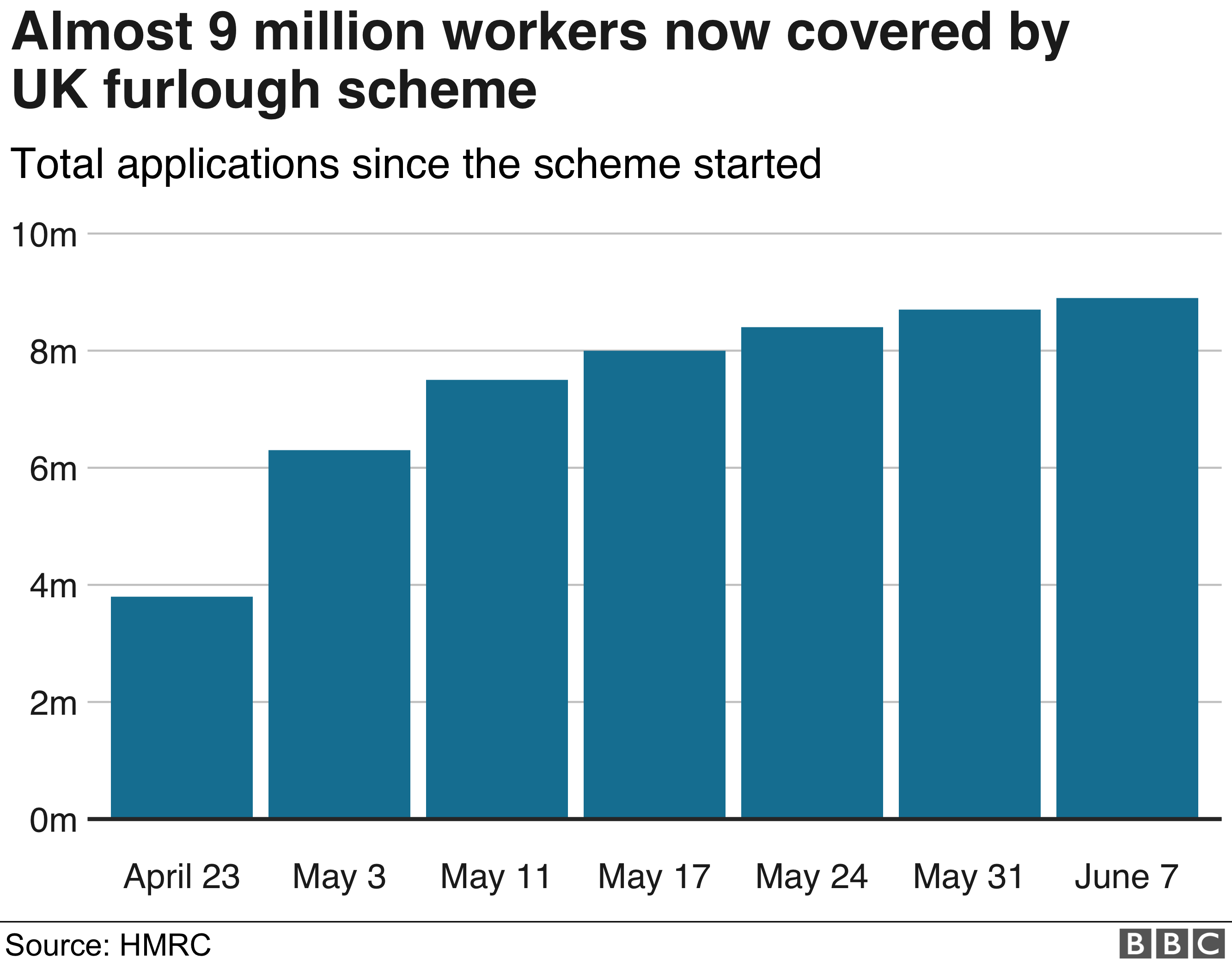
Total UK number covered by furlough scheme

So the economy has shrunk 20%. How come the other 80% is still standing?

In large part, thanks to the extraordinary levels of state intervention propping it up.
More than one in four UK workers - some 8.9 million - are now on the government's furlough scheme that allows them to receive 80% of their monthly salary up to £2,500.
The scheme has cost £19.6bn so far, while a similar programme for self-employed workers has seen 2.6 million claims made worth £7.5bn.
Without these schemes, household consumption, which makes up nearly two-thirds of the UK's GDP, would have fallen even further.

Presentational grey line

Staying positive

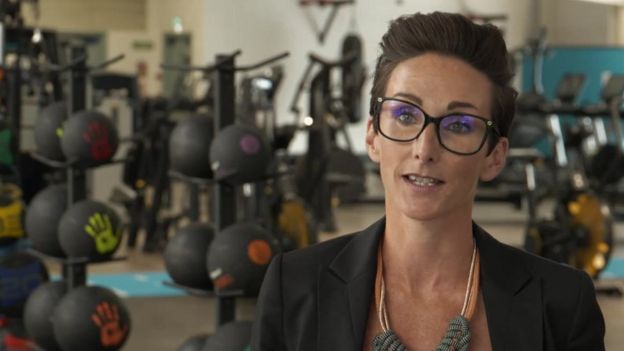
Sophie Lawler
Sophie Lawler's 17 health clubs remain closed to their 100,000 members in the north of England and Wales. And like the rest of the fitness sector, she has no idea when she might get the green light to reopen.
"The whole sector has struggled financially, and may do so for years to come," she said. "The industry is shouldering quite some rental burden, costs we still incur even while we're closed."
Furloughing has been vital, she says, but she'd like the government to do more - perhaps in the form of VAT exemptions or more support for leaseholders.
Despite the uncertainties, however, she thinks the sector will weather the storm. "In terms of demand, we will do pretty well when we get through to the other side of this."

Presentational grey line
Analysis box by Faisal Islam, economics editor
The ONS numbers add to the pressure to ease the lockdown more quickly, but fears around the control of the disease have led to a step-by-step cautious approach.
There is some pressure on the Treasury to consider similar economic rescue packages to those made across Europe.
Germany, for example, has cut VAT and offered billions in a package to help families with children and purchasers of green cars. France is offering huge rescue funds to the car and aerospace industry.
The unprecedented jobs schemes here will help to protect livelihoods. But with this scale of hit, it will not be enough.
Presentational grey line

How does this slump compare historically?

During the global financial crisis, from the peak in February 2008 to the lowest point of March 2009, a total of 13 months, GDP shrank by 6.9%.
April's unprecedented contraction is three times that - and it happened in one month.
The UK's economy was already shrinking even before April.
It contracted by 2% in the first three months of 2020, as just a few days of impact from the virus pushed it into decline.
Economists expect an even bigger slump in the April-to-June period, plunging the country into a deep recession.
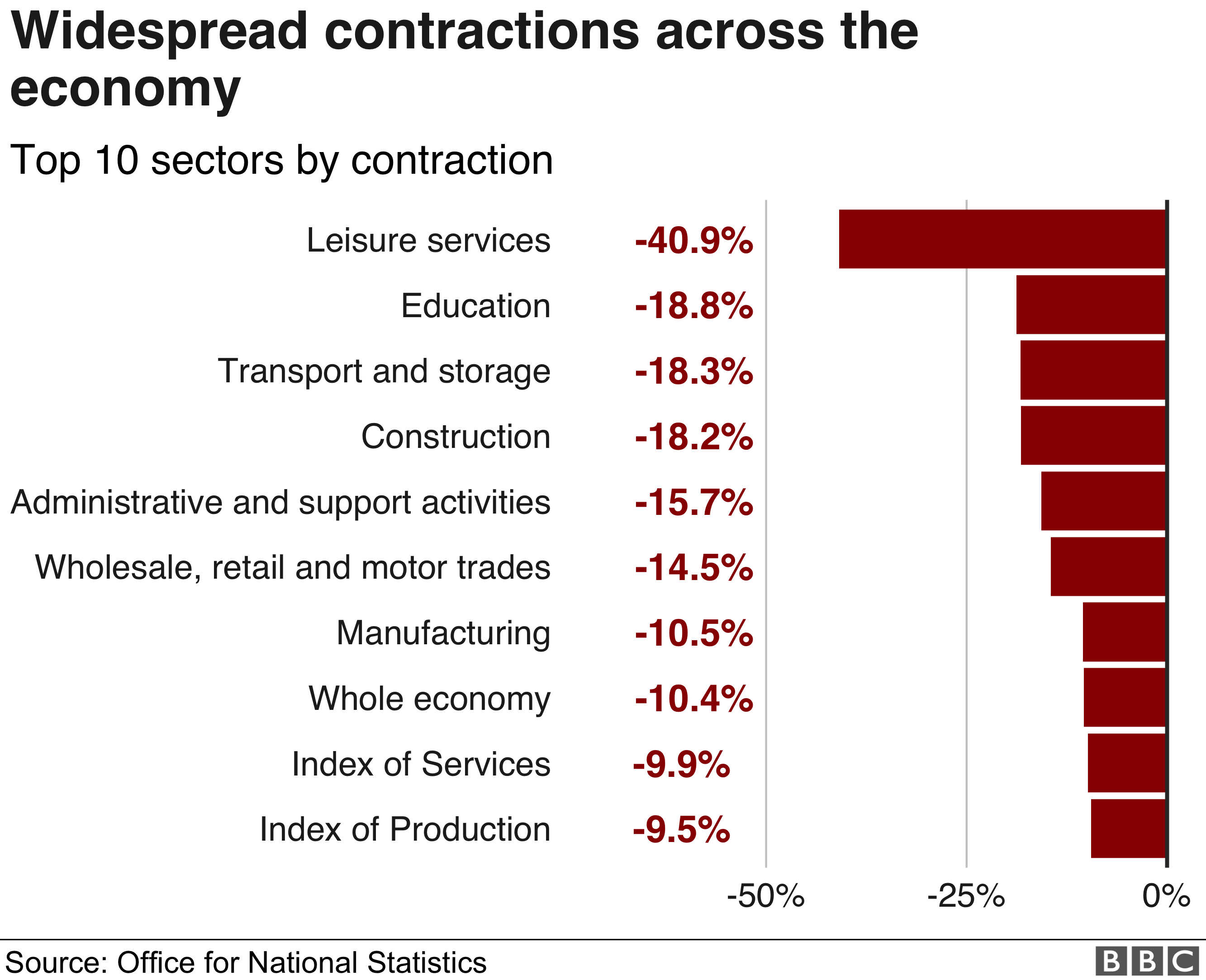
Economic performance by sector

So where do we go from here?

"Given the lockdown started to be eased in May, April will mark the trough in GDP. So we are past the worst," said Andrew Wishart, UK economist at Capital Economics.
"But the recovery will be a drawn-out affair, as restrictions are only lifted gradually and businesses and consumers continue to exercise caution."
Tej Parikh, chief economist at the Institute of Directors, said coronavirus had caused "unparalleled" economic turmoil which was "likely to scar the UK economy for some time yet".
"Having provided businesses life support, the government must now figure out how to stimulate activity," he added.
"Waiting until later in the year to act will risk more businesses and jobs will be lost."

How does the UK economy compare with other countries?

We don't really know yet. The UK is one of the few countries to publish monthly economic data - most others just produce quarterly and annual figures.
We do know, however, that coronavirus has already pushed several major economies into recession:
On Wednesday, the Organisation for Economic Co-operation and Development warned that the UK could be the hardest hit by Covid-19 among major economies.
The British economy is likely to shrink by 11.5% in 2020, slightly outstripping falls in countries such as Germany, France, Spain and Italy, it said.

Presentational grey line

What is a recession?

A recession is usually defined as two three-month periods - or quarters - of economic contraction in a row.
Technically, we are not at that point yet. But the UK, along with much of the rest of the world, is thought to be heading into the worst recession for decades.

Thursday, June 11, 2020

BBC News - Coronavirus: Young hit hardest by lockdown financial squeeze


Woman with baby looks at computerImage copyrightGETTY IMAGES
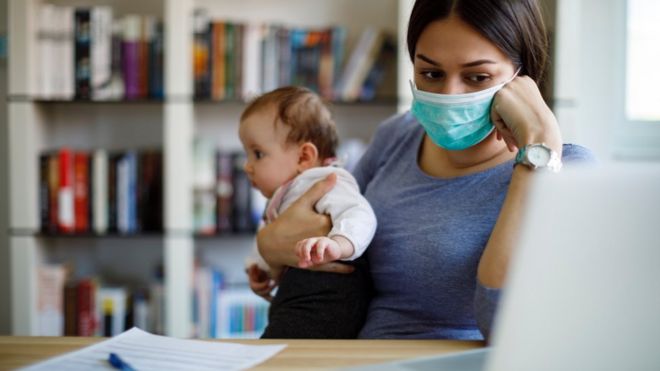
Image captionYounger women have been hit financially by lockdown
Young people have been hardest hit by a fall in their income during lockdown as more of their money goes on essentials, official data suggests.
The youngest and oldest workers are most likely to have lost their jobs or seen income cut owing to the system of state-paid wages.
With little in savings and less chance to cut spending, the under-30s would be hit hardest by this, the Office for National Statistics (ONS) said.
Renters have found it just as tough.

Money issues

The ONS has calculated, for the first time, the effect of the coronavirus outbreak on household spending.
It found that a typical household in the UK normally spent an average of £182 a week on activities, such as travel, holidays and meals out, that have been mostly ruled out under health guidance during the virus outbreak. This is equivalent to 22% of a usual weekly budget of £831.
Many households have been saving that money instead or using it to cover any loss of income.
Thousands of people have lost their jobs and millions have received only 80% of their usual wages as they have been furloughed - in other words, told not to work while the government covers their pay.
The latest figures show more than 7.5 million people had been furloughed in the UK by the end of May, while another 2.5 million self-employed workers have applied for grants to cover their losses.
ONS household spending
While many people have saved, there remains the need for about 53% of income to be spent on essentials, such as food, rent, or the mortgage.
Some, but not all of this can be deferred, through so-called payment holidays, particularly credit card bills, gas and electricity charges or mortgage repayments.
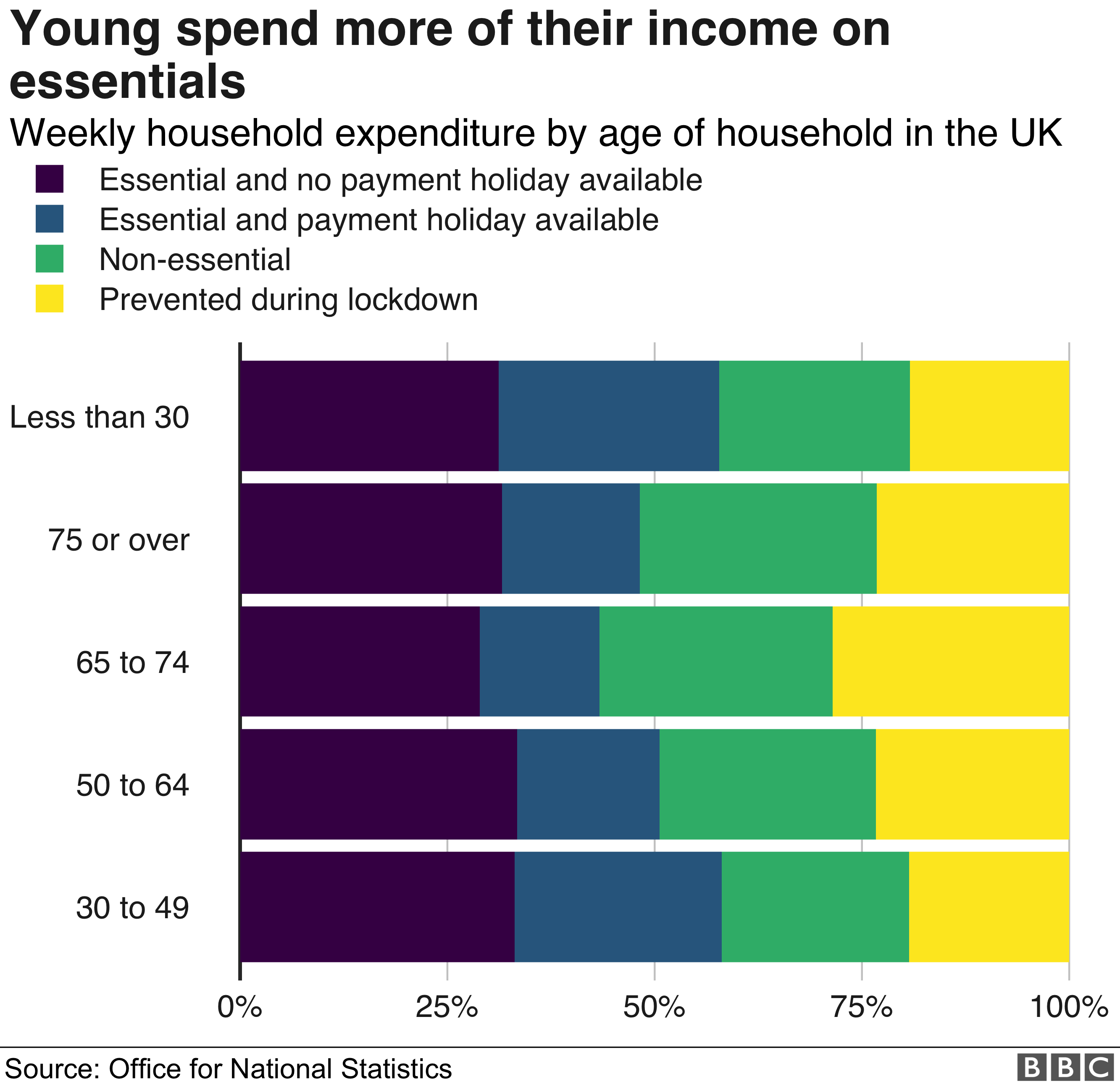
However, young people, renters and people living in London have found a greater proportion of their income goes on essentials, some of which cannot be deferred, than other groups.
As a result, they are likely to be hit the hardest if their income drops and they need to find the money for costs such as food and housing.
Presentational grey line

'Life turned upside down'

Jared ThomasImage copyrightJARED THOMAS
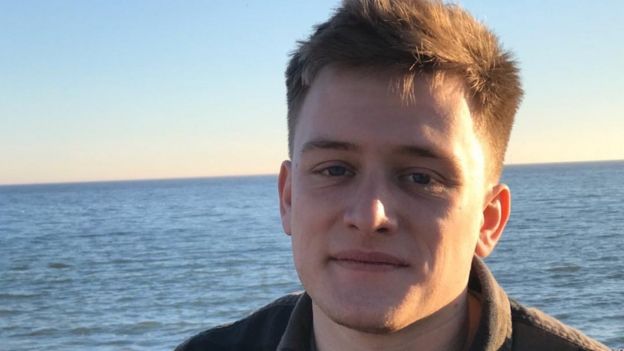
Image captionJared Thomas has seen work fail to pick up
Jared Thomas, 26, from south Wales, has seen work dry up as the coronavirus outbreak means financially stretched customers have had little demand for his tree surgery services.
"Everybody's life has been turned upside down," he says.
"I really don't know when work will pick up. I'd be surprised if it does for the next month or two."
He has claimed the universal credit benefit for the first time, so he can pay the rent.
Presentational grey line
The ONS said households renting their home from a landlord spent 61% of their usual weekly budget on essentials, compared with 52% for households which owned their home outright or with a mortgage.
A typical 30-year-old spent 58% of their weekly budget on essentials and normally only 19% on what has been prevented during lockdown, such as drinks in a pub, the ONS said.
On the other hand, older households of between 65 and 74 years old spent far less of their budget on essentials (43%) and considerably more (29%) on activities that have been unavailable.
In London, where property prices and rental costs are most expensive, a typical household spent 58% of its weekly budget on essentials such as food and housing costs, the highest of any region or country of the UK.
"For those who have faced an uphill battle during lockdown, it's a timely reminder of how much difference it can make to have something set aside for emergencies," said Sarah Coles, from investment platform Hargreaves Lansdown.
"Nobody is pretending it is easy to put money aside when you're starting out in your adult life, but it is worth doing whatever you can afford, as soon as you can afford to do so."
Alistair McQueen, head of savings and retirement at insurer Aviva, said: "While it is true to say that during the coronavirus lockdown 'we are all in it together', the impact on our individual finances is not equal."

Tuesday, June 9, 2020

Reuters News - Mexican president urges Canadian mining firms to pay taxes

MEXICO CITY (Reuters) - Mexican President Andres Manuel Lopez Obrador said on Tuesday some of Canada’s mining firms were behind on their tax payments and urged the Canadian government to lean on them to avoid the dispute reaching international tribunals.
“There are a few Canadian mining companies that are not up-to-date, they want to go to international tribunals,” Lopez Obrador told a regular government news conference.
The president then urged Canada’s ambassador to prevail on the companies that there was no need to seek legal redress because “it’s very clear that they have these debts with the tax authority, and that (Canada) help us to convince them.”
He did not name any specific companies.
Canada’s embassy in Mexico had no immediate comment.
Last month Canada’s First Majestic Silver Corp said it had served notice to Mexico’s government under its North American trade treaty obligations to begin talks to resolve disputes over how the company is taxed.
Lopez Obrador has made cracking down on tax breaks a priority. A number of major companies, including the Mexican unit of U.S. retailer Walmart Inc and Mexican conglomerate Femsa have recently agreed to make tax payments to Mexico.
Lopez Obrador also said Japanese automaker Toyota Motor Corp. is in the process of doing the same thing. Representatives for Toyota in Mexico had no immediate comment.
The president’s reference to legal disputes comes amid a major dispute between Mexico and the private sector on energy policy.
Lopez Obrador has allowed his officials to call into question contracts worth billions of dollars signed by companies from Canada, the United States and Europe under the previous administration, setting up a potentially messy legal scrap.
Reporting by Mexico City Newsroom; Additional reporting by Shara Angulo; Editing by Dave Graham and Dan Grebler

Monday, June 8, 2020

BBC News - Coronavirus: Airlines set for 'worst' year on record

passenger with a maskImage copyrightGETTY IMAGES
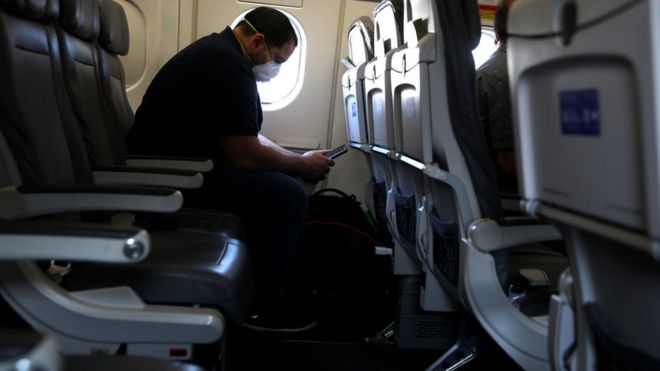
The plunge in travel caused by the coronavirus will drive airline losses of more than $84bn (£66bn) this year, a global industry group has warned.
The International Air Transport Association, which has 290 member airlines, said revenues would drop to $419bn, down 50% from 2019.
That is steeper than initially forecast and comes despite recent signs that travellers are returning to the skies.
This year will go down as the "worst" on record financially, the group said.
"There is no comparison," said Alexandre de Juniac, chief executive of the group.
The group said it expected airlines to lose $230m on average each day this year as the number of travellers falls to 2.25 billion, roughly halving from last year.
That will erase more than a decade of growth, returning the industry to 2006 levels.
The association said the industry would see losses again next year, but the damage would drop significantly - to $15.8bn - as revenues start to rebound and passenger numbers climb back to 2014 levels.
"Provided there is not a second and more damaging wave of Covid-19, the worst of the collapse in traffic is likely behind us," Mr de Juniac said.

Slow recovery

IATA had previously warned that airlines would lose $314bn this year, after air traffic all but disappeared in April, when governments around the world imposed limits on travel to try to control the spread of the virus.
While there are signs travel is starting to pick up, the recovery has been slow, complicated by economic downturn and government quarantines.
In the US, the Transportation Security Administration screened more than 440,000 people at airport checkpoints on Sunday. That's up from fewer than 100,000 people in April, but still down more than 80% from last year.
Companies have responded to the crisis by grounding fleets, scaling back service and cutting thousands of jobs. In coming months, IATA said firms are likely to lower prices in an effort to tempt back travellers, worsening their financial situation.
Some airlines such as Flybe have already failed, while other have received millions in emergency government aid.
Mr de Juniac said continued support is needed.
"Government financial relief was and remains crucial as airlines burn through cash," he said.
Industry groups, including IATA, have also called on the UK government to remove the 14-day quarantine on passengers entering the country.
Keeping such rules in place through the end of the summer could cost the UK $186bn and 2.9 million jobs, the World Travel & Tourism Council warned on Tuesday. That is up from the 1.2 million the organisation had previously said were at risk as a result of the pandemic.
"The sector's recovery risks being undermined by heavy-handed restrictions just as it emerges from one of the most punishing periods in its history - and it's not just airlines who will bear the cost but the entire travel ecosystem," said Gloria Guevara, the group's president.

Analysis box by Theo Leggett, business correspondent
A long, long time ago, IATA forecast that global airline revenues would fall by $29bn this year. The news generated shocked headlines.
Actually, that was only in late February. IATA has revised its projections a few times since then. The figure now stands at a colossal $419bn.
It's a sign of just how quickly the Covid-19 pandemic developed- and how the industry went from worrying about the disruption to traffic to and within China, to grounding 95% of flights worldwide.
Put simply, grounded planes aren't making money - while storing and maintaining them comes at a hefty cost.
Now, air traffic is slowly picking up as countries open up again. But airlines are still collectively facing a net loss of $84bn this year - where they had been expecting a $35bn profit.
It's a difference which will be measured in tens of thousands of lost jobs and livelihoods ruined.

Wednesday, June 3, 2020

Reuters News - U.S. opens national security probe into vanadium imports

WASHINGTON (Reuters) - The U.S. Commerce Department said on Tuesday it was opening an investigation into whether imports of vanadium, a metal used in aerospace, defense and energy applications, impair U.S. national security.
The “Section 232” probe is similar to ones that resulted in broad tariffs on steel and aluminum in 2018 and a probe underway into imports of titanium sponge.
The department said the domestic producers that petitioned the agency, AMG Vanadium (AMG.AS) and U.S. Vanadium LLC, assert that they are hurt by unfairly priced imports, value added tax regimes in other vanadium-producing countries and “the distortionary effect of Chinese and Russian industrial policies.”
“Vanadium is utilized in our national defense and critical infrastructure, and is integral to certain aerospace applications,” Commerce Secretary Wilbur Ross said in a statement. “We will conduct a thorough, fair, and transparent investigation to determine whether vanadium imports threaten to impair U.S. national security.”
Designated a strategic and critical material, vanadium is used in the production of metal alloys and as a catalyst for chemicals across the aerospace, defense, energy, and infrastructure sectors.
Prized for its high strength-to-weight ratio, vanadium is used for aircraft, jet engines, ballistic missiles, energy storage, bridges, buildings, and pipelines.
The Commerce Department said U.S. demand for the aerospace sector is met entirely through imports.
Reporting by David Lawder and Andrea Shalal; Editing by Chizu Nomiyama and Steve Orlofsky

Tuesday, June 2, 2020

BBC News - Coronavirus: More than a quarter of UK workers now furloughed

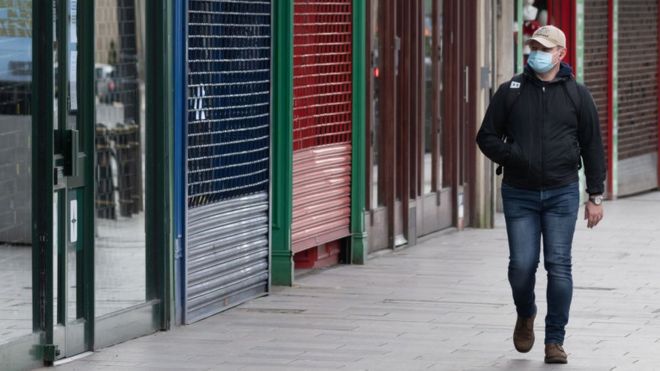
Man in mask walks past empty shopsImage copyrightMATTHEW HORWOOD
Some 300,000 more UK workers have been furloughed in the past week, raising the total to 8.7 million since the start of the coronavirus crisis.
That means more than a quarter of the workforce is now being supported by the £14bn-a-month scheme.
Another 200,000 self-employed have taken up government grants, meaning 2.5 million have been handed out.
Meanwhile businesses have borrowed more than £31bn in government-backed loans to help survive the crisis.
Last week, the schemes were extended to October by Chancellor Rishi Sunak.
The jobs retention scheme was introduced in March to mitigate the effects of coronavirus.
It allows employees to receive 80% of their monthly salary up to £2,500.
Some £17.5bn has now been claimed by more than a million firms under the scheme, up from £15bn last week, government figures show.
Last Friday, the government confirmed that furloughed workers would continue to get 80% of their pay until the end of October, but by then a fifth of their salary will have to be met by employers.
"Then, after eight months of this extraordinary intervention of the government stepping in to help pay people's wages, the scheme will close," Rishi Sunak said.
The scheme is expected to have cost a total of about £80bn by the time it is shut down.
But Labour's shadow chancellor Anneliese Dodds warned last week about job losses when the government support schemes end.
"It is concerning that there is no commitment within these plans for support to only be scaled back in step with the removal of lockdown," she said.

Self-employed grants

The Self-Employed Income Support Scheme pays a one-off grant of up to £7,500 amounting to 80% of average three-month profits.
The 200,000 additional claims for that in the past seven days has cost the government £400m, to bring the total paid out to £7.2bn.
Last week, the government confirmed that eligible self-employed workers would receive a second three-month payment under the scheme.
However, it is slightly less generous, covering 70% of the applicant's average monthly trading profits.
It will also be made in a single payment, covering three months and capped at £2,190 a month, or £6,570 in total.
People whose work has been affected by coronavirus will still be able to apply for the lump sum until 13 July.
Nearly 750,000 businesses have been approved for loans from coronavirus programmes worth more than £31.3bn, government figures show.
Low interest bounce-back loans of up to £50,000 guaranteed by the government account for the majority.
Almost 700,000 companies have been approved for £21.3bn-worth of bounce-back loans.
There were an extra 91,000 granted in the past week, with a total value of £2.8bn.
Meanwhile more than £8.9bn has been lent to nearly 46,000 companies under the coronavirus business interruption loan scheme (CBILS).
In the last seven days almost 3,000 CBILS worth a total £770m were approved.
Some £1.1billion has been lent to 191 companies through a similar scheme aimed at larger businesses, called CLBILS.
In the last week around £300m was borrowed under the scheme by 37 bigger businesses.