Tuesday, July 21, 2020

BBC News - Coronavirus: EU leaders reach recovery deal after marathon summit

EU leaders have struck a deal on a huge post-coronavirus recovery package following a fourth night of talks.
It involves €750bn (£677bn; $859bn) in grants and loans to counter the impact of the pandemic in the 27-member bloc.
The talks saw a split between nations hardest hit by the virus and "frugal" members who were concerned about costs.
It is the biggest joint borrowing ever agreed by the EU. Summit chairman Charles Michel said it was a "pivotal moment" for Europe.
The deal centres on a €390bn programme of grants to member states hardest hit by the pandemic. Italy and Spain are expected to be the main recipients.
A further €360bn in low-interest loans will be available to members of the bloc.
The summit, which began in Brussels on Friday morning, saw more than 90 hours of talks and became the EU's longest since a 2000 meeting in the French city of Nice, which lasted for five days.
The package will now face more technical negotiations by member states, and need ratification by the European Parliament.

How did we get here?

Mr Michel, the president of the European Council, tweeted "Deal" shortly after the 27 leaders reached the agreement at about 05:15 (03:15 GMT) on Tuesday.
The agreement followed a long weekend of talks between EU countries, during which tempers were often frayed.
Member states were largely split between those hit hardest by the outbreak and keen to revive their economies, and those more concerned about the costs of the recovery plan.
The self-proclaimed frugal four - Sweden, Denmark, Austria and the Netherlands - along with Finland, had opposed allowing €500bn to be offered in the form of grants to countries hardest-hit by Covid-19.
The group originally set €375bn as the limit, in addition to wanting conditions such as the right to block requests. Other members, such as Spain and Italy, did not want to go below €400bn.
At one point French President Emmanuel Macron reportedly banged his fists on the table, as he told the "frugal four" he thought they were putting the European project in danger.
The €390bn figure was suggested as a compromise, and "frugal" nations were reportedly won over by the promise of rebates on their contributions to the EU budget.
Another issue in the negotiations was how disbursements would be linked to governments respecting the rule of law. Hungary and Poland both threatened to veto the package if it adopted a policy of withholding funds from nations who do not meet certain democratic principles.
The European Commission will borrow the €750bn on international markets and distribute the aid. There will also be a means by which member states can reject a spending plan.
The deal was reached alongside agreement on the bloc's next seven-year budget, worth about €1.1tn.

How have EU European leaders reacted?

French President Emmanuel Macron said it was a "historic day for Europe".
"Never before did the EU invest in the future like this," Belgian Prime Minister Sophie Wilmès tweeted.
Mr Michel said: "We showed collective responsibility and solidarity and we show also our belief in our common future."
European Commission President Ursula von der Leyen tweeted. "Today we've taken a historic step, we all can be proud of. But other important steps remain. First and most important: to gain the support of the European Parliament. Nobody should take our European Union for granted."
Dutch Prime Minister Mark Rutte, who led the "frugal group", welcomed the agreement, but acknowledged the fractious nature of the talks. "We are all professionals, we can take a few punches," he told reporters.

Presentational grey line
Tough talks reflect power shifts
Analysis box by Gavin Lee, Europe correspondent
The deal was reached after marathon of negotiations that almost became the longest in EU history. The "EU enlargement" summit in Nice 10 years ago lasted only 25 minutes longer.
For leaders who had pushed for a far-reaching package, the deep frustration, including table-thumping anger from the French president, appears to have dissipated.
I asked Mr Macron whether he still felt that the "frugal four" had damaged the European project by their hard bargaining. He said, as had been reported: "It's legitimate that we have different sensibilities... If we don't take into account the realities, we'd put these leaders in a difficult spot and it would favour the populists."
The "Club Med" countries, Spain, Italy and Portugal, appear content with the smaller size of grants available. Portuguese PM Antonio Costa told us: "While it's true that it could have had a slightly bigger dimension, the recovery plan is robust enough to respond to the current estimates of the Coronavirus crisis."
As for Europe's most powerful leader, the German Chancellor Angela Merkel, I asked her about the new power balance in the EU. She said: "During the last negotiations [then UK Prime Minister] David Cameron's view loomed large. Now he is no longer with us, others have come to the fore."

Monday, July 20, 2020

Reuters News - Britain secures 90 million possible COVID-19 vaccine doses from Pfizer/BioNTech, Valneva

LONDON (Reuters) - Britain has signed deals to secure 90 million doses of two possible COVID-19 vaccines from an alliance of Pfizer Inc (PFE.N) and BioNTech (22UAy.F), and French group Valneva (VLS.PA), the business ministry said on Monday.

Britain secured 30 million doses of the experimental BioNTech/Pfizer vaccine, and a deal in principle for 60 million doses of the Valneva vaccine, with an option of 40 million more doses if it was proven to be safe, effective and suitable, the ministry said.
With no working vaccine against COVID-19 yet developed, Britain now has three different types of vaccine under order and a total of 230 million doses potentially available.
“This new partnership with some of the world’s foremost pharmaceutical and vaccine companies will ensure the UK has the best chance possible of securing a vaccine that protects those most at risk,” business minister Alok Sharma said.
Financial terms were not disclosed.
The deals follow a previously announced agreement with AstraZeneca (AZN.L) for the firm to produce 100 million doses of its potential vaccine being developed in partnership with the University of Oxford.
Britain said it was the first such deal which Pfizer and BioNTech had agreed for the supply of their vaccine, which is being tested in early to mid stage trials.
The firms are aiming to make up to 100 million doses by the end of this year and potentially more than 1.2 billion doses by end of 2021, if the vaccine is successful.
It uses the so-called messenger RNA approach, in contrast to the more traditional, inactivated whole virus vaccine being developed by Valneva.
Valneva’s potential vaccine is still in pre-clinical trials, and the company is aiming to move into clinical trials by the end of 2020.
Britain also said on Monday it had secured treatments containing COVID-19-neutralising antibodies from AstraZeneca (AZN.L) to protect people who can’t be vaccinated.
Reporting by Alistair Smout; Editing by Richard Pullin and Peter Graff

Friday, July 17, 2020

BBC News - Coronavirus: Chinese economy bounces back into growth

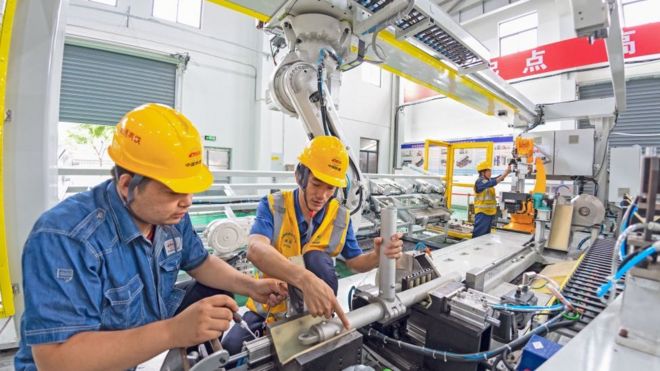
China's economy grew 3.2% in the second quarter following after a record slump.Image copyrightGETTY IMAGES
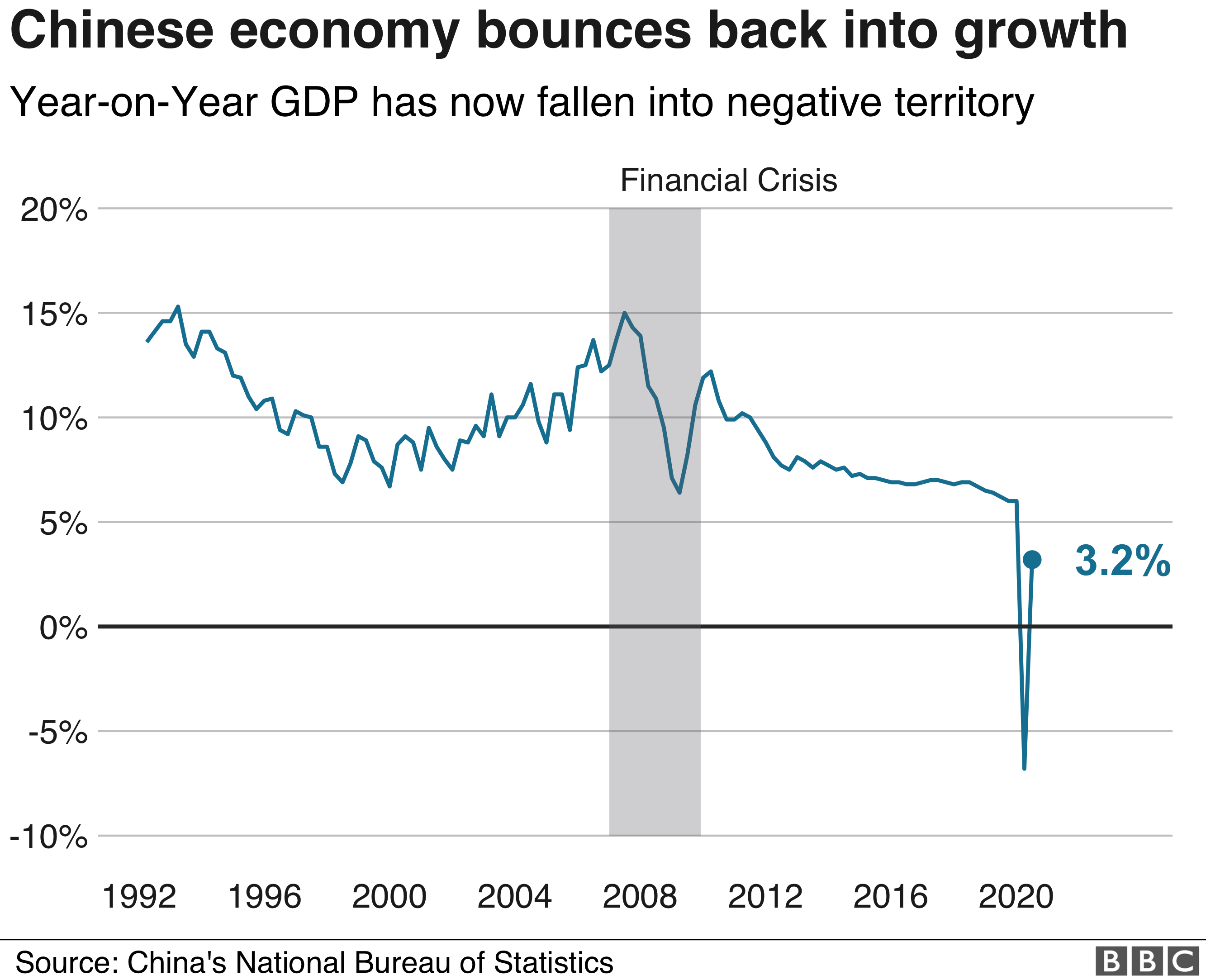
China's economy grew 3.2% in the second quarter following a record slump.
The world's second biggest economy saw a sharp decline in the first three months of the year during coronavirus lockdowns.
But figures released on Wednesday show China's Gross Domestic Product (GDP) returned to growth during April to June.
The numbers are being closely watched around the world as China restarts its economy.
China gdp
The figure is higher than experts were predicting and points towards a V-shaped recovery - that is, a sharp fall followed by a quick recovery.
It also means China avoids going into a technical recession - signified as two consecutive periods of negative growth.
The bounce-back follows a steep 6.8% slump in the first quarter of the year, which was the biggest contraction since quarterly GDP records began.
The country's factories and businesses were shutdown for most of this period as China introduced strict measures to curb the spread of the virus
The government has been rolling out a raft of measures to help boost the economy, including tax breaks.

Is this a V-shaped recovery?

Analysis by Mariko Oi, BBC News, Singapore
The Chinese economy managed to grow more strongly than expected as it emerged from the lockdown.
All the stimulus measures announced by the authorities seem to be working - with factories getting busier, evident in growth in the industrial production data.
But one sector that hasn't recovered as quickly as they had hoped is retail sales.
They still fell in the second quarter - and getting people spending again will remain a challenge.
And just as the economy starts to recover, tensions with the US are flaring up - especially over Hong Kong.
That is why some economists are reluctant to call it a V-shaped recovery just yet.
line
A research note from Deutsche Bank said the "V-shaped recovery" was "largely completed".
"Consumer spending is still below its pre-Covid path, but the remaining gap is largely concentrated in a few sectors - travel, dining, leisure services-- where rapid recovery is unlikely," it added.
In May, China announced it would not set an economic growth goal for 2020 as it dealt with the fallout from the coronavirus pandemic.
It is the first time Beijing has not had a gross domestic product (GDP) target since 1990 when records began.
For the first six months of the year, China's economy fell 1.6%, its National Bureau of Statistics said.

Wednesday, July 15, 2020

Reuters News - Wall Street climbs on vaccine bets, Goldman results

(Reuters) - U.S. stocks climbed on Wednesday, with the S&P 500 approaching its highest level in more than four months after promising early data for a potential COVID-19 vaccine and a strong quarterly report from Goldman Sachs.
Moderna Inc surged 9.2% after a small-scale study showed its experimental COVID-19 vaccine produced high levels of virus-killing antibodies.
Travel-related stocks Carnival Corp, Royal Caribbean Cruises Ltd, Marriott International and Wynn Resorts rose between 7% and 20%, with the S&P 1500 airlines index up 10.0%.
The S&P 500 was on track to beat the technology-heavy Nasdaq Composite for a fourth straight session, a feat scored only twice since Wall Street launched its massive recovery last March.
Gains for the Nasdaq were capped by online retail giant Amazon.com Inc, video streaming platform Netflix Inc and Microsoft Corp which slipped after surging to record highs recently.
“The Moderna news woke everybody up again that this is not going to last forever, and there is light at the end of the tunnel. That is why you are seeing such a strong move today into those economically sensitive stocks,” said Tim Ghriskey, Chief Investment Strategist Inverness Counsel in New York.\
Adding to investors’ enthusiasm, the Federal Reserve’s Beige Book survey showed U.S. businesses saw an uptick in activity into the beginning of July as states eased restrictions to contain the novel coronavirus pandemic, but that but many were uncertain about the economic outlook.
However, the United States has failed to control the coronavirus and there is a high level of uncertainty over how much the pandemic will affect the economy, Philadelphia Federal Reserve Bank President Patrick Harker said, as a number of U.S. sunbelt states reported a surge in COVID-19 cases recently.
The three main U.S. stock indexes have recouped most of their losses from the coronavirus-led slump, with a raft of stimulus measures and encouraging economic data lifting the S&P 500 to about 5% below its record high hit in February.
At 2:28 p.m. ET (1828 GMT), the Dow Jones Industrial Average was up 0.79% at 26,854.26 points, while the S&P 500 gained 0.94% to 3,227.45.
The Nasdaq Composite added 0.66% to 10,558.29.
Goldman Sachs rose 1.2% after it said its trading revenue doubled in the second quarter, driven by big swings in stock and bond markets since March.
Morgan Stanley gained 1.2% and Bank of America rose 1.4% ahead of their results on Thursday. The broader banking index climbed 2.3%.
UnitedHealth Group Inc fell 2.3% after warning of rising costs later this year as Americans catch up on less urgent surgeries halted by the coronavirus pandemic.
Advancing issues outnumbered declining ones on the NYSE by a 5.03-to-1 ratio; on Nasdaq, a 4.35-to-1 ratio favored advancers.
The S&P 500 posted 29 new 52-week highs and no new lows; the Nasdaq Composite recorded 67 new highs and two new lows.
Additional reporting by Medha Singh and Devik Jain in Bengaluru; Editing by Marguerita Choy

Monday, July 13, 2020

BBC News - Coronavirus: Oil producers expected to increase crude output

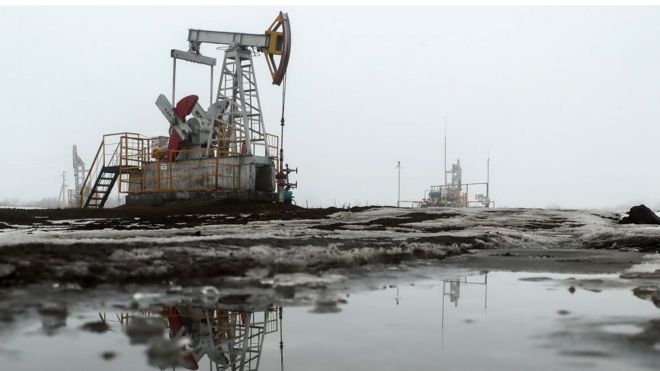
Oil cartel Opec is due to hold a meeting to discuss raising productionImage copyrightGETTY IMAGES
The world's leading oil producers are expected to announce an increase in output this week amid signs that demand is rising.
Oil cartel Opec is due to hold a meeting on Tuesday and Wednesday to discuss its next move.
Analysts predict major producers will agree to ease supply cuts that were imposed in April to prop up prices.
Opec and its allies, known as Opec+, cut daily oil output by 9.7m barrels as the pandemic saw demand collapse.
That agreement was made to help ease the effects of an oil glut caused by the lockdowns and to stabilise prices.
Brent crude, which is the global benchmark for oil, is down around 30% this year, while US-traded West Texas Intermediate (WTI) fell below zero at one point in April.
Expectations are growing that from next month those curbs will be reduced to 7.7m a day, meaning that output will increase by 2m barrels a day.
The more optimistic outlook comes after the International Energy Agency (IEA) last week suggested that the worst of the impact caused by coronavirus lockdowns may now be over.
In its monthly global energy report the IEA predicted a slight improvement in global demand for crude oil this year.
However, it also cautioned that much still depends on how the pandemic develops.
The report also noted that the resurgence of cases in some parts of the world, including the US and Latin America, was “casting a shadow” over the outlook and threatened to derail a recovery in demand.
"The recent increase in Covid-19 cases and the introduction of partial lockdowns introduces more uncertainty to the forecast," it said.
Singapore-based oil expert Vandana Hari cautioned about a swift recovery for the commodity. "Global oil demand is currently expected to come close to pre-coronavirus levels only in the second half of 2021.
It may not reach the exact levels until much later, as international air travel and jet fuel demand is not seen normalizing for the next 2-3 years," she said.
In the US, Florida has registered a state record of 15,299 new coronavirus cases in 24 hours - around a quarter of all of the United States' daily infections.
The US as a whole has been exceeding new daily totals of 60,000 cases for the past few days. Other states including Arizona, California and Texas continue to see a rising cases.

Friday, July 10, 2020

Reuters News - Exclusive: Japan may still build Aegis Ashore despite reports of cancellation - source

TOKYO (Reuters) - Japan may still build Aegis Ashore missile defense systems to defend against attacks by North Korea and other regional rivals, including China, a source told Reuters just weeks after reports that the proposal had been killed.
Japan’s defense minister, Taro Kono, last month cancelled plans to build two Aegis Ashore sites, citing cost and concerns that falling booster stages from the interceptor missiles could drop on local residents.
Japan, however, has not cancelled the $1 billion contract for the defense system’s radars, built by Lockheed Martin, and is mulling a technical assessment from the U.S. government that makes recommendations on using other sites that would eliminate the safety issues, said the source, who has direct knowledge of the process.
“Japan wants to preserve its contracts and reutilize equipment,” said the source, who declined to be identified because of the sensitivity of the matter.
Options include installing missile launchers on sea platforms or in remote coastal locations to eliminate the risk from falling boosters, the source said. Japan also has warships equipped with ballistic missile interceptors.
Any decision to stick with Aegis Ashore could upset both Beijing and Moscow, which have pushed for an end to the deployment. With at least three times the range of older Aegis radars on Japanese warships, the land-based systems can look deep into China and Russia.
In its 2019 defense white paper, Japan for the first time listed China as its main security threat, pointing to burgeoning defense spending, increased military manoeuvres and a growing arsenal of modern weapons, including ballistic missiles. The document also noted a resurgence in Russian activity in the waters and skies around Japan.
Aegis Ashore could be built at two of 28 existing air defense radar stations dotting Japan’s coast, according to Gen Nakatani, a former defense minister, who along with other former defense chiefs is in a group reconsidering defense policy in the wake of Kono’s surprise decision.
“There is no reason why we couldn’t put the radar, the combat system and missile launcher in separate locations. That is something we can consider,” he said in an interview.
Nakatani said he welcomed Kono’s decision to cancel Aegis Ashore because it was an opportunity to build an integrated air and missile defense (IAMD) system to tackle broader threats.
Japan picked Aegis Ashore in 2017 after Pyongyang fired 40 missiles over two years, some over Japan, and tested three nuclear bombs, the last of which had an explosive yield of 160 kilotonnes, eight times as powerful as the atom bomb that destroyed Hiroshima.
Subsequent North Korean missile advances, however, meant that Japan would have to pay more to upgrade Aegis when it switched on in 2025 so it could counter other threats, such as missiles on depressed trajectories that remain inside the atmosphere.
Japan’s National Security Council is considering new defense proposals, including the possibility of acquiring a strike capability to attack enemy missiles launchers, before reaching a conclusion by the end of September.
Reporting by Tim Kelly, additional reporting by Yoshifumi Takemoto and Nobuhiro Kubo; Editing by Gerry Doyle

Thursday, July 9, 2020

Reuters News - Australian PM suspends extradition treaty, extends visas for Hong Kong citizens

SYDNEY (Reuters) - Australia said on Thursday it was suspending its extradition treaty with Hong Kong and announced measures to attract people and businesses from the Asian financial hub, after Beijing imposed a new security law there.

Prime Minister Scott Morrison said the new national security law introduced last week in Hong Kong was a fundamental change of circumstances and Australia would suspend the extradition agreement.
“There will be citizens of Hong Kong who may be looking to move elsewhere, to start a new life somewhere else, to take their skills, their businesses,” Morrison said.
New Zealand said it was also reviewing its relationship with Hong Kong due to the new security law, which means Hong Kong suspects can be sent for trial in Communist Party-controlled courts in mainland China.
Morrison said Hong Kong students, graduates and workers in Australia on temporary visas will have the opportunity to stay and work for an extra five years and apply for permanent residency after that time.
There are 10,000 Hong Kong citizens in Australia on student visas or temporary work visas, with a further 2,500 outside Australia and 1,250 applications on hand, according to the government.
Future student visas would also be offered for five years, however Morrison said they were “not expecting large numbers of applicants any time soon”.
Australia offered asylum to some 42,000 Chinese students who were in Australia after a violent crackdown on pro-democracy protests Tiananmen Square in 1989.
Hong Kong applicants would be prioritised under Australia’s Global Talent Scheme and business visa programme.
“There is so much talent in Hong Kong,” said Acting Immigration Minister Alan Tudge. “There are great businesses in Hong Kong. And we know that many individuals now might be looking elsewhere, because they do want to be in a freer country, they want to be in a democratic country.”

BUSINESS PITCH

Australia also made a pitch for international financial services, consulting and media businesses with regional headquarters in Hong Kong to relocate to Australia.
“If there are businesses that wish to relocate to Australia, creating jobs, bringing investment, creating opportunities for Australia then we will be very proactive in seeking to encourage that,” said Morrison.
The measures would be accommodated within Australia’s existing caps on permanent resident visas, and Hong Kong citizens could also apply to the humanitarian and refugee visa programme, he said.
Australia changed its travel advisory for Hong Kong, where around 100,000 Australians live and work, to say “reconsider your need to remain in Hong Kong” if they are concerned about the new law.
The travel advice for Hong Kong warns Australians “may be at increased risk of detention on vaguely defined national security grounds”.
Hong Kong’s new security law punishes acts of secession, subversion, terrorism and collusion with foreign forces with up to life in prison.
The new law has pushed China’s freest city onto a more authoritarian path and drawn condemnation from some Western governments, lawyers and rights groups.
Canada last week announced it would suspend its extradition treaty with Hong Kong in the wake of the legislation and could boost immigration from the former British colony.
Australia’s Foreign Minister Marise Payne held a teleconference overnight with her counterparts in the Five Eyes security arrangement, which includes the UK, U.S., New Zealand and Canada, about Hong Kong and the new security law, Payne and UK foreign secretary Dominic Raab said on Twitter.
New Zealand said its review of relations with Hong Kong would include a review of the extradition arrangements, controls on exports of strategic goods and travel advice.
“New Zealand remains deeply concerned at the imposition of this legislation on Hong Kong. We will continue to monitor the law’s impact on the people of Hong Kong, with whom we share close links,” Foreign Minister Winston Peters said.
Reporting by Kirsty Needham; Editing by Christian Schmollinger and Lincoln Feast.