Tuesday, August 11, 2020

BBC News - UK employment falls by biggest amount in over a decade


Bar workerImage copyrightGETTY IMAGES

Employment in the UK fell by the largest amount in over a decade between April and June, official figures show.

The number of people in work decreased by 220,000 on the quarter, said the Office for National Statistics.

This was the largest quarterly decrease since May to July 2009, the depths of the financial crisis.

The youngest workers, oldest workers and those in manual occupations were the worst hit during the pandemic, the ONS added.

The figures do not include the millions of people who are furloughed, those on zero-hours contracts but not getting shifts, or people on temporary unpaid leave from a job, as they still count as employed.

As such, they do not capture the full impact of the pandemic. Similarly, the UK unemployment rate was estimated at 3.9%, largely unchanged on the year and the previous quarter.

Jonathan Athow, deputy national statistician at the ONS, said: "The groups of people most affected are younger workers, 24 and under, or older workers and those in more routine or less skilled jobs.

"This is concerning, as it's harder for these groups to find a new job or get into a job as easily as other workers."

How bad is this likely to get?

The UK economy has been battered by the coronavirus pandemic, but unemployment has not surged as much as feared because large numbers of firms have furloughed staff.

However, analysts said unemployment was set to worsen in coming months as the scheme wound down, warning of a looming "cliff-edge" and a "lull before the storm".

From restaurants to retailers, many UK businesses are already planning job cuts with 140,000 redundancies announced in June alone.

According to the ONS, the number of average hours worked continued to fall in April-June, reaching record lows both on the year and on the quarter.

The number of people claiming universal credit - a benefit for those on low pay as well as unemployed people - rose to 2.7 million in July, up by 117% since March.

How are ordinary people coping?

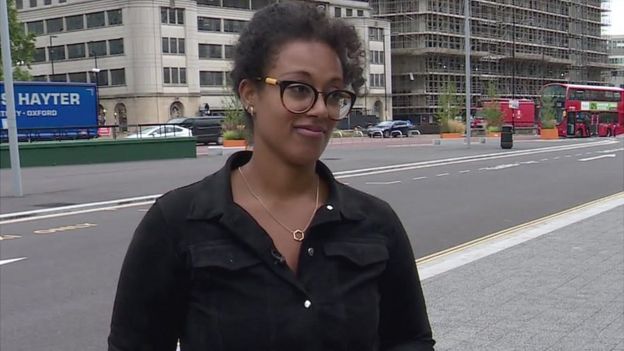
Theatre technician Charlotte Baker, 29, is out of work as a result of the coronavirus crisis.

She started a new job at the Fairfield Halls in Croydon in September last year and was furloughed in March.
Charlotte Baker

In June, she was made redundant, even though she could have been kept on furlough.

Now management at the Fairfield Halls has said the venue will not reopen until April next year, forcing her to contemplate a possible career change.

"It's definitely an uphill struggle and it's proving harder than previous ones," she told the BBC. "It's hard to have a positive outlook."

Charlotte has been looking into doing a carpentry course, but to obtain the necessary City and Guilds qualification would require her to spend £5,000 on training.

"It's a mountain to climb. I wouldn't mind climbing that mountain if it's something that I'm passionate about, but I'm not sure," she says.

"I'm hoping to make a decision by the end of August."

How is this affecting people who still have jobs?

Between April and June there were falls in pay for those still working, with regular pay levels down 0.2% compared with a year earlier - the first negative pay growth since records began in 2001.

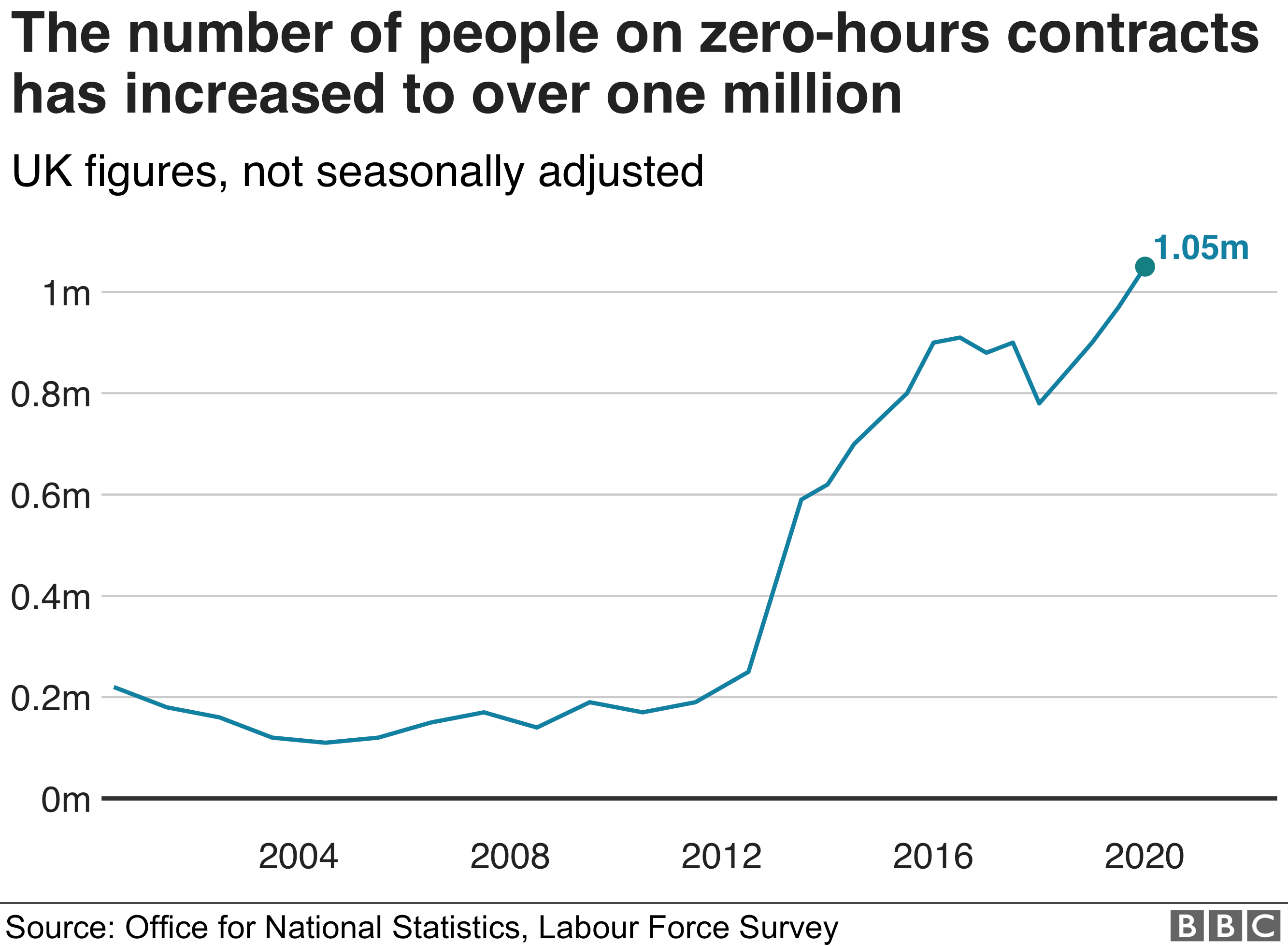
The number of people on zero-hours contracts also increased to more than one million.

"Early indicators for July 2020 suggest that the number of employees in the UK on payrolls is down around 730,000 compared with March 2020," said the ONS.

It believes the main reason this is more extreme than the fall in employment is because of workers who have a job but are not doing any paid work at the moment.

It added that a large number of people were estimated to be temporarily away from work, including furloughed workers - approximately 7.5 million in June 2020, with more than three million of these being away for three months or more.

The number of workers covered by the furlough scheme has since risen to almost 10 million.

The ONS said there had also been a sharp fall in the number of self-employed people between April and June.

It said there were 4.76 million self-employed people, 14.5% of all people in employment, a record 238,000 fewer than the previous quarter.

Presentational grey line

Is it all bad news?

Analysis box by Andy Verity, economics correspondent

If you're a glass-half-full sort of person, there is some less than awful news in the latest labour market figures.

The number of vacancies, for example, rose from its record low by 10% in May to July as lockdown restrictions were eased. The number of hours worked saw a record drop in the second quarter from April to June, but in July it was down by only 3%, less than half the fall in May and June.

However, there are some less jolly signs. The number on employer payrolls had only dropped marginally in the previous two months, but saw a much bigger drop in July, down 114,000, in spite of the reopening of many shops, restaurants and pubs.

And employers are increasingly making employees bear the risk that there isn't enough work for them to do, with the number of zero-hours contracts rising above one million for the first time.

And then there's the record drop in self-employment. And all this in spite of the government spending more than £40bn trying to protect employment through furlough and self-employed income support.

Unemployment tends to peak well after economic shocks have been and gone: this time will be no different.

Presentational grey line

What are economists saying?

Ruth Gregory, senior UK economist at Capital Economics, said the latest employment figures were "the lull before the storm".

She added: "The cracks evident in the latest batch of labour market data are likely to soon turn into a chasm, with the unemployment rate rising from 3.9% to around 7% by mid-2021."

She said further rises in unemployment in the coming months were "all but inevitable as the furlough scheme unwinds".

Capital Economics forecasts that the unemployment rate will peak at 7% in mid-2021 and remain above its pre-pandemic level of 4% until the end of 2022.

Ms Gregory said this suggested that the economic recovery would be "slow going".
Number of people on zero hours contracts

Jeremy Thomson-Cook, chief economist at Equals Money, said the figures showed the true level of those out of work had been "very effectively lowered by the government's furlough scheme" and that the worst lay ahead.

"Unfortunately, the end of the furlough scheme will present a cliff-edge, statistically and economically, for those currently relying on government support to make up their wages."

What's the political reaction?

Chancellor Rishi Sunak said: "Today's labour market stats make it clear that our unprecedented support measures, including the furlough and self-employed support schemes, are working to safeguard millions of jobs and livelihoods that could otherwise have been lost."

He said the government could not protect every job, but it did have "a clear plan to protect, support and create jobs to ensure that nobody is left without hope".

Shadow work and pensions secretary Jonathan Reynolds said it was "extremely worrying" that older workers, the self-employed and part-time workers had been hit hardest.

"Labour has repeatedly warned the government their one-size-fits-all approach will lead to job losses. These figures confirm what we feared - Britain is in the midst of a jobs crisis."

Friday, August 7, 2020

BBC News - Bank of England boss Bailey backs end of furlough scheme

 The Governor of the Bank of England has backed the government's decision to end its furlough scheme in October.

Andrew Bailey told the BBC it was important that policymakers helped workers "move forward" and not keep them in unproductive jobs.

He said coronavirus would inevitably mean that some jobs became redundant.

The Bank also predicted the economic slump caused by Covid-19 will be less severe than expected, but warned the recovery will also take longer.

More than nine million jobs have been furloughed under the government's job retention scheme, but the Bank expects most people to go back to work as the economy recovers.

Trade unions have urged Chancellor Rishi Sunak to extend the scheme, which pays a share of workers' wages, to avoid mass job losses.

However, Mr Bailey said it was right to focus on helping people to find new jobs.

"It's been a very successful scheme, but he's right to say we have to look forward now," he said. "I don't think we should be locking the economy down in a state that it pre-existed in."

Faster rebound

The Bank said a faster easing of lockdown measures and a "more rapid" pick-up in consumer spending had helped the economy rebound faster than it had assumed in May.

Its latest Monetary Policy Report showed spending on clothing and household goods were back to pre-Covid levels.

However, the Bank warned of a "material" rise in unemployment this year as it held interest rates at 0.1%.

Mr Bailey said recent data suggested the recovery in consumer spending was gaining traction, while spending on food and energy bills remained above pre-Covid levels.

He said: "We have had a strong recovery in the last few months. The pace puts the economy ahead of where we thought it would be in May."

However, Mr Bailey cautioned against reading too much into recent figures: "We don't think the recent past is necessarily a good guide to the immediate future," he said.

The Bank said spending on leisure and entertainment, which accounts for a fifth of all consumer spending, remained subdued.

Business investment was also weak, which would weigh on the recovery.

Slower recovery

The Bank expects the UK economy to shrink by 9.5% this year.

While this would be the biggest annual decline in 100 years, it is not as steep as its initial estimate of a 14% contraction.

The Bank said the UK still faced its sharpest recession on record, with the outlook for growth now "unusually uncertain".

Mr Bailey said it was the "largest quantum of uncertainty in a forecast" that policymakers had ever published.

The Bank expects the UK economy to grow by 9% in 2021, and 3.5% in 2022, with the economy forecast to get back to its pre-Covid size at the end of 2021.

This compares with growth estimates of 15% and 3% respectively, in a scenario the Bank set out in May.

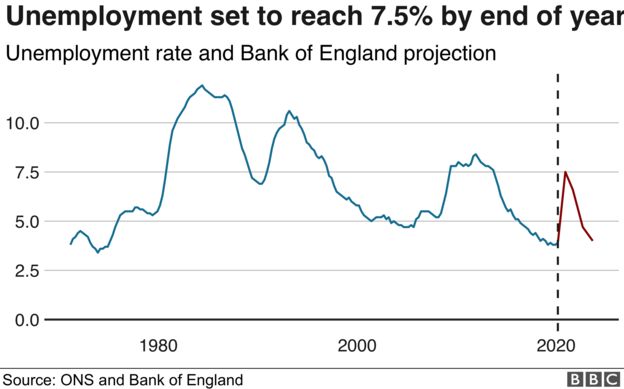
Unemployment to reach 7.5% by end of year - chart

Unemployment is expected to almost double from the current rate of 3.9% to 7.5% by the end of the year as government-funded support schemes come to an end.

Average earnings are also expected to shrink for the first time since the financial crisis.

The Bank said more workers faced a pay cut or freeze in 2020, adding: "In many cases, bonuses have been scaled back or withdrawn altogether for this year."

Its latest forecasts are based on the assumption that there is no second wave of the virus and that there is a smooth transition to a new EU free trade agreement at the start of 2021.

Meanwhile, a fall in energy prices and the temporary VAT cut for hotels, theme parks and other hospitality businesses means the cost of living is expected to barely rise this year.

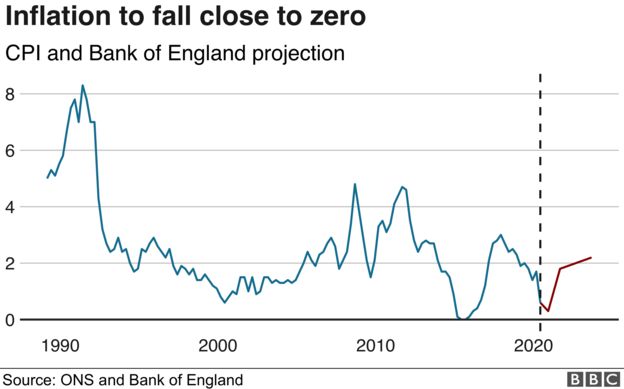
The Bank expects inflation, as measured by the consumer prices index (CPI), to fall close to zero by the end of 2020, before gradually rising back to its target of 2%.

Inflation to fall close to zero - chart

Negative rates 'under review'

The Monetary Policy Committee (MPC) said it would not even think about raising interest rates until there was "clear evidence" the recovery had taken hold.

Mr Bailey also signalled that policymakers were against using negative interest rates any time soon, adding that such a move may have unintended consequences.

It could stop the UK's already fragile banks from lending, or lead to customers withdrawing their money and holding it in cash.

Policymakers also noted that High Street banks would find it difficult to cut savings rates below zero.

"They are part of our toolbox," said Mr Bailey. "But at the moment we do not have a plan to use them."

Woman on computerImage copyrightGETTY IMAGES

He said the public may find the policy difficult to understand. "There would be a lot of explaining to do on what this means, why we're doing it, and what the benefits would be."

Ruth Gregory, an economist at Capital Economics, said the Bank was likely to increase its money printing programme by a further £100bn later this year.

She also expects the Bank to keep interest rates at 0.1% "or below" for "at least five years".

Are banks passing rate cuts on?

Millions of households that already had a variable-rate mortgage have benefitted from recent interest rate cuts.

However, the Bank said borrowing had become more expensive over the past six months for first-time buyers and others moving up the property ladder, particularly for people with small deposits.

Banks also continued to reduce rates on savings accounts. The average instant-access savings account now pays 0.1% annual interest, compared with 0.4% in February.

Lenders said they were restricting credit due to the uncertain economic outlook.

One in six mortgages in the UK is currently subject to a payment holiday because of the pandemic.


Virus is 'worst shock' in company's 49-year history

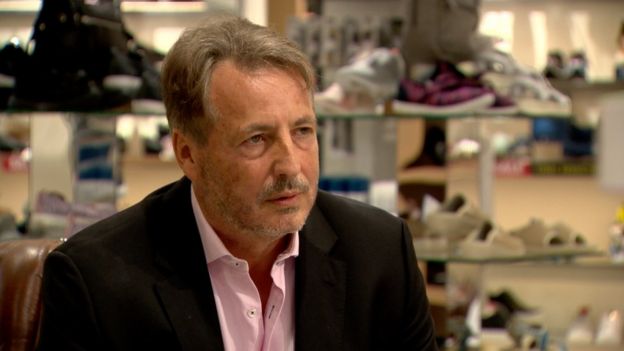
Stuart Paver, MD of Pavers Shoes

Stuart Paver, the managing director of Pavers Shoes says the pandemic is the "worst shock" the company's suffered since it was founded by his mother in 1971.

The company which has always been profitable, has now lost £7m over the past five months.

"We went from having 170 stores to no stores, and 1500, 1600 people on furlough", he says.

"It's about survival and how you come through and how you have a business that can continue to employ as many people as possible, so it was really batten down the hatches ..and really just sort of work hard to make sure we were secure".

The company is now gradually reducing the number of furloughed workers and turnover in the stores is picking up, but Stuart Paver says it's still down 40% from last year. Normally in a recession, he'd expect to lose between 5 and 8% of his turnover.

Mr Paver thinks recovery for businesses like his depends on consumer confidence.

"There's still a lot of people that won't venture into town.. we just need those people to become confident and come back in".

Thursday, August 6, 2020

Reuters News - Exclusive: Fauci says regulators promise politics will not guide vaccine timing

WASHINGTON (Reuters) - U.S. regulators have assured scientists that political pressure will not determine when a coronavirus vaccine is approved even as the White House hopes to have one ready ahead of the November presidential election, the country’s leading infectious diseases expert Anthony Fauci said on Wednesday.

“We have assurances, and I’ve discussed this with the regulatory authorities, that they promise that they are not going to let political considerations interfere with a regulatory decision,” Dr. Fauci told Reuters in an interview.

“We’ve spoken explicitly about that, because the subject obviously comes up, and the people in charge of the regulatory process assure us that safety and efficacy is going to be the prime consideration,” he said.

President Donald Trump, a Republican, is behind Democrat Joe Biden in public opinion polls ahead of the Nov. 3 election. Trump has lost ground in part due to voter concerns over his handling of the coronavirus pandemic.

A vaccine announcement in October could help Trump’s chances in the nationwide vote.

“I’m certain of what the White House would like to see, but I haven’t seen any indication of pressure at this point to do anything different than what we’re doing,” said Fauci, director of the National Institute of Allergy and Infectious Diseases.

“I mean obviously they’ve expressed: ‘Gee, it would be nice, the sooner the better.’”

Trump has suggested publicly that a vaccine could be ready long before the end of the year. In the interview Fauci offered a more conservative view, suggesting drugmakers will likely have tens of millions of doses of coronavirus vaccines in the early part of next year.

Fauci and other doctors on the White House Coronavirus Task Force, including its coordinator Deborah Birx, have come under criticism from the president for portraying the pandemic in less rosy terms than he has sought to emphasize.

Trump said in a recent interview with Axios that the virus was “under control.”

Asked if he shared that assessment, Fauci said some parts of the country were more under control than others.

“We’re a big country. You can pick out some parts of the country that are looking good and you could say is under control; you could pick some parts of the country that are on fire, in the sense, I mean you’re having outbreaks that you know you don’t get 70,000 cases a day when nothing’s going on.”

More than 157,000 people have died in the United States from COVID-19 and more than 4.7 million cases have been reported in the country and its territories, according to Reuters tallies.

Earlier this week the president criticized Dr. Birx for giving a sobering description of the state of the pandemic.

Fauci said the doctors try to focus on the science rather than political distractions.

“What we try to do, you know maybe some could do it better than others, is to focus like a laser on what we’re supposed to be doing: getting this epidemic under control,” he said.

Fauci said differences in the seriousness with which people had taken the virus in the United States had hampered the response to the pandemic in comparison to other countries.

“We have somewhat of a disjointed approach to things,” he said. “If we had a uniformity of it, and everybody rode together in the same boat, we probably would do much better.”

Fauci and other medical professionals have urged Americans to wear masks and maintain a social distance to prevent the spread of the virus. He lamented the fact that mask-wearing had become political earlier in the pandemic.

Trump declined to wear a mask in public for months and Vice President Mike Pence faced criticism for not wearing one when he visited the Mayo Clinic in April.

“Thank goodness that’s changed,” Fauci said. “I’m very pleased now that we’re seeing the vice president consistently wearing a mask, the president tweeting that you should be wearing masks. That’s a good thing. That’s a step in the right direction.”

Reporting by Jeff Mason in Washington and Michael Erman in New Jersey; Editing by Howard Goller

Wednesday, August 5, 2020

BBC News - Gold price rises above $2,000 for first time

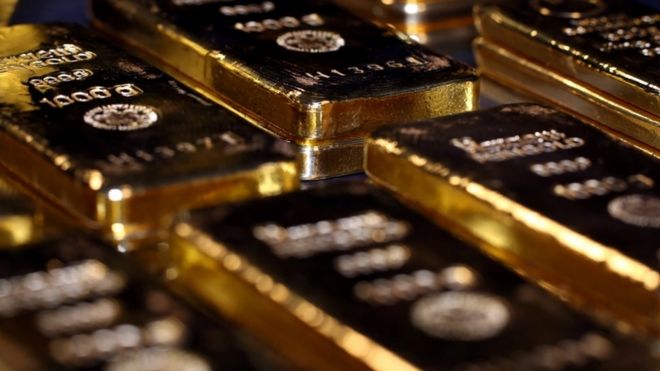
Gold bars stacked in a safe deposit box room.Image copyrightREUTERS

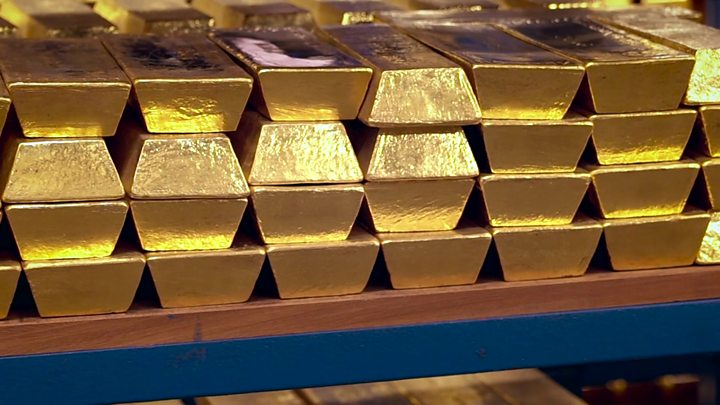
Gold has topped $2,000 (£1,527) an ounce for the first time as traders look for havens amid the pandemic.

Investors have moved cash into the precious metal as Covid-19 cases rise in the US and more money is pumped into the global economy.

The record high gold price has also been driven by concerns over tensions between Washington and Beijing.

Prices of other precious metals, including silver, have also risen sharply since the start of this year.

The price of gold has increased by more than 30% this year as coronavirus cases continue to rise in America, causing dozens of states to halt or reverse their plans to reopen.

The rapid rise in cases, which has dented hopes of a swift US economic recovery, has also helped to drive up the price of silver by around a third this year.

Among the reasons for those rises is investors preparing themselves for a possible pick-up in inflation due to the impact of trillions of dollars of stimulus from governments and central banks around the world.

In Washington, Trump administration negotiators have said that they will work "around the clock" with Democrats as they attempt to strike a deal on more economic relief measures by the end of the week.

According to Bank of America, governments around the world have already announced approximately $20tn worth of stimulus to combat the economic impact of the pandemic.

Media captionThe BBC’s Frank Gardner has been given access to the Bank of England’s gold vaults

Some investors see the fallout from the Covid-19 crisis, along with ongoing tensions between the US and China, continuing to push up the price of gold.

Market strategist Margaret Yang says she sees potential for bullion to continue rising in the coming weeks and months: "The mid-to-long-term prospect of gold and other precious metals remains bullish against the backdrop of low interest rate environment and fiscal and monetary stimulus."

Peter McGuire from XM.com said he sees gold reaching "$2,200 by Christmas" with silver, platinum and palladium also set to see strong gains.

Tuesday, August 4, 2020

Reuters News - U.S. Energy Department recommends granting partial retroactive waivers to refiners: sources

NEW YORK (Reuters) - The U.S. Department of Energy has recommended that some of the oil refiners that applied for retroactive exemptions from the nation’s biofuel blending law be granted partial relief, two sources familiar with the matter said on Tuesday.

The move could help bring those refining companies into compliance with a court ruling earlier this year that requires waivers granted since 2010 to take the form of an extension - the latest twist in a long-running battle between the refining and biofuel industries over the program.

At present there are 58 pending requests from refiners for waivers covering the years 2011 through 2018, according to government data. The sources said the DOE recommended to the U.S. Environmental Protection Agency, which has final say on the waivers, that “a number” of those requests be partially granted. The sources, who requested anonymity in order to speak candidly, could not immediately provide further details.

EPA and DOE did not immediately comment.

Under the U.S. Renewable Fuel Standard (RFS), oil refiners must blend billions of gallons of biofuels into their fuel, or buy credits from those that do. Small refiners that prove the rules would financially harm them can apply for exemptions.

ADVERTISEMENT

In January, the Denver-based 10th U.S. Circuit Court of Appeals ruled that waivers granted to small refineries after 2010 had to take the form of an “extension.” That cast doubt over the waiver program because most recipients of waivers in recent years have not continuously received them each year since 2010.

Biofuel advocates say blending waivers hurt demand for corn-based ethanol. The oil industry disputes that, and says blending requirements are too expensive.

The EPA has 90 days to act on a petition after the date of receipt of the petition, according to EPA guidelines.

Biofuel advocates urged EPA to reject the retroactive requests.

“These ‘gap year’ waivers need to be thrown in the garbage and the 10th circuit decision applied nationwide,” said U.S. Senator Joni Ernst of Iowa, the top ethanol-producing state.

Reporting by Stephanie Kelly in New York; Editing by Matthew Lewis and David Gregorio