Thursday, August 20, 2020

Reuters News - Fear fading on Wall Street as investors learn to love the new bull market

 (Reuters) - Fear is ebbing on Wall Street, with stocks on a bull run in the midst of the global coronavirus pandemic.

The Cboe Volatility Index , known as Wall Street’s “fear gauge,” is near its lowest level since late February and options markets are showing diminishing concerns of a near-term drop in equities.

The S&P 500's .SPX run to fresh highs has come as some of Wall Street's biggest banks, including Goldman Sachs, UBS Global Wealth Management and Morgan Stanley, turn more bullish on stocks and are urging clients to remain exposed to equities. The index ended at a record high on Tuesday, confirming a bull market, according to one definition.

Investors may well heed their advice: nearly 80% of fund managers surveyed by BofA Global Research, the highest level in more than a decade, expect the global economy to grow over the next year. The survey also showed falling allocations to cash, another sign of increasing bullishness.

The growing optimism is in contrast to the fear and gloom that prevailed on Wall Street only months ago, after the S&P 500 plunged 34% in just 23 trading days and the economy entered a recession that would turn out to be its worst since the Great Depression.

Although financial pain remains acute for many Americans, monetary support from the Federal Reserve and expectations for advances in fighting the coronavirus pandemic have made investors more confident in betting on the future, said Quincy Krosby, chief market strategist at Prudential Financial.

“You have a market that sees that we’re getting closer and closer to a more normal world,” she said.

Options markets are among the areas reflecting fading investor worries. Demand for protection against drops in U.S. equities of 30% or more has fallen as volatility has eased in recent months, said Paul Sandhu, BNP Paribas Asset Management’s head of multi-assets quant solutions in the Asia-Pacific region.

“The fear has definitely lessened over the (past) couple of months,” he said.

Meanwhile, selling of protective put options in individual stocks is up over the past week, said Christopher Murphy, co-head of derivatives strategy at Susquehanna Financial Group. Put sellers profit if the underlying stock does not drop to a specified level.

The put selling suggests investors are less worried about the downside, Murphy said.

In futures markets, net long equity positioning is now at its highest level since early March, with increases in both large-cap and small-cap stocks, Deutsche Bank data showed.

The increasingly bullish positioning dovetails with the messages coming from big Wall Street banks. Goldman Sachs, for instance, raised its year-end target for the S&P 500 earlier this week to 3,600 from 3,000, citing expectations for outsized growth in U.S. corporate earnings and gross domestic product next year.

Stocks have dipped since Tuesday, but several market strategists said they saw the pullback as routine rather than a sign that equities had been overbought.

Yet there are plenty of reasons for investors to be nervous and some remain skeptical of buying near all-time highs.

One concern is the potential of market volatility stemming from delayed or contested results in November's U.S. presidential election. The Dow Jones Industrial Average .DJI fell 5% in two weeks on the heels of a vote recount in the 2000 presidential election, UBS noted.

Other risks include a resurgence of COVID-19 cases, delays in a vaccine or delays by lawmakers in providing more stimulus to the still-ailing economy.

Some of that uncertainty has been reflected in the price of gold, a popular haven that has climbed to record highs this month. Prices recently got an additional boost after Berkshire Hathaway Inc (BRKa.N) disclosed a stake in Barrick Gold Corp (ABX.TO).

Still, some investors believe the prospect of economic recovery now outweighs those risks. Keith Lerner, chief market strategist at Truist/SunTrust Advisory Services, is maintaining an overweight position in U.S. equities.

“We’re not taking anything off the table,” he said. “We’re staying with the primary trend, which is still higher.”

Reporting by April Joyner in New York and Tom Westbrook in Singapore; Editing by Dan Grebler

Tuesday, August 18, 2020

BBC News - Thousands of migrants denied help in the pandemic


Jeremiah
Image captionJeremiah fell through the welfare safety net at the start of the pandemic

Poverty and destitution. That's the reality for thousands of migrants in the UK since the pandemic started.

As lockdown hit, migrants across the nation who often work in casual and low-paid roles saw their jobs disappear or incomes slashed.

But unlike the rest of the country, they have no welfare safety net to fall back on, because a controversial immigration policy known as No Recourse to Public Funds (NRPF) means they cannot access benefits.

Recently-released government figures show that applications to the Home Office for the ban to be lifted rose by more than 500% during lockdown compared with the first three months of the year.

That gives an indication of the unprecedented level of financial hardship that families across the country are experiencing.

There are an estimated 1.4 million migrants to the UK from outside the EU who have visas subject to this rule, according to the Migration Observatory, at the University of Oxford.

These migrants cannot receive most government-funded benefits, including child benefit, child tax credits, council tax benefit and disability living allowance. As a last resort, many migrants are having to turn to charities for help.

The Joint Council for the Welfare of Immigrants (JCWI) says that for the first time in its 53-year history, in addition to its advisory services, it's also providing material support such as cash, food and clothing to migrants.

"During the pandemic, people have been unable to do work that they were otherwise doing," says JCWI chief executive Satbir Singh.

"If that's been casual work or informal work or cash in hand, they obviously don't have access to job retention schemes or the support schemes for self-employed.

"So we've seen an increase in people becoming street homeless, acutely hungry and not being able to afford even basic medication because they literally have no support available to them."

Four months of poverty

Jeremiah (not his real name) is a migrant from Africa with permission to live and work legally in the UK on a temporary basis.

He has been in the UK for 16 years, working in construction helping to build new homes in and around London. He lives with his wife and three children.

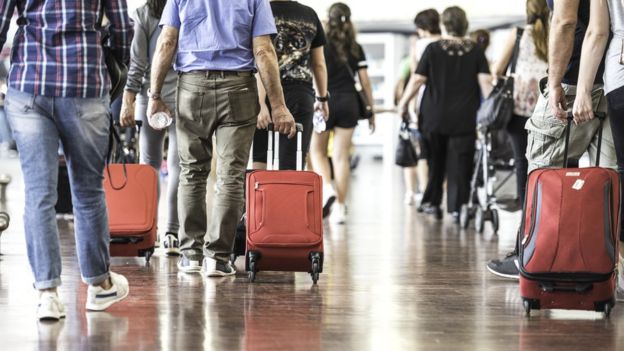
UK airportImage copyrightGETTY IMAGES
Image captionMigrants can wait months for a decision on whether they are entitled to benefits

His casual work in construction stopped abruptly following lockdown. Since then, he's struggled to provide for his family.

At the start of lockdown, NRPF barred him from claiming any benefits, including child benefit for all three of his British-born children, although he had been paying taxes on his income for years,

"I've not worked since March this year," he said, adding that he had been having sleepless nights, while he and his wife had had to cut back to one meal a day in order to make sure their children had enough to eat.

After the BBC spoke to Jeremiah, he got in touch to say his application for NRPF to be lifted was successful. He says he is relieved to finally get access to financial support, but is angry his family had to endure four months of poverty while waiting for a decision.

Since Covid-19 was declared a global pandemic, the Citizens Advice Bureau says it receives calls every 20 minutes from migrants desperate to access benefits.

Migrants who are applying for, or who have, leave to remain on family or private life grounds can apply to the Home Office for NRPF to be lifted. But the decision can take months.

Suspension call

Charities across the sector, the Local Government Association and the Work and Pensions Committee have recommended the government suspend NRPF altogether during the coronavirus crisis.

MP Stephen Timms, who chairs the committee, says: "What we need is for the 'no recourse to public funds' restriction to be suspended for the duration of this crisis.

"So that hard-working, law-abiding families can apply for universal credit, just as three million other people have done since this crisis began."

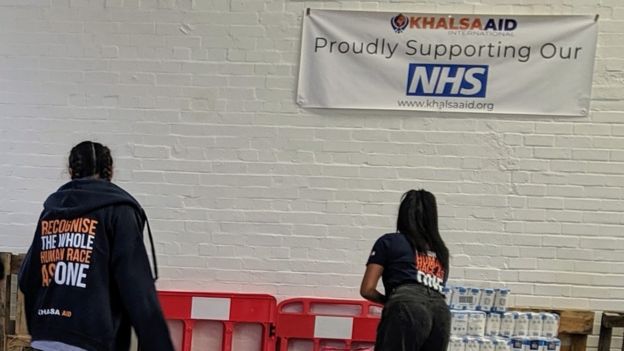
Khalsa Aid workers
Image captionKhalsa Aid delivers food parcels to migrants who need them

Home Secretary Priti Patel insists there are safeguards in place to support those affected and that the policy is in the public interest.

A government spokesperson said: "We have been clear that no one should find themselves destitute during this crisis due to circumstances beyond their control.

"Extensive action to support those with no recourse to public funds has been taken, such as rent protections, the Job Retention Scheme, the Self-Employed Income Support Scheme, allocating more than £3.2bn to local authorities and £750m for charities to support the most vulnerable."

But charity Khalsa Aid, which normally supports international refugees, says it is not seeing that financial boost filter down to people on the ground.

It set up a food parcel delivery service soon after lockdown, responding to migrants on student visas and undocumented migrants who were struggling to feed themselves.

The charity's workers are delivering more than 200 food parcels each week. Jagdeep Khera, a 22-year-old student and full-time volunteer there, says demand for food boxes has been overwhelming and that it continues to rise as more people find out about their service.

Public health issue

Undocumented migrant workers without official immigration status have no option at all to access welfare.

Pavan Sharma (not his real name) arrived in the UK from India almost 20 years ago. He has been homeless for much of that time. He works for cash in hand for as little as £5 a day - because of the pandemic, that work has gone.

He has been housed by the government as part of their Everyone In scheme for the homeless, but knows the emergency accommodation will come to an end soon.

He thinks the government should give undocumented migrants temporary permission to stay and work in the country. Similar schemes are under way in Italy and Portugal.

"I don't want recourse to public funds. All I need is for the government to give me a document that says I am Pavan Sharma with permission to work," he says.

"I would be independent of the state. I could save some money, leave the shelter, rent a room. I would be able to carry on with my life working six days a week."

The Citizens Advice Bureau points out that the overwhelming majority of people affected by NRPF are people of colour. Black and ethnic minorities, Public Health England says, are also disproportionately affected by Covid-19, partly because of their over-representation in frontline key worker roles.

And without access to benefits, they are incentivised to work even if they are sick or need to shield, which makes NRPF a public health issue.

Satbir Singh, from JCWI, argues NRPF as a policy should be lifted on public health grounds alone.

"It's creating more danger by creating spaces in which people won't necessarily access health care, in which people will work in dangerous conditions," he says.

"It's a political strategy of being as performatively hostile as possible to migrants. And that's why we don't see any movement."

For the time being, those migrants fortunate enough to qualify can apply for NRPF to be lifted on a case-by-case basis.

For the thousands of migrants who don't qualify and who have been affected by coronavirus, charities say they are at heightened risk of, or are already living in, poverty.

They warn that the coronavirus crisis, alongside hostile immigration policy, will only widen existing economic inequalities in the UK.

Monday, August 17, 2020

BBC News - Coronavirus: Japan suffers its biggest economic slump on record

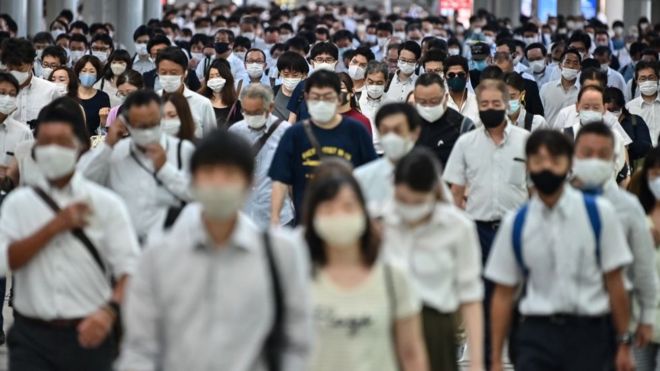
Early morning commuters in Tokyo.Image copyrightGETTY IMAGES

The Japanese economy has shrunk at its fastest rate on record as it battles the coronavirus pandemic.

The world’s third largest economy saw gross domestic product fall 7.8% in April-June from the previous quarter, or 27.8% on an annualised basis.

Japan was already struggling with low economic growth before the crisis.

The figures released on Monday are a stark reminder of the severe financial impact faced by countries around the world.

Japan slipped into recession earlier this year following two successive quarters of economic contraction.

Its latest data for the April to June quarter was the biggest decline since comparable figures became available in 1980 and was slightly bigger than analysts had expected.

One of the main factors behind the slump was a severe decrease in domestic consumption, which accounts for more than half of Japan's economy. Exports have also fallen sharply as global trade is hit by the pandemic.

The latest data is the third successive quarter of declines for the Japanese economy, representing its worst performance since 1955.

The downturn puts further pressure on a Japanese economy that was already struggling with the effects of a sales tax hike to 10% last year, along with typhoon Hagibis.

Presentational grey line

After the slump, hopes of a bounce

Analysis box by Karishma Vaswani, Asia business correspondent

Japan is the latest in a string of Asian economies to report drastically lower second quarter GDP data.

That shouldn't be a surprise: no one escaped the reach of the pandemic, and even if there weren't strict lockdowns put in place, people generally stayed indoors and didn't spend money.

That has a knock-on effect on corporate earnings, as consumers buy less and so companies earn less.

It's a vicious cycle that in turn leads to a lack of confidence about hiring prospects - which means there's also nervousness about job prospects. All of that is showing up in the numbers today.

Still, now is the time to look to the future and to the possibility of a rebound.

Japan is likely to do better than other economies according to some analysts. Capital Economics says even though the world's third largest economy is in the midst of a second wave of infections, its health care systems aren't overwhelmed, and new cases have started to decline. The research house says it expects to see third quarter GDP bounce back - and continue through to next year.

Presentational grey line

Ray of light

After the record contraction most analysts expect Japan's economic growth to rebound in the coming months.

Prime Minister Shinzo Abe has introduced massive stimulus packages aimed to help cushion the blow of the pandemic.

While Japan lifted state of emergency measures in late May, concerns remain that a recent spike in infections may again hit business and household spending.

China, the world’s second biggest economy, also offers some cause for hope. Its economy rebounded in the April to June period, with growth of 3.2%.

Friday, August 14, 2020

Reuters News - White House officials seek momentum with other countries after Israel-UAE deal

 WASHINGTON (Reuters) - Senior White House officials on Friday sought to use the momentum from a historic deal between Israel and the United Arab Emirates to appeal to more Arab and Muslim countries to set aside long-standing tensions and make similar agreements.

A senior White House official said President Donald Trump’s senior adviser, Jared Kushner, and Middle East envoy, Avi Berkowitz, had been in touch with “numerous” countries in the region, trying to see if more agreements would materialize. The official declined to name the countries.

On Thursday, Israel and the United Arab Emirates announced they would normalize diplomatic ties and forge a broad new relationship, a move that reshapes the order of Middle East politics. Trump helped broker the accord.

Speaking at a news conference, Trump predicted that other countries would be signing similar accords with Israel.

“What you will see now is other countries will come into that deal and you will have peace in the Middle East,” he said.

Speculation has centered around two Gulf nations, Bahrain and Oman, both of which welcomed the deal. Sudan was also a subject of speculation.

Bahrain hosted a U.S.-led Middle East conference a year ago, aimed at raising money for the Palestinians and Jordan as part of Trump’s Middle East peace initiative.

“There are numerous countries that we have been in contact with literally in the last 24 hours,” said the official. “We have been in contact with officials from numerous countries, Arab and Muslim, in the Middle East and Africa.”

The Israel-UAE deal was viewed widely as a foreign policy victory for Trump as he struggles to contain the coronavirus pandemic in the United States and resulting economic recession while facing a tough battle for re-election on Nov. 3.

Trump said on Thursday he expected to have a signing ceremony for the deal in about three weeks, with delegations from each country.

Kushner and Berkowitz are making the case to other countries that improved ties with Israel could have economic benefits and help counter Iranian influence in the region.

“If you’re an Arab or Muslim country and you see the positive reception the world gave this agreement, it would be natural to see this as a really historic time and opportunity and we are optimistic ongoing negotiations will prove fruitful,” the official said.

Reporting by Steve Holland; Additional reporting by Jonathan Landay; Editing by Dan Grebler and Rosalba O'Brien

Thursday, August 13, 2020

BBC News - US holds off on threatened tariff hike in EU Airbus fight


Whisky tasting glassImage copyrightGETTY IMAGES
Image captionUS imports of Scotch whisky dropped 33% after tariffs were imposed last year

The US has said it will hold off an a threatened hike in tariffs on $7.5bn (£5.75bn) worth of European and UK goods that it imposed as punishment for subsidies for plane-maker Airbus.

The move comes as the two sides wrestle to put to an end their 16-year trade battle over state aid for Airbus and American rival Boeing.

The US last year raised border taxes on more than 100 items, including jumpers, single-malt whiskies and cheese.

It has said the EU has not done enough.

"The EU and member states have not taken the actions necessary to come into compliance with WTO decisions," America's top trade official, Robert Lighthizer, said on Wednesday. "The United States, however, is committed to obtaining a long-term resolution to this dispute.

The European Union cautiously welcomed the US decision not to increase the amount of goods subject to tariffs.

"The commission acknowledges the decision of the US not to exacerbate the ongoing aircraft dispute by increasing tariffs on European products," an EU spokesperson said.

Airbus last month said it would alter some deals responsible for the dispute, saying the changes, including increasing its interest rates on loans with France and Spain, eliminated "any justification" for the US border taxes.

The move prompted EU officials to call for an end to "unjustified" tariffs. Many American businesses have also protested the duties, which raise prices for American buyers.

On Wednesday Airbus spokesman Clay McConnell said in a statement the company "profoundly regrets that, despite Europe's recent actions to achieve full compliance, USTR [US Trade Representative] has decided to maintain tariffs on Airbus aircraft - especially at a time when aviation and other sectors are going through an unprecedented crisis."

When did the tariffs start?

The US announced tariffs on $7.5bn worth of goods last year after the World Trade Organization ruled that state aid provided to Airbus to launch its A380 and A350 jets was illegal and authorised American retaliation.

In February, the US raised the rates being charged on aircraft from 10% to 15%, leaving the 25% duty on other items unchanged.

This summer, American officials again threatened to raise tariff rates or make new items subject to the import tax.

The items threatened with new duties included salmon fillets, gin and olives.

The US is required by law to review the tariffs periodically. On Wednesday it announced minor tweaks to the list, for example, removing sweet biscuits like shortbread made in the UK and adding jams from France and Germany.

Trade lawyer Jamieson Greer, former chief of staff to US Trade Representative Robert Lighthizer, told the BBC: "The reality is that this can all be solved if Airbus took some action to provide restitution."

More tariffs ahead?

The European Union, which brought its own case challenging American subsidies for Boeing, has threatened to hit the US with tariffs of its own. It is waiting for the World Trade Organization to decide how big such a punishment might be.

The US in May said it had eliminated the benefits in dispute. That WTO ruling is expected later this year.

"In the absence of a settlement, the EU will be ready to fully avail itself of its own sanction rights," Trade Commissioner Phil Hogan said last month.

The issue has also complicated trade talks between the US and the UK.

UK Trade Secretary Liz Truss raised the matter in talks with Mr Lighthizer this month, as the two sides held a third round of negotiations.

Ms Truss said that while she welcomed the US's decision not to lift levies: "The announcement does not address tariffs that already exist on goods like single malt Scotch whisky."

She said: "These tariffs damage industry and livelihoods on both sides of the Atlantic and are in nobody's interests. I am therefore stepping up talks with the US to remove them as soon as possible."

Wednesday, August 12, 2020

Reuters News - S&P 500 jumps more than 1%, again close to record high

 (Reuters) - The S&P 500 jumped on Wednesday, putting it just points away from its record closing high in a broad rally led by tech stocks.


After closing lower on Tuesday amid worries over a stalemate in U.S. fiscal stimulus bill talks, the S&P 500 was up more than 1% in afternoon trading and once again within striking distance of its record high close of 3,386.15 from Feb. 19, before the onset of the coronavirus crisis in the United States that caused one of Wall Street’s most dramatic crashes in history.

Heavyweights Microsoft Corp (MSFT.O), Amazon.com Inc (AMZN.O) and Apple Inc (AAPL.O) were the top boosts to the S&P 500.

“We’re seeing buyers show up very quickly, any chance they get when the market declines. To me, that’s a very bullish sign,” said Adam Sarhan, chief executive of 50 Park Investments in New York.

The Nasdaq was the first of the three major indexes to bounce back to an all-time high in June. The Dow remains roughly 6% below its February peak.

With a better-than-feared second-quarter earnings season largely over, investors are preparing for the risk of a contested U.S. presidential election in the fall.

Democratic candidate Joe Biden on Tuesday picked Senator Kamala Harris as his choice for vice president.

Meanwhile, a breakdown in bipartisan talks over the next federal aid bill to help tens of millions of Americans suffering in the coronavirus pandemic entered a fifth day, with neither side ready to resume negotiations.

The Dow Jones Industrial Average .DJI rose 273.69 points, or 0.99%, to 27,960.6, the S&P 500 .SPX gained 48.82 points, or 1.46%, to 3,382.51 and the Nasdaq Composite .IXIC added 237.44 points, or 2.2%, to 11,020.26.

Tesla Inc (TSLA.O) jumped 14.1%, providing the biggest lift to Nasdaq, as it announced a five-for-one stock split in an attempt to make its shares more accessible to employees and investors.

Latest data showed U.S. consumer prices increased more-than-expected in July, but high unemployment is likely to keep inflation under control, allowing the Federal Reserve to continue pumping money into the economy.

Advancing issues outnumbered declining ones on the NYSE by a 1.69-to-1 ratio; on Nasdaq, a 1.21-to-1 ratio favored advancers.

The S&P 500 posted 31 new 52-week highs and no new lows; the Nasdaq Composite recorded 78 new highs and 21 new lows.

Additional reporting by Medha Singh and Ambar Warrick in Bengaluru; Editing by Arun Koyyur, Uttaresh.V and Tom Brown