WASHINGTON (Reuters) - The U.S. Justice Department on Monday threatened to revoke federal funding for New York City, Seattle and Portland, Oregon, saying the three liberal cities were allowing anarchy and violence on their streets.
“We cannot allow federal tax dollars to be wasted when the safety of the citizenry hangs in the balance,” Attorney General William Barr said in a statement.
Spokespeople for the mayors’ offices in all three cities could not be immediately reached for comment.
Many cities across the United States have experienced unrest since the May death of George Floyd. In some cases the protests have escalated into violence and looting.
The federal government has mounted a campaign to disperse the racial justice protests, including by sending federal agents into Portland and Seattle and encouraging federal prosecutors to bring charges.
Last week, the Justice Department urged federal prosecutors to consider sedition charges against protesters who have burned buildings and engaged in other violent activity.
Monday’s threat to revoke federal funds was the government’s latest escalation in its quest to curb the protests.
It comes after President Donald Trump earlier this month issued a memo laying out criteria to consider when reviewing funding for states and cities that are “permitting anarchy, violence, and destruction in American cities.”
The criteria to make the president’s list include things such as whether a city forbids the police from intervening or if it defunds its police force.
In all three cities, the Justice Department said the leadership has rejected efforts to allow federal law enforcement officials to intervene and restore order, among other things.
Reporting by Sarah N. Lynch; Editing by Steve Orlofsky
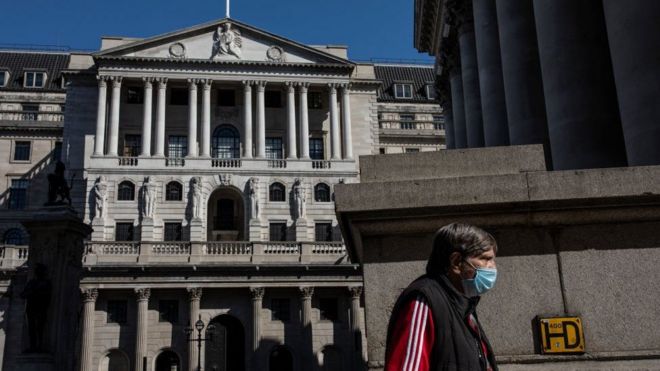
The Bank of England has warned that the rising rate of coronavirus infections and a lack of clarity over the UK's future trade relationship with the EU could threaten the economic recovery.
It said much of output lost during lockdown had been recovered but the outlook remained "unusually uncertain".
The UK is still in a deep recession, while Covid-19 infections are at their highest level since mid May.
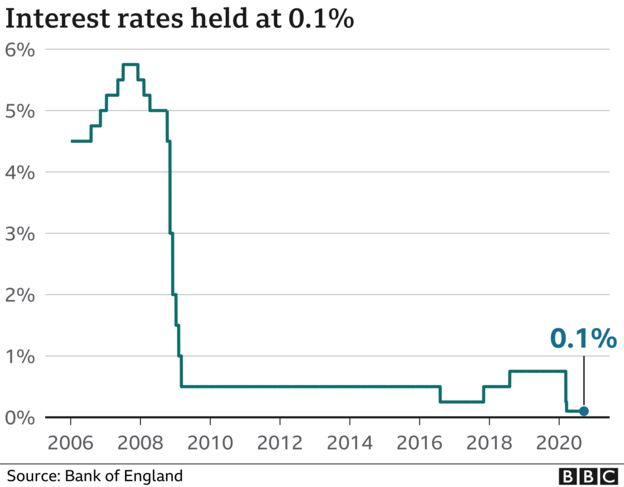
Citing the uncertainty, the Bank held interest rates at 0.1%, a historic low.
It added that it would continue its monetary support for the economy, but stopped short of increasing its bond-buying programme or reducing interest rates further.
What are interest rates?
If you borrow money you usually have to pay a small fee set by the person lending to you. How high that fee - or interest rate - is depends on a "base rate" that is set by the Bank of England at meetings throughout the year.
The rate determines how much banks have to pay to borrow money, and that has a knock-on effect on how much the bank charges consumers to borrow.
When the economy is growing quickly the Bank tries to stop it overheating by raising interest rates, making it more expensive to borrow.
When the economy is sluggish, cutting the Bank's base rate lowers the cost of borrowing and can encourage businesses and consumers to spend more.
The Monetary Policy Committee (MPC), which sets interest rate policy, said previous projections of economic recovery were "on the assumption of an immediate, orderly move to a comprehensive free trade agreement with the European Union on 1 January 2021".
Economic recovery would also depend on the evolution of the pandemic and measures taken to protect public health, the MPC said.
"The recent increases in Covid-19 cases in some parts of the world, including the United Kingdom, have the potential to weigh further on economic activity, albeit probably on a lesser scale than seen earlier in the year," it said.
No change from the Bank of England on record low interest rates, nor on its wider support for the economy. On the face of it, the economy is less weak than it expected even last month, but profound uncertainties remain.
The Bank in particular pointed to "recent increases in Covid-19", including in the UK, that "have the potential to weigh further on economic activity", as well as a recent fall in sterling partly "reflecting recent Brexit developments".
Given rates are at rock bottom already, sterling was further hit from the fact that the Bank's deliberations over rates included a presentation over how "negative interest rates" might work.
The Bank had been concerned of the impact of, in effect, lenders paying borrowers for the health of parts of the banking system. It is, as it has previously signalled, looking at how this could be achieved in practice. Should the uncertainties visible to all materialise in the coming weeks for the UK, that extraordinary and unprecedented tool is being prepared as an option.
The government has had to impose new social distancing restrictions across England, as rising cases have forced many areas into local lockdowns.
The Bank of England said despite a stronger than expected recovery in the last few months, the economy was still about 7% smaller than at the end of last year.
Usually if the economy is not growing strongly enough, the Bank of England considers lowering interest rates to encourage firms to invest and savers to spend.
However, interest rates are already close to zero after two emergency rate cuts in March.
Minutes from this month's meeting show that the MPC discussed the use of negative interest rates to stimulate the economy. Last month, the Bank's governor, Andrew Bailey, appeared to rule that out, though he said negative interest rates remained in the "tool box".
If interest rates are negative the Bank of England charges for any deposits it holds on behalf of the banks. That encourages banks to lend the money to business rather than deposit it.
The Bank also signalled that it had no intention of raising interest rates until "significant progress" had been made in getting inflation back to the Bank's 2% target. It is currently at a five-year low of 0.2%.
The Bank said it did not expect inflation to return to target levels for another two years.
"We expect interest rates to be no higher than 0.1% for the next five years," said Andrew Wishart, UK economist at Capital Economics.
The US central bank has pledged to continue its support for the US economy for several years, as households and businesses slowly recover from the impact of the coronavirus pandemic.
Most Federal Reserve leaders said they expected to keep interest rates near zero for at least the next three years.
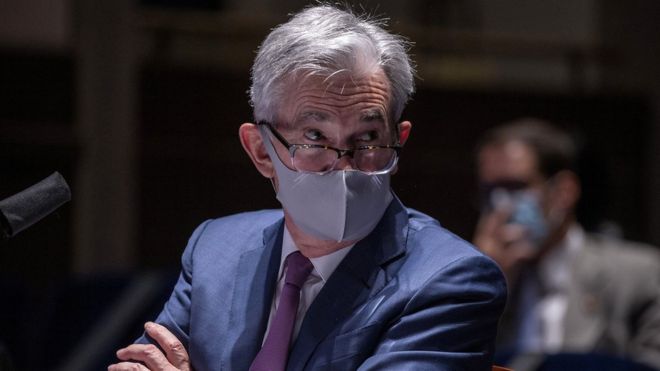
Fed Chair Jerome Powell said officials did not expect to change course until the recovery was "very far" along.
He also warned the rebound could be at risk without more government spending.
Following the bank's September meeting, Mr Powell said government aid for businesses and workers hurt by coronavirus had been "critical" to a better-than-expected recovery so far.
Outlook change
Projections released on Wednesday showed bank leaders expect the US economy to shrink by 3.5% this year - less than the 6.5% decline feared in June.
They also said they expected the unemployment rate to fall to about 7.6% by the end of the year, lower than previously anticipated.
But Mr Powell warned the recovery could falter, unless politicians approve additional aid.
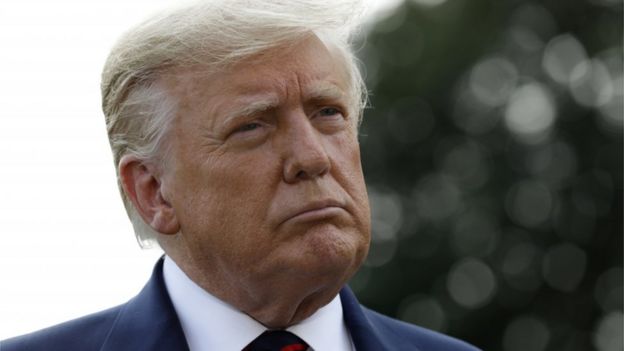
Image copyrightEPAImage captionThe economic uncertainty poses a risk for President Trump
"The real question is when and how much and what will be the content and no one has any certainty around that," he said. "If we don't have that, then there would certainly be downside risks."
Trump call for stimulus
Mr Powell's comments came as lawmakers in Washington remain at an impasse over further spending, with Democrats calling for more aggressive action than many Republicans support.
In a tweet, President Donald Trump on Wednesday urged his party to back "much higher numbers" for aid.
However, he has largely dismissed economic warnings, saying the US is doing "unbelievably well" and seizing on signs of recovery to make his case as he campaigns for re-election in November.
Polls show a majority of Americans still approve of the president's handling of the economy, but views of the economy have soured sharply since the pandemic.
Output in the US shrank by more than 9% between April and June.
While not as severe a decline as in many other countries - in the UK, the economy contracted by more than 20% - last month's jobless rate of 8.4% remained more than double the February level. Nearly 30 million Americans continue to collect unemployment benefits.
Fed response to pandemic
The Federal Reserve has taken what Mr Powell described as "forceful" steps in response, including dropping interest rates near zero and buying roughly $2tn in US government debt.
Last month, the bank also said it was relaxing its approach to managing inflation, targeting potentially higher price increases to try to stimulate growth and bolster employment.
On Wednesday, the bank confirmed that shift, saying it expected to leave interest rates near zero until inflation was "on track to moderately exceed" its 2% target "for some time".
Mr Powell on Wednesday said he hoped the bank's "highly accommodative" stance - keeping interest rates low and supporting borrowing with ongoing securities purchases - would serve as a "powerful tool" to spur economic activity over time.
"This is the kind of guidance that will provide support for the economy over time," he said.
But he has repeatedly said the bank's powers to address the current crisis are limited and urged Congress to approve further aid.
Dr Kerstin Braun, president of Stenn International, a UK-based trade finance provider, said Mr Powell "has done what he can to stop economic freefall".
"The US economy is crying out for fiscal stimulus given how uneven the pandemic's impact has been across a whole range of sectors - the economic rebound simply cannot be wholly organic," she said.
The Fed is operating "in the dark" amid so much political and economic uncertainty, said Neil Wilson, chief market analyst at Markets.com.
"All the Fed can really do is continue to stress its willingness to do whatever it takes and its willingness to overlook overshoots on inflation should they emerge," he said.
LONDON (Reuters) - Investors were generally cautious before the Federal Reserve meeting on Wednesday, boosting the yen, as the rally that pushed up shares after Chinese and U.S. economic data in the previous session slowed in early London trading.
Risk appetite was limited ahead of the U.S. Federal Reserve’s policy meeting, and its statement at 1800 GMT.
European shares were mixed at the opening, but then rose, with the Stoxx 600 up around 0.3%, pushed up by gains in retail stocks.
The MSCI world equity index, which tracks shares in 49 countries, was up 0.2% at 0724 GMT, while MSCI’s main European Index was up 0.3%.
The Fed is not expected to make changes to its monetary policy at the meeting, which will be its first since it announced that it would pursue average inflation targeting.
Although the economic projections are expected to be somewhat improved from the last round of forecasts in June, Fed Chair Jerome Powell is expected to stick to his message that the road to recovery will be long and uncertain.
“While acknowledging the more rapid improvement in the economic backdrop, we expect the message to remain one of caution,” wrote RBC Capital Markets analysts in a note to clients.
“There is no upside for the committee to be positive at this juncture.”
Investors will also be watching for U.S. retail sales data, due at 1230 GMT, which is expected to show a robust increase.
London’s FTSE 100 lagged other European indexes, down 0.4%, and the pound was down against the euro, weighed down by fears of a disorderly departure from the EU single market.
UK inflation dropped to its lowest rate in almost five years last month, led by a large reduction in meal prices.
“We’ve already started to see the early signs of the unemployment rate starting to edge higher, and with the furlough coming to an end next month and already being tapered, this deflationary wave is likely to get worse in the short term,” wrote Michael Hewson, chief market analyst at CMC Markets UK.
The yen hit a two-week high of 105.250 to the U.S. dollar overnight, as investors sought safer assets, and it held close to these levels at 105.325 at 0726 GMT.
Against a basket of currencies, the dollar was a touch weaker, down 0.1% at 93.005 at 0740 GMT.
The euro was up 0.1% at $1.18595.
High-rated eurozone government debt was little changed, with the benchmark German 10-year Bund yield at -0.483%.
Oil prices rose for a second day in a row, with U.S. crude oil hitting one week highs, up 2.4% at $39.21 a barrel at 0746 GMT.
Gold prices rose, up 0.5% at $1964.38 an ounce at 0747 GMT.
Elsewhere, the World Trade Organization ruled that the United States had breached global trade rules with the multibillion-dollar tariffs it imposed during its trade war with China.
The decision had limited market impact as it is only the start of a legal process that could take years.
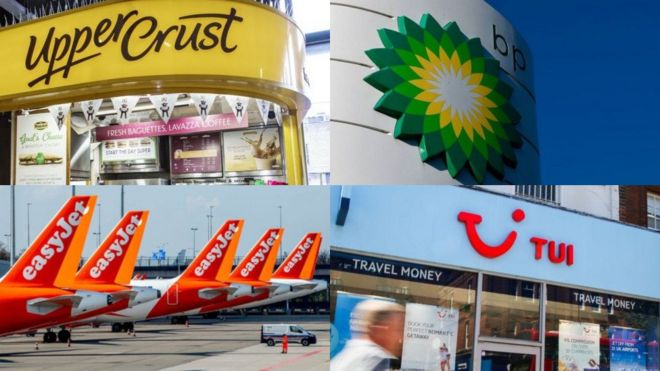
Image copyrightGETTY IMAGESImage captionA number of household names have announced redundancy plans since the pandemic began
Employers in Britain are planning more than twice as many redundancies than they did at the height of the last recession, new figures show.
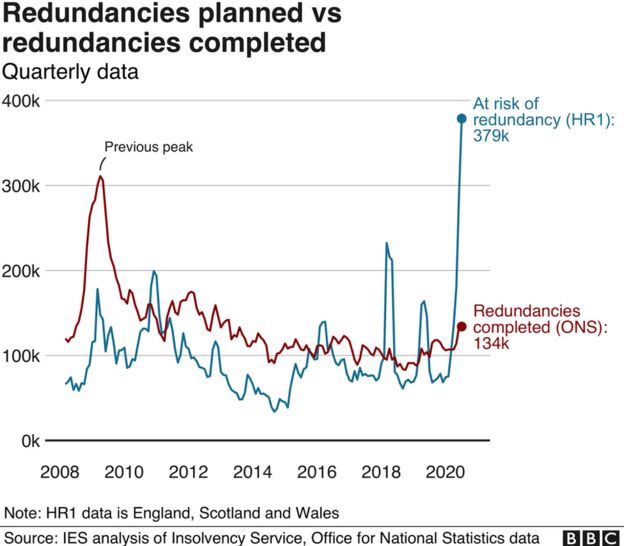
About 180,000 job cuts were planned from January to March 2009, while 380,000 were planned from May to July this year.
Completed redundancies could reach 735,000 this autumn, researchers say.
The figures were obtained by an Institute for Employment Studies (IES) Freedom of Information request.
Social distancing measures to prevent the spread of Covid-19 brought large parts of the UK economy to a standstill, forcing workers to stay at home, closing shops and bringing transport to a halt.
As a result, many businesses have been forced to consider reducing their workforces by making employees redundant.
Employers in England, Scotland and Wales must notify the Insolvency Service if they plan to make 20 or more workers redundant in any single "establishment" using a form called HR1.
This information is not usually published, but on 8 September a Freedom of Information request by the BBC revealed that employers had listed more than 380,000 positions as at risk between May and July 2020.
Image copyrightGETTY IMAGES
The IES has now obtained and analysed data stretching back as far as 2008.
This shows that the current redundancy wave is more than double the previous three-monthly peak of 180,000 from January to March 2009.
Then the crisis, which had begun in the finance industry, was affecting most of the economy - and forcing many employers to reduce their staff.
"Comparing what is happening now with what was happening in the last recession shows us we are experiencing a jobs crisis unlike anything we have seen before," said Tony Wilson, Director of the IES.
The IES is calling for extra support for viable firms to help them retain staff, as well as training and advice to help those who lose their jobs find new employment rapidly.
A government spokesperson said: "Supporting jobs is an absolute priority which is why we've set out a comprehensive 'Plan for Jobs' to protect, create and support jobs across the UK by providing significant, targeted support where it is needed the most."
Government measures include the £2bn "kickstart scheme" to encourage employers to create new training placements and apprenticeships, extra work coaches in job centres, and a £1,000 incentive to encourage employers to bring staff back from furlough.
Will these planned redundancies be completed?
Because they are filed at the start of the redundancy process, HR1 forms give an early indication of what is happening in the labour market.
The HR1 redundancy figures don't pick up employers cutting fewer than 20 jobs, so the final total of redundancies is usually higher.
The Office for National Statistics also publishes a redundancy count based on the Labour Force Survey, which is used to calculate the monthly unemployment rate.
This is always published a few months after the data is gathered, so it hasn't yet picked up a big spike in redundancies or unemployment.
However, Labour Force Survey redundancy figures have been around 20% higher than HR1 figures in recent years.
On this basis, the IES estimates that 445,000 jobs could be made redundant between July and September, considerably worse than the three-month peak in the previous recession.
During that recession, however, actual redundancies were 80% higher than notified redundancies - which could lead to as many as 735,000 positions being cut at the height of the coronavirus crisis.
However, companies sometimes announce plans redundancies which they don't actually make, because circumstances change.
Early 2019, for example, saw a big spike in redundancy plans which were never completed. Mr Wilson believes they could have been linked to fears of a no-deal Brexit, which did not happen.
The 2018 spike could be linked to the collapse of the construction company Carillion, which had a lesser impact on jobs than initially feared.
Companies in Northern Ireland file HR1 forms with the Northern Ireland Statistics and Research Agency and they are not included in these figures.
NEW YORK (Reuters) - The S&P and Nasdaq were lower on Friday as early gains in the technology sector and growth names faded, with each of the three major Wall Street averages on track for their second straight weekly decline.
After rising to a record high of $61.86, shares of Oracle Corp ORCL.N turned lower along with the rest of the technology sector .SPLRCT. The cloud services company's earnings beat estimates and it signaled a recovery in client spending due to higher demand led by the work-at-home trend.
The tech sector fell 1.39% and was on track for its fifth decline in six days and biggest weekly percentage decline since March as investors have moved away from companies such as Apple Inc AAPL.O that have helped spearhead the rebound in stocks from coronavirus-driven lows in March.
In addition, the sector was on pace to close below its 50-day moving average, a technical support level, for the first time since April 21.
Growth stocks .IGX, which include many tech names along with others that have benefited from government-imposed lockdowns such as Amazon.com Inc AMZN.O, also moved lower, down 0.82%. In contrast, value names .IVX edged up 0.09%.
“We are in another period out of growth and into value, we get these about once a month. They last either a couple of days or a week,” said Tim Ghriskey, chief investment strategist at Inverness Counsel in New York.
“And while growth isn’t cheap, it is growth and a lot of these companies are doing well during the pandemic so I wouldn’t be surprised to see money coming back to them.”
The Dow Jones Industrial Average .DJI was up 8.07 points, or 0.03%, at 27,542.65, the S&P 500 .SPX lost 15.74 points, or 0.47%, to 3,323.45 and the Nasdaq Composite .IXIC dropped 136.94 points, or 1.25%, to 10,782.65.
Industrials .SPLRCI and financial stocks .SPSY provided the biggest boost to the benchmark index. Material .SPLRCM was the only S&P sector poised to end higher on the week.
Many investors view the recent slump as a healthy consolidation after a stunning five-month rally in the S&P 500 that was powered by a narrow group of heavyweight tech companies and massive amounts of fiscal and monetary stimulus.
Meanwhile, latest data showed U.S. consumer prices increased solidly in August, but the labor market’s slack is likely to keep a lid on inflation as the economy recovers from the COVID-19 recession.
Another beneficiary of coronavirus lockdowns, exercise bike maker Peloton Interactive Inc PTON.O, gave up early gains and turned negative, down 2.1% even as it reported forecast-beating quarterly revenue due to a surge in subscribers and increased demand for its fitness products during the pandemic.
Reporting by Chuck Mikolajczak in New York; Editing by Matthew Lewis