Monday, November 9, 2020

Reuters News - 'Great day for humanity': Pfizer says COVID-19 vaccine over 90% effective

 (Reuters) - Pfizer Inc's PFE.N experimental COVID-19 vaccine is more than 90% effective based on initial trial results, the drugmaker said on Monday, a major victory in the war against a virus that has killed over a million people and battered the world's economy.

Experts welcomed the first successful interim data from a large-scale clinical test as a watershed moment that showed vaccines could help halt the pandemic, although mass roll-outs, which needs regulatory approval, will not happen this year.

Pfizer and German partner BioNTech SE 22UAy.F said they had found no serious safety concerns yet and expected to seek U.S. authorization this month for emergency use of the vaccine, raising the chance of a regulatory decision as soon as December.

If granted, the companies estimate they can roll out up to 50 million doses this year, enough to protect 25 million people, and then produce up to 1.3 billion doses in 2021.

“Today is a great day for science and humanity,” said Pfizer Chief Executive Albert Bourla.

“We are reaching this critical milestone in our vaccine development program at a time when the world needs it most with infection rates setting new records, hospitals nearing over-capacity and economies struggling to reopen,” he said.

Experts said they still wanted to see the full trial data, which have yet to be peer-reviewed or published in a medical journal, but the preliminary results looked encouraging.

“This news made me smile from ear to ear. It is a relief to see such positive results on this vaccine and bodes well for COVID-19 vaccines in general,” said Peter Horby, professor of emerging infectious diseases at the University of Oxford.

There are still many questions, such as how effective the vaccine is by ethnicity or age, and how long it will provide immunity, with the “new normal” of social distancing and face covering set to remain for the foreseeable future.

Pfizer expects to seek U.S. emergency use authorization for people aged 16 to 85. To do so, it will need two months of safety data from about half the study’s 44,000 participants, which is expected in the third week of November.

U.S. Health and Human Services Secretary Alex Azar said it would take several weeks for U.S. regulators to receive and process data on the vaccine before the government could potentially approve it.

MARKETS SURGE

The prospect of a vaccine electrified world markets with the S&P 500 and Dow hitting record highs as shares of banks, oil companies and travel companies soared. Shares in companies that have thrived during lockdowns, such as conferencing platform Zoom Video ZM.O and online retailers, tumbled.

Pfizer shares jumped more than 11% to their highest since July last year, while BioNTech’s stock hit a record high.

Shares of other vaccine developers in the final stage of testing also rose with Johnson & Johnson JNJ.N up 4% and Moderna Inc MRNA.O, whose vaccine uses a similar technology as the Pfizer shot, up 8%. Britain's AstraZeneca AZN.L, however, fell 2%. Moderna is expected to report results from its large-scale trial later this month.

“The efficacy data are really impressive. This is better than most of us anticipated,” said William Schaffner, infectious diseases expert at Vanderbilt University School of Medicine in Nashville, Tennessee. “The study isn’t completed yet, but nonetheless the data look very solid.”

U.S. President Donald Trump welcomed the test results, and the market boost: “STOCK MARKET UP BIG, VACCINE COMING SOON. REPORT 90% EFFECTIVE. SUCH GREAT NEWS!” he tweeted.

President-elect Joe Biden said the news was excellent but did not change the fact that face masks, social distancing and other health measures would be needed well into next year.

The World Health Organization said the results were very positive, but warned there was a funding gap of $4.5 billion that could slow access to tests, medicines and vaccines in low- and middle-income countries.

‘NEAR ECSTATIC’

“I’m near ecstatic,” Bill Gruber, one of Pfizer’s top vaccine scientists, said in an interview. “This is a great day for public health and for the potential to get us all out of the circumstances we’re now in.”

Between 55% and 65% of the population will need to be vaccinated to break the dynamic of the spread of COVID-19, said Germany’s health minister Jens Spahn, adding that he did not expect a shot to be available before the first quarter of 2021.

The European Union said on Monday it would soon sign a contract for up to 300 million doses of the Pfizer and BioNTech COVID-19 vaccine.

The companies have a $1.95 billion contract with the U.S. government to deliver 100 million vaccine doses beginning this year. They did not receive research funding from the Trump administration’s Operation Warp Speed vaccine program.

The drugmakers have also reached supply agreements with the United Kingdom, Canada and Japan.

Pfizer said the interim analysis, conducted after 94 participants in the trial developed COVID-19, examined how many had received the vaccine versus a placebo.

Pfizer did not break down how many of those who fell ill received the vaccine. Still, over 90% effectiveness implies that no more than 8 of the 94 had been given the vaccine, which was administered in two shots about three weeks apart.

The efficacy rate, which could drop once full results are available, is well above the 50% effectiveness required by the U.S. Food and Drug Administration for a coronavirus vaccine.

Shortly after Pfizer’s announcement, Russia said its Sputnik V vaccine was also more than 90% effective, based on data collated from inoculations of the public. Its preliminary Phase III trial data is due to be published this month.

MORE DATA NEEDED

To confirm the efficacy rate, Pfizer said it would continue its trial until there were 164 COVID-19 cases among volunteers. Bourla told CNBC on Monday that based on rising infection rates, the trial could be completed before the end of November.

Pfizer said its data would be peer reviewed once it has results from the entire trial.

“These are interesting first signals, but again they are only communicated in press releases,” said Marylyn Addo, head of tropical medicine at the University Medical Center Hamburg-Eppendorf in Germany.

Dozens of drugmakers and research groups around the globe have been racing to develop vaccines against COVID-19, which on Sunday exceeded 50 million cases since the new coronavirus first emerged late last year in China.

The Pfizer and BioNTech vaccine uses messenger RNA (mRNA) technology, which relies on synthetic genes that can be generated and manufactured in weeks, and produced at scale more rapidly than conventional vaccines. The technology is designed to trigger an immune response without using pathogens, such as actual virus particles.

The Trump administration has said it will have enough vaccine doses for all of the 330 million U.S. residents who want it by the middle of 2021.

Reporting by Michael Erman and Julie Steenhuysen; Additional reporting by Michele Gershberg in New York, Ludwig Burger and Patricia Weiss in Frankfurt and Kate Kelland in London; Editing by Bill Berkrot, Caroline Humer, Edwina Gibbs and David Clarke

Friday, November 6, 2020

BBC News - Bank of England boss pledges to do 'everything we can'


The governor of the Bank of England has vowed to do "everything we can" to support the economy amid a resurgence of Covid-19 cases.

Andrew Bailey said it was important that policymakers acted "quickly and strongly", as the Bank announced a further £150bn of support.

Tighter lockdown rules, including new restrictions in England, are expected to lead to a slower, bumpier recovery.

Policymakers also kept interest rates on hold at a record low of 0.1%.

While the economy is expected to avoid another recession, the Bank believes unemployment will rise sharply as government support schemes wind down.


The Bank expects the economy to shrink by 2% in the final three months of 2020, before bouncing back at the start of 2021, assuming current restrictions loosen.

It does not expect the UK economy to get back to its pre-virus size until the following year.

Mr Bailey said: "We are here to do everything we can to support the people of this country - and we'll do it and will do it quickly."

How has the pandemic hit the UK economy?

The Covid-19 pandemic triggered the sharpest economic contraction on record earlier this year as nationwide restrictions were brought in to try to contain the virus.

Mr Bailey said the UK had not seen a similar disruption to economic activity in peacetime.

"Even then, these numbers are unprecedented in terms of the scale", he added.

Shoppers helped the economy to bounce back over the summer, and the Bank said retail sales remained strong.

Some people had started their Christmas shopping early, while others were buying furniture and household goods to adapt to working from home.

However, it said the hospitality, leisure, and tourism sectors had "suffered from lockdown rules", and many diners had stopped going to restaurants after the end of the Eat Out to Help Out scheme.


Fresh restrictions across the UK are expected to drag on growth. The Bank expects the economy to shrink by 11% in 2020.

The UK is not predicted to sink into another technical recession - defined as two straight quarters of economic decline.

However, policymakers now see a deeper downturn and slower recovery than forecast in August.


What about the jobs market?

Hundreds of thousands of people have already lost their jobs amid the pandemic, despite various support packages, including an extended furlough scheme.

The Bank expects unemployment to peak at 7.75% in the middle of next year, from 4.5% currently. This would be the highest rate since 2013.

Chancellor Rishi Sunak has announced that the furlough scheme - under which employees receive 80% of their wages for hours not worked - will now continue until March next year.

Presentational grey line

How does the Bank inject money into the economy?

The Bank of England is in charge of the UK's money supply - how much money is in circulation in the economy.

That means it can create new money electronically and the Bank spends most of this money buying government bonds through a process known as quantitative easing (QE).

QE is sometimes described as "printing money" but in fact no new physical bank notes are created.

Government bonds are a type of investment where you lend money to the government. In return, it promises to pay back a certain sum of money in the future, as well as interest in the meantime.

Buying billions of pounds' worth of bonds pushes the price up: when demand for anything increases, the price usually goes up too.


What about Brexit?

The Bank said Brexit remained a major source of uncertainty for businesses, as negotiations between the UK and EU on a new trade deal continue.

A survey by the Bank showed many large businesses were prepared for new trading rules.

However, it said even a smooth transition to a Canada-style deal with no tariffs on goods would knock a whole percentage point off growth in the first three months of 2021.

It said some shipments were likely to be "turned back at the border" for not having the right paperwork, weighing on export activity for the first six months of the year.

What are analysts saying?

Samuel Tombs, chief UK economist at Pantheon Macroeconomics, said the Bank's economic forecasts looked optimistic.

"The MPC's forecasts have been updated for the new lockdown plans, but assume that the Covid hit to the economy gradually dissipates and that there is an immediate move to a free trade agreement with the EU in January; the risks to the outlook are skewed to the downside," he said.

The Bank is currently exploring if it can reduce interest rates below the current level of 0.1%.

It wrote to lenders in October to ask them how they would cope with negative rates. Commercial banks have until 12 November to respond.

Karen Ward, chief markets strategist at JP Morgan, said pushing interest rates into negative territory was the "direction of travel" for many central banks.

However, she expects High Street banks to shield savers from being charged.

"It tends to be large corporates that really face those negative interest rates," she said.


Are we heading for another recession?

Analysis box by Andy Verity, economics correspondent

While the Bank of England now expects the economy to contract in the fourth quarter of the year it was careful to say that, because this was just one quarter where the economy shrinks rather than two in a row, it didn't meet the rule of thumb for using the word "recession", where it shrinks for six months. So no double dip.

But before you say "Oh that's all right then," wait. The projection was that the economy would grow by 4% in the last three months of the year. Now it's expected to shrink by 2%. That's a 6% downgrade - almost as much as the peak-to-trough hit in the financial crisis. Over 2020 it will have shrunk by 11% - and won't get back to pre-Covid levels on the Bank's projections until 2022.

There's no official definition of the term "depression" and Andrew Bailey resists the term for its 1930s connotations. Informally though it's seen as a deep and prolonged recession where the economy shrinks by more than 10% - or lasts more than three years. On the former but not the latter criterion, our current economic predicament is indeed that bad.

Thursday, November 5, 2020

BBC News - Chinese President Xi opens up to more trade deals and imports

 Chinese President Xi Jinping said China will import more than $22tn (£17tn) worth of goods over the next decade.

He has also called for a more constructive approach to an open global economy, and hit out at "protectionism".

Mr Xi said China would accelerate efforts to reopen its economy after largely bringing Covid-19 under control.

China is the only major economy to grow this year.

“The Chinese economy is steadily picking up, as evidenced by the growth in the first three quarters,” he said.

Mr Xi made the comments on Wednesday in a video appearance at the China International Import Expo in Shanghai.

“China is the world’s largest market with the greatest potential,” he added.

The Chinese President also called for a more co-operative approach to international trade.

“The overwhelming trend for countries to move towards openness and co-operation remains unchanged."

Free trade

"All countries need to come together to jointly tackle risks and challenges, strengthen cooperation and communication and embrace greater openness,” Mr Xi said, pledging to pursue more free trade agreements.

Foreign businesses and governments have long criticised what they regard as weak intellectual property protections and an uneven playing field for foreign companies in China.

The comments came as a Presidential election in the US - China’s largest trade partner - remained too close to call.

China has had a contentious relationship with the US President Donald Trump over the past four years, with both sides ratcheting up tariffs on imported goods.

It’s unclear if Democrat candidate Joe Biden would make major changes to trade policy, but both US parties have been critical of Beijing’s trade policies.

Wednesday, November 4, 2020

Reuters News - Wall Street surges on tech boost as presidential race remains undecided

 (Reuters) - Technology stocks pushed Wall Street’s major averages higher on Wednesday as the race for the White House went down to the wire, although investors remained worried about the prospect of a contested result.

In a race that has been too close to call, both President Donald Trump and Democratic nominee Joe Biden still have possible paths to reach the needed 270 Electoral College votes to win as states keep counting a surge in mail-in ballots.

Ten of the 11 major S&P indexes were up in morning trading, led by information technology and healthcare sectors, as investors said chances faded for Democrats to score a big win in the U.S. Senate, lowering bets of higher antitrust scrutiny and capital gains taxes.

“What’s emerging for me is that not much is going to change as a result of this election, even if Biden wins,” said Peter Kraus, a former Goldman Sachs executive who founded asset management firm Aperture Investments in 2018.

“The Senate is unlikely to flip. Stimulus bills, investments in infrastructure, significant fiscal spending and tax changes look in a rear view mirror as opposed to the front mirror.”

Trump won the battlegrounds of Florida, Ohio and Texas, but former Vice President Biden said he was confident and was on track to winning the White House by taking three key Rust Belt states.

Biden was also back as favorite to win the election in online betting markets, according to data from three aggregators, after he overtook Trump in the state of Wisconsin.

Investors have said they favor a definitive, swift resolution to the election as that would clear the way for a deal on a stimulus package to help the damaged domestic economy. Analysts have also said the market will be comfortable with a clear Trump victory.

The NYSE FANG+TM Index, which includes the core FAANG stocks, jumped 3.5%.

However, some infrastructure, renewable energy and marijuana stocks, seen as likely winners from a Biden presidency, sank as much as 8%.

The CBOE volatility index, a gauge for short-term volatility, slipped to a two-week low after spiking to a four-month high in the run-up to the election.

Still, the prospect of political uncertainty sent investors to U.S. Treasuries, sparking the biggest one-day drop in 10- and 30-year bond yields since June. Shares of U.S. banks, which typically track Treasury yields, slipped 2%.

At 10:22 a.m. ET, the Dow Jones Industrial Average was up 632.64 points, or 2.30%, at 28,112.67, the S&P 500 was up 100.78 points, or 2.99%, at 3,469.94 and the Nasdaq Composite was up 453.66 points, or 4.06%, at 11,614.24.

Materials was the only S&P index in the red.

Advancing issues outnumbered decliners by a 1.67-to-1 ratio on the NYSE and the Nasdaq.

The S&P index recorded 38 new 52-week highs and no new low, while the Nasdaq recorded 70 new highs and nine new lows.

Additional reporting by Shivani Kumaresan in Bengaluru; Editing by Saumyadeb Chakrabarty and Anil D’Silva

Monday, November 2, 2020

BBC News - Eurozone bounces back to economic growth


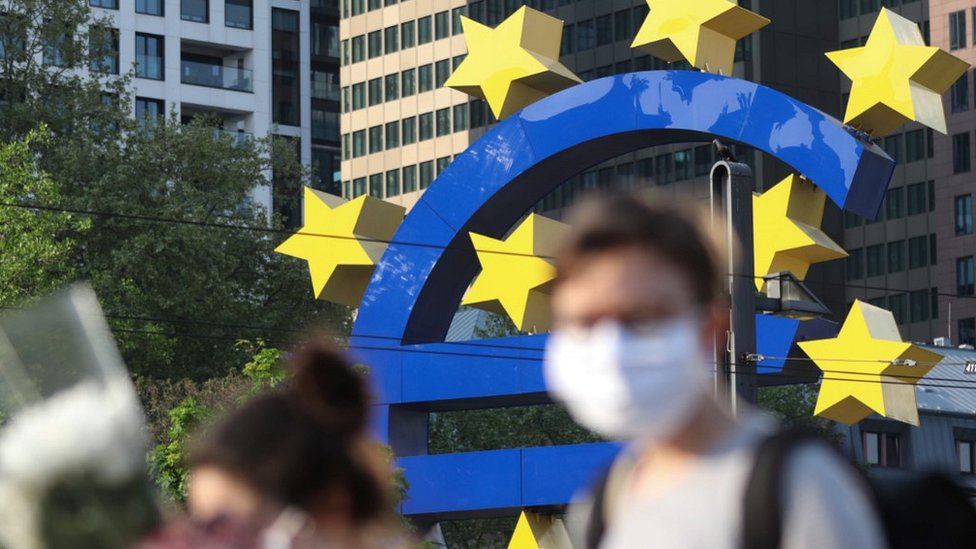
Euro sign at ECB building in Frankfurt, Germany, 24 Apr 2020IMAGE COPYRIGHTAFP

The economies of the eurozone bounced back in the third quarter of the year, according to new official figures.

But the growth was not enough to reverse the declines in the first half of 2020 due to the pandemic.

The outlook for the end of the year is further weakness caused by a renewed surge in Covid cases and tighter official restrictions.