Monday, August 15, 2016

BBC News - China's economic slowdown deepens

Chinese flagImage copyright
Image captionChina's economy is failing to catch some fresh breeze
Fresh economic data from China has added to a raft of indicators suggesting the world's second largest economy remains in the doldrums.
Both industrial output and retail sales fell short of expectations for the month of July.
The figures underline China's difficulty of transforming the economy away from factories and exports.
The data come just as economic growth had ever so slightly improved in the second quarter.
Earlier this week though, China's latest trade data had also pointed to a further slowdown.
A spokesman for the National Statistics Bureau said on Friday that the country's economy was still in a period of adjustment and facing downward pressure.
The International Monetary Fund (IMF) expects China's GDP to grow by 6.6% this year, close to the low end of China's own official forecast of between 6.5% to 7%.
The IMF also warned China against setting annual growth targets rather than projections, which it claimed fostered "an undesirable focus on short-term, low quality stimulus measures".
In a report, the Fund said it expected China's economic growth to slow towards 5.8% by 2021.

Economic transformation

Retail sales were up by 10.2% in July compared with a year earlier - below forecasts and a fall from the 10.6% increase in June.
Industrial output rose by 6% compared with the same period the previous year and was also weaker than analysts had expected.
Infrastructure spending as indicated by fixed asset investment also fell short of forecasts.
The National Bureau of Statistics pointed to flooding and high temperatures as the part of the reason.
Beijing's aim to rebalance the economy towards domestic consumption has lead to major challenges for large manufacturing sectors with layoffs, especially in heavily staffed state-run sectors such as the steel industry.
Even alternative gauges, such as cinema ticket sales, have recently indicated that consumer spending is not picking up as much as China would hope it to.

Thursday, August 11, 2016

Reuters News - Exclusive: Iraq, oil companies agree to restart investment, boost output

Iraq has reached agreement with BP, Shell and Lukoil to restart stalled investment in oil fields the firms are developing, allowing projects that were halted this year to resume and crude production to increase in 2017, Iraqi oil officials said.
The agreements, reached in July and August, effectively delay to the second half of the year projects that the three companies had planned to carry out in the first half, which had been suspended because of low oil prices.
As a result of the investment, Iraq's crude output should increase by 250,000-350,000 barrels per day next year, the Iraqi officials said. The country now produces about 4.6 million bpd, most of it from the southern region.
Iraq is OPEC's second biggest producer after Saudi Arabia, and the increase in its output, alongside that of Iran, could aggravate the global oil glut and complicate discussions between OPEC and non-OPEC producers on output limits to prop up prices.
Shell, BP and Lukoil all declined immediate comment. (BP.L) (RDSa.L) (LKOH.MM)
According to documents seen by Reuters, all three firms agreed to spend in the second half of 2016 roughly half the budgets they proposed for 2015.
BP agreed to spend $1.8 billion this year at the Rumaila field it operates. It had initially agreed to spend $3.5 billion last year, which it later revised down to $2.5 billion.
Shell agreed to spend $742 million after proposing $1.5 billion last year. Lukoil would spend $1.08 billion, compared to $2.1 billion it had proposed last year.
“Many vital projects that foreign firms were forced to halt due to lower oil prices will be brought online after the recent budget cuts agreements," said Basim Abdul Kareem, the deputy chairman of South Oil Co that oversees oil operations in the region.
"The companies now should have the needed budgets to implement these projects," he told Reuters.
Iraq has yet to reach agreements with Exxon (XOM.N), CNPC <CNPET. UL> and Petronas PETR.UL on fields those firms are also developing in the south.
STRUGGLING TO REPAY
Oil companies helping Iraq develop its massive oil fields have to clear their spending with the government each year. They are then repaid with income from Iraq's exports of crude oil produced from existing fields.
The arrangement worked smoothly when oil prices were above $100 a barrel but since crude has collapsed to about $40 a barrel, Iraq has been struggling to find enough oil to repay the companies for their investment.
Iraq relies on oil for nearly all its revenues and is spending heavily to fight Islamic State in its northern and
western provinces.
With its finances stretched, Iraq asked foreign oil companies last year to spend less than proposed, and all but cut off investment entirely for the first half of this year to the major projects.
"The agreed investment budgets are covering almost the rest of 2016 and it’s obviously a win-win deal," said another South Oil Company official who declined to be identified. "The companies will be able to resume work on many delayed projects that will help to raise Iraq’s production in early 2017."
"We are talking about at least 250,000 to 350,000 additional barrels a day in early 2017," he added.
The Iraqi oil ministry in February said the budget for foreign oil company development costs had been revised down to just over $9 billion in 2016, while the companies estimated their cost at $23 billion, following complex negotiations.
Among OPEC members, Iraq's supply rose the most last year and output reached a record 4.775 million barrels per day in January 2016. Iran also intends to boost supply after a deal to lift sanctions imposed over its nuclear programme, making it more difficult for OPEC to agree production limits.

(Reporting by Ahmed Rasheed and Aref Mohammed; writing by Maher Chmaytelli; editing by Peter Graff)

Wednesday, August 10, 2016

BBC News - EU waives budget deficit fines for Spain and Portugal

Lisbon tramImage copyright
The European Union has formally agreed to waive fines for Spain and Portugal over their excessive budget deficits.
Under EU rules, member states are not supposed to run annual deficits greater than 3% of their total economic output.
Last year, Spain's deficit was 5.1% of its gross domestic product (GDP) and Portugal's stood at 4.4%.
But citing "exceptional circumstances", the EU Council has given each country more time to conform to the rules and bring their deficits down.
Against a background of uncertainty caused by the UK's Brexit vote and rising anti-EU sentiment in the rest of Europe, the Council confirmed a plan suggested in July by the European Commission.

Losing credibility?

Both countries have now been set new deadlines.
Spain has been given until 2018 to reduce its deficit below 3% and Portugal has until the end of 2016 to bring its deficit down to 2.5%.
The Council said that Madrid and Lisbon must submit a report to Brussels by 15 October showing how they will achieve their revised targets.
Last year, France was given a similar waiver of a potential fine when it missed its own target.
BBC reporter Naomi Grimley in Brussels says European leaders are reluctant to impose fines, fearing it could simply stoke anti-EU opinion in Spain and Portugal.
However, critics are likely to argue that the EU loses credibility if it agrees rules and then fails to enforce them.
Although all EU countries are required to run budget deficits below 3% of GDP, only the 19 countries that use the euro as a currency can be fined.

Tuesday, August 9, 2016

Bloomberg News - BOE’s Bond-Buying Program Creates Wrinkles in Gilts’ Yield Curve

The Bank of England’s renewed bond-buying program is already creating signs of distortion in the $2.2 trillion U.K. gilt market.
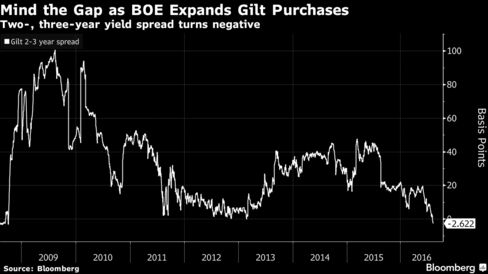
Three-year gilts have yielded less than their two-year counterparts since Aug. 4, when the new round of purchases was announced, in their first so-called yield-curve inversion in almost eight years.
The central bank started buying government securities again on Monday as part of its suite of stimulus aimed at heading off economic fallout from Britain’s decision in June to leave the European Union. It kicked off the program with a 1.17 billion-pound purchase of shorter-term gilts, with two-year debt excluded from the program.
Yield-curve inversions are the very kind of market anomalies that investors and analysts watch out for. When the BOE started its quantitative-easing program in 2009, gilt issuance was at a record high as the government needed to borrow more to deal with the crisis-hit economy, and 10-year yields were above 3 percent.

Return of QE

The latest round of QE is taking place after issuance has dropped by more than 40 percent from that level and 10-year gilt yields have fallen below 0.6 percent. The easing policy has caused longer-dated bond yields to fall. While that is probably good for borrowers, the downside is that it may hurt banks’ profitability and force consumers to save more to make up for shortfalls in earned interest.
“The market is watching this sovereign bond-buying program closely,” said Mohit Kumar, head of rates strategy at Credit Agricole SA’s corporate and investment-banking unit in London. “While it’s likely to lower longer-maturity yields, it’s not obvious at this point, on its own, how effective it will be given yields are already very low.”
Click here to see an analysis of how a weaker pound may not offset an industrial slowdown
Policy makers reduced growth forecasts in their latest analysis last week. The Monetary Policy Committee’s measures include the first rate cut since March 2009, a plan to buy 60 billion pounds of government securities over six months, as much as 10 billion pounds of corporate bonds in the next 18 months and a potential 100 billion-pound loan program for banks. Governor Mark Carney declared that all elements of the stimulus can be taken further.

Record Low

The yield on benchmark 10-year gilts dropped three basis points, or 0.03 percentage point, to 0.58 percent as of 4:48 p.m. London time, having dropped earlier to a record-low 0.56 percent. It has fallen by more than 20 basis points since just before the BOE announced its policy decision on Aug. 4.
The 2 percent security due in September 2025 rose 0.295, or 2.95 pounds per 1,000-pound face amount, to 112.535. The gain was helped by result of the second round of purchases, held Tuesday, when the BOE failed to meet its buying goal.
Two-year gilts were yielding about three basis points more than those due in three years. The last time the difference turned negative was in October 2008. The yield gap between two- and 30-year gilts narrowed four basis points to 128 basis points, also the least in almost eight years on a closing basis, as investors moved further up the curve to grab higher returns.
When viewed as part of a package of measures rather than in isolation, the expansion of gilt buying is more likely to benefit the economy than not, according to Kari Hallgrimsson, London-based head of sterling-rates trading at JPMorgan Chase & Co.

Fiscal Policy

Chancellor of the Exchequer Philip Hammond has said he’s ready to “reset” fiscal policy and has signaled that additional borrowing may be on the way. Yet, investors have taken that in stride. Gilts are the best performers this year among developed markets’ sovereign securities, returning 16 percent, according to Bloomberg World Bond Indexes.
“It is a positive policy response,” said Hallgrimsson in a phone interview. “It gives room for the Treasury to look at fiscal stimulus. Those two measures together will be effective in combating the uncertainty that has arisen due to the Brexit result.”
For Mark Dowding, the inversion at the short end of the yield curve is not as important as a steady decline in longer-dated yields, which he said could undermine what the BOE is trying to achieve.
“The more yields fall at the longer end of the curve, the worse pension deficits become,” said Dowding, a London-based partner and money manager at BlueBay Asset Management. “This means that as companies plug pension black holes, there is less left to invest, fewer jobs and weaker growth.”

Monday, August 8, 2016

BBC News - UK tourism boosted by fall in pound

Tourists look at London themed merchandise with Big Ben in backgroundImage copyrightGETTY IMAGES
Flight bookings to the UK jumped since June, driven by the sharp fall in the pound following the vote to leave the European Union.
Overall, there were 4.3% more flights booked to the UK in the 28 days following the vote than last year.
Bookings from Hong Kong leapt by 30.1%, while they were up by 9.2% from the US and 5% from Europe.
Travel researcher ForwardKeys said Brexit had had an "immediate, positive impact" on tourism to the UK.
The organisation, which analyses 14 million reservation transactions a day to monitor future travel patterns, said: "The most favourable exchange rate in decades is probably the major driver for the uptake in bookings to Britain."
While the pound has fallen about 13% against the dollar since its peak on 23 June, the day of the referendum, it has also fallen about 10% against the euro. A lower pound cuts the cost of a holiday for foreign visitors to the UK.
"In the months ahead our data will show whether this post-Brexit bounce is sustained", said Olivier Jager, ForwardKeys chief executive.
The company said worldwide economic uncertainty, terror attacks in France and Belgium and air traffic disruption also benefitted UK tourism.

Record year

Its figures are backed up by evidence from other organisations.
Airline BA reported a rise of a third in the number of US customers searching for flights to the UK on its website between 27 June to 3 July, compared with the same few days last year.
Hotels.com said it had seen hotel searches for UK destinations by Americans increase by 50% year-on-year since the referendum.
However, even prior to the referendum, the number of tourists from abroad had risen.
According to the promotional body VisitBritain, in the first three months of the year trips by international visitors rose by 6% to 7.36 million compared with the same time in 2015.
Last year as a whole was a record year for inbound tourism, with 36.1 million visits, up 5% on 2014.
"With the weakened pound Britain offers good value for money at the moment, particularly for high spending long-haul markets such as China and the USA," said VisitBritain.
Tourism is the UK's seventh biggest export earner and is the third biggest employer

Friday, August 5, 2016

Bloomberg News - Is China’s Role in Hinkley Point Really a Security Threat?

All it took was an unexpected delay and a rediscovered blog by the Prime Minister’s new chief of staff, and suddenly the debate about the U.K.’s first nuclear power station in a generation shifted from the project’s price tag to the risk of Chinese cyber-sabotage.
After the U.K.’s last government welcomed China’s investment in everything from wind farms to oil fields, it touched a nerve when Nick Timothy, a long-time adviser of Prime Minister Theresa May, warned last year that involvement by the Asian giant in nuclear projects could allow them to “shut down Britain’s energy production at will.”
While the government has postponed approval for the project, experts say fears over China’s involvement in Hinkley Point is overblown, and the huge cost of the plant’s public subsidy remains the biggest threat to its future.
“Are we really saying as a country that we are so distrustful of our future relations with the Chinese that we think it’s a real possibility” they could pull the plug on a nuclear plant, Barry Gardiner, the opposition Labour Party’s spokesman on energy, said Thursday in a phone interview. The government needs to “take a critical look at what is really wrong with this contract, which is that the public is being asked to pay 30 billion pounds of subsidy.”

Controversial Plant

The British government last week cast doubt on the future of a controversial 18-billion pound ($24 billion) project led by Electricite de France SA to build Britain’s first nuclear power plant in more than 20 years, pledging to review the deal just hours after the board of France’s state-run utility gave the go-ahead. Concern about China General Nuclear Power Corp.’s minority stake in the project may have been among reasons for the delay.
The Prime Minister’s office reiterated Friday that the government is considering all component parts of the project, without specifically addressing Chinese involvment.
Concern about China is largely misplaced, said Tim Yeo, chairman of New Nuclear Watch Europe, an industry-funded lobby group, and former chair of U.K. Parliament’s Energy and Climate Change committee.
“There’s no reason to be concerned about China having a minority stake in any U.K. infrastructure asset,” Yeo said Thursday in a phone interview. “I welcome that CGN is willing to make investments.”

Trustworthy Partner

The Chinese company’s main involvement will be in the supply chain, providing some components for Hinkley, said Malcolm Grimston, senior research fellow at Imperial College London’s center for environmental policy. Operation of the facility would be in the hands of EDF, which has been in U.K. for years, he said.
“The Chinese see Hinkley C as first step towards their goal of building a nuclear station using Chinese technology in the U.K. and as a stepping stone to starting a plant export business to rival the Russians, the Japanese and the French,” said Grimston. “I’m not sure what their motivation would be” to halt an operational power plant “given their interest in being seen as a trustworthy partner.”
The strategic investment agreement reached by EDF and state-owned CGN in October was to build three new nuclear power stations in the U.K., including a 1 gigawatt plant at Bradwell that the Chinese company would build using its own technology and take a 66.5 percent stake. Chinese reactor designs haven’t yet been approved by the British nuclear regulator, a process which could take at least three years.
Bernard Jenkin, the Conservative member of parliament for Harwich and North Essex, near the proposed Bradwell plant, last year urged the government to assess the security implications of a Chinese designed, owned and operated technology. It could be a “Trojan horse” used to threaten the U.K at a time of critical disagreement or conflict, he said. He wasn’t immediately available for comment on Friday.
There is potentially more cause for concern about Bradwell, said Yeo and Grimston. However both doubted the Chinese company would have any motivation to switch off the plant.
“I can’t see in what circumstances it would be in the interests of the Chinese owner not to make the plant work as efficiently as possible,” said Yeo. “They would both lose any prospect of getting a return on their very big investment and secondly I think they would effectively close down any future chance of infrastructure investment in the U.K.”
The U.K. government agreed to pay 92.50 pounds for every megawatt-hour of electricity produced from Hinkley Point for 35 years, about twice the current market rate. That contract has been widely criticized after data published on a government website last month showed this subsidy could cost more than 30 billion pounds.
The government should “focus on the real upfront issues that make this contract a bad deal for the U.K.,” said Labour’s Gardiner. The emphasis on China’s involvement "really does smack a bit of James Bond.”

Thursday, August 4, 2016

BBC News - Indian parliament backs key tax bill

India's parliament has passed the much-awaited Goods and Services Tax (GST) bill.
The tax reform has been labelled a landmark and India's biggest tax reform since independence.
The changes aim to streamline India's fragmented tax system with a single levy.
Indian businesses have been lobbying for the single tax rate as it would reduce costs, particularly for shipping goods across state borders.

A truly single market? by Soutik Biswas, BBC News, Delhi

What promises to one of the world's most complex tax reforms is expected to be serviced by state-of-the-art technology.
Indian software giant Infosys is building a gigantic electronic infrastructure - a GST portal - where taxpayers can register, make payments and file returns.
Some 7.5 million businesses will be covered by the tax. Clearly, a successful GST in India will be a minor miracle.

Why is this move so important?

The goal is to create one single market. Currently, everything sold in India is subject to a multitude of taxes varying from state to state.
This is a bureaucratic burden, with a lot of money lost in a fragmented market. With every state deciding its own taxes it also encourages local protectionism.
The new efficiency aims to boost growth, with optimistic estimates suggesting more than 2% of added economic growth. India already has overtaken China as the world's fastest growing economy.

What are the changes?

The Goods and Services Tax will replace that confusing jumble of existing taxes - ranging from lottery and entertainment tax to VAT, sales tax or luxury tax - with one single tax.
There also will be no more taxes at the different state borders within the country.
Currently, goods brought for example from the northern city of Haryana to Chennai are taxed in six different states.

Why did it take forever?

The individual states fear they will lose money. They will now be compensated for their lost revenue over the next five years. Another compromise is that the lucrative businesses of fuel and alcohol have been entirely left out of the new tax for now.
The bill has been a key goal of Prime Minister Narendra Modi and easily passed the lower house, but was long held up in the upper house where Mr Modi's BJP party does not have a majority.

What happens next?

Although the vote in the upper house is labelled a breakthrough, the actual tax is still quite some time off. First, at least half of the country's 29 states will have to approve the bill before it can become law. Then, the actual tax will need to be decided. A government panel has suggested a rate of 17-18%.
The government target for the tax coming into effect is April 2017 but many doubt it will be in place by then. It's to be an electronic tax with no more manual filing - the massive IT infrastructure will be an added challenge on the way to India's tax miracle.