Wednesday, May 17, 2017

Reuters News - U.S. stock futures, dollar fall on rising concerns over Trump


A woman walks past electronic board showing stock prices at a business district in Tokyo, Japan, January 23, 2017. REUTERS/Kim Kyung-Hoon

By Hideyuki Sano | TOKYO
U.S. share futures and the dollar tumbled on Wednesday on worries about more U.S. political turmoil after media reports said President Donald Trump asked then-FBI Director James Comey to end a probe into Trump's former national security advisor.
The reports raised questions over whether obstruction of justice charges could be laid against Trump, weakening confidence in the U.S. president's ability to push through an aggressive stimulus program that investors had been banking on since his election in November.
S&P 500 mini futures ESc1, the world's most liquid stock futures, dropped 0.5 percent to 2,385, though they have managed to hold above their recent lows around 2,379.
European shares are expected to open lower, with spread-betters looking at declines of 0.6 percent for Germany's DAX .GDAXI, 0.4 percent in France's CAC .FCHI and 0.2 percent for Britain's FTSE .FTSE.
MSCI's broadest index of Asia-Pacific shares outside Japan .MIAPJ0000PUS dropped 0.3 percent while Japan's Nikkei .N225 shed 0.5 percent.
Mike O'Rourke, chief market strategist at Jones Trading, wrote in a note that "Rising doubts about U.S. political leadership should fuel further rotation into Europe. The situation remains fluid, but this development should finally break the financial markets out of the volatility vacuum."
Nobuhiko Kuramochi, chief strategist at Mizuho Securities, said "worries about European politics and North Korea have receded... But now we have worries about the Trump Administration. Given that there are some stock indexes that have risen more than 10 percent so far this year, we may be entering a consolidation phase."
Trump asked Comey to end the FBI investigation into ties between former White House national security advisor Michael Flynn and Russia, according to a source who has seen a memo written by Comey.
The news, first reported by the New York Times, came after Trump had fired Comey and then discussed classified national security information about Islamic State with Russian Foreign Minister Sergei Lavrov.
The White House quickly denied the New York Times report, saying in a statement it was "not a truthful or accurate portrayal of the conversation between the president and Mr. Comey."
The tumult at the White House prompted currency traders to ditch the dollar against a broad range of currencies, most notably against the yen, to which investors often turn as a safe haven when there are problems in Europe and the United States.
The dollar dropped 0.7 percent to 112.37 yen JPY=, slipping further from its highs near 114.40 yen touched last week.
The dollar's index against a basket of six major currencies .DXY =USD dropped to 97.93, giving up all of the gains made after Trump's election victory in November.
Other traditional safe-haven assets were also well bid. The Swiss franc gained 0.3 percent against the dollar to 0.9828 franc per dollar CHF=. The gold rose 0.6 percent to $1,243.4 per ounce XAU=.
The euro EUR= hit a six-month high of $1.1117, as it also drew support from solid economic data in the euro zone.

The euro zone's GDP grew 0.5 percent in January-March, in line with expectations, and underscoring a recovery in the currency bloc.
On the other hand, U.S. economic data published on Tuesday was mixed, raising more doubts about some rosy views on the economy.
While U.S. manufacturing production recorded its biggest increase in more than three years in April, housing starts posted a surprise fall to five-month lows.
The data came after Friday's softer-than-expected retail sales and inflation.
"Until Friday, markets had been focusing only on the bright side of the U.S. economy. But that seems to have changed," said Daisuke Uno, chief strategist at Sumitomo Mitsui Bank.
The 10-year U.S. Treasuries yield US10YT=RR dipped to 2.294 percent, flirting with its lowest level in two weeks.
Oil prices dropped after data showed an increase in U.S. crude inventories, stoking concerns that markets remain oversupplied despite efforts by top producers Saudi Arabia and Russia to extend output cuts.
Brent crude futures LCOc1 were at $51.28 per barrel, down 36 cents, or 0.7 percent, from their last close.
(Reporting by Hideyuki Sano; Editing by Eric Meijer and Richard Borsuk)

Tuesday, May 16, 2017

BBC News - UK inflation rate at highest level since September 2013

The UK's inflation rate rose last month to its highest since September 2013, official figures show.
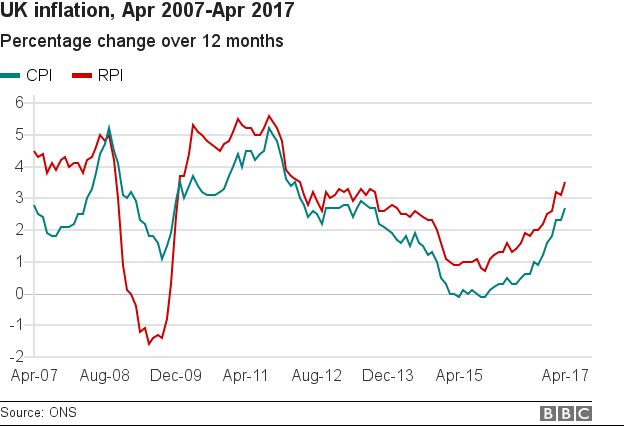
Inflation now stands at 2.7% - up from 2.3% in March - and above the Bank of England's 2% target.
The main reason was higher air fares, which rose because of the later date of Easter this year compared with 2016.
Rising prices for clothing, vehicle excise duty and electricity also played a part, but a fall in the price of petrol and diesel slightly offset this.
Last week, the Bank of England warned that inflation as measured by the Consumer Prices Index (CPI) would peak at just below 3% this year.
It also warned that 2017 would be "a more challenging time for British households" with inflation rising and real wages falling - leading to a consumer spending squeeze.
Pay including bonuses rose at an annual rate of 2.3% in the three months to February, according to the ONS. The latest figures on earnings growth are due out on Wednesday.

Cheaper fuel

The Office for National Statistics (ONS) said the cost of air travel went up by 18.6% from the month before, with Easter falling on 16 April this year compared with 27 March last year.
The price of clothes jumped to the highest level for six years, with a rise of 1.1% between March and April.
Electricity and food prices also went up, but there were falls in the cost of gas, petrol and diesel.
The Retail Prices Index (RPI), a separate measure of inflation which includes council tax and mortgage interest payments, reached 3.5% last month, up from 3.1% in March.
The ONS's new preferred inflation measure of CPIH, which contains a measure of housing costs, rose to 2.6% from 2.3% in March.
Inflation graph
Chris Williamson, chief business economist at analysts IHS Markit, said: "The timing of Easter looks to have played an important role in pushing inflation higher in year-on-year terms.
"But sterling's depreciation since the referendum last June is also clearly a significant factor, lifting prices for imports and likely to pile further upward pressure on consumer prices in coming months.
"There are nevertheless signs that inflation could perhaps rise less than many had been fearing.
"Survey data are already showing companies' costs are rising at a slower rate than earlier in the year, and recent weeks have seen some easing in global commodity prices, notably oil."

'Transitory' effect

Suren Thiru, head of economics at the British Chambers of Commerce, said: "Businesses continue to report that the substantial increases in the cost of raw materials and other overheads over the past year are still filtering through the supply chain, and are therefore likely to lift consumer prices higher in the coming months
"However, it remains probable that the current period of above target inflation is transitory in nature, with little evidence that higher price growth is becoming entrenched in higher pay growth.
"This should give the Bank of England sufficient scope to keep interest rates on hold for some time yet, despite their recent warning."

Monday, May 15, 2017

Bloomberg News - Banks in Rand-Rigging Probe Are in Behind-the-Scenes Negotiations

Behind-the-scenes talks may result in some of the banks named in South Africa’s probe into rand manipulation paying penalties rather than being dragged through lengthy hearings, the regulator said.
Some of the lenders are in confidential talks with the Competition Commission that may lead to a settlement, Sipho Ngwema, a spokesman for the Pretoria-based regulator, said in an emailed response to questions on Friday, declining to identify the banks. The lenders that want to settle must agree to an admission of liability, he said.
All but one of the 14 banking entities in the probe have filed papers saying the antitrust body doesn’t have jurisdiction, that the case be amended or dismissed, or criticizing the charges against them as being too vague. Only Standard Chartered Plc hasn’t filed what’s called an exception application. The U.K. lender declined to comment when asked if it was in settlement talks with the commission. 
Standard Bank Group Ltd., Commerzbank AG, Investec Ltd., Australia and New Zealand Banking Group Ltd., Nomura International Plc, BNP Paribas SA and Macquarie Group Ltd., that were also named in the probe, declined to comment.

Maximum Penalties

“We will continue to co-operate fully” with the competition authorities, Standard Chartered said in an emailed response to questions on Thursday. “Standard Chartered remains committed to adhering to the laws and regulations in each market where we operate.”
Citigroup Inc. in January agreed to pay a 69.5 million rand ($5.2 million) fine for its alleged role in manipulating the rand, while Barclays Africa Group Ltd. may be exempt from a penalty because it blew the whistle on the traders’ alleged actions. Bank of America Corp., JPMorgan Chase & Co., HSBC Bank Plc and Credit Suisse Group AG have also been identified in the investigation.
The commission recommended the banks be fined 10 percent of turnover, the maximum allowed, and the penalty will be based on revenue from their foreign-exchange units. Aside from using a common trading platform, holding meetings and discussing strategy over the phone, the traders had an instant messaging chatroom called “ZAR Domination” where they would agree on their currency trades, according to the commission.

Friday, May 12, 2017

Reuters News - In Trump's shadow, Fed official says trade barriers a 'dead end'


William Dudley, President of the New York Federal Reserve Bank, answers a question, after addressing the Indian businessmen at the Bombay Stock Exchange (BSE) in Mumbai, India May 11, 2017. REUTERS/Shailesh Andrade


By Suvashree Choudhury and Jonathan Spicer | MUMBAI/NEW YORK
Trade protectionism is a "dead end" that may score political points but will ultimately hurt the U.S. economy, one of the most influential Federal Reserve officials said on Thursday in the central bank's strongest defense yet of open borders in the face of a skeptical Trump administration.
William Dudley, head of the New York Fed, did not mention U.S. President Donald Trump by name in a speech at the Bombay Stock Exchange. But he gave a full-throated economic and even political argument for resisting trade barriers that he said would hurt growth and living standards in both the United States and around the world.
"Protectionism can have a siren-like appeal," said Dudley, a close ally of Fed Chair Janet Yellen and a key decision-maker on U.S. interest-rate policy.
"Viewed narrowly, it may be potentially rewarding to particular segments of the economy in the short term," he said in prepared remarks. "Viewed more broadly, it would almost certainly be destructive to the economy overall in the long term."
The Fed is independent but answerable to Congress, and its governors are appointed by the White House and confirmed by the Senate. While Fed officials usually avoid recommending fiscal policies, several have highlighted the benefits of open borders since Trump was elected on an "America First" platform of revamping or ripping up trade deals.
The White House has said trade deals often do more harm than good for U.S. workers and companies, especially those in the manufacturing sector hard-hit by globalization. Over the last 25 years trade has grown to represent roughly 57 percent of global output, from less than 40 percent.
Dudley said he was speaking out because "we are at a particularly important juncture" in which trade issues could imperil the long-term health and productivity of the economy and "the economic opportunities available to our people."
Barriers to trade are very costly, he said, because they blunt export opportunities, make everyday goods more expensive, and they can often "backfire" by harming workers who can no longer compete in a global economy.
"There are many approaches to dealing with the costs of globalization, but protectionism is a dead end," said Dudley, a former Goldman Sachs partner who joined the New York Fed in 2007 and became its president in the depths of the financial crisis in early 2009.

"Trying to achieve a high standard of living by following a policy of economic isolationism will fail," he said in Mumbai.
The unusually pointed speech comes after the New York Fed published research in recent months that warned against a Republican proposal for a border-adjustment tax and a Trump threat to ditch the North American Free Trade Agreement. Both the Republicans and Trump have since largely backed down from those positions.
The U.S. central bank has hiked interest rates twice since December and expects to tighten policy about two more times this year as the economy carries on a roughly 2-percent growth track, and as unemployment at 4.4 percent remains low.
Dudley has said the Fed would adapt its approach as tax, spending and trade policies emerge from Washington. He does not expect a "dramatic change" in policy, he said on Thursday, repeating his preference to start trimming the Fed's $4.5 trillion balance sheet as early as this year in such a way that it is "a modest and minor" event.
(Additional reporting by Rafael Nam in Mumbai)

Thursday, May 11, 2017

BBC News - Bank of England warns of consumer spending squeeze


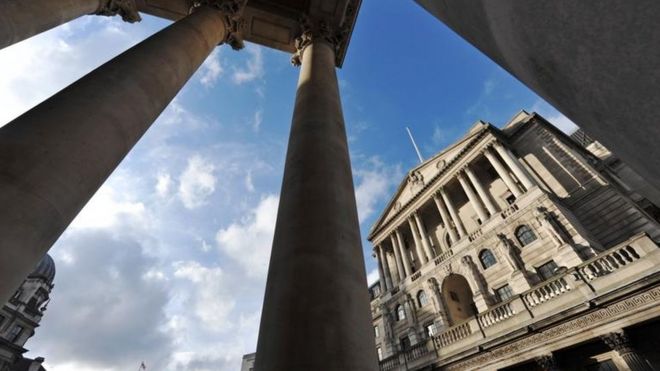
Bank of England governor Mark Carney has warned of a consumer spending squeeze this year as inflation rises and real wages fall.
This year will be "a more challenging time for British households" and "wages won't keep up with prices", he said.
He was upbeat about wage growth beyond 2017 - but only if the government secures a "smooth" exit from the EU.
It came as the bank trimmed UK economic growth forecasts for 2017 from 2% to 1.9% and held interest rates at 0.25%.
The bank, unveiling its Quarterly Inflation Report, also raised its forecast for inflation this year to 2.7% from its February forecast of 2.4%.
Interest rates are set by the Bank's Monetary Policy Committee (MPC), which is tasked with keeping inflation at 2%.
The Bank said the expected overshoot in inflation to 2.7% this year was "entirely" due to the impact of weak sterling and that raising interest rates would not be an effective way of tackling the increase in living costs.
Before last June's referendum the pound was trading at about $1.47. It is currently trading around $1.29, down 12%.
The Bank also highlighted that its current forecasts were based on the assumption that "the adjustment to the United Kingdom's new relationship with the European Union is smooth".
Mr Carney characterised a "smooth" Brexit as the UK securing "an agreement about future trading arrangements and there will be a transition, or an implementation period, from the negotiation to that new agreement."
Lucy O'Carroll, chief economist at Aberdeen Asset Management, said: "The Bank of England is stuck between a rock and hard place. It has to base its forecasts on a view of the Brexit deal but, with so little to go on at present, it's not an easy judgement.

"To say that is far from certain is a huge understatement. Governor Carney acknowledges the risks, but the weight of uncertainty - and therefore frailty of the forecasts - does undermine the Bank's relatively positive message."
At the moment, Mr Carney said there was some evidence "that businesses are hesitating to bring in higher wage costs at a time of some uncertainty about market access and other costs that could be associated with the Brexit process, resulting in more modest wage settlements".
However, if business concerns ease over the process of exiting the EU, wage growth will accelerate.
Since the MPC's previous interest rate meeting in March, official figures have indicated that the economy is weakening. The economy grew by 0.3% in the first quarter of 2017, a sharp slowdown from the 0.7% growth rate in the final three months of 2016.
"The slowdown appears to be concentrated in consumer-facing sectors, partly reflecting the impact of sterling's past depreciation on household income and spending," the Bank said in its report.
It says that consumption growth will be "slower in the near-term than previously anticipated", but then forecasts that it will recover over the next two years as income growth picks up.
The Bank forecasts that average weekly earnings will grow at a rate of 2% this year, but rise to 3.75% by 2019.

Rate moves

If the UK economy follows the Bank's projections and begins to improve, it said monetary policy may need to be tightened.
At this month's meeting the Bank of England's Monetary Policy Committee (MPC) voted 7-1 to keep the interest rate on hold.
Ben Brettell, senior economist at Hargreaves Lansdown, said: "Unsurprisingly interest rates were left unchanged, with just Kristin Forbes voting for a 0.25% rise to 0.5%. However, the Bank also warned that rates may have to rise sooner and faster than the market currently expects.
"It might not take much positive economic data to persuade further MPC members to join Forbes and vote to hike rates, though it should be noted that she is due to leave the MPC at the end of June."

Wednesday, May 10, 2017

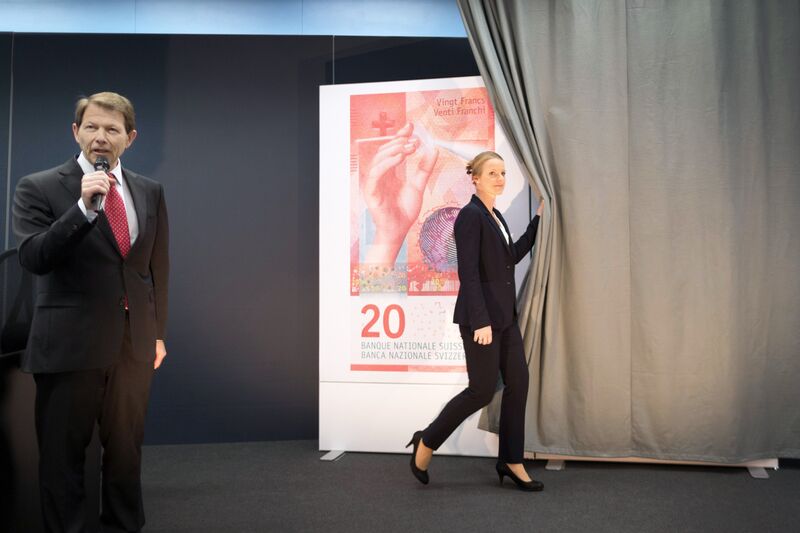
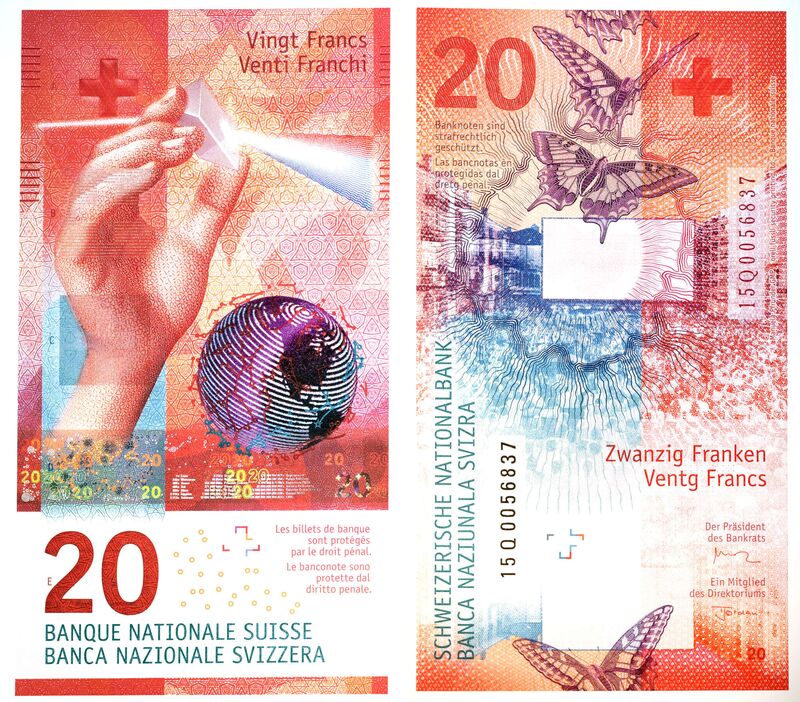
Bloomberg News - Meet Switzerland’s New 20-Franc Note

Tuesday, May 9, 2017

BBC News - Is work 'fair and decent'? That's not how the voters see it

The head of the government's review into zero-hours contracts and the less secure world of work has said that too many businesses still allow "bad work" to flourish.
Ahead of a speech on Tuesday evening, Matthew Taylor told the BBC that workers should be "engaged" by employers and feel more in control of how they work.
"I think some business leaders understand completely the importance of good work and its link to productivity, but, as always, we have a long tail of businesses where there doesn't seem to be that understanding," he told me.
Mr Taylor said that he was "shocked" at a new poll which suggests only 1-in-10 believe that all work is "fair and decent".

In-work poverty

Mr Taylor argued that it was "unacceptable" that so many people in work were classed as below the official poverty line.
recent report by the Joseph Rowntree Foundation found that the number of people defined as suffering "in-work poverty" had risen by 1.1 million since 2010, to 3.8 million.
Although overall poverty is down, the report said that high housing costs, low wage growth and cuts to benefits meant that more people were officially classed as below the poverty line (an income of 60% of median earnings) despite being in work.
Less secure work in the "gig-economy" is also seen as a challenge to employment standards.

Quality of work

Companies like Deliveroo and Uber have been criticised for controversial workplace practices, though many say that the companies offer good, flexible alternatives to 9-5 work and a better deal for consumers.
"I think bad work is unacceptable when so many people in work are in poverty," Mr Taylor told me.
"Bad work is clearly bad for our health and well-being, it leads to people dropping out of work.
"Bad work is bad for productivity, so it's bad for our economy.
"If we're going to introduce technology - robots, artificial intelligence - we need to do that in a way which thinks about the quality of people's work experience.
"Bad work just doesn't fit 2017. We want a world of engaged citizens, part of our communities.
"How can it be right that those same citizens who go to work for half their lives, don't get listened to, don't get involved, don't get engaged?"

Long journey

Mr Taylor, who is head of the Royal Society for the Encouragements of the Arts (the RSA), said the new poll findings showed that the public were not convinced that all work was of the right quality.
The RSA commissioned Populus to question more than 2,000 people.
Fewer than 1-in-10 thought that "all work was fair and decent".
And nearly 75% said that more should be done to improve the quality of work.
Close up of someone signing for a delivery
"Three quarters of people think that making work better should be a national priority," Mr Taylor said.
"It shows that nearly as many people think it is perfectly possible for all jobs to be fair and to be decent but actually, shockingly, only 1-in-10 think that is currently the state of affairs.
"So the public wants change, believes change is possible, but thinks we have got a long journey to go on."

New norm

As I wrote yesterday, the changing world of work is rising up the political agenda.
Theresa May made "an economy that works for everyone" the cornerstone of her "offer" to the voters after she became Prime Minister.
The government has said that introducing the National Living Wage and lifting tax thresholds (the point at which we start paying tax on our income) has helped many poorer people in work.
Both Labour and the Liberal Democrats have criticised the government for letting the problem of the "quality" of work become so acute.
Labour has suggested it will ban zero-hours contracts and the Lib Dems have said that more transparency around what people are paid will help tackle the gap between higher and lower earners.
Mr Taylor said his review, which will be delivered to Number 10 shortly after the election whoever becomes Prime Minister, will call for a mix of new tax rules and workplace regulations as well as the promotion of a "new norm" around how businesses treat their employees.
"There is an old fashioned view in some parts of business that good work is somehow anti-competitive - it isn't," Mr Taylor said.
"If you get people to work better, then they will be more productive and be better for your business.
"That is an argument we've still got to win."