Friday, July 21, 2017

Bloomberg News - Euro Continues Advance as Politics Sink Dollar: Markets Wrap

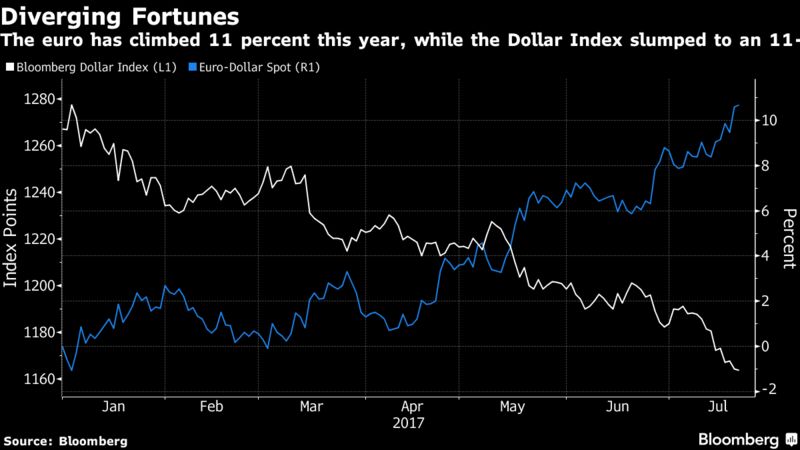
Bonds gained and the euro headed for a two-year high against the dollar on bets the European Central Bank will start tapering its stimulus program, with the greenback already under pressure from U.S. political developments.
The common currency gained impetus after ECB President Mario Draghi said Thursday that the central bank will discuss in the autumn any plans for tapering quantitative easing. The Bloomberg Dollar Spot Index fell to the lowest since August as investors assess an investigation into U.S. President Donald Trump that may stall his economic agenda. Stocks traded sideways, while copper led an advance in industrial metals and oil edged towards a second weekly increase.
Increased hawkishness from the ECB has helped the euro rally from lows last seen near the start of the millennium, with investors expecting tapering to start in the new year and pricing in a 10 basis point rate hike by September 2018. In the U.S., politics are again at the forefront, with reports that U.S. special counsel Robert Mueller is expanding his investigation of Trump less than a day after the president told the New York Times that any digging into his finances would cross a red line.
“Draghi tried to talk the Euro down, even going so far as to suggest that ECB’s quantitative easing could be increased and prolonged,” said Yann Quelenn, a market strategist at Swissquote Bank SA. “But the currency markets were not buying Draghi’s line, and neither are we. Available bonds are too scarce, and turn to a taper is too clear to disguise.”
Here are the main moves in markets:
Currencies
  • The Bloomberg Dollar index was down 0.1 percent, in line for a weekly loss of 0.8 percent, at 9:56 a.m. in London, as the greenback weakened against most of its G-10 peers. 
  • The yen was up 0.2 percent at 111.74 per dollar.
  • The euro climbed 0.2 percent to $1.1650 after reaching a 23-month high earlier in the session. The common currency has gained 1.6 percent this week.
Bonds
  • The yield on U.S. 10-year Treasuries fell one basis point to 2.25 percent.
  • Benchmark yields in Germany fell two basis points to 0.51 percent, down nine points this week. Yields in France dropped three basis points.
Stocks
  • The Stoxx Europe 600 was little changed, with gains in oil and gas stocks balanced by a drop in auto stocks. The gauge is heading for its first weekly decline in three.
  • Futures on the S&P 500 Index edged 0.1 percent higher after the underlying gauge closed flat Thursday.
Commodities
  • Oil edged toward its second weekly increase as U.S. crude inventories continued to shrink. West Texas Intermediate was 0.4 percent higher at $47.09 a barrel.
  • Copper advanced 1.3 percent to $6,038 a ton, a four month high, leading a rally in industrial metals.
  • Gold was poised for its first back-to-back weekly advance since June 2. Bullion for immediate delivery added 0.2 percent to $1,247.52 an ounce.

Thursday, July 20, 2017

Reuters News - White House makes broad deregulatory push

WASHINGTON (Reuters) - The White House said Thursday it had withdrawn or removed from active consideration more than 800 proposed regulations that were never finalized during the Obama administration as it works to shrink the federal government's regulatory footprint.
In a report, the Trump administration said it had withdrawn 469 planned regulatory actions that had been part of the Obama administration's regulatory agenda published last fall. Officials also reconsidered 391 active regulatory proceedings actions by reclassifying them as long-term or inactive "allowing for further careful review," the White House said.
The administration's move to eliminate regulations makes good on a much-repeated Trump campaign promise to promote business-friendly policies. Investors have also anticipated the action, helping to push share prices higher on hopes fewer regulations will unfetter business growth and lead to higher corporate profits.
In February, President Donald Trump signed an executive order to place "regulatory reform" task forces and officers within federal agencies in what may be the most far reaching effort to pare back U.S. red tape in recent decades.
Trump has vowed a sweeping cut in U.S. regulations and previously ordered agencies to repeal two rules for every new one adopted.
Trump directed every federal agency to establish a task force to ensure each has a team to research all regulations and take aim at those deemed burdensome to the U.S. economy. They must designate regulatory reform officers within 60 days and then report on the progress within 90 days.
The effort is part of a Republican push to undo many of the actions of former President Barack Obama.
Reporting by David Shepardson; Editing by Chris Sanders and Nick Zieminski

Wednesday, July 19, 2017

BBC News - China's second quarter growth beats expectations at 6.9%

Shanghai skyline
China's economy grew at an annual rate of 6.9% between April and June according to official figures, slightly higher than forecast.
The growth rate, which compares expansion with the same three months in the previous year, was the same as in the first quarter of 2017.
Beijing is trying to rein in debt and a housing bubble with tough measures on the property sector and lenders.
Many analysts expected China's economy to slow as those policies kicked in.
But the latest data is well above Beijing's 6.5% growth target for 2017.

Limited impact

Despite efforts to slow down the housing market, property investment grew by 8.5% in the first half, which is up from the same period in 2016.
Some analysts are predicting that tighter lending rules may not have the cooling effect that many expected.
"Property prices will have an impact in the second half, but the impact might not be as big as we thought. It is only on prime cities. The third-tier and fourth-tier cities might catch up a little bit and that will offset some of the slowdown in first tier cities," said Iris Pang, Greater China Economist with ING.
China's economy grew at its weakest pace in 26 years during 2016, but other data released on Monday added to the picture of rebounding growth for the Chinese economy.
Industrial output for June grew by 7.6%, well above the forecast 6.5%.
Retail spending grew 11% last month compared with June 2016.
And growth in both imports and exports also came in above expectations.

Tuesday, July 18, 2017

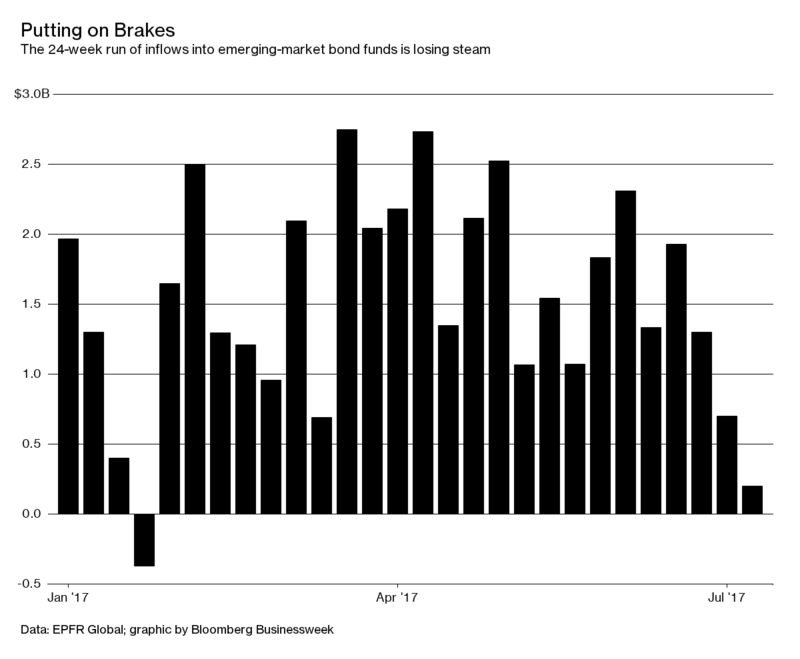
Bloomberg News - Investor Love Affair With Emerging Bonds Is Losing Momentum

Monday, July 17, 2017

Reuters News - Major tech firms urge U.S. to retain net neutrality rules

WASHINGTON (Reuters) - A group representing major technology firms including Alphabet Inc (GOOGL.O) and Facebook Inc (FB.O) urged the U.S. Federal Communications Commission on Monday to abandon plans to reverse the landmark 2015 rules barring internet service providers from blocking or slowing consumer access to web content.
The Internet Association said in its filing with the FCC that dismantling the net neutrality rules "will create significant uncertainty in the market and upset the careful balance that has led to the current virtuous circle of innovation in the broadband ecosystem."
The rollback will harm consumers, said the group, which also represents Amazon.com Inc (AMZN.O), Microsoft Inc (MSFT.O), Netflix Inc (NFLX.O), Twitter Inc (TWTR.N) and Snap Inc (SNAP.N).
In May, the FCC voted 2-1 to advance Republican FCC Chairman Ajit Pai's plan to reverse the former Obama administration's order reclassifying internet service providers as if they were utilities.
Pai has asked if the FCC has authority or should keep its rules barring internet companies from blocking, throttling or giving "fast lanes" to some websites, known as "paid prioritization."
Pai, who argues the Obama order was unnecessary and harms jobs and investment, has not committed to retaining any rules, but said he favors an "open internet."
The Internet Association said there was "no reliable evidence" provider investment had fallen.
More than 8.3 million public comments have been filed on the proposal. Pai will face questions on Wednesday on the issue at a U.S. Senate hearing.
Broadband providers AT&T Inc (T.N), Verizon Communications Inc (VZ.N) and Comcast Corp (CMCSA.O) opposed the 2015 order, saying it discouraged investment and innovation.
Providers say they strongly support open internet rules and will not block or throttle legal websites even without legal requirements. They separately plan to file comments with the FCC on Monday.
But some providers have said paid prioritization may make sense at times, citing self-driving cars and healthcare information.
Internet firms say opening the door to prioritization could enable providers to "destroy the open nature of the internet that allows new or smaller streaming video providers to compete with larger or better-funded edge providers."
Internet providers want Congress to resolve the decade-old dispute and pass open internet protections, but narrowly tailor rules to exclude a future FCC from imposing rate regulations.
The Internet Association said it was "open to alternative legal bases for the rules, either via legislative action codifying the existing net neutrality rules or via sound legal theories offered by the commission."
But it said Pai's proposal "offers no clear alternatives."

Friday, July 14, 2017

BBC News - Weak pound sees surge in tourists visiting UK

By Brian Milligan
scene in WalesImage copyright
Image captionThe delights of Wales proved a particular attraction to visitors
The weakness of sterling was behind a surge in the number of tourists visiting the UK in the first three months of 2017, according to the Office for National Statistics (ONS).
The number of holidaymakers coming to the UK rose by 21.1% - although the number of business visitors declined.
Overall there were a record 8.3 million visits in the quarter, a rise of nearly 10% on the same period in 2016.
The visitors spent £4.4bn while in the country, also a record amount.
But at the same time the fall in the value of the pound did not discourage Britons from travelling overseas.
UK residents made 14.1 million trips abroad over the three months, a rise of 8.1% on 2016.
The decline in sterling makes it cheaper for foreign visitors to come to the UK, but more expensive for Britons going the other way.

Brits abroad

The number of American visitors was particularly significant. Their numbers were up by 16%, while their spending grew 29% to £604m.
There were a record 54,000 visits from Chinese nationals, who spent a record £91m, and there was strong growth in the number of Australian and French visitors too.
Wales appears to have been one of the most popular destinations, with the number of overnight visits increasing by 28%.
But the "visitor balance of payments" remains tilted against the UK.
While visitors spent £4.4bn in Britain over the quarter, Britons spent nearly twice as much - £8.6bn - on trips abroad. a figure that has risen by 11.7% over the past year.

Thursday, July 13, 2017

Reuters News - Trump envoy announces Israeli-Palestinian water deal, silent on peace prospects

by Jeffrey Heller

JERUSALEM (Reuters) - U.S. President Donald Trump's Middle East envoy announced an Israeli-Palestinian water agreement on Thursday but dodged questions on whether he was making headway on reviving peace talks.
At his first news conference in Jerusalem since launching a series of visits in March, Jason Greenblatt declined to say if he was any closer to a return to negotiations between the two sides that collapsed in 2014.
"Let me interrupt you to save time. We are only taking questions about the Red-Dead (water) project," said Greenblatt, who was a legal adviser to Trump's businesses before being appointed Special Representative for International Negotiations.
He was referring to a World Bank-sponsored plan to build a nearly 200-km (120-mile) pipeline from the Red Sea to the Dead Sea and a desalination plant in the Jordanian port of Aqaba that was agreed in principle in 2013.
Under that deal, which aims to increase fresh water supplies for Jordan, the Palestinians and Israel and revitalize the Dead Sea's falling water levels, Israel agreed to increase water sales to the Palestinian Authority by 20 million to 30 million cubic meters a year.
Israeli Regional Cooperation Minister Tzachi Hanegbi, estimated it would take another four to five years to complete the $900 million endeavor.
The desalination plant will produce at least 80 million cubic meters of water annually. Under an agreement signed with Jordan in 2015, Israel will buy up to 40 million cubic meters of that at cost each year.
Greenblatt said Israel, whose own desalination plants have led to a water surplus, would sell up to 33 million cubic meters to the Palestinian Authority as part of the finalised agreement signed on Thursday.
Palestinian Water Authority head Mazen Ghoneim put the figure at 32 million and said 22 million would go to the Israeli-occupied West Bank and 10 million to the Gaza Strip.
"We hope that this deal will contribute to the healing of the Dead Sea and that it will help not only Palestinians and Israelis but Jordanians as well," Greenblatt said.
"I am proud of the role that the United States and our international partners have played in helping the parties reach this deal and I hope it is a harbinger of things to come."
The idea of a canal from the Red Sea to the Dead Sea was first talked about by the British in the 1850s, as an alternative to the Suez Canal.
Many plans have since been proposed, mainly aiming to preserve the Dead Sea, whose minerals are used in ointments and cosmetics.
Editing by Jeffrey Heller and Robin Pomeroy