Wednesday, August 23, 2017

BBC News - ECB chief Draghi: QE has made economies more resilient

Mario Draghi
European Central Bank President Mario Draghi has said unconventional policies like quantitative easing (QE) have been a success both sides of the Atlantic.
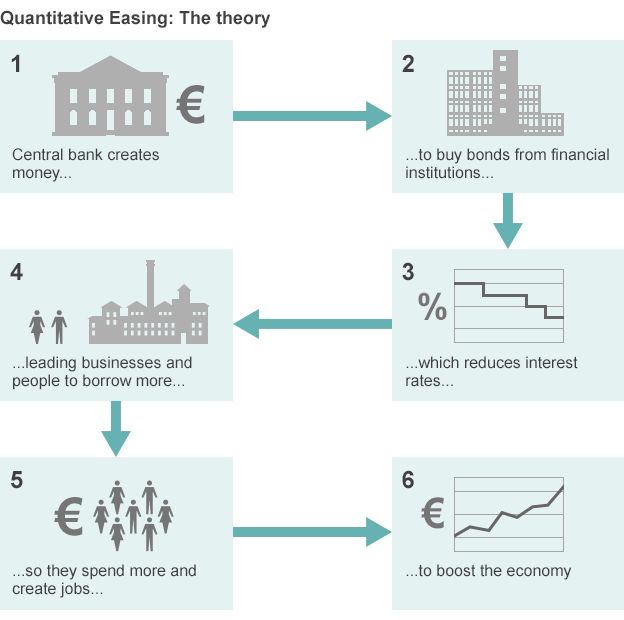
QE was introduced as an emergency measure during the financial crisis to pump money directly into the financial system and keep banks lending.
A decade later, the stimulus policies are still in place, but he said they have "made the world more resilient".
But he also said gaps in understanding these relatively new tools remain.
As the economic recovery in the eurozone gathers pace, investors are watching closely for when the ECB will ease back further on its 60bn euro (£55bn) a month bond-buying programme.
Central bankers, including Mr Draghi, are meeting in Jackson Hole, Wyoming, later this week, where they are expected to discuss how to wind back QE without hurting the economy.
On Monday, a former UK Treasury official likened the stimulus to "heroin" because it has been so difficult to wean the UK, US and eurozone economies off it.
Quantitative easing graphic
In a speech in Lindau, Germany on Wednesday, Mr Draghi defended QE and the ECB's policy of forward guidance on interest rates.
"A large body of empirical research has substantiated the success of these policies in supporting the economy and inflation, both in the euro area and in the United States," he said.
The ECB buying relatively safe assets such as government bonds means that banks can lend more and improve access to credit for riskier borrowers, Mr Draghi said.
He added: "Policy actions undertaken in the last 10 years in monetary policy and in regulation and supervision have made the world more resilient. But we should continue preparing for new challenges."

'Heroin'

Critics of QE argue it has inflated asset bubbles and stoked inequality by rewarding the asset-rich while punishing savers.
Lord Macpherson, who was permanent secretary to the Treasury when the Bank of England started QE in 2009, tweeted on Monday: "QE like heroin: need ever increasing fixes to create a high. Meanwhile, negative side effects increase. Time to move on."
The Bank of England's balance sheet swelled to £500bn last year, while the US Federal Reserve held $4.2 trillion (£3.3tn) of assets - which it is now looking to cut down.
The ECB's massive bond-buying programme, which started in March 2015, is expected to top 2tn euros by the year end.
Mr Draghi's comments came as a survey showed continued eurozone businesses growth in August, raising further questions about how much longer the stimulus is needed.
The fastest rise in manufacturing exports in six-and-a-half years helped to offset a mild slowdown in services growth, according to the Eurozone Composite Purchasing Managers' Index.

Tuesday, August 22, 2017

Bloomberg News - Nigerian Investor Sets Up $135 Million Commodities Exchange

A Nigerian startup is developing the first agricultural commodities exchange in Africa’s most populous country to take advantage of the government’s efforts to boost farming output to reduce reliance on oil.
The exchange, Integrated Produce City Ltd., will be located near the southern city of Benin, about 300 kilometers (186 miles) east of Lagos, Nigeria’s commercial hub, a site accessible to nearby growers of cocoa, palm oil, rubber and cassava, Chief Executive Officer Pat Utomi said in an interview.
“The concept of a wholesale-produce market is to enable the farmer to fully dispose of his produce, instead of today where he loses 80 percent of his output” that rots before it can reach the market, Utomi said on Aug. 18 in the capital, Abuja.
Nigeria is boosting investment in agriculture to increase exports and cut food imports that cost it $3.2 billion in 2015, according to the National Bureau of Statistics. The economy of Africa’s biggest oil producer has been hit hard by lower output and prices of crude, which accounts for more than 90 percent of foreign income and two-thirds of government revenue.
Integrated Produce City will have storage facilities, including refrigerated warehouses, and host processing plants on its 100-hectare (247-acre) site in Edo state’s Ugbokun village when it takes off by the end of 2018, Utomi said. “It will be an export hub for produce,” where exporters will have access to large quantities stored in one place rather than sending agents to individual farmers to collect small amounts, he said.
The company has put up 20 percent of the required $135 million and is in talks with lenders and investors from South Africa, China and Australia for additional capital, Utomi said, declining to name them. Integrated Produce City signed an agreement with KPMG LLP’s Nigerian unit on Monday to help it raise more capital, Vitus Akudinobi, a spokesman for the new exchange, said.
Cocoa, palm produce, cashew nuts and rubber are among the products to be traded on the exchange. Others are fresh fruit and vegetables, grains and tubers such as cassava and yams. Local manufacturing companies will be able to buy agricultural goods at the exchange, he said.
“Among the factories we’re trying to attract are chocolate makers,” he said. “The entire cocoa value-chain will be represented.”
Nigeria is Africa’s fourth-largest cocoa producer and the seventh worldwide with a 2015-2016 output of 190,000 metric tons, according to the International Cocoa Organization.
In addition to cocoa, other major exported products during the last quarter of 2016 were sesame seed, frozen shrimps, soy beans, cashew nuts and crude palm kernel, figures from the statistics agency showed.
By Dulue Mbachu

Monday, August 21, 2017

BBC News - Crawford Falconer takes up post as UK's top trade negotiator

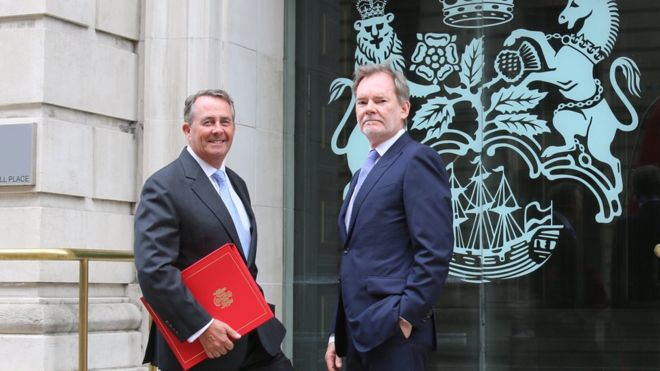
Liam Fox and Crawford Falconer
Image captionCrawford Falconer, right, will begin his new job this week
The man in charge of negotiating the UK's trade deals once Brexit is finalised, starts his job this week.
Crawford Falconer will take up the post of chief trade negotiation adviser at the Department for International Trade.
Leaving the single market would mean the UK would have to establish new bilateral trade agreements, but cannot formally do so until after Brexit.
However, one economist suggested Mr Falconer would already be "building bridges" with the European Commission.
The UK faces a huge challenge in resetting its trading relationship with the EU and other countries when Brexit takes effect.
Trade pacts that have been negotiated by the EU with the rest of the world will no longer apply to the UK, while Britain will also need to define new trading relationships with the EU itself.
Membership of the EU has meant the UK does not have a large bank of trade negotiators with recent experience.
A New Zealander, Mr Falconer has more than 25 years trade experience. He has represented New Zealand at the World Trade Organization (WTO) and held various posts in foreign and trade affairs in his home country.
Prof Alan Winters, from the University of Sussex's UK Trade Policy Observatory, said Mr Falconer's experience and contacts at the WTO would mean the groundwork for separating UK trade policy from Brussels would be made easier.
"He knows quite a lot of the main players at the WTO and can build bridges at the European Council, which is good as there is work to be done right now," he said.
"There is work he can do, such as discussions on whether the UK uses replicas or changes trade agreements that we have with nations by way of membership with the EU."
One suggestion has been that initially trade agreements could be adopted by the UK in their current form - replicating them - at the point of Brexit, to be altered subsequently as new deals are agreed.
International Trade Secretary Liam Fox said of the new appointee: "Crawford Falconer brings a wealth of international trade expertise to our international economic department, ensuring that as we leave the EU, the UK will be at the forefront of global free trade and driving the case for international openness."
Mr Falconer will lead trade policy and negotiation teams at the DIT. His appointment was first announced in June.

Friday, August 18, 2017

Reuters News - Trump disbands business councils after CEOs quit in protest

WASHINGTON/NEW YORK (Reuters) - President Donald Trump disbanded two high-profile business advisory councils on Wednesday after several chief executives quit in protest over his remarks blaming weekend violence in Virginia not only on white nationalists but also on anti-racism activists who opposed them.
A parade of prominent Republicans and U.S. ally Britain also rebuked Trump, leaving him increasingly isolated after his comments on Tuesday about the bloodshed in the college town of Charlottesville further enveloped his seven-month-old presidency in controversy.
The mayor of Phoenix asked Trump to delay a rally planned for next Tuesday, an appeal the president appeared to reject.
A memorial service was held on Wednesday in Charlottesville for 32-year-old Heather Heyer, killed when a car plowed into anti-racism protesters. A 20-year-old Ohio man said to have harbored Nazi sympathies has been charged with murder.
Trump, a real estate magnate who had never before held public office, was elected president in November touting his experience in the business world and ability to strike deals. But some of the Republican president's actions and words have alienated many corporate leaders.
Trump said he would dissolve the American Manufacturing Council and the Strategic and Policy Forum after eight executives including Campbell Soup Co CEO (CPB.N) Denise Morrison and 3M Co CEO (MMM.N) Inge Thulin quit the panels.
Both of the councils were moving to disband on their own when Trump made his announcement on Twitter.
"Rather than putting pressure on the businesspeople of the Manufacturing Council & Strategy & Policy Forum, I am ending both," he wrote.
The Strategic and Policy Forum was headed by Blackstone Group (BX.N) CEO Stephen Schwarzman, a close ally of Trump in the business world. Schwarzman organized a call on Wednesday for member executives to voice concerns after Trump's comments, and an overwhelming majority backed disbanding the council, two sources said.
Schwarzman then called Trump to tell him about the decision to disband.
"Racism and murder are unequivocally reprehensible and not morally equivalent to anything else that happened in Charlottesville," Morrison said.
JPMorgan Chase & Co (JPM.N) CEO Jamie Dimon, a member of one of the panels, said in a statement that "fanning divisiveness is not the answer."
Dow Chemical Co (DOW.N) Chief Executive Andrew Liveris, who headed the manufacturing council, said he told the White House on Wednesday that "in the current environment it was no longer possible to conduct productive discussions."
The Strategic and Policy Forum was intended to advise Trump on how government policy impacts economic growth, job creation and productivity. The manufacturing council was designed to promote U.S. job growth.
Along with the snubs from business leaders, Trump was rebuked by a string of Republicans including Senate Majority Leader Mitch McConnell, Ohio Governor John Kasich, Senator Lindsey Graham and former U.S. presidents George H.W. Bush and George W. Bush.
The president needs the support of fellow Republicans as he tries to push his policy agenda, including tax cuts, through a Congress that is controlled by the Republicans.
Phoenix Mayor Greg Stanton, a Democrat, said Trump would "enflame emotions and further divide our nation" if he used next week's rally to pardon Joe Arpaio, a former Arizona sheriff who was found guilty last month of criminal contempt of court. Arpaio gained a national profile due to his harsh treatment of inmates and outspoken opposition to illegal immigration.
Shortly after Stanton's statement, Trump urged supporters on Twitter to attend the rally.
Few public figures have voiced support for Trump over his response to the violence. Vice President Mike Pence, who is cutting short a trip to Latin America, told reporters in Chile that "I stand with the president and I stand by those words." Former Ku Klux Klan leader David Duke praised Trump's "honesty and courage." Richard Spencer, head of a white nationalist group, lauded the president for "speaking the truth."
U.S. stocks ended slightly firmer but off the day's highs as investors worried that the backlash to Trump's remarks could stunt his ability to deliver on pro-business promises.

POSSIBLE RESIGNATIONS

A former senior Trump administration official raised the prospect that some White House officials could quit because of Trump's comments.
The demise of the councils raised Wall Street speculation that senior administration figures such as White House economic adviser Gary Cohn or U.S. Treasury Secretary Steven Mnuchin might step down to avoid the tarnish of being associated with Trump.
Cohn, Mnuchin and Transportation Secretary Elaine Chao stood awkwardly by Trump during his remarks at Trump Tower on Tuesday.
"He's worried about his reputation being trashed, which is much more valuable to him than anything else," the former administration official, speaking on condition of anonymity, said of Cohn.
McConnell, who last week drew Trump's ire over the Senate's failure to pass healthcare legislation, issued a statement saying "messages of hate and bigotry" from white supremacists, should not be welcome in the United States. McConnell's statement did not mention Trump by name.
The Republican Jewish Coalition, a group whose board includes big party donors including casino mogul Sheldon Adelson, called on Trump to "provide greater moral clarity in rejecting racism, bigotry and antisemitism."
There is "simply no place" in American public discourse for "hate and violence" displayed in Charlottesville, U.S. Secretary of State Rex Tillerson said before meeting with Canada's foreign minister.

'BLAME ON BOTH SIDES'

Trump's remarks on Tuesday were a more vehement reprisal of his initial response to the bloodshed. At a heated news conference in New York, he said "there is blame on both sides" of the violence, and that there were "very fine people" on both sides.
In London, British Prime Minister Theresa May offered a rare rebuke of Trump from so close a U.S. ally.
"I see no equivalence between those who propound fascist views and those who oppose them and I think it is important for all those in positions of responsibility to condemn far-right views wherever we hear them," May told reporters.
Politicians in Germany, which has tough laws against hate speech and any symbols linked to the Nazis who murdered six million Jews in the Holocaust, expressed shock at the images of people in Charlottesville carrying swastikas and chanting anti-Jewish slurs. The country's justice minister accused Trump of trivializing anti-Semitism and racism.
Senior American military officers usually stay clear of politics, but two more of the U.S. military's top officers weighed in on Wednesday, without explicitly mentioning Trump.
U.S. Army Chief of Staff General Mark Milley wrote on Twitter, "The Army doesn't tolerate racism, extremism, or hatred in our ranks. It's against our Values and everything we've stood for since 1775."
Air Force Chief of Staff General Dave Goldfein‏ said on Twitter that "I stand with my fellow service chiefs in saying we're always stronger together."
Their comments followed similar ones from the top officers of the Navy and Marine Corps.
Reporting by David Shepardson in Washington and Michael Erman in New York; Additional reporting by Jeff Mason in New York, Susan Heavey, Steve Holland, Andy Sullivan and Makini Brice and Mohammad Zargham in Washington, and Lisa Girion in California; Writing by Will Dunham and Andy Sullivan; Editing by Frances Kerry and Howard Goller
Thursday, August 17, 2017

BBC News - UK unemployment falls to new 42-year low

Unemployment in the UK fell by 57,000 in the three months to June, official figures show, bringing the jobless rate down to 4.4% - its lowest since 1975.
The squeeze on real incomes continues to grow, though at a slower pace.
Average weekly earnings increased by 2.1% compared with a year earlier - slightly higher than last month's 2% increase.
But with inflation standing at 2.6%, real earnings still fell by 0.5%, the ONS figures showed.
At 75.1%, the proportion of people in work is the highest it has been since 1971 - partly due to the introduction of a later state pension age for women.
There were 32.07 million people in work in the three months to June - 338,000 more than for the same period last year.
A decade of pay and prices

  • Annual % change in average earnings
  • CPI annual % inflation
  • "The employment picture remains strong, with a new record high employment rate and another fall in the unemployment rate. Despite the strong jobs picture, however, real earnings continue to decline," said Office for National Statistics senior labour market statistician Matt Hughes.

    Analysis
    Andy Verity, economics correspondent
    Pay rises improved, up by 2.1% (excluding bonuses) compared with a consensus prediction of 2%. Maybe the economic theory was right after all - and pay is now ticking up because labour markets are tight.
    It remains, however, a long way short of what would be required to trigger the sort of wage-price spiral about which central bankers have been hyper-vigilant since the 1970s.
    That employees are prepared to accept wages that shrink by a tiny bit less than they did the last time these figures came out does not exactly bespeak a dramatic new assertion of workers' bargaining power.

    Jobs were created in the construction, accommodation and food services sectors and transport and storage industries.
    Pay rises improved, up by 2.1% (excluding bonuses) compared with a consensus prediction of 2%.
    The increase prompted some economists to suggest that wages may finally be responding to an economy which is closing in on full employment.
    It remains, however, a long way short of what would be required to trigger the sort of wage-price spiral about which central bankers have been hyper-vigilant since the 1970s.
    That employees are prepared to accept wages that shrink by a tiny bit less than they did the last time these figures came out does not exactly bespeak a dramatic new assertion of workers' bargaining power.
    Ruth Gregory, UK economist at Capital Economics said the figures gave some signs that the tighter labour market was leading to a recovery in wage growth.

    Productivity slips

    "Inflation is likely to fall back next year as the impact of the drop in the pound dwindles. What's more, the tightness of the labour market should deliver further rises in nominal wage growth over the coming quarters," she said.
    The pound rose rose against both the dollar and the euro following the positive news on jobs, recovering some of the ground lost on Tuesday, before losing most of those gains.
    However, productivity - or output per worker - continued to decline, the ONS said, issuing preliminary figures for the second quarter. Productivity was 0.1% lower than in the first quarter and "remains at around the same level as its pre-downturn peak".
    The number of non-UK nationals employed in the UK workforce continued to increase, rising 109,000 to 3.56 million compared to a year earlier.
    Within that non-UK nationals from in the EU continued to rise, while workers from outside the EU decreased by 18,000 from a year ago.
    The number of people on zero hours contracts as their main job fell 20,000 compared to a year earlier to 883,000 people.