Tuesday, November 21, 2017

Reuters News - Trump open to dropping healthcare provision in Senate tax bill: aide

WASHINGTON (Reuters) - U.S. President Donald Trump would not insist on including repeal of an Obama-era health insurance mandate in a bill intended to enact the biggest overhaul of the tax code since the 1980s, a senior White House aide said on Sunday.

The version of tax legislation put forward by Senate Republican leaders would remove a requirement in former President Barack Obama’s signature healthcare law that taxes Americans who decline to buy health insurance.
“If we can repeal part of Obamacare as part of a tax bill ... that can pass, that’s great,” White House budget director Mick Mulvaney said on CNN’s “State of the Union” on Sunday. “If it becomes an impediment to getting the best tax bill we can, then we are OK with taking it out.”
It was too soon to say whether eliminating the repeal of the so-called individual mandate would increase the bill’s chances of passing. The provision was not an impediment now, Mulvaney said.
Republican senators who have been critical of the plan said that some middle-income taxpayers could see any benefits of the tax cuts wiped out by higher health insurance premiums if the repeal of the Obamacare mandate goes through.
Among them was Senator Susan Collins, one of a handful of Republicans who voted in July to block a broader Republican attempt to dismantle the Affordable Care Act, commonly known as Obamacare.
“I don’t think that provision should be in the bill. I hope the Senate will follow the lead of the House and strike it,” Collins said on CNN’s “State of the Union.”
Republicans can only afford to lose two votes on the tax bill because of their slim 52-48 majority in the Senate.
Getting rid of the mandate is one of Republican Trump’s main goals. He campaigned for president last year on a promise to repeal and replace Obamacare, but Congress has not agreed so far on how to do that.
Another top Trump administration official, Treasury Secretary Steve Mnuchin, said the individual mandate “isn’t a bargaining chip.”
“The president thinks we should get rid of it and I think we should get rid of it,” he told “Fox News Sunday.”
Mnuchin said the objective “right now” was to keep repeal of the mandate in the bill. “We are going to work with the Senate as we go through this. We are going to get something to the president to sign this year,” he said.
The House of Representatives last week passed its tax bill. Republicans, who control both chambers of Congress, consider a tax bill critical to their party’s prospects in the 2018 U.S. congressional elections. Democrats call the Republican plan a giveaway to corporations and the rich.
‘NEEDS WORK’
Trump had urged lawmakers to add repeal of the mandate to the tax bill, writing on Twitter last week that the provision was “unfair” and “highly unpopular.” The next day, Senate Majority Leader Mitch McConnell did just that.
The mandate plays a critical role in Obamacare by requiring young, healthy people, who might otherwise go without coverage, to purchase insurance and help offset the costs of covering sicker and older Americans.
The nonpartisan Congressional Budget Office has said that repealing the mandate would increase the number of Americans without health insurance by 13 million by 2027.
Republican Senator Roy Blunt said he thought the Senate bill would pass with or without the individual mandate repeal. “It depends on where the votes are,” he told NBC’s “Meet the Press.”
Appearing on several television shows, Collins said she also wanted the Senate to “skew more of the relief to middle-income taxpayers.” She advocated keeping the top tax rate of 39.6 percent for people who make $1 million or more a year, as the House does, as well as the deduction for state and local taxes.
The corporate tax does not need to be cut so steeply to 20 percent, Collins said. A 22 percent rate would garner an additional $200 billion and allow the Senate to restore the deduction for state and local property taxes, she told ABC.
Collins has emerged as a pivotal lawmaker in the tax debate, along with Republican Senators John McCain, Lisa Murkowski and Ron Johnson, all of whom are also on the fence or oppose the bill.
The Senate bill needs work, Collins told ABC’s “This Week.”
“I want to see changes in that bill,” she said. “And I think there will be changes.”
Reporting by Lucia Mutikani and Valerie Volcovici; Writing by Doina Chiacu; Editing by Grant McCool and Peter Cooney
Our Standards:The Thomson Reuters Trust Principles.

Monday, November 20, 2017

BBC News - Fresh call for crackdown on gig economy

Firms in the "gig economy" are exploiting loopholes in employment law leaving workers worse off, say MPs.
Minicab drivers and delivery riders face an "unacceptable burden" of having to prove they are "workers" not self-employed, two Commons committees say.
They suggest that companies should be fined if they falsely classify workers and deny them benefits.
A spokeswoman said the government recognised the "labour market is not working for everyone".
She said that was why the government had commissioned Matthew Taylor, chief executive of the Royal Society of the Arts, to review employment practices.
The Work and Pensions Committee and the Business Select Committee have drawn up a draft bill which would assume "worker by default", to make firms pay holiday and sick pay.
Frank Field, the Labour chairman of the Work and Pensions Committee, said the draft bill would "end the mass exploitation of ordinary, hard-working people in the gig economy".
"It is time to close the loopholes that allow irresponsible companies to underpay workers, avoid taxes and free ride on our welfare system," he said.
The committees said that fines levied against firms would make sure that "the risks of being caught outweigh the gains companies stand to make from illegal practices".
Mr Taylor's report, published in July, called for reform of the law so that gig workers are reclassified as dependent contractors who could then maintain flexibility whilst receiving statutory benefits.
"We are considering his report carefully and will respond in due course," a government spokeswoman said.
Uber appImage copyrightImage caption
Uber says its workers are self-employed
Gig economy businesses like Uber and Deliveroo insist their workers are self-employed, although Uber has lost several legal cases on the issue.
"Self-employed" workers who log on to the gig-business technology platform to find work do not automatically receive statutory benefits.
The firms say gig workers value the flexibility such "on-demand" working provides.

What is the gig economy?

In the gig economy, instead of a regular wage, workers get paid for the "gigs" they do, such as a food delivery or a car journey.
In the UK, it is estimated that one million people are employed in this type of capacity.
Jobs include couriers, ride-hailing drivers and video producers.
Workers in the gig economy are classed as independent contractors.
That means they have no protection against unfair dismissal, no right to redundancy payments, and no right to receive the national minimum wage, paid holiday or sickness pay.

Window cleanerImage copyright
Rachel Reeves, the Labour chairwoman of the Business Select Committee, said that workers rights should not be sacrificed for flexibility.
"Uber, Deliveroo and others like to bang the drum for the benefits of flexibility for their workforce but currently all the burden of this flexibility is picked up by taxpayers and workers," she said, referring to the fact that gig firms do not have to pay the same rates of tax as businesses which employ staff on full-time or part-time contracts.
"This must change. We say that companies should pay higher wages when they are asking people to work extra hours or on zero-hours contracts.
"Recent cases demonstrate a need for greater clarity in the law to protect workers."
Ms Reeves also said that employment tribunals should consider higher fines for any firm found to have breached the law.
Companies like Deliveroo, which recently won a case on the self-employed status of its riders before the Central Arbitration Committee, said that the law on self-employment prevented them offering statutory rights.
"Deliveroo riders are self-employed for one reason only, it allows them to work flexibly, which riders tell us is exactly what they want," a spokesman said.
"Riders make on average £9.50 an hour with Deliveroo, well above the National Living Wage.
"Alongside this flexibility and good pay, we want to offer riders more security - such as injury pay and sick pay. At the moment the law prevents us from doing so.
Mr Taylor has urged the government to act.
"The government should note that there is now cross party support for legislation in key areas like extra pay for non-guaranteed hours, a day one statement of rights and conditions and making it much easier for all workers to have independent representation," he told me.

Friday, November 17, 2017

BBC News - Labour's John McDonnell demands 'emergency Budget'

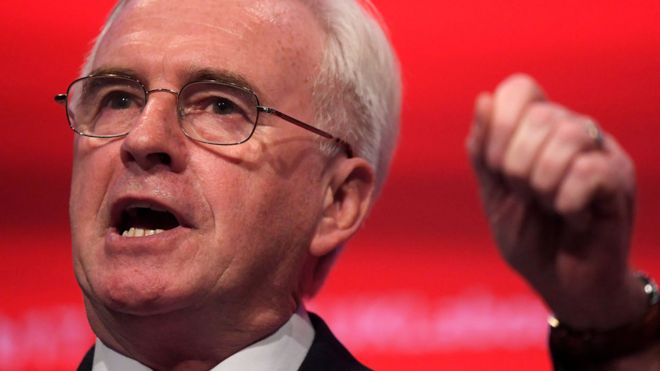
Shadow chancellor John McDonnell has demanded "an emergency Budget for our public services", which he says are in crisis.
John McDonnell, Shadow chancellor
He is promising to spend about £17bn a year extra on the NHS, social care, schools and local government.
The extra spending would be paid for by tax rises for companies and "the rich", while tackling tax avoidance.
The government said Labour's plans would lead to more debt, higher taxes and fewer jobs.
Chancellor Philip Hammond is due to give his Budget speech next Wednesday afternoon.

'Growing anger'

In a speech at Church House in Westminster, Mr McDonnell called for an end to austerity by the government and set out five main proposals:
  • Pause the roll-out of Universal Credit to fix delays in benefits payments
  • Fund public sector pay rises
  • Put more money into infrastructure such as road and rail projects
  • Increase funding for health, education, and local government
  • Launch a large-scale house-building programme.
He said the Chancellor, Philip Hammond, was out of touch with the lives of ordinary people and there was growing anger after seven years of austerity.
"They were told austerity was the solution to the economic crisis," he said.
"So it's understandable that after seven years of the austerity solution, they are angry when they queue for hours at A&E, see their school laying off teaching assistants, their Surestart centre closing and the local neighbourhood police withdrawn from their streets.
"Especially, while at the same time, they learn about the Paradise Papers and the tax avoidance of the super-rich."
Mr McDonnell said the Conservatives were giving away about £76bn in cuts to corporation tax, capital gains tax and "the rich" during the life of this Parliament.
He said Labour had already calculated £6.5bn could be raised from clamping down on tax avoidance, but he believed that could be significantly higher after the leaking of the Paradise Papers.
A global investigation looked at 13.4 million previously secret documents that revealed offshore investments made by companies, politicians and wealthy individuals.

Analysis: Kamal Ahmed, BBC economics editor

John McDonnell wants to create a clear red line between him and the present incumbent of Number 11, Philip Hammond.
A week ahead of the Budget, the shadow chancellor has said that more should be spent on health, education and housing and that the public sector pay cap of 1% should be lifted.
The controversial introduction of the new benefits system - the universal credit - should also be delayed after evidence that some recipients were being left without payments for several weeks.
To pay for the new policies, Mr McDonnell will say he is willing to borrow more to invest in infrastructure, arguing it is a good time to do so as interest rates are at historic lows.
It is a position rejected by the Conservatives, with Mr Hammond saying that more borrowing now simply means more debts to be repaid in the future.
It is expected that he will focus any new spending on health and housing in the Budget, next Wednesday.

'Accountancy tricks'

Mr McDonnell said more action was needed to tackle what he called the "housing crisis".
The government is to wipe about £70bn worth of debt from housing associations' balance sheets, allowing them to raise money more cheaply.
But Mr McDonnell described it as "accountancy tricks" and called for more funding.
"The scale of the crisis demands action on an equal scale. We need at least 100,000 new social homes a-year funded and built by this government, to even begin to address the problem."
He said Mr Hammond could do far more.
"He wants to pretend he cannot invest on the scale needed, yet he has already borrowed more in his first year as chancellor than any of his predecessors in their first year at the Treasury."
Responding to Mr McDonnell's proposals, Chief Secretary to the Treasury Liz Truss said: "The shadow chancellor has today admitted Labour would borrow billions more and hike up taxes to record levels.
"The costs would rack up and up - putting economic growth at risk and hitting ordinary working people in the pocket.
"Only the Conservatives can build a country that is fit for the future."

Thursday, November 16, 2017

Reuters News - U.S. Congress poised for first vote on tax cut plan

by David Morgan and  Amanda Becker

WASHINGTON (Reuters) - The Republican-controlled U.S. Congress approached a major test on Thursday of its ability to enact sweeping tax cuts, as lawmakers prepared for their first full-scale vote on tax legislation.

President Donald Trump met with Republicans from the House of Representatives at the U.S. Capitol and urged them to pass their bill to cut federal tax rates on corporations, small businesses and individuals.
Trump wants to sign a tax package into law before the end of the year, giving him and his Republican allies their first major legislative accomplishment of 2017.
“He said that we’ve got to get this tax bill passed to get the economy moving,” U.S. Representative Matt Gaetz told reporters. Trump talked to lawmakers for about 20 minutes and left the Capitol without speaking to reporters.
U.S. House Speaker Paul Ryan told Fox News he was confident his chamber had the votes to pass their version of the plan. A vote was expected early on Thursday afternoon.
“Big vote tomorrow in the House. Tax cuts are getting close!” the Republican president tweeted on Wednesday night.
But the tax overhaul has encountered resistance in the Senate, where the Republicans’ narrow majority means they have to keep almost everyone in the party on board. The Senate version has faced criticism from some Republican lawmakers, including Senator Susan Collins, who helped sink a Republican effort to repeal Obamacare earlier this year.
Senate Republicans made the risky decision to tie their tax plan to a repeal of the mandate for people to get healthcare insurance under former President Barack Obama’s Affordable Care Act, exposing the tax initiative to the same political forces that wrecked their anti-Obamacare push.
Republican U.S. Senator Ron Johnson said Trump called him on Wednesday night after Johnson announced his opposition to the current Senate plan over what he said were unequal rates for small businesses and non-corporate enterprises known as “pass-throughs,” versus corporations.
Still, Johnson said he was hopeful a final bill could be passed by year’s end.
“I‘m trying to fix it, and I want to vote yes,” Johnson told CNBC, adding Trump told him he would meet with Treasury officials on the issue. The president’s public schedule did not list any Department of Treasury meetings for Thursday.
Republicans have long promised tax cuts and see enacting the legislation as critical to their prospects of retaining power in Washington in the November 2018 congressional elections. Despite controlling the White House and Congress, Republicans so far have no major legislative achievements to show voters.
“The American people have waited years for a fair, simple, and competitive tax code. Right now, in this moment, we stand on the doorstep of delivering,” Kevin Brady, chairman of the tax-writing House Ways and Means Committee, said during the House tax debate.
The House bill, which is estimated to increase the federal deficit by nearly $1.5 trillion over 10 years, consolidates individual and family tax brackets to four from seven and reduces the corporate tax rate from 35 percent to 20 percent.
It also would scale back or end some popular tax deductions, including one for state and local income taxes, while preserving a capped deduction for property tax payments.
‘TAX SCAM’
Democrats have condemned both the House and Senate tax plans as giveaways to the wealthy and U.S. corporations, pointing to analyses showing millions of Americans could end up with a tax hike because of the elimination of popular deductions. Repealing or cutting some deductions is a way to offset the revenue lost from tax cuts.
“This is not a tax plan. This is a tax scam,” said Representative Maxine Waters, a California Democrat.
Nonpartisan congressional analysts say the provision to repeal the health insurance mandate in the Senate version would drive up premium costs and cause some 13 million Americans to lose coverage. It also sets individual tax rate cuts to expire while reductions for corporations are permanent.
The Senate and House tax plans must eventually be reconciled and merged into a final plan that can pass both chambers before Trump signs it into law.
“We’ll find a middle ground and we’ll get it to the president’s desk ... This is a big deal for us,” Republican Representative Tom Cole told MSNBC.
The main challenge facing Republicans remains the 100-seat Senate, where they can lose no more than two votes from their 52-48 majority if they hope to enact tax reform.
Senator John McCain, a Republican who also voted against his party’s healthcare overhaul effort earlier this year, and his colleagues Bob Corker and Lisa Murkowski, are considered critical votes along with Collins and Johnson.
Reporting by David Morgan and Amanda Becker; Additional reporting by Susan Heavey, David Alexander and Katanga Johnson; Editing by Frances Kerry and Alistair Bell
Our Standards:The Thomson Reuters Trust Principles.

Wednesday, November 15, 2017

BBC News - Japan's economy posts longest growth streak since 2001

Tokyo streets

Japan's economy has expanded for seven quarters in a row in the longest period of growth in more than a decade.
Data showed gross domestic product (GDP) grew at an annualised rate of 1.4% between July and September.
The solid quarterly result comes after more than four years of economic stimulus by Prime Minister Shinzo Abe.
Exports and stronger global demand for Japanese products has driven the expansion which helped offset a dip in consumer spending at home.
Martin Schulz, senior fellow at the Fujitsu Research Institute in Tokyo said the economy has been boosted by very strong export demand, growing at 6%.
With the "world economy recovering almost in sync and with expansions from the US through Asia to the European Union, this helps Japan's exporters tremendously," he added.

'Not out of the woods'

Mr Abe's economic policies have also been partly credited for the longest stretch of Japanese economic growth in 16 years.
Mr Abe's grand plan to kick-start the world's third largest economy, known as "Abenomics", has been focused on tackling nearly two decades of stagnant growth and falling consumer prices.
Despite doubts about Abenomics among many economists, David Kuo, chief executive of the Motley Fool Singapore, said the numbers showed "quantitative easing is working in Japan".
After being re-elected last month, Mr Abe vowed to continue his efforts to propel the Japanese economy into a cycle of rising wages, spending and inflation.
But Mr Kuo said "Japan is not out of the woods yet" as inflation is still weak and consumer spending is still anaemic.
Private consumption fell an annualised 1.8% in the quarter, showing how Mr Abe's economic policies have not yet spurred consumers to spend,

Tuesday, November 14, 2017

Bloomberg News - South African Banks Prepare for Worst as Junk Rating Looms

South African banks are preparing for the worst when it comes to the threat of another downgrade of the country’s debt.
“FirstRand anticipated the downgrades since 2015 and has been working on a number of proactive strategies to mitigate the impact,” said Andries du Toit, the treasurer at Johannesburg-based FirstRand Ltd., the country’s second-biggest bank by assets. The measures included adjusting credit origination, and boosting liquidity and capital buffers, he said.
The credit ratings of the continent’s largest lenders such as Standard Bank Group Ltd., Barclays Africa Group Ltd., Nedbank Group Ltd. and FirstRand are inextricably tied to that of South Africa, where they make most of their profit. Banks also need to hold sovereign bonds for regulatory purposes, meaning that any increase in the government’s borrowing costs immediately causes the capital the companies need to support lending to become more expensive.
In a move that may help establish a sizable offshore base, FirstRand last month offered to buy all of the U.K.’s Aldermore Group Plc for about 1.1 billion pounds ($1.4 billion). Although the purchase of the challenger to some of Britain’s biggest lenders won’t save FirstRand from higher costs in South Africa, it’s a step to creating a platform to source offshore funding and to earn income in a currency other than rand. 
FirstRand increased its total Tier 1 capital levels to 17.1 percent as of the end of June compared with 16.9 percent a year earlier.

Pending Reviews

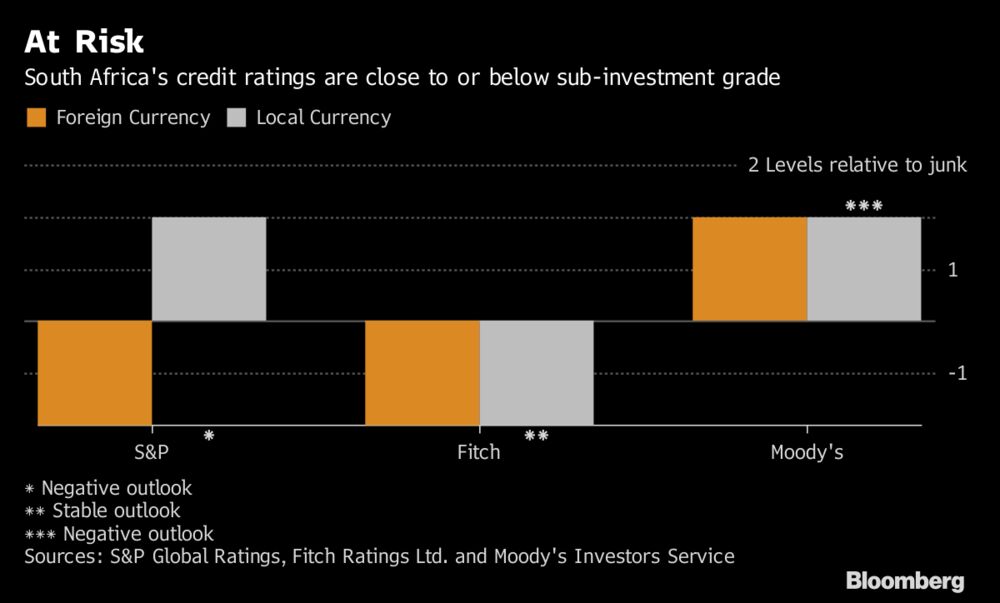
At stake for the nation’s lenders is the credit assessment on the country’s local-currency bonds, which account for 90 percent of the government’s issued debt. S&P Global Ratings and Moody’s Investors Service, which are both due to announce their latest reviews on Nov. 24, still rate rand-denominated debt as investment grade.
A change in either one of those evaluations could see South Africa removed from some indexes tracked by global investors, triggering outflows and pushing up borrowing costs. While the ratings companies could wait until after the ruling African National Congress’s conference next month to decide on who will replace President Jacob Zuma, the agencies may be swayed to act sooner after National Treasury on Oct. 25 said that the budget deficit will widen and debt levels will climb.
The country’s foreign-currency debt was downgraded to junk by S&P and Fitch Ratings Ltd. after former Finance Minister Pravin Gordhan was fired by President Jacob Zuma at the end of March.
“Banks are cyclical investments so will be impacted by any downturn as a result of a sovereign downgrade and the resultant impact on the economy and our clients,” said Mike Davis, Nedbank Group Ltd.’s executive for balance-sheet management. “We have, however, been aware of this risk for a long while and are well prepared for such an event should it happen.”
Nedbank, majority held by London-based insurer Old Mutual Plc, has been applying conservative lending policies with high levels of provisions, high capital buffers and diversified funding sources, Davis said. The lender had a core equity tier 1 ratio of 12.3 percent at the end of June from 12.1 percent a year earlier, and compared with 11.3 percent in December 2015.

‘Front-Loaded’

The lender has no plans to raise additional funding in the market this year, having “front-loaded” earlier in 2017 in anticipation of a credit downgrade, said Davis. Only about 8 percent of its funding is raised in bond markets, with the bulk of it provided by deposits. Barclays Africa didn’t respond to emailed requests for comment.
Even with operations across 19 other countries on the continent, Standard Bank still would not be able to achieve credit ratings above that of its home market, which accounts for about 70 percent of its revenue, according to data compiled by Bloomberg.
The rating of a bank “is linked by credit-rating agencies to sovereign exposures it holds,” said Arno Daehnke, the finance director of Johannesburg-based Standard Bank, Africa’s largest lender. “It is difficult to pierce the sovereign ceiling, even after the consideration of foreign-asset holdings.”
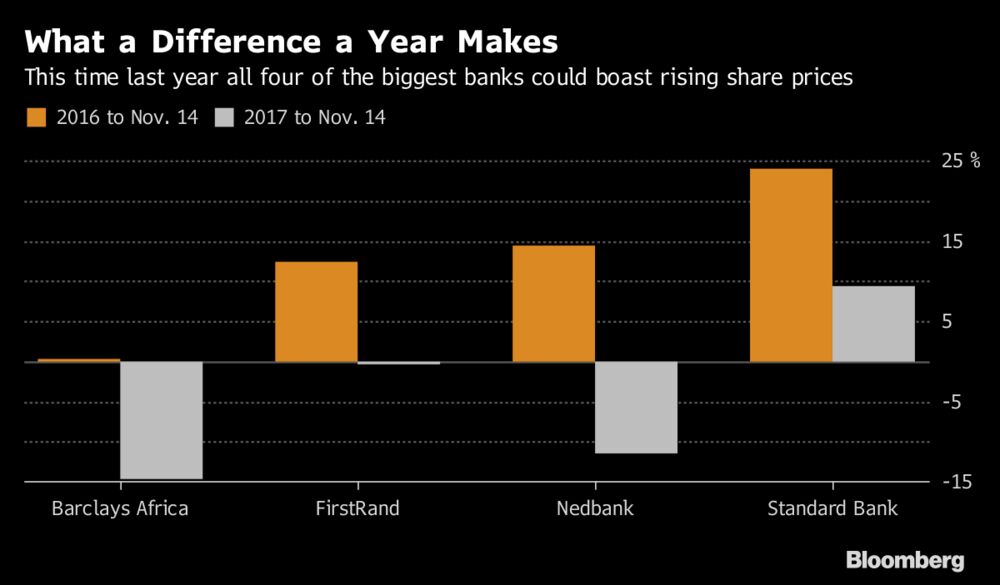
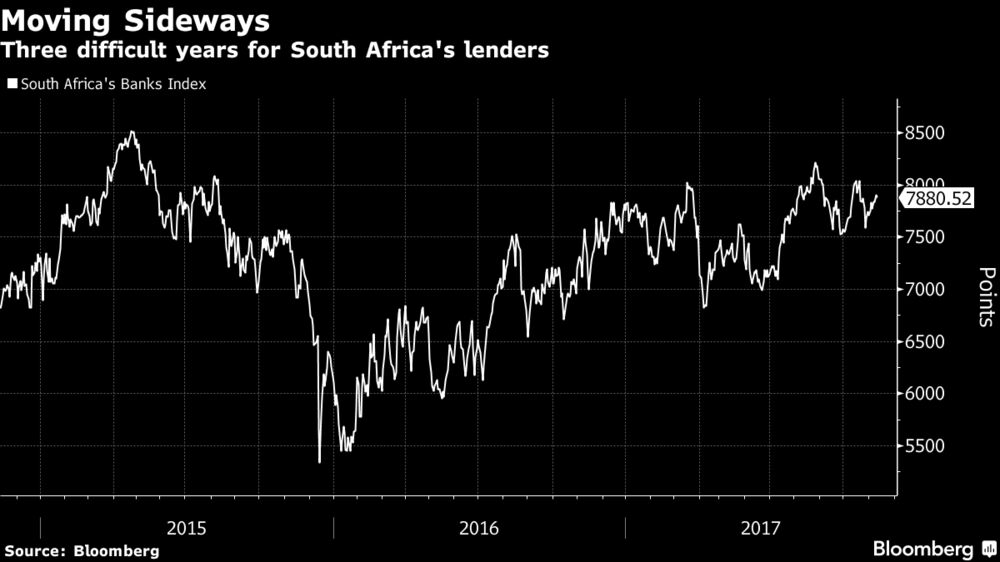
The pressure on the banks has been evident in their slowing profit growth and lackluster share prices. The six-member FTSE/JSE Africa Banks Index has climbed 1.3 percent this year, compared with the all-share gauge’s 18 percent rally to a record high.
“The bank undertakes scenario planning on an ongoing basis, including the possibility of a downgrade of the sovereign local-currency rating to sub-investment grade,” Standard Bank’s Daehnke said. “The bank accesses a diverse source of retail and wholesale funding markets, and the mix is not expected to change materially in the next two to six months.”

Monday, November 13, 2017

BBC News - Theresa May to meet EU business leaders

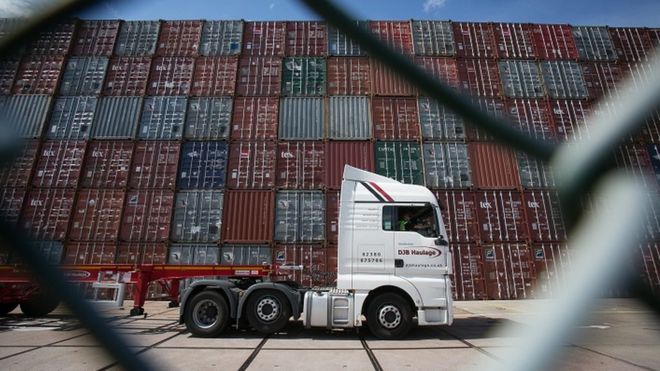
Lorry passing shipping containers
European business leaders will meet Prime Minister Theresa May later on Monday to voice concerns about the future of UK-EU trade.
Experts from groups including the CBI and BusinessEurope will stress the need for a transitional deal that preserves the status quo after Brexit.
They will urge the government to clarify the future relationship between the UK and the rest of the EU.
The next round of Brexit talks is due to start in mid-December.
They will meet Mrs May at No 10, as well as Business Secretary Greg Clark, Brexit Secretary David Davis and Economic Secretary to the Treasury Stephen Barclay.
The CBI and the Institute of Directors will be represented, as will business organisations from France, Germany, Spain, Italy, the Netherlands, Ireland, Sweden, Poland, the Czech Republic and Belgium.
There are concerns that future trade talks could collapse ahead of December's EU summit.
EU chief negotiator, Michel Barnier, has warned that the talks will only go ahead if the UK first clarifies its financial obligations to the EU.
Mr Davis has said the UK was "ready and willing" to engage with Brussels "as often and as quickly as needed".

Growing urgency

CBI director general Carolyn Fairbairn told the BBC that it was an important meeting. "The urgency that's shared by business across Europe is growing by the day."
She said a CBI survey indicated that 10% of firms had "already pressed the button on their contingency plans".
"A firm I spoke to in Belfast last year - who manufactures in Belfast - because of tariffs and red tape that would result from a no-deal Brexit, they have pulled together plans for moving to France."
The pace of planning by firms was picking up, she added, with about 60% of firms saying they would have implemented contingency plans by the end of next March.
Bernard Spitz, a director of Medef, France's biggest business lobby group, said his organisation had always said "Brexit was bad for the UK and for Europe". He said agreement on a transition deal was important not just for UK firms, "but for firms across the European Union".
"We know that for us, especially for the French, the relationship with the UK is absolutely key, but if business continuity is important, what is even more important is the integrity of the European market."
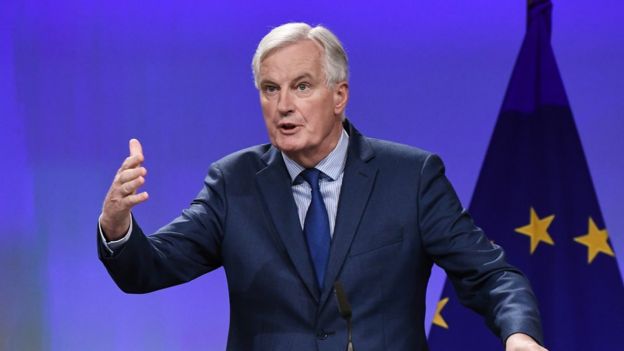
Michel Barnier
Michel Barnier has warned of the possible collapse of upcoming Brexit negotiations

Property developer Richard Tice, co-founder of Leave Means Leave, told the BBC time was very short.
He said that if there was no sign that a trade deal was going to be reached, "then actually we would be better to give certainty to everybody that actually we're going to do a different type of deal which is to go to WTO [World Trade Organization rules]".
"These European Union business groups - the message they've got to take back to their governments, to take back to Brussels, is you've got to get on with it and either start talking about a trade deal or accept that everybody must get on and start planning for a different type of deal."

Shared input

The business leaders are set to tell the prime minister they want real progress on a future free trade agreement, as well as a transitional arrangement until that can be implemented.
Mrs May is expected to reiterate the UK's commitment to securing an implementation period of about two years once the country leaves the EU in March 2019.
She will also ask the business experts to share their input on how the UK and EU can continue to thrive side by side in industry and economic development.
The BBC's business editor, Simon Jack, says some UK business leaders in favour of Brexit are concerned that a transition period maintaining the current arrangements will delay and frustrate Britain's attempts to strike new independent deals.
Our editor says that while hoping a deal with the EU can be achieved, some are concerned that the lack of progress so far plays into the EU's hands.
They are therefore recommending the government uses its time to prepare for a "no deal" scenario which would see the UK trade with Europe on the same terms - and tariffs - as the rest of the world.