Wednesday, April 18, 2018

BBC News - IMF predicts stronger growth but warns of risks

By Andrew Walker
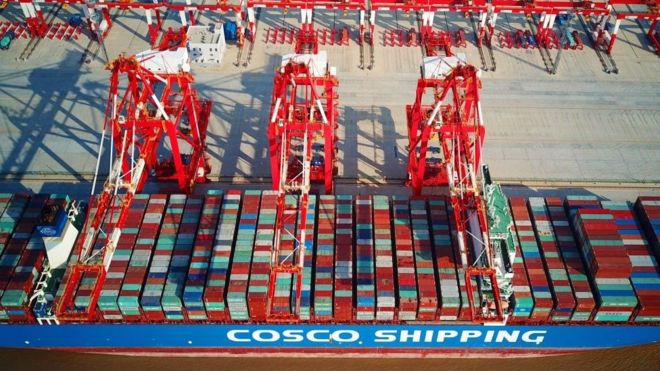
Yangshan deep-water port, an automated cargo wharf, in Shanghai.
The International Monetary Fund has forecast that 2018 will be the strongest year for global growth since 2011.
In its new assessment of the World Economic Outlook, the IMF predicts growth this year and next of 3.9%.
However, it warned that performance could be curtailed by trade barriers.
For the UK, the IMF has made a modest upgrade for growth this year to 1.6%. For next year, the forecast has been slightly reduced, to 1.5%.
The IMF report warned that the current momentum was "not assured".
It lists a number of risks that could lead to weaker performance than its main forecast, including what it calls policies that "harm international trade".
The report refers to "waning support for global integration". It says increased trade barriers - tariffs or other restrictions - could harm sentiment in financial markets, disrupt global supply chains and slow the spread of new technology.
Protectionism also affects consumers by making tradable goods more expensive.
The increased tension in recent months over trade largely reflects President Trump's view that the deficit in US trade - the country imports more than it exports - is a result of poor agreements negotiated by his predecessors and other countries taking advantage of the US.
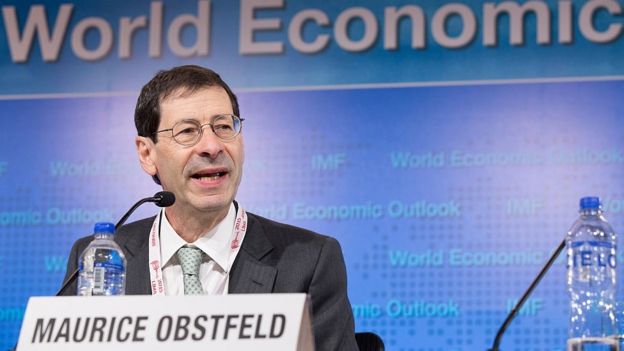
But IMF chief economist Maurice Obstfeld dismisses the idea that the steps taken by the US can reduce the deficit.
He says the reason for the deficit is that total spending in the US exceeds income. He says that recent tax measures are actually likely to increase the deficit.
Maurice Obstfeld, IMF chief economistImage copyrightGETTY IMAGES
Image captionIMF chief economist Maurice Obstfeld warned of a 'sobering' long-term outlook for the global economy
The general thrust of this report is relatively upbeat for the near-term future. The forecasts for this year and next have been raised.
The upgrade to global growth for this year to 3.9% potentially makes 2018 the strongest year since 2011, when the economy was rebounding from the financial crisis.
Mr Obstfeld describes the upgrade from 3.7% as "substantial".
Compared with forecasts issued in October 2017, the predictions for this year for the euro-area, Japan and the US have all been raised by half a percentage point or slightly more.
For the UK, the report says that unemployment close to historic lows could add to inflationary pressures, by triggering faster wage growth.
Inflation is already above the government and Bank of England's target of 2%. The IMF says further increases in interest rates are needed to bring price rises back towards that rate.

Lurking dangers

That said, Mr Obstfeld describes longer-term prospects as "more sobering".
In the developed economies, he says, ageing populations and low growth in productivity (the amount each worker produces) mean they are unlikely to achieve the per capita growth rates they managed before the crisis - and it is per capita growth that drives average living standards.
Among developing countries, he says those that depend on exporting commodities need to diversify their economies.
There are warnings about the risks ahead, lurking dangers that could lead to the global economy falling short of the IMF's forecasts, in addition to the concerns about trade.
Debt levels - private and government - are very high. That could lead to debtors getting into difficulty with repayments as interest rates rise from the post-financial crisis lows.

Tuesday, April 17, 2018

Reuters News - As Republicans push for second tax vote in Congress, Democrats say 'Let's see

by Amanda Becker

WASHINGTON (Reuters) - Republican leaders in the U.S. Congress are moving forward with a plan to vote before the 2018 midterm elections on a bill to make permanent the temporary individual tax cuts in their recent tax overhaul.
It is not yet clear, however, if the plan would pick up support from Democrats, whose votes would be needed to pass legislation in the Senate.
The Republican tax law, approved in December without Democratic support, permanently cut the top corporate rate to 21 percent from 35 percent and created a permanent deduction for pass-through businesses. It created lower rates and new credits for individuals, but those expire at the end of 2025.
Democrats have said the tax code rewrite favors businesses and the wealthy, and that working-class taxpayers will see little benefit in their paychecks.
The nonpartisan Congressional Budget Office said last week that the tax bill, as written, is projected to add $1.9 trillion to the national debt over the next decade.
“We fully intend to make these things permanent, and that’s something we’ll be acting on later this year,” House Speaker Paul Ryan told reporters on Tuesday, referring to the individual rates.
Making the individual cuts permanent after 2025 would cost an additional $1.5 trillion over the next decade, according to a Tax Foundation analysis of data from the nonpartisan Joint Committee on Taxation.
Senate Majority Leader Mitch McConnell, asked if he would hold a vote, said that if Democrats are interested, “that’s something we ought to take a look at.”
But many Democrats have already said Republicans could have prioritized low- and moderate-income taxpayers over the wealthy and businesses when writing permanent sections of the original law.
In order to comply with the Senate rules that allowed Republicans to pass the tax overhaul with a simple majority - and no Democratic support - the measure was not supposed to add more than $1.5 trillion to the U.S. debt over the next decade.
“Look, we’d have to see what their bill is,” Senate Minority Leader Chuck Schumer said.
In order to make the individual rate cuts permanent, other parts of the bill should be renegotiated, some Democrats have said.
“Let’s see what they do, but if they’re going to create more debt, and they’re not going to pay for it ... I think we can show the American people that is a shell game,” Representative Steny Hoyer, the No. 2 House Democrat, told reporters.
Reporting by Amanda Becker; additional reporting by Susan Cornwell; Editing by Dan Grebler

Friday, April 13, 2018

BBC News - Rate rise doubts as property demand falls, says RICS

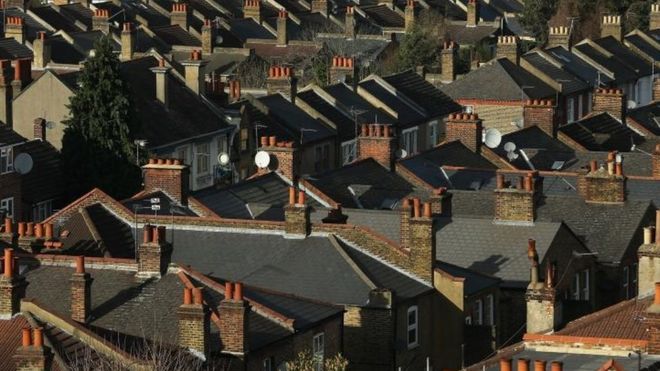
Houses
A lack of activity in the UK housing market could make it more difficult for Bank of England policymakers to raise interest rates, surveyors have said.
There has been widespread speculation of a potential increase in the Bank rate in May from its level of 0.5%.
The Royal Institution of Chartered Surveyors (RICS) said property buyer demand had fallen for its 12th consecutive month in March.
This could mean slower household spending as fewer people move home.
Simon Rubinsohn, chief economist at RICS, said that there was little sign of any potential pick-up in buyer demand.
"Apart from the implications this has for the market itself, it also has the potential to impact the wider economy, contributing to a softer trend in household spending," he said.
"This could make Bank of England deliberations around a May hike in interest rates, which is pretty much odds-on at the moment, a little more finely balanced than would otherwise be the case."
Across the UK, 9.2 million households have a mortgage. Of these, about half are on a standard variable rate or a tracker rate, and they would most likely be affected by a rise in the Bank rate.
However, these figures, as well as an unexpected 0.2% fall in UK manufacturing output in February, do mean that the UK economy may not be growing as fast as predicted, making an interest rate rise less inevitable.

Regional differences

Demand for property and house price changes vary considerably across the UK.
London is seeing the sharpest fall in prices, according to surveyors. Respondents in the South East of England, East Anglia and the North East of England also reported prices to be falling, but to a lesser extent than in London. Prices increased elsewhere in the UK in the last three months.
Surveyors predicted that in a year's time, house prices would be higher, particularly in the North West of England, Wales and Scotland.
London remained the only region in which surveyors expected prices to be lower in one year's time.

Thursday, April 12, 2018

Reuters News - Trade war backfire: Steel tariff shrapnel hits U.S. farmers

by Tom Polansek, P.J. Huffstutter
KANE COUNTY, Ill. (Reuters) - Lucas Strom, who runs a century-old family farm in rural Illinois, canceled an order to buy a new $71,000 grain storage bin last month - after the seller raised the price 5 percent in a day.

The reason: steel prices jumped right after U.S. President Donald Trump announced tariffs.
Throughout U.S. farm country, where Trump has enjoyed strong support, tariffs on steel and aluminum imports are boosting costs for equipment and infrastructure and causing some farmers and agricultural firms to scrap purchases and expansion plans, according to Reuters’ interviews with farmers, manufacturers, construction firms and food shippers.
The impact of rising steel prices on agriculture illustrates the unintended and unpredictable consequences of aggressive protectionism in a global economy. And the blow comes as farmers fear a more direct hit from retaliatory tariffs threatened by China on crops such as sorghum and soybeans, the most valuable U.S. agricultural export.
A&P Grain Systems in Maple Park, Illinois - the seller of the storage bin Strom wanted to buy with a neighboring farmer - raised its price two days after Trump announced aluminum and steel tariffs on March 1 to protect U.S. producers of the metals. Strom and his neighbor backed out.
“Would that price destroy us? No,” Strom said. “But these days, you have to be smart about your expenses.”
The metals tariffs also hitting makers and sellers of farm equipment, from smaller firms like A&P Grain to global giants such as Deere & Co (DE.N) and Caterpillar Inc (CAT.N). Such firms are struggling with whether and how to pass along their higher raw materials costs to farmers who are already reeling from low commodity prices amid a global grains glut.
The world’s two largest economies have threatened each other with tariffs on tens of billions of dollars of goods recent weeks.
Trump imposed tariffs of 25 percent on steel and 10 percent on aluminum in a move mainly aimed at curbing imports from China. He has since temporarily excluded the European Union and six other allies from the duties and given them until May 1 to negotiate permanent exemptions.
A&P Grain President Dave Altepeter said the steel used in their bins is made in the United States, but domestic steel prices also have soared because of the tariffs.
U.S. steel mills typically adjust their prices once a year, normally in the first quarter, Altepeter said. But this year, those prices have jumped four times, he said.
The price of steel used in A&P’s grain bins has jumped about 20 percent since January 1.
“Any time there’s any type of negative talk that affects the steel mill, they’ve raised the price,” said Altepeter.
Last year, about 95,000 tons of steel was shipped to the agriculture industry, compared to the 14 million tons for the U.S. auto industry, according to the American Iron and Steel Institute, an industry group.
Other factors had been driving up steel prices before the recent trade disputes, including an improving global economy and accelerating manufacturing and construction, particularly in the U.S.
The White House referred questions from Reuters to the U.S. Department of Agriculture, which did not respond to a request for comment. Trump and Agriculture Secretary Sonny Perdue have vowed the U.S. government will protect farmers from China’s tariffs, but not explained how.
U.S. farmers can ill-afford any loss of sales. Farm income has dropped by more than half since 2013, following years of massive harvests that have depressed prices for staples such as corn and soybeans.
U.S. competitors Brazil, Argentina and Russia have all raised grain output in recent years, eating into the U.S. share of global markets. Mexico imported ten times more corn from Brazil last year and is set to buy even more in 2018 on worries that renegotiations of the NAFTA trade pact could disrupt their U.S. supplies.
Strom said he has also pushed back plans to build a new metal storage building to house his planter and the combine head he uses for harvesting corn and soybeans. Other farmers, food producers and beer makers have scrambled to finalize deals for steel-based equipment before prices climb more.

CONSTRUCTION POSTPONED

In Riverton, Illinois, farmer Allen Entwistle said he postponed construction of a new $800,000 storage system for grain after AGCO Corp’s (AGCO.N) GSI unit increased prices by 15 percent.
Entwistle, who voted for Trump, will instead store corn in bags on the ground.
“President Trump keeps telling us he’s going to get a better deal,” Entwistle said. “When are we gonna make it better?”
AGCO said Trump’s tariffs will raise its costs and make price hikes to customers unavoidable.
“As the entire grain storage industry has weathered increased steel prices, AGCO and GSI are constantly looking for new ways to maximize efficiency and minimize the impact to customers,” said spokeswoman Kelli Cook.
Other companies, including Deere and Caterpillar, are also facing pain from rising steel prices, which account for about 10 percent of equipment manufacturers’ direct costs.
Deere CEO Samuel Allen told Reuters last month the company will have to absorb the price increase and cut costs elsewhere. China’s threatened tariffs on U.S. crops could hurt the company even more by undermining demand from farmers, he said.
“This has a huge effect on livelihood of the farmer right now, and at the same time it has a huge impact on manufacturers,” said Dennis Slater, president at the Association of Equipment Manufacturers, an industry group.
U.S. net farm income is forecast to drop to $59.5 billion in 2018 dollars, down from $64.9 billion in 2017, an 8.3 percent decline, according to the USDA.
TARIFF ‘DOOM-AND-GLOOM’
In Sheffield, Iowa, Sukup Manufacturing has seen steel prices soar 40 percent since November, said Brent Hansen, the company’s commercial accounts manager.
The maker of grain bins and pre-manufactured steel buildings has encouraged customers to buy quickly before prices jump more. But some have already postponed projects, Hansen said.
“That’s obviously a big price increase for an industry that’s a little bit doom-and-gloom over tariffs,” Hansen said.
Sukup used to give customers up to two months to consider its bids for projects. Now, it allows just a week in some cases because of volatile steel prices, Hansen said.
Prices have jumped by 25 percent for thermal insulated panels that keep food cold – which can use either steel, aluminum or both, said Glenn Todd, owner of Todd Construction Services. The company has built food processing and storage facilities for Bumble Bee Seafoods and poultry company Foster Farms.
Richard Adkins, director of sales at Discovery Designs Refrigeration in Mukwonago, Wisconsin, thought his company wouldn’t have to worry about Trump’s tariffs. Most of the metal they use to design industrial refrigeration systems comes from Canada and Mexico, he said, and the president has exempted both countries from the levies.
It didn’t matter. Price-hike notices from vendors landed in Adkins’ mailbox days after Trump announced the duties.
“There’s this knee-jerk reaction,” Adkins said. “We’re quoting prices for projects that won’t be awarded for another six or eight months, and no one wants to be hung out to dry.”
Reporting by Tom Polansek in Chicago and PJ Huffstutter in Kane County. Additional reporting by Rajesh Kumar Singh in Chicago.; Editing by David Gaffen, Simon Webb and Brian Thevenot
Wednesday, April 11, 2018

Bloomberg News - China’s Vast Intercontinental Building Plan Is Gaining Momentum

China’s massive build program to recreate trade routes stretching from Asia to Africa and Europe is gaining momentum.
Since President Xi Jinping’s flagship Belt and Road project was announced about five years ago, it gave impetus to billions of dollars of Chinese investment -- some of which were already in the pipeline for several years -- to build railways, roads, ports and power plants.
The program isn’t without controversy: debt risk is rising, an influx of Chinese workers has fueled tension with locals, and there are worries about China’s dominance in the region. And not all of the projects have succeeded.
“It’s been a mixed bag so far,” said Michael Kugelman, a senior associate for South Asia at the Woodrow Wilson Center in Washington. “There have certainly been success stories, and there will be more of them too, but there have also been setbacks.”
With many projects in various stages of developments, measuring the success and potential benefits can be tricky. Here’s a list of projects that analysts who track China’s Belt and Road investments say will provide the most economic impact to countries by unlocking trade routes:

Myanmar’s Kyaukpyu Pipeline

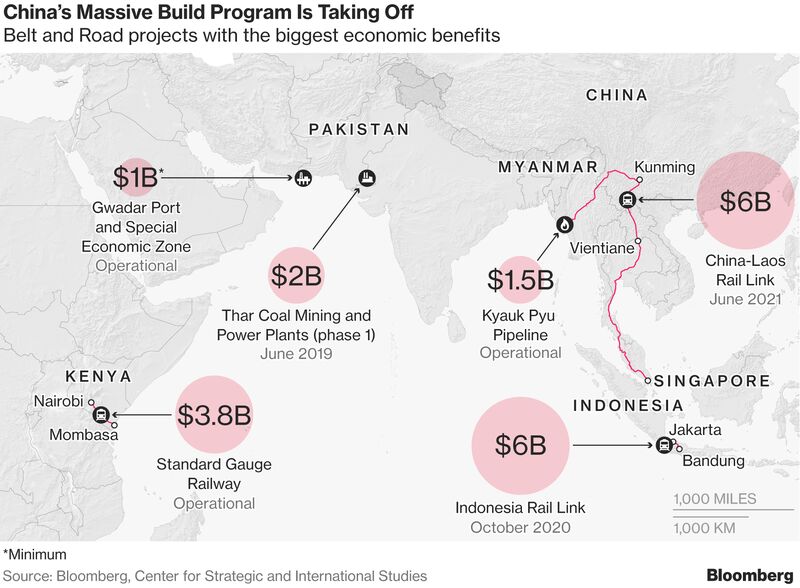
The $1.5 billion oil pipeline that runs from Kyaukpyu to Kunming began operations last year, allowing crude supplies from the Middle East and Africa to reach China faster as shipments no longer need to be transported through the Straits of Malacca and the South China Sea. The pipeline is designed to carry 22 million tons of crude a year, representing about 5 percent of China’s annual oil imports. Talks are also ongoing about building a $7.3 billion deep-water port, which would be China’s largest investment in the Southeast Asian nation. Along with a natural gas pipeline, the project represents an alternative route for energy imports and an important access point for goods shipped via the Indian Ocean, said Andrew Small, a senior fellow at the German Marshall Fund of the United States, and author of “The China-Pakistan Axis.”

Pakistan’s Gwadar Port

Sharing a border with China, Pakistan has projects that are among the most developed of the Belt and Road Initiative. The Gwadar deep sea port and a 3,000 kilometer-long corridor of roads and railways links China with the Arabian Sea. Transshipment from the port has begun, giving China’s western Xinjiang province closer access to a port than Beijing. It’s located at the mouth of the Persian Gulf, just outside the Straits of Hormuz, near shipping routes that accommodate more than 17 million barrels of oil per day and a large quantity of bulk, break-bulk and containerized cargo. With China expected to increase oil imports from the Middle East, Gwadar is seen as a potential trade route, said Hasnain Malik, head of equities research at Exotix Capital in Dubai.

Asia Pacific Rail Links

China has a plan to connect Southeast Asian countries with the southwest region of Yunnan through a series of high-speed railways. There are three routes planned: a central one that runs through Laos, Thailand and Malaysia to reach Singapore; a western route through Myanmar; and an eastern one through Vietnam and Cambodia. Projects are at various stages of development, with construction on the Thailand and Laos legs already progressing. The plan represents some of the most important and high impact of China’s rail investments, said Small. In Indonesia, the $6 billion Jakarta-Bandung project is a flagship of President Joko Widodo’s infrastructure program and expected to cut the travel time between the two traffic-clogged cities to 40 minutes, from about three hours by car. The project has so far stalled because of disputes over land clearance.

Kenya Railways

China is replacing decrepit Colonial-era trains with new and faster ones in African countries from Ethiopia to Senegal. One of the key projects is the Standard Gauge Railway that links Kenya’s port city of Mombasa to landlocked neighbors including Rwanda and Uganda via a network of high speed lines. The $3.8 billion passenger and cargo link between Mombasa and Kenya’s capital Nairobi started last year. It cuts the journey time by about half to 5 hours, while also reducing the cost of transporting freight.
Pakistan is seeking to extract coal in the Thar desert at one of the world’s biggest known deposits of lignite, a lower-grade brown version of the fuel. The project includes the building of power plants to expand electricity capacity in a country that faces chronic shortages. The first phase, which will add 660 megawatts of power, will be completed next year and can be scaled to 5,000 megawatts to make it the largest cluster of electricity production in Pakistan.
(Analysts interviewed for this article were from the Center for Global Development, Exotix, Business Monitor International, Boston University, Woodrow Wilson Center, German Marshall Fund of the United States.)
— With assistance by Eric Ombok, Adrian Leung, and Jing Yang

Tuesday, April 10, 2018

BBC News - US punishes key Putin allies over worldwide 'malign activity'

The US has imposed sanctions on seven Russian oligarchs and 17 senior government officials, accusing them of "malign activity around the globe".
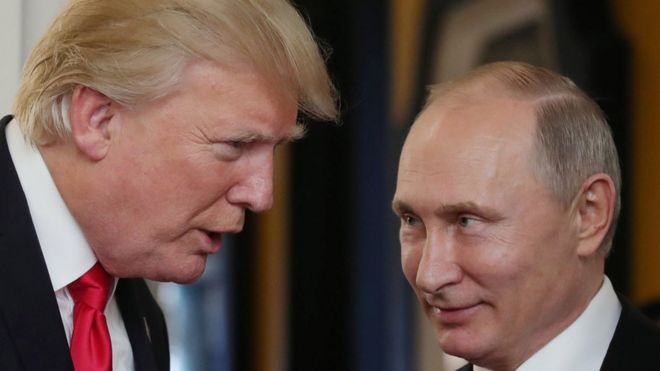
Donald Trump and Vladimir Putin
t is the most aggressive move against Russia taken by President Trump's administration
Twelve companies owned by the oligarchs, the state arms exporter and a bank are also sanctioned.
Treasury Secretary Steven Mnuchin said the penalties targeted those profiting from Russia's "corrupt system".
The move was a response to Russia's alleged meddling in the 2016 US presidential election, he said.
The sanctions are also being imposed because of the actions taken by the Kremlin in Crimea, eastern Ukraine and Syria, Mr Mnuchin said in a statement on Friday.
He accused the Russian government of "malicious" cyber-activities and said the sanctions would target "those who benefit from the Putin regime".
"The Russian government operates for the disproportionate benefit of oligarchs," he added.
It is the most aggressive action taken by the Trump administration thus far against Moscow.
Last month the US imposed sanctions on 19 Russians, accusing them of interference in the 2016 election and alleged cyber-attacks.
The US has also expelled dozens of Russian diplomats in response to the poisoning of a former Russian spy in the UK.

Who's been targeted?

Among those targeted is Oleg Deripaska, a billionaire aluminium magnate and Putin associate with ties to President Donald Trump's former campaign chairman Paul Manafort.
Also on the list is Suleiman Kerimov, who is one of Russia's richest men. His family controls Russia's largest gold producer, Polyus, and he has an estimated net worth of $6.3bn (£4.7bn).
In November, Mr Kerimov was placed under formal investigation in France on suspicion of tax evasion.
Suleiman KerimovImage copyrightAFP
Image captionSuleiman Kerimov is one of Russia's richest men
Alexander Torshin, a senior Russian official with reported ties to the National Rifle Association of America (NRA), has been blacklisted.
Mr Putin's bodyguard, his son-in-law, the head of Russia's national security council, and former prime minister Viktor Zubkov are also sanctioned.
Russian state arms exporter Rosoboronexport, one of the companies targeted, said the sanctions were designed to force Russia out of the global arms market.
Any assets they have under US jurisdiction have been frozen and US nationals are forbidden from doing business with them.
"This is unfair competition in its purest form," a spokeswoman told Reuters news agency.
Presentational grey line

Raising the stakes

Barbara Plett Usher, BBC News, Washington
This is the most aggressive move against Russia taken by the Trump administration: targeting Vladimir Putin's inner circle.
The name most familiar to Britons will be Oleg Deripaska, a billionaire who was at the centre of a political scandal ten years ago when he entertained Labour's Peter Mandelson and the Conservative shadow chancellor George Osborne on his super yacht.
Of more interest here in the US are his connections to Paul Manafort, Mr Trump's former campaign manager.
Congress passed a law last summer calling for such measures and has criticised the Trump administration for taking so long to act.
But senior officials insist that they have been planning the moves for some time.
These sanctions were already in the works before the nerve agent attack on a former Russian spy in the UK, so are not a direct response to it.
But they add to the rising diplomatic tensions between the West and Russia over that incident, and contrast sharply with President Trump's consistently softer approach to Mr Putin.
Earlier this week, Mr Trump felt compelled to insist he was being tough on Russia but said he still hoped a good relationship with its leader was possible. That seems even less likely now.

What does Russia say?

Russia has vowed that there will be a "tough response" to the new sanctions.
"We will not leave the current and any new anti-Russian attack without a tough response," the foreign ministry said in a statement.
"We would like to advise Washington to drop, as soon as possible, the illusions that they can talk to us in the language of sanctions".
Earlier on Friday, the Russian embassy in Washington said the sanctions were a mistake.
"We are told that these measures are not aimed against the Russian people, but they are," the embassy said in a post on its Facebook page.
It described the sanctions as "a new blow to Russo-American relations."