Monday, July 23, 2018

Bloomberg News - U.K. Says It Won't Blink First on Brexit So EU Must Back Down

By Patrick Donahue and  Tim Ross
British Foreign Secretary Jeremy Hunt said the U.K. will not “blink” in Brexit negotiations, as he warned the European Union it risks forcing the country to crash out of the bloc with no deal.
On his first trip to Berlin since he replaced Boris Johnson earlier this month, Hunt appealed for more flexibility from his European counterparts as time for talks runs out. He said failure to strike a deal would poison British attitudes to Europe for a generation and cause major economic challenges for the U.K.
“When it comes to Brexit, there is now a very real risk of a Brexit no-deal by accident,” Hunt said at a press conference on Monday alongside German Foreign Minister Heiko Maas. “And this is because, I think that many people in the EU are thinking that they just have to wait long enough and Britain will blink, and that’s not going to happen.”
Hunt’s visit marks the start of a week of intense diplomatic efforts by the U.K. government in an attempt to step up the pace of negotiations. Talks in Brussels have stalled as EU negotiators awaited a clear plan from the U.K. for its future relationship with the EU.
Prime Minister Theresa May published her compromise proposals on July 12 but has been struggling to win support for them among members of her own government.
Hunt said he wanted the U.K. and Germany to remain “best friends” after Brexit but warned that British relations with the continent will inevitably suffer if the EU’s negotiators do not change their attitude.
“Without a real change in approach from the EU negotiators, we do now face the real risk of a no-deal by accident and that would be incredibly challenging economically,” he said. “My real concern is that it will change British public attitudes to Europe for a generation – and it will lead to a fissure to relations which would be highly damaging for that great partnership that we’ve had for so many years.”
Speaking alongside Hunt, Maas said “we don’t want a disorderly Brexit; we want an agreement.”

Thursday, July 19, 2018

BBC News - Unlikely partners? China and Israel deepening trade ties

By Dave Gordon
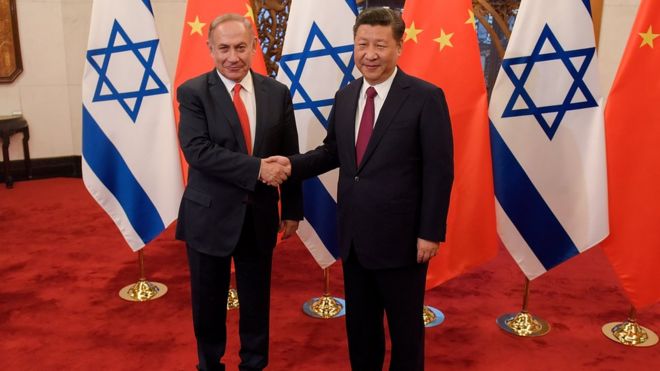
Chinese President Xi Jinping and Israeli Prime Minister Benjamin NetanyahuImage copyrightGETTY IMAGES
Image captionIsraeli Prime Minister Benjamin Netanyahu and Chinese President Xi Jinping have met on a number of occasions to boost ties between the two countries
On paper Israel and China are unlikely close trading partners.
China, the world's second-largest country, is the biggest exporter on the planet. While Israel, a tiny strip of land in the Middle East, is only in 45th place on the global exporting league table.
And importantly - Israel has always been a steadfast ally of the US.
So given the current trading spat between the US and China, you would expect Israel to be firmly on the American side.
Yet what many people don't know is that Chinese investment in Israel is continuing to boom, at the same time as a growing number of Israeli firms are entering the Chinese marketplace.
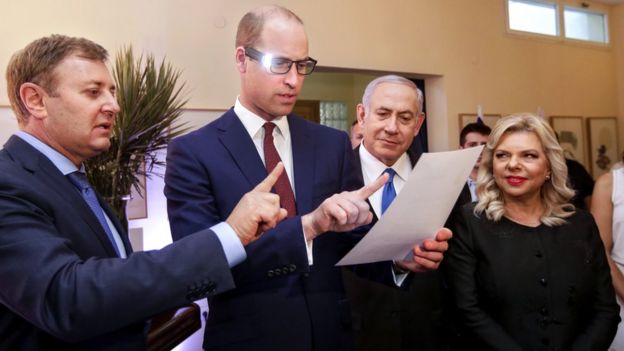
The UK's Prince William tests out some Israeli technology on his recent visit to IsraelImage copyrightGETTY IMAGES
Image captionThe UK's Prince Williams was shown some examples of Israeli technology on his recent visit to the country, such as these AI glasses that help people with limited sight more easily read
So while President Trump is slapping tariffs on Chinese exports and talking tough, Israel's Benjamin Netanyahu is happily encouraging his country's firms to accept Chinese investments, as the figures show.
In 2016 China's direct investment in Israel almost tripled to $16bn (£12bn), according to a report in the South China Morning Post newspaper.
Meanwhile, the Jerusalem Post predicts that China will overtake the US as the number one source of overseas investment in Israel.
So what has brought the two countries together, and should Israeli firms be cautious?
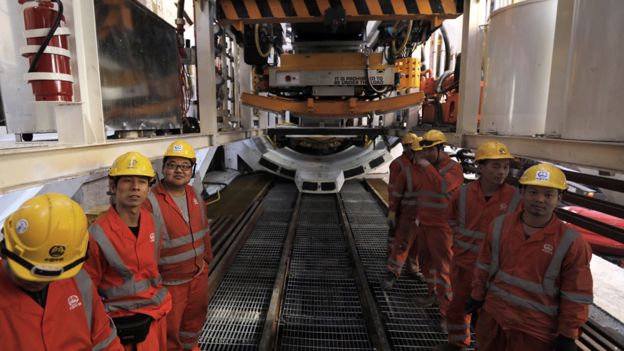
Chinese workers building the Tel Aviv undergroundImage copyrightGETTY IMAGES
Image captionChinese firms are not just buying up Israeli firms, they are also working on Israeli construction projects, such as the Tel Aviv Metropolitan Area Mass-Transit System
Over the past two decades the Israeli economy has established itself as a leading hub of technological development.
Commentators say that Chinese firms want to get their hands on that technology, at the same time as Israeli companies want better access to the giant Chinese marketplace.
"The Chinese are leveraging Israeli tech to fuel their economy, Israel is held in high esteem as a hub of innovation," says Hagai Tal, chief executive of Taptica, an Israeli mobile advertising company.
"China is set on learning as much as it can in order to position itself as an innovation economy.
"[Meanwhile], Israeli companies also see important opportunities in the East, and the meeting point of these two approaches is what produces such successful business partnerships."
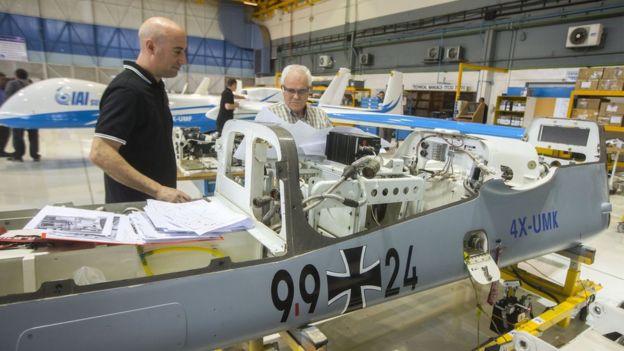
Technicians at an Israeli drone companyImage copyrightGETTY IMAGES
Image captionIsrael has built a hi-tech economy over the past two decades
To help bring Israeli and Chinese companies together, a number of business events are now held every year, such as Silicon Dragon Israel, which took place in Tel Aviv at the start of the year, and the China-Israel Innovation Summit, which was held earlier this month in Guangdong.
Rebecca Fannin, a founder of Silicon Dragon Israel, says Israeli tech start-ups that have secured Chinese investment tell her they "are progressing faster with Chinese capital, and through introductions, collaborations, and easier access to the large China mainland markets".
In recent years Israeli firms that have either been bought outright by Chinese companies, or sold them share of their business, include medical lasers operation Alma Lasers, and medical devices group Lumenis. Others are Israeli dairy business Tnuva, image recognition firm Cortica, and gesture control group Extreme Reality.
Royi Benyossef, an Israel-based manager at investment fund Samsung Next, says that the Chinese are "mesmerized by Israel and its technology exporting capabilities".
Other commentators say that the different national characteristics of the two countries complement each other.
Peggy Mizrahi, a Chinese citizen who lives in Israel, says: "The Chinese are known for long-term planning, and being conservative and hierarchical, unlike the commonly recognised Israeli mindset of [being] fast, innovative, flexible, and having a lack of respect for authority."
Daniel Galily, an Israeli expat who has lectured in business at Beijing Geely University, adds that: "The educational system in China places great emphasis on discipline and obedience to superiors, while the Israeli educational system and the Israeli army encourage students and soldiers to think about new ideas, and to solve problems in situations of uncertainty.
"The Chinese understand that, and so they strive to integrate the Israeli creativity into their economy."
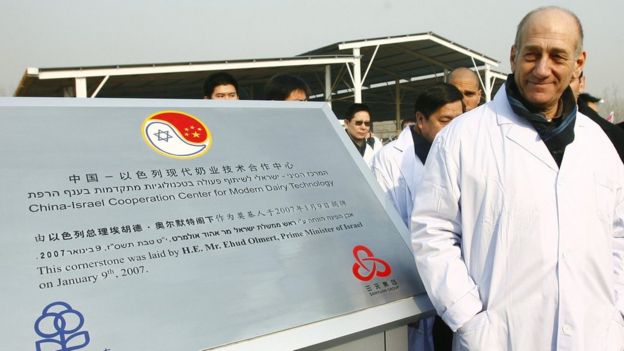
Former Israeli Prime Minister Ehud OlmertImage copyrightGETTY IMAGES
Image captionFormer Israeli Prime Minister Ehud Olmert also worked to establish closer trade and business ties between Israel and China
However, it is not just Chinese firms that are benefiting from closer trade ties between the two countries.
Spotad, an Israeli digital advertising firm, entered the Chinese market last year after securing funding from a Hong Kong-based private equity firm.
The company now works with all the major Chinese online advertising exchanges.
Other Israeli firms that are continuing to make inroads into the Chinese market include mobile marketing firm AppsFlyer, and diamond trading platform Carats.

Global Trade

More from the BBC's series taking an international perspective on trade:

Yet while both Chinese and Israeli firms seem pleased with their continuing cooperation, some commentators are anxious.
"One of the biggest drawbacks that I see here for Israel is that China is notorious for not respecting the intellectual property laws of other nations, so Israel has to be very careful about what kind of manufacturing they outsource to China," says Jason McNew, founder and boss of Pennsylvania-based Stronghold Cyber Security.
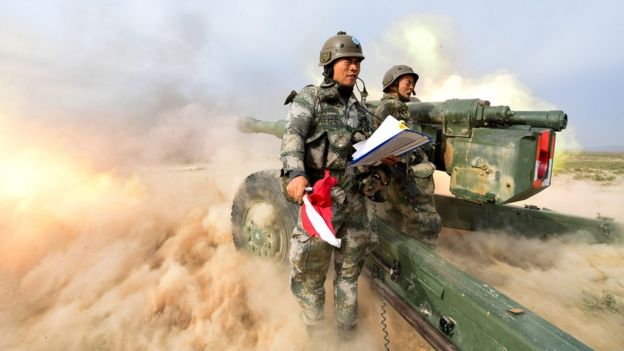
Chinese solders on a training exerciseImage copyrightGETTY IMAGES
Image captionSome analysts fear that Israeli technology could end up being used by Chinese troops, such as these two soldiers, pictured on a training exercise
Lee Branstetter, professor of economics and public policy at Carnegie Mellon University's Heinz College, says that the concern in the US is that Israeli technology could ultimately find its way into the hands of the Chinese military.
"The Pentagon is increasingly worried that artificial intelligence capabilities acquired by Chinese firms through civilian investments or licensing deals could find their way into a new generation of Chinese weapons that would threaten American troops and American allies.
"The Pentagon is also worried that Israel could become a back door through which China could acquire capabilities that it could not get in the US due to regulatory scrutiny.
"I suspect that this will place some limits on the extent and magnitude of the emerging Israel-China relationship. If an American pilot were ever shot down by a Chinese missile powered by Israeli technology, it would be a real problem for the Israeli government."
The Israeli government declined to comment on these security and defence sector issues.

Wednesday, July 18, 2018

Reuters News - Trump expects 'big results,' including North Korea, after Putin summit

(Reuters) - President Donald Trump said on Wednesday his meeting with Vladimir Putin would lead to “big results,” in a continuing bid to calm a storm over his failure to criticize the Russian leader for Moscow’s actions to undermine the 2016 U.S. election.

In a tweet Trump said he elicited a promise from Putin to help negotiate with North Korea but did not say how. “Russia has agreed to help with North Korea, where relationships with us are very good and the process is moving along,” he said. “There is no rush, the sanctions remain! Big benefits and exciting future for North Korea at end of process!”

Russia’s RIA news agency, citing Moscow’s envoy to Pyongyang, reported on Wednesday that a summit between the leaders of Russia and North Korea is “on the agenda” and that it would be “logical” to raise the idea of lifting sanctions.

Trump met North Korea’s Kim Jong Un last month in the first meeting between leaders of the two countries, and recently received a letter from Kim expressed hope for “practical actions” in the future.
Trump had said he and Putin discussed reducing nuclear weapons worldwide.
“So many people at the higher ends of intelligence loved my press conference performance in Helsinki,” Trump said in a series of early-morning tweets about their Monday summit. “Putin and I discussed many important subjects at our earlier meeting. We got along well which truly bothered many haters who wanted to see a boxing match. Big results will come!”
Republicans and Democrats both accused him of siding with an adversary rather than his own country after he shied away from criticizing the Russian leader for what U.S. intelligence agencies say were Moscow’s efforts to undermine the 2016 election.
Instead, standing next to Putin Trump cast doubt on the agencies. On Tuesday Trump said he had misspoken and that he had complete faith in U.S. intelligence agencies and accepted their conclusions.
Trump also tweeted on Wednesday that his NATO meeting in Brussels last week was an “acknowledged triumph,” adding that his one-on-one with Putin “may prove to be, in the long run, an even greater success. Many positive things will come out of that meeting.”
Additional reporting by Denis Pinchuk in Moscow and Alison Williams in London; Editing by Jon Boyle and Jeffrey Benkoe