Friday, October 19, 2018

BBC News - China economy: Third quarter growth misses expectations at 6.5%

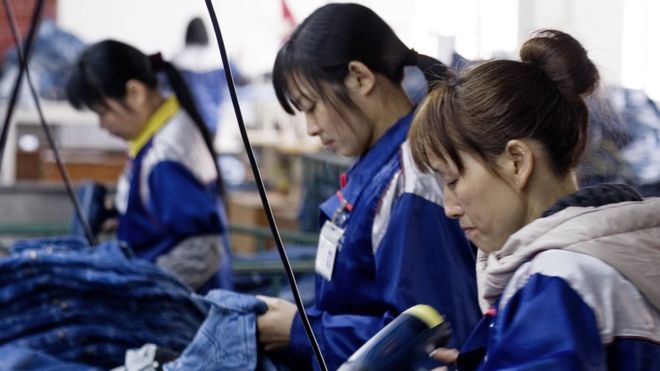
Women sew jeans at a factory in ChinaImage copyrightGETTY IMAGES
China has reported its slowest quarterly growth rate since the global financial crisis.
The growth figure for the July to September quarter was 6.5% from a year earlier, the National Bureau of Statistics said. The result fell short of Reuters analyst forecasts of 6.6%.
Policymakers have moved to support the cooling economy in recent months.
China faces rising economic challenges including high debt levels and an intensifying trade battle with the US.
The impact of the trade dispute with the US is expected to weigh on growth figures in the coming months.
Friday's growth figure was the slowest quarterly expansion since the first quarter of 2009 - the height of the global financial crisis.
The result was also a drop from the 6.7% rate in the prior quarter, but remains in line with the government's full-year target of about 6.5%.
While China watchers advise caution with Beijing's official GDP numbers, the data is seen as a useful indicator on the country's growth trajectory.
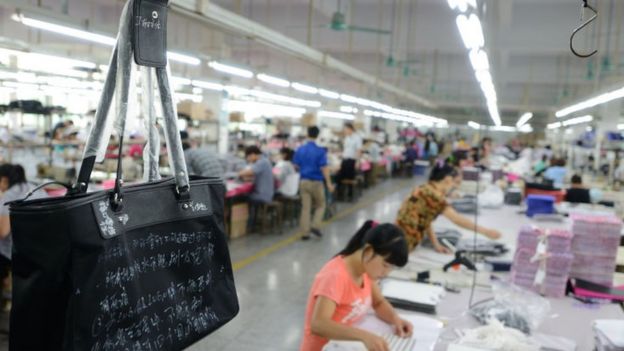
Bags factory in ShenzhenImage copyrightGETTY IMAGES

A 'war on two fronts'

Analysis: Karishma Vaswani, Asia business correspondent
As one China observer told me during a recent trip to Beijing, the country was not expecting to fight a trade war at a time that it was also trying to manage systemic risks in the economy.
They don't have a lot of options on the table. The country is saddled with extraordinary levels of debt so policymakers are reluctant to take measures to stimulate the economy the way they did after 2008.
It means that Beijing is fighting a war on two fronts, without all of the cavalry at its disposal. And it's fighting an increasingly unpredictable and volatile enemy, in the form of an aggressive US administration.
None of which bodes well for China's economic outlook.

Economic risks

For years China has pushed to wean off exports and rely more on domestic consumption for growth.
At the same time, the government has been fighting to contain ballooning debt - driven by a wave of infrastructure development - and a housing bubble without hurting growth.
In recent months Beijing has taken steps to support its economy, including cutting capital requirements to boost liquidity, and ease the slowdown.
Capital Economics China economist Julian Evans-Pritchard said in a research note the latest data showed "some early signs...that policy support is starting to gain traction" but added "more easing will still be needed in order to stabilise growth".
Other data released Friday showed factory output growth in September missed expectations, while retail sales for the month came in slightly above forecasts.
Alongside its domestic challenges, China is also expected to feel the pinch from a trade dispute with the US in the months ahead.
The third-quarter figures are the first to be released by Beijing since US President Donald Trump hit China with two sets of tariffs, targeting $250bn (£192bn) worth of Chinese goods.

Thursday, October 18, 2018

BBC News - US shies away from calling China a currency manipulator

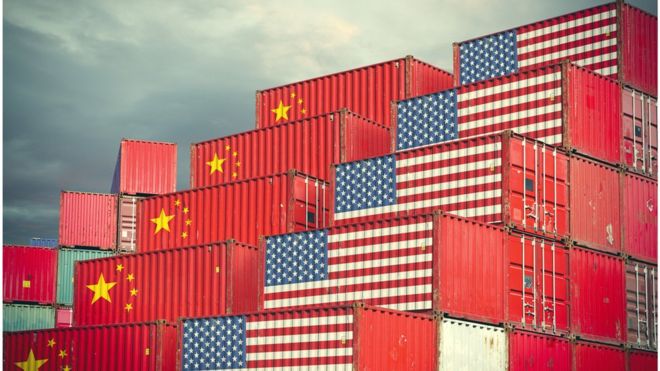
Shipping containers bearing US and Chinese flagsImage copyrightGETTY IMAGES
Image captionThe latest raft of trade tariffs imposed by the US and China have come into effect
The United States has refrained from labelling China a "currency manipulator" in a move which may help defuse escalating tension over trade between the two countries.
President Donald Trump has previously accused China of keeping its currency weak to make exports more competitive.
Speculation that the US Treasury would make that claim formally this week has not been borne out, however.
China's policies were still of "particular concern" the Treasury said.
Beijing's lack of transparency and the recent weakness of the yuan continued to pose major challenges to achieving "more balanced trade", Treasury Secretary Steven Mnuchin said in a twice-yearly report on the foreign exchange policies of major US trading partners.
However, the Treasury did not find that China was directly intervening to undermine the currency's value.
The yuan fell to its lowest level against the dollar since January 2017 following the report.
President Trump argues the growth in Chinese exports to the US has destroyed American jobs. He has ordered tariffs on more than $250bn of Chinese exportsto try to stem the US's growing deficit with China.
On the campaign trail and again this summer, he claimed China was pursuing a deliberate policy of keeping the value of the yuan low. The US dollar has strengthened against the yuan in recent months, prompting speculation that this month's report might contain formal claims of manipulation.
However at meetings of the International Monetary Fund in Bali, Indonesia last week, China's central bank governor Yi Gang said that Beijing would not engage in "competitive devaluation" or use the exchange rate as a "tool to deal with trade frictions".
The US Treasury report also said it has was keeping India, Japan, Germany, South Korea and Switzerland on a monitoring list for extra scrutiny.

Wednesday, October 17, 2018

Reuters News - Exclusive: Don't mention the oil price - U.S. legal threat prompts change at OPEC

LONDON/DUBAI (Reuters) - OPEC has urged its members not to mention oil prices when discussing policy in a break from the past, as the oil producing group seeks to avoid the risk of U.S. legal action for manipulating the market, sources close to OPEC said.
Proposed U.S. legislation known as “NOPEC”, which could open the group up to anti-trust lawsuits, has long lain dormant, with previous American presidents signaling that they would veto any move to make it law.
But U.S. President Donald Trump has been a vocal critic of the Organisation of the Petroleum Exporting Countries, blaming it for high oil prices and urging it to increase output to relieve pressure on a market hovering around four-year highs.
That has made OPEC and its unofficial leader, Saudi Arabia, nervous about what it might mean for NOPEC, or No Oil Producing and Exporting Cartels Act.
The decision to refrain from discussing a preferred oil price level — one way the group can guide market expectations — underlines how Trump’s aggressive stance on the oil market is unsettling OPEC and testing ties between allies Riyadh and Washington.
In July, senior OPEC officials attended a workshop in Vienna with international law firm White & Case to discuss the NOPEC bill, and the lawyers advised avoiding public discussion of oil prices and rather talk about the stability of the oil market, two sources familiar with the matter said.
OPEC officials were also advised to explore diplomatic lobbying channels to try and prevent the NOPEC bill from becoming law, one of the sources said.
On Aug. 1, the OPEC secretariat sent a letter to the ministers making a similar recommendation.
“We solemnly believe that market stability, and not prices, is the common objective of our actions,” UAE Energy Minister Suhail al-Mazroui, who holds the rotating OPEC presidency this year, wrote in the letter, seen by Reuters.
“I would like to call upon OPEC Member Countries, as well as our participating Non-OPEC colleagues, to refrain from any reference to prices in their commentary about our collective efforts or oil market condition,” he added.
White & Case did not respond to a Reuters request for comment.
Specifying oil prices is not the only way OPEC tries to guide the market. By cutting production it can support prices and by raising supplies it can do the opposite, for example.
But the private coordination of how to communicate OPEC’s message to the market represents a departure from past practice, when Saudi Arabia would often signal a preferred price level when speaking about OPEC policy and seek to push through actions to achieve that.

TIES STRAINED

While chances of the law passing this year appear slim, concerns among OPEC members and other oil producers are growing that it may ultimately get the support of Trump, given his open criticism of OPEC and high oil prices.
The OPEC letter came two months before U.S.-Saudi relations were further strained when a Saudi journalist disappeared during a visit to the kingdom’s consulate in Istanbul.
Turkish officials say they believe Jamal Khashoggi, a critic of Saudi policies, was murdered and his body removed. Saudi Arabia has strongly denied killing Khashoggi.
Some members of the U.S. Congress, which has long had a testy relationship with Saudi Arabia, have criticized the kingdom over the case.
A Senate source familiar with the bill said renewed interest in NOPEC was likely, as lawmakers weigh any actions in response to Khashoggi’s disappearance.
The source, who declined to be named, said that with lawmakers out of town for the next several weeks, it was difficult to measure current sentiment.

LITIGATION RISKS MAY BE BEHIND IPO DELAY

Over much of the last year, Saudi Arabia irked Washington by pushing OPEC to adopt measures to boost oil prices in a shift from its previous, more moderate stance.
Industry sources have linked that shift to a desire to maximize revenues and raise the valuation of state energy giant Saudi Aramco ahead of a planned IPO, a key part of Crown Prince Mohammed bin Salman’s reforms aimed at diversifying the economy.
The share float, expected by some to be worth up to $100 billion, has been put on hold, sources have told Reuters.
Prince Mohammed said this month the float was postponed to 2021, and several industry sources say the delay was partly because of litigation risks if Aramco was listed in New York, a preferred venue by the Saudi crown prince.
“There is a major fear NOPEC could turn into another JASTA,” one of the sources familiar with Aramco IPO preparations said, referring to the Justice Against Sponsors of Terrorism Act which allows victims of the Sept. 11, 2001, attacks to sue Riyadh.
Saudi Arabia, which denies involvement in the attacks, had long had broad immunity from the lawsuits. That changed in 2016, when the U.S. Congress overrode then-President Barack Obama’s veto of JASTA.
With close to $1 trillion in investments in the United States, including assets owned by Aramco, Riyadh has a lot to lose if the NOPEC bill was passed into law.
It would revoke the sovereign immunity which oil producers, including OPEC members, currently enjoy from U.S. legal action.
Washington-based legal firm Gibson Dunn and the Saudi embassy there signed a contract in late August, according to a copy of the contract filed to the U.S. Department of Justice.
The contract outlines that among its other responsibilities, Gibson Dunn would be “opposing NOPEC”.
Saudi Energy Minister Khalid al-Falih has also raised concerns over NOPEC with senior U.S. officials including U.S. Energy Secretary Rick Perry during private meetings, two sources familiar with the talks told Reuters, on condition of anonymity.
Additional reporting by Jarrett Renshaw in New York and Yara Bayoumy in Washington; Editing by Mike Collett-White

Tuesday, October 16, 2018

BBC News - Hammond’s £19bn bill to 'end austerity'

by Kamal Ahmed
The government will have to find an extra £19bn a year if it is to uphold Theresa May's promise that "austerity is over", a major report has said.
In its pre-Budget report, the Institute for Fiscal Studies says it means higher borrowing and higher taxes.
If not, pledges to raise NHS spending by £20.5bn and "balance the books" by 2020, matching spending and taxation, were likely to be incompatible.
The Treasury said its approach was to keep taxes as low as possible.
A Treasury spokesperson said: "Our balanced approach is getting debt falling and supporting our vital public services, while keeping taxes as low as possible. This year, we have already committed an extra £20.5bn a year to the NHS, scrapped the public sector pay cap, and frozen fuel duty for the ninth year in a row."

'Incompatible offers'

"The government seems to have made two incompatible offers to the electorate," Paul Johnson, the director of the IFS, told me.
"The first is that it wants to get rid of the deficit in the next few years. And the second thing that the PM said just a couple of weeks ago is that the end of austerity is nigh.
"Well, getting rid of austerity will mean spending at least an extra £20bn or so by the end of this parliament [in 2023]. If you're going to spend an extra £20bn or so, you're not going to get rid of the deficit unless you have some big tax rises."
Mr Johnson doubted there would be any significant tax rises in the Budget in two weeks' time, as there was still a good deal of economic uncertainty over Brexit and the government would struggle to push any substantial changes through Parliament, where it lacks a majority.
"The chances of anything significant - the chances of the sort of £10bn to £20bn that might really make a difference - I think are close to zero and essentially for political and not for economic reasons," he said.
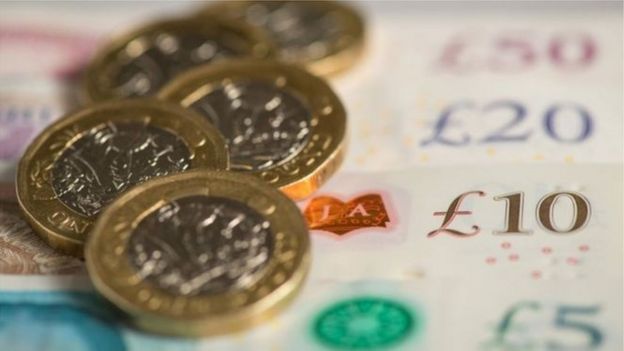
coins and notesImage copyrightPA

'Relief boost'?

In his interview with the BBC last week, Philip Hammond left the door open to tax rises, but said that any increases would be kept to "an absolute minimum" .
One policy the government is looking at is freezing tax thresholds (the amount of money working people can earn before they start paying tax), putting in jeopardy a manifesto pledge to raise the limit to £12,500 a year for lower-rate taxpayers and £50,000 a year for higher-rate taxpayers by 2020.
As the BBC revealed last week, the Chancellor is also looking at tightening up self-employment rules, so that more self-employed people pay higher levels of tax .
There is a belief in the Treasury that if there is a Brexit deal, that will give a short-term "relief boost" to the economy which will help the public finances.
Tax revenues tend to rise during periods of better economic growth and the need for benefit payments tends to reduce.
The IFS said that austerity was not yet over.

Smaller economy

Departments such as the Home Office, responsible for police services, the Justice department, responsible for prisons, and local government were facing cuts of £4bn in day-to-day spending next year.
There are also benefit cuts of £7bn to be made by 2023, the report says.
The economy is already 2% smaller than expected before the Brexit referendum, which means that the government's revenues from taxes are also lower.
Despite the prime minister's pledge that a "Brexit dividend" could be used to pay for some of the extra money for the NHS, the IFS said there was "virtually no" such dividend by 2023, as savings on contributions to the EU would be less than £1bn a year.
Extra Brexit costs - such as the need for border controls - could easily exceed that saving.

Monday, October 15, 2018

BBC News - UK will see three years of low growth, says EY Item Club

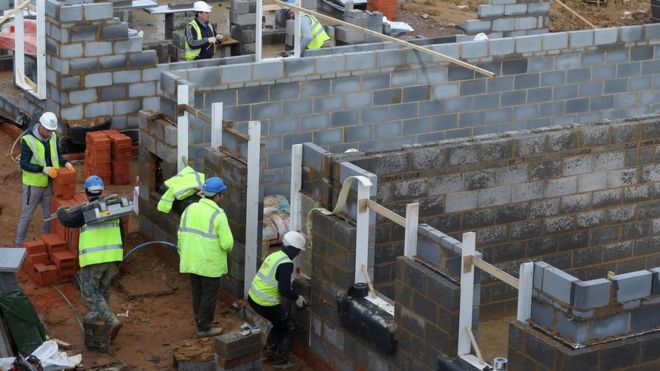
Workers on a building siteImage copyrightPA
The UK can expect low economic growth for the next three years, while a no-deal Brexit could dent growth even further, says a forecasting body.
The EY Item Club predicted GDP growth of 1.3% this year and 1.5% in 2019, down from 1.4% and 1.6% respectively in its previous outlook three months ago.
The forecaster said these figures were based on the assumption that the UK and the EU would agree transition terms.
If this did not happen, conditions could be "significantly weaker".
If the forecaster's prediction turns out to be accurate, 2018 would be the worst year of growth for the UK economy since the financial crisis.
Howard Archer, chief economic adviser to the EY Item Club, said: "Heightened uncertainties in the run-up to and the aftermath of the UK's exit could fuel business and consumer caution.
"This is a significant factor leading us to trim our GDP forecasts for 2018 and 2019."
Earlier this year, the EY Item Club predicted that the UK would see two interest rate rises this year and two more in 2019.
However, following the Bank of England's decision in August to raise ratesfrom 0.5% to 0.75%, the forecaster said it did not now expect another increase until August next year, with two more rate rises likely in 2020.
"The EY Item Club suspects that the Bank of England will want to see sustained evidence that the UK economy is holding up relatively well after Brexit occurs in late March, before hiking interest rates," it added.
EY chief economist Mark Gregory said: "The UK economy is going to experience a period of low economic growth for at least the next three years, and businesses need to recognise this and adjust accordingly.
"They should also consider a sharp downside to the economy in the event of a no-deal Brexit and make preparations for such a scenario."
Mr Gregory said a "prudent approach" would be for firms to test the robustness of their businesses, especially cash flow, against a short period of severe disruption, followed by a downturn for three or four quarters.
"Even if the Brexit process goes smoothly, the cyclical risks to the UK economy mean this would still be a worthwhile exercise. Now is the time to start to think about the future shape of any UK business after 2020," he added.

Friday, October 12, 2018

Bloomberg News - Trump, Gloomy Outlook Hit Finance Chiefs in Bali: World Economy This Week

By Lucy Meakin
Central bankers from around the world jumped to the U.S. Federal Reserve’s defense in Bali after President Donald Trump accused the central bank of going “loco.” But some economists says what’s at risk of getting lost in the focus on the shift by central banks to quantitative tightening is how accommodative they still are.
Here’s our weekly wrap of what’s going on in the world economy.

Central Bank Pushes

Fed chief Jerome Powell came under pressure from all sides this week as he and his fellow finance chiefs gathered for International Monetary Fund and World Bank meetings in Bali. While he faced warnings to be mindful of the effects of his policies on emerging economies from his Indonesian hosts, the biggest attack came from home, where Trump said that plunging stock markets weren’t because of his trade conflict with China, but “wild” Fed policy. That at least prompted support from Powell’s peers, as they sought to defend central bank independence. Economists say the Fed might stay more accommodative than investors fear and by some measures it still looks loose.
Other factors are also occupying the minds of officials – like how, and how fast, to normalize policy. In China, the central bank cut the amount of cash lenders must hold as reserves for the fourth time this year, while Singapore’s central bank – encouraged by steady economic growth – tightened monetary policy

Trade Chronicles

As the U.S. and China sought support for their respective cases in Bali, the IMF blamed escalating trade tensions and stresses in emerging markets as it said the world economy is plateauing. It cut its growth forecast for the first time in more than two years, in projections don’t even take into account Trump’s threat to expand the tariffs to effectively all of the more than $500 billion in goods the U.S. bought from China last year. China insists it won’t be forced down by levies, but the European Union says Trump’s aggressive strategy on trade has proven successful.

World Outlook

While the IMF cut its projections, accounts of the European Central Bank’s last meeting showed policy makers held back from raising the alarm about risks to the euro-area outlook even after a debate that noted mounting global threats. Italy’s finance minister was less optimistic, warning of a deceleration for advanced economies. In the U.S., consumer sentiment cooled, especially among women. France’s Treasury raised questions about economic stability for recipient countries of China’s Belt and Road initiative and access for European businesses. U.K. lawmakers were also asking questions, about the Bank of England’s assessment of a possible no-deal Brexit, even as house prices in London took a beating. For the new Nobel Prize in Economics winners, climate and technology are the real issues for the global economy.