The government borrowed far more than analysts expected in October, the first figures to be published since Philip Hammond's Budget last month show.
The deficit rose to £8.8bn from £7.2bn last year, marking the biggest October figure for three years, and well above the £6.1bn forecast.
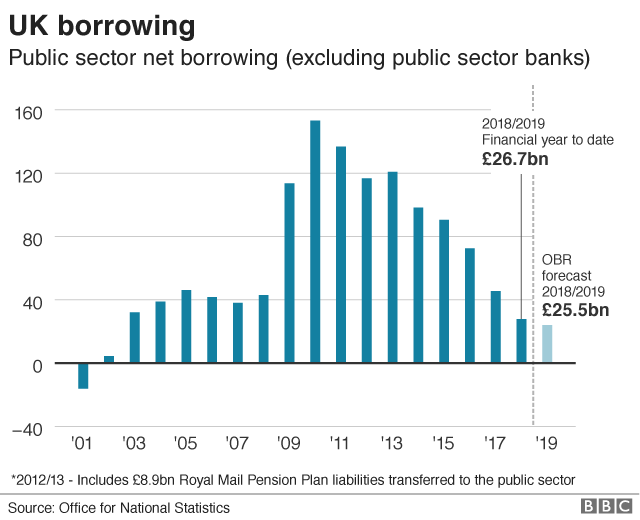
However, the amount borrowed so far this financial year is the lowest for 13 years.
The figures come after the chancellor said austerity was coming to an end.
The Office for National Statistics said the current year-to-date borrowing was £26.7bn, which is £11.2bn less than the same period last year and the lowest since 2005.
During his budget announcement the Chancellor also said borrowing is likely to fall over the next five years.
A Treasury spokesperson said it was the government's best year-to-date performance since 2005, adding "our balanced approach is getting debt falling while supporting our vital public services, keeping taxes low, and investing in Britain's future".
Why is borrowing rising in October?
The ONS said there had been "notable" growth in expenditure on goods and services, as well as social benefits.
Interest payments on government debt also increased.
"The increase in borrowing compared to last year was due to a £2.2bn rise in "other" (most likely departmental) spending," said Andrew Wishart, UK economist at Capital Economics.
Should we be worried?
Mr Wishart said the October figures could be a "worrying sign for the Chancellor" if the trend continued.
Samuel Tombs, chief UK economist at Pantheon Macroeconomics, said it was to soon to conclude that the Chancellor would miss the official forecast for borrowing this year.
He points out that the data is often revised and "the Chancellor won't need to respond to a modest overshoot".
What about Brexit?
The nature of the UK's exit from the European Union, is likely to have an impact on the nation's finances.
In October, the Chancellor said that a good Brexit agreement would enable the Treasury to spend a "double deal dividend".
However, a no deal scenario could upset government spending plans, economists say.
"If there is a no deal Brexit, the resulting economic slowdown would probably cause the public finances to deteriorate further," Mr Wishart said.
by Dan Levine SAN FRANCISCO - A U.S. judge on Monday temporarily blocked an order by President Donald Trump that barred asylum for immigrants who enter the country illegally from Mexico, the latest courtroom defeat for Trump on immigration policy. U.S. District Judge Jon Tigar in San Francisco issued a temporary restraining order against the asylum rules. Tigar’s order takes effect immediately, applies nationwide, and lasts until at least Dec. 19 when the judge scheduled a hearing to consider a more long-lasting injunction.
Representatives for the U.S. Department of Justice could not immediately be reached for comment.
Trump cited an overwhelmed immigration system for his recent proclamation that officials will only process asylum claims for migrants who present themselves at an official entry point. Civil rights groups sued, arguing that Trump’s Nov. 9 order violated administrative and immigration law.
In his ruling, Tigar said Congress clearly mandated that immigrants can apply for asylum regardless of how they entered the country. The judge called the latest rules an “extreme departure” from prior practice.
“Whatever the scope of the President’s authority, he may not rewrite the immigration laws to impose a condition that Congress has expressly forbidden,” Tigar wrote.
Tigar was nominated to the court by President Barack Obama.
Previous Trump immigration policies, including measures targeting sanctuary cities, have also been blocked by the courts.
The asylum ruling came as thousands of Central Americans, including a large number of children, are traveling in caravans toward the U.S. border to escape violence and poverty at home. Some have already arrived at Tijuana, a Mexican city on the border with California.
“IT IS TOO MUCH”
Rights groups have said immigrants are being forced to wait days or weeks at the border before they can present themselves for asylum, and the administration has been sued for deliberately slowing processing times at official ports.
At a hearing earlier on Monday, American Civil Liberties Union attorney Lee Gelernt said the order clearly conflicted with the Immigration and Nationality Act, which allows any person present in the United States to seek asylum, regardless of how they entered the country.
Gelernt said the ACLU had recently learned Mexican authorities have begun barring unaccompanied minors from applying at U.S. ports of entry.
Mexico’s migration institute said in a statement to Reuters that there was “no basis” for the ACLU’s claims, noting that there had been no such reports from the United Nations or human rights groups that are monitoring the situation at the border.
Uriel Gonzalez, the head of a YMCA shelter for young migrants in Tijuana, said he had not heard of any new measures directed at unaccompanied minors. He noted there were already long lines to get a turn with U.S. authorities.
“This can take a while because the number of migrants has overwhelmed capacity. It is too much,” he said.
The judge on Monday wrote that Trump’s refugee rule would force people with legitimate asylum claims “to choose between violence at the border, violence at home, or giving up a pathway to refugee status.”
Caravan participants began to arrive last week in Tijuana on the Mexican side of the U.S. border, which has put a strain on shelters where many will wait to seek asylum. Their presence has also strained Tijuana’s reputation as a welcoming city, with some residents screaming at the migrants, “Get out!”
Trump sent more than 5,000 soldiers to the 2,000-mile (3,100 km) frontier with Mexico to harden the border, although critics dismissed the move as a political stunt ahead of congressional elections on Nov. 6.
Reporting by Dan Levine in San Francisco; Additional reporting by Tom Hals in Wilmington, Delaware and Lizbeth Diaz in Tijuana; Editing by Leslie Adler, Tom Brown and Andrew Heavens
But the CBI employers' group is urging MPs to consult the business leaders in their constituencies when THEY come to vote on Theresa May's Brexit deal.
CBI President John Allan will open Monday's annual conference by admitting that while the Prime Minister's deal is not perfect, it is a lot better than leaving with no deal - an outcome he will describe as a "wrecking ball".
Mrs May, speaking later, will have the chance to sell the deal herself.
She is expected to focus on how immigration will change after the UK leaves the EU, which is an area of concern for many businesses.
Competition for workers
She will say that EU nationals will no longer be able to "jump the queue" ahead of skilled workers from India or Australia.
While business approves of the government's plans to make it easier for more high-skilled workers to come to the UK from outside the EU, business leaders are worried about her plans to make it much harder to access workers of lower skill levels.
Unemployment is at historic lows and 130,000 EU nationals left the UK in the last 12 months.
Competition for workers has seen welcome rises in average pay in recent months but businesses are reporting acute skills shortages in some areas, including construction.
While most businesses will support Mrs May for fear of a no deal - in picking immigration as a focus, she's chosen one subject this audience has serious doubts about.
The pound has fallen sharply after Cabinet ministers Dominic Raab and Esther McVey quit over Prime Minister Theresa May's draft Brexit deal.
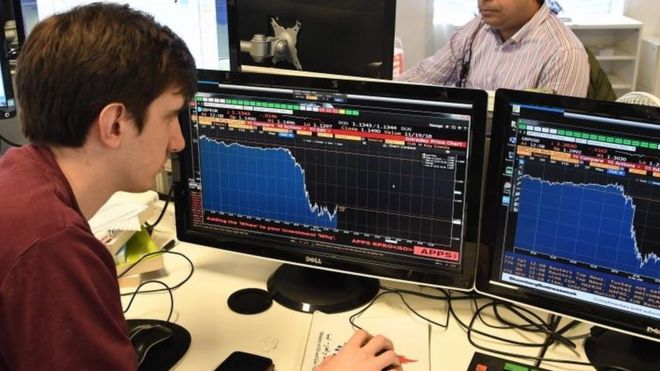
Sterling fell more than 1% against the dollar to $1.2778 and also sank more than 1% against the euro to €1.1309.
On Wednesday, Theresa May had secured Cabinet backing for the draft Brexit agreement with Brussels.
Business had generally welcomed the agreement, as it avoided the prospect of a cliff-edge Brexit.
What has happened to the pound?
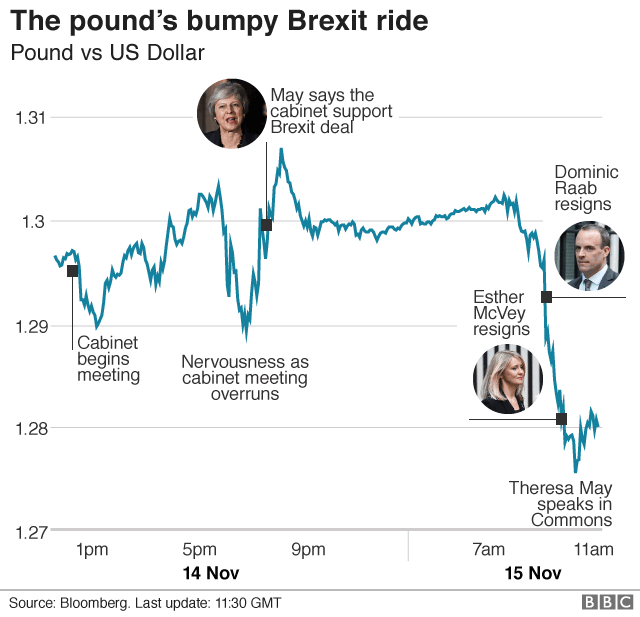
Initially the pound had rallied on Wednesday after the Prime Minister announced she had the backing of the cabinet for her Brexit withdrawal plan.
Wednesday's trading had been volatile, while the outcome of Theresa May's five-hour meeting with cabinet colleagues remained unclear.
Sterling had fallen to $1.28 at one point, but then rose to $1.30 following the announcement, before falling back slightly.
However, on Thursday morning sterling fell after Junior Northern Ireland Minister Shailesh Vara quit in protest over the agreement, and then dropped sharply when Brexit Secretary Dominic Raab resigned.
Shortly afterwards, Work and Pensions Secretary Esther McVey also stepped down. Junior Brexit Minister Suella Braverman, and Parliamentary Private Secretary Anne-Marie Trevelyan were next to go, followed by Ranil Jayawardena, another Parliamentary Private Secretary.
Pound vs US dollar
How has Brexit affected the pound's volatility?
The Brexit process has been punctuated by big movements in the pound's relationship with the dollar, something which can lead to big gains or losses for investors.
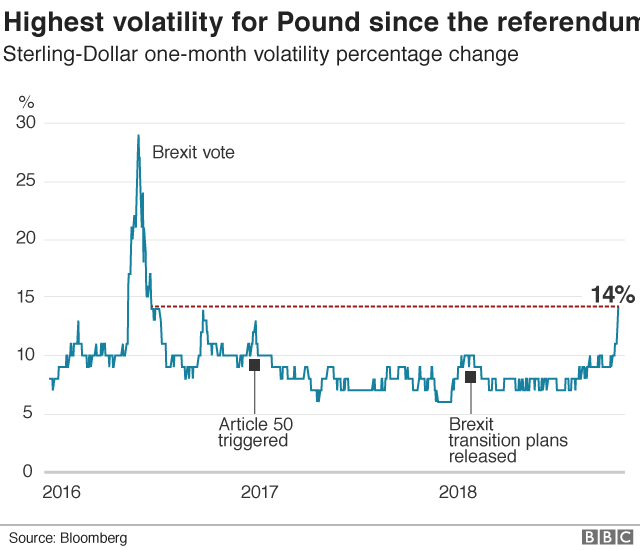
In the run up to and immediate aftermath of the Brexit referendum on 23 June 2016, for example, the pound hit a peak of volatility against the dollar amid enormous uncertainty about the future.
And as the graphic below shows, the events surrounding Wednesday's draft agreement has triggered the greatest volatility for sterling since the referendum.
What do the currency strategists make of it?
Jane Foley, head of currency strategy at Rabobank, said the pound's plunge was "firmly tied" to the perception that Mrs May will have difficulty in pushing the Brexit plan through Parliament.
In addition, Ms Foley said the government resignations had emphasised speculation that Mrs May could face a no-confidence vote.
"Although [Mrs] May has appeared defiant in Parliament this morning, the next few days will clearly be crucial with respect to whether [she] is likely to gain Parliamentary approval for her Brexit deal, but also in determining whether she can hold on to office.
"A lack of Parliamentary approval for the deal or a hard Brexit would both weigh heavily on the pound. Any turn of events that could raise the risk of a general election would also punish the pound, given the risk of a market-unfriendly far-left government."
Chris Turner, head of foreign exchange at ING, said Mr Raab's resignation had increased the chances of a leadership challenge and a no-deal Brexit.
Even though it was "very hard" to make forecasts about the pound's direction, he said it "could fall another 3-4% unless the threat of a leadership election is quashed or there are clearer signs that the withdrawal agreement can garner more support in parliament".
How did the government sell the agreement to business?
He said Mr Hammond and Mr Clark were trying to be clear "that this had been a long and hard process in persistence and resilience, but it had reached a conclusion which would be much much better than the chaos of no decision".
"It had the key elements in it that people were looking for particularly in the sense of a pathway to frictionless trade and control over our borders, the preservation of the United Kingdom, and in those circumstances they were recommending that business leaders support it, and I have to say the response on the call was a positive one."
So what does big business make of the agreement?
The agreement includes a 21-month transition period, with a unilateral right for the UK to extend it, which was described as "very positive for business" by James Stewart, head of Brexit at KPMG UK.
Northern Ireland also has the guarantee of a "friction-free" customs border with the Republic of Ireland.
The CBI described the agreement as a "compromise, including for business" but it unreservedly welcomed the "step back from the cliff-edge".
Director general Carolyn Fairbairn told the BBC: "The second plus of where we got to yesterday is there is a possible path to frictionless trade now in terms of negotiating the final deal.
"I don't think anyone thinks the transition or the backstop is the answer, so this has to be used as a route to a final deal with frictionless trade and access for services."
However, she did sound a note of caution. "It's not the end of the road - there's a hard slog ahead to get that final deal that will work for the country,"
Image copyrightGETTY IMAGES
So is everyone happy?
Dr Gerard Lyons, chief economic strategist at Netwealth Investment and chief economic adviser to Boris Johnson while he was Mayor of London, says the draft Brexit withdrawal deal is not something to cheer about.
"Whilst it has avoided the cliff edge, I think it's important we don't bury our heads in the sands here and view this as a 'good' deal - this is still disappointing," he said.
"To make a success of Brexit, we've got to get three things right - our relationship with the EU, our position with the rest of the world and our domestic economic and financial agenda.
"The biggest single problem with this divorce settlement is it ties our hands on two of those three areas - our ability to position ourselves globally and our domestic economic agenda.
LONDON (Reuters) - Prime Minister Theresa May will try to convince senior ministers on Wednesday to accept a draft European Union divorce deal that opponents say threatens both her government and the unity of the United Kingdom.
The weakest British leader in a generation, she has to try to get the deal approved by parliament before exiting the bloc on March 29, 2019.
Brexit campaigners in May’s Conservative Party accused her of surrendering to the EU and said they would vote down the deal. The Northern Irish Democratic Unionist Party (DUP) which props up May’s minority government questioned whether she would be able to get parliamentary approval.
The pound has rebounded in afternoon trading in response to a report that the main elements of a Brexit treaty text are ready to present to the UK cabinet on Tuesday.
Sterling regained some ground after a Financial Times report cited the EU's main Brexit negotiator, Michel Barnier.
The pound turned positive against the euro, up 0.17% on the day at €1.1466.
Against the dollar, it recovered partially to stand 0.43% lower at $1.2918.
Mrs May is trying to rally support among cabinet ministers for her Brexit proposal in time for a hoped-for summit in Brussels later this month.
However, the pound sagged in morning trading amid indications that her efforts had been delayed by increasing disarray in her cabinet over the issue.
On Friday, Transport Minister Jo Johnson became the latest government figure to quit his post over Brexit, arguing that UK was "on the brink of the greatest crisis" since World War Two.
Simon Derrick, head of currency research at Bank of New York Mellon, told the BBC that the pound's weakness against the dollar was "obviously related to the uncertainty over the weekend", but added: "At least half of it is actually about dollar strength and the expectation that the Federal Reserve will hike interest rates in December."
The resurgent dollar also hit the euro, down 0.6% against the greenback on Monday to $1.1265, having earlier touched a 17-month low.
Monex Europe analyst Bart Hordijk blamed the euro's weakness on "the four apocalyptic horsemen" of "Brexit, Italy, slower growth and a cautious European Central Bank".
He forecast that the euro could fall further against the dollar.
"Signs are certainly dire for the euro and a drastic change of monetary policy signalling, the Italian budget stance, macroeconomic prospects, or Brexit is what the currency needs now to turn this momentum around," he said.
South Sudanese authorities, eager for investment after a five-year civil war, vowed to meet international companies’ needs for foreign exchange, shortages of which forced Anheuser-Busch Inbev SA’s unit to close.
The Investment Authority’s pledge comes as the oil-producing East African nation enacts a peace deal and pursues international financing to overcome an economic crisis that saw inflation exceed 200 percent. Units of both MTN Group Ltd. and Kuwait’s largest mobile-phone provider are among the few major remaining foreign companies -- and they’ve made cuts to survive.
“Our country has been closed for so long and now is the time to speak volumes -- loud and clear -- that our country is ready for investment,” Abraham Maliet Mamer, the authority’s secretary-general, said in an interview.
The world’s youngest nation will host the South Sudan Oil & Power 2018 conference in the capital, Juba, on Nov. 21-22. China National Petroleum Corp., Oil & Natural Gas Corp. of India and Petronas Bhd of Malaysia are the main operators of oil blocks in South Sudan, which has sub-Saharan Africa’s third-largest reserves and is counting on increased production to help fund the peace agreement.
Trade and investment conditions aren’t favorable to U.S. companies, according to the latest bulletin from the U.S.’s Bureau of Economic and Business Affairs. Among its concerns: the tight control of hard currency by the government, an ineffective legal system, limited physical infrastructure and high political risk.
South Sudan Beverages Ltd., a unit of what was then SABMiller Plc, closed its brewing operations about two years into the conflict as a currency shortage curtailed its ability to import raw materials.
 GETTY IMAGES