Thursday, February 14, 2019

Bloomberg News - U.S. Stock Futures Erase Gain, Dollar Dips on Data: Markets Wrap

by Todd White
U.S. equity futures erased a gain, Treasuries extended their advance and the dollar turned lower after American data including retail sales and jobless claims disappointed. European stocks were flat as investors digested a slew of company earnings.
Contracts on the Dow Jones Industrial Index, S&P 500 and Nasdaq all traded little changed after poor data, including the worst drop for retail sales in nine years, added to signs that U.S. economic growth is cooling from prior quarters. Coca-Cola fell in pre-market trading after results showed it sold fewer drinks in the Americas in the fourth quarter.
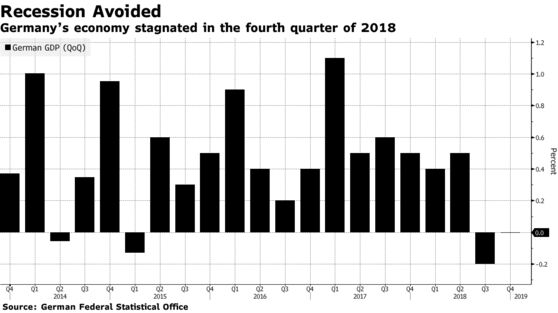
Food and industrial-goods shares had spurred the Stoxx Europe 600 Index amid a slew of company news, but it tracked the move of U.S. futures. Equity benchmarks drifted in Japan, China and Australia, and ticked lower in Hong Kong. European core sovereign bonds rose and the single currency strengthened after data showed the euro region’s biggest economy stagnated in the fourth quarter, but dodged recession.
GermanyĆ¢€™s economy stagnated in the fourth quarter of 2018
Germany’s economy stagnated in the fourth quarter of 2018
Earlier shares had gained on reports President Donald Trump is considering pushing back the deadline for imposition of higher tariffs on Chinese imports by 60 days, as the world’s two-biggest economies try to negotiate a solution to their trade dispute. Trump also told reporters that trade talks are making good progress, helping to steady investor sentiment.
Elsewhere, emerging-market shares and currencies fell. Russia’s 10-year bonds dropped the most since since November after the U.S. Senate introduced sanctions legislation targeting the country’s banks and state debt.
Oil continued its rebound as falling shipments from Saudi Arabia and Venezuela outweighed gains in U.S. crude stockpiles. And the pound weakened while gilts advanced ahead of Parliament’s latest set of voteson Theresa May’s Brexit strategy, and after dovish remarks from a Bank of England policy maker.
Here are some key events coming up:
  • Steven Mnuchin and Robert Lighthizer are in Beijing for high-level talks, and will meet China President Xi Jinping on Friday, the South China Morning Post reported.
  • The U.K. Parliament, with less than two months before its deadline to leave the European Union, votes on alternatives to Prime Minister Theresa May’s defeated Brexit legislation.
  • U.S. Congress is close to voting on legislation to avert another partial government shutdown, with the Friday deadline quickly approaching.
These are the main moves in markets:

Stocks

  • The Stoxx Europe 600 Index rose 0.1 percent as of 8:46 a.m. New York time.
  • Futures on the S&P 500 Index fell less than 0.05 percent.
  • The MSCI World Index of developed countries increased less than 0.05 percent to the highest in more than 10 weeks.
  • The MSCI Asia Pacific Index fell less than 0.05 percent.

Currencies

  • The Bloomberg Dollar Spot Index fell 0.1 percent.
  • The euro rose 0.3 percent to $1.13.
  • The British pound fell 0.2 percent to $1.2816.
  • The Australian dollar rose 0.3 percent to the strongest in more than a week.
  • The MSCI Emerging Markets Currency Index sank 0.4 percent to the lowest in three weeks on the largest decrease in two months.

Bonds

  • The yield on 10-year Treasuries sank five basis points to 2.65 percent.
  • Germany’s 10-year yield fell three basis points to 0.09 percent.
  • Japan’s 10-year yield fell one basis point to -0.014 percent.

Commodities

  • Gold climbed 0.4 percent to $1,311.40 an ounce, the largest increase in more than two weeks.
  • West Texas Intermediate crude rose 0.2 percent to $54.00 a barrel.
  • Arabica coffee fell 0.8 percent to $1.01 a pound.
  • LME copper increased 0.6 percent to $6,160.50 per metric ton.
— With assistance by Andrew Dunn, April Ma, and Adam Haigh
(An earlier version corrected direction of share move in first paragraph.)

Wednesday, February 13, 2019

BBC News - Brexit doubts leave firms 'hung out to dry'

Payment in a coffee shopImage copyrightGETTY IMAGES
UK firms have accused the government of leaving them "hung out to dry" in the event of a no-deal Brexit.
With less than 50 days until 29 March when the UK is due to leave the EU, the British Chambers of Commerce (BCC) says 20 key questions remain unresolved.
How to move skilled staff between the UK and EU, which rules to follow, and what trade deals will be in place are all still unknown, the BCC says.
The government said it was focused on getting approval for its Brexit deal.
"The best way to support our economy, protect jobs and provide certainty for businesses and individuals as we leave is to back the deal we have agreed with the EU.
"We are focused on securing the necessary changes to ensure the deal passes through Parliament," a government spokesman said,
Theresa May is currently seeking changes to her Brexit deal with the EU after it was emphatically rejected last month, in the largest defeat ever for a sitting government.
The prime minister needs to get a deal approved by Parliament by 29 March to avoid a no-deal Brexit. In that case, in the countries where the UK had no formal trade agreement, both would have to trade under the rules overseen by the World Trade Organization (WTO).
Under this system, every WTO member is free to negotiate its own tariffs - or taxes - on different goods. But under the rules, members have to offer the same tariff to every other WTO country.
The UK has signed "continuity agreements", which mean there will be no disruption to trade, with Switzerland, Chile, The Faroe Islands and Eastern and Southern Africa. That means free trade agreements currently in place between the EU and those countries will apply to the UK after Brexit.
Mutual recognition agreements - where a product lawfully sold in one country can be sold in another - have also been signed with Australia and New Zealand.
Labour has accused Mrs May of "cynically" running down the clock. It claims the prime minister is planning to delay the final, binding vote on the withdrawal deal she has agreed with the EU until the last possible moment, so that MPs will be faced with a stark choice between her deal and no deal.

'Stifling investment'

The BCC - which represents thousands of firms - says its members are "hugely concerned" that the UK is not prepared for all eventualities.
The business lobby group also warned that the lack of clarity over what will happen had already "stifled investment and growth".
"There is a very real risk that a lack of clear, actionable information from government will leave firms, their people and their communities hung out to dry," said BCC director general Adam Marshall.
Mr Marshall said firms remained "in the dark" over crucial issues including contracts and customs tariffs.
"Businesses need answers they can base decisions on, no matter the outcome," he added.
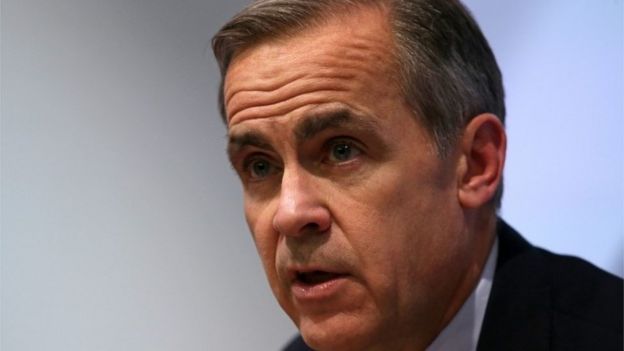
Mark CarneyImage copyrightPA
Image captionThe Bank of England governor has urged MPs to solve the current Brexit impasse
The BCC has published the list of 20 questions firms want answered. They include whether firms will be able to fly people and goods between the UK and EU after the end of March and whether there will be any import tariffs.
The business group's warning comes after Bank of England governor Mark Carney earlier urged MPs to solve the current Brexit impasse.
Mr Carney warned a no-deal Brexit would create an "economic shock" at a time when China's economy is slowing and trade tensions are rising.
"It is in the interests of everyone, arguably everywhere" that a Brexit solution is found, he said.
Earlier this week, official figures showed that the UK economy had expanded at its lowest annual rate in six years last year, with many economists blaming Brexit for the slowdown.

Tuesday, February 12, 2019

Reuters News - Stocks buoyed by deal to avert U.S. government shutdown

by Hideyuki Sano
TOKYO (Reuters) - Asian shares gained on Tuesday as investors hoped a new round of U.S.-China trade talks would help to resolve a dispute that has dented global growth and some corporate earnings.

Market sentiment also got a boost on news U.S. lawmakers had reached a tentative deal on border security funding that could help avert another partial government shutdown due to start on Saturday. Congressional aides, however, said it did not contain the $5.7 billion President Donald Trump wants for a border wall.
S&P 500 e-mini futures were up nearly 0.5 percent.
Spreadbetters expected European stocks to track Asia and open higher, with Britain’s FTSE gaining 0.25 percent and Germany’s DAX and France’s CAC each adding 0.5 percent.
MSCI’s broadest index of Asia-Pacific shares outside Japan edged up 0.3 percent.
The Shanghai Composite Index rose 0.35 percent, South Korea’s KOSPI climbed 0.6 percent and Australian shares were up 0.3 percent.
Japan’s Nikkei advanced 2.6 percent after a market holiday on Monday, lifted by a weaker yen.
U.S. and Chinese officials expressed hopes the new round of talks, which began in Beijing on Monday, would bring them closer to easing their months-long trade war.
Beijing and Washington are trying to hammer out a deal before a March 1 deadline, without which U.S. tariffs on $200 billion worth of Chinese imports are scheduled to increase to 25 percent from 10 percent.
“There will be no winner in a trade war. So at some point they will likely strike a deal,” said Mutsumi Kagawa, chief global strategist at Rakuten Securities in Tokyo.
The trade dispute has already started to impact global growth, hitting businesses confidence, factory activity and disrupting supply chains. The worry is that a protracted Sino-U.S. tariff row could severely hurt corporate earnings globally.
Analysts are now expecting U.S. corporate earnings for the current quarter to drop 0.2 percent from last year, which would be the first contraction since the second quarter of 2016.
In the currency market, the dollar held firm, having gained for eight straight sessions against a basket of six major currencies until Monday, its longest rally in two years.
Although the Federal Reserve’s dovish turn dented the dollar earlier this year, some analysts noted the U.S. currency still has the highest yield among major peers and that the Fed continues to shrink its balance sheet.
“We see the dollar’s strength essentially stemming from the Fed’s balance sheet reduction,” said Makoto Noji, chief currency and foreign bond strategist at SMBC Nikko Securities.
Growing evidence of a loss of momentum in the global economy has also lifted the U.S. currency, most recently led by the European Commission’s downgrade of growth in Europe, making the dollar a better investment option by default.
The dollar index rose to its highest in almost three months, at 97.123, on Monday. It last stood at 97.055.
In contrast, the euro dropped to as low as $1.1267, its weakest in 2-1/2 months, and last traded at $1.1277.
The dollar popped up to a six-week high of 110.65 yen.
Oil prices ticked up after falls on Monday as traders weighed support from OPEC-led supply restraint and a slowdown in the global economy.
U.S. crude futures traded at $52.68 per barrel, up 0.5 percent. Brent crude rose 0.6 percent to $61.89 per barrel.
Additional reporting by Shinichi Saoshiro in Tokyo; Editing by Richard Borsuk and Jacqueline Wong

Monday, February 11, 2019

BBC News - Austerity to continue unless Hammond spends, says IFS

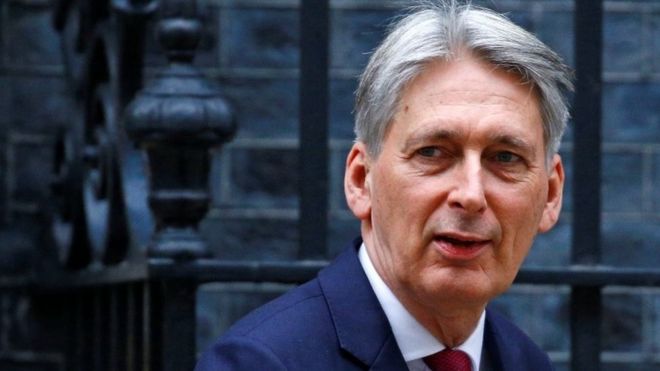
Philip HammondImage copyrightREUTERS
Image captionChancellor Philip Hammond is due to unveil his Spring Statement next month
Philip Hammond must spend billions extra to end austerity, says think tank the Institute for Fiscal Studies (IFS).
To maintain per capita spending across government departments that do not have ring-fenced budgets, he must find an extra £5bn a year by 2023, it adds.
And maintaining spending on unprotected services as a share of national income would require £11bn on top of spending plans set out in the 2018 Budget.
The Treasury says long-term funding decisions will be made later this year.

Population growth

In its analysis, the IFS said spending increases already promised by the chancellor would be swallowed up by commitments to fund the NHS, defence and international aid.
That could mean cuts in other areas, IFS director Paul Johnson told the BBC's Today programme.
"[Unless he finds the money] we will continue to see cuts in some departments at least as a fraction of national income, and don't forget the scale of the cuts up to now really has been extraordinary historically.
"We've had £40bn of cuts to department spending and cuts of 30% and 40% to some budget items. So even if he even if he stops cutting, it's still not going to feel great in a lot of areas."
NHS hospitalImage copyrightGETTY IMAGES
Image captionThe Treasury says health is the "number one spending priority"
But a Treasury spokesman said public investment would hit peaks not seen since 1979.
"The chancellor has said that the Spending Review will take place in 2019, and that is the right moment for government to make long term funding decisions," he said.
"We have made clear that health is our number one spending priority by announcing a five-year settlement which will provide an extra £34bn a year for the NHS by 2023-24.
"Outside the NHS, total day-to-day departmental spending is now set to grow in line with inflation, and public investment will reach levels not sustained in 40 years in this parliament. "

Stimulus package?

Meanwhile, the IFS said a no-deal Brexit would mean lower growth, requiring either spending cuts or higher taxes.
And it said in the short term the government might need to borrow more to fund a stimulus package to mitigate the impacts for the hardest-hit areas of the economy.
But Mr Johnson said any spending boost to spending would be temporary.
"Obviously if there is some kind of no-deal Brexit that is going to be bad for the economy both in the short run and in the long run, there will be less money around.
"[The chancellor] can probably put a bit more money in [in the short run], but in the long run that is going to mean several more years of austerity to row back from that initial expansion."

'Brutal'

Shadow chancellor John McDonnell said: "The evidence is mounting that despite Theresa May's rhetoric, austerity is not over.
"Unless Philip Hammond, at the very least, finds another £5bn at the Spring Statement, departments will be planning for yet more cuts next year.
"Nine years of brutal Tory austerity have wounded our public services and the whole country which relies on them."

Friday, February 8, 2019

BBC News - Bank forecasts worst year for UK since 2009

By Ben Morris
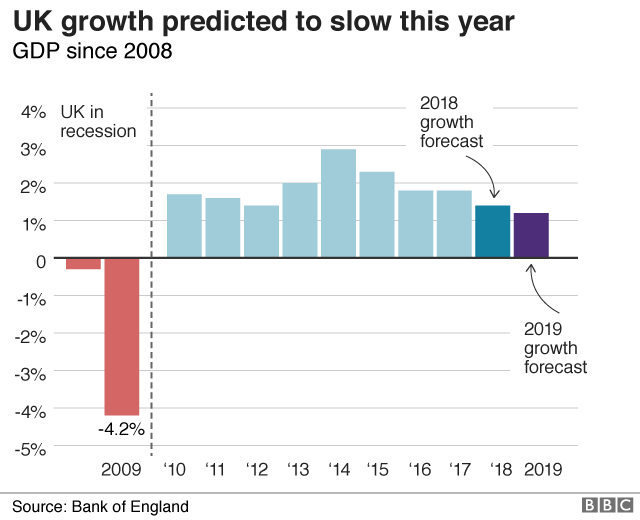
The Bank of England expects growth this year to be the slowest since 2009 when the economy was in recession.
It is forecasting growth of 1.2% this year, down from its previous forecast of 1.7% made in November.
The Bank said it had seen further evidence that businesses were being cautious in the run-up to Brexit, including evidence from its own survey of firms.
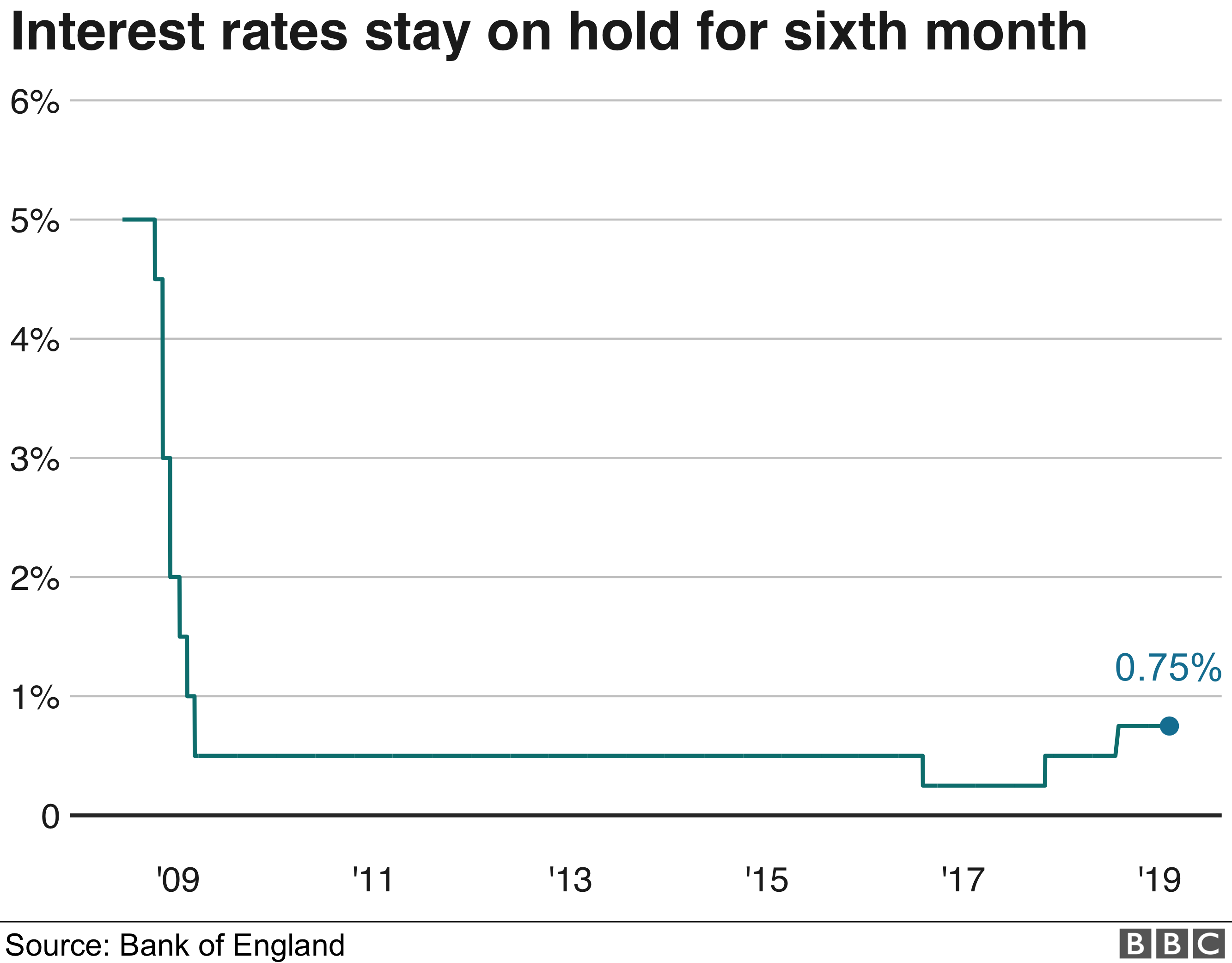
As expected the Bank kept interest rates on hold at 0.75%.
The Bank put the fall in growth down to a decline in business investment and housebuilding, as well as a halving of the growth rate in exports.
The UK was also being hit by slower-than-expected growth in the eurozone and China, the Bank said in its Quarterly Inflation Report.
"Growth appears to have slowed at the end of 2018 and is expected to remain subdued in the near term," it said.
The Bank even sees a one-in-four chance of the economy slipping into recession in the second half of this year.

What did the Bank say about Brexit?

There has been an "intensification" of Brexit uncertainties, the Bank said.
Its survey of 208 firms showed that half had started putting plans in place for a no-deal Brexit. The survey also showed that a fifth had taken on extra warehouse space
It also noted a sharp fall in business investment at the end of last year.
"Uncertainty appears to have risen recently, and may have weighed on investment by more than had been expected in August," the Bank said.
Bank of England Governor Mark Carney said: "The fog of Brexit is causing short term volatility in the economic data, and more fundamentally, it is creating a series of tensions in the economy, tensions for business."
GDP growth graphic

When will interest rates rise?

Interest rates remain at 0.75%, where they have been since the Bank of England last raised in interest rates in August.
Many economists think that once the uncertainty over Brexit is lifted then the economy will accelerate and the Bank will have to raise interest rates to stop it overheating.
However, recent economic data has indicated weakness in the UK economy. Growth in the service sector, the biggest part of the economy, appeared to have stalled in January, according to closely-watched survey of purchasing managers.
Interest rates
Samuel Tombs, an economist at Pantheon Macroeconomics, predicts that the Bank will raise rates once this year and twice in 2020.
Paul Dales, chief UK economist at Capital Economics, said: "We still think that a decent rebound in GDP growth, should a Brexit deal be reached, will result in interest rates rising further than the Bank and the financial markets assume."

What effect is all this having on mortgage rates?

Moves in interest rates are important to the 3.5 million people with variable or tracker mortgages. Even a small rise of 0.25% can add hundreds of pounds to their annual mortgage costs.
"It's a very good time for people looking to borrow," said Andrew Montlake, a director at Coreco, a mortgage broker.
He said there had been a lot of competition among lenders in January, with some very good deals for five-year fixed mortgage deals. Some lenders are offering five-year fixed deals at below 2%, he said.
Concern over Brexit has held back some people from borrowing. "There is a lot of pent-up demand," said Mr Montlake.
Savers who depend on higher interest rates to boost their incomes will be disappointed that rates have stayed on hold for a sixth consecutive month.

Is the Brexit uncertainty hitting jobs?

While the Bank cut its growth forecast it also noted the strength of the labour market, where the unemployment rate is currently 4%.
The rate at which people are switching to new jobs is only slightly below the level hit before the financial crisis of 2007.
That switching suggests that employers are having to compete to attract staff, the Bank said.
It also noted a pick-up in the average number of hours worked at the end of last year and firmer wage growth.

What does it all mean for our wages?

The Bank thinks that wage growth will increase in the coming years as the UK's unemployment rate continues to fall.
The main reason the Bank thinks underlying inflation pressures will grow is that wage growth will rise.
Britain's unemployment rate has hit its lowest level in more than 40 years.
The Bank predicts that earnings will rise by more than 3% a year over the next three years.

Thursday, February 7, 2019

Reuters News - Long, strange trip: How U.S. ethanol reaches China tariff-free

by Chris Prentise, A. Ananthalakshmi
NEW YORK/KUALA LUMPUR (Reuters) - In June, the High Seas tanker ship loaded up on ethanol in Texas and set off for Asia.

Two months later - after a circuitous journey that included a ship-to-ship transfer and a stop in Malaysia - its cargo arrived in China, according to shipping data analyzed by Reuters and interviews with Malaysian and Chinese port officials.
At the time, the roundabout route puzzled global ethanol traders and ship brokers, who called it a convoluted and costly way to get U.S. fuel to China. (MAP: tmsnrt.rs/2HP1ywa )
But the journey reflects a broader shift in global ethanol flows since U.S. President Donald Trump ignited a trade war with China last spring.
Although China slapped retaliatory tariffs up to 70 percent on U.S. ethanol shipments, the fuel can still legally enter China tariff-free if it arrives blended with at least 40 percent Asian-produced fuel, according to trade rules established between China and the Association of Southeast Asian Nations (ASEAN), the regional economic and political body.
In a striking example of how global commodity markets respond to government policies blocking free trade, some 88,000 tonnes of U.S. ethanol landed on Malaysian shores through November of last year - all since June, shortly after China hiked its tax on U.S. shipments. The surge follows years of negligible imports of U.S. ethanol to Malaysia.
In turn, Malaysia has exported 69,000 tonnes of ethanol to China, the first time the nation has been an exporter of the fuel in at least three years, according to Chinese import data.
Blending U.S. and Asian ethanol for the Chinese market undermines the intent of Beijing’s tariffs and helps struggling American ethanol producers by keeping a path open to a major export market that would otherwise be closed.
“Global commodity markets are incredibly creative in finding ways to ensure willing sellers are able to meet the demands of willing buyers,” Geoff Cooper, head of the Renewable Fuels Association, said in a statement to Reuters. The group represents U.S. ethanol producers.
In at least two cases examined by Reuters, including that of the High Seas, blending of U.S. ethanol cargoes with other products appeared to have occurred in Malaysia before the cargoes were shipped on to China, according to a Reuters analysis of shipping records and interviews with port officials. 
Chinese merchants including the state-backed oil company Unipec notified Chinese authorities about the unusual activity last summer - which represented competition they had not anticipated under the tariff scheme, according to two industry sources.
Unipec’s parent company Sinopec did not respond to requests for comment. A spokesman for China’s General Administration of Customs declined to comment.
Norazman Ayob, deputy secretary general of the Malaysian trade ministry, confirmed that Malaysia exported ethanol to China this year. The ministry was unable to confirm whether it had been mixed with U.S. fuel, he said, but noted such blending would be legal under the ASEAN-China pact.
Malaysia has no track record of significant domestic ethanol production, so it is unclear where the ethanol blended with the U.S. product originates.
Additional U.S. ethanol has flowed in unusual volumes to other destinations since Trump’s trade war began, including other ASEAN member nations the Philippines and Indonesia, according to shipping and trade data, though Reuters could not confirm its final destination.

ETHANOL ON THE HIGH SEAS

The High Seas cargo ship was among the first to engage in the rising U.S.-to-Malaysia ethanol trade, according to shipping data from financial information provider Refinitiv and bills of lading from the ports.
It loaded 25,000 tonnes of ethanol in Texas City on June 23 and then another 10,000 tonnes in Beaumont on June 27.
Some of the ethanol was produced by Green Plains Inc, one of America’s top ethanol producers. Green Plains spokesman Jim Stark confirmed the loading of the company’s product in Beaumont but said it could not confirm the cargo’s ultimate destination.
At the time it left Texas, the shipment was owned by units of SOCAR Trading SA, the marketing arm of the State Oil Company of Azerbaijan Republic, according to the bills of lading.
The shipment was initially destined for the Philippines.
But after it crossed through the Panama Canal and reached the waters near Singapore in mid-August, the High Seas transferred its cargo to the QUDS, another tanker, according to the Refinitiv data.
Vincent Mohy, general counsel for SOCAR, said that the firm sold all of the U.S. ethanol at the time of the transfer to the QUDS and that it made clear to the buyer the fuel originated in the United States. Mohy declined to name the buyer.  
The QUDS landed in the Malaysian port of Kuantan days later and took on another 12,074 tonnes of ethanol before heading to the Chinese port of Zhoushan and emptying its hold by the end of the month, according to the shipping data, a Chinese port official and two Malaysian port officials.
According to one of the Kuantan port officials and a source in the Malaysian government, the cargo on the QUDS was sold by Malaysia’s Rich Greenergy Sdn Bhd to China’s Zhanjiang Industry Petrochemical Company Limited.
Kelvin Shum, Rich Greenergy’s CEO, declined to comment, saying he had signed a non-disclosure agreement about the deal. Efforts to reach Zhanjiang were not successful.
The convoluted voyage was replicated in at least one other case, that of the Maritime Tuntiga. That ship also carried Texas ethanol into Southeast Asia this summer, transferring its cargo into another vessel – the Taibah – near Singapore.
Like the QUDS, the Taibah moved on to the port of Kuantan in Malaysia, picked up about 12,000 tonnes more ethanol, and then moved on to Zhoushan, according to the shipping data and the Kuantan port officials.
 (Additional reporting by Dominique Patton, Meng Meng, and Hallie Gu in Beijing and Michael Hirtzer in Chicago; Editing; by Richard Valdmanis and Brian Thevenot)